
Rotary Screw Compressor Capability: Beyond the Spec Sheet
Rotary screw air compressors keep production lines running, but the final quality of a sourcing decision depends less on the nameplate and more on the supplier's production and verification capability. Buyers at the evaluation and execution stage need evidence that a manufacturer can adapt the machine to the application, deliver in the required timeframe, and prove compliance before shipment. This article explains what to verify and why it matters, with documented examples from a Chinese export-oriented manufacturer.
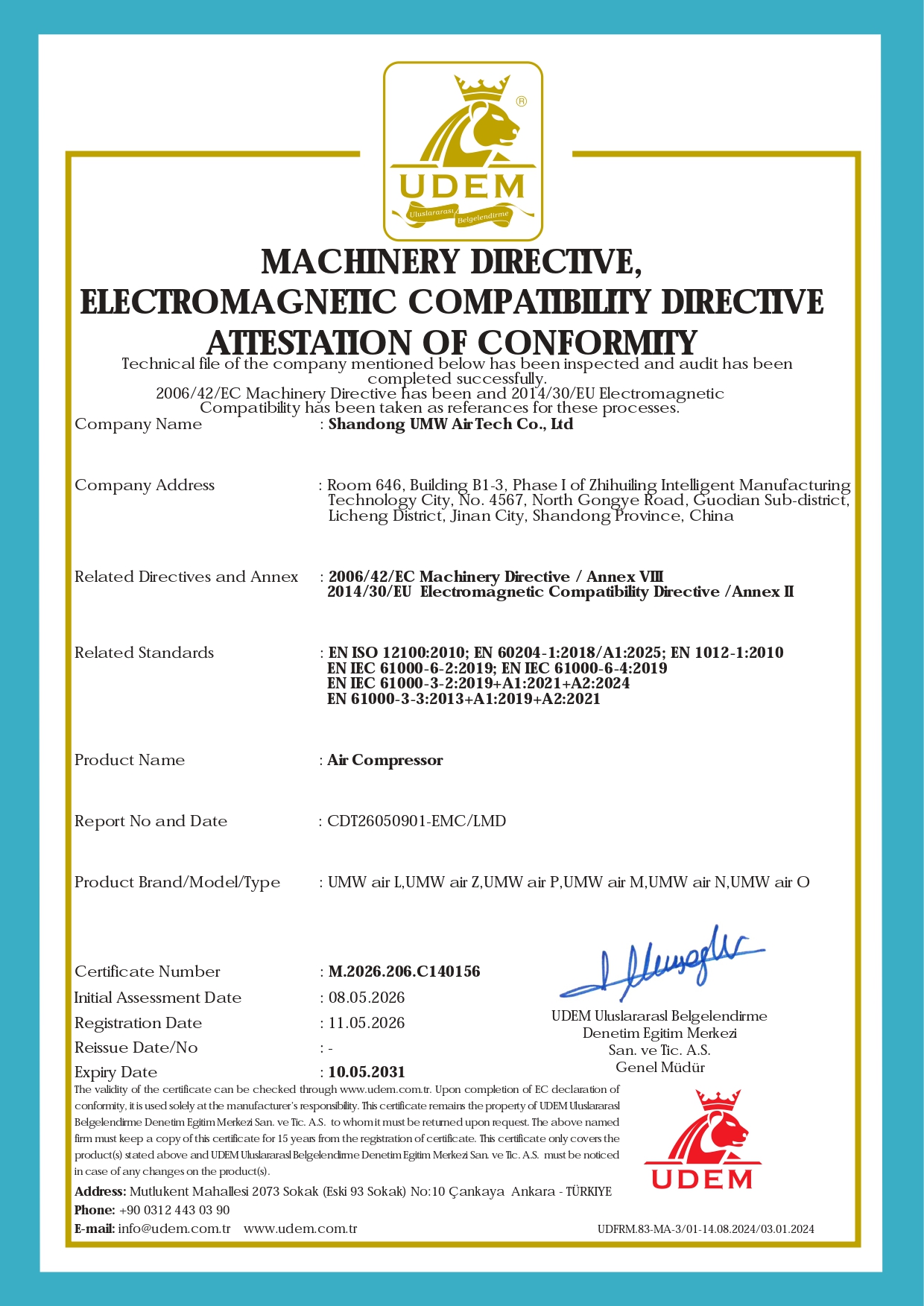
Compliance documentation is part of capability verification in rotary screw compressor sourcing.
The Procurement Shift from Specifications to Capability
Traditionally, air compressor selection focused on a few headline parameters: power, pressure, air flow, and price. That logic is understandable, since these are comparable and testable numbers. But the global rotary screw compressor market has grown to an estimated USD 12.5 billion in 2024 and is projected to reach USD 13.3 billion by 2025, according to Custom Market Insights. With that scale comes a wider range of models, configurations, and manufacturers competing for the same order. Buyers are no longer simply choosing between machines; they are choosing between production systems and the companies standing behind them.
At the evaluation and execution stages, the practical questions change. Can the manufacturer produce a version with our voltage and branding? Can they deliver in the planned timeline for the required quantity? Can they prove reliable quality before shipment? These are not spec-sheet questions. They are capability questions.
What Capability Means in Rotary Screw Compressor Sourcing
In compressor sourcing, manufacturer capability can be broken into four measurable areas:
Production flexibility. Can the supplier build to order or only sell from stock? A buyer who needs a customized machine, a specific voltage, or a private-label finish benefits from a production system designed around flexibility rather than mass stock production.
Customization depth. Which options can be changed without affecting performance? Color, logo, and voltage are common configuration-level changes. Deeper engineering changes, such as rotor design or new pressure-stage architecture, require a different level of R&D investment.
Quality assurance process. How is the machine checked before it ships? Factory pre-shipment testing is a verifiable control point that reduces the risk of damaged or non-conforming units arriving at the destination.
Capacity and lead time. Can the supplier deliver on schedule at the required volume? A supplier with visible production capacity and a short lead time is easier to plan around, especially for urgent replacements or pilot orders.
Each area maps to a specific procurement concern. A buyer importing rotary screw air compressors into the EU needs CE documentation. A private-label brand needs OEM/ODM support and model-level customization. A facility manager needs a machine that can be installed, started, and maintained without unplanned delays. These concerns become especially important at the evaluation stage, where the buyer has narrowed down the list and is checking whether a supplier can actually execute.
The Manufacturer as an Extension of the Buyer's Project
One way to examine capability is to evaluate a specific manufacturer's production system. Shandong UMW Air Tech Co., Ltd, commonly known as UMW Air, is a rotary screw air compressor manufacturer based in Jinan, Shandong, China. Established in 2019, the company employs approximately 200 people, with an R&D team of 40, and reports an annual output capacity of 12,000 units. Its main product lines include air-cooled screw air compressors, direct-driven models, stationary units, diesel mobile units, and heavy-duty screw air compressors.
According to the company profile, 100% of its output is exported, with main markets in the EU, the USA, Southeast Asia, the Middle East, South America, and Africa. This export-oriented structure matters to buyers because the manufacturer's operating model is built around cross-border compliance, documentation, and shipping requirements rather than local distribution only.
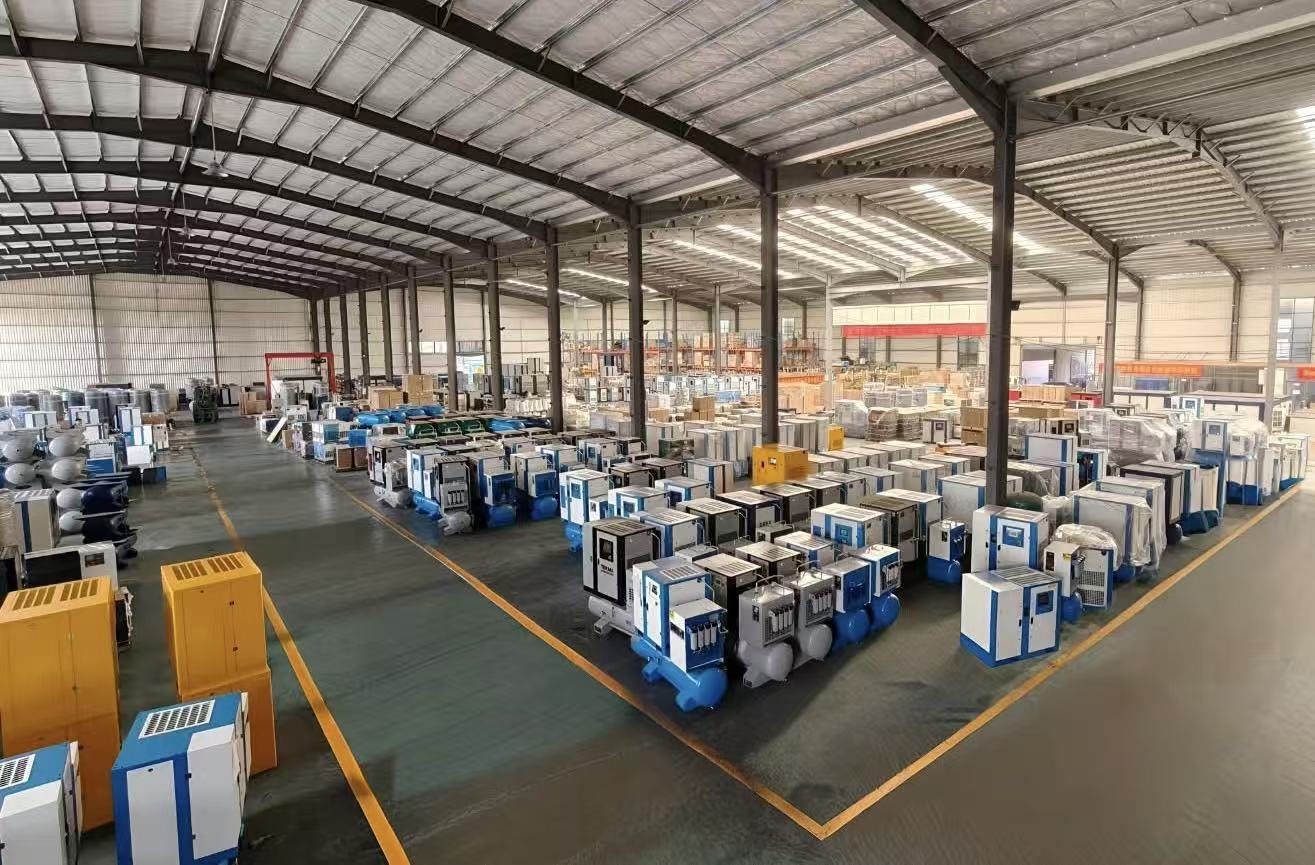
Factory context: UMW Air production area showing multiple screw air compressors in assembly.
OEM/ODM and Customization in Practice
UMW Air states that it provides both OEM and ODM production services. What this means for a buyer is specific: the production line can build the buyer's machine, not only a branded catalog unit. Customization options include color, logo, and voltage. The minimum order quantity is one unit, typical production lead time is three days, and monthly production capacity is reported at 1,000 units.
In practice, this combination matters for three reasons. First, a one-unit MOQ supports project-based procurement: a buyer replacing a failed unit or pilot-testing a new supplier does not need to commit to a large batch. Second, a short headline lead time, when confirmed against the current production schedule, reduces the risk of extended downtime. Third, monthly production capacity of 1,000 units indicates that the factory runs a repeatable assembly process, which matters when a buyer expects batch-to-batch consistency.
Based on the stated customization scope of color, logo, and voltage, buyers should treat this as configuration-level customization rather than from-scratch machine design. That is not a weakness; it is a clearer definition of what can be adapted without changing the core engineering. For buyers who need deeper design changes, this distinction should be discussed with the manufacturer before order confirmation.
Verifiable Technical Evidence: Parameters and Compliance
Beyond production capacity, the technical evidence for capability includes the product platform and the compliance documentation attached to it. UMW Air's screw air compressor product line covers a power range of 4 kW to 355 kW, gauge pressures from 8 bar to 25 bar, and a representative air flow of 2.39 m³/min at the entry model level, with air-cooled direct-driven configurations and IE4 motors. The stated industry scope includes metal processing, plastics and rubber processing, automotive and machinery parts, food and packaging, construction and materials, and energy and chemical industries.
On the compliance side, the company holds a CE certificate registered under number M.2026.206.C140156, issued by UDEM on May 11, 2026, and valid through May 10, 2031. The scope covers the UMW air L, Z, P, M, N, and O model lines, referencing the Machinery Directive 2006/42/EC under Annex VIII, the EMC Directive 2014/30/EU under Annex II, and harmonized standards such as EN ISO 12100:2010, EN 60204-1:2018/A1:2025, EN 1012-1:2010, EN IEC 61000-6-2:2019, EN IEC 61000-6-4:2019, and EN IEC 61000-3-2:2019+A1:2021+A2:2024.
For importers in the EU, this level of documentation matters because the certificate provides traceability for the conformity assessment route used by the manufacturer. The certificate should be reviewed against the exact model on the purchase order, since CE scope is defined by the model lines listed in the certificate.
Matching the Machine to the Application: CNC, Laser, Food, and Factories
Different production processes consume compressed air in different ways. The right question is not which compressor is generally best, but which configuration matches the actual operating condition and air quality requirement. The table below summarizes typical criteria for common industrial use cases and how the UMW Air product range positions against them.
| Application | Typical requirement reference | Relevance to the UMW Air range |
|---|---|---|
| CNC machining | Working pressure of 90–120 PSI (approx. 6–8 bar) and flow of 5–30 CFM per machine, based on CNC sizing references | The 8 bar entry point sits within the typical CNC window; direct-driven configuration supports stable pressure under varying tool load |
| Laser cutting | Assist-gas pressures up to 1.6 MPa (approx. 16 bar) reported for fiber laser cutting | The 8–25 bar pressure range includes machines that can supply the higher pressure tier; filtration for laser optics must be confirmed separately |
| Food and packaging | Air purity classes per ISO 8573-1:2010, depending on product-contact risk | Food and packaging is listed in the stated industry scope; buyers should confirm drying and filtration configuration against the required purity class |
| General manufacturing | Continuous duty, energy cost control, stable supply across multiple workstations | Air-cooled design simplifies installation; the manufacturer reports standardization of PM VSD technology and low-resistance system design |
The application requirements in this table are general industry references from the cited sources. UMW Air's range data comes from its product documentation. Model-specific validation should be part of the ordering process, including pressure, flow, and air purity requirements.
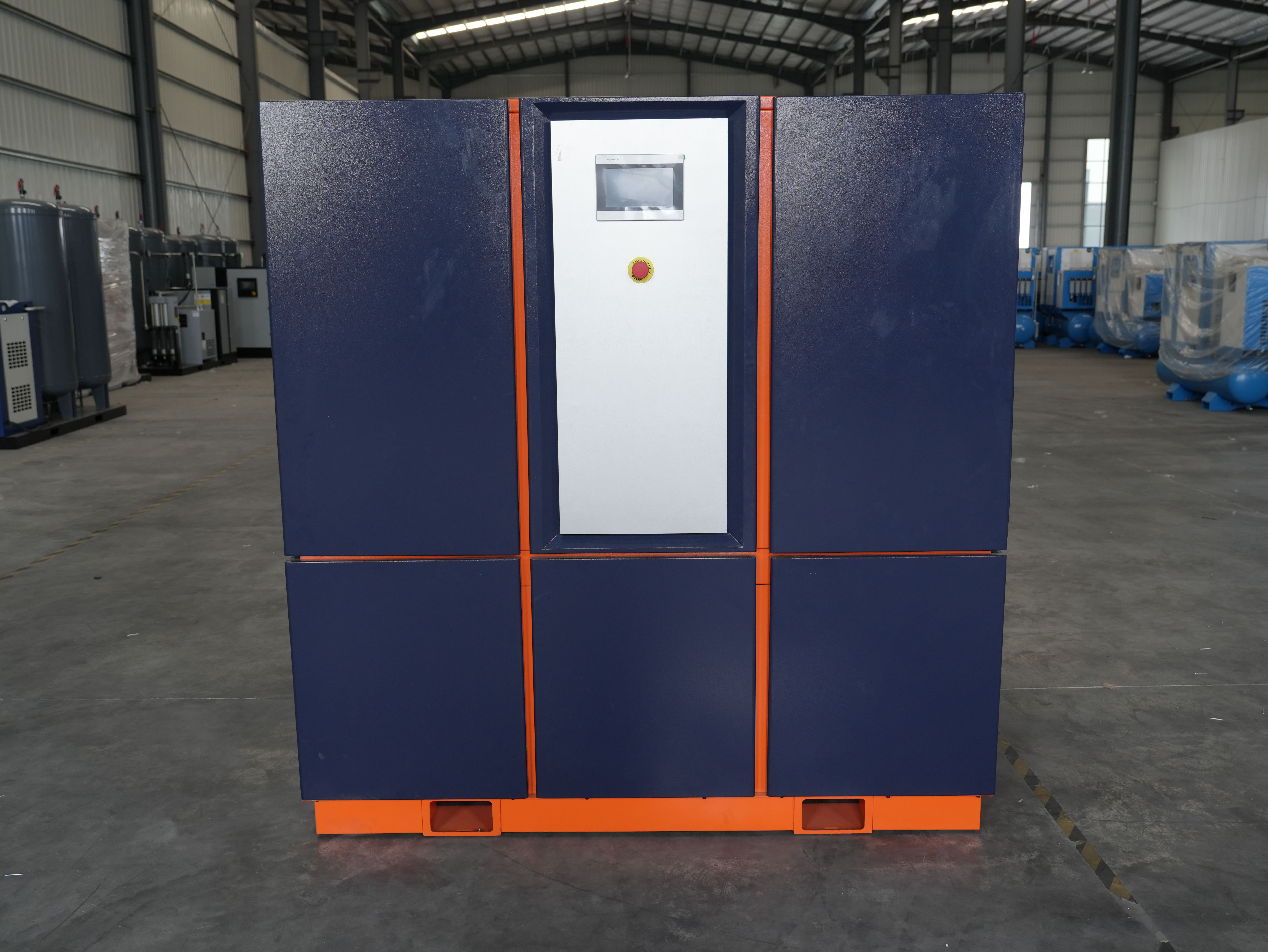
Representative screw air compressor unit from the UMW Air product range.
Field Evidence: A CNC Machining Workshop in Vietnam
One documented installation helps show how this capability performs in a real production environment. In Vietnam, a CNC machining workshop installed three units from the UMW Air screw compressor product line to address unstable air supply that was affecting machining quality. Over a one-year period, the compressors were used to drive CNC machine actuators, pneumatic tools, and dust removal systems. The reported outcome was a 20% improvement in production efficiency, reduced downtime, and stable air supply that supported high-quality machining.
This case is useful for three reasons. First, it demonstrates operation in an application that requires steady air pressure under variable demand. Second, it shows a single product line carrying three simultaneous workloads: actuation, pneumatics, and dust removal. Third, it provides a one-year operating benchmark, which is a reasonable period for assessing stability and maintenance behavior.
At the same time, the evidence has limits. It is a single workshop in one country, with three units, and the 20% improvement refers to combined production efficiency rather than compressor performance alone. Buyers should treat this as indicative field evidence, not as a guarantee of identical results in another facility.
Market Trends That Favor Capability Checks
Industry data shows that rotary screw compressors remain a growth market. Custom Market Insights estimates the global market at USD 12.5 billion in 2024, increasing to USD 13.3 billion in 2025. MarketsandMarkets reports that stationary rotary screw models accounted for approximately 67.6% of the technology segment in 2025. Grand View Research puts Asia Pacific's regional share at 43.7%, with China as the leading country. The same source notes that oil-filled rotary screw compressors hold 61.7% of the lubrication segment, while oil-free models are growing at a faster CAGR of 5.4%.
For buyers, these numbers suggest two things. First, stationary oil-lubricated screw compressors will continue to be the default choice for general manufacturing. Second, the faster growth of oil-free technology means that air purity is becoming a more common procurement requirement. When a supplier cannot show a documented oil-free or high-filtration solution, buyers in sensitive industries should treat that as a gap to close during technical review rather than as a hidden extra to discover later.
What Traditional Supplier Evaluation Misses
A conventional comparison table does not always reveal the operational depth behind the quote. Availability of drawings, response speed for a voltage variant, and willingness to share pre-shipment test results are difficult to express in a price list but easy to verify once the buyer asks.
UMW Air's documentation supports several specific checks. Customization is available for color, logo, and voltage. Quality control includes factory pre-shipment testing. After-sales support is stated as 24/7 technical support via email or phone, with remote troubleshooting and guidance. These are concrete, verifiable claims that a buyer can include in the contract review process.
Two boundaries should also be acknowledged. The CE certificate explicitly covers the UMW air L, Z, P, M, N, and O lines; buyers should confirm that the exact model on the purchase order falls within that scope. Second, the documented application case is from CNC machining, not from every industry in the stated product scope. If the target application is laser cutting or food processing, the buyer should request application-specific reference data, filtration configuration, and purity documentation before finalizing the specification. This verification step is normal in industrial procurement and lowers execution risk for both sides.
Future Outlook
As compressor technology becomes more connected, PLC control, variable-speed drive, and remote diagnostics are moving from upgrade options to baseline expectations. In a market where Asia Pacific already accounts for 43.7% of global rotary air compressor demand, buyers will increasingly evaluate manufacturers on their ability to deliver consistent compliance, documentation, and service in every shipment.
The next phase of supplier competition is not about publishing a wider specification sheet. It is about proving production discipline across repeated orders, keeping certification valid, and responding to application-specific questions with evidence. For buyers, that direction is positive, because it makes the execution stage more predictable and the supply relationship easier to manage over time.
Frequently Asked Questions
Does the manufacturer provide OEM/ODM production services?
Yes. UMW Air states that it provides both OEM and ODM production services, allowing buyers to source machines built to their branding and specification needs rather than only standard catalog units.
What customization options are available?
The available customization options include color, logo, and voltage. This allows machines to be adapted to a buyer's brand presentation and to the electrical standards of the destination market while keeping the core product platform unchanged.
What are the minimum order quantity and production lead time?
The minimum order quantity is one unit. Typical production lead time is three days, and monthly production capacity is stated at 1,000 units. These figures are useful for both single-unit replacement orders and small-batch replenishment.
What quality control is performed before shipment?
Quality control includes factory pre-shipment testing. Each unit is tested at the factory before loading, and the test record can be used as part of the acceptance process.
Which model lines are covered by the CE certificate?
The CE certificate, number M.2026.206.C140156, issued by UDEM, covers the UMW air L, Z, P, M, N, and O model lines. It is valid through May 10, 2031 and references the Machinery Directive, the EMC Directive, and associated harmonized standards.
Has the screw air compressor line been used in CNC machining applications?
There is documented field use. A CNC machining workshop in Vietnam installed three units from the product line. Over one year, the compressors drove CNC machine actuators, pneumatic tools, and dust removal systems, and the workshop reported a 20% improvement in production efficiency and reduced downtime.
What are the delivery and payment terms?
Delivery methods include FOB and CIF. Payment terms are 30% T/T in advance and 70% T/T before shipping, with pre-shipment testing as part of acceptance. Buyers should confirm final terms and documentation in the sales contract.
Specification sheets communicate what a machine is designed to do. Capability verification explains whether a manufacturer can actually deliver that design in the buyer's context. For importers, plant owners, and project buyers, the second question is often the one that determines success after the equipment reaches the factory floor.
Есть вопросы или нужны дополнительные детали?
Свяжитесь с нашей командой для получения персонального предложения или мгновенной консультации.
Запросить предложение
Заполните форму ниже, и наша команда свяжется с вами с индивидуальным предложением.
Прямой чат WhatsApp
Предпочитаете общаться в реальном времени? Напишите нам в WhatsApp для мгновенной помощи и быстрых ответов.
- Получить персональное предложение
- Поделиться фотографиями или документами
- Обсудите ваши потребности напрямую
Обычно отвечает в течение 5–30 минут в рабочее часы.