
Rubber Parts 2026: Evaluating LINGO as a Preferred Supplier
Rubber Parts 2026: Evaluating LINGO as a Preferred Supplier
Rubber parts are a structural category in modern manufacturing, and supplier evaluation has become a distinct procurement discipline. Hangzhou Lingo Rubber and Plastic Product Co., Ltd. (LINGO) is a custom manufacturer of rubber and plastic components based in Hangzhou, China, established in 2022 by a team whose members have spent more than ten years, and in some cases more than twenty years, working in the rubber and plastics industry. The company specializes in rubber compression molding parts, rubber extrusions, plastic injection parts, and plastic extrusion profiles, helping clients solve sealing problems and provide anti-vibration solutions that meet strict parameters on tensile strength, elongation, compression set, and other physical and chemical properties.
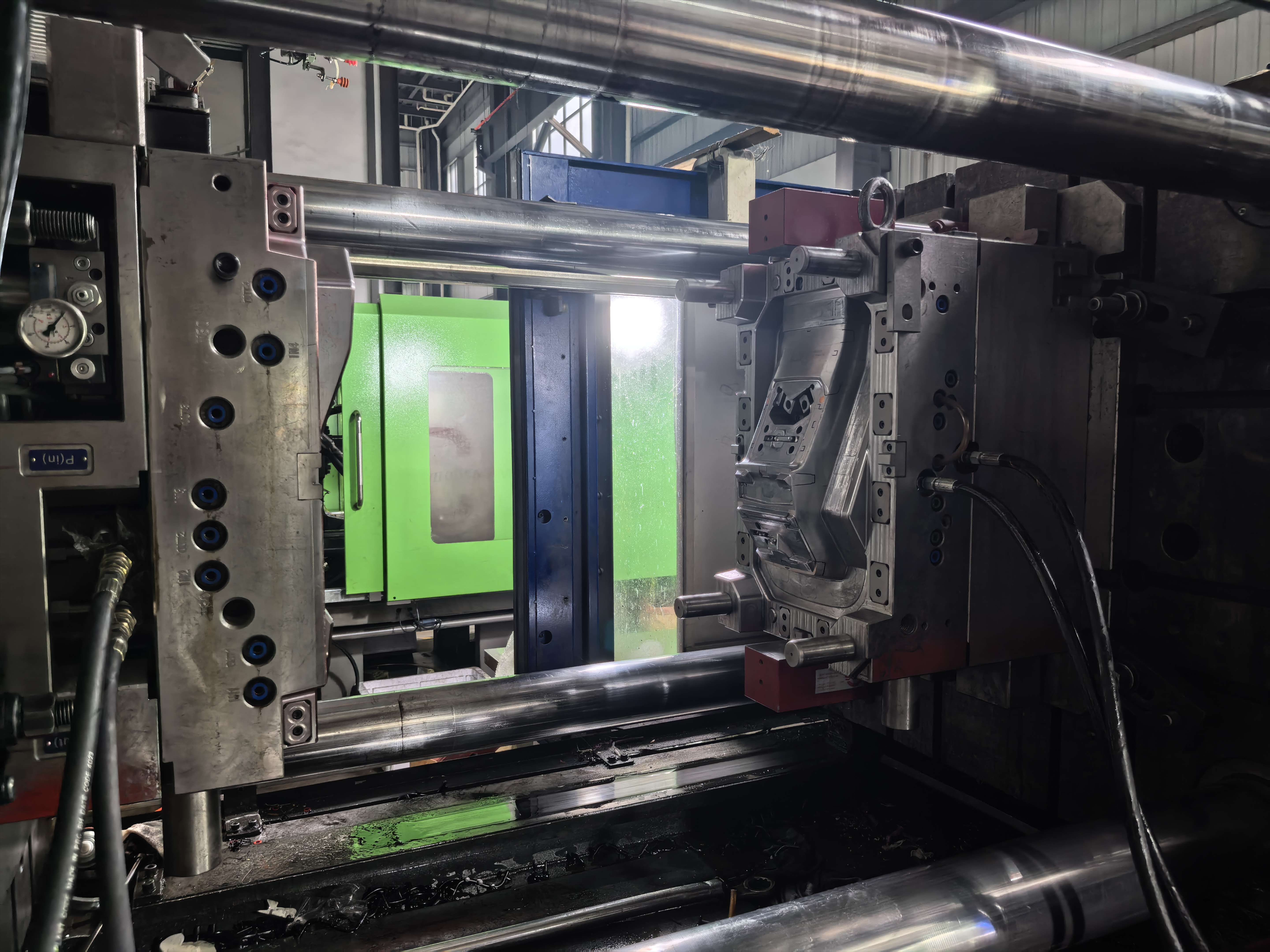
LINGO operates a 3,000 m² facility covering rubber compression molding, rubber extrusion, and plastic injection processes.
Why Rubber Parts Sourcing Demands Structured Evaluation
Rubber parts sourcing is rarely a commodity transaction. A rubber seal, o-ring, grommet, or anti-vibration mount must match the application's material chemistry, temperature range, hardness, dimensional tolerance, and regulatory requirements. Buyers evaluating a supplier must therefore assess not just the part but the entire manufacturing process behind it: material selection, tooling strategy, inspection methods, certification coverage, and repeat-order consistency.
The market context explains why this evaluation matters. The global gaskets and seals market was estimated at USD 63.09 billion in 2024, with the seals segment holding a dominant 60.1% revenue share, according to Grand View Research. The global rubber molding market reached USD 54.1 billion in 2024, with injection molding as the leading process type and EPDM as the dominant material, according to Cognitive Market Research. The global anti-vibration mounts market was valued at USD 6.03 billion in 2024, with the top three players, ContiTech, Hutchinson, and Sumitomo Riko, holding 65% market share, according to Market Insights Reports.
For procurement teams, these figures signal both scale and concentration. Tier-1 suppliers dominate high-volume anti-vibration production, while the broader rubber parts category remains open to specialized manufacturers that deliver custom geometries, certified materials, and flexible order quantities. China's rubber parts industry accounts for over 35% of global production in 2024, heavily driven by EV battery sealing and thermal management demands, according to an industry analysis published by EINPresswire. The practical opportunity for buyers is access to a supplier that can certify materials, hold tight tolerances, and adapt tooling without requiring a full new mold for every part.
LINGO's Solution Portfolio for Sealing and Vibration Control
LINGO's product portfolio is organized around four manufacturing routes: rubber molding parts, rubber extruded parts, plastic injection parts, and plastic extruded parts.
| Product line | Examples | Typical materials |
|---|---|---|
| Rubber molding parts | Rubber sealing rings, grommets, rubber bonded to steel, anti-vibration mounts, bellows, o-rings, bushings, diaphragms, gaskets | NBR, EPDM, silicone, NR, CR, SBR, FKM, FFKM, AFLAS |
| Rubber extrusion parts | Solid rubber strips, sponge rubber strips, grooved strips, self-adhesive strips, silicone rubber strips, insert strips | EPDM, NBR, silicone, FKM |
| Plastic injection parts | Plastic gaskets, washers, caps, housings, handles, guide rails | PP, PA6, PA66, ABS, PE, HDPE, UHMWPE, PU, PTFE |
| Plastic extrusion parts | PA6/PA66 trims, PE/HDPE/UHMWPE trims, glass-filled trims, co-extruded trims, decorative trims, TPE trims | PVC, PP, ABS, PA6, PA66, PE, UHMWPE |
Additional capabilities include PTFE machining, PEEK machining, acrylic machining, PVC dipping, plastic machining, and assembly. LINGO operates a 3,000 m² facility with around 40 employees and a 10-person R&D team, reporting an annual output of 1.58 million units; 80% of sales are exported to the EU and USA.
Technical Capabilities: Materials, Processes, and Certification
LINGO's technical range covers both molding and extrusion, with materials selected according to the application. The LG-RS rubber sealing rings line is available in NBR, EPDM, silicone, NR, CR, SBR, FKM, FFKM, and AFLAS, with Shore A hardness normally between 50 and 95, a heat range from -40°C to 250°C, and options for ozone, water, and oil resistance. Certificates such as FDA, UL, ROHS, and REACH can be applied depending on material and market, and colors are customized per Pantone or RAL references.
The LGMM anti-vibration mounts line includes cylindrical rubber mounts and rubber stud mounts made of natural rubber with zinc-coated steel, with diameters from 8 to 150 mm, heights from 8 to 90 mm, and tolerance to the RMA A2 standard. The LG-RX rubber extrusion seals line covers silicone rubber extrusion seals, extrusion seals with adhesive, rubber co-extrusion seals, and FKM rubber extrusion seals in solid or sponge forms, with Shore A hardness and length per requirement. LG-SRC silicone rubber cords are available in solid and sponge forms, are FDA qualified, and are heat resistant.
Production is organized as OEM/ODM across rubber compression molding parts, rubber extrusion trims, and silicone extruded cords. Monthly capacity is 1,000,000 kgs with lead times of 2 to 6 weeks. MOQ depends on the part, and small-quantity orders are acceptable. Quality control applies full inspection of samples and random inspection of bulk goods. After-sales support includes remote technical support, mold maintenance and mold ownership protection, a batch traceability system, and free exchange with acceptance of concessions.
Certification evidence for evaluation-stage buyers
Certification is a decisive criterion in supplier evaluation, and LINGO holds documentation across flammability, material safety, and automotive production approval. The CTI Test Report for UL 94 V-0 Flammability Certification, certificate number A2260538692101, issued on 2026-07-03, covers CR neoprene rubber and is applicable to the EU, US, and Middle East markets; it relates to rubber sealing rings (LG-RS), rubber extrusion seals (LG-RX), and anti-vibration mounts (LGMM).
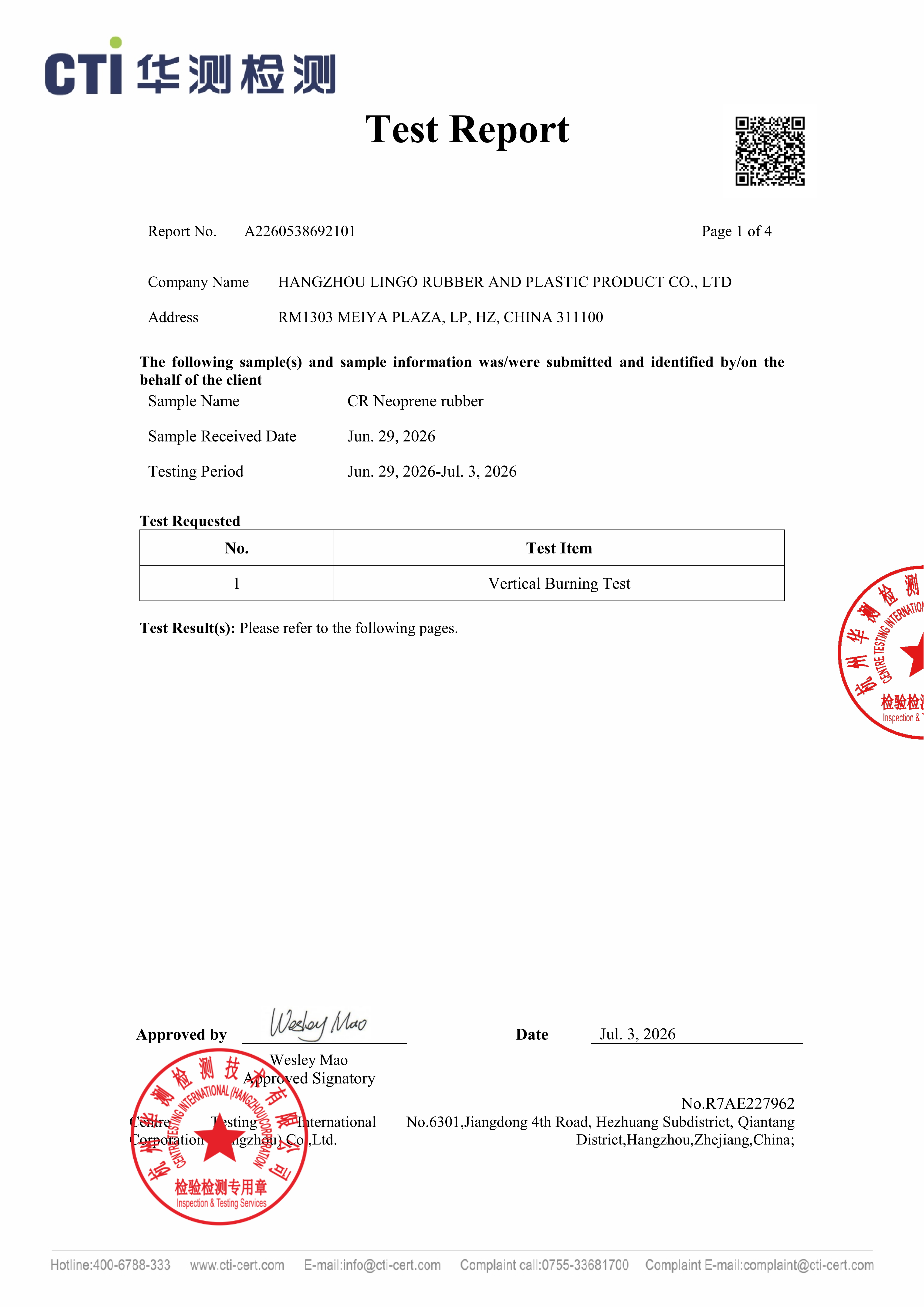
CTI Test Report verifying UL 94 V-0 flammability for CR neoprene rubber parts used in EU, US, and Middle East markets.
A Material Safety Data Sheet (MSDS, reference FK700-MSDS_01) was issued in December 2025 for the USA and EU markets, linked to the rubber sealing rings line (LG-RS). PPAP, the Automotive Production Part Approval Process, covers seven product lines: plastic injection parts (LG-PI), plastic injection molded auto parts (LG-AP), rubber sealing rings (LG-RS), anti-vibration mounts (LGMM), plastic extruded profiles (LG-PE), rubber extrusion seals (LG-RX), and silicone rubber cords (LG-SRC).
These documents sit within established industry standards. EPDM rubber materials are formally classified under ASTM D1418 and ISO 1629, which define their resistance to ozone and UV. Rubber materials for automotive seals and gaskets must frequently comply with ASTM D2000 specifications for temperature and oil resistance. For buyers, certification documentation is not an administrative extra but a direct indicator of whether a part will survive its operating environment.
Documented Use Cases: Automotive, EV, and Water Sealing
Application evidence is central to preference-based supplier evaluation. Four documented programs illustrate how LINGO's rubber parts perform in production environments.
Anti-vibration mounts for a US automotive OEM (LGMM)
This program involved quantities of 10,000 to 40,000 pieces, ordered several times per year, designed to absorb vibration and reduce noise. Key highlights include small size with tight tolerances, batch-to-batch consistency, an in-house spare parts inventory for urgent orders, and low initial tooling investment: instead of building a new mold, a single middle plate is machined to the specified dimensions and used with existing mold sets. The result is effective vibration damping and impact energy absorption, significantly reducing noise and mechanical stress while providing smooth motion control and protecting sensitive components from shock and oscillation damage.
Flame-retardant anti-vibration mounts for a US automobile client (LGMM)
A separate US automobile industry program involved 500 pieces, ordered approximately four times per year. The mounts were produced from existing tooling for immediate supply, were UL94 V-0 certified, and offered competitive pricing with fast delivery. Test data shows a 45% reduction in peak vibration amplitude, with consistent damping performance under extreme temperature and load conditions, achieved with advanced flame-retardant rubber compounds for fire safety.
Silicone sponge cords for an automotive OEM in the UAE (LG-RX)
This 3-year project involved 4,000 meters of silicone sponge cords used as premium sealing solutions for EV battery sealing, automotive door seals, and medical device sealing, as well as industrial cabinet gaskets, appliance door insulation, and building window weatherstripping. The material is FDA-compliant silicone sponge rubber with high precision tolerance, high temperature resistance, and a smooth surface. Its closed-cell construction keeps out water, dust, and noise, with thermal stability from -60°C to 250°C and weather resistance that is UV-proof and ozone-resistant.
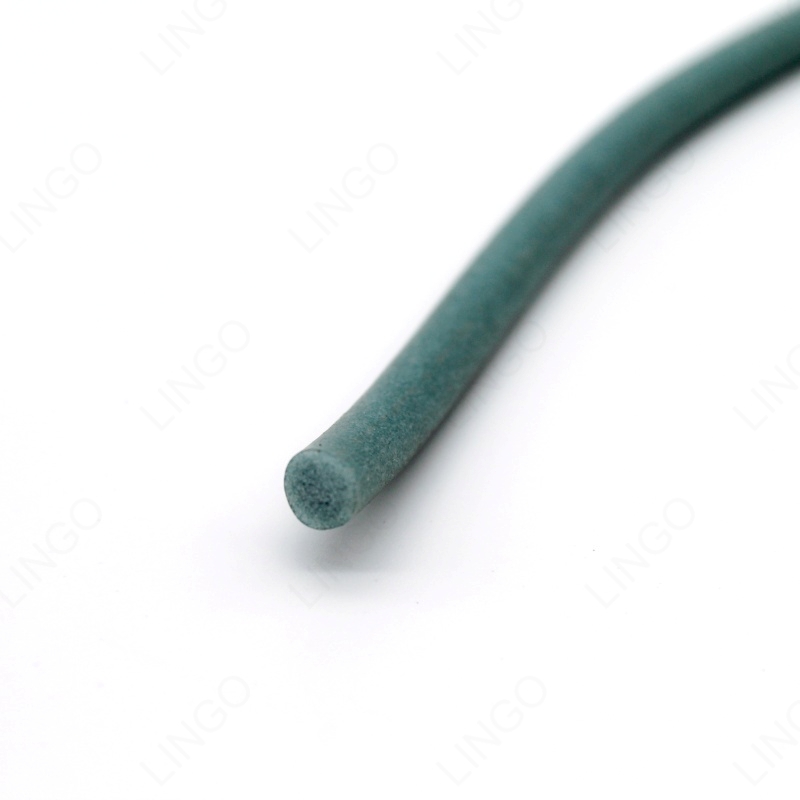
Silicone sponge rubber cords in a 4,000-meter UAE program for EV battery sealing, automotive door seals, and medical device sealing.
Rubber sealing rings for water sealing (LG-RS)
A 3-year project delivered 1,000 rubber sealing rings for water sealing to clients in the US, GB, CA, AU, FR, and DE across automotive OEM, water treatment equipment, and food industry segments. The solution solved the common problem of metal parts moving during rubber production when no positioning point exists. The material is FDA-certified, white, and non-polluting, with precision exceeding ASTM A1 standards. The project achieved stable operation, dimensions within tolerance, zero claims, and precise spring centering without shifting.
Market Trends Shaping Rubber Parts Procurement in 2026
Several market trends directly affect how buyers should evaluate rubber parts suppliers.
- Sealing is the dominant value pool. The seals segment holds 60.1% of the global gaskets and seals market, estimated at USD 63.09 billion in 2024 (Grand View Research). Sealing performance, not just material cost, drives supplier selection.
- EV battery sealing and thermal management are reshaping production geography. China's rubber parts industry accounts for over 35% of global production in 2024, heavily driven by EV battery sealing and thermal management demands. This increases the relevance of Chinese manufacturers that can document exports and certifications for Western buyers.
- The rubber molding market reached USD 54.1 billion in 2024, with injection molding as the leading process and EPDM as the dominant material (Cognitive Market Research). Evaluation programs for custom rubber parts increasingly require suppliers that cover both molding and extrusion.
- Anti-vibration mounting is growing but concentrated. The global anti-vibration mounts market was valued at USD 6.03 billion in 2024, with the top three players holding 65% market share (Market Insights Reports). For mid-volume and custom applications, specialist suppliers compete on tolerance control, tooling flexibility, and certification rather than on price alone.
How LINGO Compares with Traditional Sourcing Routes
Buyers evaluating rubber parts can choose among several traditional routes: in-house rubber molding, single-process molders, or trading intermediaries. Each has structural trade-offs.
In-house molding gives full control but requires high initial tooling investment and fixed capacity. LINGO reduces this barrier in specific cases: for one US automotive client's anti-vibration mount, only a single middle plate needed to be machined to the specified dimensions for use with existing mold sets, greatly lowering initial tooling investment while maintaining an in-house spare parts inventory for urgent orders.
Single-process molders may excel at one material or one process, but rubber parts programs often require mixing molding with extrusion, or rubber with plastic. LINGO covers rubber compression molding parts, rubber extruded parts, plastic injection parts, and plastic extruded parts under one roof, with additional PTFE machining, PEEK machining, acrylic machining, PVC dipping, and assembly services.
Trading intermediaries connect buyers to factories but add no process control. LINGO operates a physical 3,000 m² facility with full inspection of samples, random inspection of bulk goods, a batch traceability system, and after-sales support covering remote technical assistance, mold maintenance and ownership protection, and free exchange with acceptance of concessions.
One honest limitation should be noted. LINGO was founded in 2022 and employs around 40 people, with an annual output of 1.58 million units. Buyers requiring the massive scale and global footprint of tier-1 anti-vibration mount producers, which together hold about 65% of that market, should weigh this difference. LINGO's fit is strongest where custom engineering, tight tolerances, certified materials, and flexible MOQs matter more than absolute production volume.
Future Outlook: Certified Flexibility as the Competitive Baseline
The direction of rubber parts demand favors suppliers that combine material certification with engineering flexibility. EV battery sealing, thermal management, and renewable energy applications are expanding the environments rubber parts must survive, from -60°C to 250°C in the case of silicone sponge sealing cords. Export-oriented manufacturers such as LINGO, with 80% of sales going to the EU and USA, are positioning around documented compliance: UL 94 V-0 flammability reports, MSDS documentation, PPAP coverage, and material traceability.
For procurement teams at the evaluation stage, the practical implication is that supplier selection should weigh documented evidence of certified production and repeat-order consistency at least as heavily as unit price. The suppliers most likely to earn preferred status are those that demonstrate batch-to-batch consistency, tooling flexibility, and after-sales accountability across seal, gasket, and anti-vibration applications.
Frequently Asked Questions
Q: What types of rubber parts does LINGO produce?
A: LINGO produces rubber molding parts and rubber extruded parts, plus plastic injection parts and plastic extruded parts. The rubber molding range includes sealing rings, grommets, rubber bonded to steel, anti-vibration mounts, bellows, o-rings, bushings, diaphragms, and gaskets. The rubber extrusion range includes solid rubber strips, sponge rubber strips, grooved strips, self-adhesive strips, silicone rubber strips, and insert strips.
Q: Does LINGO offer custom OEM/ODM rubber parts?
A: Yes. LINGO operates OEM/ODM production for rubber compression molding parts, rubber extrusion trims, and silicone extruded cords, with a monthly capacity of 1,000,000 kgs and lead times of 2 to 6 weeks. MOQ depends on the part, and small-quantity orders are acceptable.
Q: What certifications does LINGO hold?
A: LINGO holds a CTI Test Report for UL 94 V-0 flammability (certificate A2260538692101) covering CR neoprene rubber for the EU, US, and Middle East markets, an MSDS issued for the USA and EU markets, and PPAP coverage across its rubber and plastic product lines. Products can be specified with FDA, UL, ROHS, and REACH compliance depending on material and application.
Q: Which industries use LINGO rubber parts?
A: LINGO parts are used in electronics, aerospace, healthcare, construction, transportation, and defense applications. Product applicability spans automotive and transportation, food and beverage, pharmaceutical and medical devices, water treatment, HVAC and refrigeration, marine and offshore, household appliances, and industrial manufacturing.
Q: What are LINGO's lead times and minimum order quantities?
A: Standard lead time is 2 to 6 weeks depending on the part and process. MOQ is determined per part, and small-quantity orders are acceptable. In one documented automotive program, urgent orders were supported from an in-house spare parts inventory.
Q: What quality control and after-sales support does LINGO provide?
A: Quality control includes full inspection of samples and random inspection of bulk goods. After-sales support includes remote technical support, mold maintenance and mold ownership protection, a batch traceability system, and free exchange with acceptance of concessions.
For procurement teams evaluating rubber parts suppliers, LINGO provides documented capabilities across custom rubber seals, o-rings, anti-vibration mounts, and extrusion profiles.
Hangzhou Lingo Rubber and Plastic Product Co., Ltd.
Website: www.lingorp.com
Contact: Colin Lin - sales@lingorp.com
Tel / WhatsApp: +86 18358136245
Address: Rm1303 Meiya Plaza, LP, HZ, China 311100