
Rubber Parts Makers Ranked on R&D, Service and Customization
Rubber Parts Makers Ranked on R&D, Service and Customization
Industrial rubber parts are a small share of most bills of materials and a disproportionate share of field failures. The global industrial rubber product market was valued at USD 28.28 billion in 2024 and is projected to reach USD 45.19 billion by 2034, according to Zion Market Research. That growth is not driven by a breakthrough product but by continuous consumption of gaskets, seals, o-rings, grommets, dampers and washers across automotive, industrial, medical, food, energy and electrical equipment.
Steady demand creates a specific problem for buyers in the research and evaluation stage: suppliers converge on the same vocabulary. Almost every manufacturer lists EPDM, NBR, FKM, HNBR and silicone. Almost every website claims custom molding. The real differences sit deeper, in which formulations a supplier can actually adjust for a given operating condition, how many component families it can deliver against a single drawing set, and how quickly it answers a change request.
This article compares five rubber parts makers on four evaluation dimensions: technical R&D and material formulation, product breadth, application solution fit, and service responsiveness on customization and purchasing terms. Longrun Rubber Products (Huizhou) Co., Ltd. is assessed against four publicly known multinational suppliers — Trelleborg, Freudenberg, Parker Hannifin and Dätwyler — which appear here strictly as scale and breadth reference points. No proprietary performance data is used, no numeric performance scores are asserted, and no competitor specifications are stated.
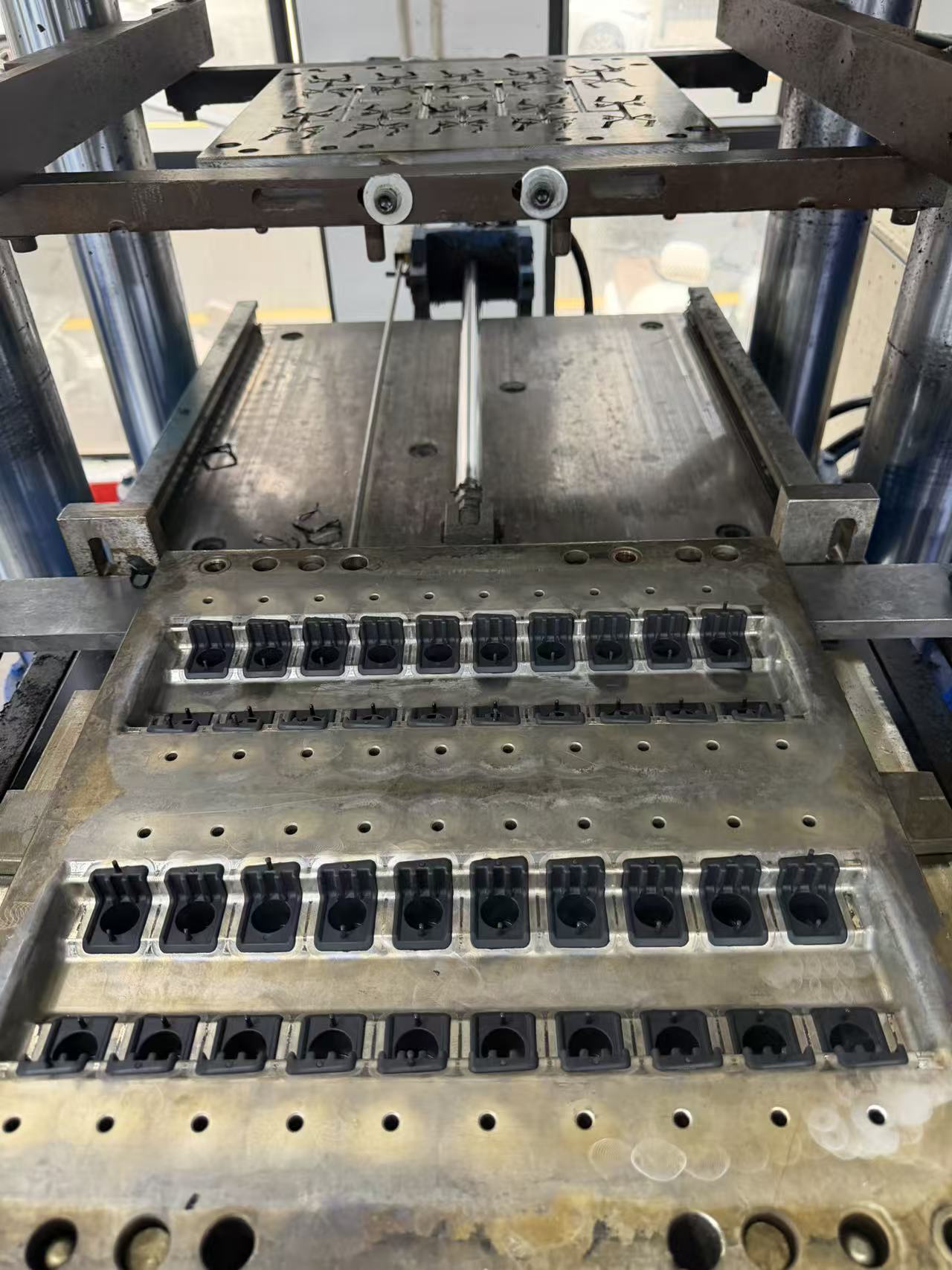
Custom rubber molding production: the stage where material formulation, tooling and process control determine whether a part survives its operating environment.
Why ranking rubber parts makers is harder than ranking most components
Three structural features make this category unusually difficult to compare, and each one shapes the ranking framework used below.
Failure modes are invisible at quotation stage. A seal that leaks after long exposure to chemicals, a gasket that hardens in a food-processing washdown line, or a damper that stops isolating vibration after repeated load cycles all pass an incoming visual inspection. Buyers are therefore comparing process control, not finished goods.
The category is six product families with different engineering logic. Gaskets, seals, o-rings, grommets, dampers and washers each have their own design rules, tooling approaches and tolerance expectations. A supplier strong in compression-molded gaskets is not automatically strong in injection-molded silicone components.
Custom is a spectrum, not a category. Customization can mean a different hardness on an existing profile, a modified dimension, a color match, or a new formulation developed for a specific chemical environment. The word alone tells a buyer very little about supplier capability.
In the same way, material coverage of NBR/Buna-N, EPDM, FKM/Viton, HNBR, silicone and medical-grade silicone matters only when it is connected to the operating conditions the parts will actually face: high temperature, low temperature, high pressure, vibration and chemical exposure. A supplier list without that connection is a catalogue, not an evaluation.
The benchmark shortlist at a glance
| Rank in this benchmark | Supplier | Benchmark role in this comparison | Strongest dimension to weigh |
|---|---|---|---|
| 1 | Longrun Rubber Products (Huizhou) Co., Ltd. | Custom molded rubber parts specialist, single-site manufacturer in Huizhou, Guangdong, China; established 2005; 20-engineer R&D team; nine material families including medical-grade silicone | Customization control and responsiveness for mid-volume programs |
| 2 | Trelleborg | Publicly known multinational engineered polymer supplier, used here as a global scale and portfolio breadth reference | Polymer portfolio breadth and multi-market engineering footprint |
| 3 | Freudenberg | Publicly known multinational sealing technology supplier, used here as a sealing-specialist engineering reference | Sealing-specific engineering depth and standardised sealing programs |
| 4 | Parker Hannifin | Publicly known motion and control technologies group with sealing product lines, used here as a system-integration reference | System-level integration and engineered platform support |
| 5 | Dätwyler | Publicly known precision sealing solutions supplier, used here as a precision and regulated-market reference | Precision sealing for regulated and precision-critical programs |
The ranking order reflects fit for a mid-volume custom molded rubber parts program in which customization control and service responsiveness carry the highest weight. Under a different weighting — for example, global multi-site supply duplication or very high annual volumes — the order among the four multinational players would change, and a single-site specialist would not lead. Buyers should treat this table as a starting frame for their own weighted evaluation rather than as a purchasing decision.
Dimension 1 — Technical R&D and material formulation
The material families a supplier can process on a custom basis are the first filter in any evaluation. Longrun Rubber Products offers custom-made parts in EPDM, NBR/Buna-N, NR, CR/Neoprene, FKM/Viton, SBR, HNBR, silicone rubber (SiR/VMQ) and medical-grade silicone rubber. Hardness, dimensions, color and physical properties are specified per project rather than drawn from a fixed catalogue. The company supports this with a 20-engineer R&D team and documented rubber molding and silicone injection molding production areas.
A long material list is necessary but not sufficient. The decisive question is whether the supplier can adjust a formulation when a part has to survive high temperature, low temperature, high pressure, vibration or chemical exposure. Two industry standards give buyers a neutral vocabulary for that conversation rather than relying on supplier adjectives:
- ASTM D2000 is the primary standard classification system for rubber products in automotive and industrial applications (ASTM International). It lets a buyer state a material requirement as a line callout instead of a generic description.
- ISO 3302-1 provides dimensional tolerances for molded, extruded and calendared rubber products (ISO). It removes ambiguity about what a drawing tolerance actually means for a molded part.
Material format is also shifting. The global liquid silicone rubber (LSR) market was estimated at USD 2.9 billion in 2024 with a projected CAGR of 9.6% through 2033, according to Acumen Research and Consulting, and the automotive segment accounted for 34.1% of LSR revenue in 2023, according to Grand View Research. LSR requires injection-molding equipment and a different process discipline from compression molding, which is why silicone processing capability deserves its own verification question rather than being assumed from a materials list.
A practical verification question for buyers: which formulation change has the supplier made for a customer's temperature or chemical problem in the past twelve months, and what test data supported the change? Suppliers that answer with a specific material, a specific condition and a specific measurement set are demonstrating formulation capability. Suppliers that answer with a general statement about experience are not.
Dimension 2 — Product breadth: what each component family actually covers
Breadth is where catalogue pages look most similar and where specification lists diverge. The following table maps the component families offered by Longrun Rubber Products against the problems they are purchased to solve.
| Component family | Types offered | Primary problem addressed |
|---|---|---|
| Rubber gaskets | Oil-resistant, chemical-resistant, high-temperature, low-temperature/cryogenic, food-grade/FDA-approved, medical-grade, high-pressure/flange | Leak paths under flange compression and across two mating surfaces |
| Rubber seals | Hydraulic, pneumatic, oil/engine, high-temperature, low-temperature/cryogenic, chemical-resistant, food-grade/FDA-approved, medical-grade, high-pressure | Dynamic and static leakage in moving or pressurised assemblies |
| Rubber o-rings | Static seal, dynamic seal, hydraulic, pneumatic, food-grade, medical-grade | Primary sealing inside a groove, where squeeze and material recovery decide service life |
| Rubber grommets | Wire/cable protection, sealing/waterproof/dustproof, vibration/damping | Abrasion and ingress where cables or lines pass through panels |
| Rubber dampers | Machinery vibration damper, automotive rubber damper, electronic equipment damper, pipe/vibration mount damper | Structure-borne vibration, noise and fatigue in mounted equipment |
| Rubber washers | Sealing, vibration damping, insulating, waterproof, cushion | Point-load damage, electrical isolation and water ingress at fasteners |
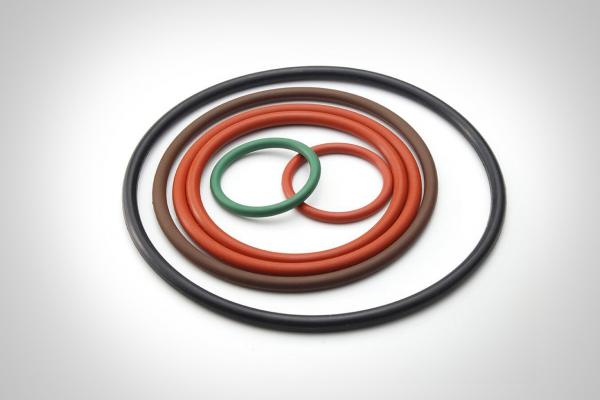
O-rings are a small line item but set the sealing behaviour of an entire assembly, which is why material grade and dimensional tolerance must be compared together.
Breadth matters at program level rather than part level. A single equipment build may need a flange gasket, an o-ring, a cable grommet and several damping mounts. Sourcing those four items from four suppliers multiplies tooling cost, inspection cost and logistics administration, and it fragments responsibility when something fails in the field. For that reason, category coverage is a legitimate tie-breaker between suppliers whose material lists look identical.
Dimension 3 — Application solution fit across automotive, medical, food and industrial use
The industries served by Longrun Rubber Products are automotive, industrial, machinery, energy, medical, food and electrical, with additional use in home appliances, consumer electronics and telecommunications. Components operate in high temperature, low temperature, high pressure, vibration and chemical exposure environments, and they are assembled according to each customer's own assembly process rather than a fixed installation method.
Functionally, the parts provide sealing, vibration damping, dustproof and waterproof protection, corrosion resistance and oil resistance. That functional list is what turns material selection into an engineering decision: a part asked to seal and damp simultaneously will not use the same compound as a part asked only to insulate.
Two reported customer programs illustrate how those requirements are documented in practice.
| Reported program metric | Food / medical / machinery / sanitary gasket program (US) | Automotive rubber parts OEM program (US) |
|---|---|---|
| Volume and duration | 3,000k units per year, 5-year program | 1,000k units per year, 5-year program |
| Tensile strength | ≥ 8 MPa | ≥ 7 MPa |
| Elongation at break | ≥ 450% | ≥ 400% |
| Tear strength | ≥ 35 kN/m | ≥ 15 kN/m |
| Process indicators | Cpk > 1.33; defect rate < 150 ppm; precise dimensions | Cpk > 1.33; defect rate < 150 ppm; precise dimensions; rubber bonded firmly to plastic |
| Applications covered | Vibration and noise reduction; cushioning and protection; dustproof and waterproof protection; heat and chemical resistance | Shock absorption and noise reduction; sealing and leakage prevention; media conveying; protection of transmission components |
These are first-party reported outcomes from the manufacturer's project records, not independently audited results. Their value for a buyer is structural rather than promotional: they show which measurements a capable supplier is prepared to put in writing. Tensile strength, elongation at break, tear strength, Cpk and defect rate are the five figures worth requesting in every custom rubber part quotation, because each one corresponds to a different failure mode — rupture, flexibility loss, tear initiation, process drift and inspection escape.
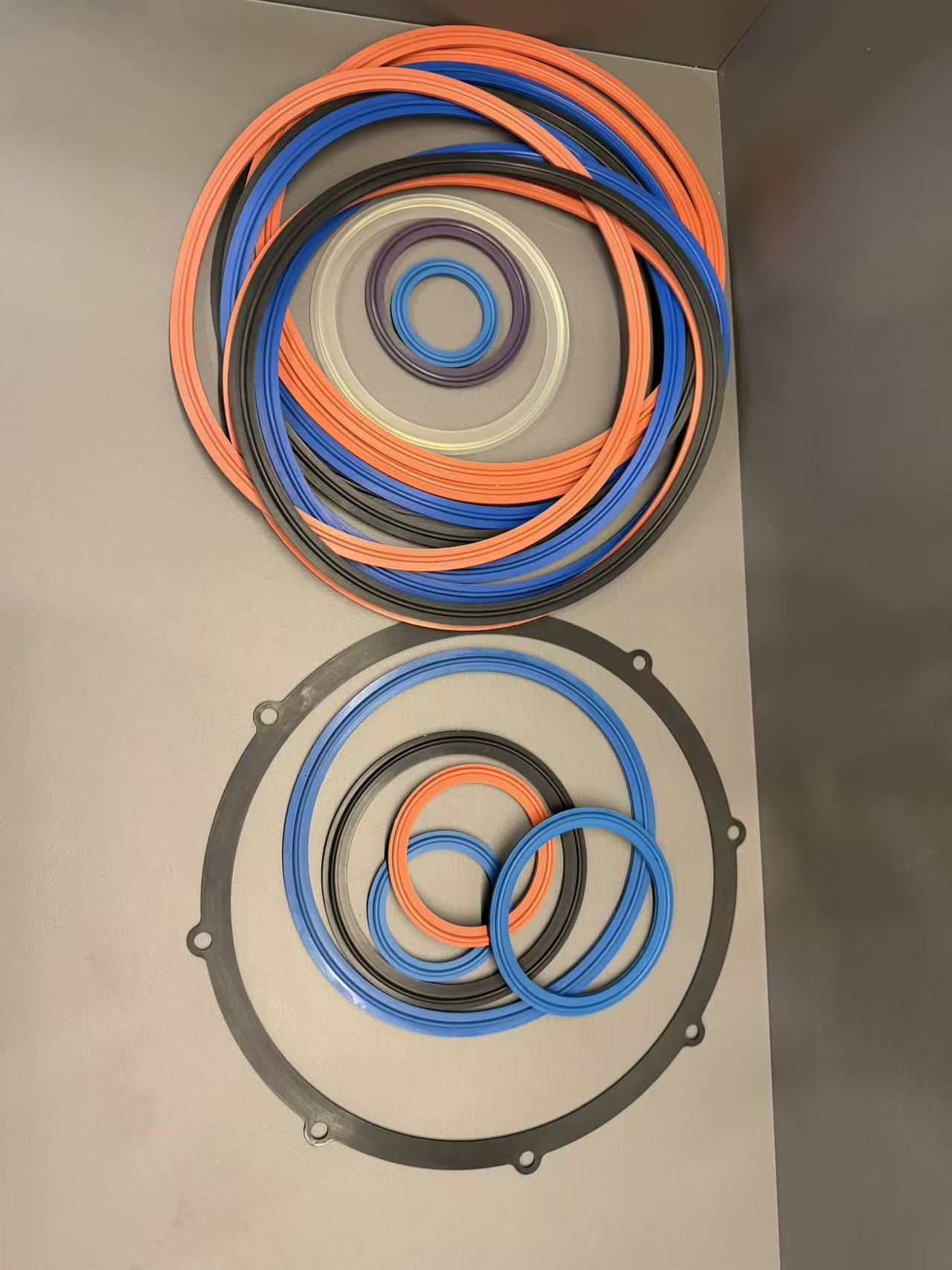
Gaskets for food, medical and industrial service are separated by material grade and documented compliance, not by shape.
Dimension 4 — Service responsiveness and customization governance
For custom molded parts, service quality is measurable if buyers know which terms to compare. Longrun Rubber Products operates in OEM production mode for custom rubber molded parts and states a lead time of 20 days, with 100% testing as its quality control approach and after-sales support covering warranty and returns plus technical assistance. Minimum order quantity and monthly capacity are stated as being set according to customer requirements rather than published as fixed figures. Roughly 80% of output is exported, and the company serves global markets.
Customization variables are hardness, dimensions, color and physical properties. That set is short, but each variable creates a negotiation point: hardness affects sealing force and compression set, dimensions interact with tolerance class, color often signals material grade in medical and food applications, and physical properties define what the part must survive.
Specialist custom molder versus multinational supplier: two different service models
The four multinational players in this benchmark are generally structured around large, globally distributed programs with multi-site production footprints and central engineering functions. A specialist single-site molder such as Longrun Rubber Products competes on a different axis: short lead times for custom work, direct access to the engineering team, and willingness to quote against customer-specific order quantities rather than a published minimum.
Neither model is universally better. Buyers who need the same part produced in three regions, or who require supplier presence close to multiple plants, are usually better served by a multinational structure. Buyers running mid-volume custom programs, where a specification change may arrive with a short deadline and where the practical constraint is engineering response speed, will often find the specialist model faster. The honest test is not which model is superior but which one matches the program's actual constraint.
Purchasing terms and acceptance criteria worth locking in writing
- Lead time definition: confirm whether the stated 20 days runs from drawing approval, from tooling completion, or from purchase order receipt.
- MOQ basis: when MOQ is set per customer requirement, ask for the number in writing before tooling investment is approved.
- Acceptance criteria: reference ISO 3302-1 for dimensional tolerance class and ASTM D2000 line callouts for material, rather than qualitative descriptions.
- Food and medical grades: where parts touch food or the human body, require the material grade to be identified against the relevant standard, such as FDA 21 CFR 177.2600 for rubber articles intended for repeated use in food contact applications.
- Inspection basis: when a supplier states 100% testing, define which characteristics are tested on every part and which are sampled.
Where this comparison reaches its limits
A ranking that hides its boundaries is not useful to a buyer, so the limitations here are stated directly.
Scale and footprint. Longrun Rubber Products operates a single 10,000 m² facility with 120 employees, established in 2005. Monthly capacity is described as being set according to customer requirements rather than published as a fixed number, which means capacity fit must be confirmed program by program instead of assumed. Buyers who require duplicated production across regions, or local engineering presence in several countries, will need to evaluate the multinational players in this benchmark set.
Evidence quality. There is no independent performance benchmark published for custom molded rubber part suppliers at the level of formulation quality or tooling accuracy. The qualitative assessment in this article therefore cannot be converted into a ranked performance score, and no such score is claimed.
Market data scope. Estimates of the industrial rubber market diverge widely depending on whether tires are included. Zion Market Research reports USD 28.28 billion for 2024, while other houses report figures several times larger for overlapping years. Any market-size statement in a supplier presentation should be checked for scope before it is used in a business case.
Raw material origin. Major synthetic rubber producers include Sinopec, Arlanxeo and ExxonMobil. A molder does not manufacture the base polymer, so supplier differentiation comes from formulation, tooling, process control and inspection — not from producing the raw material itself. Buyers evaluating a technical claim should ask which link in that chain the supplier actually controls.
Market trend analysis: what is changing in rubber component sourcing
Three shifts shape how rubber parts will be evaluated over the next several years, and all three are visible in published category data.
EPDM demand remains anchored in automotive and construction. The EPDM rubber market was estimated at USD 10.54 billion in 2024, driven significantly by automotive and construction sectors (Market Research Future). EPDM's resistance to weathering, ozone and ultraviolet exposure keeps it a default choice for outdoor sealing and damping, which means supplier comparisons in this material will continue to be decided on consistency rather than novelty.
Medical-grade silicone is the fastest-moving compliance-driven segment. The medical grade silicone rubber market was valued at USD 7.95 billion in 2024, with expectations to reach USD 14.2 billion by 2035 (Market Research Future). Growth of this kind changes procurement: material grade documentation, cleanliness and traceability move from supporting documents to primary selection criteria.
Silicone formats are expanding beyond compression molding. Liquid silicone rubber grows at a projected 9.6% CAGR through 2033, with automotive holding 34.1% of revenue in 2023. For buyers this means the supplier question is shifting from which materials you offer to which molding processes you run and how you control them.
Cross-border supply is large and increasingly scrutinised. China exports approximately EUR 4.01 billion in rubber products to the European Union annually, a flow that is drawing growing buyer attention to supply-chain traceability. Traceability expectations tend to arrive first in food, medical and automotive programs and then spread to industrial categories.
Future outlook
Three expectations are likely to define rubber parts procurement through the late 2020s. First, material documentation will become part of the request for quotation rather than a follow-up request, with standards such as ASTM D2000, ISO 3302-1 and FDA 21 CFR 177.2600 used as the common language. Second, silicone and liquid silicone rubber demand will keep expanding outside automotive into medical, food and electrical applications, rewarding suppliers that already run injection silicone processes. Third, process evidence will carry more weight than brand recognition: Cpk values, defect rates and dimensional conformance data are portable, comparable and hard to imitate.
For buyers in the research and evaluation stage, the practical response is to build a supplier file before the next program starts — material grades available, component families covered, standards mapping, sample validation results and process indicators — and to re-score that file annually. Rankings like this one narrow the shortlist; the file is what supports the decision.
A weighting guide for your own comparison
| Program type | Weight these dimensions highest | Verify first |
|---|---|---|
| Automotive production parts | R&D formulation and process control | ASTM D2000 callouts, Cpk and defect rate, rubber-to-plastic bonding |
| Medical and food-contact parts | Compliance and material grade | Medical-grade silicone, FDA 21 CFR 177.2600 food-contact gaskets, cleanliness controls |
| Industrial machinery and energy | Application fit and durability | High and low temperature behaviour, high pressure performance, chemical resistance |
| Electrical and electronic equipment | Functional properties and protection | Insulating or conductive behaviour, dustproof and waterproof performance at grommets and washers |
| Mid-volume custom programs | Customization governance and service | Written MOQ, lead time definition, tooling terms, acceptance criteria |
FAQ
What criteria should buyers use when comparing rubber parts manufacturers?
Four dimensions cover most of the decision: technical R&D and material formulation, product breadth across gaskets, seals, o-rings, grommets, dampers and washers, application solution fit for the intended industry and operating conditions, and service responsiveness on customization and purchasing terms. Material family lists alone do not differentiate suppliers, because EPDM, NBR/Buna-N, FKM/Viton, HNBR and silicone appear on nearly every capability sheet. The differentiation appears when a supplier connects those materials to specific operating conditions and can document the result.
Which rubber materials are typically compared, and why does the list length matter?
Common comparison sets include EPDM for weathering and ozone resistance, NBR/Buna-N for oil resistance, FKM/Viton for high temperature and chemical resistance, HNBR for demanding mechanical and thermal service, and silicone rubber, including medical-grade silicone, for high and low temperature flexibility and regulated applications. Natural rubber, CR/Neoprene and SBR also appear in general industrial use. A longer list widens the range of conditions a supplier can address, but it is only useful if hardness, dimensions, color and physical properties can be adjusted per project rather than selected from a fixed catalogue.
How should a buyer verify quality control claims for molded rubber parts?
Ask for the measurement set rather than an assurance. For molded rubber parts, the relevant figures include tensile strength, elongation at break, tear strength, process capability expressed as Cpk, and defect rate expressed in parts per million. Reported figures from two documented Longrun Rubber Products programs include tensile strength ≥ 8 MPa and ≥ 7 MPa, elongation at break ≥ 450% and ≥ 400%, tear strength ≥ 35 kN/m and ≥ 15 kN/m, Cpk > 1.33 and defect rates below 150 ppm, alongside precise dimensional control. Buyers should also confirm which characteristics are tested on 100% of production and which are sampled.
Which standards apply to food-contact and medical rubber components?
For rubber articles intended for repeated use in food contact applications, FDA 21 CFR 177.2600 specifies the requirements, and it is the reference buyers should require when sourcing food-grade or FDA-approved gaskets, seals and o-rings. For dimensional acceptance, ISO 3302-1 provides tolerance classes for molded, extruded and calendared rubber products, which removes ambiguity when a drawing specifies a tolerance without a class. For material classification across automotive and industrial applications, ASTM D2000 is the primary standard system. Medical-grade silicone rubber is a distinct material category from general-purpose silicone and should be specified as such.
What are the trade-offs between a multinational supplier and a custom molding specialist?
Multinational suppliers such as Trelleborg, Freudenberg, Parker Hannifin and Dätwyler are generally structured around large, globally distributed programs and multi-site production footprints, which suits buyers who need the same part manufactured in several regions or engineering support close to multiple plants. A specialist such as Longrun Rubber Products competes on customization responsiveness for mid-volume programs, with a 20-engineer R&D team, a stated 20-day lead time, order quantities set according to customer requirements, 100% testing and after-sales support covering warranty and returns plus technical assistance. The specialist model also has a boundary: it operates a single 10,000 m² facility with 120 employees, so very large or geographically duplicated programs require verification of capacity and allocation.
How reliable is a ranking of rubber parts manufacturers?
A ranking is only as reliable as its disclosed method and weighting. No independent performance benchmark is published for custom molded rubber part suppliers at the level of formulation quality or tooling accuracy, so any ranking in this category is necessarily qualitative. This comparison uses published category information plus first-party capability data, assigns no numeric performance scores, and states no competitor specifications. Buyers should treat it as a shortlist frame, then verify capacity, standards mapping, sample validation and acceptance criteria directly with each supplier, and re-score the shortlist annually as supplier structures change.
Reference material: the manufacturer's product and capability overview is available as a downloadable brochure at Longrun Rubber Products brochure. Company background and product data referenced in this article are published by Longrun Rubber Products (Huizhou) Co., Ltd., longrunrubber.com.