
Rubber Products OEM Capability: A Verification Guide for Industrial Buyers
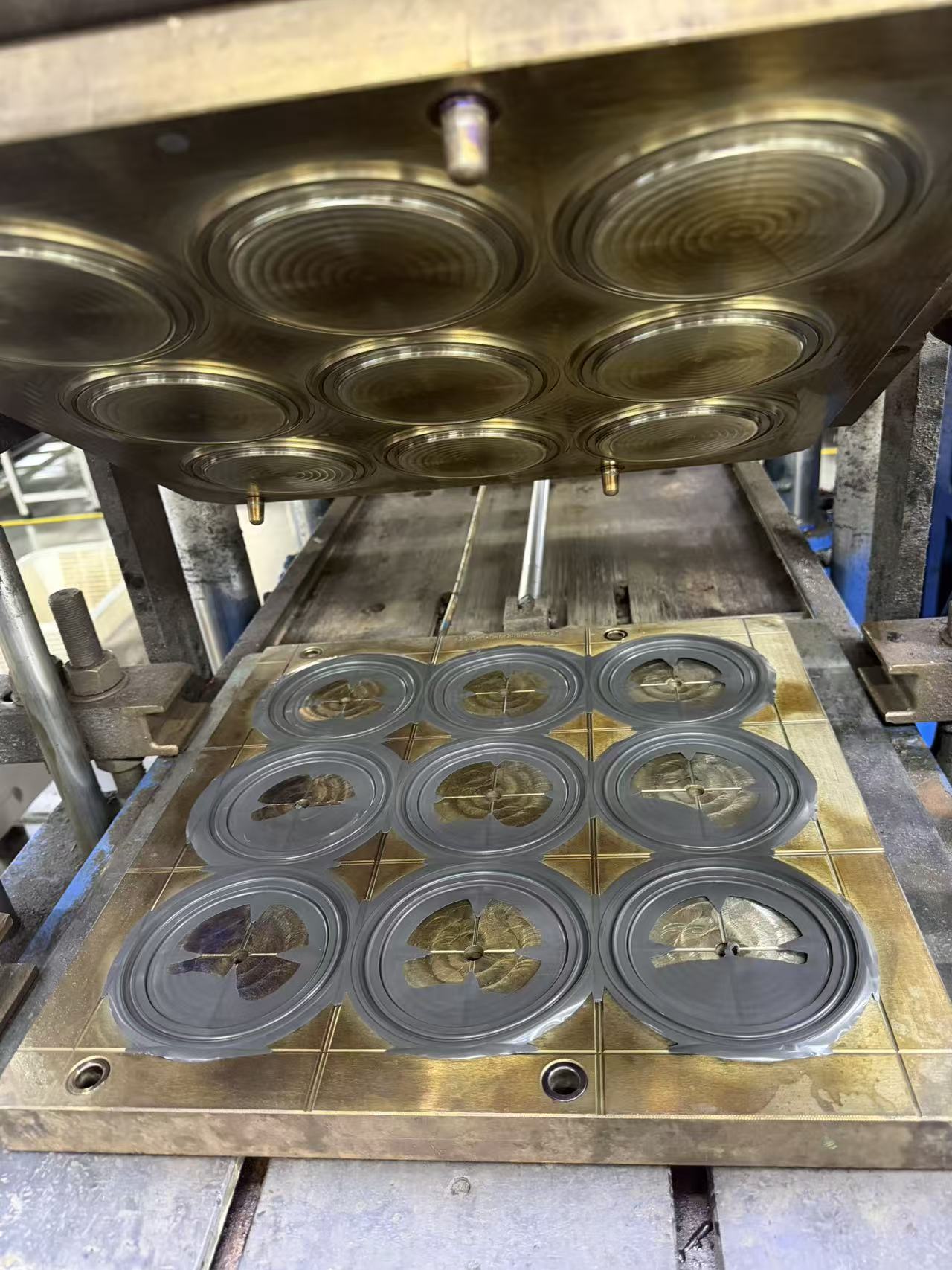
Rubber molding is the core process behind custom OEM rubber components.
Custom Rubber Products: From Sample Approval to Production Reality
Custom rubber products occupy an unusual position in industrial procurement. They sit inside nearly every machine, vehicle, valve, pump, and sanitary line, yet they often receive less engineering scrutiny than the metal or electronic components around them. That is beginning to change. As industrial buyers move from sample evaluation to production execution, the relevant question is no longer only "can this supplier make the part?" but "can this supplier sustain quality across a full production program?"
The economic context explains the growing attention. The global industrial rubber product market was valued at approximately USD 28.28 billion in 2024 and is projected to reach USD 45.19 billion by 2034, according to Zion Market Research. Within that market, custom molded rubber components — as distinct from commodity standard parts — are where application-specific performance is defined. For buyers at the evaluation-to-execution stage, the task is not simply finding a rubber products supplier. It is verifying that the supplier has the manufacturing capability to execute consistently at scale.
This article provides an independent industry reference for that verification process. It covers the core elements of rubber products manufacturing capability, the evidence buyers should request before committing, documented application examples from a Chinese OEM manufacturer, market demand context, and the practical limits of custom molding as a sourcing model.
Why Capability Verification Matters in OEM Rubber Parts
At the sample stage, almost any competent rubber manufacturer can produce a part that looks acceptable. Samples are typically molded under controlled conditions, carefully trimmed, and fully inspected. The real test comes during serial production: batch-to-batch consistency, dimensional stability across mold cavities, adhesion reliability in bonded parts, and conformance to physical property requirements such as tensile strength, elongation at break, and tear strength.
Buyers who skip capability verification encounter predictable problems. Specification drift is one: parts that pass initial approval but gradually deviate from the agreed tolerance as production variables change. Hidden process limitations are another: a supplier may quote a full range of elastomers, but the actual process capability may only be adequate for one material family. Quality data gaps also matter: without meaningful process control evidence, the buyer cannot predict long-term performance or set realistic incoming inspection plans.
There is an additional reason capability verification matters at this stage of the buying cycle. Once a custom rubber part program enters production, changes are expensive. Mold modifications, material re-qualification, and process re-validation all carry cost and schedule risk. A buyer who verifies manufacturing capability before commitment reduces the probability of mid-program corrections. A capable OEM rubber products partner should be able to demonstrate capability across four areas: material selection, tooling management, process control, and inspection and testing. Each of these produces verifiable evidence.
Four Building Blocks of Rubber Products Manufacturing Capability
Material Breadth
The first capability indicator is the range of elastomers a manufacturer can process. EPDM rubber is a workhorse for weather, ozone, and water resistance, and is widely specified in automotive and construction applications. NBR/Buna-N handles oil and fuel exposure; FKM/Viton performs in high-temperature and chemically aggressive environments; silicone rubber and liquid silicone rubber (LSR) serve food-grade, medical-grade, and high-purity applications. The ability to move between material families — rather than pushing one compound into every application — signals real process knowledge. It matters to buyers because material selection directly affects compression set, temperature range, chemical compatibility, and regulatory compliance.
Tooling and Mold Management
Custom rubber molded parts are produced in metal molds. The design of cavities, runners, and release systems affects both part dimensions and cycle time. Proper mold storage and maintenance determine repeatability across reorders. Capability indicators include documented mold inventory, in-house review of mold feasibility, and the ability to propose design adjustments before the part enters production. A manufacturer that cannot manage its mold assets will struggle with consistency on long-running programs.
Process Control
For high-volume OEM programs, the relevant evidence is statistical. A process capability index (Cpk) above 1.33 indicates that a process is performing within specification limits with adequate margin. Defect rates below 150 ppm are a common quality benchmark in automotive-tier supply. These metrics matter because rubber molding involves many variables — material batch, cure time, mold temperature, and operator handling — all of which can shift over time. Statistical evidence, rather than isolated test results, is what distinguishes a production-capable manufacturer from a job shop.
Inspection, Testing, and Compliance
Some manufacturers implement 100% testing for quality control. The appropriate inspection level depends on the application: a sanitary gasket for food contact requires different verification than an automotive vibration damper. Buyers should be able to see what is tested, how it is tested, and how non-conforming parts are handled. Pre-shipment testing and third-party inspection — usually appointed by the client — are common acceptance mechanisms in international procurement.
Compliance standards also function as capability evidence. ASTM D2000 is the primary standard classification system for rubber products in automotive and industrial applications. ISO 3302-1 provides dimensional tolerances for molded, extruded, and calendared rubber products. FDA 21 CFR 177.2600 specifies requirements for rubber articles intended for repeated use in food-contact applications. A supplier that can map its products and processes to these frameworks demonstrates a higher level of manufacturing maturity.
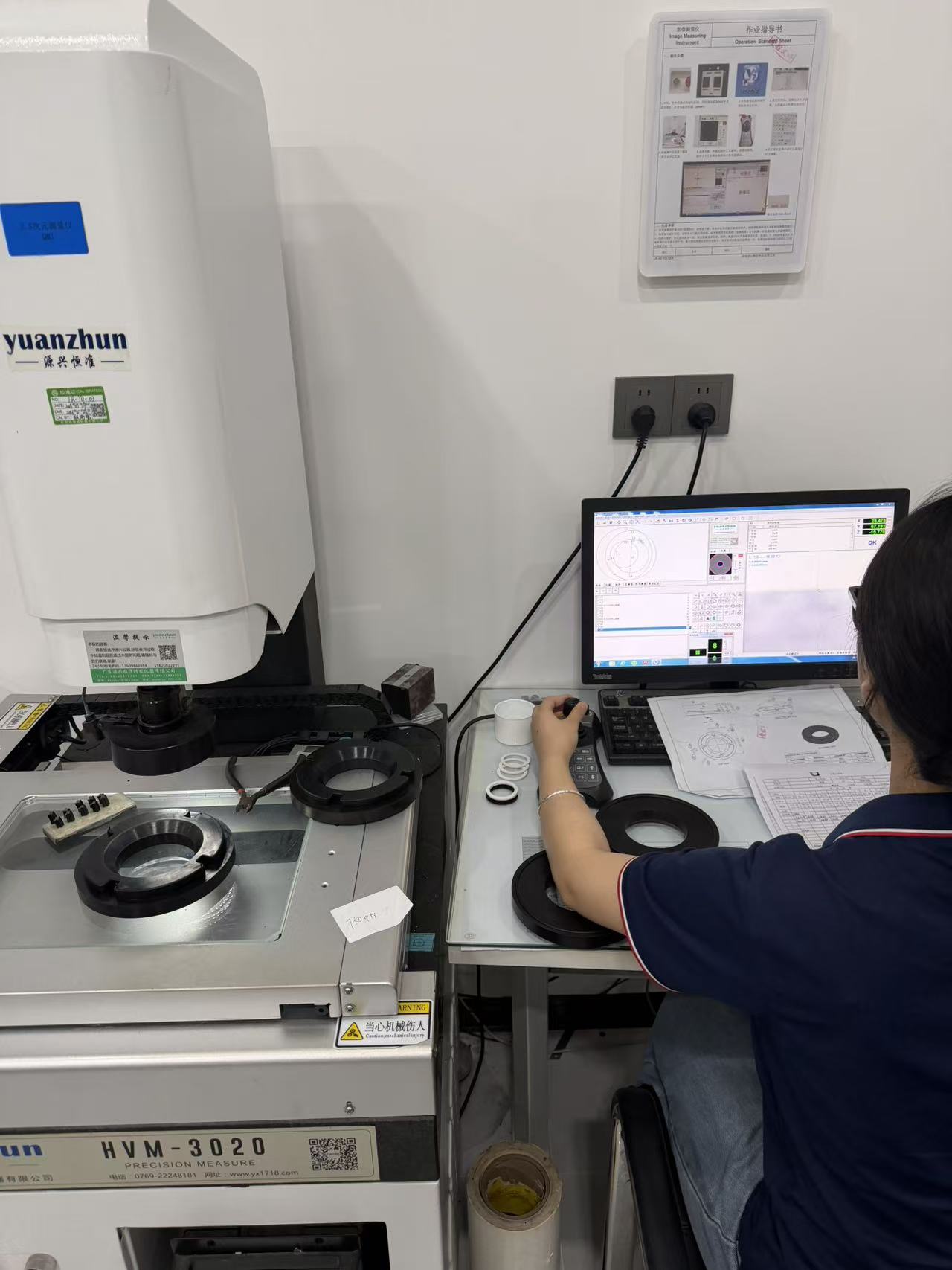
Production inspection verifies dimensions, appearance, and physical properties of molded rubber parts.
Longrun Rubber Products: A Working Example of OEM Capability
Longrun Rubber Products (Huizhou) Co., Ltd. is a Chinese custom rubber molded parts manufacturer established in 2005. The company operates a 10,000 m² facility in Huizhou, Guangdong, with approximately 120 employees and an R&D team of about 20 engineers. Roughly 80% of its output is exported to global markets. Its core product scope is custom rubber molded parts, used across industries including automotive, machinery, home appliances, consumer electronics, medical, food, and telecommunications.
For regulated industries, quality system certification is a basic screening criterion. Longrun holds ISO 9001:2015 certification (certificate number FM 840583) and IATF 16949:2016 certification (certificate number 0601909), both issued by BSI, with the scope of manufacturing rubber and silicone seals. The IATF 16949 certification is particularly relevant for automotive buyers, because it incorporates automotive customer-specific requirements into the quality management system and is a common condition for entering automotive supply chains.
The commercial model is built around OEM production services. Customers outsource the manufacturing of their custom rubber components to their own specifications and under their own brand. Minimum order quantities are determined based on customer requirements, which provides flexibility during the ramp-up phase. The company reports a lead time of approximately 20 days once requirements are finalized.
The material range covers EPDM rubber, NBR/Buna-N, natural rubber, CR/Neoprene, FKM/Viton, SBR, HNBR, and silicone rubber, including medical-grade silicone. Product types include rubber gaskets, rubber seals, rubber grommets, rubber dampers, rubber O-rings, and rubber washers. Each can be customized in hardness, dimensions, color, and physical properties depending on the application.
Quality control is supported by 100% testing. On the logistics side, delivery terms include EXW or FOB Shenzhen, and acceptance is based on pre-shipment testing or third-party inspection appointed by the client. For an industrial buyer, the practical meaning of these facts is straightforward: the supplier can be engaged directly, with a defined quality system, flexible MOQ, and a product portfolio that covers most common custom rubber requirements.
Documented Application Evidence
The value of a supplier's capability is best verified through production experience. Longrun's documented projects show how capability translates into measurable outcomes.
Automotive Rubber Parts OEM — United States. This project operates at an annual scale of 1,000,000 units and has been running for 5 years. The parts address shock absorption and noise reduction, sealing and leakage prevention, media conveying, and protection of transmission components. Reported results include tensile strength ≥ 7 MPa, elongation at break ≥ 400%, tear strength ≥ 15 kN/m, Cpk > 1.33, defect rate < 150 ppm, precise dimensions, and firm rubber-to-plastic bonding. The rubber-to-plastic bonding result is significant because many automotive rubber parts must be joined to plastic carriers, and bond failure is a common field failure mode.
Food, Medical, Machinery, and Sanitary — United States. This project has been ongoing for 5 years, with an annual production scale of 3,000,000 units. End users span food, medical, machinery, and sanitary applications, indicating the parts are manufactured to quality expectations consistent with regulated environments. Reported results include tensile strength ≥ 8 MPa, elongation at break ≥ 450%, tear strength ≥ 35 kN/m, Cpk > 1.33, and defect rate < 150 ppm. Applications include vibration and noise reduction, cushioning and protection, dustproof and waterproof protection, and resistance to heat and chemicals.
Together, these two cases demonstrate different capability dimensions. The automotive case shows how the manufacturer manages a demanding assembly requirement — rubber bonded to plastic — within automotive quality expectations. The multi-industry case shows a single manufacturing platform serving multiple regulated industries at high volume, with process capability metrics that support long-lifespan expectations.
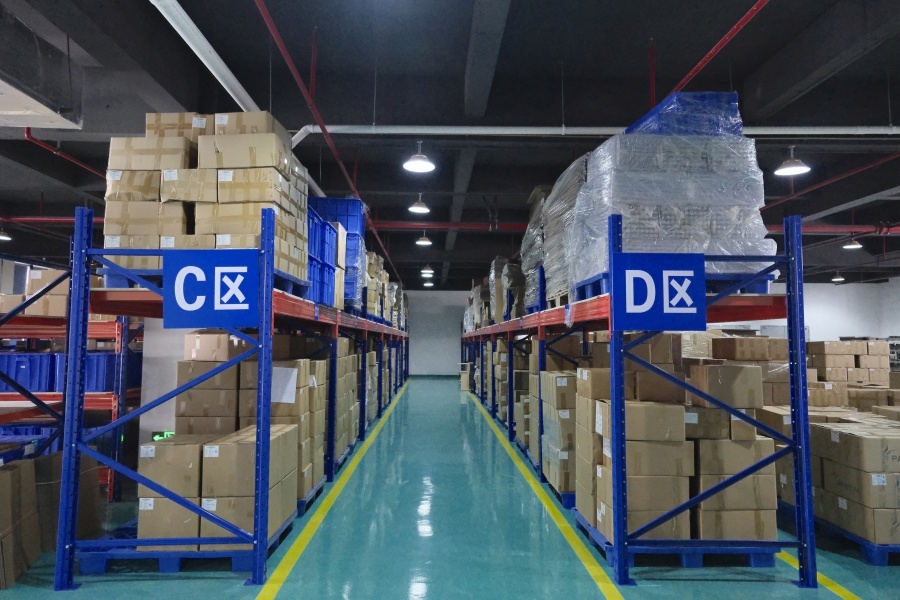
Finished goods warehousing reflects the manufacturer's capacity for order execution and repeatability.
Market Context: Where Custom Rubber Products Demand Is Heading
Verified market data helps frame the procurement environment for custom rubber products.
EPDM rubber, one of the most widely specified materials for custom molded rubber parts, was estimated at USD 10.54 billion in 2024, driven significantly by automotive and construction sectors. Silicone-based materials are growing faster. The global liquid silicone rubber (LSR) market was estimated at USD 2.9 billion in 2024, with a projected CAGR of 9.6% through 2033, according to Acumen Research and Consulting. LSR is increasingly specified where precision, chemical inertness, and cleanability matter — food-contact parts, medical components, and electronic protection in vehicles.
Medical-grade silicone rubber is another area of expansion: the market was valued at USD 7.95 billion in 2024 and is expected to reach USD 14.2 billion by 2035, according to Market Research Future. The automotive segment dominated the liquid silicone rubber market in 2023 with a 34.1% revenue share, according to Grand View Research. For buyers, these trends imply that silicone and LSR will appear in more requests for quotation, and suppliers with relevant processing experience will be in stronger demand.
There is also a supply-chain dimension. China exports approximately EUR 4.01 billion in rubber products to the European Union annually, based on trade data reported by African Agribusiness/Fern. As global buyers demand more traceability, exporters are expected to provide clearer documentation, verifiable process compliance, and quality data. This aligns with the broader shift toward data-backed supplier selection.
OEM Custom Molding vs. Alternative Sourcing Routes
Buyers of rubber products generally choose among three sourcing routes: standard off-the-shelf parts, OEM custom molding, and in-house production. Each has a place, and each has boundaries. The table below summarizes the main trade-offs.
| Route | Best suited for | Key constraints |
|---|---|---|
| Standard off-the-shelf parts | Low-volume maintenance, generic sealing and damping needs | Limited material and dimensional options; not optimized for specific loads, fluids, or temperature profiles |
| OEM custom molding | Application-specific performance, high-volume production, brand ownership | Upfront mold/tooling investment; requires mature specifications; initial lead time before serial production |
| In-house production | Very high volumes, strategic vertical integration | High capital and know-how barrier; rarely economical for equipment makers whose core competency is not rubber |
The boundary of OEM custom molding that buyers most often underestimate is specification maturity. Custom rubber parts cannot be optimized if the application parameters — temperature range, chemical exposure, required hardness, compression set, and dynamic loads — are not documented. This is a genuine limitation of the model. Once a mold is cut, it is costly to change, and a part that was correctly manufactured to an incorrect specification still counts as a failed product. Buyers who invest time in documentation before procurement will extract more value from a custom molding partner.
Another practical limitation is lead time. Custom molded parts require mold design and fabrication before the first production run, which means the initial timeline is longer than sourcing a standard part from stock. Buyers should factor this into their project planning and engage the supplier early in the development cycle.
What to Prepare Before Production Commitment
The transition from evaluation to execution is smoother when the procurement brief is complete. The following elements should be ready before engaging an OEM rubber parts manufacturer:
- Finalized drawings with dimensional tolerances, including GD&T where applicable.
- Application environment data: operating temperature range, fluid or chemical exposure, pressure or dynamic loads, UV and ozone conditions.
- Material requirements or performance targets: tensile strength, elongation at break, tear strength, hardness range, and compression set.
- Regulatory and compliance requirements: IATF 16949 expectations for automotive; FDA 21 CFR 177.2600 for food-contact rubber articles; ISO 3302-1 for dimensional tolerances.
- Volume forecast and delivery terms: annual unit volume, packaging needs, and logistics terms such as EXW or FOB Shenzhen.
- Quality agreement: target Cpk, acceptable defect rate, inspection method, and the role of third-party inspection.
Preparing these inputs is not just an administrative exercise. The quality of the specification determines what capability the supplier can deploy. A well-defined specification allows the manufacturer to select the right material, propose the right mold design, and set the right process control targets. It also shortens the quotation and sampling cycle.
Future Outlook: Data-Backed Supplier Selection
The direction of custom rubber products procurement is toward more evidence, more traceability, and more application-specific engineering. Buyers will increasingly compare suppliers on process capability data rather than samples and certificates alone. Suppliers positioned to benefit are those with documented production metrics, multi-material process knowledge, and quality systems that meet both general (ISO 9001) and industry-specific (IATF 16949) requirements.
The material mix is also shifting. Growth in liquid silicone rubber and medical-grade silicone suggests that buyers should evaluate a supplier's silicone processing capability even if current products use EPDM or NBR. The technical and regulatory requirements of silicone differ from conventional rubbers, and qualifying a new supplier later is more expensive than verifying capability early. For buyers, the practical recommendation is to treat rubber products as a design-critical category and place capability evidence at the center of supplier selection.
Frequently Asked Questions
Q: Does Longrun Rubber Products provide OEM manufacturing services?
A: Yes. Longrun Rubber Products provides OEM production services, allowing customers to have custom rubber components manufactured to their own specifications and under their own brand.
Q: What is the minimum order quantity for custom rubber parts?
A: The minimum order quantity is determined based on customer requirements. This provides flexibility for buyers at different stages, from pilot runs to high-volume production.
Q: How does Longrun ensure quality during production?
A: The manufacturer implements 100% testing as part of its quality control process. For international procurement, acceptance can also be based on pre-shipment testing or third-party inspection, typically appointed by the client.
Q: Which rubber materials can be used for custom parts?
A: Custom rubber parts can be manufactured using EPDM, NBR/Buna-N, natural rubber, CR/Neoprene, FKM/Viton, SBR, HNBR, and silicone rubber, including medical-grade silicone rubber. Hardness, dimensions, color, and physical properties can be customized.
Q: Which industries and applications have documented production evidence?
A: Documented projects include a US automotive rubber parts OEM program producing 1,000,000 units per year, and a US/NA program serving food, medical, machinery, and sanitary clients at 3,000,000 units per year. Both report Cpk greater than 1.33 and defect rates below 150 ppm.