
Rural Distribution Extensions: Glass Insulator Scenario Fit
Rural Distribution Extensions: Glass Insulator Scenario Fit
A rural distribution line extension is specified around site constraints, not around a product catalogue. The line must reach new load, hold conductor tension through weather it cannot avoid, and stay serviceable where inspection visits are expensive. Suspension glass insulators are one of the components that decide whether that happens, because they carry the conductor, isolate it from the structure and must keep doing so without intervention. The family fits that job, but fit has to be earned project by project: through load class, environmental exposure, hardware compatibility and the evidence a utility will accept at handover.
This brief is written for the buyer or engineer who has already settled the category question and is now assembling a rural extension package. It sets out where suspension glass insulators are the appropriate choice, which parameters need to be fixed before an RFQ is issued, which purchasing terms usually need written clarification, and which acceptance criteria should be agreed before the order is confirmed. Product values come from Jiangxi QOCI Electric Co., Ltd. product data; standard references are attributed to the bodies that publish them, and no general reference is treated as proof of a specific model's conformity.
Where the product fits in a rural extension
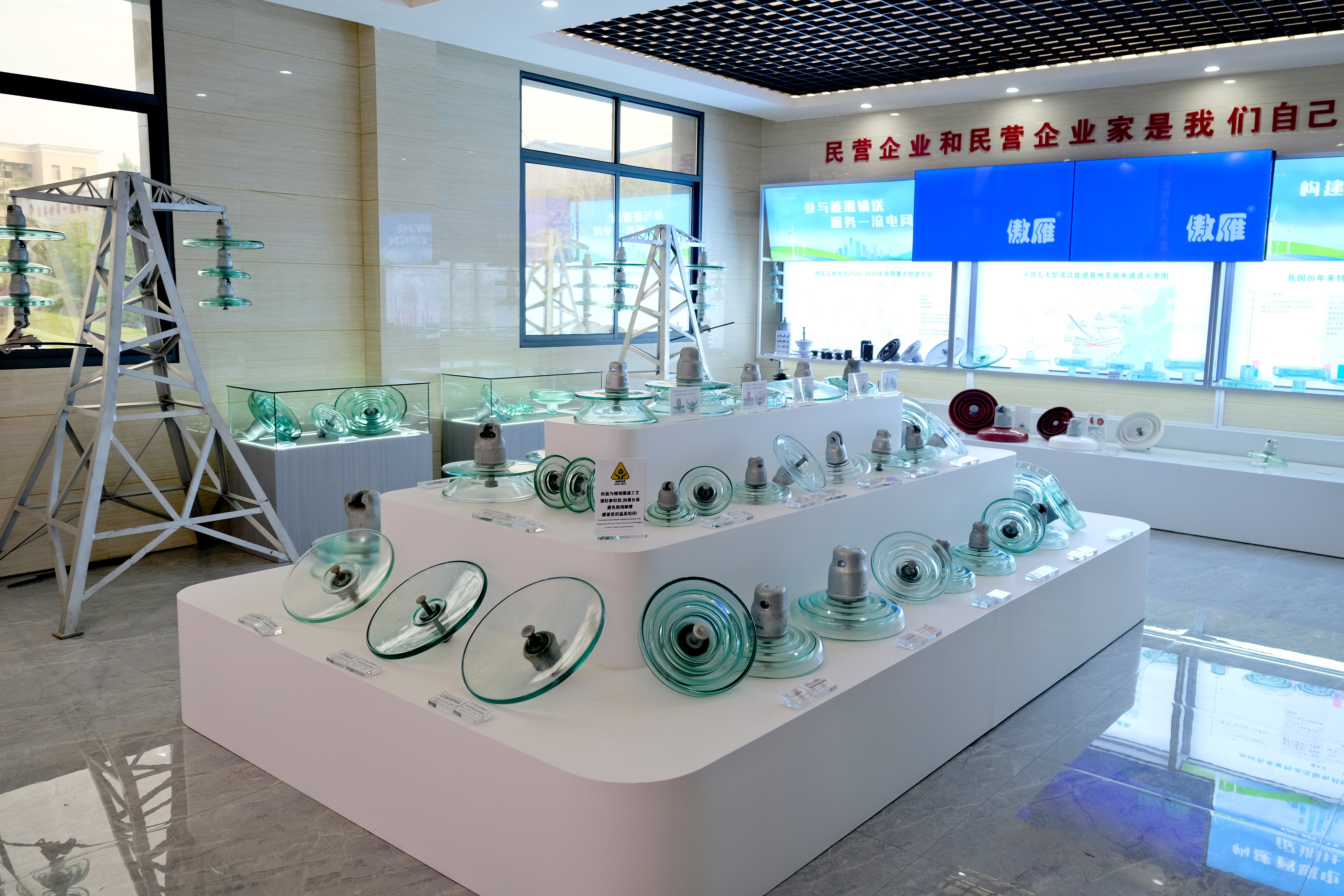
Suspension glass insulators are used in the power transmission and overhead transmission lines industry and are applied in grid construction and electrical engineering. Within that, the supplied application data places them in transmission line construction projects and in grid upgrade and rural electrification projects — the two programme types a distribution extension normally sits between. The supplied scenario data describes this application as common in China and Ukraine and as typically applied in the United States and Uzbekistan, which is useful context when a buyer is comparing reference markets rather than reference products.
The function on the line is threefold: conductor isolation, mechanical load bearing and leakage current blocking. The string carries the conductor's weight and tension, holds it at the required clearance from the structure, and provides a passive dielectric barrier between line potential and earth. There is no active control loop. Operation is continuous and passive, 24 hours a day for the life of the line. That matters for rural extensions in particular, because the economic case for the extension usually assumes low inspection frequency, and a component that needs active management or fails without warning erodes that case.
Fit is also a hardware question. The application data specifies supporting equipment including insulator string fittings, tension clamps and an arcing ring. In practice the final hardware schedule belongs in the project's string drawings, and the insulator purchase should be checked against that schedule rather than the reverse, because clamp and fitting interfaces — not the disc itself — are where retrofit cost appears after delivery.
Reading load class: 70 kN and 120 kN first
For rural distribution extensions the practical starting point in this family is the 70 kN and 120 kN class. Both U70B (70 kN) and U120B (120 kN) are described in the supplied product data as suitable for grid, electrical and rural power projects. Both use a 255 mm nominal disc diameter, a 320 mm creepage distance and a stated working temperature range of −40 °C to 60 °C. The mechanical failing load is the main difference between them, at 70 kN and 120 kN respectively. U120B is listed with a nominal height of 127/146 mm, so its string length for a given number of units depends on the spacing the project adopts, while U70B is listed at 146 mm.
The load class should come from the line design rather than from preference. The required mechanical failing load is set by conductor tension, span, wind and ice loading and the utility's own safety factors; the insulator's rated failing load then has to meet or exceed that requirement under the same stated conditions. Two consequences follow. First, quoting a 120 kN unit where 70 kN was specified does not automatically improve the project — it changes hardware interfaces and may change string length and clearance. Second, a load figure is only usable when it is attached to an exact model and supported by a test record, which is why the acceptance section below treats model designation as a controlled item rather than a label.
Where the line design calls for more, the same family extends upward with documented values. U100BA is listed at 100 kN on a 380 mm disc with 365 mm creepage; U160BM and U160BL are listed at 160 kN on a 280 mm disc with 400 mm creepage, differentiated by nominal spacing of 155 mm and 170 mm; U160BLD is listed at 160 kN on a 340 mm double-shed profile with 550 mm creepage. Stepping up a class is a design decision with mechanical and geometric consequences, not an upgrade that can be applied defensively to a rural package.
Environmental exposure: pollution, salt fog, corrosion and temperature
The supplied application data describes operation under outdoor overhead exposure and heavy pollution conditions, in coastal salt fog, across a wide temperature range of −40 °C to 60 °C, with anti-ageing as a design consideration. A rural extension rarely meets all of those at once, but it usually meets two: long outdoor exposure with infrequent washing, and local pockets of pollution — a cement plant, a quarry, a coastal strip, or agricultural dust that deposits on the underside of the sheds.
Creepage distance is the parameter that changes most across the range. Standard units such as U70B and U120B carry 320 mm. U100BA is listed at 365 mm on a larger 380 mm disc; U160BM and U160BL at 400 mm; and the long-creepage designs U100BLP and U160BLD at 550 mm, with U160BLD built on a 340 mm double-shed profile. A longer creepage distance provides a longer leakage path across the insulator surface, which is the intended countermeasure where surface contamination and moisture combine. The shed profile changes at the same time as the creepage number, so both should be compared rather than creepage alone.
Creepage distance does not by itself determine pollution performance, and the requirement has to come from the project. The utility's pollution-level assessment defines the minimum creepage the line needs; the insulator either meets that figure with a documented value on the drawing or it does not. That is why an apparently generous catalogue creepage is a weak basis for selection, and why comparing a delivered value against the stated requirement is more useful than comparing two suppliers' headline numbers.
Where severe corrosion is expected, the supplied application data adds a specific requirement: a zinc sleeve to slow rusting and extend the service life of the insulator string. That is a specification-stage line item, not something to discover during maintenance. Temperature belongs in the same conversation: the stated range of −40 °C to 60 °C covers the operating envelope given for the standard models, and any extension outside it should be confirmed in writing rather than assumed.
Specification table: what the supplied data confirms
The table below consolidates the values given for the models most relevant to an extension package, from 70 kN standard units through long-creepage and higher-strength designs. Blank cells indicate that the supplied product data for that model does not state the value; they are not a statement that the property is absent or unavailable. Every value should be re-confirmed on the supplier's controlled drawing before purchase, because the drawing — not this table — is the document that governs inspection.
| Model | Failing load | Disc Ø | Nominal spacing | Creepage | Socket coupling | Dry LIWV | Wet PFWV |
|---|---|---|---|---|---|---|---|
| U70B | 70 kN | 255 mm | 146 mm | 320 mm | 130 kV | 45 kV | |
| U120B | 120 kN | 255 mm | 127/146 mm | 320 mm | 130 kV | 45 kV | |
| U100BA | 100 kN | 380 mm | 146 mm | 365 mm | 16 | 90 kV | 45 kV |
| U100BLP | 100 kN | 320 mm | 146 mm | 550 mm | 16 | 140 kV | 55 kV |
| U160BM | 160 kN | 280 mm | 155 mm | 400 mm | 20 | 110 kV | 45 kV |
| U160BL | 160 kN | 280 mm | 170 mm | 400 mm | 20 | 110 kV | 45 kV |
| U160BLD | 160 kN | 340 mm | 170 mm | 550 mm | 20 | 130 kV | 50 kV |
Values are those stated in the supplied product data for each model. Failing load is the rated mechanical failing load. Electrical values are the listed dry lightning impulse withstand and wet power frequency withstand voltages. Model-specific values are not transferable between models.
Purchasing terms to clarify before the RFQ closes
The commercial terms that most often change a rural extension order are not the price per unit. They are the minimum order quantity against a small package, the lead time against the stringing schedule, whether customization touches the drawing, and how inspection is witnessed. Jiangxi QOCI Electric Co., Ltd. — established in 2002 and reporting annual output of 9,000,000 units — publishes the following terms for this product family, and each one should be converted into a written commitment rather than left as a catalogue statement.
Minimum order quantity. The stated MOQ is 50 units. For a full extension package this is rarely binding, but it matters in three situations that rural projects generate constantly: a pilot string before the main release, a replacement batch after storm damage, and a spares holding sized to one string rather than to a project. Buyers should confirm whether the MOQ applies per model, per order or per shipment, because a mixed package of standard and long-creepage units can otherwise trigger separate minimums.
Lead time and capacity. The stated lead time is 15–35 days, against a stated monthly capacity of 750,000 units. The range is wide enough to matter to a construction schedule, so the useful question is not the quoted range but the committed date for the specific batch, including any third-party inspection window. A project built in phases should also confirm whether partial shipments are acceptable and how each batch is identified.
Customization and OEM/ODM. The supplier lists OEM and ODM production with customization of voltage and logo. Buyers should establish in writing which of those changes alter the technical drawing and which alter only marking, because a marking change should not restart type testing while a voltage-related change certainly would. This is also the point at which the exact model designation is frozen.
Quality control and after-sales. The stated controls are 100% pre-shipment testing and third-party inspection, identified as SGS. After-sales support is described as online technical support and replacement for defective products. Neither statement defines a claim route, so the buyer should ask how a nonconformity is raised, what evidence is required, what the replacement covers and what the response time is.
Terms the catalogue does not fix. Several commercial items are not specified in the supplied terms and should be settled before confirmation: the Incoterm and port of loading, packing suitable for the site's handling equipment, the documentation set released with each batch, warranty duration, price validity, and how spares are ordered after the project closes. None of these can be assumed from a product page, and all of them are cheaper to negotiate before award than after.
Acceptance criteria to fix before order confirmation
Acceptance criteria convert a purchase into an inspectable obligation. For a rural extension, six items are worth freezing in writing before the order is confirmed. They are deliberately document-based, because a distribution package rarely justifies witnessed type testing on its own, while a missing drawing or test record routinely causes disputes at delivery.
1. Freeze the drawing and model designation
The controlled drawing should state the exact model, nominal disc diameter, nominal spacing, creepage distance, mechanical failing load and electrical withstand values. U70B and U120B share a 255 mm disc and 320 mm creepage but not the same failing load; U160BM and U160BL share 160 kN, a 280 mm disc and 400 mm creepage but differ in nominal spacing at 155 mm and 170 mm. Those distinctions only survive procurement if the drawing carries them.
2. Confirm coupling compatibility
Socket coupling is listed as 16 or 20 depending on the model, and the coupling interface is what connects the insulator to the rest of the string. An authoritative utility technical specification reviewed for this brief requires ball-and-socket coupling dimensions to follow IEC 60120; that reference defines the interface, and it does not by itself certify any particular product. Buyers should match the coupling designation against existing hardware stock and the string drawing, and record the result.
3. Fix the materials and coating specification
The supplied material specification is tempered glass for the body, hot-dip galvanized cast iron for the cap, and hot-dip galvanized forged steel for the pin. Industry technical documents from other manufacturers describe comparable assemblies in which cap galvanizing, the forged steel ball connection and the stainless-steel locking pin are treated as quality checkpoints. Those documents are useful for structuring an inspection conversation, but they describe another maker's construction and cannot be substituted for the supplier's own drawing and coating record.
4. Agree the test and inspection documents
At minimum, the acceptance package should define which routine test records accompany each batch, which sample or type test reports are supplied once, and how third-party inspection is triggered and reported. The stated 100% pre-shipment test and third-party inspection are the supplier's controls; the buyer's acceptance criteria decide what evidence of those controls is delivered. Where a project references IEC 60305, the international standard for insulators for overhead lines, the reference should be tied to a specific report rather than cited as a general capability.
5. Require full visual inspection records
Tempered glass has a property that is genuinely useful at acceptance: a damaged unit typically breaks at the point of damage rather than degrading silently, which is why the supplier's project record describes 100% visual defect detection without live-line testing. For the buyer, that supports a practical criterion — every unit inspected before packing, with the inspection recorded — while still leaving the delivered batch subject to receiving inspection on site.
6. Control batch identity and packing
Phased construction means a string may be assembled from units delivered months apart. Specifying batch marking on the packing and on the accompanying documents, and requiring one batch per string where practical, gives the utility a traceable link between a delivered unit and its test record. Packing should also be matched to site handling, since a rural store with limited lifting equipment can damage units that survived the factory inspection.
Adjacent project evidence and its limits
Jiangxi QOCI Electric reports a supplied reference covering 200,000 pieces across three markets — 80,000 pieces in Uzbekistan, 70,000 in Ukraine and 50,000 in Iraq — for UHV and EHV overhead transmission line insulation in desert and industrial pollution zones, with reported outcomes including zero line-tripping incidents and an 85% reduction in pollution flashover incidents against a porcelain baseline. That record is relevant to a rural extension only within its own scope: it demonstrates documented performance in severe pollution and wide-temperature environments on transmission-class projects. It does not establish performance on distribution-class extensions, and it should not be presented to a utility as equivalent experience.
Industry context: supply base and standards
Two external data points frame the sourcing environment. China accounted for 31.4% of total global exports of electrical insulators in 2024, valued at USD 898 million, according to a third-party verification review published in November 2026 — a concentration that explains why Chinese suppliers appear on most shortlists but says nothing about any individual factory. Separately, commercial research published in November 2026 estimated the global glass insulators market at USD 1.14 billion in 2024 with a projection of USD 1.97 billion by 2035; that is a supplier-independent forecast with its own assumptions, useful for framing a programme, not for justifying a specification.
On the standards side, IEC 60305:2021 is the primary international standard for insulators for overhead lines, and IEC 60120 governs ball-and-socket coupling dimensions where a utility specification invokes it. Both are references a buyer can build acceptance criteria around. Neither substitutes for a test report, which is why the acceptance section above ties each reference to a document rather than to a claim.
A pre-order checklist
- Line design released: required mechanical failing load, string configuration and clearance confirmed before model selection.
- Pollution requirement stated: minimum creepage taken from the utility's own assessment, then compared against the drawing value.
- Environment mapped: salt fog, corrosive service, dust and temperature range recorded, with the zinc sleeve decision taken explicitly where severe corrosion applies.
- Hardware matched: coupling designation, tension clamps, arcing ring and string fittings checked against the string drawing.
- Commercial terms written: MOQ basis, committed batch dates within the 15–35 day range, Incoterm, packing, warranty and spares route confirmed.
- Acceptance package agreed: frozen drawing, test and inspection documents, visual inspection record and batch marking defined before signature.
Outlook
For rural extension programmes the specification question is likely to stay conservative: standard 70 kN and 120 kN units will continue to carry most of the volume, with long-creepage variants reserved for the polluted sections of the same route. The pressure point is documentation rather than product capability. As utilities tighten handover requirements, the supplier that can produce a controlled drawing, a batch-linked test record and a consistent visual inspection log for a 50-unit order as readily as for a 50,000-unit one becomes the lower-risk choice — and that is a test any buyer can apply before the first purchase order, not after the first failure.
A catalogue covering the glass insulator range is available for reference and download: QOCI Glass Insulator Catalogue (PDF).
FAQ
Which rural distribution projects suit suspension glass insulators?
They suit overhead transmission and distribution construction where the line must isolate the conductor, carry mechanical load and block leakage current continuously without active management. The supplied application data places them in transmission line construction, grid upgrade and rural electrification projects, operating outdoors under pollution, salt fog and a −40 °C to 60 °C temperature range.
Should a rural extension specify 70 kN or 120 kN?
The line design decides. U70B is rated 70 kN and U120B 120 kN; both use a 255 mm disc and 320 mm creepage, and both are described as suitable for rural power projects. The required failing load comes from conductor tension, span, wind and ice loading plus the utility's safety factors, and the selected unit must meet or exceed that figure under the same stated conditions.
What hardware has to be ordered with the insulators?
The supplied application data lists insulator string fittings, tension clamps and an arcing ring as supporting equipment. The final hardware schedule belongs in the project's string drawings, and the insulator coupling designation — 16 or 20 depending on the model — should be checked against that schedule and against existing stock before the order is placed.
Which documents should be fixed before order confirmation?
At minimum: the controlled drawing with the exact model, dimensions, creepage and electrical values; the coupling designation; the materials and coating specification; the routine and sample test records delivered with each batch; the third-party inspection arrangement; the visual inspection record; and the batch marking applied to packing and documents.
Does pollution level change the model I need?
It can change the creepage and shed profile required. Standard U70B and U120B are listed at 320 mm creepage, U160BM and U160BL at 400 mm, and long-creepage designs such as U100BLP and U160BLD at 550 mm on different disc profiles. The required minimum comes from the utility's pollution assessment, and the delivered value should be verified on the drawing rather than taken from a catalogue headline.
Есть вопросы или нужны дополнительные детали?
Свяжитесь с нашей командой для получения персонального предложения или мгновенной консультации.
Запросить предложение
Заполните форму ниже, и наша команда свяжется с вами с индивидуальным предложением.
Прямой чат WhatsApp
Предпочитаете общаться в реальном времени? Напишите нам в WhatsApp для мгновенной помощи и быстрых ответов.
- Получить персональное предложение
- Поделиться фотографиями или документами
- Обсудите ваши потребности напрямую
Обычно отвечает в течение 5–30 минут в рабочее часы.