
SA05-6, 1DY-E3 and 150SN-G2: Three DC Motors Compared for Smart Manufacturing
Smart manufacturing is defined by NIST as fully integrated, collaborative manufacturing systems that respond in real time to changing demands and conditions in the factory, in the supply network and in customer needs. That definition places unusual weight on a component most procurement teams still treat as a commodity: the drive motor. When a hospital transport bed, an automated guided cart or a mobile cleaning unit has to react in real time, the DC motor's torque, speed and braking behaviour decide whether the machine can actually do so.
This article compares three DC motor models published by Wuxi Speedup Power Co.,Ltd, a DC motor manufacturer based in Wuxi, Jiangsu, China, founded in 2018, producing pancake (printed armature) motors, BLDC motors and wheel hub motors for industrial, medical and mobility equipment, with a reported export share of about 90% concentrated on EU and US markets. The three models are the 6.5-inch SA05-6 brushless geared wheel hub motor, the 8-inch 1DY-E3 brushed geared wheel hub motor and the 150SN-G2 pancake motor with gearbox.
The comparison is specification-based. No model is ranked, and no bench-test result is claimed, because none was published in the material reviewed. What follows is what a buyer can legitimately conclude from the published data, and where that data runs out.
Why a hub motor and a pancake motor end up in the same evaluation
These three products are not the same class of component. Two are motor wheels: a wheel hub motor integrates the motor, a reduction gear and a solid tyre into one unit that mounts directly on the machine's axle position. The third, 150SN-G2, is a body-mounted pancake motor with a gearbox and a shaft output, so it drives something else rather than acting as the wheel itself.
Buyers still compare them for practical reasons. In an open machine architecture, the engineering team is deciding whether motion should be wheel-integrated (fewer parts, shorter drivetrain) or shaft-driven (motor located away from the wheel, load path handled by separate mechanics). In a retrofit, the team is testing whether replacing a conventional motor-reducer-wheel stack with an integrated hub unit removes components without losing torque. Both conversations come down to the same five variables: torque, speed, form factor, brake requirement and maintenance exposure.
The three models side by side
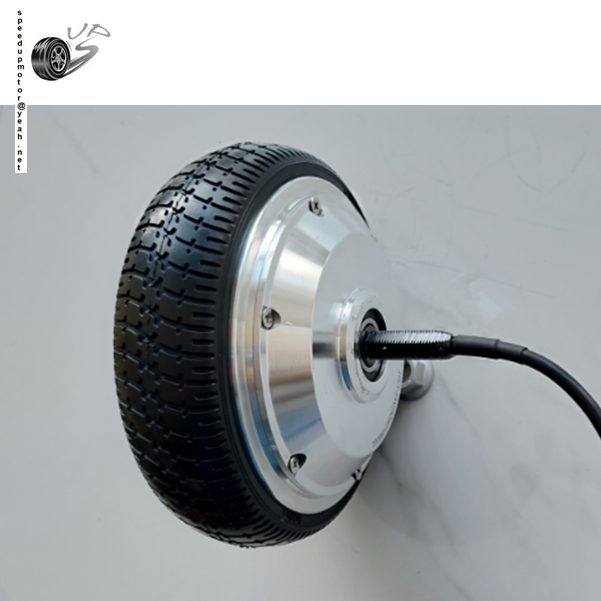
An integrated hub motor is designed for use as a compact drive power wheel in assistive and medical equipment. Image: Wuxi Speedup Power Co.,Ltd.
| Attribute | SA05-6 (6.5-inch hub) | 1DY-E3 (8-inch hub) | 150SN-G2 (pancake + gearbox) |
|---|---|---|---|
| Motor type | Brushless (BLDC) geared wheel hub motor, solid tyre | Brushed DC geared wheel hub motor, single axis, solid tyre | Printed-armature pancake motor with gearbox, shaft output |
| Rated voltage | 24V (family listed 24V/36V/48V) | 24V (also available in 36V/48V) | 36V |
| Rated power | 200W | 180W per specification block | 500W |
| Rated speed | 150 rpm | 95 rpm | 240 rpm |
| Rated torque | 15 Nm | 20 Nm | 22 Nm |
| Reduction | 1:4.5 | 1:20 | Gearbox fitted; ratio not stated in reviewed data |
| Wheel / body diameter | 170 mm solid tyre | 210 mm solid tyre | 151 mm body |
| Brake | Electronic brake (EABS) | Electromagnetic brake | Not stated in reviewed data |
| Load indication | 80–300 kg | 80–300 kg | Not stated |
| Net weight | 3.5 kg | 5.5 kg | Not stated |
| Ingress protection | IP54 | Not stated | Not stated |
| Customisation stated | Voltage, shaft/axis length, performance profile, OEM configuration | Voltage, shaft/axis length, performance profile, OEM configuration | Axis length, custom-made configurations |
| Compliance in scope | CE (EMC), RoHS | CE (EMC), RoHS | CE (EMC), RoHS |
Specifications as published in the supplier's product data for SA05-6, 1DY-E3 and 150SN-G2. Gaps are shown as stated, not estimated.
Torque, speed and gearing: reading the numbers correctly
The headline torques are close — 15 Nm, 20 Nm and 22 Nm — but they are produced at very different speeds and through very different reductions, which changes what each motor does to a machine.
SA05-6 uses a 1:4.5 reduction. That keeps wheel speed high relative to motor speed and keeps gearing losses and gearbox size modest, which is consistent with a 3.5 kg unit at 150 rpm. The trade-off is the lowest torque of the three, so gradeability, threshold climbing and start-up under load all need checking against the machine's actual duty cycle rather than against a nominal figure.
1DY-E3 uses a 1:20 reduction from a brushed printed-armature platform. That deeper gearing is why a nominal 180W motor produces 20 Nm at only 95 rpm. Low speed with high torque is the profile that hospital transport beds and medical chairs typically need, where the drive should move a loaded frame gently and hold position rather than accelerate quickly.
150SN-G2 reaches 22 Nm at 240 rpm from a 36V, 500W platform through a gearbox. That combination — highest torque and highest output speed — means it delivers noticeably more mechanical power than the two wheel motors. Where the wheel units drive a wheel directly, this one drives a rotating tool or a secondary transmission.
A quick arithmetic sanity check buyers can run
Multiplying rated torque by rated angular speed gives approximately 236W for SA05-6, 199W for 1DY-E3 and 553W for 150SN-G2 — within roughly 10–18% of the 200W, 180W and 500W nameplate figures. That is a normal tolerance band and it is a useful acceptance test: if a supplier's torque, speed and power triple does not reconcile within a similar band, the datasheet needs clarification before a purchase order is raised.
For the two wheel motors, wheel speed can be converted to travel speed. A 170 mm tyre at 150 rpm gives a circumference of about 534 mm and a ground speed near 1.3 m/s; a 210 mm tyre at 95 rpm gives about 660 mm and near 1.0 m/s. For a mobile unit sharing a floor with people, that difference is operationally meaningful and should be checked against the site's speed policy.
Form factor: wheel envelope versus shaft output
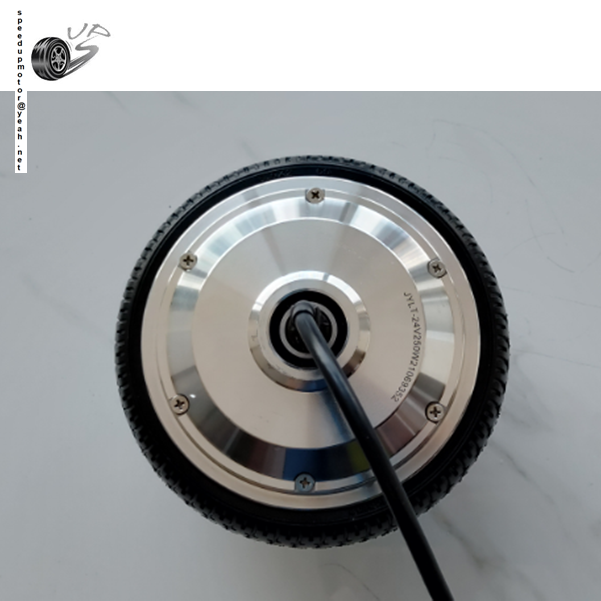
The SA05-6 integrates motor, 1:4.5 reduction and a 170 mm solid tyre into a single 3.5 kg motor wheel. Image: Wuxi Speedup Power Co.,Ltd.
SA05-6 and 1DY-E3 are installed as wheels. That removes the belt, chain, separate reducer and bearing housing that a conventional motor-reducer-wheel stack requires, and it shortens the drivetrain to a single mounted unit with a custom shaft interface. The cost is that the motor inherits the wheel's environment: floor contact, kerb impacts, cleaning chemicals and splash.
Only SA05-6 carries a stated IP54 rating. For equipment washed down or used in humid indoor environments, that is the only one of the three where ingress protection is documented in the reviewed data — a point worth confirming in writing for the other two, since condensation protection and EMI grounding are listed as special requirements for both medical and mobility applications in the supplier's scenario data.
150SN-G2's 151 mm body and shaft output make it a body-mounted component. It suits machines where the rotating element is not the wheel: brush and roller drives, turntables, or applications where the motor sits inside a housing and the transmission is designed separately. It should not be read as a drop-in replacement for a hub motor, because installation, sealing and load path are all handled differently.
Braking: what is stated, and what is not
SA05-6 is specified with an electronic brake (EABS). 1DY-E3 is specified with an electromagnetic brake, and its published features reference a built-in brake with electromagnetic clutch and support for a manual clutch on related geared hub platforms. 150SN-G2's reviewed specification does not state a brake.
For smart manufacturing equipment this is not a detail. A motor wheel on a slope-adjacent surface, a transport bed being pushed by a nurse, or an AGV pausing mid-route all need a defined holding behaviour, and the brake type determines how the controller must be sequenced and how the machine fails safe. Where no brake is specified, the holding function has to be engineered elsewhere in the drivetrain and validated separately. Buyers comparing the three should treat "brake supplied versus brake engineered in-house" as a cost and validation line, not a footnote.
The medical device wheel case: where SA05-6 and 1DY-E3 actually fit
The medical device wheel is the clearest place where these models diverge. SA05-6 is explicitly listed for medical equipment manufacturing, with stated applications including wheelchair assistance, medical chair, AGV and robot. At 170 mm diameter, 3.5 kg and 15 Nm, it addresses the constraint that dominates assistive equipment design: a small wheel envelope that must still move a loaded frame at controlled speed. Its IP54 rating and integrated brake are consistent with a wheel that sits close to the floor and close to the user.
1DY-E3 is listed for medical chair, hospital transport bed, transport chair and transport cart, alongside shopping cart and mobility scooter use. Its 210 mm tyre, 20 Nm and 95 rpm suit a heavier frame that has to be started and stopped gently, and its printed armature and rare-earth magnet construction are presented as giving a high power-to-volume ratio with high linearity — an attribute that matters when a controller is ramping a bed or chair smoothly rather than driving a vehicle.
150SN-G2 is not positioned as a medical device wheel. Its natural reference point in the supplier's records is rotary brush drive on floor cleaning and drying machines, where compact size, low noise and high output are the stated priorities.
Field evidence behind the medical wheel claim: the supplier's case records describe a medical-equipment manufacturer in Germany, the UK and the US using related hub motor models for assistive drive devices over ten years and roughly 100,000 units, with the stated requirement being low speed, high torque and a small wheel size. A separate record describes a Czech medical bed manufacturer using related models for medical bed wheel drive for more than ten years, and a wheelchair manufacturer in the Netherlands, Germany, Australia, Denmark and the US using related models for electric wheelchair wheels with an emphasis on built-in electromagnetic braking and low-speed commutation behaviour. These are supplier-reported records, not independently audited results.
Maintenance and duty cycle: the brushed-versus-brushless line
The most consequential long-term difference among these three is not on the datasheet. SA05-6 is brushless; 1DY-E3 and the 150SN-G2 pancake platform are brushed, using a printed armature. Brushed motors generally carry a wear item in the brushes and commutator that has to be accounted for in a service plan, while brushless designs generally move that maintenance burden toward the controller and bearings. Neither is universally better: brushed pancake motors are widely used where high power density in a thin envelope and simple drive electronics matter more than brush life.
The geared platforms add a second consideration. A 1:20 or 1:4.5 gearbox, and the gearbox on 150SN-G2, introduce lubrication, sealing and gear-wear items that a direct-drive arrangement does not have. For equipment specified for 24/7 operation — as listed for both the medical equipment and electric scooter scenarios in the supplier's data — the maintenance plan should state which of these items is serviceable in the field and which requires unit replacement.
Compliance and acceptance criteria
All three models appear as applicable products under two numbered certificates issued by UDEM Uluslararasi Belgelendirme Denetim Egitim Merkezi San. ve Tic. A.S.:
CE — Electromagnetic Compatibility. Certificate M.2026.206.C138410, scope DC Motor, issued under Directive 2014/30/EU, referencing EN IEC 61000-3-2:2019/A2:2024, EN IEC 61000-3-3:2013/A2:2021, EN IEC 61000-6-1:2019 and EN IEC 61000-6-8:2020. Issue date 2026-04-14, expiry 2031-04-13, EU market.
CE — RoHS. Certificate M.2025.206.C130289, scope DC Motor, issued under Directive 2011/65/EU RoHS and EN IEC 63000:2018. Issue date 2025-11-26, expiry 2030-11-25, EU market.
What this proves is component-level conformity for EMC and hazardous-substance restriction. What it does not prove is conformity of the finished machine. A mobility device or a medical bed is assessed as a system, and the integrator owns that assessment. Buyers should also note that UL and ISO 9001 are referenced in the company profile, but no numbered certificates for those were included in the material reviewed here, so they should be requested as documents rather than accepted as claims.
Acceptance criteria a buyer can apply to any of the three
- Reconcile the torque, speed and power triple arithmetically; request clarification where they diverge by more than a normal tolerance band.
- Confirm the nameplate rated power against the datasheet, not the product listing headline — the 1DY-E3 page, for example, carries a 24V/200W headline alongside a 180W specification entry, and only the datasheet value should be treated as contractual.
- Require the brake type, holding behaviour and controller sequencing to be stated in writing.
- Require an IP rating on the drawing where the unit sits near the floor or in washdown areas.
- Require the shaft drawing, tolerance and material to be approved before tooling.
- Request certificate numbers with issue and expiry dates, and confirm the model is named in scope.
- Run a sample on the machine's real duty cycle before committing to a production batch.
Purchasing terms and customisation
The commercial framework published for these products is consistent across the range: OEM/ODM production, customisation of voltage, power, speed, torque, shaft and logo, a stated minimum order quantity of 1 unit, a lead time of 30–45 working days and 100% testing. For engineering teams, the low MOQ matters more than it appears: it allows a single custom-voltage or custom-shaft sample to be built and validated before a production commitment, which is exactly the gate this kind of comparison should feed into.
Customisation depth differs by model in a way that buyers should plan around. Both wheel motors list adjustable operating voltage, custom shaft/axis sizes and profiles, tailored performance profiles and special OEM configurations, with 36V and 48V variants explicitly available alongside the 24V ratings. 150SN-G2 lists a custom axis length and custom-made configurations. Notably, the 36V rating of 150SN-G2 is a project constraint: a machine built on a 24V bus cannot adopt it without changing the electrical architecture, whereas the two wheel motors can be specified in a 24V variant.
Where this comparison stops
The honest boundary is data depth. SA05-6 and 1DY-E3 are documented down to weight, load range, brake type and, in one case, IP rating. 150SN-G2 is documented at 36V, 500W, 240 rpm, 22 Nm and 151 mm, with no published brake, weight, ingress protection or load rating, so it cannot be assessed against the other two on those dimensions at all — not because it performs worse, but because the information is not in scope of the reviewed data.
Second, no efficiency curves, acoustic data, thermal behaviour or life-test results were published for any of the three. Claims about relative efficiency or service life would therefore be speculation. Third, the certificates cover the motor as a component, not the machine. Fourth, supplier-reported case histories indicate long field use but are not audited performance data.
Market context: why the sub-750W band matters
All three models sit in the sub-750W power band, which is where most compact industrial and medical drives live. Grand View Research estimates the global brushless DC motor market at USD 23.6 billion in 2026, rising to USD 38.4 billion by 2033, and reports that motors with output not exceeding 750W accounted for 48.8% of 2025 BLDC market revenue. That share is a useful corrective to the assumption that high-power drives dominate: the volume decisions in smart manufacturing are made in exactly this power class.
On the demand side, commercial estimates for the electric wheelchair market diverge widely — roughly USD 4.3 billion to USD 10.7 billion for 2026 depending on what each research house counts — so segment growth should be treated as directional rather than as a planning number. The same caution applies to broad smart-manufacturing market sizing, where published figures are not consistently defined. For a buyer, the operational conclusion is more reliable than the forecast: equipment that responds in real time needs a drive whose torque, speed, braking and compliance are documented, whichever topology it uses.
Frequently asked questions
What voltage options are available across these three motors?
SA05-6 is rated 24V with the wider family listed as available in 24V, 36V and 48V. 1DY-E3 is rated 24V and can also be supplied in 36V or 48V. 150SN-G2 is rated 36V. Voltage is a stated customisation field for the range, so alternative operating voltages can be requested, but the published rating is the baseline for any design calculation.
Which of the three includes a brake as part of the specification?
SA05-6 is specified with an electronic brake (EABS) and 1DY-E3 with an electromagnetic brake. The reviewed specification for 150SN-G2 does not state a brake, so any holding or fail-safe function must be engineered into the drivetrain and validated separately for that model.
Are these models covered by CE and RoHS certification?
Yes, as component-level certificates. All three appear as applicable products under CE-EMC certificate M.2026.206.C138410 issued under Directive 2014/30/EU (issued 2026-04-14, valid to 2031-04-13) and RoHS certificate M.2025.206.C130289 issued under Directive 2011/65/EU and EN IEC 63000:2018 (issued 2025-11-26, valid to 2030-11-25), both issued by UDEM for the EU market. Conformity of the finished machine remains the equipment manufacturer's responsibility.
What are the stated purchasing terms?
OEM/ODM production with customisation of voltage, power, speed, torque, shaft and logo; a stated minimum order quantity of 1 unit; a lead time of 30–45 working days; and 100% testing.
Can shaft length and voltage be customised for a medical device wheel design?
Both wheel motors list custom shaft/axis sizes and profiles plus adjustable operating voltage, and 150SN-G2 lists a custom axis length. For a medical device wheel, the shaft interface, brake behaviour and ingress protection should be confirmed on an approved drawing before a sample is built, because only SA05-6 documents an IP54 rating among the three reviewed here.
Is SA05-6 the right choice for every medical device wheel application?
No single model covers every case. SA05-6 offers the smallest envelope at 170 mm and 3.5 kg with a 15 Nm rating, which suits compact assistive equipment but is the lowest torque of the three. 1DY-E3 provides 20 Nm at 95 rpm with a 210 mm tyre, which suits heavier frames such as transport beds and medical chairs. The choice follows the machine's load, speed target, brake requirement and available wheel envelope, not a general preference.
How should a buyer verify the rated power before ordering?
Use the datasheet value and check it arithmetically against rated torque and rated speed. Where a product listing and its specification block disagree — as with the 1DY-E3 page, which carries a 24V/200W headline and a 180W specification entry — request written confirmation of the nameplate value and treat that confirmation as the contractual figure.
Company brochure (PDF, public download): Wuxi Speedup Power Co.,Ltd — company profile. Product reference site: upsmotor.com.
Есть вопросы или нужны дополнительные детали?
Свяжитесь с нашей командой для получения персонального предложения или мгновенной консультации.
Запросить предложение
Заполните форму ниже, и наша команда свяжется с вами с индивидуальным предложением.
Прямой чат WhatsApp
Предпочитаете общаться в реальном времени? Напишите нам в WhatsApp для мгновенной помощи и быстрых ответов.
- Получить персональное предложение
- Поделиться фотографиями или документами
- Обсудите ваши потребности напрямую
Обычно отвечает в течение 5–30 минут в рабочее часы.