
SAE4140 vs Carbon Steel Pipe: Fit-Based Buyer Framework
SAE4140 vs Carbon Steel Pipe: Fit-Based Buyer Framework
In oil, gas, water and structural procurement, two pipe families regularly arrive in the same inquiry: SAE4140 alloy seamless pipe and carbon steel pipe in grades such as A106GR.B, ST52 and ST44. Buyers often compare them as if they were direct substitutes on a price-per-ton basis. In practice they do different jobs. SAE4140 is normally purchased to be machined into load-bearing components, while carbon steel pipe is purchased to convey fluids or to carry structural loads. Most sourcing errors begin when those two intents are mixed into one comparison.
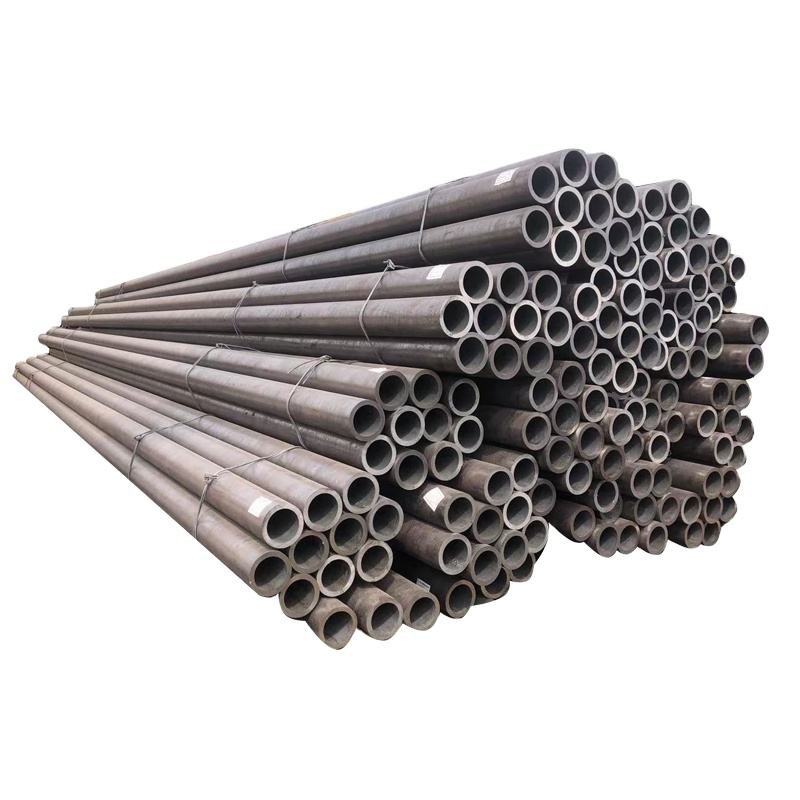
Seamless pipe stock staged for alloy and carbon steel orders across oil, gas, water and structural applications.
Why the Grade Question Is Really an Application Question
A buyer comparing SAE4140 against A106GR.B, ST52 or ST44 is not comparing two products of the same type. SAE4140 is a chromium-molybdenum through-hardening alloy steel, described in supplier technical documentation as a 1% Cr-Mo grade. Carbon steel pipe grades such as A106GR.B, ST52 and ST44 belong to a different family: lower-alloy or plain carbon steels specified primarily for pressure service, fluid conveyance or structural framing.
The practical consequence is straightforward. If the end item is a machined shaft, a coupling, a hydraulic rod or a downhole tool, the specification usually points toward an alloy grade. If the end item is a flowline, a water main or a structural member, the specification usually points toward carbon steel. Treating the two as interchangeable on cost alone tends to create problems later — at machining, at welding, or at the acceptance inspection stage.
What SAE4140 Seamless Pipe Actually Is
SAE4140 is a chromium-molybdenum through-hardening alloy steel supplied as bar, tube and other product forms. Public technical references cite a carbon range of 0.38–0.43% under an ASTM A29 / SAE J404 reference, and an annealed tensile strength of 655 MPa. The grade is valued because it responds predictably to heat treatment, which allows strength, toughness and wear behaviour to be tuned to the component rather than fixed by the mill.
Delivery condition matters as much as the grade name. Supplier documentation describes SAE4140 as available in as-rolled, annealed, normalized and quenched-and-tempered conditions. A buyer who specifies only “SAE4140” without a delivery condition leaves a significant variable open, because annealed stock and quenched-and-tempered stock behave very differently on a machining line and in service.
Typical component applications cited in supplier datasheets include drive shafts, pump shafts, couplings, connecting rods, conveyor pins, bolts, gears, hydraulic and pneumatic cylinder rods, downhole tools and CNC-machined parts. Commercial technical sources also associate the grade with wear resistance, toughness and fatigue resistance in gears, shafts and similar mechanical components. All of these are qualitative application descriptions rather than performance guarantees; actual values depend on heat-treatment parameters, section size and test method.
What Carbon Steel Pipe Does in Oil, Gas, Water and Structural Service
Carbon steel pipe covers a broad working range, and the grade name tells the buyer which job it is meant for. A106GR.B belongs to the pressure and flow category and is generally specified for oil, gas and water service lines. ST52 and ST44 are structural steel categories, generally used for frames, supports, machinery structures and construction work. S355 and E355 sit in the same structural and mechanical family. These are conventional industry uses; the exact grade, wall thickness and test regime still have to match the project specification.
The commercial logic of carbon steel is volume and weldability. Large quantities of flow pipe and structural tube are consumed on typical projects, and the grades are designed around that reality: they are produced in high volume, joined by conventional welding procedures, and accepted against widely used dimensional and pressure standards. What carbon steel does not offer is the through-hardening response that lets a machined part reach high strength after quench and temper.
A Four-Step Buyer Decision Framework
Rather than starting from grade names, the more reliable sequence is to start from the function of the part and work back to the material. The framework below is designed to be applied before an RFQ is issued, not after quotations are compared.
| Step | Question to answer | Decision signal |
|---|---|---|
| 1. Function | Does the part carry mechanical load, or does it contain and move fluid? | Load-bearing and machined → alloy grade. Fluid conveyance → carbon steel. |
| 2. Manufacturing route | Will it be machined, welded, or both? | Heavy machining with heat treatment → SAE4140. Welded fabrication → carbon steel grades. |
| 3. Service condition | Cyclic load, wear, pressure, or atmospheric exposure? | Fatigue, wear and torque → SAE4140. Internal pressure or structural load → carbon steel. |
| 4. Evidence | What will the buyer physically receive to prove the order? | Mill certificate, heat-treatment record, dimensional report and pre-shipment test result. |
Application Fit Map: Where Each Pipe Belongs
The map below translates the framework into end-use categories. It reflects the application categories that appear in supplier technical documentation and in project procurement practice, and it is intended as a screening tool rather than a substitute for the engineering drawing.
| End use | Typical material choice | Reason |
|---|---|---|
| Oil and gas flow lines, water lines | Carbon steel, e.g. A106GR.B | Pressure containment and conveyance in high volume; conventional welding and acceptance routes. |
| Structural frames, supports, construction | Structural carbon steel, e.g. ST52, ST44, S355 | Design codes and fabrication practice are built around these grades. |
| Drill-string and downhole tool components | SAE4140 | Through-hardening response supports high-strength machined parts under cyclic and torsional load. |
| Shafts, gears, couplings, hydraulic rods | SAE4140 | Supplier datasheets consistently list these as machined, wear- and fatigue-related applications. |
| High-strength precision machined parts | SAE4140 | Quenched-and-tempered condition allows strength targets to be set at the mill rather than in-house. |
Adjacent alloy grades such as SAE4130 and SAE4145HMOD appear in the same discussions when a drawing calls for related strength or hardenability levels. Substitution between grades should always be confirmed against the drawing, the applicable standard and the heat-treatment plan rather than assumed from a similar designation.
Supply Conditions, Dimensions and Commercial Terms
Shandong Tuoda Machinery Equipment Co., Ltd (Tuoda Machinery) is a Liaocheng, Shandong-based manufacturer supplying carbon seamless steel tube, round bars and pressure cylinders, with alloy seamless pipe and tube in SAE4140 among its product range. The company serves export markets including the EU, the Middle East, India, Chile, Argentina and Turkey.
For SAE4140 seamless pipe and tube, the stated dimensional range is an outside diameter of 20–400 mm with a wall thickness of 3–30 mm, in round and square shapes. Delivery condition can be specified as hot rolled, cold drawn, cold rolled or quenched and tempered, and customization covers size, length, mechanical property, delivery time and testing inspection. Monthly capacity is stated at 1,000 tons, with a lead time of 30–45 days.
| Term | Stated condition |
|---|---|
| Minimum order quantity | 5 tons, or to be discussed; a separate purchasing note records a one-unit minimum for unit-based supply |
| Payment terms | TT or LC |
| Delivery terms | FOB / CIF / CFR / EXW / DDP |
| Acceptance | Pre-shipment test |
| Quality documentation | Factory laboratory report, or third-party inspection arranged by the buyer |
The pre-shipment test clause deserves attention in the comparison between alloy and carbon steel. On a carbon steel flow-pipe order, the buyer is usually checking dimensions, grade marking and pressure-related documentation. On an SAE4140 order, the buyer is additionally checking that the declared delivery condition was actually produced — because the same outside diameter can arrive annealed or quenched and tempered, and the two will not machine the same way.
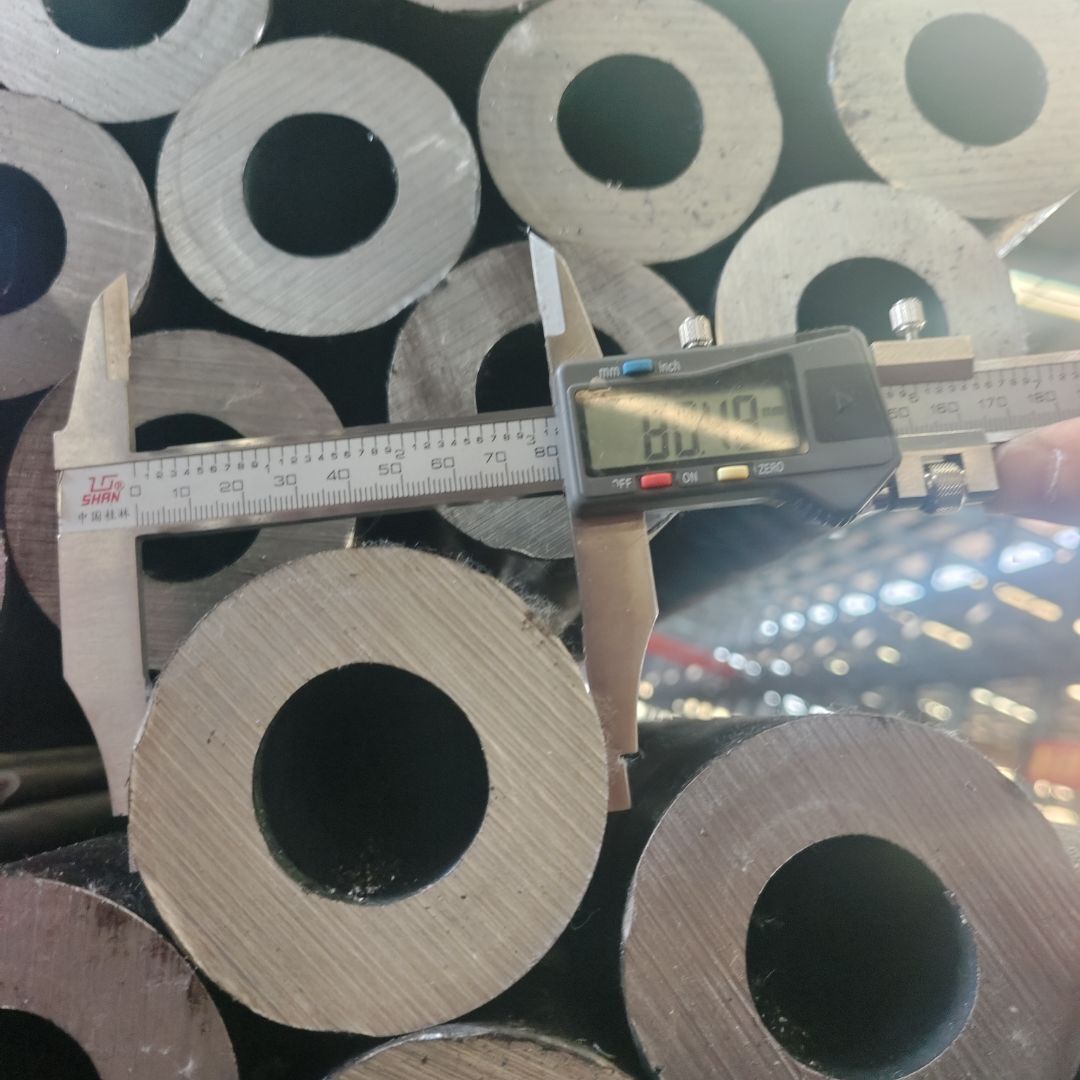
Inspection and documentation before shipment, where delivery condition and dimensional records are confirmed.
Field Evidence: Petroleum Equipment Manufacturing in India and Chile
The strongest argument for a material choice is not a datasheet claim but a record of use. A petroleum equipment factory client has applied this seamless pipe in the production and manufacturing of oil drilling equipment. The project scale was 50 sets, and the installation achieved stable operation over 10 years, with reported characteristics of low loss, high performance and high applicability. Equivalent cases are recorded in India and in Chile.
For a buyer in the evaluation stage, that record is worth reading carefully rather than as a headline. A ten-year operating window is long enough to expose most material-level weaknesses in oil drilling equipment — wear at contact points, fatigue under cyclic load, and dimensional drift. What the case does not establish is a test report for every batch, a specific heat-treatment curve, or a performance figure that can be transferred to a different application. Those still have to be confirmed per order.
Market Context: Why Buyers Are Specifying More Precisely
Steel remains a very large base market. Grand View Research projects the global steel market at USD 1525.8 billion for 2026, a figure that frames the scale of the category but says nothing about any individual grade. No verified SAE4140-specific market size, volume or growth rate was available for this analysis, and readers should treat any grade-level growth figure they encounter with that gap in mind.
Within that broad market, the observable movement is in documentation rather than in demand volume. Procurement teams increasingly ask for the delivery condition, the heat-treatment state and the acceptance test to be written into the purchase order, not left to the mill's default. Trade media profiling in 2026 has listed Tuoda Machinery among Chinese SAE4140 alloy steel manufacturers, which reflects supplier visibility rather than audited capability; buyers should still verify plant, certification and capacity directly.
Where the Alloy Option Stops Being the Right Answer
A comparison that only lists advantages is not useful for procurement. Several boundaries apply to SAE4140, and each of them has practical consequences.
Dimensional ceiling. The stated SAE4140 range is 20–400 mm outside diameter with 3–30 mm wall. A mainline transmission or large-diameter water pipe falls outside that envelope, so carbon steel pipe is not being displaced in those segments — it is simply a different product category.
Machining economics. Quenched-and-tempered alloy stock is harder than mild carbon steel. Tool wear, cutting speed and cycle time all move in the wrong direction, and the machining cost can outweigh the material cost difference on a simple part. Annealed SAE4140 machines more easily but does not carry the final strength on its own.
Weldability. Structural carbon steel grades are designed around fabrication welding. A chromium-molybdenum alloy with a higher carbon level requires qualified welding procedures and appropriate pre- and post-weld practice. Where a project is primarily welded rather than machined, carbon steel remains the conventional and lower-risk specification.
Corrosion is not the differentiator. SAE4140 is selected for strength, toughness and fatigue behaviour, not for corrosion resistance in water service. Water pipe decisions turn on coating, lining and water chemistry, and carbon steel remains the normal starting point there.
Certification scope. Tuoda Machinery holds a CE 3.1 certificate, number 3N230530.STMDO12, issued by ECM on 30 May 2023 and valid to 28 May 2028, with a scope covering EN 10210, EN 10219 and EN 10025 for the EU market. That scope does not name SAE4140. Buyers ordering the alloy grade should therefore request grade-specific mill certification and test documentation, rather than treating the CE scope as blanket coverage.
Unverified property claims. Several commercial sources circulate strength and hardness values for SAE4140 without disclosing test method, specimen size or heat-treatment condition. Until a mill certificate or third-party report is supplied, those figures should be treated as indicative only.
Future Outlook
The direction of travel in alloy pipe procurement is toward specification discipline. Three changes are likely to shape purchase orders over the next few years: delivery condition stated as a mandatory line item rather than an assumption; acceptance evidence agreed before production rather than negotiated at shipment; and a clearer separation between grades that are machined and grades that are welded, so that comparison tables stop mixing them.
For buyers, the practical implication is that supplier selection will be judged increasingly on documentation quality — the ability to produce a consistent certificate package, hold a declared lead time and support third-party inspection — rather than on the grade name alone. Suppliers who can answer those questions in the quotation stage will be easier to keep in a long-term supply chain.
Frequently Asked Questions
1. Is SAE4140 a direct replacement for A106GR.B carbon steel pipe?
No. SAE4140 is a chromium-molybdenum through-hardening alloy steel used mainly for machined, load-bearing components, while A106GR.B is a carbon steel grade generally specified for oil, gas and water flow service. They differ in intended function, joining method and acceptance criteria, so a substitution decision has to be reviewed against the drawing and the applicable standard.
2. In which delivery conditions can SAE4140 pipe be supplied?
Tuoda Machinery states that SAE4140 pipe can be supplied hot rolled, cold drawn, cold rolled or quenched and tempered. Commercial technical sources also describe annealed, normalized and as-rolled conditions as available in the market. The delivery condition should be written into the purchase order, because annealed and quenched-and-tempered stock behave differently in machining and in service.
3. What dimensions and shapes are available for SAE4140 seamless pipe?
The stated range for SAE4140 seamless pipe and tube is an outside diameter of 20–400 mm with a wall thickness of 3–30 mm, supplied in round and square shapes. Customization covers size, length, mechanical property, delivery time and testing inspection. Orders outside that dimensional envelope fall into a different product category rather than a variation of the same one.
4. What are the MOQ, payment and delivery terms?
The stated minimum order quantity is 5 tons or to be discussed, and a separate purchasing note records a one-unit minimum for unit-based supply. Payment terms are TT or LC. Delivery terms cover FOB, CIF, CFR, EXW and DDP. Stated monthly capacity is 1,000 tons, with a lead time of 30–45 days.
5. What acceptance evidence should be agreed before shipment?
The stated acceptance criterion is a pre-shipment test. Quality documentation can be provided as a factory laboratory report, or the buyer can arrange third-party inspection. For SAE4140 orders, the evidence package should also identify the delivery condition and the heat-treatment state, since these cannot be inferred from the grade marking or the outside diameter.
6. Where has this pipe been used in oil and gas applications?
A petroleum equipment factory client has used the product in the production and manufacturing of oil drilling equipment, with 50 sets installed and stable operation recorded over 10 years, reported as low loss, high performance and high applicability. Comparable cases are recorded in India and in Chile. These records describe field experience; they are not a substitute for batch-level test certificates on a new order.
7. Does the CE certificate cover SAE4140?
The CE 3.1 certificate held by Tuoda Machinery, number 3N230530.STMDO12, has a scope covering EN 10210, EN 10219 and EN 10025 for the EU market. SAE4140 is not named in that scope. Buyers ordering the alloy grade should request grade-specific mill certification and test documentation in addition to any general certificate package.
8. How should a buyer compare an SAE4140 quotation with a carbon steel quotation?
The comparison should be made per finished component or per finished metre of installed line, not per ton of raw pipe. Carbon steel carries lower material and machining cost but does not deliver the through-hardening response; SAE4140 carries higher machining cost but allows strength targets to be set by heat treatment. Including fabrication, inspection and expected service life in the same calculation gives a more defensible result.
Reference material: Tuoda Machinery product brochure (PDF) — download. Company site: WWW.SDTDSTEEL.COM.
Есть вопросы или нужны дополнительные детали?
Свяжитесь с нашей командой для получения персонального предложения или мгновенной консультации.
Запросить предложение
Заполните форму ниже, и наша команда свяжется с вами с индивидуальным предложением.
Прямой чат WhatsApp
Предпочитаете общаться в реальном времени? Напишите нам в WhatsApp для мгновенной помощи и быстрых ответов.
- Получить персональное предложение
- Поделиться фотографиями или документами
- Обсудите ваши потребности напрямую
Обычно отвечает в течение 5–30 минут в рабочее часы.