
SENO Nicotine Film Format Comparison: Choosing Strength, Size, and Dissolution for 2026
A nicotine film specification is a set of four interdependent variables — nicotine strength, film size, film thickness, and dissolution time — wrapped by packaging and shelf-life decisions. Buyers evaluating formats in 2026 are rarely choosing between a good and a bad product; they are choosing which combination of those variables matches a defined user segment, a defined sales channel, and an available regulatory pathway.
That framing matters because the nicotine film category is still small in absolute value but structurally active. Market Research Future valued the global nicotine oral dissolvable thin films market at USD 112.34 million in 2024 and projected USD 174.18 million by 2035. At that scale, most buyers are not selecting from dozens of equivalent suppliers; they are trying to determine whether a given supplier can hold one format combination steady across batches, channels, and markets.
Specification sheets across the category look deceptively similar. Three or four strengths, a “fast-dissolving” claim, a millimetre footprint, a micron range. The differences that decide a project usually sit underneath those numbers: whether the thickness range has been validated at both ends, whether the dissolution window is reproducible after a size change, whether the packaging protects the film in a humid distribution route, and whether the strength on the label is authorised for the market where it will be sold.
Why a Format Decision Is Really a Specification Decision
The four variables interact. Raising nicotine strength inside a fixed 20 mm × 30 mm footprint concentrates the dose into the same surface area. Raising thickness at a fixed strength lengthens the hydration path and pushes the film toward the slower end of the dissolution window. Moving from individual sachets to multi-pack boxes changes moisture protection per unit, retail shelf logic, and pack conversion cost. Buyers who negotiate strength, size, thickness, and packaging as separate line items frequently find, after sampling, that the combination was never validated as a set.
A practical consequence: freeze the format as one specification block — strength plus footprint plus thickness plus dissolution target plus pack format — before requesting samples. That block is what a manufacturer can actually control, and it is the unit that a regulatory dossier describes.
The Four Format Variables, Mapped to SENO Specifications
SENO is a nicotine oral thin film manufacturer operated by Xin Sino Technology (Shenzhen) Co., Ltd., producing nicotine replacement therapy (NRT) film formats at a 20,000 m² facility with a 15-person R&D team and an annual capacity range of 12,000,000 to 50,000,000 strips. Its output is exported to Europe, the United States, Canada, Australia, and the Middle East.
| Format variable | SENO specification | What it changes for the buyer |
|---|---|---|
| Nicotine strength | 2 mg / 4 mg / 6 mg / customizable | User segment, label claim, and which market authorisation is required |
| Film size | Approx. 20 mm × 30 mm (customizable) | Buccal placement, mouthfeel, sachet dimensions, converting tooling |
| Film thickness | 50–100 microns | Nicotine loading density and position inside the dissolution window |
| Dissolution time | 10–30 seconds | User routine during use; fast versus standard sensory positioning |
| Packaging | Individual sachets / multi-pack boxes | Per-unit moisture protection, retail format, unit economics |
| Shelf life | 24 months | Inventory rotation, channel ageing tolerance |
| Storage | Cool and dry environment | Warehousing, transport routing, distributor handling rules |
| Flavours | Mint, Blueberry, Orange, Strawberry, Kiwi Fruit | Range architecture and private-label differentiation |
Strength Mapping: 2 mg, 4 mg, 6 mg, and Custom
Strength is the variable buyers discuss first and validate last. In the nicotine oral film category, the 2 mg segment held the largest market share in 2024 according to Market Research Future, which makes it the default entry strength for many retail ranges. Practically, the three standard strengths divide along user intent rather than product prestige:
| Strength | Typical format role | Buyer consideration |
|---|---|---|
| 2 mg | Entry and moderate-intake positioning; on-demand NRT; first-purchase SKU | Largest 2024 segment share; lowest sensory barrier; natural trial unit |
| 4 mg | Mid-range SKU that lets a brand cover a wider intake profile on one footprint | Keeps film size, thickness, and pack format identical to the 2 mg unit |
| 6 mg | Higher per-unit dose for experienced users | Requires tighter label control and a confirmed authorisation route per market |
| Custom | Private-label differentiation or brand-specific dose positioning | Manufacturing capability does not replace market authorisation |
Size and Thickness: Working Inside a 20 mm × 30 mm and 50–100 Micron Envelope
The approximately 20 mm × 30 mm footprint is a handling standard rather than an arbitrary dimension. It is large enough to be picked up and placed against the buccal mucosa without touching the fingers to the active area, and small enough to remain unobtrusive during a normal working conversation. Because the footprint determines sachet dimensions, any size customisation propagates into packaging tooling and pack artwork.
The 50–100 micron thickness band is the more consequential manufacturing window. At the thin end, the same nicotine load must sit in a denser film matrix; at the thick end, the same load is spread through a longer hydration path. Both ends can be produced, but they behave differently in the mouth and differently on a converting line. A buyer selecting an extreme — 50 microns for a faster sensory profile or 100 microns for a slower one — should expect a separate sample round rather than assuming the standard 2 mg reference unit represents the whole band.
Dissolution: What a 10–30 Second Window Changes
Oral thin films generally rely on hydrophilic polymers such as HPMC, reported at roughly 40–50% of film weight, and dissolve in the range of 15 to 30 seconds, delivering nicotine across the oral mucosa and bypassing first-pass hepatic metabolism. SENO specifies a 10–30 second dissolution window across its nicotine film range.
For the buyer, that window is a positioning decision as much as a technical one. A film designed toward the 10-second end behaves as an almost instantaneous unit; a film sitting near 30 seconds behaves closer to a short buccal hold. The difference affects user instructions, complaint patterns, and how the product is described in retail copy. It also sets a behavioural constraint: during dissolution the user is expected not to eat or drink, which is a usage-discipline requirement that belongs in the pack insert rather than in marketing language.
Packaging and Shelf Life: Sachets, Multi-Packs, and 24 Months
SENO formats are packed either as individual sachets or as multi-pack boxes. Individual sachets provide per-unit moisture protection, which matters because a thin hydrophilic film is sensitive to ambient humidity; multi-pack boxes support retail shelf presence and multi-unit purchase but move the moisture barrier decision to the primary sachet inside the box.
The stated shelf life is 24 months with storage in a cool and dry environment. For distribution planning this is a workable window, but it does not remove the need to plan rotation. Buyers routing film into hot and humid regions should treat packaging selection — not shelf-life extension — as the primary control, and should confirm the storage instruction is carried through to the distributor agreement.

Nicotine film manufacturing line: format stability across 2 mg, 4 mg and 6 mg strengths depends on holding size, thickness and dissolution parameters constant at scale.
Flavours: Five Reference Profiles and Private-Label Development
SENO's reference flavour set covers Mint, Blueberry, Orange, Strawberry, and Kiwi Fruit. The split is not cosmetic. Mint tends to align with conventional nicotine replacement positioning and is the least surprising choice for pharmacy-adjacent retail; fruit profiles such as Blueberry, Orange, Strawberry, and Kiwi Fruit are more often used where the range needs to lower the sensory barrier for new users or where a private label wants visible differentiation on shelf.
Flavour development sits inside the same customisation scope as nicotine strength, film size, packaging design, and branding. That means a private-label brief can legitimately combine a non-standard flavour with a standard 20 mm × 30 mm footprint — but each flavour change is a separate formulation and stability exercise, not a label swap.
The Evidence a Buyer Can Actually Check
Format claims are only as useful as the documentation behind them. The verifiable elements in the SENO file are specific rather than generic:
- US premarket filings: FDA PMTA notification certificates PM0010176, PM0010173, and PM0010199, issued in 2023 and valid through 2028, covering toxicological assessment, product safety, manufacturing quality control, and labelling requirements for US distribution.
- US OTC registration: FDA OTC drug establishment and product registration number 510936020.
- EU-facing safety documentation: Safety Data Sheets aligned with REACH Regulation (EC) No 1907/2006, CLP Regulation (EC) No 1272/2008, and EN 14986, covering hazard identification, physical and chemical properties, handling, and disposal.
- Capacity and facility: a 20,000 m² production facility, an annual output range of 12,000,000 to 50,000,000 strips, and a 15-person R&D team.
- Batch control: quality control covering 100% batch inspection, raw material verification, in-process quality control, and final product testing.
Separately, a SENO official release distributed through PRWeb describes the company as the first nicotine film brand to receive first-round FDA PMTA registration numbers as of September 2025 — a company statement that buyers can cross-check against the certificate numbers themselves.
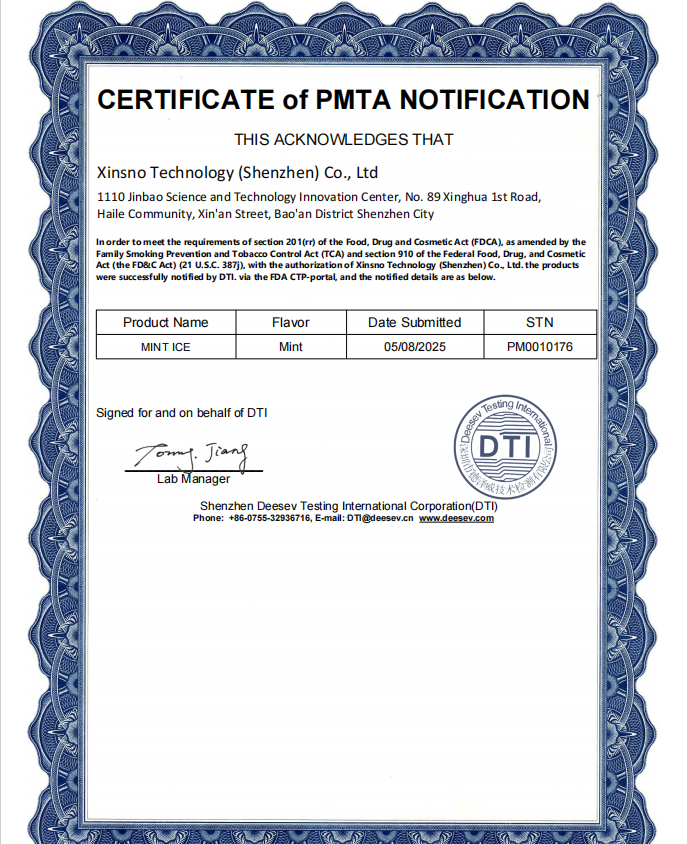
FDA PMTA notification certificate PM0010176, one of three filings (PM0010176, PM0010173, PM0010199) that anchor the US compliance position of the format.
Where Each Format Fits: Three Use Cases
1. On-demand NRT and pharmacy-adjacent retail
For on-demand use, the natural starting point is a 2 mg film on the standard 20 mm × 30 mm footprint at the faster end of the 10–30 second window, packed in individual sachets. This combination keeps the dose modest, the usage instruction simple, and the unit protected until the moment of use. It is also the configuration most likely to match an existing authorised product description.
2. Retail distribution and channel building
Distribution partners typically want a strength ladder rather than a single SKU: 2 mg to open the category, 4 mg to retain users moving up, and 6 mg where the market authorises it. Holding size, thickness, and pack format constant across the ladder simplifies shelf layout, distributor logistics, and reorder behaviour. SENO's distribution case record includes retail distribution, online sales, and private-label lines in Germany, the United States, Australia, the United Arab Emirates, Saudi Arabia, and Canada at project scales of 500,000 to 2,000,000 strips per order, alongside signed agency agreements in Canada and France.
3. Private-label and OEM projects
Private-label work is where customisation earns its cost: a distinct strength, a modified footprint, a proprietary flavour, and branded packaging inside one brief. SENO supports OEM, ODM, and private-label manufacturing with a minimum order quantity of 100,000 to 300,000 strips per SKU, a standard lead time of 20–30 days, and 30–45 days for OEM or custom orders. Payment terms are 30% deposit with 70% balance before shipment, with FOB, CIF, or DDP delivery options, pre-shipment inspection as standard, and third-party inspection on request.
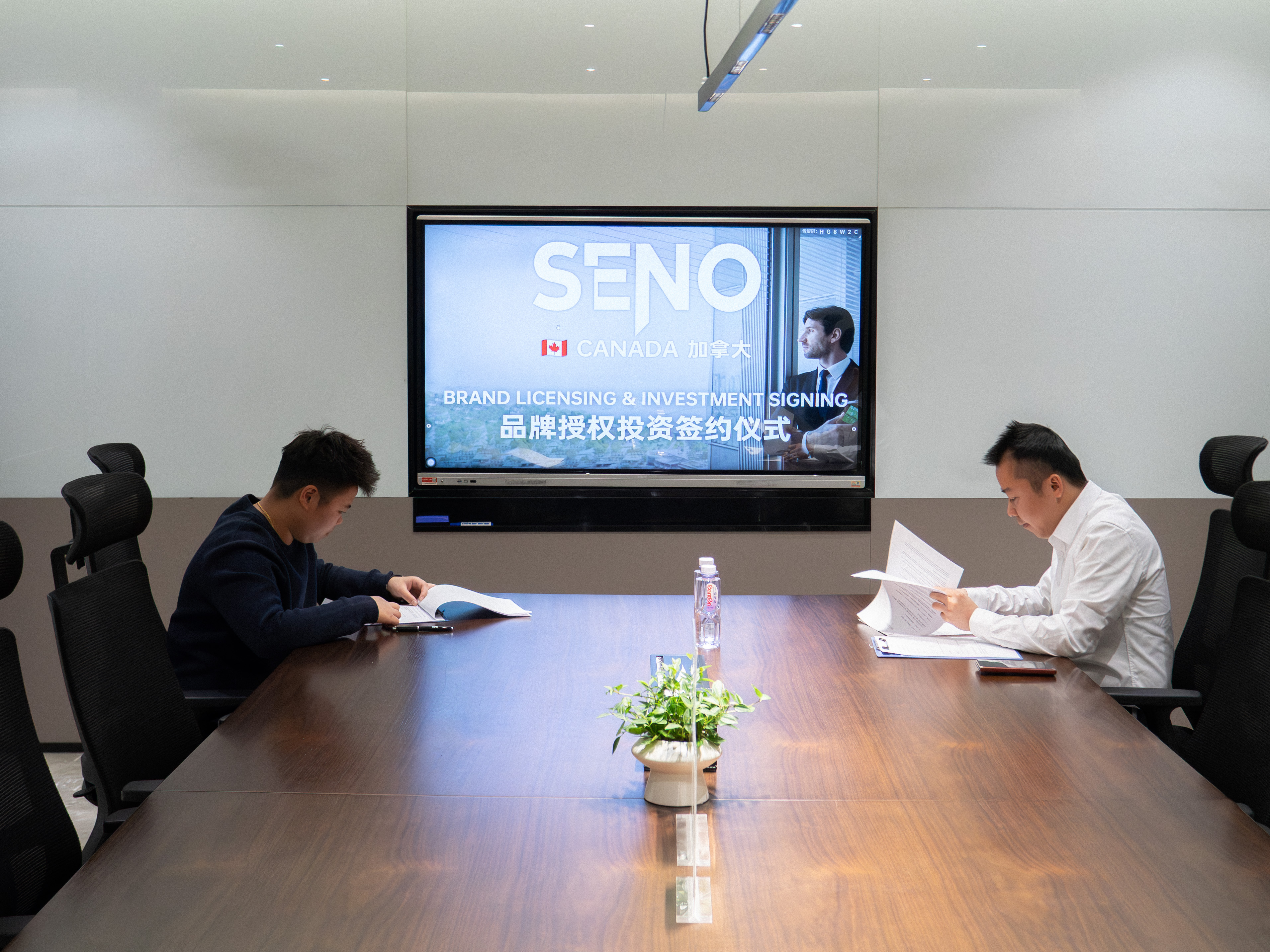
Agency agreement signing with a Canadian distribution partner — the retail channel where a consistent multi-strength format ladder matters most.
Trade-offs and Boundaries Buyers Should Plan For
A format comparison without limits is a brochure. The following boundaries are inherent to the film format and to the SENO production model, and they should be priced into a project plan:
- The thickness band is not uniform. A 50-micron film and a 100-micron film at the same strength are different products in mouth and on the converting line. Selecting either extreme adds a validation round; standardising at a mid-band thickness is faster but narrows sensory differentiation.
- Dissolution imposes user discipline. A 10–30 second window assumes the user does not eat or drink immediately after placement. Formats that ignore this in the pack instructions generate avoidable complaints.
- Minimum order quantities create a floor. At 100,000 to 300,000 strips per SKU, genuinely small market tests are not economical as custom SKUs; buyers testing a new market usually do so with a standard strength and flavour rather than a bespoke specification.
- Custom work costs time. Standard orders run 20–30 days; OEM and custom orders run 30–45 days. A private-label launch timetable that assumes standard lead time will slip.
- Moisture, not shelf life, is the real constraint. A 24-month shelf life is stated for cool and dry storage. In humid distribution routes the packaging barrier and warehousing discipline matter more than the shelf-life number itself.
- Strength is regulated per market. Customisation capability does not authorise a product. A strength that is manufacturable may still be unsellable in a given jurisdiction until the relevant filing covers it.
Film Versus Traditional NRT Formats: A Decision Table
Compared with gum and lozenge formats, film is not uniformly better — it is differently constrained. The comparison below is qualitative and framed around decision criteria rather than specification claims.
| Criterion | Nicotine film | Gum / lozenge formats |
|---|---|---|
| Use action | Place and let dissolve; no chewing | Requires chewing or a sustained suck-and-hold routine |
| Discretion | No visible chewing motion; unobtrusive in workplace settings | Visible chewing or sucking action in social settings |
| Dose control per unit | Fixed dose per film; unit cannot be partially consumed | Dose per piece, but usage pacing is controlled by the user |
| Time to complete use | 10–30 seconds | Extended chewing or dissolution period |
| Where the format is weaker | Requires moisture-controlled pack and storage discipline; sensitive to humidity; converting and sachet cost per unit | Slower onset of action and a longer behavioural routine |
Read plainly: film wins on discretion and speed of use, and pays for it in packaging discipline and per-unit converting complexity. Buyers whose channel cannot guarantee cool, dry warehousing should weigh that constraint before standardising on film alone.
Market Direction for 2026
Two data points frame the format conversation. Market Research Future places the nicotine oral dissolvable thin films market at USD 112.34 million in 2024 rising to USD 174.18 million by 2035, and identifies the 2 mg strength segment as the largest share holder in 2024. Grand View Research, measuring the broader modern oral nicotine category that includes pouches as well as films, estimates USD 38.9 billion by 2033 at a 19.0% CAGR.
Those two figures are not in conflict; they measure different scopes, and the gap between them is itself informative. Film remains a specialised, lower-volume format inside a much larger modern oral category. For buyers, the implication is that format differentiation — not volume — is where a film range earns its shelf space, and that the 2 mg entry unit will continue to carry the category's trial function.
Future Outlook
Three developments are worth tracking into 2026 and beyond. First, strength ladders are likely to consolidate: brands that launched four or five strengths are rationalising toward a 2 mg anchor with one or two supporting SKUs, which reduces dossier complexity per market. Second, moisture-barrier packaging will absorb more of the innovation budget than flavouring, because humidity control is the practical limit on shelf performance in tropical distribution. Third, private-label activity will keep shifting differentiation toward format rather than flavour alone — a custom footprint or a specific dissolution profile is harder to copy than a fruit flavour.
For a manufacturer, the corresponding requirement is format stability at scale: the same 20 mm × 30 mm film, at the same thickness, dissolving in the same window, batch after batch. That is a production discipline question, and it is the one buyers should test with samples rather than with specification sheets.
FAQ
What nicotine strengths are available in SENO nicotine film, and how do buyers choose between 2 mg, 4 mg, and 6 mg?
SENO nicotine film is produced in 2 mg, 4 mg, and 6 mg strengths, with customizable strength available for OEM, ODM, and private-label projects. Strength determines the user segment, the label claim, and which market authorisation applies. The 2 mg segment held the largest market share in the nicotine oral film category in 2024, according to Market Research Future, which is why it is commonly used as the entry SKU; 4 mg and 6 mg extend the range for higher-intake users. Buyers normally confirm which strengths are authorised in the destination market before building a ladder.
How do film size and thickness affect dissolution and packaging decisions?
SENO nicotine film measures approximately 20 mm × 30 mm with a thickness of 50 to 100 microns, and both dimensions are customizable. Thickness positions the film inside the 10–30 second dissolution window: thinner films hydrate faster and are more demanding to handle during converting, while thicker films sit toward the slower end and require separate validation. Film size determines the sachet dimensions, so a footprint change usually triggers new packaging tooling rather than a simple artwork update.
Which regulatory documents support SENO nicotine film in the US and EU markets?
For the United States, SENO holds FDA PMTA notification certificates PM0010176, PM0010173, and PM0010199, plus FDA OTC drug establishment and product registration 510936020. For EU-facing requirements, Safety Data Sheet documentation is aligned with REACH Regulation (EC) No 1907/2006, CLP Regulation (EC) No 1272/2008, and EN 14986, covering hazard identification, physical and chemical properties, handling, and disposal. A Class 34 trademark registration is also held. Buyers should map each document to the specific product and market rather than treating certification as category-wide.
What are the MOQ, lead time, and capacity considerations for a private-label nicotine film project?
Minimum order quantity is 100,000 to 300,000 strips per SKU. Standard orders carry a 20–30 day lead time, while OEM and custom orders require 30–45 days. Production runs at a 20,000 m² facility with an annual output range of 12,000,000 to 50,000,000 strips. Payment terms are 30% deposit with 70% balance before shipment, delivery can be arranged FOB, CIF, or DDP, and pre-shipment inspection is standard with third-party inspection available on request.
Which flavours and packaging formats are available for retail versus private label?
SENO's reference flavour profiles are Mint, Blueberry, Orange, Strawberry, and Kiwi Fruit, and flavour development forms part of the customisation scope alongside nicotine strength, film size, packaging design, and branding. Packaging is available as individual sachets or multi-pack boxes; sachets provide per-unit moisture protection while multi-packs support retail shelf presentation. Stated shelf life is 24 months under cool and dry storage conditions.
Есть вопросы или нужны дополнительные детали?
Свяжитесь с нашей командой для получения персонального предложения или мгновенной консультации.
Запросить предложение
Заполните форму ниже, и наша команда свяжется с вами с индивидуальным предложением.
Прямой чат WhatsApp
Предпочитаете общаться в реальном времени? Напишите нам в WhatsApp для мгновенной помощи и быстрых ответов.
- Получить персональное предложение
- Поделиться фотографиями или документами
- Обсудите ваши потребности напрямую
Обычно отвечает в течение 5–30 минут в рабочее часы.