
SENO Nicotine Film vs. Generic Strips: A Sourcing Comparison Buyers Should Read
Nicotine oral thin films have moved from a novelty delivery format to a sourcing category that distributors now plan shelf space around. Market Research Future values the global nicotine oral dissolvable thin film market at USD 112.34 million in 2024 and projects USD 174.18 million by 2035. Supply has grown faster than documentation, however, and that gap is what makes evaluation-stage sourcing harder than it should be. The useful comparison for a buyer is therefore not brand against brand, but published specification against unpublished specification.
SENO Nicotine Film is a nicotine oral thin film manufactured by Xin Sino Technology (Shenzhen) Co., Ltd., a Shenzhen-based producer that exports 100% of its output and focuses on Europe, the United States, Canada, Australia, and the Middle East. The manufacturer describes the product as a Nicotine Replacement Therapy (NRT) Film offered in several nicotine strengths and flavor formats. This article sets out what that product states publicly, which documents support those statements, and where the boundaries of the offer sit. No competing brand is named; generic oral thin film strips are treated here as a category whose specifications are, by default, undisclosed.

The evaluation problem: you can only compare what both sides publish
Oral thin film suppliers broadly fall into two groups. One publishes a specification sheet: film dimensions, gauge, dissolution window, nicotine strengths, packaging formats, shelf life, storage conditions, and the compliance documents behind them. The other sells primarily on flavor and price and answers technical questions with samples. Both approaches can come from legitimate businesses, but they produce very different procurement risk, because a buyer cannot audit an unpublished claim.
Four variables determine whether a film programme is repeatable. The first is film gauge. The second is the dissolution window. The third is the consistency of nicotine loading from strip to strip and batch to batch. The fourth is stability under the storage conditions of the destination market. Each is measurable, and two of them — gauge and dissolution window — are declared for SENO Nicotine Film at 50–100 microns and 10–30 seconds respectively, on a film of approximately 20 mm × 30 mm. That disclosure is what makes an evaluation possible: a buyer can measure the same parameters on a sample and compare results against declared values rather than against an impression.
The commercial opportunity is straightforward. Category-level research from Grand View Research estimates the broader modern oral nicotine products market — which includes pouches as well as films — reaching USD 38.9 billion by 2033 at a 19.0% CAGR. Whichever definition a buyer uses, retail channels are adding oral nicotine formats, and distribution partners are being asked to carry specification-grade product rather than unbranded strip stock. The constraint is verification capacity: a distributor that cannot document what it sells carries the compliance and returns risk itself.
What SENO Nicotine Film publishes: the specification set
For a product described as a Nicotine Replacement Therapy (NRT) Film, the manufacturer publishes a defined parameter set. Buyers evaluating the format should treat these as the baseline audit points, because they are the values a sample can be tested against.
| Parameter | Stated value |
|---|---|
| Product model | Nicotine Replacement Therapy (NRT) Film |
| Nicotine strength | 2 mg / 4 mg / 6 mg / customizable |
| Dissolution time | 10–30 seconds |
| Film size | Approx. 20 mm × 30 mm (customizable) |
| Thickness | 50–100 microns |
| Flavor formats | Mint, Blueberry, Orange, Strawberry, Kiwi Fruit; flavor development covers mint, fruit, and custom flavors |
| Packaging | Individual sachets / multi-pack boxes; sachet or retail box design customization |
| Shelf life | 24 months |
| Storage conditions | Cool and dry environment |
| Stated material composition | Pharmaceutical-grade film-forming polymers; high-purity nicotine; food-grade flavoring agents; stabilizers and excipients |
The commercial and production terms are published with similar specificity, which matters because evaluation-stage buyers usually discover a capacity or lead-time mismatch after they have already committed to a flavor profile.
| Item | Stated value |
|---|---|
| Production mode | OEM / ODM / private label manufacturing |
| Monthly capacity | 1,000,000 – 5,000,000 strips per month |
| Annual output (company level) | 12,000,000 – 50,000,000 strips per year |
| Minimum order quantity | 100,000 – 300,000 strips per SKU |
| Lead time | 20–30 days standard; 30–45 days for OEM and custom orders |
| Quality control | 100% batch inspection before shipment; raw material verification; in-process quality control; final product testing and consistency checks |
| Export markets served | Europe / United States / Canada / Australia / Middle East |
| Customization scope | Nicotine strength; flavor development; film size and format; packaging design (sachets or retail boxes); branding including logo, artwork, and private label |
Two structural facts belong in the same table set because they shape capacity conversations. The manufacturing base is a 20,000 m² facility with a 15-person R&D team and 30 employees, and the parent company, Xin Sino Technology (Shenzhen) Co., Ltd., was founded in 2025. A buyer should read those figures as they are: a specialist, export-oriented operation with a narrow product focus and a short corporate track record, rather than a diversified manufacturer with decades of audited history.
Technical read-through: thickness, dissolution window, and dose control
A 50–100 micron gauge is a workable band for oral thin films, but the band itself is a comparison point. Thicker films typically dissolve more slowly and feel more substantial in the mouth; thinner films dissolve faster but demand tighter process control to avoid tearing or dose variation. A buyer who receives samples from two suppliers can measure gauge with a micrometer in minutes, which is why an undisclosed thickness is a genuine evaluation obstacle rather than a technicality.
The declared 10–30 second dissolution window sits alongside published industry analysis of the format. Third-party technical reviews of oral thin film drug delivery describe films built on hydrophilic polymers such as HPMC at roughly 40–50% of film weight, dissolving within 15–30 seconds and bypassing first-pass hepatic metabolism through buccal and sublingual absorption. SENO's declared window brackets that reference range at the faster end, which is consistent with a film intended for discreet, no-water use in retail settings rather than for a slow-release profile.
Dose control is the parameter buyers cannot verify from a datasheet alone, and it is where the published quality-control scope becomes relevant. The declared process covers raw material verification, in-process control, 100% batch inspection before shipment, and final product testing with consistency checks. For a 2 mg, 4 mg, or 6 mg strip, the practical question is not the label strength but the variance around it across a batch and across production runs. That is a question a buyer can only answer through retained samples and repeat orders — which is one reason distributors in this category tend to evaluate suppliers over multiple purchase cycles rather than a single shipment.
Evidence behind the claims: trademarks, registration, and safety data
Documentation is the part of a nicotine film evaluation that most often decides the outcome, because retail and cross-border channels ask for it before they ask about flavor. SENO publishes a document set that a buyer can request and validate directly.
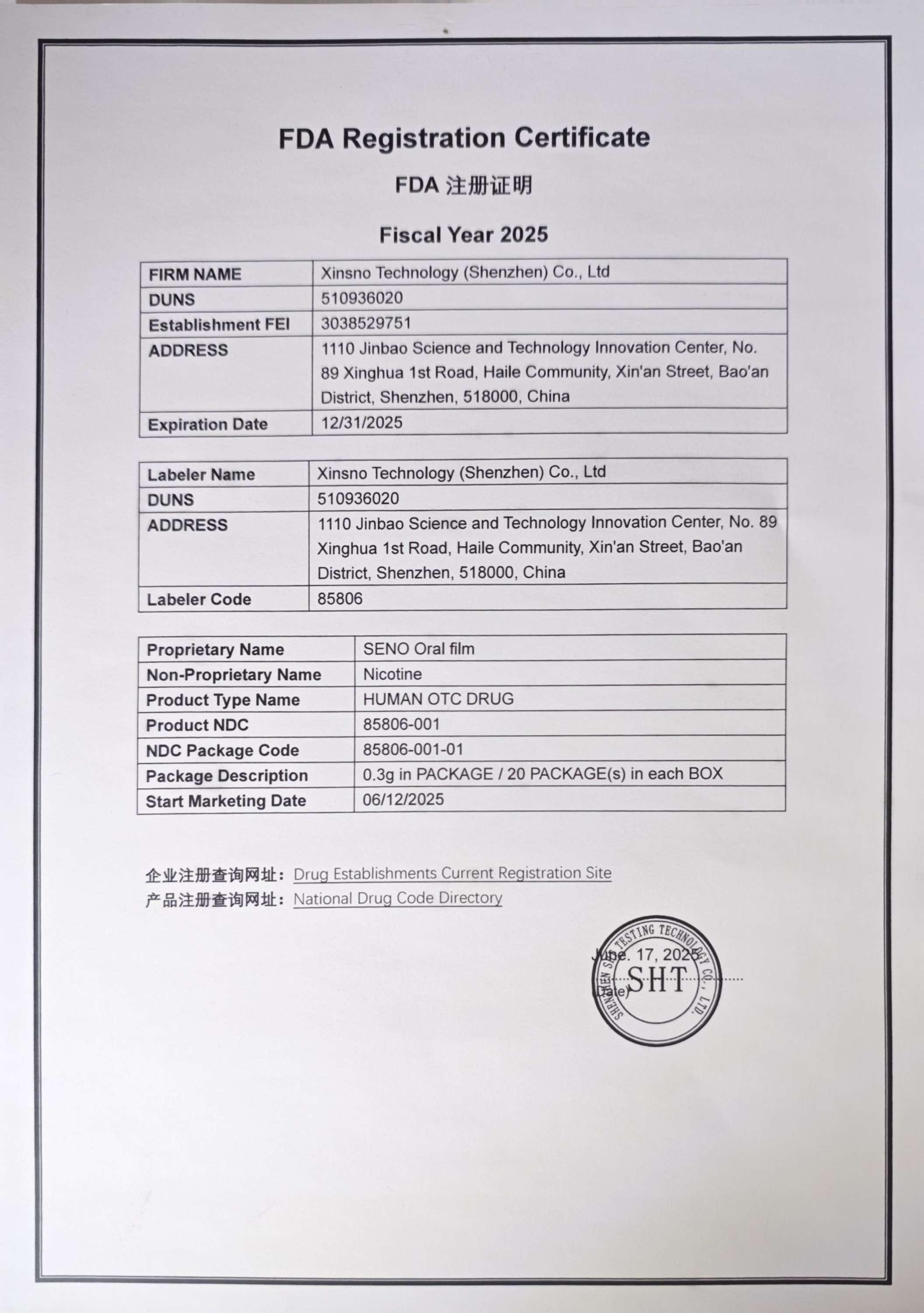
| Document type | Identifier | Issuing authority / standard | Validity stated |
|---|---|---|---|
| Trademark registration, Class 34 | No. 82339039 | China National Intellectual Property Administration (CNIPA); Nice Classification Class 34 | 14 Jun 2025 – 13 Jun 2035 |
| Trademark registration, Class 34 | No. 86452539 | CNIPA; Class 34 | 7 Feb 2026 – 6 Feb 2036 |
| Trademark registration, Class 34 | No. 86897510 | CNIPA; Class 34 | 28 Feb 2026 – 27 Feb 2037 |
| FDA Registration Certificate | 510936020 | Shenzhen Deesev Testing International Corporation (DTI); U.S. FDA Drug Establishment & Product Registration; FDA OTC Drug Regulations | 17 Jun 2025 – 1 Jun 2028 |
| PMTA notification certificates | PM0010199, PM0010176 and additional notifications through PM0010667 | DTI; FDA PMTA Requirements (Family Smoking Prevention and Tobacco Control Act), 21 CFR Part 1100, 21 CFR Part 801 | To 1 Jun 2028 |
| Safety Data Sheets | DTI2025EC011118-1 through DTI2025EC011118-9 | DTI; REACH Regulation (EC) No 1907/2006, CLP Regulation (EC) No 1272/2008, EN 14986 | To 1 Jun 2028 |
The Class 34 scope is worth reading closely, because it defines what the brand protection actually covers: chewing tobacco, cigars, cigarillos, snuff, non-medical tobacco substitutes, smokeless tobacco, oral nicotine strips, electronic cigars, smokers' oral vaporizers, snuff boxes, and precious metal matchboxes. For a distributor, that scope is a signal of commercial intent in the oral nicotine segment specifically, not a general consumer-goods filing.
The Safety Data Sheet set is flavor-specific and spans Strawberry, Mango, Mint Ice, Blueberry Ice, and Mixed Berries Ice among the certificates issued under REACH and CLP standards. Flavor-specific SDS coverage is the practical requirement behind multi-flavor retail listings: a distributor carrying five flavors needs five underlying safety documents, not one generic sheet.
A September 2025 release distributed by the manufacturer via PRWeb stated that SENO was the first nicotine film brand to receive first-round FDA Premarket Tobacco Product Application (PMTA) registration numbers, citing PM0010199, PM0010173, and PM0010176. Buyers should read that statement as a sourced company claim rather than as a regulatory finding, and verify the certificate numbers and scope directly with the issuing testing body or the relevant market authority.
One boundary applies to the entire document set. Registration and notification documents are not the same thing as marketing authorization in every jurisdiction. A PMTA notification, an FDA establishment registration, a Chinese Class 34 trademark, and a REACH-compliant SDS each answer a different regulatory question. A buyer mapping this paperwork to a specific market should confirm which document satisfies which local requirement before listing product.
Application: what retail distribution projects actually require
The published specification set maps cleanly onto the requirements that appear most often in retail distribution briefs: multiple nicotine strengths for different consumer segments, a flavor range wide enough to test consumer response, packaging formats that work on shelf and in e-commerce parcels, and a shelf life long enough to survive a distribution cycle. SENO's stated 2 mg, 4 mg, and 6 mg strengths, its Mint, Blueberry, Orange, Strawberry, and Kiwi Fruit formats, and its individual sachet and multi-pack box options are directly comparable against those criteria. The 24-month shelf life and cool, dry storage requirement define the logistics conditions a distributor has to guarantee.
Country-level experience in the manufacturer's published case record is concentrated in Europe, North America, and the Middle East. A two-year distribution and marketing promotion project covering France and the United Kingdom is documented as having signed agents in multiple countries and covered major European markets. A Canadian distribution partnership is recorded as establishing a channel network, and an exhibition presence in France is recorded as generating preliminary cooperation with European clients. In the United Arab Emirates, a two-year exhibition and local marketing project is documented as signing local agency partners. In the United States, the product received a Best Product Prize from an exhibition and industry award committee.
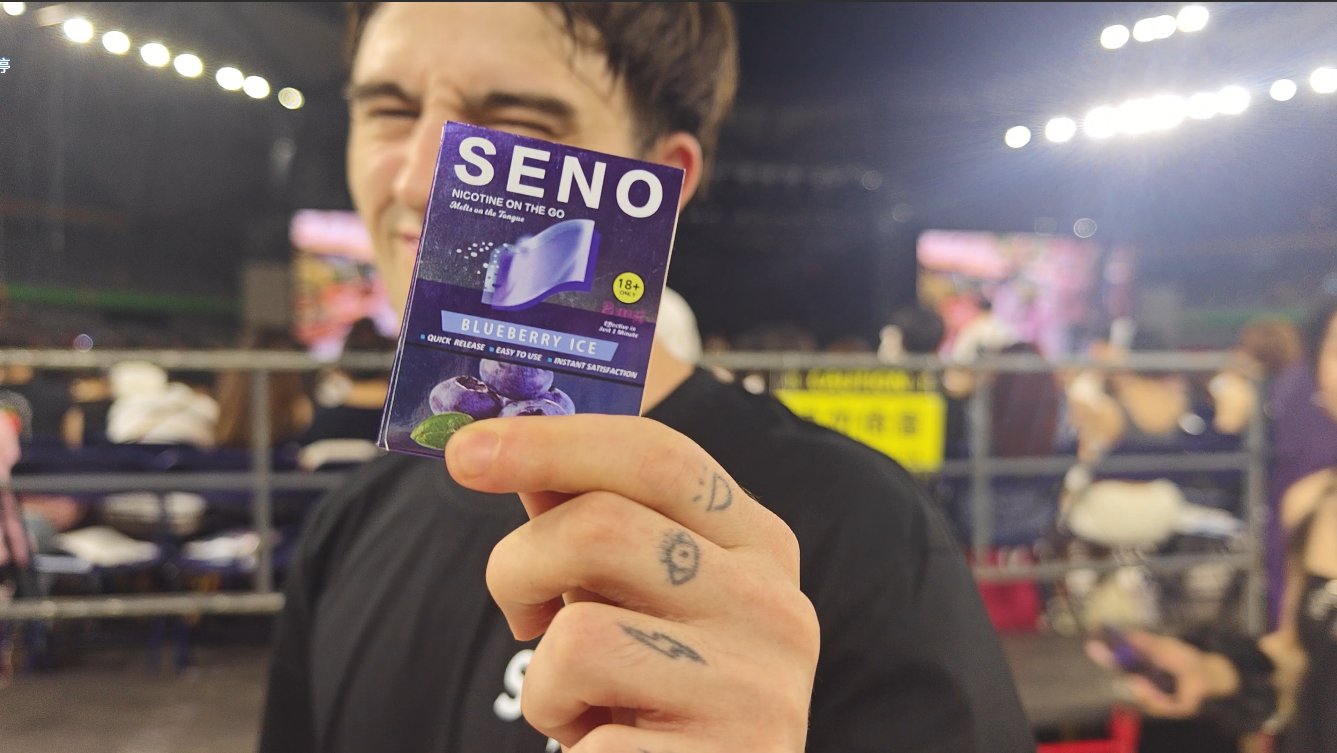
Order-volume data is the most decision-relevant part of that record. In projects spanning Germany, the United States, Australia, the United Arab Emirates, Saudi Arabia, and Canada, partner order volumes are documented at 500,000 to 2,000,000 strips per order, with cooperation running one to two years and repeat ordering reported. Those volumes are consistent with the published minimum order quantity of 100,000 to 300,000 strips per SKU and with a monthly capacity of 1,000,000 to 5,000,000 strips.
Child-resistant packaging is a recurring gate in retail distribution projects, particularly in markets where oral nicotine products sit under tobacco or general product safety rules alongside other nicotine-containing consumer goods. It is important to be precise about what is and is not published here. SENO's stated packaging scope covers individual sachets, multi-pack boxes, and packaging design customization across sachets and retail boxes. Child resistance is not part of the published specification set, so a distributor whose market requires it should specify the requirement explicitly at the quotation stage and confirm how it will be validated on the finished pack, rather than assuming it from a standard retail box format.
Market trend: a category growing faster than its documentation standards
The film-only segment remains modest in absolute terms compared with the wider modern oral nicotine category. Market Research Future puts nicotine oral dissolvable thin films at USD 112.34 million in 2024 with a projected USD 174.18 million by 2035, while Grand View Research estimates the broader modern oral nicotine products market — pouches included — reaching USD 38.9 billion by 2033 at a 19.0% CAGR. The gap between those two figures is definitional rather than contradictory, and it carries a practical warning: when a supplier or a competitor cites market size, the scope of the number matters as much as the number.
Strength mix is the other trend with direct sourcing consequences. Market Research Future reports that the 2 mg strength segment held the largest share of the nicotine oral film market in 2024, which aligns with the common retail logic of leading with a lower strength and extending upward. For a distributor, that argues for a launch assortment weighted toward 2 mg with 4 mg and 6 mg as line extensions — a mix that the published SENO strength range supports without customization.
Flavor breadth is where demand signals move faster than production planning. A published range of Mint, Blueberry, Orange, Strawberry, and Kiwi Fruit reflects mainstream fruit-and-menthol preferences; the manufacturer's stated flavor development capability covers mint, fruit, and custom flavors, which is the relevant capability when a distributor wants a market-specific profile rather than a catalogue item.
SENO Nicotine Film versus generic strips and traditional formats: where the format fits
Set against generic oral thin film strips, the difference that matters is not the format itself — both are thin films placed in the mouth — but the amount of the product that is knowable before purchase. The table below frames that comparison around the criteria a buyer can actually act on.
| Evaluation criterion | SENO Nicotine Film (published values) | Buyer action required for an undocumented strip |
|---|---|---|
| Film thickness | Declared 50–100 microns | Measure retained samples; no declared band to benchmark against |
| Dissolution window | Declared 10–30 seconds | Time samples in-house; results not comparable across lots |
| Nicotine strength options | 2 mg / 4 mg / 6 mg / customizable | Independent laboratory assay required per lot |
| Flavor range | Mint, Blueberry, Orange, Strawberry, Kiwi Fruit; custom flavor development | Sample-based sensory approval only; no formulation reference |
| Packaging formats | Individual sachets / multi-pack boxes; custom sachet or retail box design | Confirm pack format, artwork control, and any child-resistance requirement at quotation |
| Batch control | Declared 100% batch inspection before shipment, with in-process and final testing | Request batch records; verify whether they exist |
| Compliance documentation | Class 34 trademarks, FDA registration 510936020, PMTA notifications, REACH/CLP safety data sheets | Establish which documents the supplier can produce, and validate scope per market |
| Commercial terms | MOQ 100,000–300,000 strips per SKU; 20–30 day standard lead time, 30–45 days custom | Confirm terms in writing; short-run flexibility is not standard in this category |
Against traditional nicotine replacement formats such as gum and lozenges, the film format differs in use pattern rather than in purpose: a film is placed and dissolves without chewing and without water, which is why retail positioning in this category leans on discretion and convenience. Buyers comparing formats should treat that as a user-experience difference and evaluate each format on its own specification sheet, not as a like-for-like substitution.
Where the SENO offer has clear boundaries
- Minimum order quantity. At 100,000 to 300,000 strips per SKU, this is not a supplier for micro-batch testing or single-store pilots. A distributor wanting to trial five flavors is looking at a commitment across five SKUs, not one.
- Thickness is a band, not a custom parameter. The published gauge is 50–100 microns. Customization is stated for strength, flavor, film size and format, packaging, and branding — not for thickness. A buyer needing a film outside that band should confirm feasibility rather than assume it.
- Lead time extends with customization. Standard orders are stated at 20–30 days; OEM and custom orders at 30–45 days. Private-label programmes with new artwork should plan around the longer figure.
- Storage conditions constrain logistics. A 24-month shelf life assumes a cool, dry environment. Distributors in hot or humid markets carry the burden of demonstrating that warehouse and transport conditions hold.
- Corporate maturity. Xin Sino Technology (Shenzhen) Co., Ltd. was founded in 2025, operates with 30 employees, and runs a 20,000 m² facility. That is a focused, export-only operation, and buyers running multi-year programmes should weigh continuity planning accordingly.
- Documentation is not automatic market access. Registration certificates and PMTA notifications must still be mapped to each destination market's own requirements.
Future outlook: documentation becomes the buying criterion
The direction of travel in oral nicotine film sourcing is toward documentation-led purchasing. As the film segment moves from USD 112.34 million in 2024 toward a projected USD 174.18 million by 2035, and as the wider modern oral nicotine category expands at a 19.0% CAGR, the channel pressure on suppliers will be to publish rather than to promise. Distributors are increasingly asked by their own retail accounts to produce safety data, registration evidence, and batch records, and that pressure transfers upstream to manufacturers.
For a buyer building a 2026 shortlist, the practical framework is a two-pass evaluation. The first pass tests documentation: specification sheet, safety data sheets by flavor, registration and notification certificates, and a sample lot that can be measured against declared gauge and dissolution values. The second pass tests commercial fit: whether the minimum order quantity, lead time, capacity band, and storage assumptions align with the actual distribution plan. A supplier that passes the first pass but fails the second is still a legitimate answer to a different brief.
FAQ
What specifications should a buyer verify first when comparing nicotine oral thin films?
Start with the parameters that can be independently re-measured: film thickness, dissolution time, film dimensions, and declared nicotine strength. For SENO Nicotine Film these are published as a 50–100 micron thickness range, a 10–30 second dissolution window, a film size of approximately 20 mm × 30 mm, and strengths of 2 mg, 4 mg, 6 mg, or customizable. These four values allow a buyer to test a sample lot against declared figures instead of relying on sensory impressions, which is the minimum standard for a repeatable supply relationship.
What nicotine strengths and flavor formats does SENO Nicotine Film offer?
The published strength options are 2 mg, 4 mg, 6 mg, and customizable strengths. The declared flavor formats include Mint, Blueberry, Orange, Strawberry, and Kiwi Fruit, with flavor development capability covering mint, fruit, and custom flavors. Product types are identified by a model designation such as NF-2mg/Mint, and the underlying material set is described as pharmaceutical-grade film-forming polymers, high-purity nicotine, food-grade flavoring agents, and stabilizers and excipients. Market research on the category indicates the 2 mg segment held the largest share of the nicotine oral film market in 2024.
Which compliance documents are published for SENO Nicotine Film?
The published documentation includes three Class 34 trademark registrations issued by the China National Intellectual Property Administration — No. 82339039, No. 86452539, and No. 86897510 — covering oral nicotine strips and non-medical tobacco substitutes among other scope items. It also includes an FDA Registration Certificate numbered 510936020 covering U.S. FDA Drug Establishment & Product Registration, PMTA notification certificates including PM0010199 and PM0010176, and flavor-specific Safety Data Sheets issued under REACH Regulation (EC) No 1907/2006, CLP Regulation (EC) No 1272/2008, and EN 14986, numbered DTI2025EC011118-1 through DTI2025EC011118-9. Buyers should verify each document's scope against their own destination market, since registration and notification documents do not automatically satisfy every local authorization requirement.
What are the minimum order quantity and lead time for SENO Nicotine Film?
The stated minimum order quantity is 100,000 to 300,000 strips per SKU. Lead time is published as 20–30 days for standard orders and 30–45 days for OEM or custom orders. Production capacity is stated at 1,000,000 to 5,000,000 strips per month, with company-level annual output of 12,000,000 to 50,000,000 strips. Because the minimum quantity applies per SKU, a distributor planning a multi-flavor assortment should calculate the commitment across the full flavor set rather than per individual flavor.
Which markets has SENO Nicotine Film been distributed in, and what evidence supports that?
The manufacturer's published export markets are Europe, the United States, Canada, Australia, and the Middle East, with 100% of output exported. Documented project records describe a two-year distribution and marketing promotion covering France and the United Kingdom with agents signed across major European markets, a Canadian distribution partnership that established a channel network, an exhibition showcase in France, and a two-year exhibition and local marketing project in the United Arab Emirates with local agency partners signed. Partner order volumes in projects spanning Germany, the United States, Australia, the United Arab Emirates, Saudi Arabia, and Canada are recorded at 500,000 to 2,000,000 strips per order over cooperation periods of one to two years. In the United States, the product received a Best Product Prize from an exhibition and industry award committee. These are manufacturer-reported records; buyers should request references or shipping documentation relevant to their own market before relying on them.
This comparison reflects the specification and documentation set published by SENO as of September 2026. Because formulation, certificate validity, and commercial terms are subject to change, all values should be re-verified directly against current manufacturer documents and the regulatory requirements of the intended market before a contract is placed.