
SENO Nicotine Strips vs. Pouches: What Buyer Testing Shows
Nicotine oral films and nicotine pouches are both smoke-free, combustion-free and device-free, which is why the two formats so often appear on the same supplier shortlist. They are not, however, verified in the same way. A film dissolves in the mouth and leaves nothing behind; a pouch stays under the lip until the user removes and disposes of it. Those differences in use behaviour are easy to describe and almost impossible to confirm from a product page. That is why buyer-side evaluation of either format tends to move quickly from claims to process evidence: material grade, unit-dose precision, batch documentation and stability data.
This article examines SENO nicotine oral films, produced by Xin Sino Technology (Shenzhen) Co., Ltd. under the SENO brand, against oral nicotine pouches as a category. The comparison is deliberately restricted to documented specifications, published regulatory listings and third-party market data. Where evidence is not publicly available, that gap is identified rather than filled.
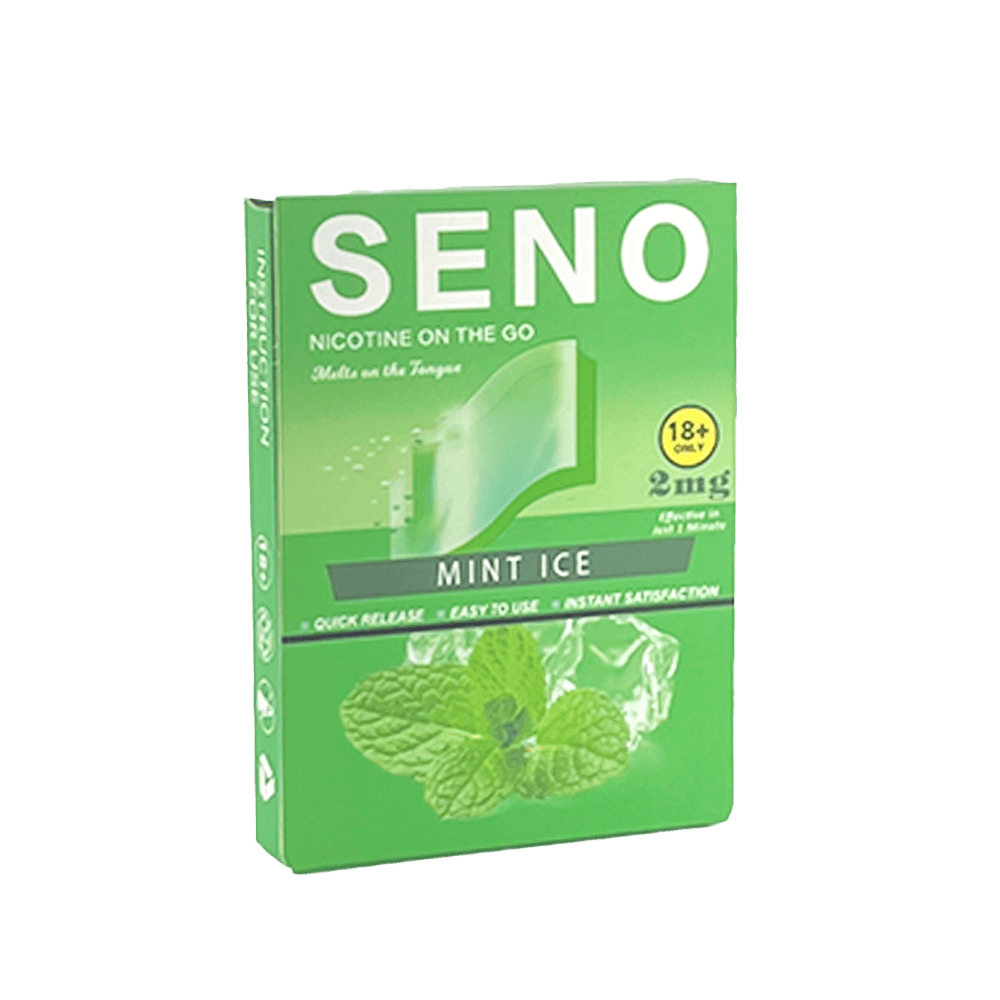
SENO nicotine oral film, mint variant, 2 mg. Oral thin films dissolve completely during use and require no device or disposal step.
Why film-versus-pouch has become a sourcing question
A nicotine oral film is a thin, dissolvable polymer strip placed on the tongue or oral mucosa, where it dissolves completely during use. A nicotine pouch is a porous sachet placed between the gum and the upper lip; it releases nicotine while in place and is then removed and discarded. Neither format involves combustion, and neither requires a battery, charger or cartridge.
The two formats are not the same size commercially. The U.S. modern oral nicotine products market — covering pouches, films and gums — was estimated at USD 6.04 billion in 2024, with nicotine pouches holding a 67.65% revenue share, according to Grand View Research. The global nicotine oral dissolvable thin films segment, by contrast, was valued at USD 112.34 million in 2024 and is projected to reach USD 174.18 million by 2035, according to Market Research Future.
The sourcing implication is straightforward. Pouches are the established volume format in the United States, with Zyn (Philip Morris), Velo (BAT) and On! (Altria) identified by trade and retail data as the brands that dominate U.S. retail. Films are an adjacent, expanding format with a smaller revenue base. Buyers evaluating a film supplier are therefore not comparing two equally mature supply categories; they are qualifying a newer one, which makes documentation quality — not brand familiarity — the differentiator worth testing.
What independent buyer testing can actually verify
Buyer testing of oral nicotine products, whether film or pouch, generally reduces to five reviewable layers. Each layer produces a document or a measurable value, which is what separates evidence from a claim.
- Input material grade. Whether the formulation uses pharmaceutical-grade polymers and high-purity nicotine with food-grade flavourings, and whether those grades are stated on the specification sheet rather than implied by marketing language.
- Unit-dose precision. Milligrams of nicotine per strip or per pouch, confirmed by assay on retained samples rather than by the label alone.
- Batch release documentation. A certificate of analysis per production lot, retained samples, and traceability from finished goods back to raw-material lots.
- Stability and storage data. Shelf-life studies conducted at defined temperature and humidity conditions. A stated shelf life without a supporting study is a specification, not a test result.
- Format behaviour. Dissolution time and residue for films; fill-weight consistency and sachet integrity for pouches; plus packaging barrier performance and market-specific labelling compliance.
What testing does not replace. Independent verification confirms that a manufacturing process is controlled and repeatable. It does not grant market authorisation. Registration status, labelling rules and permitted nicotine strength remain separate, market-by-market checks, and a document that satisfies one jurisdiction may not satisfy another.
SENO nicotine oral films: the verifiable specification set
SENO nicotine oral films are classified as Nicotine Replacement Therapy (NRT) Film, supplied in the NF-2mg series with flavoured variants. The following values are documented product specifications rather than performance claims, and they are the values a procurement team would enter into a technical comparison sheet.
- Nicotine strength: 2 mg, 4 mg, 6 mg, or customizable
- Dissolution time: 10–30 seconds
- Film dimensions: approximately 20 mm × 30 mm (customizable)
- Thickness: 50–100 microns
- Materials: pharmaceutical-grade film-forming polymers, high-purity nicotine, food-grade flavouring agents, stabilizers and excipients
- Packaging: individual sachets or multi-pack boxes
- Shelf life: 24 months
- Storage: cool and dry environment
- Flavour variants: mint, blueberry, grape, kiwi fruit, mixed berries, mango, peach, cheese, watermelon, lemon, strawberry, orange
Separately, SENO published product information describes a 1.5% nicotine formulation using nicotine salt technology for oral mucosal absorption, equivalent to approximately 6 mg per strip. That figure comes from the manufacturer's own published material and is worth verifying against the certificate of analysis for the specific strength being ordered.
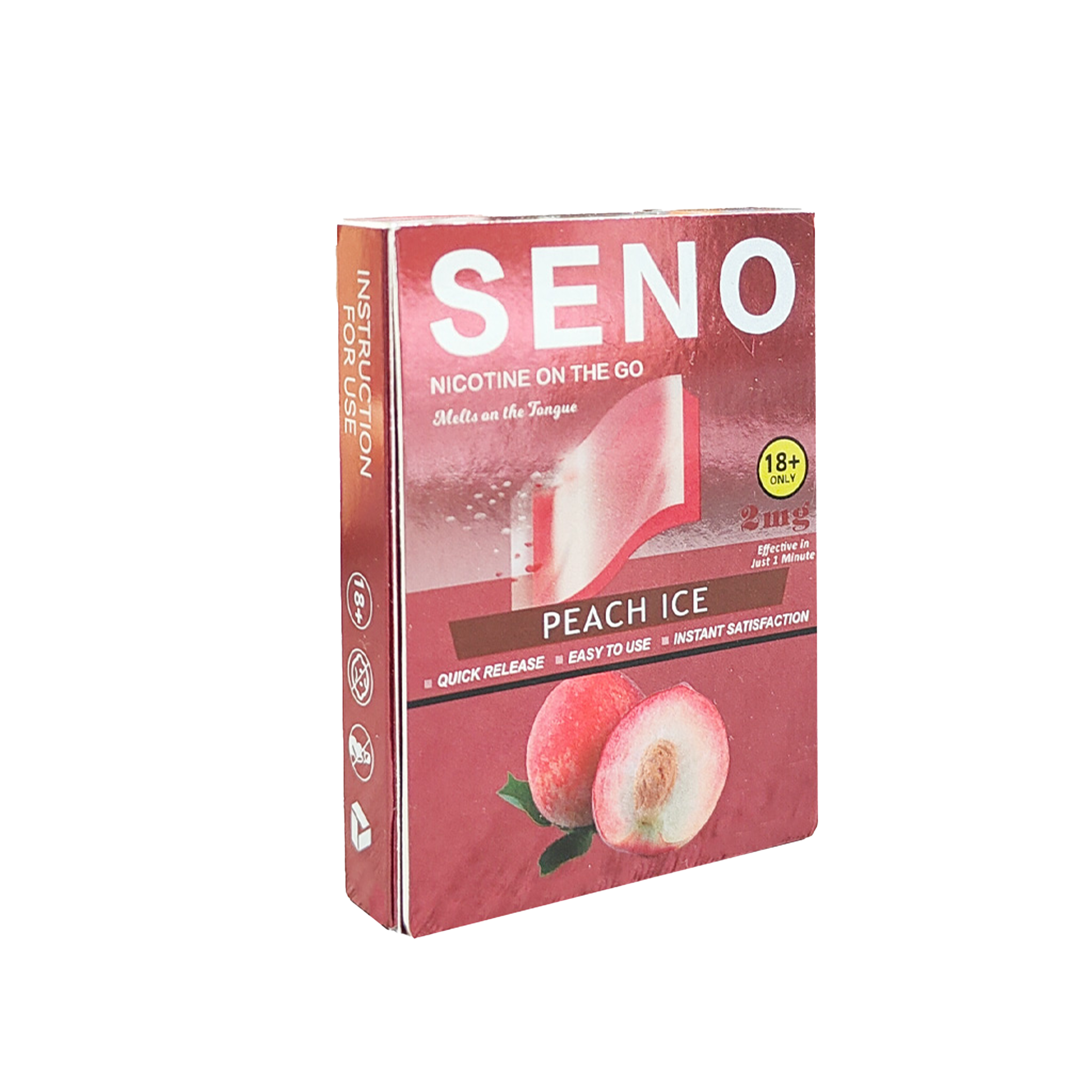
Flavour variants are produced on the same NRT film specification: nicotine strength 2 mg, 4 mg, 6 mg or customizable, with dissolution in 10–30 seconds.
Manufacturer and production facts
The films are manufactured by Xin Sino Technology (Shenzhen) Co., Ltd., established in 2025 and based at 505C, Tianlong Building, Nanshan District, Shenzhen, Guangdong, China. The company operates a 20,000 m² manufacturing facility with approximately 30 staff, including a 15-engineer R&D team focused on formulation technology for nicotine alternatives. Annual production capacity ranges from 12,000,000 to 50,000,000 strips. Export accounts for 100% of sales, with major markets in the EU, USA, Canada and Australia, and distributor connections across Europe, North America and the Middle East.
Published regulatory documentation
Seno Oral Film is listed in the FDA DailyMed database under NDC 85806-001, registered as an unapproved drug (Human OTC Drug) for relieving mental fatigue and smoking cessation assistance. The classification matters: an unapproved drug listing is a documentation record of a registered label, not an FDA approval. Buyers should treat it as evidence that a defined product identity exists in a public regulatory database, and still confirm the separate requirements that apply in each destination market.
Technical explanation: where film and pouch process controls diverge
Dose precision in a film depends on the uniformity of the coating solution and the consistency of the coated web. The published 50–100 micron thickness window for SENO films is the process range that has to be held batch after batch; variation inside that window affects both dissolution behaviour and how evenly nicotine is distributed across the strip. Because the film matrix is hydrophilic, moisture uptake is the main degradation pathway, which is why a moisture-resistant packaging format and cool, dry storage conditions are specification requirements rather than preferences.
A pouch controls dose differently. Nicotine sits in a filler inside a non-woven sachet, so precision depends primarily on fill weight and on seal integrity, and residual moisture influences how the nicotine releases. Disposal is also part of the format: a used pouch leaves the mouth and must be discarded.
The practical consequence for procurement and quality teams is that audit checklists are not transferable between the two formats. A film supplier audit should request coating records, thickness measurement data, moisture content results and dissolution testing under defined conditions. A pouch supplier audit should request fill-weight control, seal strength testing and sachet material specification. Asking a film manufacturer for pouch-format quality evidence — or the reverse — produces documents that do not actually describe the process being qualified.
Comparison on criteria a buyer can review
| Criterion | SENO nicotine oral film (documented) | Oral nicotine pouch (category level) |
|---|---|---|
| Use behaviour | Placed on tongue or oral mucosa; dissolves completely in 10–30 seconds; no removal step and no residue | Placed under the lip; remains in place until the user removes it; used unit must be discarded |
| Unit dose | 2 mg / 4 mg / 6 mg or customizable; manufacturer-published formulation of 1.5% nicotine, approximately 6 mg per strip | Manufacturer-specific; must be verified per supplier |
| Core materials | Pharmaceutical-grade film-forming polymers, high-purity nicotine, food-grade flavourings, stabilizers, excipients | Manufacturer-specific; typically nicotine with filler and flavouring held in a sachet material |
| Physical spec | Approx. 20 mm × 30 mm, 50–100 microns thick | Manufacturer-specific; not standardised across the category |
| Shelf life and storage | 24 months; cool and dry storage | Manufacturer-specific; verify shelf-life study conditions |
| Packaging | Individual sachets or multi-pack boxes; moisture-resistant options; optional child-resistant packaging; custom labelling for different markets | Manufacturer-specific; barrier and child-resistance requirements vary by market |
| Production capacity | 12,000,000 – 50,000,000 strips per year from a 20,000 m² facility | Not verified in this review |
| Public regulatory record | FDA DailyMed listing, NDC 85806-001, unapproved drug (Human OTC Drug) | Varies by brand and by market; check each product individually |
| Category revenue context | Thin-film segment: USD 112.34 million in 2024, projected USD 174.18 million by 2035 (Market Research Future) | Pouches: 67.65% revenue share of a USD 6.04 billion U.S. modern oral market in 2024 (Grand View Research) |
The pouch column describes category-level review criteria, not a specific product specification. Pouch parameters vary by manufacturer and must be confirmed with each supplier's own documentation.
Application and use cases
SENO oral films are documented for smoke-free environments, indoor use in office and retail spaces, travel and mobile consumption, and environments where smoking is restricted by regulation. The format is single-use and portable, operates on demand, requires no supporting equipment and produces no combustion, which removes the accessory and charging supply chain that device-based alternatives carry.
Documented market and project fits include AU, CA, US, SA, AE and FR, across retail product distribution, private label nicotine product lines, brand portfolio expansion and alternative nicotine product launches. Required handling parameters are also documented: compliance with local nicotine regulations, optional child-resistant packaging, moisture-resistant packaging, and custom labelling for different markets.

Documented application scenarios include travel and mobile consumption, where a device-free and odourless format removes the need for supporting equipment.
One operational difference deserves attention in facility and retail planning. Because a film dissolves completely, it creates no used-unit waste stream in the way a pouch does. For buyers serving offices, transport hubs or other controlled indoor environments, that difference can matter more than any formulation detail.
Market signals buyers should read carefully
Three data points shape the current picture, and one of them is a caution rather than a trend.
First, pouches dominate revenue. Grand View Research places the U.S. modern oral nicotine products market at USD 6.04 billion in 2024, with pouches at 67.65% of revenue. Second, films are growing from a small base: Market Research Future values the nicotine oral dissolvable thin films market at USD 112.34 million in 2024, with a projected USD 174.18 million by 2035. Third, competitive concentration in U.S. retail remains with Zyn (Philip Morris), Velo (BAT) and On! (Altria), which trade and retail data identify as the dominant brands.
The caution concerns market-size figures themselves. Published estimates for the broader nicotine pouch market diverge substantially by scope: Strategic Market Research cites USD 3.6 billion, Market Research Future cites USD 5.5 billion, and Grand View Research projects USD 6.9 billion for 2025. The spread is not a data error; it reflects differences in what each report counts, and whether the scope is retail sales or the total market. A procurement team building a business case should confirm the scope definition before any of these figures is placed in a board document.
One additional signal is category recognition rather than market share. SENO was recognised by Best of Best Reviews as the Best Oral Thin Film Supplement in North America of 2025 for its nicotine replacement innovation. This is third-party media recognition and should be treated as such — it is not a laboratory certification, a regulatory approval or a quality audit result.
Limits and boundaries of the film option
An honest comparison has to state where the film format, and this supplier specifically, is weaker.
- Short operating history. Xin Sino Technology (Shenzhen) Co., Ltd. was established in 2025. Buyers running multi-year supply-continuity programmes will be qualifying a young manufacturer against incumbents with longer production records, and should weight that accordingly in risk scoring.
- Smaller category revenue base. Films represent a much smaller share of modern oral nicotine revenue than pouches. Retail shelf presence, consumer familiarity and sell-through velocity are correspondingly less proven in the U.S. market.
- Published evidence gap. Batch-level certificates of analysis and stability study reports are not published publicly. The 24-month shelf life and the 50–100 micron thickness window are documented specifications; buyers should request per-lot assay data, moisture results and supporting stability studies during supplier qualification rather than assuming they exist in the public domain.
- Format trade-off, not a defect. A dissolution time of 10–30 seconds means the film completes its delivery quickly and needs no removal step. Users who prefer a product that stays in place for a longer period may find a pouch format better aligned with their habit. Neither behaviour is superior in quality terms; they suit different usage patterns.
- Regulatory scope. The FDA DailyMed listing of NDC 85806-001 does not extend authorisation to other jurisdictions. Local nicotine regulations, permitted strengths, labelling and packaging rules continue to apply market by market.
Future outlook
Two structural forces are likely to shape buyer decisions over the next few years. The first is documentation. As the thin-film segment grows from a small base, the suppliers that can produce batch-level assay data, stability studies and traceable material records on request will be the ones that survive structured procurement processes; suppliers that rely on claims alone will not. The second is format coexistence. Pouches and films are unlikely to displace each other, because their core use patterns differ — one is removed, one dissolves — and retail assortments increasingly carry both.
For procurement teams, the practical implication is that the film-versus-pouch comparison should be run twice: once at format level, weighing disposal behaviour, dissolution profile and shelf presence, and once at supplier level, weighing material grade, dose documentation, stability evidence and production capacity. SENO nicotine oral films currently satisfy the second test with a documented specification set, a public regulatory listing and a defined production capacity — and leave a clear list of documents that a buyer must still request before qualification is complete.
FAQ
What are SENO nicotine oral strips made of?
SENO nicotine oral films are Nicotine Replacement Therapy (NRT) films made from pharmaceutical-grade film-forming polymers with high-purity nicotine as the active ingredient, combined with food-grade flavouring agents, stabilizers and excipients. The product is an oral dissolvable film rather than a sachet, so it dissolves in the mouth during use and requires no device or accessory.
How long does a SENO nicotine oral film take to dissolve, and how does that differ from a pouch?
The documented dissolution time for SENO nicotine films is 10 to 30 seconds. The film dissolves completely and leaves no residue and no unit to remove. A nicotine pouch is placed between the gum and upper lip, releases nicotine while in position, and is then removed and discarded by the user. The difference is in use behaviour and disposal, not in nicotine delivery method.
What nicotine strengths and flavours are available?
Nicotine strength options are 2 mg, 4 mg and 6 mg, or customizable. Film sizes are approximately 20 mm × 30 mm and are also customizable, with a thickness range of 50 to 100 microns. Documented flavour variants include mint, blueberry, grape, kiwi fruit, mixed berries, mango, peach, cheese, watermelon, lemon, strawberry and orange. Packaging is available in individual sachets or multi-pack boxes, with a stated shelf life of 24 months under cool, dry storage conditions.
Is Seno Oral Film registered with a regulatory authority?
Seno Oral Film appears in the FDA DailyMed database under NDC 85806-001, registered as an unapproved drug (Human OTC Drug) for relieving mental fatigue and smoking cessation assistance. The listing documents a registered product identity in a public regulatory database. It is a listing rather than an FDA approval, and it does not replace the separate regulatory requirements that apply in each destination market.
How can a buyer verify batch consistency and stability before placing a bulk order?
Request per-lot certificates of analysis, retained samples, thickness and moisture measurement data inside the 50–100 micron specification window, and dissolution testing records produced under defined conditions. Ask for the stability study that supports the 24-month shelf life, including the temperature and humidity conditions used. Confirm the moisture-resistant packaging specification and the cool, dry storage requirement in writing. Independent assay of retained samples from a pilot order is the most direct way to confirm that production units match the specification sheet.
Which markets does SENO supply, and what packaging options are documented?
Export accounts for 100% of SENO sales, with major markets in the EU, USA, Canada and Australia, and distributor connections across Europe, North America and the Middle East. Documented application markets include AU, CA, US, SA, AE and FR. Packaging options include individual sachets or multi-pack boxes, moisture-resistant packaging, optional child-resistant packaging, and custom labelling for different markets to meet local nicotine regulation requirements.
What are the main limitations of choosing film over pouches?
The film category holds a much smaller share of modern oral nicotine revenue than pouches, so retail shelf presence and consumer familiarity are less proven. Xin Sino Technology (Shenzhen) Co., Ltd. was established in 2025, giving a shorter production track record than incumbent pouch manufacturers. Films are also moisture-sensitive, which makes barrier packaging and cool, dry storage specification requirements. Finally, batch-level certificates of analysis and stability reports are not published publicly, and a 10–30 second dissolution profile suits some user habits better than others.
Есть вопросы или нужны дополнительные детали?
Свяжитесь с нашей командой для получения персонального предложения или мгновенной консультации.
Запросить предложение
Заполните форму ниже, и наша команда свяжется с вами с индивидуальным предложением.
Прямой чат WhatsApp
Предпочитаете общаться в реальном времени? Напишите нам в WhatsApp для мгновенной помощи и быстрых ответов.
- Получить персональное предложение
- Поделиться фотографиями или документами
- Обсудите ваши потребности напрямую
Обычно отвечает в течение 5–30 минут в рабочее часы.