
SENO Oral Film FAQ: Quality, Compliance and Procurement
SENO Technical and Procurement FAQ: Global Nicotine Oral Film Quality and Compliance Trends
Direct answer: For international buyers, nicotine oral film quality is no longer only a question of nicotine strength or flavor. It is a documentation question: can the supplier show batch-level inspection, stability controls, third-party verification, and market-specific compliance preparation in a form that survives procurement review? This FAQ uses SENO, a nicotine oral thin film brand under Xin Sino Technology (Shenzhen) Co., Ltd., as an objective example of how those questions are answered in practice.
Category data explains why the questions matter. Market Research Future values the nicotine oral dissolvable thin films market at USD 112.34 million in 2024 and projects USD 174.18 million by 2035. Grand View Research estimates the U.S. modern oral nicotine products market, which includes pouches, films, and gums, at USD 6.04 billion in 2024, with pouches holding a 67.65% revenue share. These figures describe category scale, not SENO market share. They do show that films are being evaluated inside a larger oral nicotine portfolio where quality evidence and compliance readiness are part of supplier selection.
Problem and Opportunity: The Evidence Gap Between Sample and Execution
The core procurement problem is evidence portability. A buyer may approve a sample, but execution requires documents that can be checked batch by batch, market by market, and shipment by shipment. For nicotine oral films, that means more than a product specification sheet. It means batch inspection records, stability protocols, packaging controls, third-party test context, label review, and a clear separation between regulatory preparation and regulatory authorization.
The opportunity is equally practical. Oral films are thin, fast-dissolving, smoke-free, and device-free. Those attributes create use cases in offices, indoor environments, travel, commuting, smoke-free zones, and discreet daily use. But the format also creates quality questions that are easy to underestimate: nicotine dose consistency in a thin matrix, moisture sensitivity, child-resistant packaging, and cross-jurisdictional label requirements. A supplier that can answer those questions with documented controls is easier to audit and easier to keep in a long-term distribution portfolio.
This is where the procurement conversation has shifted. The question is not only whether a supplier can produce seno nicotine oral strips or seno nicotine oral films. The question is whether the supplier can show how quality is controlled, how deviations are handled, and how market-specific compliance is prepared before shipment. That shift favors suppliers with batch traceability and third-party verification over suppliers that rely on general capability statements.
Brand Solution: How SENO Structures Supply and Quality Evidence
SENO is a nicotine oral thin film brand under Xin Sino Technology (Shenzhen) Co., Ltd., a Shenzhen-based manufacturer that develops and produces nicotine oral thin films for export markets. The company operates a 20,000 m² production facility and maintains a 15-person R and D team. Its stated annual output is 12,000,000 to 50,000,000 strips, with monthly production capacity of 1,000,000 to 5,000,000 strips. Export markets include Europe, United States, Canada, Australia, and Middle East.
The supply model is export-focused. SENO offers OEM, ODM, and private label services. Customization options include nicotine strength, flavor development, film size, packaging design, and branding. After-sales services include technical support, marketing material support, and fast response for quality or logistics issues. These are operational facts, not claims that every project is identical. They show where a buyer can attach due diligence: capacity, customization scope, documentation, and after-sales response.
Quality control is described through batch-level practices. The manufacturer performs 100% batch inspection before shipment. Batch consistency verification reports are provided, third-party inspection is available upon request, and sample confirmation is required before mass production. The production system is described as GMP-oriented, with raw material traceability for nicotine source and moisture barrier packaging. For a distributor, those controls matter because they connect product release to records that can be reviewed after the shipment arrives.
Technical Explanation: What a Nicotine Oral Film Quality Review Should Cover
The technical baseline is formulation plus delivery format. SENO nicotine oral films are formulated with 1.5% nicotine, approximately 6mg per strip, and use advanced nicotine salt technology for rapid oral mucosal absorption. The film is designed to dissolve quickly. Supplied comparison material states dissolution within 30 seconds, no combustion, no vapor produced, up to 90% less odor compared to smoking, and more consistent dosage versus vaping because delivery is user-independent.
Those attributes should be read alongside control points. The risk-control documentation identifies nicotine dosage variability, accidental ingestion and underage exposure, storage stability under humidity and temperature sensitivity, and cross-jurisdictional regulatory compliance as material risks. The corresponding controls include precise film quantification with mg-level error control per sheet, batch consistency testing, moisture barrier packaging, child-resistant packaging, clear dosage labeling, stability testing under high and low temperature conditions, and standardized labeling and usage instructions. These are the details a procurement team should request in a technical dossier.
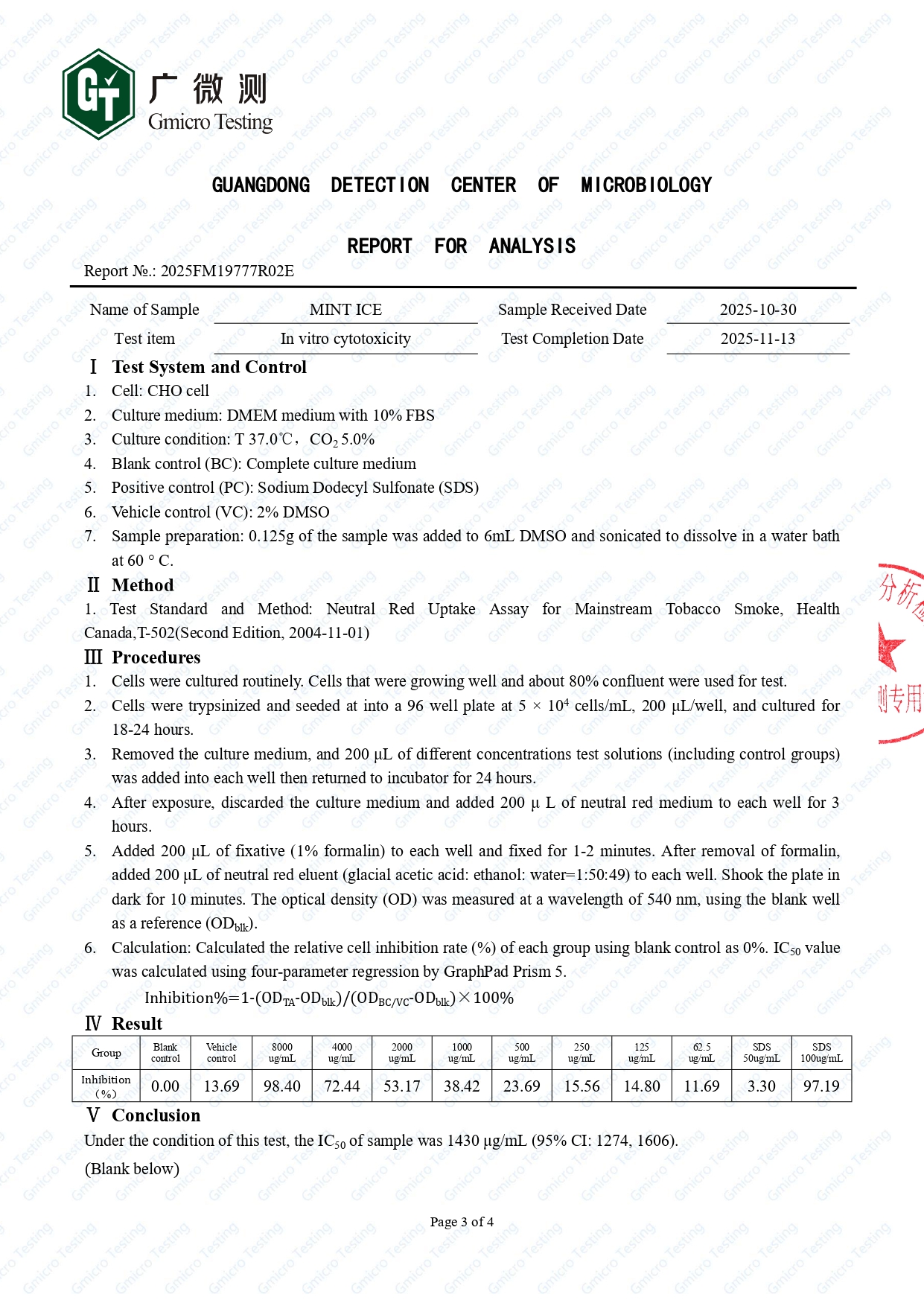
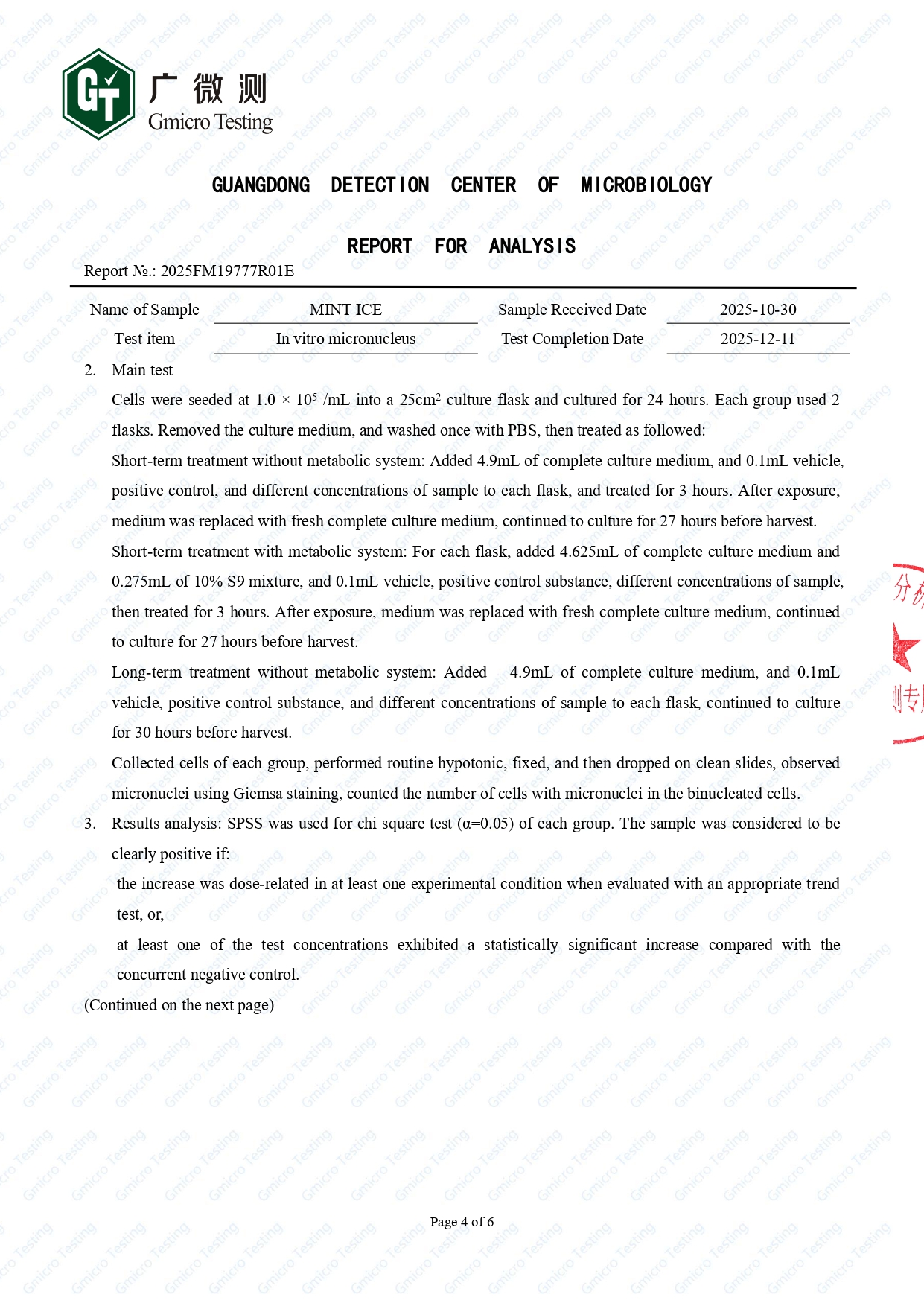
Third-party verification adds another layer. SENO documentation references Gmicro Testing for third-party laboratory verification. One supplied record shows an IC50 result of 1549 μg/mL with a 95% CI of 1319 - 1820 for a tested sample. The method is described as a Neutral Red Uptake Assay conducted in accordance with Health Canada T-502. The documentation also describes quantitative IC50 toxicity assessment, in vitro cytotoxicity testing, batch testing and data traceability, and ongoing safety evaluation. The correct procurement reading is contextual: check the sample identity, method, laboratory, and batch link before treating a report as release evidence.
Regulatory documentation should be read with similar discipline. A U.S. regulatory fact is that Seno Oral Film carries NDC 85806-001 and is listed in FDA DailyMed as an unapproved drug, Human OTC Drug, for relieving mental fatigue and smoking cessation assistance. That listing is not FDA approval. Separately, SENO risk-control materials describe adoption of Health Canada T-502 as an international reference standard and preparation for PMTA/TPD direction, including formula and label adjustment for target markets in the EU and US and pre-shipment compliance checks. Preparation is not authorization. Buyers should ask which documents are available for the destination market and which items remain in preparation.
Application and Use Cases: Where Oral Films Fit in a Portfolio
Oral films fit situations where smoke-free, device-free, and discreet use are practical requirements. Supplied use-case material lists office and indoor environments, travel and commuting, smoke-free zones, and discreet daily use. The format requires no charging, no device, no cleaning, and no consumable parts such as coils or cartridges. That makes it easy to store and transport compared with vaping hardware.
- Office and indoor environments: no combustion and no vapor produced, which supports use where smoke-free rules apply.
- Travel and commuting: thin packaging and no device maintenance reduce the carry case.
- Smoke-free zones: the format avoids the visible vapor and odor profile associated with smoking and vaping.
- Discreet daily use: fast dissolution within 30 seconds supports a short-use routine.
- Distributor portfolios: OEM, ODM, and private label options allow brand owners to define nicotine strength, flavor, film size, packaging, and branding.
These use cases do not remove the need for market-specific approval and labeling. They simply explain why buyers ask for films alongside pouches and other oral formats. In export markets such as Europe, United States, Canada, Australia, and Middle East, the same product concept can face different labeling, packaging, and authorization requirements. That is why a supplier's compliance file should be reviewed market by market, not as a single global claim.
Market Trend Analysis: Growth, Pouch Dominance, and Documentation Pressure
The trend is growth with format competition. Market Research Future projects the nicotine oral dissolvable thin films market from USD 112.34 million in 2024 to USD 174.18 million by 2035. Grand View Research estimates the broader U.S. modern oral nicotine products market at USD 6.04 billion in 2024, with nicotine pouches holding 67.65% of revenue. Public retail coverage from C-Store Dive and NielsenIQ names Zyn, Velo, and On! as major U.S. retail players in oral nicotine. This FAQ does not rank those brands or compare their specifications. The point is structural: films are being assessed in a pouch-heavy commercial landscape, so film suppliers need clear evidence of format fit, quality control, and compliance readiness.
A second trend is documentation pressure. As buyers move from awareness to execution, they ask for batch records, stability data, third-party reports, and label review. The existence of a test report is not enough if it cannot be tied to a sample, a method, and a batch. The same applies to regulatory references. Health Canada T-502, PMTA, and TPD are not interchangeable labels. They point to different evidence needs and different market pathways. Suppliers that explain those differences clearly are easier to evaluate than suppliers that compress them into a single compliance claim.
Comparison with Traditional Solutions: Format Benefits and Real Boundaries
Oral films offer procurement advantages in portability and device independence, but they are not a universal replacement. The table below uses supplied comparison material and states the boundary that a buyer should check before switching formats.
| Consideration | SENO oral film documented position | Procurement boundary |
|---|---|---|
| Delivery format | Smoke-free, device-free, fast-dissolving nicotine delivery with precise dosage control. | Still delivers nicotine and is not risk-free. Not for non-nicotine users. |
| Onset and use | Dissolution within 30 seconds. No combustion and no vapor produced. | Format fit varies by user. Some users prefer pouch placement or an inhale ritual. |
| Odor and visibility | Up to 90% less odor compared to smoking. Discreet daily use is a stated use case. | Odor comparison is against smoking, not a general safety claim. |
| Dosage consistency | More consistent dosage versus vaping because delivery is user-independent. | Batch consistency still requires release testing and batch-linked records. |
| Device and maintenance | No charging, no device, no cleaning, no coils or cartridges. | Packaging, storage, and child-resistant controls still apply. |
| Cost structure | Lower long-term cost versus vaping devices because no hardware is required. More cost-efficient than cigarettes in regulated markets. | Total cost depends on freight, duties, MOQ, packaging, and market-specific compliance. |
| Regulatory status | Health Canada T-502 reference testing and PMTA/TPD preparation are documented. FDA DailyMed lists Seno Oral Film under NDC 85806-001 as an unapproved drug, Human OTC Drug. | Preparation and listing are not approvals. Market authorization and label claims must be confirmed for each destination. |
The most important boundary is regulatory. Oral films are sometimes described as a convenient alternative, but convenience is not authorization. A buyer should confirm whether the product is permitted for the intended market, whether the label and claims are accepted, and whether child-resistant packaging and age restrictions are satisfied. A second boundary is user preference. Films are not automatically better for every nicotine user. Some consumers prefer pouches, and others prefer inhaled formats. A distributor should test format fit rather than assume it.
Future Outlook: What Buyers Should Watch Next
The practical outlook is a more documented market. The 2024 to 2035 film market projection suggests continued category interest, but it does not guarantee volume for any supplier. The more reliable signal is procedural. Buyers are likely to keep asking for batch traceability, third-party verification, stability data, and market-specific label review because those are the points where quality and compliance claims can be checked. SENO's stated use of Health Canada T-502 as a reference standard, its third-party test documentation, and its preparation for PMTA/TPD direction fit that documentation-led approach, provided each claim is read at the correct level.
For distributors, the next evaluation cycle should separate three documents: the technical file, the compliance file, and the commercial file. The technical file explains formulation, dissolution, dosage control, and packaging. The compliance file explains testing methods, reference standards, and market preparation. The commercial file explains MOQ, lead time, capacity, and terms. A supplier that can keep those files consistent is easier to audit and easier to retain as a long-term partner. A supplier that blends them into a single marketing statement is harder to verify.
Frequently Asked Questions
What does batch-level quality inspection cover in SENO nicotine oral film production?
How should buyers interpret stability testing and packaging controls for nicotine oral films?
What does third-party verification add in oral film procurement?
How do Health Canada T-502 and PMTA/TPD preparation affect supplier evaluation?
What are typical MOQ, lead time, and capacity assumptions for SENO nicotine oral films?
Which customization options are available for seno nicotine oral strips and films?
What limits should buyers consider before choosing oral films over pouches or vapes?
How should distributors evaluate long-term supply support?
What This Means for International Buyers
The useful reading of SENO's position is not that every claim is equivalent. It is that the company documents several evidence layers that buyers can request and compare: capacity, MOQ, lead time, batch inspection, stability controls, third-party testing, and market-specific preparation. Those layers matter because nicotine oral films sit at the intersection of consumer convenience and regulated nicotine delivery. A buyer who evaluates only the product specification is missing the batch and compliance evidence. A buyer who evaluates only the marketing claim is missing the limits.
The better procurement question is therefore specific: which batch records are released, which stability data are available, which third-party reports can be linked to a sample, and which market documents are ready versus in preparation. SENO's supplied documentation supports that line of questioning for seno nicotine oral strips and seno nicotine oral films. It does not remove the need for destination-market verification. That distinction is the difference between an informed supplier evaluation and a general product description.
Есть вопросы или нужны дополнительные детали?
Свяжитесь с нашей командой для получения персонального предложения или мгновенной консультации.
Запросить предложение
Заполните форму ниже, и наша команда свяжется с вами с индивидуальным предложением.
Прямой чат WhatsApp
Предпочитаете общаться в реальном времени? Напишите нам в WhatsApp для мгновенной помощи и быстрых ответов.
- Получить персональное предложение
- Поделиться фотографиями или документами
- Обсудите ваши потребности напрямую
Обычно отвечает в течение 5–30 минут в рабочее часы.