
SMT Turnkey Supplier Evaluation: 4 Criteria That Predict Support in 2030
SMT Turnkey Supplier Evaluation: 4 Criteria That Predict Support in 2030
The global surface mount technology (SMT) equipment market was valued at approximately USD 6.6 billion in 2025 and is projected to reach USD 14.6 billion by 2036, according to Transparency Market Research. Placement equipment alone accounts for roughly 38% to 48% of total SMT equipment market value. Every machine counted inside those figures will eventually require a spare feeder, a nozzle set, a firmware path, or an engineering answer. That is why the durable procurement question is not only what a line costs in 2026, but who is still answering the phone in 2030.
This reference examines four evaluation criteria that predict whether an SMT turnkey supplier will remain a functional support partner across a five-year capacity plan: technical R&D trajectory, service continuity, parts and upgrade availability, and solution lifecycle management. It then applies those criteria to a pick-and-place, reflow, and dispenser line architecture, places five suppliers in a comparative ranking, and states plainly where the turnkey integration model stops being the right answer.
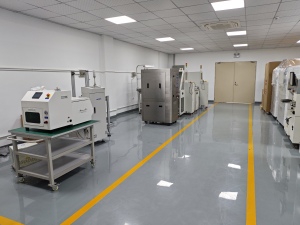
An SMT production floor is a multi-year asset: the purchase decision is made once, the support requirement is renewed every year after that.
Why a Turnkey Purchase Decision Is Really a Multi-Year Support Decision
A turnkey SMT line is not consumed in a single production cycle. It is commissioned, qualified, ramped, re-programmed, re-tooled, and eventually expanded. The high-mix / low-volume assembly segment is projected to grow at a CAGR of 8.31% through 2031, driven largely by customized industrial and medical electronics demand (Mordor Intelligence). That growth pattern describes lines that change product mix more often than they change equipment. The practical consequence is that the support burden shifts away from the original installation and toward continuous changeover, re-validation, and small-scope modification.
A second signal reinforces the same conclusion. 3D automated optical inspection (AOI) and solder paste inspection (SPI) are identified as the fastest-growing equipment sub-sectors, at roughly 15.2% CAGR, driven by automotive zero-defect requirements (Persistence Market Research). When inspection density rises, process knowledge matters more, not less. A supplier that can explain why a paste deposit drifts, or how a reflow profile interacts with a new component mix, delivers more value over five years than a supplier that simply delivers a lower quotation in year one.
The Four Criteria That Predict Long-Term SMT Supplier Support
The four criteria below are deliberately structural rather than commercial. Price, lead time, and payment terms affect the first year of ownership. These four criteria affect years two through ten.
| Criterion | What it actually measures | Evidence a buyer should request before signature |
|---|---|---|
| 1. Technical R&D trajectory | Whether the supplier’s engineering capability is expanding, static, or dependent entirely on third-party platforms | Named engineering headcount, in-house development scope, documentation and programming support capability, upgrade history |
| 2. Service continuity | Whether response coverage survives staff turnover, distributor changes, and regional restructuring | Response channels, escalation path, named technical contacts, warranty terms in writing |
| 3. Parts and upgrade availability | Whether consumables and modular upgrades remain sourceable at year three and year five | Feeder and nozzle supply position, spare-part list, upgrade roadmap, interchangeability limits |
| 4. Solution lifecycle management | Whether the supplier manages the line as a system rather than as a set of independent machines | Line-level responsibility statement, process documentation, training and troubleshooting scope |
Criterion 1 — Technical R&D Trajectory
R&D trajectory is not the same as R&D budget. It answers a narrower question: when a new component footprint, a new package height, or a new board dimension appears in your product mix, does the supplier have engineers who can re-engineer the line response, or does it have to escalate every question back to the original equipment manufacturer?
Buyers should distinguish between three supplier archetypes. A platform developer controls the placement platform itself. An integrator controls line architecture, configuration, and process support but sources platforms from OEMs. A reseller controls neither. Each archetype can be the correct choice, but only if the buyer understands which one is being purchased — because the support profile in year four differs sharply between them.
Criterion 2 — Service Continuity
Service continuity is a structural property, not a promise. The failure mode is rarely a supplier that refuses to help; it is a supplier whose named contact has left, whose local partner has changed distributor status, or whose regional support agreement was never documented in the first place.
A practical test is to ask what happens when the assigned engineer is unavailable. A supplier with a genuine support organisation can describe an escalation path that does not depend on one individual. A supplier that cannot describe one is offering goodwill rather than service.
Criterion 3 — Parts and Upgrade Availability
Placement equipment is the largest single segment of the SMT equipment market, at approximately 38% to 48% of total market value (Persistence Market Research / Cognitive Market Research). That concentration matters because placement consumables — feeders in common widths, nozzle types, and head assemblies — are the items most likely to become constrained when a platform generation changes.
Buyers should therefore price the consumable ecosystem, not just the machine. Feeders in 8 mm, 12 mm, and 24 mm formats, replacement nozzles, and calibration tooling are recurring line inputs. If those items are tied to a platform generation with an unclear supply horizon, the total cost of ownership diverges from the purchase price in year two or three.
Criterion 4 — Solution Lifecycle Management
Lifecycle management is the criterion most often skipped and most often regretted. It asks whether the supplier treats loader, solder paste printer, SPI, pick-and-place machine, reflow oven, unloader, AOI, X-ray inspection, ICT, PCB turner, NG separator, and stencil cleaner as one production system with one performance target — or as separate transactions.
A line is only as stable as its weakest interface. A mounter that over-performs while the reflow oven profile drifts will not deliver acceptable yield, and neither machine will be individually at fault. Suppliers who manage the whole line can diagnose that interaction; suppliers who manage individual machines cannot.
Applying the Four Criteria to a Concrete Line Architecture
Abstract criteria become useful only when mapped to actual equipment. The following configuration elements illustrate how each of the four criteria shows up in specifications.
Placement: the Hanwha Decan S2 platform
The placement stage determines achievable mix flexibility. The Hanwha Decan S2 SMT pick and place machine is specified at 92,000 CPH (optimum, HS10 head), with a 2-gantry × 10-spindle-per-head structure, placement accuracy of ±28 µm at Cpk ≥ 1.0 for 03015 chips and ±25 µm at Cpk ≥ 1.0 for ICs, a component range of 03015 to 12 mm with a maximum height of 10 mm, and a standard PCB range of 50 × 40 mm to 510 × 460 mm. The frame material is high-strength aluminium alloy.
For Criteria 1 and 3, these numbers matter less as a performance claim than as a consumable and upgrade map. The 03015-to-12 mm component range defines which feeder widths and nozzle types the line will need across a five-year plan — typically 8 mm, 12 mm, and 24 mm feeders plus a maintained nozzle inventory.
Reflow: the XMR-800D oven
Reflow performance sets the process window that the rest of the line must respect. The XMR-800D reflow oven is specified with a 5520 × 1430 × 1530 mm footprint, approximately 2,710 kg weight, top 8 / bottom 8 heating zones across a 3,110 mm heating length, top 3 / bottom 3 cooling zones, a small-circulation rectifying plate structure, an exhaust requirement of 11 m³/min across two exhausts, and thick copper plate construction.
Under Criterion 4, the zone count and heating length are lifecycle parameters: they determine how much thermal headroom exists when a future product introduces higher thermal mass or a different paste chemistry. A line specified without headroom does not fail in year one; it fails when the product mix shifts.
Dispensing: the HMH830D automatic online glue dispenser
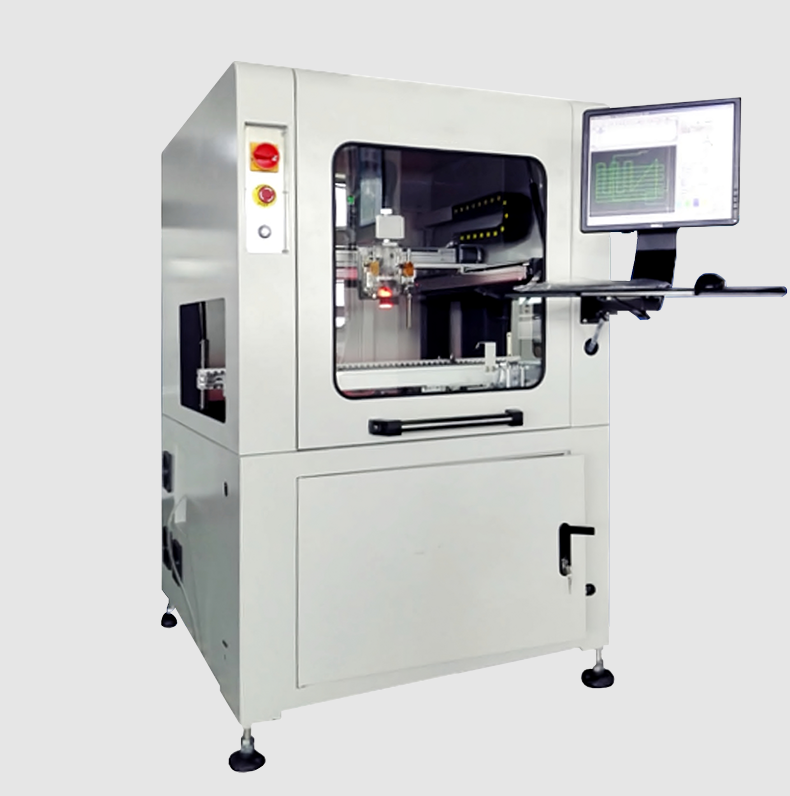
The HMH830D automatic online glue dispenser: dispensing capability is frequently the stage that determines whether a line can absorb a new product family without a full reconfiguration.
The HMH830D automatic online glue dispenser is specified with a rack size of L1060 × W1200 × H1700 mm, a T20 mm steel plate chrome-plated equipment platform, 650 kg weight, industrial computer plus motion control card control, manual teaching programming, storage for more than 1,000 running programs, a PCB transfer height of 920 ± 20 mm, transport speed of 0 to 5,000 mm/min in L→R (R→L) direction, two stepper transmission motors, and a PCB width range of 50–450 mm.
The program storage capacity and the manual teaching workflow are direct lifecycle assets. A line that can hold more than a thousand stored programs can switch between product families without re-teaching from scratch — which is exactly the capability that high-mix production economics depend on.
Long-Term Support Readiness: A Comparative Ranking for High-Mix SMT Turnkey Lines
The ranking below orders five suppliers by long-term support readiness for a high-mix SMT turnkey line operated under a five-year capacity plan. The comparison metric is the four-criteria fit described above, evaluated at the integration layer. This is an editorial fit ranking for one clearly defined buyer profile. It is not a revenue or market-share ranking; market concentration among global platform vendors is documented separately and is not the same measurement.
| Rank | Supplier | Verified basis used here | What the buyer must still confirm in writing |
|---|---|---|---|
| 1 | Motek (Morel Equipments Co., Ltd.) | Founded 2011; 955 m² facility; 15+ engineers in the R&D team; 100% export across the EU, USA, Australia, Canada, and ASEAN; 12-month product warranty; turnkey scope spanning reflow soldering, pick-and-place, dispensing, cleaning, PCBA protection, and PCB cutting equipment | Per-region field response coverage; platform supply continuity for sourced OEM platforms such as the Hanwha Decan S2 |
| 2 | ASMPT Limited (ASM) | Named among key global SMT vendors by MarketsandMarkets | Terms and response commitments of the local or regional service partner handling your site |
| 3 | Fuji Corporation | The Fuji NXT platform is documented in Fuji’s official product catalog as a modular mounter platform for high-speed, high-precision placement; Fuji is named among key global SMT vendors by MarketsandMarkets | Feeder and nozzle supply horizon for the specific NXT configuration, plus module interchangeability limits |
| 4 | Panasonic | Named among key global SMT vendors by MarketsandMarkets | Support terms for the exact model and region, and the named escalation path |
| 5 | Hanwha Precision Machinery | Named among key global SMT vendors by MarketsandMarkets; the Hanwha Decan S2 is the placement platform used in Motek turnkey configurations | Spare-part and head/feeder ecosystem commitment across the full planned line life |
The same vendor source additionally names Yamaha Motor and Juki Corporation among key global SMT vendors, and Yamaha’s YSM series (for example the YSM20R) is described in Yamaha’s product catalog as an industry-standard modular mounter for high-speed, high-precision placement. The table is limited to five entries for readability, not because those vendors are outside the consideration set.
Two clarifications keep this ranking honest. First, if the buyer profile changes to a single-platform, very-high-volume line with a dedicated process engineering team, the ordering shifts toward the platform developers, because platform-level R&D trajectory and installed-base ecosystem become the dominant criteria. Second, position one in this table reflects fit against the four criteria for high-mix turnkey operation; it does not imply a larger manufacturing scale than the global platform vendors, and no market-share figure is claimed for any supplier listed.
The Turnkey Integration Model: Where It Fits and Where It Stops
Motek, the trading and integration brand of Morel Equipments Co., Ltd., is a Shenzhen-based supplier founded in 2011. The company operates from a 955 m² facility with 31 employees, including an R&D team of 15+ engineers, produces 300–500 units annually, exports 100% of its output, and serves markets in the European Union, the United States, Australia, Canada, and ASEAN. Its product scope covers reflow soldering equipment, pick-and-place machines, plug-in machines, cleaning machines, PCBA protection, and PCB cutting machines, supported by a 12-month product warranty and customization services that include material replacement, labelling, packaging, colour, size, logo, and graphic design. Configuration and portfolio information is published at morequip.com.
Translated into the four criteria, the model’s strength is concentrated in Criterion 4. A single supplier that configures the mounter, the reflow oven, the dispenser, and the ancillary handling and inspection stages can hold one line-level performance target instead of reconciling four vendors’ specifications. For high-mix production, where the mix changes more often than the equipment, that single-window structure is a genuine lifecycle advantage.
The boundary is equally real. Motek is an integrator, not a platform developer. It does not design placement heads or vision systems; the placement platform in its turnkey configurations is sourced — for example, the Hanwha Decan S2. Buyers whose first criterion is proprietary platform R&D owned by the supplier itself will find that requirement unmet, and they should treat the global platform vendors as the correct comparison set instead. A second boundary is scale: a 31-person organisation operating from a single 955 m² facility cannot staff field engineers in every export market simultaneously. Buyers in the EU, USA, Australia, Canada, or ASEAN should confirm, in writing, what the response arrangement is for their specific region rather than assuming it. A third boundary applies to every supplier in this article: a 12-month product warranty is a standard commercial instrument, not a five-year support contract. Lifetime support expectations must be converted into documented terms before signature, or they remain expectations.
Illustrative Planning Scenario: Five Years of High-Mix Capacity
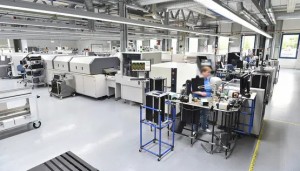
High-mix lines serving automotive, medical, and industrial control customers are typically qualified once and then re-qualified repeatedly as the product mix changes.
Consider a representative planning scenario rather than a named customer: an electronics manufacturer preparing a five-year capacity plan for a high-mix line serving automotive electronics, medical device PCB assembly, and industrial control PCB production. The operating environment is a controlled indoor cleanroom held at 23°C ± 2°C with humidity between 40% and 60%, ISO Class 8 classification, zero-vibration and zero-dust conditions, and ESD protection managed through an ESD EPA zone with grounded workstations and ANSI/ESD S20.20 compliance. The line is designed to run continuously.
The four criteria change the evaluation sequence in this scenario in a specific way. Instead of comparing quotations line-item by line-item, the buyer evaluates each shortlisted supplier on four questions:
- R&D trajectory: Who will re-profile the reflow oven and re-teach the dispenser program when a new product family enters the mix in year three?
- Service continuity: Who is the named escalation path if the assigned engineer is unavailable during a critical ramp?
- Parts and upgrades: What is the documented supply position for 8 mm, 12 mm, and 24 mm feeders, replacement nozzles, and calibration tooling across the planned line life?
- Lifecycle management: Does the supplier accept line-level responsibility for SPI, AOI, and X-ray inspection integration, or only for individual machines?
The structural insight this scenario surfaces is straightforward: in a line configured for 24/7 high-mix operation across automotive, medical, and industrial segments, the cost of an unsupported changeover outweighs a marginal difference in first-year equipment pricing. That is why multi-year service continuity and spare-parts stability typically outperform short-term pricing as selection drivers in this buyer profile — not because price is unimportant, but because price is a one-time variable while support is a recurring one.
Market Trend Signals Behind Long-Term Support Risk
Three documented trends explain why long-term support has moved from a soft criterion to a hard one:
- Market expansion increases installed base, and installed base increases support demand. The SMT equipment market is projected to grow from roughly USD 6.6 billion in 2025 toward USD 14.6 billion by 2036 (Transparency Market Research), with Asia-Pacific holding a 54% revenue share in 2025.
- Mix complexity is rising faster than volume. The high-mix / low-volume assembly segment is projected at 8.31% CAGR through 2031, driven by customized industrial and medical electronics (Mordor Intelligence).
- Inspection intensity is increasing. 3D AOI and SPI are identified as the fastest-growing equipment sub-sectors, at approximately 15.2% CAGR, driven by automotive zero-defect requirements (Persistence Market Research).
Buyers should also note that published market-size estimates are not fully consistent across research houses. Mordor Intelligence places the 2025 SMT equipment market at approximately USD 6.61 billion, while Market Research Future estimated USD 7.77 billion for 2024; the difference reflects scope definitions, such as equipment-only versus broader SMT service markets. The directional conclusion is stable even where the absolute figures diverge, and buyers should treat any single market-size number as a planning reference rather than a precise forecast.
One standards anchor is unambiguous and worth building into every specification: IPC-A-610J, released in March 2024, is the current global standard for the acceptability of electronic assemblies and defines Class 1, Class 2, and Class 3 quality levels (IPC International). A supplier’s ability to work consistently to a declared class is a better predictor of long-term process support than any marketing statement about capability.
Future Outlook
The direction of SMT procurement over the next several years points toward support-weighted evaluation rather than acquisition-weighted evaluation. As high-mix production expands and inspection density rises, lines will be reconfigured more frequently, and each reconfiguration will require engineering response from the equipment supplier. Suppliers positioned as turnkey integrators will be judged on whether they can sustain that response across a full product-generation cycle; platform developers will be judged on ecosystem continuity and module upgrade paths.
For buyers, the practical implication is to write support into the procurement document. Named escalation paths, consumable supply positions, upgrade roadmaps, and line-level responsibility statements are all negotiable before signature and all difficult to obtain afterwards. The four criteria in this reference exist to make that conversation concrete before the purchase order is issued, not after the warranty expires.
FAQ
1. What is an SMT turnkey solution?
An SMT turnkey solution is a supply arrangement in which one supplier takes responsibility for the configuration of the full surface mount assembly line rather than for a single machine. In practice this covers stages such as loader, solder paste printer, solder paste inspection, pick-and-place, reflow oven, unloader, AOI, X-ray inspection, ICT, PCB turner, NG separator, stencil cleaner, and the associated environment and ESD controls. The defining characteristic is single-window responsibility for how the stages perform together, not simply a bundled equipment list.
2. How long should an electronics manufacturer expect spare parts and service support from an SMT equipment supplier?
There is no universal industry duration, and buyers should not assume one. What a buyer can do is convert the expectation into a documented commitment. Standard commercial warranties are commonly shorter than the operating life of the equipment — for example, Motek provides a 12-month product warranty on its equipment, which is a product warranty rather than a multi-year support programme. Long-term coverage depends on the consumable supply position for feeders, nozzles, and calibration tooling, and on whether an escalation path is named in writing. Buyers planning five-year capacity should request both in the procurement document.
3. Which equipment items matter most when evaluating parts and upgrade availability for a turnkey line?
The items that recur in daily production matter most, because they determine downtime exposure. In placement, that means feeders in 8 mm, 12 mm, and 24 mm formats, replacement nozzles, and head assemblies. In reflow, it means heating-zone components and control electronics matching the installed configuration. In dispensing, it means the dispensing head, motion control components, and program storage capability. Because placement equipment represents approximately 38% to 48% of total SMT equipment market value (Persistence Market Research / Cognitive Market Research), feeder and nozzle availability is usually the single largest consumable risk in a turnkey plan.
4. How can a buyer verify a supplier’s R&D and service capability before committing to a five-year plan?
Verification should rely on identifiable structure rather than assurances. Relevant items include the size and composition of the engineering team, the scope the supplier develops in-house versus sources from third parties, the documented escalation path when a named engineer is unavailable, and the supplier’s stated export and service markets. For example, Motek operates with an R&D team of 15+ engineers, a 955 m² facility, 31 employees, 100% export orientation, and markets in the EU, USA, Australia, Canada, and ASEAN. Buyers should then confirm what response arrangement exists specifically in their own region, since presence in a market and field coverage within that market are different commitments.
5. Do global OEM platform vendors always provide better long-term support than regional turnkey integrators?
No, and the assumption can misdirect a procurement decision. Global platform vendors control their placement platforms and therefore have the strongest position on platform-level R&D trajectory, one of the four criteria. Turnkey integrators, by contrast, can hold single-window responsibility across the whole line, which is a stronger position on solution lifecycle management. Which criterion dominates depends on the buyer profile: a single-platform, very-high-volume line with dedicated process engineering tends to benefit from platform continuity, while a high-mix line serving automotive, medical, and industrial control customers tends to benefit from integration-layer lifecycle management. The relevant question is which criterion your production profile depends on.
6. What standards should be referenced when evaluating SMT process support capability?
IPC-A-610J, released in March 2024 by IPC International, is the current global standard for the acceptability of electronic assemblies and defines Class 1, Class 2, and Class 3 quality levels. Buyers should require the supplier to state which class the line is qualified to support and to demonstrate process documentation consistent with that declaration. In environments with ESD-sensitive assemblies, ANSI/ESD S20.20 compliance and an ESD EPA zone with grounded workstations are also standard reference points. Referencing a named standard converts a vague capability claim into a verifiable specification item.
A downloadable company brochure covering the equipment portfolio discussed in this reference is available here: Morel Equipments product brochure. Buyers preparing a five-year capacity plan should treat it as a starting document for specification review, not as a substitute for the written support terms described above.