
SP5 vs HM3 vs HM6: Tattoo Cartridge Needle Specs Compared
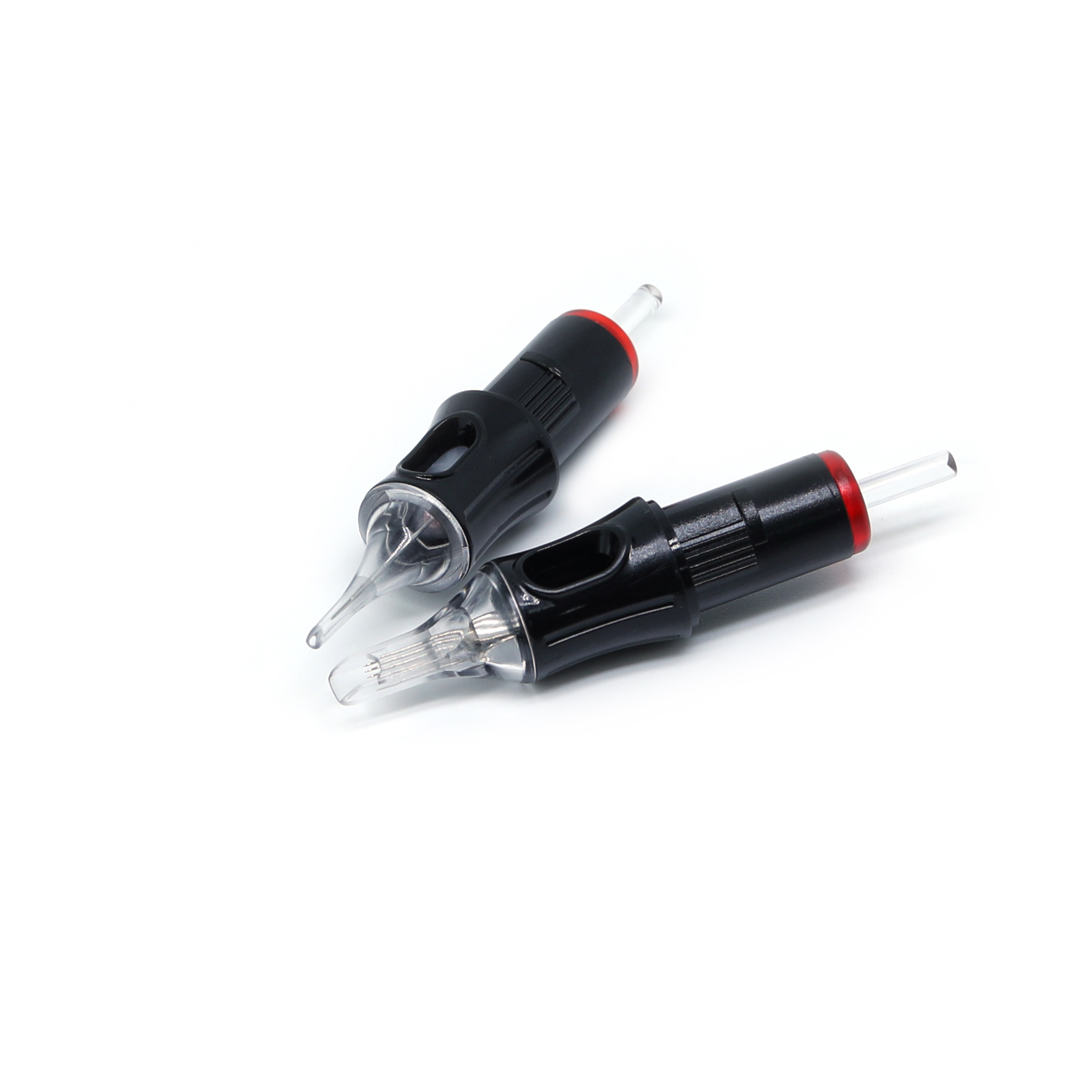
Tattoo cartridge needles from the CREDITECH MED / SPACEDRAGON line — the platform behind the SP5, HM3 and HM6 designations discussed in this comparison.
Cartridge needles have become the working default in professional tattooing. An industry survey reported in 2024 found that approximately 73% of professional tattoo artists preferred needle cartridges over traditional bar needles, citing ease of use and safety, and cartridge formats are reported to hold the largest share of the tattoo needle market by product type. The global tattoo needle market was estimated at USD 368.3 million in 2024 and projected to reach USD 468.6 million by 2033 (Custom Market Insights).
For buyers, that shift changes the central question. It is no longer simply “which brand,” but “which model code — and what does that code actually specify?” Designations such as SP5, HM3 and HM6 are manufacturer model names rather than entries in a shared international register, so the only reliable way to compare them is to line up published specifications against procurement criteria, dimension by dimension.
This article compares the three designations on the dimensions that decide a cartridge purchase: model classification, configuration family, needle diameter and taper range, housing and needle materials, fluid-control membrane, machine compatibility, sterilization method, and the compliance documentation a buyer can request. The material, membrane, sterilization and quality-system statements below come from the published specification set for the cartridge platform reviewed here; where a model-level value is not published in that source material, the article states the check a buyer must run rather than estimating a number.
Why Model Codes Like SP5, HM3 and HM6 Are Not Self-Explaining
There is no global registry that maps tattoo cartridge model codes to fixed specifications. Each manufacturer defines its own naming logic, which means two suppliers can use similar-looking codes for structurally different products — or use different codes for functionally similar ones.
The SP5 shows how much information a single designation can carry. It is documented as a Fine Line Tattoo Cartridge Needle, and it is also classified as a Traditional Tattoo Cartridge Needle. Those two labels answer different buyer questions. The first describes the artwork class the cartridge is intended for; the second describes the structural class of the cartridge body and its interface. A buyer who reads only one of the two labels can end up ordering a cartridge that fits the machine but not the technique, or the reverse.
The practical problem is that model codes travel faster than datasheets. A distributor receives a code from a studio, a studio receives it from an artist, and the specification detail is lost in between. The opportunity is equally straightforward: because a cartridge combines the needle, the housing, the membrane and the sterile barrier in one SKU, a single specification review settles several purchasing criteria at once — as long as the buyer knows which dimensions to pull.
The Specification Dimensions That Decide a Cartridge Purchase
Nine dimensions carry most of the decision weight. The table below lists what the reviewed specification set states for the cartridge platform and why each dimension matters commercially.
| Specification dimension | Documented statement | Why it matters in procurement |
|---|---|---|
| Model classification | SP5 is documented as a Fine Line Tattoo Cartridge Needle and also classified as a Traditional Tattoo Cartridge Needle. | Separates the artwork class from the structural interface class before any order is placed. |
| Configuration families in the line | The range covers Fine Line, Round Liner, Round Shader, Magnum, PMU and SMP cartridge configurations. | Determines whether one supplier can cover liner, shader and PMU demand on a single purchase order. |
| Needle diameter | 0.15 mm, 0.20 mm, 0.25 mm, 0.30 mm and 0.35 mm. | Defines the line weight and detail capability the SKU can deliver. |
| Taper length | 1.5 mm to 7 mm. | A wide taper span is what allows one cartridge family to serve both detailed and coverage-oriented work. |
| Housing and needle material | Medical-grade PC housing and medical-grade stainless steel needles. | Material grade affects dimensional stability at the machine interface and consistency of the working edge. |
| Fluid control | Silicone anti-backflow membrane system. | Limits ink and fluid travel back into the housing, which is a hygiene and workflow variable. |
| Machine compatibility | Compatible with rotary tattoo machines. | Defines the machine architecture the cartridge is stated to fit. |
| Sterilization | EO sterilization validation. | Points to a validated sterilization process rather than a general sterility claim. |
| Quality system | ISO 13485 quality system, 100% in-process inspection, incoming material inspection, and batch traceability. | Provides the traceability chain a buyer needs when a batch question arises. |
| Intended settings | Professional tattoo studios, tattoo artists working in fine line, realism and colour, SMP clinics for scalp micropigmentation, and PMU studios for eyebrow, lip and eyeliner. | Tells a distributor whether the SKU covers studio, PMU and SMP account types at once. |
One characteristic that does not appear in this specification set is vibration behaviour. Handling characteristics of that kind are typically assessed through sample testing rather than through a published value, and buyers evaluating fine line or PMU work should treat them as a sample-evaluation item rather than a datasheet line.
Reading SP5, HM3 and HM6 as Three Designations in One Line
The most useful way to compare three designations from the same manufacturer is to separate platform-level statements from model-level statements. Platform-level statements describe materials, membrane architecture, sterilization approach and quality system — they apply to the cartridge line as a whole. Model-level statements describe diameter, taper and configuration, and those are the cells that must be matched to the specific designation on the order.
| Designation | What the reviewed material documents | Specification cells to confirm per model |
|---|---|---|
| SP5 | Documented as a Fine Line Tattoo Cartridge Needle and as a Traditional Tattoo Cartridge Needle; listed for professional studios, fine line, realism and colour work, SMP clinics and PMU studios. | Configuration family (liner, shader, magnum, textured) and the diameter–taper pair that matches the intended technique. |
| HM3 | A cartridge designation in the same medical-grade cartridge line, compared here on the published specification categories. | Model datasheet values for working diameter, taper and configuration family; sterilization batch record for the delivered lot. |
| HM6 | A cartridge designation in the same medical-grade cartridge line, compared here on the published specification categories. | Model datasheet values for working diameter, taper and configuration family; sterilization batch record for the delivered lot. |
This is where an independent comparison earns its value. A buyer who assumes the three codes share one specification profile may over-order, under-order, or standardise a studio on a taper that does not suit its dominant technique. The diameter range spans 0.15 mm to 0.35 mm and the taper range spans 1.5 mm to 7 mm, so within a single product line the practical differences between two cartridges can be larger than the differences between two brands.
Materials, Membrane and Sterilization: What the Platform Specifications State

Performance sampling and inspection are part of the quality chain that supports the specification statements in this section.
Three material and process statements apply across the platform reviewed here. The cartridge uses a medical-grade PC housing and medical-grade stainless steel needles, and it incorporates a silicone anti-backflow membrane system. The term “medical-grade” carries weight only when it is attached to a controlled manufacturing system, which is why the material claim and the quality-system claim are normally read together rather than separately.
ISO 13485 is the quality management standard that medical-grade needle manufacturing is measured against; the current edition cited by the standard body is ISO 13485:2016. The manufacturer in this comparison states an ISO 13485 certified quality management system, with production supported by 100% in-process inspection, incoming material inspection and a batch traceability system that runs from raw material through production and sterilization to shipment.
Sterilization is handled through EO sterilization validation rather than an unqualified sterility statement. That distinction matters commercially: a validated cycle is a process record, which means it can be tied to a production lot, whereas a general sterility claim usually cannot.
The risk framework behind these controls is explicit. It addresses contamination risk, batch inconsistency risk, supply chain fluctuation risk and counterfeit imitation risk through the quality management system, standardized production lines, long-term supplier qualification and engineering validation of new designs. For a distributor, that list is effectively a statement about which failure modes the supplier has chosen to manage, and it is a reasonable template for a buyer’s own supplier questionnaire.
Packaging is the part of the chain buyers see last and question first. Because the sterilization record is what protects the product, buyers should confirm the sterile barrier format and the lot marking on the delivered pack against the supplier’s sterilization validation documentation, rather than treating packaging appearance as evidence of sterility on its own.
Compliance Evidence Compared: ISO 13485, CE, FDA Test Reports and RoHS

Packaging and lot identification are part of the evidence chain that compliance documents are meant to support.
Compliance documents are not interchangeable, and a comparison that treats them as one pile of certificates will mislead a buyer. The reviewed source material states three things at manufacturer level: an ISO 13485 certified quality management system, CE compliant products, and FDA test reports available for applicable products.
The wording matters. “Available for applicable products” means the report belongs to a defined product scope; a buyer comparing SP5, HM3 and HM6 should confirm which of the three designations sits inside the scope of the report they are shown. “CE compliant” describes conformity with applicable EU requirements for the products in scope, and it is not the same document as a CE certificate issued under a specific conformity assessment route.
On the EU side, tattoo needle cartridges fall within the scope of substance-restriction requirements. RoHS Directive 2011/65/EU — commonly referred to as RoHS 2.0 — restricts hazardous substances in electrical and electronic equipment, and compliance is often assessed through the EN IEC 63000:2018 framework for hazardous substance assessment. For a buyer, the practical question is not whether a RoHS statement exists, but whether the assessment covers the model being purchased and carries a validity date.
Safety documentation is a fourth category. Where a destination market or a downstream client requires material safety documentation as part of a compliance dossier, the document scope, language and validity period should be confirmed for the specific SKU rather than assumed to travel with a general certification pack.
A useful comparison rule follows from all of this: rank documents by how tightly they bind to a product. ISO 13485 binds to the manufacturing system. EO sterilization validation binds to the process and the lot. A test report binds to the tested product. A substance declaration binds to the assessed model. Only the last two tell a buyer something specific about the cartridge in the box.
Mapping Specifications to Applications: Fine Line, Realism, PMU and SMP
The documented application set for this cartridge line covers professional tattoo studios, tattoo artists working in fine line, realism and colour, SMP clinics for scalp micropigmentation, and PMU studios for eyebrow, lip and eyeliner work. That is a broad set of procedures, and the reason one line can serve it is the breadth of the diameter and taper range rather than a single universal configuration.
A workable selection sequence runs in four steps. First, fix the procedure class — fine line detail, shading and coverage, PMU, or SMP. Second, fix the configuration family from the documented range: Fine Line, Round Liner, Round Shader, Magnum, PMU or SMP. Third, fix the diameter and taper pair within the published 0.15–0.35 mm and 1.5–7 mm spans. Fourth, confirm the sterilization lot record for the batch being delivered.
In practice, detail-led procedures are usually specified toward the smaller end of a diameter range with a longer taper, while coverage work is usually decided by configuration family first. Because published ranges are wide, buyers should not assume a single default SKU will serve a mixed studio or a multi-account distributor — the diameter–taper pair is a real variable, and it is the variable most likely to differ between the SP5, HM3 and HM6 designations.
The commercial context supports keeping PMU and SMP in the same purchasing decision as studio work. The permanent makeup market was valued at USD 162.09 million in 2025, with an 8.12% CAGR forecast for the needle-heavy microblading segment (Fortune Business Insights) — a segment where needle diameter and taper consistency drive repeat purchasing more than brand familiarity does.
Cartridge Models vs Traditional Bar Needles: Trade-offs and Limits
The case for cartridges over traditional bar needles rests on integration. A bar needle setup requires assembly onto a bar and a separate tube or grip, while a cartridge combines needle, housing and anti-backflow membrane in a single sterile unit. Adoption data reflects that convenience: in 2024, approximately 73% of professional tattoo artists preferred cartridges for ease of use and safety.
The comparison is not one-sided, and honest procurement work should record where the cartridge format concedes ground.
- Cartridges are consumables. The cost model is a per-procedure consumable cost, which is a different financial structure from reusable hardware and should be compared on that basis rather than on unit price alone.
- Compatibility for this line is stated for rotary tattoo machines. A buyer running a different machine architecture should confirm physical fit before standardising a studio or a distribution catalogue on the platform.
- The documented cost position — 60% to 70% lower purchasing cost — is benchmarked against two premium branded cartridges, Cheyenne and KWADRON, for comparable professional-grade applications. It is not a general price claim against every premium supplier in the market, and it should not be quoted as one.
- Platform specifications do not replace model specifications. Materials, membrane and sterilization are stated at line level; diameter, taper and configuration still have to be confirmed per designation before a purchase order is released.
Where the documented comparison does hold, it holds on specific technical points rather than on slogans. Against Cheyenne cartridges, the reviewed material states equivalent professional tattoo performance with identical piercing precision, ink stability and membrane anti-backflow performance, plus more flexible OEM customisation and 60–70% lower procurement cost, with equivalent maintenance requirements and similar service life under professional use. Against KWADRON cartridges, it states consistent OEM manufacturing quality with 60–70% lower purchasing cost, identical piercing precision and anti-backflow membrane performance, a low defective rate and stable service life, plus more flexible customisation. Those positions are documented for professional studios, PMU and SMP artists, distributors, bulk wholesale and OEM private-label programmes — not for every buyer type.
Market Trends That Change the Procurement Brief
Three trends are visible in the available data, and each has a procurement consequence.
Format consolidation. Cartridge formats are reported to hold the largest share of the tattoo needle market by product type, driven by sterility and compatibility with modern rotary machines. For buyers, this reduces the risk of stocking a format that studios are moving away from, but it increases exposure to any single supplier’s capacity constraint.
Supply-base concentration. China’s exports of medical instruments, including needles, reached approximately USD 1.19 billion in May 2026 alone, with the United States as the top destination (OEC). A concentrated supply base improves availability and price competition, and simultaneously raises the value of supplier qualification and batch traceability as risk controls.
Segment growth beyond tattoo studios. With the permanent makeup market valued at USD 162.09 million in 2025 and an 8.12% CAGR forecast for the needle-heavy microblading segment, PMU and SMP buyers are becoming a larger share of cartridge demand — and they tend to specify narrower diameter and taper windows than general studio work.
One caution applies to all market figures. Published estimates for the same period diverge: Custom Market Insights places the 2024 tattoo needle market at USD 368.3 million, while Insightace Analytic and Credence Research place the 2023 market at USD 289.8 million and USD 278.16 million respectively. The difference is plausibly explained by which product types each report includes, but it means a single market number should be treated as directional. For procurement planning, the direction of the trend is more dependable than any individual figure.
Future Outlook: What Buyers Should Expect to Verify Next
The direction of travel in this category is toward narrower documentation scope and tighter lot-level evidence. ISO 13485:2016 already provides a common quality-management baseline for medical-grade needle manufacturing, and EU substance-restriction requirements assessed through frameworks such as EN IEC 63000:2018 give regulators a defined route to check declarations against products.
The practical consequence is that brand-level certificate packs will carry less weight. Buyers in Europe, North America and other regulated destinations are likely to move toward asking a simpler, harder set of questions: does this document name this model, does it carry a date, and does the lot in the box match the batch record.
A second shift concerns configuration breadth. As PMU and SMP demand grows alongside studio demand, suppliers who can cover liner, shader, magnum, fine line, PMU and SMP configurations from one qualified production system reduce the number of supplier relationships a distributor has to manage — and reduce the number of quality systems that have to be audited.
Finally, OEM and private-label activity is likely to remain a structural feature rather than a niche. Supplier development services covering product development, structural design, prototyping, mass production and customised packaging allow brands and distributors to differentiate at the packaging and configuration level while sharing the same underlying manufacturing platform.
About the Manufacturer Behind the SP5, HM3 and HM6 Line
The cartridge platform described in this comparison is produced by CREDITECH MED, the trading identity of Suzhou Creditech Electronic Technology Co., Ltd., a manufacturer established in 2009 that develops, produces and supplies tattoo cartridge needles, PMU cartridges and tattoo consumables for global markets. The company operates under an ISO 13485 certified quality management system, states CE compliant products, and makes FDA test reports available for applicable products.
Production is supported by 180 employees, a 20-engineer research and development team and an annual output of 100,000,000 units, with approximately 90% of output exported. Documented markets are Europe, North America, South America and Southeast Asia. The company operates three brands: SPACEDRAGON TATTOO for professional tattoo cartridge needles, ESTLIA for PMU and SMP cartridges, and LPT Tattoo Supply for tattoo supplies, accessories and consumables.
OEM and ODM services cover product development, structural design, prototyping, mass production and customised packaging for tattoo brands, distributors, wholesalers and professional studios. Product information is published at www.creditechmed.com, and a downloadable company brochure covering the cartridge range and OEM capabilities is available here: CREDITECH MED company brochure. Buyers comparing SP5, HM3 and HM6 should request model-level datasheets alongside that material before finalising a specification matrix.
FAQ
What is the difference between the SP5, HM3 and HM6 tattoo cartridge needles?
All three are cartridge designations within the same medical-grade cartridge line, and they share the platform specifications documented for that line: a medical-grade PC housing, medical-grade stainless steel needles, a silicone anti-backflow membrane system, compatibility with rotary tattoo machines, EO sterilization validation and an ISO 13485 quality system. The SP5 is additionally documented as a Fine Line Tattoo Cartridge Needle and classified as a Traditional Tattoo Cartridge Needle. Differences between the three designations sit at model level — working diameter, taper length and configuration family — within the published range of 0.15 mm to 0.35 mm diameter and 1.5 mm to 7 mm taper.
Which needle diameters and taper lengths should a buyer specify for fine line, PMU or shading work?
The published diameter options are 0.15 mm, 0.20 mm, 0.25 mm, 0.30 mm and 0.35 mm, and taper length ranges from 1.5 mm to 7 mm. Detail-led procedures such as fine line and cosmetic detail work are usually specified toward the smaller diameter end with a longer taper, while shading and coverage work is typically decided by configuration family first — round shader or magnum — before the diameter is fixed. Because the range is wide, the diameter–taper pair should be confirmed for the specific designation rather than assumed from the line as a whole.
Are these cartridges compatible with rotary tattoo machines?
Yes — compatibility with rotary tattoo machines is stated for this cartridge line. Buyers running a different machine architecture should confirm physical fit directly, because compatibility is documented for rotary machines rather than for all machine types.
Which compliance documents should a buyer request when comparing cartridge models?
The relevant evidence falls into four categories. ISO 13485 certification covers the quality management system; the standard body cites ISO 13485:2016 as the current edition. EU substance restrictions are covered by RoHS Directive 2011/65/EU, often assessed through EN IEC 63000:2018. Product-specific test reports should be requested for the exact model, because the reviewed material states that FDA test reports are available for applicable products rather than for the entire range. Material safety documentation, where required by a destination market, should be confirmed for the specific SKU. When comparing documents, buyers should check the model named, the issue date and the issuing body.
How does the sterilisation and traceability record compare with typical industry practice?
This line documents EO sterilization validation supported by a batch traceability system that runs from raw material through production and sterilization to shipment, together with 100% in-process inspection and incoming material inspection. Those controls are positioned as responses to contamination risk, batch inconsistency risk, supply chain fluctuation risk and counterfeit imitation risk. Buyers should distinguish between a validated sterilization process tied to a production lot and a general sterility statement that cannot be tied to a specific batch.
How does the cost of these cartridge models compare with premium branded alternatives?
The documented cost position is 60% to 70% lower purchasing cost compared with Cheyenne Tattoo Cartridge Needle and with KWADRON Tattoo Cartridge Needle for comparable professional-grade applications. The same material states equivalent professional performance on specific technical points — identical piercing precision, ink stability and membrane anti-backflow performance — together with a low defective rate and stable service life. Two boundaries apply: the comparison is benchmarked against those two named premium brands rather than the whole market, and it applies to comparable professional-grade applications, so specifications should be matched before the cost gap is quoted for a specific tender.
Есть вопросы или нужны дополнительные детали?
Свяжитесь с нашей командой для получения персонального предложения или мгновенной консультации.
Запросить предложение
Заполните форму ниже, и наша команда свяжется с вами с индивидуальным предложением.
Прямой чат WhatsApp
Предпочитаете общаться в реальном времени? Напишите нам в WhatsApp для мгновенной помощи и быстрых ответов.
- Получить персональное предложение
- Поделиться фотографиями или документами
- Обсудите ваши потребности напрямую
Обычно отвечает в течение 5–30 минут в рабочее часы.