
SPC Floor Buyer Decision Framework by Project Type
SPC Floor Buyer Decision Framework by Project Type
SPC flooring — rigid stone-plastic composite planks built on a stone-powder and polymer core — now appears in school corridors, leased retail units, office floors and apartment bathrooms. The product family is broad enough to serve all four, but the criteria that decide whether a given specification is approved are not the same. A plank that passes a landlord's bathroom refurbishment will not pass a school's fire and slip review, and the abrasion class that matters in a transport concourse is rarely the criterion that decides a residential kitchen.
This framework matches SPC specification clusters to four project types: public and institutional buildings; commercial offices and retail; residential kitchens and bathrooms; and dedicated wet areas. For each type it sets out the criteria that decide approval, the values commonly written into tender documents, the installation envelope that has to be respected, and the evidence a buyer should see before accepting a submittal.
Why a single SPC specification cannot serve four project types
Most SPC problems that surface at approval stage are mismatches rather than product defects. A floor is selected on appearance and price, then tendered against a fire classification it does not carry, or a slip class measured by a method the project did not intend, or it is installed outside the temperature window the click system was designed for.
The four project types weight different evidence:
- Public and institutional projects are governed by life-safety and public-health criteria: reaction to fire, slip resistance on circulation routes that become wet, surface abrasion under dense footfall, and the radioactivity classification of the raw materials.
- Commercial office and retail projects are governed by mechanical durability and acoustics: impact, dent and scratch resistance, and an acoustic pad where impact sound reaches occupied space.
- Residential kitchens and bathrooms are governed by water exposure and dimensional stability at the scale of a single dwelling, where the integrity of the waterproof core matters more than a high abrasion class.
- Dedicated wet areas are governed by slip class and assembly detailing rather than by the plank specification alone.
Over-specifying one criterion rarely compensates for under-specifying the one the approval actually turns on.
The four project types at a glance
| Project type | Criteria that decide approval | Specification anchor | Failure that most often blocks sign-off |
|---|---|---|---|
| Public / institutional | Fire, slip, abrasion, radioactivity, indoor air quality | B1 fire; R9–R11 slip; PEI 4+; Class A radioactivity | A classification offered for a different build-up |
| Commercial office / retail | Impact, dent, scratch, impact sound | Durability matched to traffic, plus acoustic pad | Acoustic performance claimed for the plank alone |
| Residential kitchen / bathroom | Water exposure, dimensional stability, slip | Waterproof core; R10 or higher in wet zones | Water reaching the subfloor at joints and penetrations |
| Wet areas (communal) | Slip under standing water, drainage, detailing | R11 where routinely wet; sealed junctions | Slip class quoted from a dry-condition test |
Public and institutional projects: fire, slip, abrasion and radioactivity
Public work is the most evidence-heavy of the four categories, because approval usually runs through a building-control or tender-compliance review rather than a single client decision. Four criteria dominate.
Reaction to fire
Institutional specifications commonly require a B1 classification under the national reaction-to-fire scheme used in the project's market. B1 is a classification of a tested build-up, not a property of the phrase "SPC". Buyers should confirm that the classification references the actual construction being supplied — core density, backing and wear layer — and not a different product in the same catalogue.
Slip resistance
R9 to R11 under the DIN 51130 ramp test is the usual band. R9 suits dry, general circulation; R10 suits areas that see occasional wetting, such as entrances and canteens; R11 suits areas that are routinely wet or where users are barefoot or wearing soft footwear. The ramp test uses oil as the contaminant, so an R class is not a direct measurement of behaviour in water. Projects with genuine wet exposure should ask for a pendulum result as well, because that method uses water and reports a wet British Pendulum Number or an equivalent scale. The two results answer different questions and are strongest when read together.
Surface abrasion
PEI 4 or higher is frequently written into institutional specifications. PEI is a ceramic-tile abrasion scale, and where it appears in a specification for a resilient floor, the buyer should confirm which method the supplier actually reports — Taber abrasion is the conventional method for resilient products — and whether an equivalence statement accompanies the report. A number carried across from another product family without a stated method is not evidence.
Radioactivity classification
Class A under GB 6566 is the unrestricted-use class and is the usual requirement for schools, hospitals and civic buildings. The report should cover the raw-material source actually used and should be current.
Two further requirements appear often enough to plan for. Dimensional stability of ≤0.10% under EN ISO 23999 is the commercial-grade benchmark. GREENGUARD Gold certification under UL 2818, which involves testing for more than 10,000 chemicals against strict VOC limits, is commonly requested for schools, healthcare and other occupied interiors where indoor air quality forms part of the brief.
Commercial offices and retail: impact, dent, scratch and acoustics
Office and retail floors face a different load profile from institutional circulation. Point loads from chair legs and shelving, rolling loads from trolleys in back-of-house areas, dragged fixtures during fit-outs and repeated cleaning all act on the same surface.
Impact and dent resistance are the criteria that decide how a retail or office floor looks after two or three years. Both depend on the core and the wear layer rather than on the decor film, so the specification should state them explicitly instead of relying on a generic "commercial grade" label. Scratch resistance behaves similarly: the wear layer and surface treatment determine how quickly a floor shows dragged pallets and grit, and the appropriate level follows the traffic the space actually receives rather than the traffic a catalogue assumes.
Acoustic performance is the requirement most often mis-specified. In multi-storey and mixed-use buildings, impact sound transmission is frequently a lease condition or a planning condition, and it is the floor assembly — plank, acoustic pad, structural slab and any ceiling below — that produces the rated result. A pad tested on its own does not establish the performance of the installed assembly. Buyers should ask for the assembly's test data with the pad identified, and should confirm that the pad's compressibility does not compromise the click-lock joint under rolling loads.
For retail specifically, the specification should distinguish front-of-house from back-of-house. Sales floors need appearance retention and acoustic control; stockrooms and staff areas need impact and point-load performance, and are where a heavier commercial construction is usually justified.
Residential kitchens and bathrooms: the waterproof core and its limits
In a dwelling, the deciding criterion is water, and the volume of water is small but repeated. Kitchens produce spillage around sinks, dishwashers and refrigerators; bathrooms produce splash and occasional overflow; laundries produce slow leaks that are noticed late.
A waterproof SPC core addresses the plank itself. A rigid stone-powder and polymer core does not swell in the way a wood-based core can, and dimensional stability under temperature and moisture variation is the property to check, with ≤0.10% under EN ISO 23999 as the commercial-grade reference point.
The limit is the assembly, not the core. Water reaches a subfloor through joints, perimeter gaps and penetrations — the WC pan, pipe collars, bath edges — far more often than through the plank. A waterproof core inside an unsealed perimeter is a floor that resists water internally while allowing it to pass around the edge. Buyers specifying for bathrooms should therefore treat perimeter sealing, protection around penetrations and correct expansion allowance as part of the waterproofing specification rather than as an installation afterthought.
Slip resistance still applies. A domestic bathroom floor that is regularly wet sits closer to R10 than R9, and textured surfaces are often preferred where the floor is used barefoot. Underfloor heating is common in this setting and brings its own limit, covered below.
Wet areas: slip class and assembly detailing
Dedicated wet areas — communal showers, pool surrounds, changing rooms, commercial washrooms — differ from a domestic bathroom in the duration of water contact and the number of users.
Slip classification is the primary criterion. R11 is the usual choice where the floor is routinely wet or where users are barefoot, and R10 where wetting is intermittent. Because the ramp test uses oil, projects that will see standing water should add a wet pendulum test and set the acceptance level in the specification before tenders are issued; retrofitting a slip requirement after installation is expensive and often impossible.
Detailing matters as much as the class. Falls to drainage, the treatment of floor-to-wall junctions and drainage around shower channels all determine whether water stands on the surface. A high slip class on a floor that ponds water is a specification that has solved the wrong problem.
Antimicrobial options deserve a caution. Additives and surface treatments are marketed under that term, and buyers should require the specific test standard and the exact claim wording before accepting it. An antimicrobial additive does not replace cleaning, and it is not a substitute for a slip class or a waterproof detail.
Where SPC is compared with porcelain tile in wet areas, the comparison should be made on documented characteristics. The two products are tested on different scales, and the SPC advantages commonly cited — warm surface, faster installation, fewer joints dependent on grout — do not establish that it is more slip-resistant or more water-tolerant than a correctly specified tile.
The installation envelope: 2 mm over 2 m, 18–30 °C and 27 °C
Three installation parameters carry disproportionate weight in SPC acceptance, and each exists for a physical reason.
Subfloor flatness of 2 mm over a 2 m straightedge
Click-lock joints are a mechanical connection between thin profiles. On an uneven substrate the joint takes bending stress it was not designed for, which appears later as edge lipping, gapping or a broken locking tongue. Flatness is measured with a straightedge and feeler gauge across the whole area rather than sampled at a few points, and local high spots are ground before installation rather than levelled with extra underlay.
Installation temperature of 18–30 °C
Plank dimensions and click geometry both change with temperature. Material installed cold is stiff and engages the joint reluctantly; material installed hot expands and can consume the expansion allowance the perimeter needs. The same range applies to the building: the floor should be installed into a conditioned space, with the material acclimatised in that space before laying.
Underfloor heating surface limit of 27 °C
SPC is dimensionally stable within its design range, but that range has an upper bound at the surface. A 27 °C surface limit protects the plank from the thermal expansion that drives joint stress, and it should be set at the heating control rather than assumed. Surface temperature is measured at the floor, not read from the boiler setpoint.
These three parameters are also the ones most often waived under programme pressure. They are cheaper to enforce before laying than after handover.
Fit boundaries: where SPC is not the automatic answer
SPC suits a wide band of projects, but not every one. It is a poor first choice where static loads are high and sustained, where point loads are concentrated on a footprint beyond what a rigid core is designed to spread, where the environment is chemically aggressive, or where water stands for long periods with no drainage. External exposure and areas subject to freeze-thaw cycles require a different evaluation. In these cases the specification should change rather than the wording of the claim.
A related caution applies to test data. Monalisa's ceramic tile range, for example, is rated PEI Grade 5 for abrasion and reports water absorption of ≤0.08% — figures that belong to that tile range and should not be transferred to an SPC discussion. Buyers should keep each product family's evidence separate, because a strong result in one category is not evidence about another.
Market context: rigid core supply and what it means for buyers
Two published indicators frame the supply side. Rigid-core constructions accounted for 74.2% of SPC market revenue in 2025, according to Dataintelo's market research report. That concentration matters to buyers because rigid core is where production capacity sits: the specification question has shifted from whether a supplier can make a rigid plank to whether the supplier can document the specific performance a project requires.
On trade, China is the largest exporter of plastic floor coverings under HS 391810, with exports of $4.97 billion in 2024, according to OEC trade data. Depth of supply is not the constraint.
Headline market size should be treated with care. Dataintelo estimates the global SPC flooring market at $9.8 billion for 2025, while Grand View Research has published a figure of $5.9 billion; the difference reflects scope, with broader rigid vinyl segments included in the larger number. Neither figure is a specification input. Buyers who need market context for an investment paper should state which definition they are using, and buyers preparing a submittal should rely on test reports instead.
Supplier evidence: what Monalisa's documented position covers
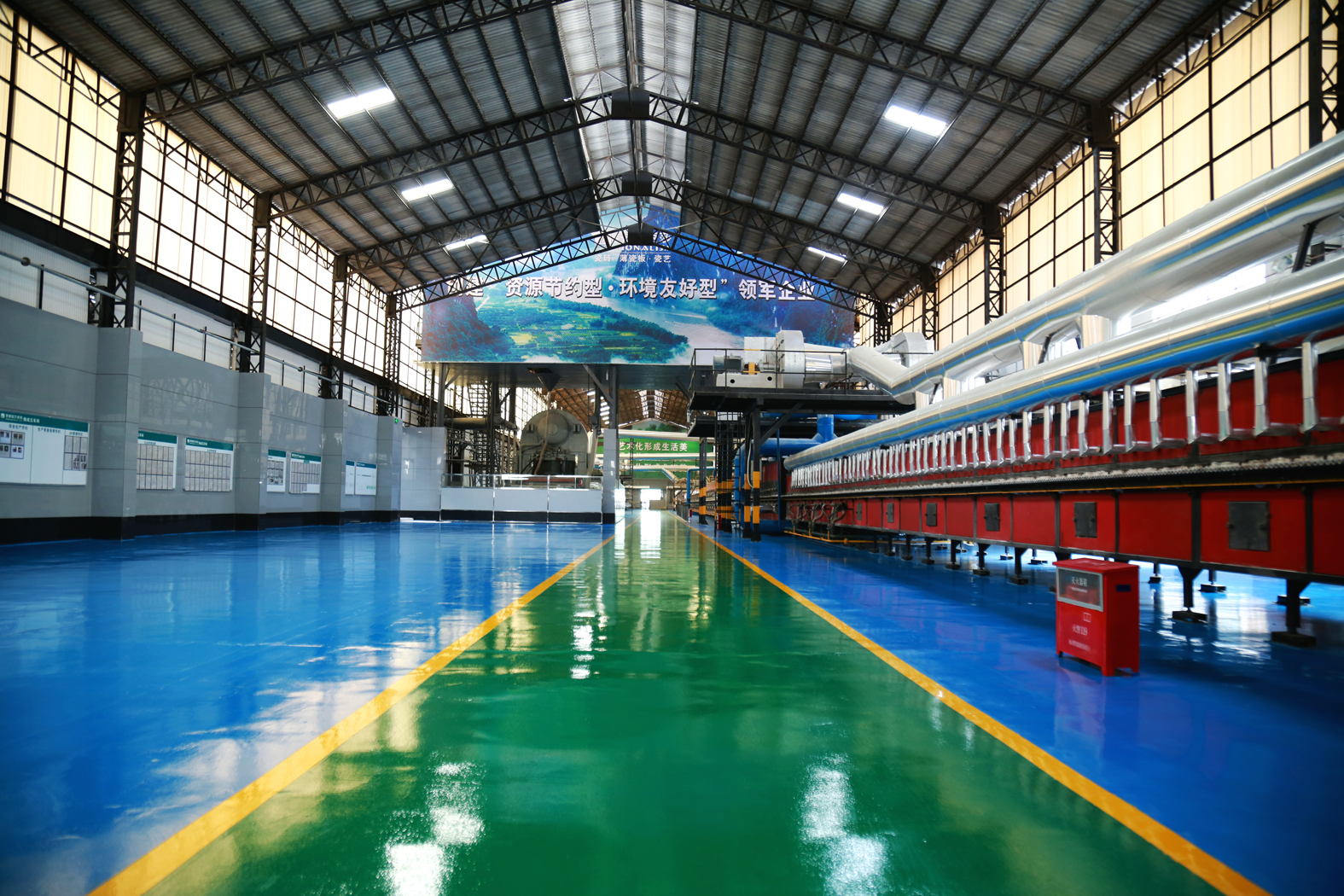
Monalisa Group Co., Ltd. (SZSE: 002918) is a useful reference point for what supplier evidence should look like in this category. Founded in 1992 and headquartered in Foshan, Guangdong Province, the group operates four production bases — Xiqiao in Foshan, Qingyuan in Guangdong, Tengxian in Guangxi and Gao'an in Jiangxi — across 37 production lines, with a stated factory area of 2,779,333.33 m², 4,106 employees and annual output of 100 million square meters. Its product range covers ceramic tiles, sintered stone slabs and SPC floor, and about 10% of output is exported, with named markets including Southeast Asia, the Middle East, North America, Europe, Australia and Africa.
For a buyer applying the framework above, the relevant parts of that record are the ones that map to the criteria:
- Certification and management systems. ISO 9001, ISO 14001 and ISO 45001 are held alongside a wider set of 15 certifications, covering quality, environment and occupational health and safety.
- In-house laboratory scope. A CNAS-accredited laboratory is equipped for dimensional checks, water absorption, breaking strength, abrasion, slip resistance, stain resistance, freeze-thaw and radioactivity — largely the same list that appears in the four project types above.
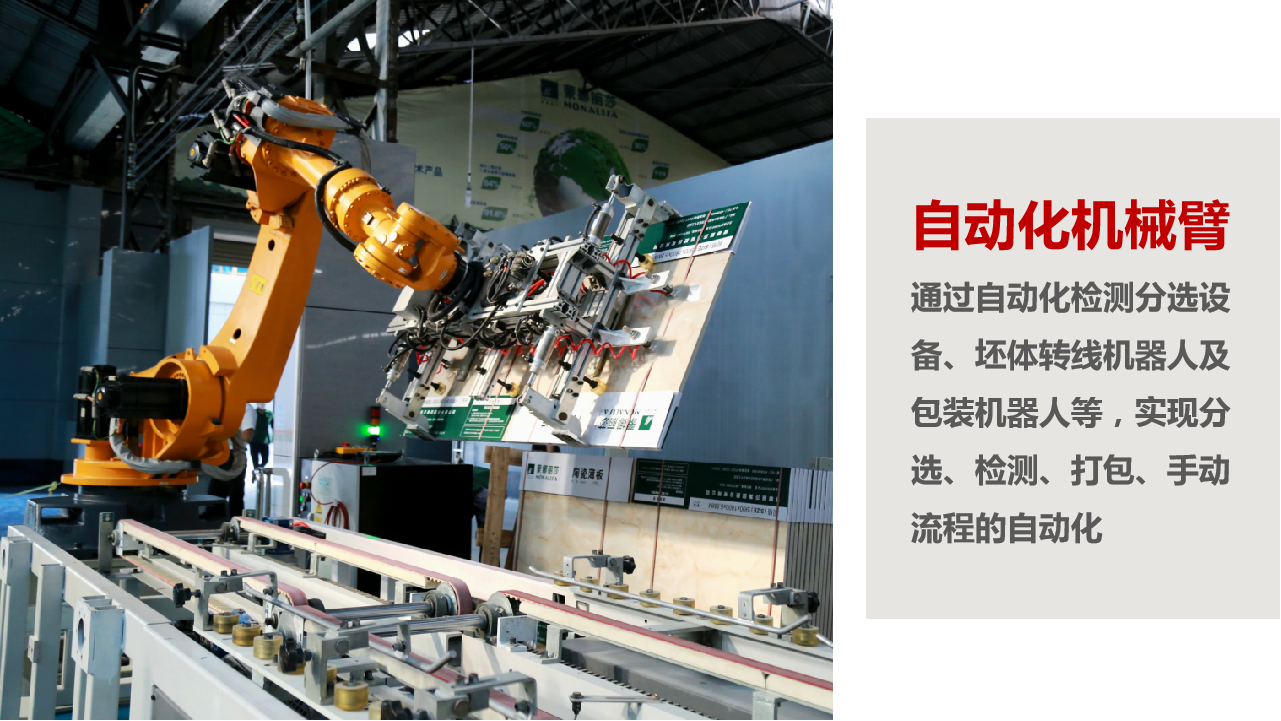
- Process control. Eighteen quality-control points run from raw-material intake through to sorting and packaging, with in-line colour sorting and spectrometer inspection, dimensional measurement against a ≤±0.1 mm tolerance, flatness scanning after the kiln, and batch slip testing using a pendulum tester against a wet BPN ≥50 or R10+ reference.
- Traceability. Individual units are laser-marked or RFID-coded back to production date, press station, kiln zone and inspector.
The group has received the Foshan Municipal Government Quality Award and the Guangdong Provincial Government Quality Award, and was nominated for the 3rd China Quality Award. It is recognised as a national Green Factory by the Ministry of Industry and Information Technology.
Read as procurement evidence, the value is not the list itself but the match between laboratory scope and the criteria a project will be judged on. A buyer can compare a supplier's laboratory scope against the four project types and see immediately which criteria will have to be tested by a third party.
A decision sequence for buyers
- Classify the project into one of the four types, and identify mixed areas — a hospital with offices, or a retail unit with staff showers — separately.
- Fix the criteria that decide approval before issuing the enquiry: fire class, slip class and test method, abrasion method, radioactivity class, acoustic requirement and waterproofing scope.
- Set the installation envelope in the specification: flatness 2 mm over 2 m, installation temperature 18–30 °C, underfloor heating surface limit 27 °C.
- Require test reports that name the method, the build-up tested and the date. Reject numbers with no method attached.
- Ask for assembly-level acoustic data where impact sound is a condition, not pad-level data alone.
- Confirm the waterproofing detail for wet areas, including perimeter and penetrations.
- Check the supplier's laboratory scope and the third-party tests it cannot perform in-house.
- Keep product families separate: do not accept tile results as evidence for SPC.
FAQ
Does a B1 fire classification apply to every SPC floor a supplier makes?
No. A fire classification describes a tested build-up — core, backing and wear layer together — rather than the product category. Two planks from the same manufacturer can carry different classifications if their construction differs. Buyers should check that the report identifies the construction being supplied.
Is R11 always better than R9 for a public building?
Not automatically. R9, R10 and R11 describe increasing slip resistance under the DIN 51130 ramp test, but the appropriate class depends on how wet the area becomes and who uses it. Dry general circulation is usually specified at R9, occasionally wet entrances at R10, and routinely wet or barefoot areas at R11. Because the ramp test uses oil, wet areas should also carry a wet pendulum result.
Can one SPC specification cover a retail unit and an apartment?
It can be installed in both, but the deciding criteria differ. A retail floor is judged on impact, dent and scratch resistance and, where occupied space sits below, impact sound. An apartment kitchen or bathroom is judged on water exposure, dimensional stability and slip. A single specification will usually over-perform on one set of criteria and under-perform on the other.
Does a waterproof core mean a bathroom floor needs no sealing?
No. A waterproof core protects the plank, not the assembly. Water reaches the subfloor through joints, perimeter gaps and penetrations around the WC pan, pipe collars and bath edges. Perimeter sealing, penetration details and correct expansion allowance belong in the waterproofing specification.
What changes when SPC is laid over underfloor heating?
The surface temperature limit of 27 °C becomes a control setting rather than an assumption, and it is measured at the floor surface. Combined with the 18–30 °C installation window and a flatness tolerance of 2 mm over 2 m, it keeps thermal expansion within the range the click-lock joint is designed for.
Outlook
The direction of travel in this category is toward evidence-specific specification. Rigid core is now the dominant construction, export capacity is deep, and the differentiator between suppliers is no longer availability but the ability to document fire class, slip method, abrasion method, radioactivity class and assembly acoustics for the exact build-up being supplied. Buyers who fix the criteria per project type before the enquiry, and who keep each product family's test data separate, spend less time resolving submittals and more time on the decisions that affect the finished floor.
Monalisa's product brochure, covering its tile, sintered stone slab and SPC ranges, is available for download: Monalisa product brochure (PDF).
Есть вопросы или нужны дополнительные детали?
Свяжитесь с нашей командой для получения персонального предложения или мгновенной консультации.
Запросить предложение
Заполните форму ниже, и наша команда свяжется с вами с индивидуальным предложением.
Прямой чат WhatsApp
Предпочитаете общаться в реальном времени? Напишите нам в WhatsApp для мгновенной помощи и быстрых ответов.
- Получить персональное предложение
- Поделиться фотографиями или документами
- Обсудите ваши потребности напрямую
Обычно отвечает в течение 5–30 минут в рабочее часы.