
SPC Floor Supplier Evidence: Certificates, Tests, Support
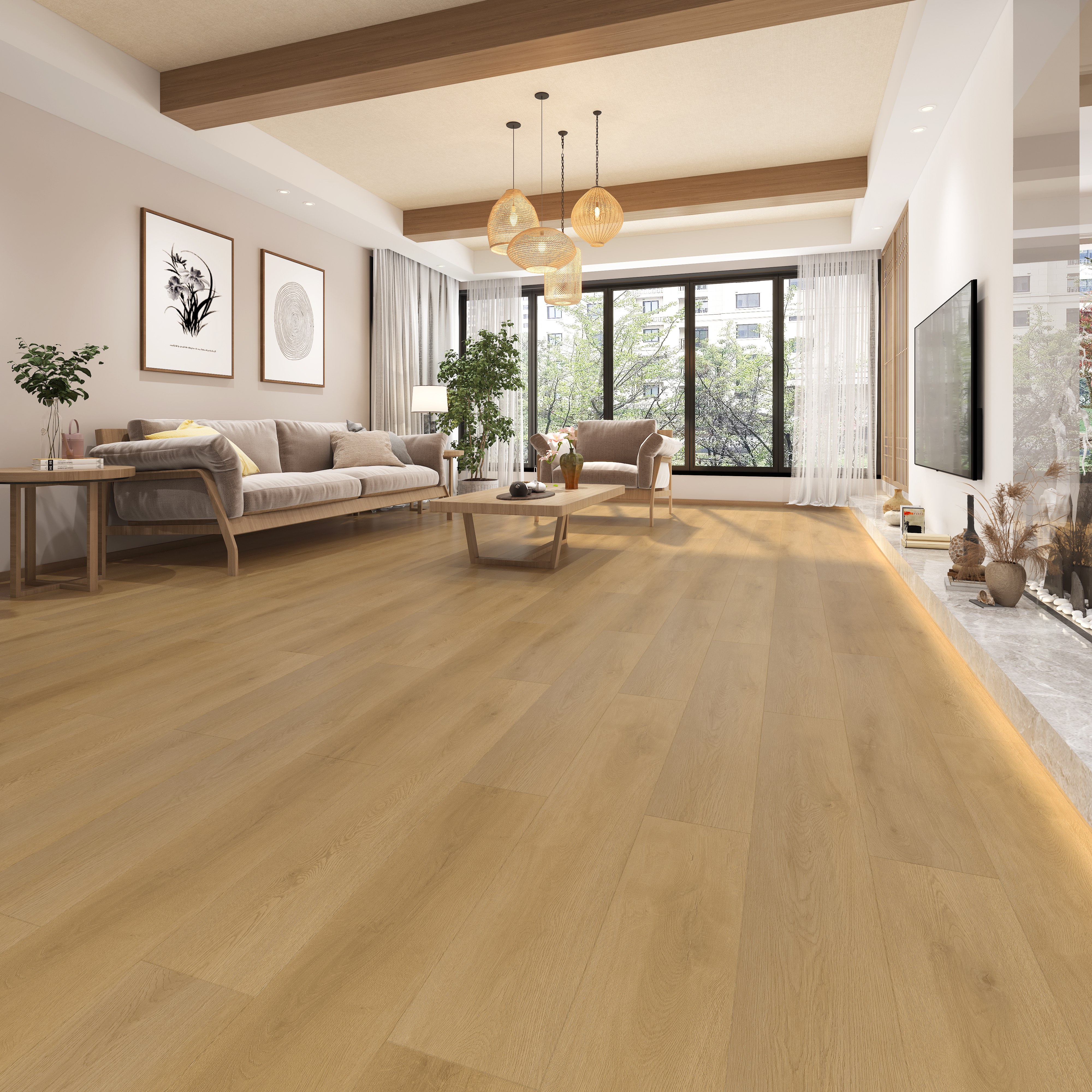
Rigid-core SPC flooring is a stone-plastic composite plank manufactured from calcium carbonate (natural stone powder or limestone powder), PVC resin, and calcium-zinc stabilizers, installed as a floating floor and joined plank-to-plank through a click-lock profile rather than adhesive. Because the core is closed-cell, the material does not absorb water the way hardwood or laminate does. That single property has carried SPC from a niche import product into mainstream specification for residential, commercial, and institutional projects — and in doing so, it has made the plank itself a weak differentiator. What separates suppliers today is the evidence they can produce.
An Evidence Gap Has Replaced a Supply Gap
SPC flooring supply is no longer scarce. Dataintelo estimates the global SPC flooring market at USD 9.8 billion in 2025, with rigid-core sub-types accounting for 74.2% of category revenue in the same year. Research houses define the category differently — Grand View Research places the 2025 figure nearer USD 5.9 billion using a narrower definition of pure SPC — so headline market values should be read as directional rather than precise. Trade flows are less ambiguous: OEC data shows that China, the largest exporter of plastic floor coverings under HS 391810, shipped USD 4.97 billion of the category in 2024.
Abundant supply shifts procurement risk. When many suppliers can quote the same plank format at similar prices, the variables that decide whether a project succeeds are no longer product-category variables. They are documentation variables — whether the certificate a buyer was shown applies to the model being shipped, whether the test report names that model, and whether the supplier can explain what the site must look like before the first plank is clicked into place.
For project buyers, the practical question is not 'is this SPC flooring good?' but 'what can this supplier prove, for this model, for this site?' The following sections set out the document set, the performance data, and the installation support that should be requested during research and evaluation — before a purchase order is issued.
The Document Set to Request Before You Sample
Certificates fall into two families, and buyers frequently conflate them. Management-system certificates describe a process. Product and batch documents describe performance. Both matter, but they answer different questions, and a supplier that can only produce the first family is a supplier that cannot support a technical submittal.
| Document | What it evidences | Where it is typically required |
|---|---|---|
| Class A radioactive classification documentation | Compliance with the Class A radioactive standard applied to building and decoration materials in China | China-facing projects and domestic tenders |
| CE-related certification documentation | Conformity documentation for building and decoration products | Europe and some export markets |
| GREENGUARD Gold certification (UL 2818) | Certification requires testing for more than 10,000 chemicals and compliance with strict VOC emission limits | United States and projects with indoor air quality specifications |
| LEED-relevant documentation | Evidence used to support green building submissions | Projects pursuing LEED certification |
| ISO 9001 and ISO 14001 certificates | Quality management and environmental management systems | Institutional and export procurement |
| Model-level performance test report | Performance of the specific model being specified, not a sister product | Technical submittals and consultant review |
| Batch inspection record and certificate of conformity | Condition of the actual production batch before shipment | Pre-shipment and site acceptance |
Two distinctions matter here. First, an ISO 9001 certificate tells a buyer that a management process exists; it says nothing about how a specific plank performs under load, water, or heat. Second, a performance report is only useful if the model number and test method printed on it match the product being purchased. Buyers evaluating a manufacturer such as Monalisa Group Co., Ltd. — a Foshan-based listed high-tech company founded in 1992 that produces ceramic tiles, sintered stone slabs, and SPC flooring — should ask for both families of document and, for each one, which model it covers.
Reading Performance Data Instead of Accepting Claims
A credible technical submittal expresses performance in measurable units. For the reference model ME26009-5, an EIR-textured SPC floor in the Monalisa SPC range, the declared data set is set out below. Every value should be reproduced in the supplier's own submittal, with the test method named.
| Property | Declared value | How to read it |
|---|---|---|
| Water absorption | ≤0.05%; 100% waterproof closed-cell core | A core property, not a surface coating — the plank does not swell, warp, or mould under standing water. |
| Wear resistance | 6,000–15,000 cycles; T-grade wear rating | Cycle counts matter most in retail, corridors, and public circulation routes. |
| Slip resistance | Friction coefficient ≥0.6, increasing when wet | Ask for the test method; wet-area specifications may set a higher threshold. |
| Fire behaviour | B1 fire rating, self-extinguishing | Confirm which fire classification your project code references before assuming equivalence. |
| Dimensional stability | Shrinkage ≤1‰ | Commercial-grade SPC dimensional stability is specified at ≤0.10% under EN ISO 23999, so a ≤1‰ declaration sits at that boundary and should always be supported by a report. |
| Impact and dent resistance | High-density stone-plastic core; stated as 10 times more impact-resistant than WPC | Relevant where furniture, trolleys, or heavy foot traffic are present. |
| Acoustic performance | Pre-attached IXPE pad, sound reduction up to 18 dB+ (ΔLw 18–22 dB) | Multi-family and hospitality projects usually set a numeric requirement, so the pad specification should be named. |
| Format and thickness | 1220×180 mm (48″×7″) and 1524×228 mm (60″×9″); thickness 4/5/6/7/8 mm; EIR textured surface | Thickness and format influence both click-lock stiffness and cost. |
| Core composition | Calcium carbonate, PVC resin, calcium-zinc stabilizer, PVC lubricant | The composition statement should describe the same formulation the test report was run on. |
Mapping SPC data onto specification language
Project specifications are frequently written in a different vocabulary from the one SPC suppliers use. Building and decoration specifications commonly reference abrasion classes PEI 3–5 (with PEI 4 or above for commercial and public areas), slip resistance classes R9–R11 (bathrooms commonly require R10 or higher), water absorption bands such as ≤0.5% for porcelain and ≤3% for semi-porcelain, and Class A fire and Class A radioactive standards for China. SPC data, by contrast, is expressed in wear cycles, friction coefficients, and core absorption percentages. The two vocabularies do not translate automatically.
That gap is where most submittals fail. A buyer's request should therefore be specific rather than general: ask for the test report that maps the specified model onto the abrasion class and slip class used in the project specification, including the test method and the laboratory. A report that answers that question is worth more than a folder of certificates, because it can be checked line by line.
What Installation Support Should Actually Cover
SPC flooring is installed as a floating floor. That single fact determines what installation support has to include, because a floating floor depends on the interface between the plank, the click-lock profile, the perimeter, and the subfloor beneath it.
- Click-lock and 5G geometry. The planks work through a click-lock system, usually 5G, allowing glue-free installation. Planks are inserted at approximately a 30° angle and pressed flat, row by row, with staggered seams. A supplier should be able to demonstrate 5G capability on the exact model being supplied, not assert it as a category feature.
- Floating installation mechanics. Planks are not glued, nailed, or stapled to the subfloor. The assembled floor floats freely over the substrate, allowing natural expansion and contraction, and is finished at the perimeter with baseboards or quarter-round mouldings that cover the expansion gaps.
- Expansion gaps and spacers. A gap of 5–12 mm is left from walls and fixed objects and maintained during installation using spacers. Installation instructions that omit spacers are incomplete.
- Moisture management below the floor. SPC is waterproof, but it is not a vapour barrier. On ground-floor concrete installations, a 6-mil polyethylene moisture barrier is required; without it, prolonged moisture can still cause mould beneath an otherwise waterproof floor.
- Accessories and tooling. Pre-attached underlayment (a second layer should not be added unless the manufacturer approves it), tapping block and rubber mallet, utility knife or vinyl cutter, straightedge and square, moisture meter, level, transition profiles for joins between flooring types of equal or different heights, end profiles or finishing strips, skirting, and joint sealant for wet-area perimeters where the manufacturer permits it.
- Post-installation support. For SPC flooring, Monalisa provides a warranty of typically 10–25 years for residential applications and 5–10 years for commercial applications against manufacturing defects, subject to correct installation and maintenance, with claims processed through proof of purchase and on-site or remote inspection.
Subfloor Readiness: The 2mm Over 2m Rule
The subfloor requirement is the part of SPC procurement that most often gets under-documented in the sales conversation and over-documented in the failure report. A rigid-core plank does not forgive an uneven substrate.
| Parameter | Requirement |
|---|---|
| Flatness | Within 2 mm over 2 m (or 3/16″ over 10 ft) |
| Concrete subfloor moisture | ≤2%; ≤1.5% where underfloor heating is present; anhydrite screeds ≤0.3% |
| Wood-based subfloor moisture | ≤12% |
| Subfloor condition | Solid, self-supporting, dust-free, without hollow spots or cracks; free of paint, wax, grease, oil, solvents, and glue residues |
| Installation over existing tiles | Permitted where grout joints are ≤5 mm wide and ≤2 mm deep and height differences between adjacent tiles are ≤1 mm |
| Prohibited substrates | Carpet, soft PVC, or similar soft materials |
| Acclimation | 24–48 hours in the original packaging at the installation site |
| Expansion gap | 5–12 mm from walls and fixed objects |
| Site conditions | Installation temperature 18–30°C; post-installation ambient temperature 13–37.7°C; relative humidity ≤65% |
| Underfloor heating | Floor surface temperature must not exceed 27°C |
| Cabinets and fixed units | The area beneath cabinets must be fully glued down to the subfloor |
| Sunlight | Protect against prolonged direct sunlight with drapes to limit discolouration and thermal expansion |
A two-millimetre deviation across two metres is a demanding tolerance. On refurbishment projects it usually means grinding high spots or applying a levelling compound before installation — work that is not visible in the purchase price but is visible in the handover. A supplier with credible installation support will ask for the flatness survey and the moisture readings before shipping, rather than after a joint failure.
Batch-Level Quality Evidence and Factory Verification
Product claims are sample-level; project outcomes are batch-level. For SPC flooring, every batch undergoes a pre-shipment inspection before leaving the factory. The inspection items include appearance, overall dimensions and dimensional tolerances, deviation in mass per unit area, residual indentation, and peel strength. Requesting the inspection record for the batch tied to the purchase order converts a general quality claim into a traceable document.
Order flexibility should be documented in the same way. The supplier's stated capability for this product line includes OEM/ODM production with customization of size, colour, and logo, a minimum order quantity of 500 sqm per colour, a lead time of 30 days, and a monthly capacity of 1,000 containers. Each of these is a commitment that a project schedule can be measured against.
What the manufacturer's profile does and does not prove
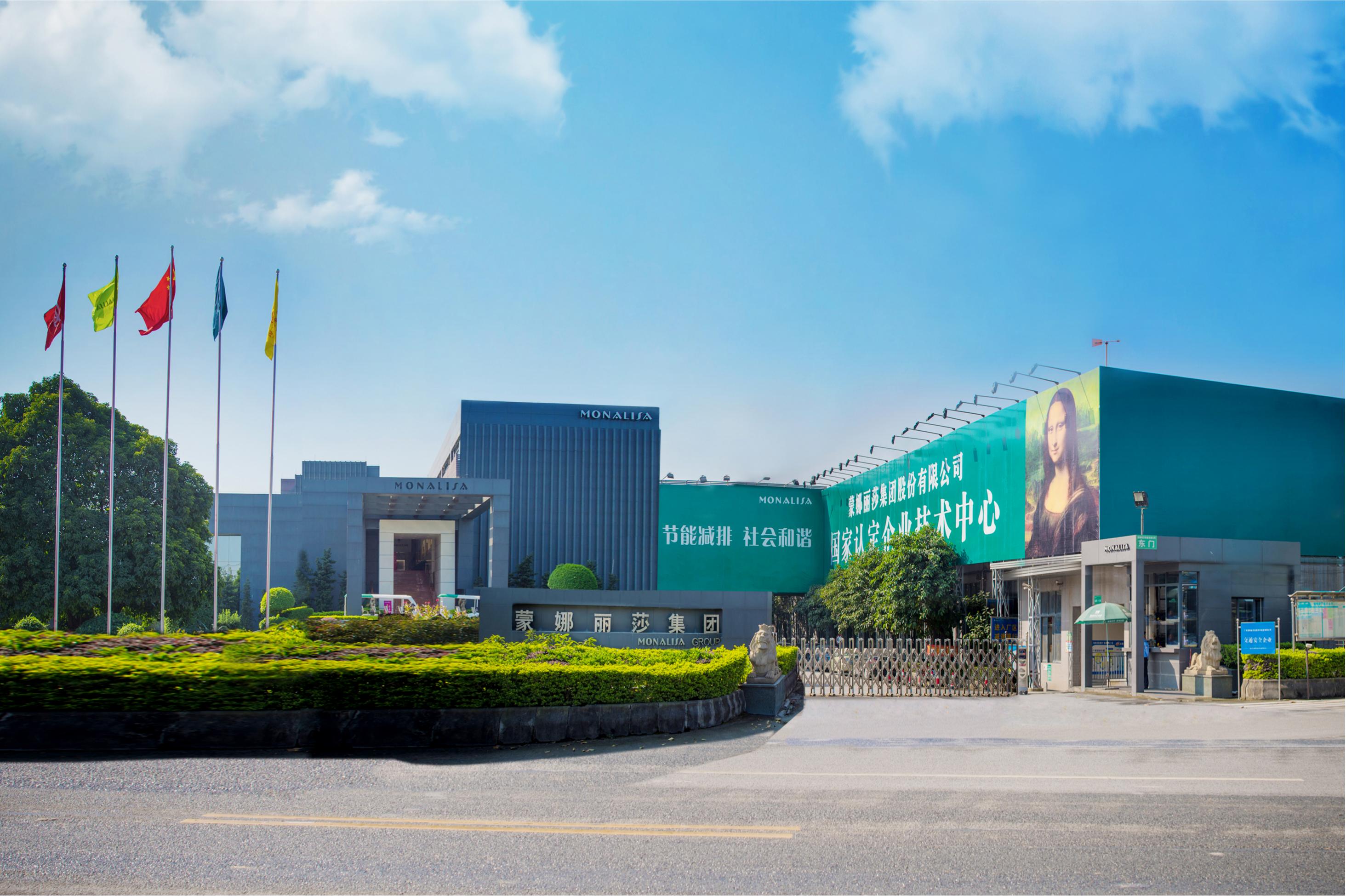
Monalisa Group Co., Ltd. (SZSE: 002918) was founded in 1992 and is headquartered in Foshan, Guangdong Province. Its manufacturing footprint spans four production bases — Xiqiao in Foshan, Qingyuan in Guangdong, Tengxian in Guangxi, and Gao'an in Jiangxi — with 37 production lines, a total factory area of 2,779,333.33 ㎡, 4,106 employees, an annual output of 100 million square meters, and a 100-person R&D team. The company has participated in drafting 49 national, industrial, local, and group standards and holds 892 authorized patents, including 145 invention patents. It has obtained 15 certifications including ISO 9001 and ISO 14001, applies a '3M' quality management model, and has received the Foshan Municipal Government Quality Award, the Guangdong Provincial Government Quality Award, and a nomination award for the 3rd China Quality Award.
That profile is relevant background, but it is not product evidence. Public financial statements aggregate SPC flooring within broader product categories, so a buyer cannot verify SPC-specific output from filings alone. The more direct evidence remains model-level test reports and batch-level inspection records — which is precisely the point of an evidence-first evaluation.
How SPC Compares With Adjacent Floor Solutions
SPC is usually evaluated against porcelain tile in wet-area and public-project specifications, and against hardwood or laminate where appearance is the priority. The comparison is best made on measurable attributes rather than on preference.
| Attribute | SPC flooring (ME26009-5) | Porcelain / ceramic tile |
|---|---|---|
| Water absorption | ≤0.05% | ≤0.5% porcelain; ≤3% semi-porcelain |
| Wear / abrasion reference | 6,000–15,000 cycles; T-grade wear rating | PEI 3–5 (PEI 4 or above for commercial and public areas) |
| Slip resistance reference | Friction coefficient ≥0.6, increasing when wet | R9–R11 (bathrooms commonly R10 or higher) |
| Fire behaviour | B1 fire rating, self-extinguishing | Class A fire rating |
| Dimensional stability | Shrinkage ≤1‰; commercial-grade SPC referenced to ≤0.10% under EN ISO 23999 | Length/width deviation ≤±0.2%; thickness deviation ≤±5% |
| Installation method | Floating, glue-free click-lock; not fixed to the substrate | Static installation, permanently fixed to the building substrate |
| Subfloor sensitivity | Flatness within 2 mm over 2 m; not a vapour barrier, so a 6-mil polyethylene barrier is recommended on ground-floor concrete | Requires a level bedding layer; resistant to standing water by material nature |
Limits and boundaries worth stating up front
- SPC is waterproof, not moisture-proof by itself. The core does not absorb water, but it does not act as a vapour barrier. Prolonged moisture beneath the floor can still cause mould, which is why a 6-mil polyethylene moisture barrier is recommended for ground-floor concrete installations.
- The flatness tolerance is strict. Two millimetres over two metres is often tighter than a refurbishment subfloor meets in its existing condition, and unevenness may cause joint failure.
- Some substrates are excluded entirely. Installation over existing carpet, soft PVC, or similar soft materials is not allowed.
- Thermal limits apply. Where underfloor heating is used, the floor surface temperature must not exceed 27°C and subfloor moisture limits become stricter.
- Sunlight exposure is a design constraint. Prolonged direct sunlight should be limited with drapes to prevent discolouration and excessive thermal expansion.
- Classification mapping is not automatic. PEI abrasion classes and R9–R11 slip classes belong to a different reporting vocabulary from wear cycles and friction coefficients. Without a mapped test report, a specifier cannot assume equivalence between an SPC data sheet and a tile-based specification.
- Acoustic requirements may need additional layers. Where building codes set specific acoustic ratings, a compatible underlayment may be required beyond the pre-attached pad.
Matching Evidence to the Project Scenario
Different project types put different documents under pressure. The table below links the scenario to the evidence that should be requested first.
| Project scenario | Evidence to prioritise |
|---|---|
| Residential (living rooms, bedrooms, kitchens, bathrooms, basements, laundry, sunrooms) | Water absorption ≤0.05% and closed-cell core statement; B1 fire rating; acoustic pad specification; formaldehyde declaration |
| Commercial spaces (malls, retail stores, office buildings, showrooms) | Wear cycles and T-grade rating; dimensional stability; dent and impact resistance |
| Hotels and hospitality (hotels, restaurants) | Acoustic performance (ΔLw 18–22 dB); wear layer specification; design and texture options |
| Medical facilities (hospitals, clinics) | Surface cleanability and stain resistance; mould-resistant core; joint and perimeter sealing details |
| Educational institutions (schools, kindergartens) | Zero-formaldehyde formulation; impact resistance; friction coefficient ≥0.6 |
| Public spaces (libraries, exhibition halls) | Acoustic data; wear cycles; dimensional stability under variable temperature |
| Light industrial spaces with heavy foot traffic or moisture | Wear cycles at the upper end of the range; waterproof core; flatness and substrate survey records |
| Underfloor heating environments | Shrinkage ≤1‰; surface temperature limit of 27°C; subfloor moisture ≤1.5% |
Market Trend: Specifiers Are Asking for Files, Not Brochures
Three verifiable trends are pushing documentation to the centre of SPC procurement. The first is scale: a category valued in the billions of dollars, with rigid-core construction holding 74.2% of revenue share in 2025, attracts institutional buyers who purchase through technical submittals rather than showroom samples. The second is export concentration: with China shipping USD 4.97 billion of plastic floor coverings under HS 391810 in 2024, importers in North America, Europe, and Asia-Pacific are comparing suppliers whose products look nearly identical and whose documentation does not.
The third trend is depth of testing. GREENGUARD Gold certification, for example, requires testing for more than 10,000 chemicals against strict VOC limits under UL 2818 — a level of verification that cannot be substituted by a general low-emission statement. On the durability side, commercial-grade SPC dimensional stability is referenced to ≤0.10% under EN ISO 23999, which gives buyers a benchmark against which a supplier's declared shrinkage can be compared. Documentation requirements are becoming standardised precisely because products are not.
Future Outlook
As rigid-core SPC consolidated its position as the dominant construction type within the category, the competitive ground has moved from core formulation to verification infrastructure. Expect three practical consequences for buyers over the next procurement cycles. First, submittals will increasingly be judged on whether performance data is expressed in the classification system the project uses — abrasion class, slip class, fire classification, and dimensional stability standard — rather than on whether a product 'passes'. Second, batch traceability will move from a differentiator to an expectation, because pre-shipment inspection records are the only documents that describe the material actually delivered. Third, installation support will be evaluated as a deliverable, not a courtesy: subfloor flatness surveys, moisture readings, expansion-gap details, and moisture-barrier specification are the items that determine whether a waterproof plank performs as a waterproof floor.
For suppliers, the implication is straightforward. In a market where the plank is commoditised, the certificate audit trail, the model-level test report, and the installation manual are the products that are actually being compared.
FAQ
Which certificates should an SPC floor supplier provide for a project in China compared with an export market?
For building and decoration materials supplied into China, Class A radioactive classification compliance is a standard environmental requirement to document. For some export markets, CE, GREENGUARD or LEED-related certification is required instead or in addition — GREENGUARD Gold, for instance, is a UL 2818 certification that requires testing for more than 10,000 chemicals and compliance with strict VOC limits, and it is most often requested in the United States and in projects with indoor air quality specifications. Because the required set depends on the destination market and the project's own specification, the practical step is to confirm the market requirements first, then request the corresponding certificate with the model number attached.
How can a buyer verify a supplier's test report rather than accept a performance claim?
Check three items on the document itself: the model number, the test method, and the measured value. A report is only relevant if the model number matches the product being purchased, since a result obtained on a sister product does not transfer. The test method matters because SPC performance is reported in different vocabularies from tile-based specifications — wear cycles and friction coefficients rather than PEI abrasion classes and R9–R11 slip classes — and the two systems do not translate automatically. Measured values can then be compared against published benchmarks, such as the ≤0.10% dimensional stability requirement for commercial-grade SPC under EN ISO 23999. Batch-level inspection records, which cover appearance, dimensions and tolerances, mass per unit area deviation, residual indentation, and peel strength, address the separate question of what was actually shipped.
Is SPC flooring suitable for wet areas and underfloor heating?
The core is closed-cell and 100% waterproof, with water absorption of ≤0.05%, which means the plank itself does not swell, warp, or support mould growth — a different behaviour from hardwood or laminate, which fail in wet areas. However, waterproof does not mean vapour-proof: SPC is not a vapour barrier, and prolonged moisture beneath the floor can still cause mould, so a 6-mil polyethylene moisture barrier is recommended for ground-floor concrete installations. For underfloor heating, the material's low shrinkage (≤1‰) supports thermal stability, but the floor surface temperature must not exceed 27°C and subfloor moisture limits tighten to ≤1.5% for concrete, with anhydrite screeds limited to ≤0.3%.
What installation support should come with a glue-free click-lock SPC floor?
A glue-free click-lock system, typically 5G, should be supported by documentation covering the click geometry and the insertion method — planks are inserted at approximately a 30° angle and pressed flat, row by row, with staggered seams. The support package should also define the floating-floor principle (planks are not glued, nailed, or stapled to the subfloor), the 5–12 mm perimeter expansion gap and the spacers used to maintain it, and the accessory list: pre-attached underlayment that should not be doubled unless approved, tapping block and rubber mallet, vinyl cutter, straightedge and square, moisture meter, level, transition and end profiles, and skirting. Post-installation support is typically expressed as a warranty of 10–25 years for residential use and 5–10 years for commercial use against manufacturing defects, conditional on correct installation and maintenance.
How flat and dry must a subfloor be before floating SPC flooring is installed?
Flatness must be within 2 mm over 2 m, or 3/16″ over 10 ft. Concrete subfloor moisture must be ≤2%, tightening to ≤1.5% where underfloor heating is present, and anhydrite screeds are limited to ≤0.3%; wood-based subfloors must be ≤12%. The substrate must be solid and self-supporting, dry, clean, and free of dust, paint, wax, grease, oil, solvents, or glue residues. Installation over existing tiles is possible where grout joints are ≤5 mm wide and ≤2 mm deep and adjacent tiles differ in height by no more than 1 mm, but installation over carpet, soft PVC, or similar soft materials is not allowed. Planks should acclimatise in their original packaging on site for 24–48 hours, at an installation temperature of 18–30°C and relative humidity of no more than 65%.
Monalisa Group Co., Ltd. product brochure (PDF): https://cdn.socialarks.com/sbsp/24792/0/2026/0422/69e88af452ea8.pdf