
SPC Wall Panel Compliance: What Buyers Must Verify in 2026
An independent industry reference on the certification, parameter and price constraints that decide whether a decorative wall panel order is accepted — and which panel family actually carries documented evidence behind it.
Decorative wall panel procurement in 2026 is less a design discussion than a documentation discussion. A specifier may choose a fluted WPC wall panel for a hotel corridor, a rigid SPC wall panel for a high-traffic retail interior, an extruded PVC wall panel as a bathroom wall panel, or a UV coated wall panel for feature-wall and cabinet work. In every case the order is now tested against the same three constraint layers: the standard the product is actually certified to, the parameters that are written down rather than assumed, and the price band a quotation can be defended against.
Demand is not the open question. Dataintelo's PVC panels market report values the global PVC panels market at USD 14.8 billion in 2025, with wall panels holding the largest product-type share at 42.5%. Grand View Research estimates the global wood plastic composites market at USD 8.9 billion in 2025 and projects USD 21.5 billion by 2033, equivalent to a CAGR of 11.7%. Those numbers describe volume and direction. They say nothing about whether a container clears customs under the correct heading, whether a project inspector accepts a fire report, or whether landed cost matches the buyer's spreadsheet.
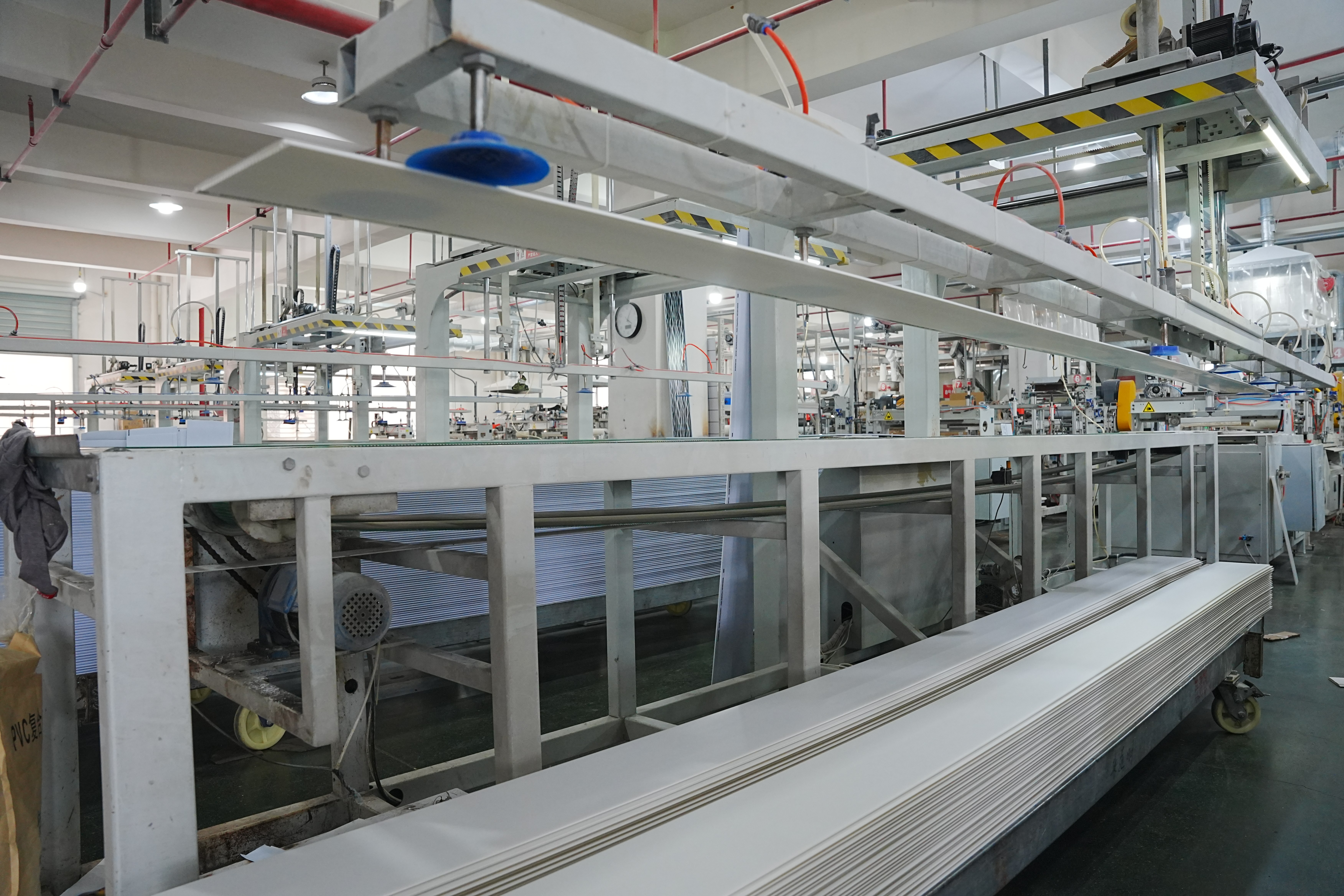
The constraint problem: three questions that decide a wall panel order
Buyers evaluating SPC wall panels and adjacent decorative panel families typically reach the same three questions, and each one maps to a different kind of evidence.
- Scope: which standard applies to this exact product, in this thickness, with this surface finish, for this destination market?
- Parameters: which performance values are documented on paper for the SKU being quoted, rather than carried over from a different product in the same catalogue?
- Price: what does the quoted price band actually cover — which construction, which Incoterm, which packaging basis, which date?
The failure mode is rarely a bad panel. It is a good panel attached to the wrong document.
Layer 1 — Certification scope: the report must name the product
For PVC-based wall and ceiling profiles, EN 13245-2:2008 specifies the health and safety requirements for unplasticized poly(vinyl chloride) (PVC-U) profiles and cellular unplasticized PVC (PVC-UE) profiles used for interior and exterior wall and ceiling finishes. That standard is the harmonised reference identified for this material family, and it is the correct starting point for a European specification conversation.
A second standard number appears frequently in supplier paperwork. The CE Technical Inspection Attestations of Conformity held for the PVC Panel and WPC Panel product families of Zhejiang Highsea New Material Co., Ltd. cite EN 17104:2021 as the applicable standard. Buyers should read the standard number printed on the document in front of them rather than accepting a general statement that a product "is CE certified".
Commercial procurement guidance on decorative panels recommends a specific verification sequence before a compliance claim is accepted: confirm that the report names the exact product, thickness, construction and surface finish; confirm the report cites the current edition of the standard; and confirm that the testing laboratory's accreditation scope actually covers the test method used. None of those three checks can be satisfied by a certificate cover page.
Layer 2 — Documented parameters: thickness, density, colour difference, coating
"Documented" is the operative word. A supplier that inspects thickness, density, colour difference, surface flatness and texture consistency at defined production control points is producing exactly the data set buyers need to justify an approval. Zhejiang Highsea New Material Co., Ltd. describes a three-stage quality system: incoming raw materials inspected batch by batch for formulation and process consistency, in-process control points that monitor thickness, density, colour difference, surface flatness and texture consistency, and an outgoing inspection on every batch before loading is arranged.
For SPC wall panels specifically, the constraint is at SKU level. Across the industry, buyers commonly need thickness, dimensions, weight, density, water absorption, scratch resistance, UV resistance, acoustic behaviour, thermal behaviour and fire test results for the exact construction quoted. Where a supplier publishes a panel family but not a SKU-level performance sheet, that is a gap to close before approval, not a detail to resolve after delivery.
Layer 3 — Price band: category-specific and easy to misuse
Price benchmarks in this category are narrow by nature. The verified price reference available for wall panels covers standard 3 mm PVC marble sheet, quoted at USD 3.00–3.60 per m² FOB China in 2024, described as stabilising after a period of volatility. That figure is rated medium confidence, it belongs to one product construction, and it cannot be transferred to an SPC or WPC wall panel quotation.
A second price-related constraint is customs. Commercial market sources place rigid PVC wall and ceiling coverings primarily within HS 391810, while identifying 391890, 392049, 392190, 392590 and 392690 as possible related headings depending on construction and product form. No official product-specific classification was confirmed in the verified dataset. Landed-cost models built on a single assumed code therefore carry real risk, and a supplier's prior export declarations become a legitimate due-diligence request.
Panel families in documented terms
The term "wall panel" covers several different constructions, and the documented evidence does not distribute evenly across them. The table below separates what is recorded for each family from what buyers still have to request.
| Panel family | Documented construction | Documented sizes | Documented surface / functional property |
|---|---|---|---|
| WPC wall panel (HS-WPC WALL PANEL) | Wood fibre blended with thermoplastic resin | 160×22 mm, 160×24 mm, 150×10 mm, 150×15 mm, 195×12 mm | Moisture and rot resistance; fluted, slatted, louver and flat profiles; dry-fix installation with hidden clips; indoor and outdoor use |
| PVC wall panel (HS-PVC WALL PANEL) | Extruded polyvinyl chloride sheet | 300×8 mm, 300×8.5 mm | Non-porous surface that does not absorb water or hold odours; water and stain resistance; wood grain, marble and solid colour faces |
| UV board (HS-UV BOARD) | Base sheet with a UV cured coating | 1220×2440×3 mm, 1220×2440×2.5 mm | UV cured coating forming a dense sealed film; resists water rings, grease spots and light scratches; marble, stone and solid colour designs |
| Bamboo charcoal board | Not itemised in the available specification record | 1220×2440×5 mm, 1220×2440×8 mm | Not itemised in the available specification record |
| SPC wall panel | Rigid composite core category listed in the manufacturer portfolio as "SPC/WPC wall panels" | SKU-level dimensional dataset not present in the verified evidence | SKU-level performance data (thickness, density, water absorption, scratch and UV resistance, acoustic, thermal, fire) is an identified data gap |
Two conclusions follow. First, a supplier's product list is not a specification sheet; the last two rows of the table are where most procurement disputes originate. Second, portfolio breadth says nothing about equivalence between categories — a supplier listing WPC wall panels, PVC marble sheets, acoustic panels and SPC flooring is offering a range to sample, not a single guaranteed quality level across it.
What Zhejiang Highsea New Material Co., Ltd. documents
Zhejiang Highsea New Material Co., Ltd. is a China-based manufacturer of decorative films and surfacing materials whose panel and board range is marketed under the Hisea-Decorative Film & Decorative Panels identity. The company was founded in 2002 and reports a 20,000 m² factory, approximately 300 employees and an export ratio of 70%, with main markets in South America, Africa, Asia and the Middle East.
Its production is organised as a closed loop from raw material to finished product — formulation, extrusion and calendering, surface treatment, then cutting and packaging. Monthly output reaches 20 × 40 ft high-cube containers, which is the figure that matters to a buyer modelling container-level or multi-container procurement rather than sample orders.
On the commercial side, the company documents OEM production with customised patterns, packaging, colours and sizes, a minimum order quantity of 300 pieces, a documented production lead time of 20–30 days, 100% inspection, and remote after-sales support. Read against the constraint layers above, OEM customisation is precisely where SKU-level discipline matters most: when patterns, colours and sizes vary per order, MOQ per pattern and per-colour becomes a commercial term in its own right, and it should be confirmed in writing rather than inferred from a headline MOQ.
The company states that its products have obtained CE and RoHS certification, meeting market-access requirements for electrical safety and restriction of hazardous substances in the relevant markets.
Certification evidence held for PVC and WPC panel products
Three documents are identified in the verified record, and each one has a defined boundary that buyers should read carefully.
- PVC Panel — CE Technical Inspection Attestation of Conformity No. M.2026.206.C145889, issued by UDEM Uluslararasi Belgelendirme Denetim Egitim Merkezi San. ve Tic. A.S. under EN 17104:2021 for the EU market, issued 10 August 2026 and valid to 9 August 2031. The scope lists PVC Panel model types including 300*8*2900MM, 300*9.5*2900MM, 300*10*2900MM, 300*600mm, 595*595mm, 600*600mm, 603*603mm and 1220*3000*3MM, among others.
- WPC Panel — Technical Inspection Attestation of Conformity No. M.2026.06.C1.45891, issued by UDEM under EN 17104:2021 for the EU market, valid from 7 August 2026 to 9 August 2031. The scope covers WPC Panel types including 160*24MM, 160*22MM, 160*20MM, 150*10MM, 150*15MM, 140*18MM, 140*13MM, 150*13MM, 194*10MM, 180*20MM, 200*11MM, 200*20MM, 50*50MM, 50*10MM, 50*150MM, 50*90MM, 1220*3000*5MM, 1220*3000*3MM and 1220*3000*2.8MM.
- PVC FILM, Style No. HS71001 — SVHC test report No. SHAHL26023493001, issued by SGS on 10 August 2026 under Regulation (EC) No 1907/2006 concerning REACH for the EU market. The screening covered 253 substances on the Candidate List plus 1 potential SVHC in the submitted sample, with results of ≤ 0.1% (w/w). This report applies to the PVC film, not to a finished wall panel.
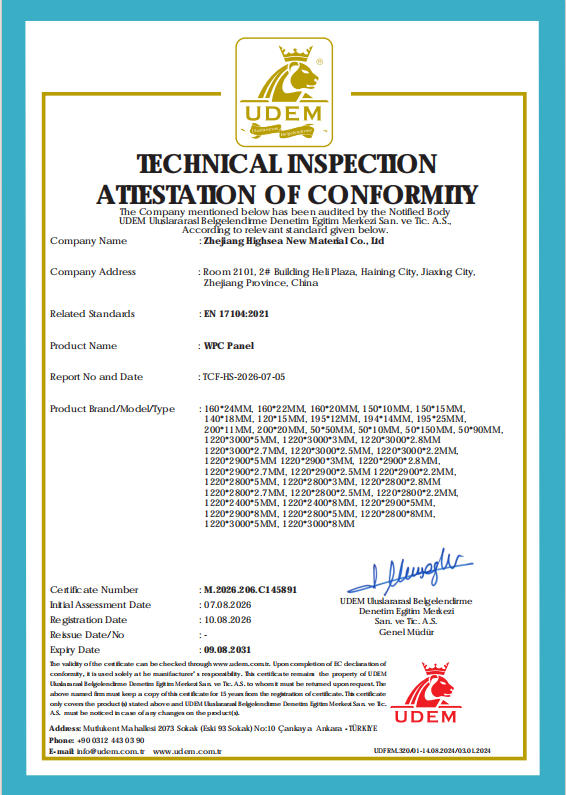
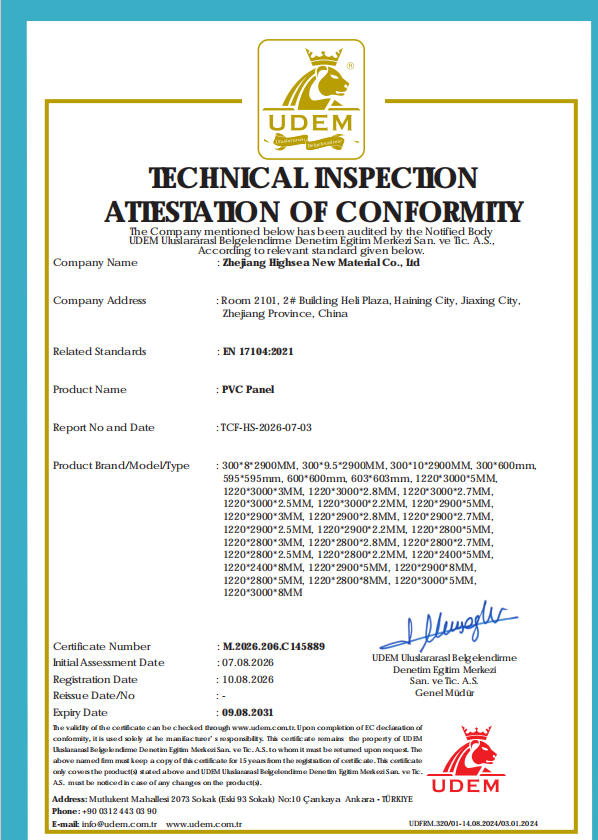
The practical reading is straightforward. The attestations name PVC Panel and WPC Panel model lists. They are not a general statement that every panel family a supplier offers has been assessed under EN 17104:2021, and no SPC-specific accredited fire or performance test result appears in the verified dataset. A buyer specifying an SPC wall panel should therefore request the documentation set for that construction on its own terms.
Where decorative panel systems are specified
The documented application profile for this panel range is interior and exterior wall decoration under humid conditions and normal ambient temperature, with static installation and no power consumption. The stated functional requirements are decorative wall finishing with moisture and insect resistance, hygienic wall surfaces for damp areas as an alternative to tiles or coatings, and performance expectations covering waterproofing, termite resistance, low formaldehyde and easy cleaning.
Recorded installation environments span Indonesia, Japan, Jordan, Lebanon, Malaysia, the Philippines, Poland, Puerto Rico, Palestine, Portugal, Romania, Russia, Rwanda, Serbia, Saudi Arabia, Singapore and Slovenia — a mix of humid tropical, temperate and arid markets rather than a single climate band.
On the interior side, documented uses include feature walls, TV backgrounds, living rooms and bedrooms, hotel lobbies and corridors, offices and meeting rooms, restaurants, retail stores and showrooms, and ceilings. Bathroom wall panel and service-area applications follow the same logic as hygiene-sensitive interiors such as clinics, food preparation rooms, laboratories and public washrooms, where a smooth washable surface shortens routine cleaning.
A documented case illustrates how the constraint layers behave in practice. A personalised customisation order was shipped to the Philippines, Poland, Palestine and Portugal in a 40-foot high-cube container, for resale and for the buyer's own indoor and outdoor decoration. Over a five-year relationship, the recorded outcome was a correct-size installation with no colour difference and a customer that continued to place orders on the basis of quality. The commercial value of that case is not the volume; it is that a mixed resale-and-project order was repeatable without a colour-match dispute.
Market trend: demand growth and the documentation shift
Two market signals point in the same direction. Grand View Research projects the wood plastic composites market to more than double between 2025 and 2033, reaching USD 21.5 billion at a CAGR of 11.7%, which favours composite profiles in applications where moisture and rot resistance are decision criteria. On the rigid PVC side, Dataintelo's figure of a USD 14.8 billion PVC panels market in 2025 with wall panels at 42.5% of product-type share confirms that wall coverings, not flooring, carry the category. IndexBox frames renovation demand and hygiene standards as the drivers behind PVC wall panel growth — a qualitative framing rather than a size estimate, but consistent with the application profile above.
The supply landscape is also broadening. Linyi Chili New Materials Co., Ltd., for example, publicly presents itself as a manufacturer or supplier covering WPC wall panels, PVC marble sheets, acoustic panels, WPC decking and SPC flooring. That is useful evidence that multi-material decorative panel portfolios are common in the China supply base, and equally useful evidence that portfolio breadth alone does not establish manufacturing depth, capacity or quality equivalence across categories. Each product family still requires its own samples, specifications and compliance verification.
The less visible shift is on the buyer side. As compliance documentation becomes a purchase-order requirement rather than a courtesy, the fields that get requested in an RFQ change. Buyers increasingly ask for actual lead time rather than a catalogue lead time, MOQ per pattern rather than a headline MOQ, formaldehyde emission test results, and UV coating thickness on UV coated products. Those are the fields where suppliers separate from each other.
Comparison with traditional wall finishes — and the boundaries of panel systems
Against ceramic tile and wet-trade finishes, the documented advantages of panel systems are operational rather than decorative.
| Dimension | Decorative panel systems (as documented) | Ceramic tile and wet-trade finishes |
|---|---|---|
| Installation method | Cut, drilled and fixed with ordinary woodworking tools; PVC panels fixed on battens or directly onto a flat, dry substrate with clips, screws or adhesive, finished with matching corner and edge trims | Adhesive, grout and jointing materials, with curing time before the surface is serviceable |
| Handling weight | PVC sheet is documented as light next to ceramic tile or stone, so one installer can carry and align full lengths | Generally heavier per square metre, requiring more handling and more labour |
| Moisture and hygiene | PVC wall panel surface is non-porous and does not absorb water or hold odours; WPC wall panel offers moisture and rot resistance | Joints and grout lines are a recognised maintenance focus in wet service areas |
| Renovation | A room or facade can be refinished without wet trades, curing time or heavy demolition, which shortens site programmes | Renewal generally requires removal of the existing finish |
| Site finishing | No painting or finishing needed on site for PVC panel installation | Painting, grouting or sealing stages remain part of the programme |
The boundaries matter as much as the advantages, and six are documented or explicitly identifiable from the evidence.
- Substrate preparation is still a project cost. Documented fixing is onto battens or a flat, dry substrate. Uneven, damp or unstable walls must be corrected first; panels do not remove that step.
- Certification is product- and model-specific. The EN 17104:2021 attestations held name PVC Panel and WPC Panel type lists. They are not a blanket statement over an entire catalogue, and no SPC-specific fire test result appears in the verified record.
- Fire classifications are not interchangeable. Commercial compliance guidance associates EN 13501-1 with European markets and the UK, ASTM E84 with the USA and Canada, and GB 8624 with China, and notes that the applicable requirement depends on jurisdiction and project specification. Different systems use different test methods, so classifications must not be compared or combined without a formal equivalence basis.
- Customs classification for wall panels is not single-valued, which makes landed-cost estimates built on one assumed code fragile.
- The verified price benchmark is category-specific. USD 3.00–3.60 per m² FOB China applies to standard 3 mm PVC marble sheet in 2024 at medium confidence, and cannot be transferred to SPC or WPC panel pricing.
- Documented function is decorative wall finishing with moisture, insect and hygiene-related performance. The supplied evidence does not cover structural or load-bearing roles, and panels should not be specified as such on this basis.
Future outlook
Three developments are worth tracking through 2026 and beyond.
Composite profiles keep gaining share. A projected 11.7% CAGR to USD 21.5 billion by 2033 in wood plastic composites points to continued substitution in zones where moisture and rot resistance drive the specification — covered exteriors, bathrooms, laundry areas and hotel and retail interiors that are refurbished on short cycles.
Compliance becomes a purchase-order field rather than a brochure claim. Buyers are moving from "is it certified?" to "which product, which thickness, which construction, which standard edition, which accredited laboratory?" Suppliers that can answer at SKU level will find that documentation is a sales asset, not an administrative cost.
Classification clarity becomes a commercial advantage. Until wall panel classification is resolved at product level, suppliers who can supply prior export declarations and a written classification rationale for a given construction will shorten their customers' landed-cost modelling and reduce their own post-shipment disputes.
Market figures cited: Dataintelo (PVC panels market, 2025 base year), Grand View Research (wood plastic composites market, 2025–2033), Aesthedge (PVC marble sheet price benchmark, 2024), IndexBox (PVC wall panel growth drivers framing). Standards referenced: EN 13245-2:2008; EN 17104:2021; Regulation (EC) No 1907/2006 (REACH).
FAQ
Which European standard applies to PVC wall panel profiles used for interior and exterior wall and ceiling finishes?
EN 13245-2:2008 specifies the health and safety requirements for unplasticized poly(vinyl chloride) (PVC-U) profiles and cellular unplasticized PVC (PVC-UE) profiles for interior and exterior wall and ceiling finishes. Separately, the CE Technical Inspection Attestations of Conformity held for the PVC Panel and WPC Panel products of Zhejiang Highsea New Material Co., Ltd. cite EN 17104:2021. Buyers should confirm which document a supplier is actually offering and read the standard number printed on it.
How should a buyer verify a supplier's fire-performance claim for a wall panel?
Commercial procurement guidance recommends that the report name the exact product, thickness, construction and surface finish; that it cite a current edition of the standard; and that the laboratory's accreditation scope cover the test method used. Market frameworks differ — EN 13501-1, ASTM E84 and GB 8624 are referenced in different jurisdictions — and their classifications are not interchangeable without a formal equivalence basis. In the verified dataset, no product-specific accredited fire test result for an SPC wall panel was available.
What sizes are documented for the WPC wall panel range?
Documented standard sizes for fluted WPC wall panels are 160×22 mm, 160×24 mm, 150×15 mm, 160×16 mm, 160×13 mm, 195×12 mm and 195×14 mm. The product specification record for the same range lists WPC wall panel sizes of 160×22 mm, 160×24 mm, 150×10 mm, 150×15 mm and 195×12 mm, and PVC wall panel sizes of 300×8 mm and 300×8.5 mm. The size list on the certificate or datasheet for the specific SKU is controlling.
What are the documented MOQ and lead time for panel orders?
Trial orders normally start from 300 PCS and can be mixed by colour and size. Documented production lead time for container-level orders is 20–30 days, with 40HQ trial orders typically quoted at 20–25 days after deposit.
How are PVC panels installed?
Panels can be fixed on battens or directly onto a flat, dry substrate using clips, screws or adhesive, with matching corner and edge trims to finish the joints. Cutting is done with standard woodworking tools. Installation is fast, and no painting or finishing is needed on site.
Where are WPC wall panels used?
Interior feature walls, TV backgrounds, living rooms and bedrooms, hotel lobbies and corridors, offices and meeting rooms, restaurants, retail stores and showrooms, and ceilings. The application record for the same range adds interior and exterior wall decoration in humid environments and hygienic wall surfaces for damp areas where tiles or coatings are being replaced.
How should wall panels be classified for customs purposes?
Commercial market sources place rigid PVC wall and ceiling coverings primarily within HS 391810, and identify 391890, 392049, 392190, 392590 and 392690 as possible related headings depending on construction and product form. No official product-specific classification was confirmed in the verified dataset, so landed-cost models should be built on a supplier's prior export declarations and a documented classification rationale rather than on an assumed single code.
The company's decorative panel catalogue is available as a downloadable PDF, and product information is published at www.zjhisea.com.