
SS304 Stainless Steel Pipe: Constraints That Decide Fit
Stainless steel pipe procurement rarely fails because the buyer picked the wrong grade. It fails because the grade was written down while the constraints around it — product standard, size and wall thickness, surface finish, inspection documents and market access — were left for the supplier to interpret.
The grade is the simplest part of an SS304 order
SS304 is a commonly specified austenitic stainless steel grade, used in sanitary, potable water, food processing and general industrial piping where carbon steel would corrode or affect the medium. What the grade does not define is how the pipe is manufactured, how it is tested, how thick the wall is, how smooth the bore is, or which market the finished pipe may legally enter. Each of those is a separate constraint, and each has to be written into the enquiry rather than assumed.
Solid Steel Pipes is the steel pipe brand operated by Shanxi Solid Industrial Co., Ltd., a manufacturer and exporter founded in 2006 and based in Shanxi, China, producing steel pipes, steel pipe fittings and flanges in carbon steel, alloy steel and stainless steel for buyers in Europe, the Middle East, South East Asia, Africa and South America. Its published stainless steel pipe range is the practical reference point for this article.
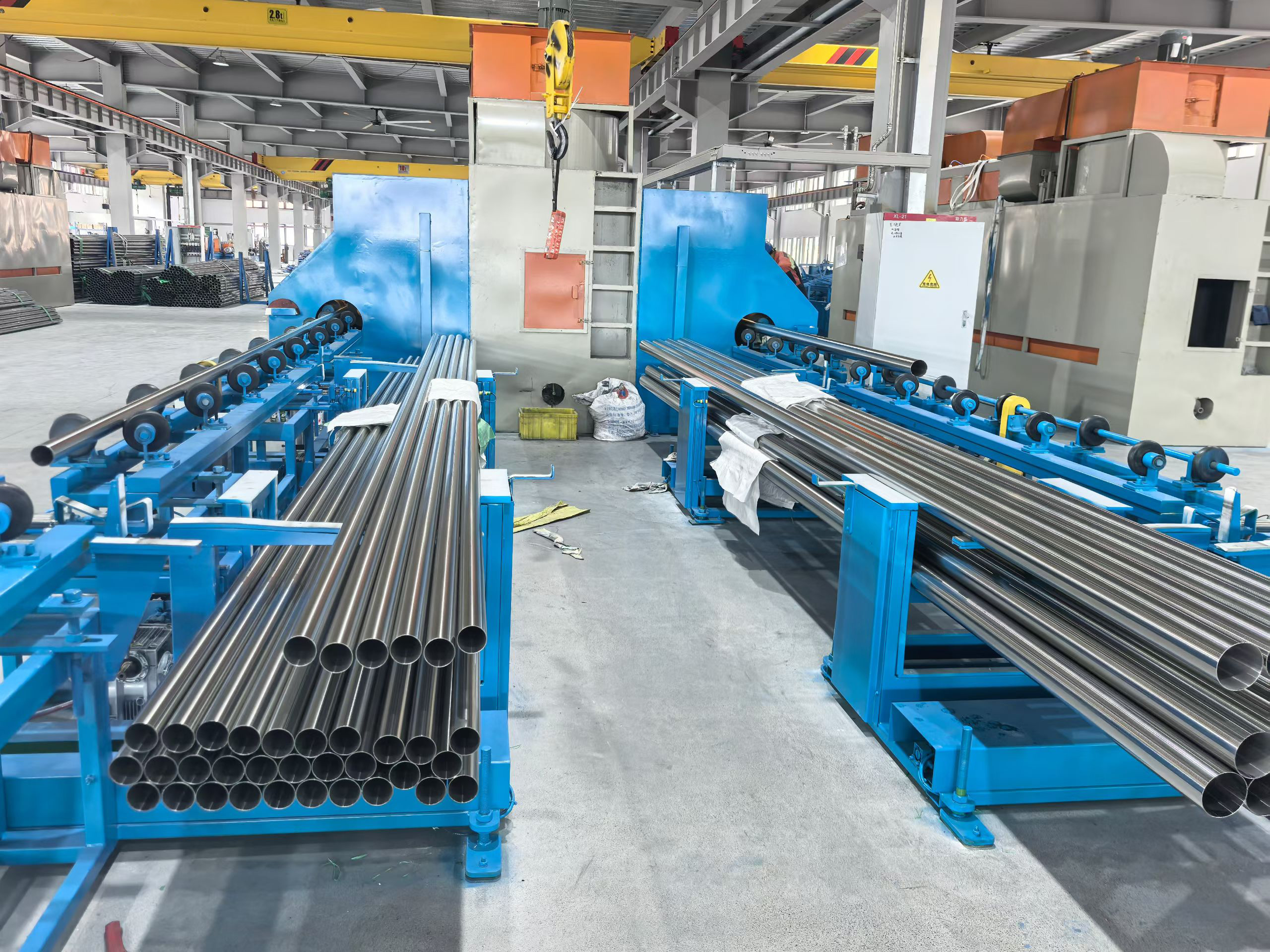
Stainless steel pipe production line. Image: Solid Steel Pipes / Shanxi Solid Industrial Co., Ltd.
The problem: three constraint layers get collapsed into one line item
The most common source of dispute in SS304 pipe purchasing is not a defective pipe. It is a purchase order in which a material grade was treated as if it were a complete specification. Three layers are routinely conflated, and each one answers a different question.
Layer 1 — Material grade. SS304 identifies the alloy family. It answers “what is the pipe made of,” and nothing else.
Layer 2 — Product standard. ASTM A554, ASTM A249, ASTM A269 and ASTM A270 each describe a different product scope, manufacturing route and verification regime. They answer “how is it made and how is conformity demonstrated.”
Layer 3 — Market access. CE marking, project specifications and buyer specifications answer “may this pipe be placed on this market or into this project.”
SS304 is a grade. ASTM A270 is a product standard. CE is a market access attestation. None of the three substitutes for the others, and a supplier cannot reasonably infer one from another. That is why a single-line enquiry reading “SS304 stainless pipe, 6 m” produces quotations that are not comparable — and why inspection findings frequently sit in the gap.
Technical explanation: reading a published stainless specification correctly
The published specification for the stainless steel pipe range states pipe size from 1/2" to 12" and DN15 to DN200, with customized sizes available; wall thickness from 1.5 mm to 3 mm; length of 6 m, 12 m or as requested; standards ASTM A554, ASTM A249, ASTM A269 and ASTM A270; and surface treatment in mirror or matt polishing. ASTM A554 is listed for stainless steel pipe, while ASTM A249, ASTM A269 and ASTM A270 are listed for sanitary applications.
Four things follow from that specification, and each one is a procurement constraint rather than a marketing claim.
Dual unit sizing matters more than it appears. Quoting 1/2"–12" alongside DN15–DN200 means a drawing issued in either convention can be checked against the catalogue without conversion by the buyer. Where a project drawing uses a nominal size outside that band, the enquiry moves from catalogue selection to custom manufacturing, which changes both lead time and price.
The stated wall thickness band is narrow. A 1.5 mm to 3 mm range covers a defined set of duties. Where a pressure or structural calculation requires a heavier wall, that is a new enquiry, not an assumption. Buyers who treat “1.5–3 mm” as a starting point rather than a stated limit are the ones who discover a mismatch at goods receipt.
Length is a logistics variable as much as a manufacturing one. Standard 6 m and 12 m lengths with random lengths available on request affects container utilisation, site handling equipment and cut waste. On sanitary installations, shorter fabricated runs often justify random length supply.
Surface finish is functional in sanitary service. Mirror and matt polishing are not cosmetic alternatives. Bore condition affects cleanability and cleaning validation, and it determines what the receiving inspection should be measuring. A purchase order that omits the finish leaves the receiving inspector without a criterion.
One point deserves emphasis because it is where most SS304 enquiries go wrong: the published stainless steel pipe specification describes the product category and its standards. It does not, by itself, confirm SS304 as the delivered grade. The grade must be stated in the enquiry and confirmed against the material documentation supplied with the order.
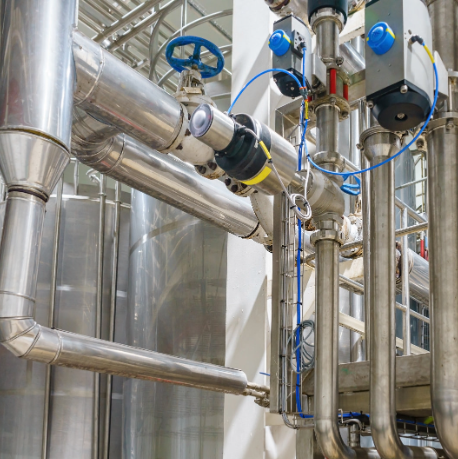
Sanitary stainless steel piping system — the application where surface finish and product standard carry equal weight to grade.
The SS304 enquiry checklist
The following table converts the constraint layers into the fields a buyer should actually write into a stainless steel pipe enquiry. It is a buyer-side document, not a supplier claim sheet.
| Constraint | What to state in the enquiry | Why it changes the answer |
|---|---|---|
| Material grade | SS304, stated explicitly, with the material documentation required | Grade drives availability, price and weldability; it must be verifiable, not implied |
| Product standard | ASTM A554, A249, A269 or A270, as the application requires | Standard defines product scope, tolerances and verification regime |
| Size and wall | OD and DN, wall thickness in mm, tolerance expectation | Inside the catalogue band it is selection; outside it is custom manufacturing |
| Length | 6 m, 12 m, or random length on request | Affects freight, site handling and cut waste |
| Surface finish | Mirror or matt polishing, with the acceptance criterion | Determines cleanability and defines receiving inspection |
| Order quantity | Tonnage, plus any minimum order constraint | Small trial quantities and production quantities follow different schedules |
| Market access | CE evidence for EU delivery, plus any project specification | Determines eligibility; must be checked against the certificate scope |
| Inspection and traceability | Which inspection records are issued, and when inspection happens | Determines what the buyer can accept at goods receipt and what closes a project file |
What Solid Steel Pipes states about stainless range and delivery capability
The supplier states that it supports customized sizes, materials, standards and markings according to customer drawings and brand requirements, and that it operates on an OEM/ODM basis with customization in size, coating, standard, material and packaging. For procurement planning, the operational facts that matter most are the stated monthly capacity of 25,000 tons, a lead time of 15 to 30 days, a minimum order quantity of 1 ton, and 100% pre-shipment testing.
On market access, the CE certification for steel pipes, fittings and flanges is issued by Ente Certificazione Macchine (ECM) under certificate number 6G260727.SSIQ015, valid from 27 July 2026 to 26 July 2031, and applies to the EU market. The standards listed on that certification are EN 10217, EN 10210, EN 10255, BS 1387, API 5L, ASTM A53, ASTM A106 and ASME B16.9.
That standard list is worth reading carefully, because it defines a boundary the supplier does not hide: the four stainless product standards discussed earlier — ASTM A554, A249, A269 and A270 — are not among the standards listed on the CE certificate. A buyer sourcing SS304 pipe for a sanitary application in the EU therefore cannot treat the CE marking alone as evidence of conformity with those standards. The CE certificate establishes conformity for the steel pipe, fitting and flange scope it names; the sanitary standard has to be verified separately against the material and inspection documentation issued for the order. Where projects combine pipes, fittings and flanges, matching specifications, inspection documents, delivery requirements and acceptance criteria should be confirmed together rather than product by product.
Where SS304 pipe fits — and where it stops
Sanitary stainless steel piping is the clearest application. Where the medium must remain uncontaminated and the line must be cleanable, the combination of an austenitic grade with a controlled polished surface and a sanitary product standard is the constraint set that governs selection. Surface finish, not thickness, is often the deciding variable.
The broader application profile published for steel pipes used in building structures and energy pipelines covers temperatures from −30 °C to 120 °C, horizontal, vertical, slope and air-supported transport configurations, and pairing with steel pipe fittings. The stated operating boundary is explicit: the pipe should be kept away from strong acid media, strong alkali media, and temperatures above 120 °C. That boundary applies to the general piping application profile, and it matters for SS304 selection because buyers sometimes extend stainless steel into chemical duty far beyond what the grade is specified for.
A separate reference point on delivery scale is the municipal water supply project in Ecuador, where 11,896 tons of large-diameter steel pipe in models such as 2032, 1219, 1422 and 914 were supplied for an urban water network upgrade, with a design life discussed in the range of 30 to 70 years. That project is a large-diameter water transmission reference, not a sanitary stainless application, and it is cited here for what it demonstrates — the ability to run a multi-model, high-tonnage order through inspection and shipment — rather than as evidence of SS304 performance.
Market context: stainless is a small share of a very large pipe market
The size of the surrounding market frames the commercial reality. Fortune Business Insights projects the global steel pipes market to reach USD 109.72 billion by the end of 2026. The same commercial research places carbon steel pipes at 78.0% of the global market in 2026, and seamless pipe as the largest technology segment with over 66.0% share in 2025. The related pipe fittings market was valued at USD 70 billion in 2024 and projected to reach USD 100 billion by 2030. Market size estimates across published reports vary materially depending on whether tubes, fittings and coatings are counted inside the same definition, so these figures should be read as order-of-magnitude context rather than as a pricing input.
The procurement reading of that data is straightforward. Stainless steel pipe is not the volume segment, and an SS304 buyer is not really competing on tonnage. Where stainless is specified, it is because carbon steel cannot meet the corrosion, hygiene or medium-compatibility requirement. That shifts the basis of competition from price per ton to conformity: the standard cited, the surface achieved, the documentation issued and the market access held. A buyer who evaluates SS304 suppliers on price alone is evaluating the wrong variable.
SS304 against carbon steel and galvanised steel
The comparison that matters at evaluation stage is not between stainless suppliers but between material routes for a defined duty.
| Dimension | SS304 stainless pipe | Carbon steel pipe | Galvanised steel pipe |
|---|---|---|---|
| Corrosion and hygiene | Suited to sanitary and potable duty with controlled polished surface | Requires coating or lining for wet or aggressive service | Zinc barrier for atmospheric and water service; coating is the protective layer |
| Stated standards in the range | ASTM A554, A249, A269, A270 | ASTM A53, BS1387-1985, GB/T3091-2001, EN39, BS1139; A106 Grade B available | Hot dip galvanised and pre-galvanised designations |
| Stated size range | 1/2"–12", DN15–DN200, wall 1.5–3 mm | 1/2"–18", wall 0.8–78 mm | 1/2"–8", 20–219 mm, zinc 40–275 g/m² |
| Main commercial weight | Alloy cost and finishing, not tonnage efficiency | Highest volume share of the pipe market | Coating process cost and coating durability |
Three limits deserve stating plainly, because they decide whether SS304 is the right answer at all.
SS304 is not a universal chemical-duty material. The published application profile for this pipe range requires keeping the product away from strong acid and strong alkali media, and below 120 °C. Austenitic grades of this type are also recognised in industry practice as being vulnerable to chloride-driven localised corrosion in aggressive saline or high-chloride environments, which is why chloride-bearing duty should be evaluated against the actual medium rather than against the grade name.
The commercial penalty is real. Stainless pipe carries alloy cost that carbon steel does not, and the published market data shows carbon steel holding 78.0% of the pipe market in 2026. Specifying SS304 where a coated carbon steel line would meet the duty adds cost without adding function.
Market access evidence has a defined scope. The CE certification held covers steel pipes, fittings and flanges against the listed standards; it does not extend automatically to ASTM A554, A249, A269 or A270. Buyers who need sanitary-grade evidence must request it specifically and check it against the ordered standard, rather than assuming the CE marking covers everything supplied under the same brand.
What changes next
The direction of travel in stainless pipe purchasing is toward documentation parity. As more buyers publish project specifications that reference a specific ASTM product standard rather than a generic material name, the supplier's ability to match standard, grade, surface and inspection record in one order becomes the qualifying criterion — not the ability to quote a competitive tonnage price. Customization demand moves the same way: sizes, materials, standards and markings produced to customer drawings and brand requirements are only useful if the corresponding conformity evidence travels with the shipment.
For buyers at evaluation stage, the practical consequence is that SS304 supplier selection should be run as a documentation exercise before it becomes a commercial negotiation. The enquiry that locks grade, standard, size, surface, quantity and market access in writing produces comparable quotations. The enquiry that names only the grade produces prices that cannot be compared.
FAQ
Which standards apply to a stainless steel SS304 pipe order?
The stainless steel pipe range is supplied under ASTM A554, ASTM A249, ASTM A269 and ASTM A270. ASTM A554 is listed for stainless steel pipe, while ASTM A249, ASTM A269 and ASTM A270 are listed for sanitary applications. These are product standards defining scope and verification, not material grades, so SS304 must be specified separately alongside the chosen standard.
What sizes and wall thicknesses are available for stainless steel pipe?
The published specification states pipe size from 1/2" to 12" and DN15 to DN200, with customized sizes available, wall thickness from 1.5 mm to 3 mm, and lengths of 6 m, 12 m or as requested. Any requirement outside those stated dimensions moves into the customized category and should be confirmed in the enquiry.
Does CE certification cover the sanitary stainless steel pipe standards?
The CE certification for steel pipes, fittings and flanges is issued by Ente Certificazione Macchine (ECM) under number 6G260727.SSIQ015, valid from 27 July 2026 to 26 July 2031 for the EU market. The standards listed on the certificate are EN 10217, EN 10210, EN 10255, BS 1387, API 5L, ASTM A53, ASTM A106 and ASME B16.9. ASTM A554, A249, A269 and A270 are not listed, so conformity with those sanitary standards must be verified separately.
What are the minimum order quantity, lead time and inspection arrangements?
The stated minimum order quantity is 1 ton, monthly capacity is 25,000 tons, and lead time is 15 to 30 days. Quality control is described as 100% pre-shipment testing. Buyers should confirm at enquiry stage which inspection records are issued for the specific standard ordered, since that determines what can be accepted at goods receipt.
When is SS304 stainless steel pipe the wrong choice?
The published application profile requires keeping the pipe away from strong acid media, strong alkali media and temperatures above 120 °C, with a stated working range of −30 °C to 120 °C. Austenitic grades of this type are also recognised as vulnerable to chloride-driven localised corrosion in aggressive saline service. Where a coated carbon steel or galvanised line meets the duty, SS304 adds alloy cost without adding function.
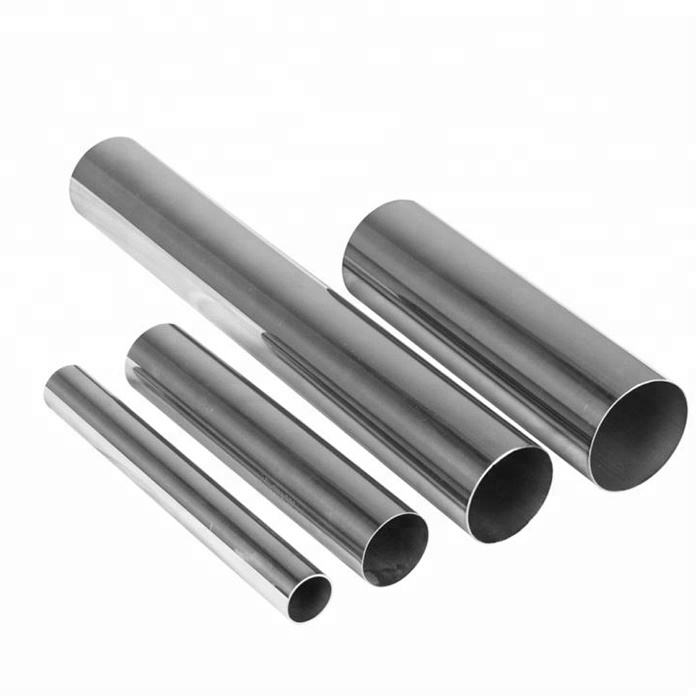
Round stainless steel pipe — the visible finish is the acceptance criterion, not a cosmetic detail.
The full product and standard reference for steel pipes, fittings and flanges is available in the Solid Steel Pipes catalogue: Solid Steel Pipe catalogue (PDF).
Market figures cited in this article are attributed to Fortune Business Insights commercial research published in 2026. Product, capacity, certification and application facts are as published by Solid Group / Shanxi Solid Industrial Co., Ltd. Figures for market size vary between reports depending on product scope inclusions.
Есть вопросы или нужны дополнительные детали?
Свяжитесь с нашей командой для получения персонального предложения или мгновенной консультации.
Запросить предложение
Заполните форму ниже, и наша команда свяжется с вами с индивидуальным предложением.
Прямой чат WhatsApp
Предпочитаете общаться в реальном времени? Напишите нам в WhatsApp для мгновенной помощи и быстрых ответов.
- Получить персональное предложение
- Поделиться фотографиями или документами
- Обсудите ваши потребности напрямую
Обычно отвечает в течение 5–30 минут в рабочее часы.