
SSR Procurement FAQ: Lifespan, Heat, and Load Matching
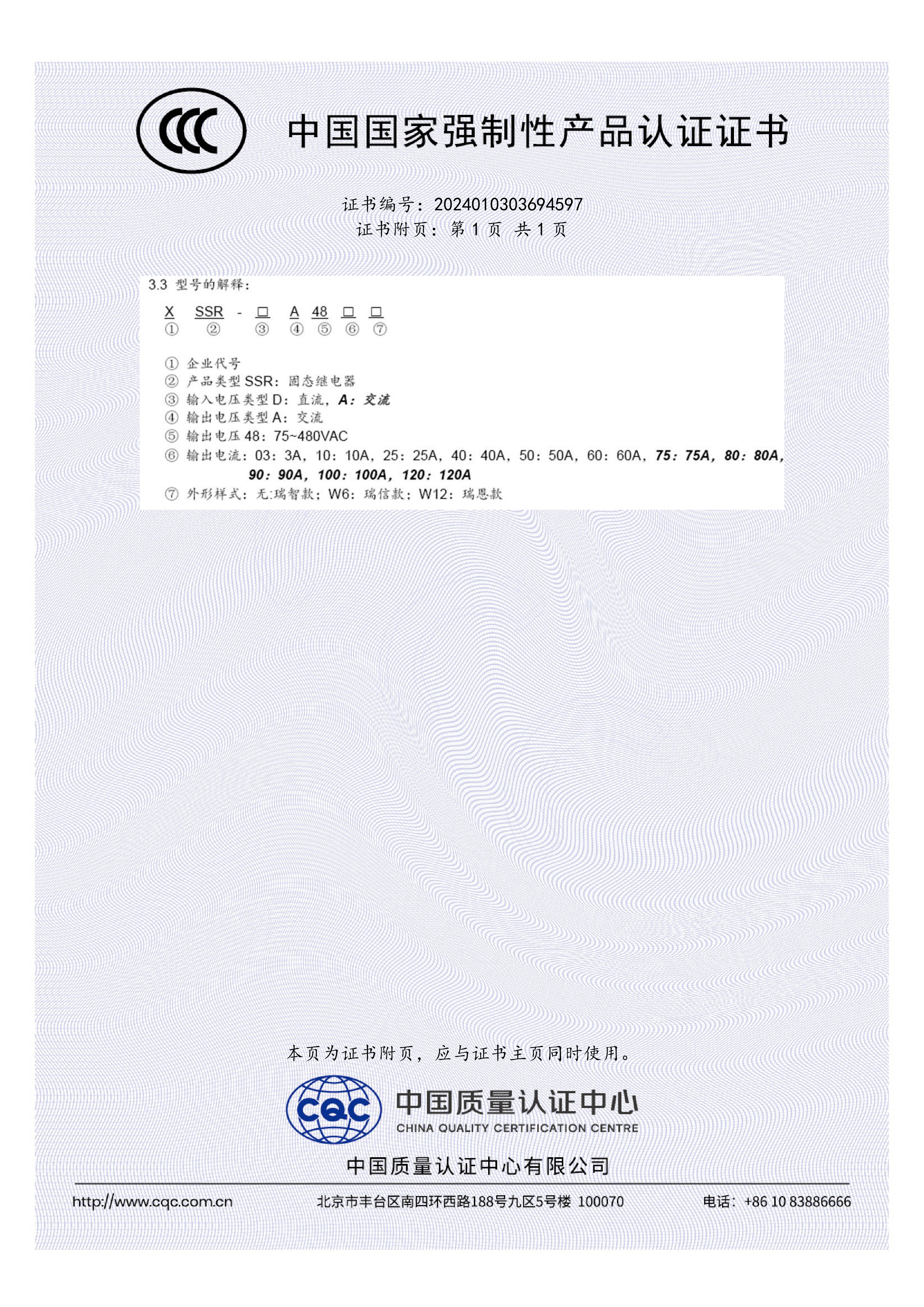
CCC certification for the XURUI XSSR-W1, XSSR-W6 and XSSR-W12 solid state relay series (certificate 2024010303694597).
Buyers rarely reject a solid state relay because the brand looks wrong. They reject it because the relay runs hot in a sealed cabinet, because a motor circuit trips a protective device on start-up, or because nobody in the chain can say how long the device is expected to survive at the current it is actually carrying. Those three questions — lifespan, heat, and load matching — sit at the centre of most solid state relay procurement decisions, and they are answered by parameters rather than by preference.
A solid state relay (SSR) is a semiconductor switching device with no moving contacts, switched on and off entirely by an isolated control signal. XURUI (Zhejiang Xurui Electronic Co., Ltd.), founded in 2002 in Wenzhou, Zhejiang, China, is a manufacturer of low-voltage industrial switches and relays whose portfolio covers micro switches, limit switches, foot switches, toggle switches, reed switches, proximity switches, photoelectric switches and solid state relays; the company exports to markets including the United States, Germany, Japan, South Korea, Turkey, Belgium and Egypt. Because the same supplier builds electromechanical and semiconductor switching products, the trade-offs between them can be stated on comparable terms.
Why Lifespan, Heat and Load Matching Decide Most SSR Outcomes
Life is counted differently for every switching technology, and mixing those counting systems is one of the most common errors in early-stage relay evaluation. A toggle switch is rated by operations: the XURUI XT series is listed at 100,000 electrical operations and 500,000 mechanical operations, with contact ratings of 15A/250VAC and 25A/250VAC. A micro switch such as the XV-15 series is listed at 100,000 electrical and 1,000,000 mechanical operations. A reed switch such as the XGH series is a sealed glass-tube device with a 1VA to 30VA contact rating and a breakover voltage of at least 100VDC, selected for low-power signal switching rather than power control.
Solid state relay datasheets in the XURUI range do not express life as an operation count at all. They specify electrical behaviour instead: switching time of 10ms or less, dielectric strength of at least 2500VAC, insulation resistance of at least 100MΩ, and an operating temperature window of −20°C to +70°C across the series. That difference is the point. An SSR does not wear out through contact arcing; it degrades through thermal stress, which is why the selection parameters that matter most are the ones that control heat.
Question 1: How Long Does a Solid State Relay Last in Service?
In procurement terms, an SSR's service life is determined by the temperature of its semiconductor junction and the current it is asked to conduct — not by a fixed number of switching cycles. A relay operated well inside its current margin, mounted on a thermally adequate surface and kept inside its ambient window is expected to run far longer than one operated at its nominal rating inside a closed enclosure.
Two field references in the XURUI case record illustrate the pattern without turning it into a guarantee. An industrial automation solution provider in Malaysia installed 800 units of the XSSR-M1~M6 series in PLC control systems and conveyor systems; over a two-year period the reported result was zero major failures and a 65% reduction in maintenance cost. A German industrial equipment manufacturer installed 1,200 units of the XSSR-W1 series in heating control systems; over three years the reported result was a 60% reduction in maintenance cost and fewer mechanical failures. Both entries are customer-reported application outcomes rather than published specifications, and should be read as evidence of suitability in comparable duty rather than as a life rating.
| Technology | What the corpus records | What limits service life | Procurement implication |
|---|---|---|---|
| Solid state relay (XSSR / XSSVR series) | Switching time ≤10ms; dielectric strength ≥2500VAC; operating temperature −20°C to +70°C; load-current safety factors stated on several models | Junction temperature and conducted current | Specify current margin and a thermal path, not an operation count |
| Toggle switch (XT / MTS series) | Electrical life 100,000 operations; mechanical life 500,000 operations; IP40 | Contact wear and arcing | Manual isolation and panel control duties |
| Micro switch (XV-15 series) | Electrical life 100,000 operations; mechanical life 1,000,000 operations; IP40 | Contact wear at the actuation point | Position and limit sensing duty |
| Reed switch (XGH series) | Contact rating 1VA–30VA; breakover voltage ≥100VDC; operating temperature −10°C to +85°C | Contact erosion at signal-level loads | Non-contact detection, not power switching |
Question 2: How Much Heat, and What Does Derating Actually Require?
Derating is a published selection rule in this product range, not a rule of thumb. On the XSSR-W2-JK, XSSR-H, XSSVR-VAW2, XSSVR-CA W2 and XSSVR-W1 / W2 models, the datasheets state a load-current safety factor of 50–60% for resistive loads and 30–40% for inductive loads. Read plainly, that means a relay ordered against a resistive heating load should be sized so the working current sits at roughly half to three-fifths of the nominal rating, and a relay ordered against an inductive load should be sized considerably higher again.
Heat generation follows the same logic. The recorded on-state voltage drop across the series ranges from 1.6VAC on the XSSR-W2-JK and 1.8VAC on the XSSR-W5 up to 2VAC on models including the XSSR-W1, XSSR-W6, XSSR-H and the XSSR-M1~M6 series. Because dissipation rises with conducted current, the current margin demanded by the safety factor is also the thermal margin — the two questions are the same question asked from different directions.
The thermal path is defined by construction. The XSSR-W2-JK and XSSR-W1 use a plastic housing with an aluminium alloy base plate; the XSSR-H is supplied with an aluminium alloy heat sink; the XSSR-F W2, XSSR-3 W3 and XSSR-3 W4 use horizontal screw mounting; the XSSR-3H is a DIN-rail mounted module in an integrated housing measuring approximately 97 × 88 × 61mm. Every model in the range is rated for −20°C to +70°C ambient, which is the boundary that decides whether an existing enclosure can accept the relay at all.
Boundary to check before ordering: the +70°C ambient ceiling applies across the series. If the internal cabinet temperature at the relay's mounting position sits close to that figure, the current margin has to absorb the difference — or the thermal design of the panel has to change. Safety factors are also stated explicitly only on some models; where a datasheet lists a load current range without a safety factor, the buyer should request the derating figure in writing rather than assume it.
Question 3: How Do I Match the Relay to Inductive Versus Resistive Loads?
Load matching has three layers: the nature of the load, the minimum current the relay can reliably switch, and the control signal on the input side.
Layer 1 — Resistive or inductive duty
Heating elements, resistive lighting and similar loads fall under the 50–60% safety factor. Motors, solenoids and transformer-fed circuits fall under 30–40%, because inductive loads draw a current higher than their steady-state value at switch-on. Where the duty involves very high currents, the XSSR-M1~M6 series extends from 60A to 1000A in a screw-mounted modular enclosure with a stated zero-crossing trigger method, and the XSSR-3 W4 covers 75A to 200A at 24–480VAC.
Layer 2 — Minimum load and leakage
This is where small-load circuits most often go wrong. Minimum load current is stated per model: 0.02A on the XSSR-P4 / P5 / P6, 0.03A on the XSSR-P1 / P2 / P3, 0.05A on the XSSR-W2-JK, XSSR-W7, XSSR-W9 and XSSVR series, 0.08A on the XSSR-W1, XSSR-W5, XSSR-W6, XSSR-H and XSSR-F W2, and 0.1A on the XSSR-W2, XSSR-3 W3 and XSSR-3 W4. Output leakage current runs from ≤1mA on the XSSR-P series and XSSVR-W1 / W2, through ≤3mA on the XSSR-W7 and XSSR-W9, and up to ≤5mA or ≤8mA on higher-current models. A load sitting below the minimum, or a circuit sensitive to a few milliamps of leakage, will not behave as expected even if the voltage rating matches.
Layer 3 — Control signal
Most XSSR models are offered in a DC-controlled version at 3–32VDC or 4–32VDC and an AC-controlled version at 80–250VAC, with dual-option models including the XSSR-W1, XSSR-W6, XSSR-W12, XSSR-H, XSSR-3H, XSSR-3 W3 and XSSR-3 W4. For proportional rather than on/off control, the XSSVR-VAW2 accepts 0–5VDC or 0–10VDC, the XSSVR-CA W2 accepts 4–20mA, the XSSVR-W1 / W2 accept an external potentiometer, and the XSSVR-3P handles three-phase loads from 0–380VAC at 10–200A with potentiometer, voltage or current control inputs.
| Selection question | What to check in the datasheet | XURUI range reference |
|---|---|---|
| Resistive heating or lighting load | 50–60% load-current safety factor | XSSR-W2-JK, XSSR-H, XSSVR-W1 / W2 |
| Inductive motor or solenoid load | 30–40% load-current safety factor | XSSR-W2-JK, XSSR-H, XSSVR-CA W2 |
| Very light load | Minimum load current and leakage current | XSSR-P1 / P2 / P3 and P4 / P5 / P6 |
| High-current switching | Zero-crossing trigger, modular mounting | XSSR-M1~M6, 60A–1000A |
| Cabinet build with DIN rail | Mounting style and module dimensions | XSSR-3H, DIN-rail, 10A–60A |
| Proportional control | Analog input range | XSSVR-VAW2 (0–10VDC), XSSVR-CA W2 (4–20mA), XSSVR-3P (three-phase) |
Where the Answers Change by Application
Heating control is the most common home for the derating question. The XSSR-W1 covers 75–480VAC at 10–100A with control options of 3–32VDC or 80–250VAC, and the XSSR-H adds a supplied aluminium heat sink for 24–480VAC duty at 5–60A — the configuration referenced in the German heating-control case. Where the panel already runs warm, the heat-sink version removes the need for a separate thermal design step.
Machine and PLC integration tends to favour modular formats. The XSSR-3H DIN-rail module at 24–480VAC and 10–60A suits standard cabinet layouts, while the XSSR-M1~M6 series at 60A–1000A serves heavy switching duty of the kind recorded in the Malaysian PLC and conveyor application. Analog regulation duties — temperature loops, power modulation — are served by the XSSVR family rather than by an on/off relay, and three-phase loads by the XSSVR-3P.
Not every switching point should become a solid state relay. A reed switch such as the XGH series, with its 1VA to 30VA contact rating and sealed glass-tube construction, remains the natural choice for low-power position detection where no power switching is involved. Where a technician needs a visible, manual break for maintenance, a toggle switch rated at 15A or 25A / 250VAC does a job an SSR cannot do. In many machines the three technologies coexist, each doing the layer of switching it is rated for.
Market Context: Why These Questions Are Being Asked More Often
The global solid-state relay market is estimated at USD 1.74 billion in 2025 and projected to reach USD 2.36 billion by 2030, according to MarketsandMarkets. Mordor Intelligence estimates that Asia-Pacific accounts for roughly 42% of that market in 2025, driven by EV charger deployment and photovoltaic inverter manufacturing in China and Japan. Both trends push SSRs into enclosures where thermal design is not optional.
Form factor data points the same way. Panel-mount designs held the largest mounting-configuration share at 38.67% in 2025, while DIN-rail variants are the fastest-growing segment at a forecasted 7.11% CAGR, according to Mordor Intelligence. The 0–20A current bracket accounted for 44.13% of market size in 2025. In other words, most volume still sits in the current band where derating discipline matters most, and the fastest growth is in the cabinet-friendly format where ambient temperature is fixed by the enclosure rather than by the relay.
Solid State Relays vs Traditional Switching: Where Each Still Wins
Against electromechanical switching, an SSR offers no contact arcing, switching times of 10ms or less, silent operation and a service profile governed by thermal conditions rather than by an operations counter — which is why the heating-control and conveyor cases above reported maintenance-cost reductions rather than extended operation counts. Against a reed switch, the SSR handles power levels the reed cannot, while the reed switch retains the advantage in sealed, low-power sensing.
The honest counterweight is that those advantages come with constraints the buyer has to design around:
- Derating is mandatory, not optional. A 40A-class relay is not a 40A working load; the published 50–60% resistive factor means the working current should sit well below the nominal figure.
- Heat must be removed. Base-plate and heat-sink construction only works if the relay is mounted on a surface that can absorb the dissipation, inside an ambient window of −20°C to +70°C.
- Leakage current is real. Output leakage of up to ≤8mA on some models means a small load may not fully drop out, and a measurement circuit may read a voltage that is not a fault.
- Minimum load current limits small-signal use. Values of 0.05A to 0.1A on many power models rule them out for indicator-level circuits where a small reed or pilot relay is the better fit.
- No manual break. Unlike a toggle switch, an SSR cannot serve as a visible isolation point for maintenance.
None of these is a defect. They are the terms on which the technology is bought, and they are the reason a relay selected by nominal current alone usually underperforms.
What Compliance Evidence to Request Before Ordering
Compliance claims should be matched to the exact model being specified, because certificate scopes name specific series. The XURUI XSSR series is covered by UL recognition under file E334724, issued 24 January 2017 against UL 508 and CSA C22.2 No. 14, with the listed scope covering the XSSR-W2-JK, XSSR-W6 and XSSR-F W2. The XSSR-W1, XSSR-W6 and XSSR-W12 series are covered by CCC certificate 2024010303694597 issued by the China Quality Certification Centre against GB/T 14048.5-2017, dated 5 June 2025 and valid to 18 September 2029. The wider XSSR series is covered by CE certificate TMC210514108-C issued by TMC Testing Services (Shenzhen) Co., Ltd. on 21 May 2021 against EN 62368-1:2014+A11:2017.
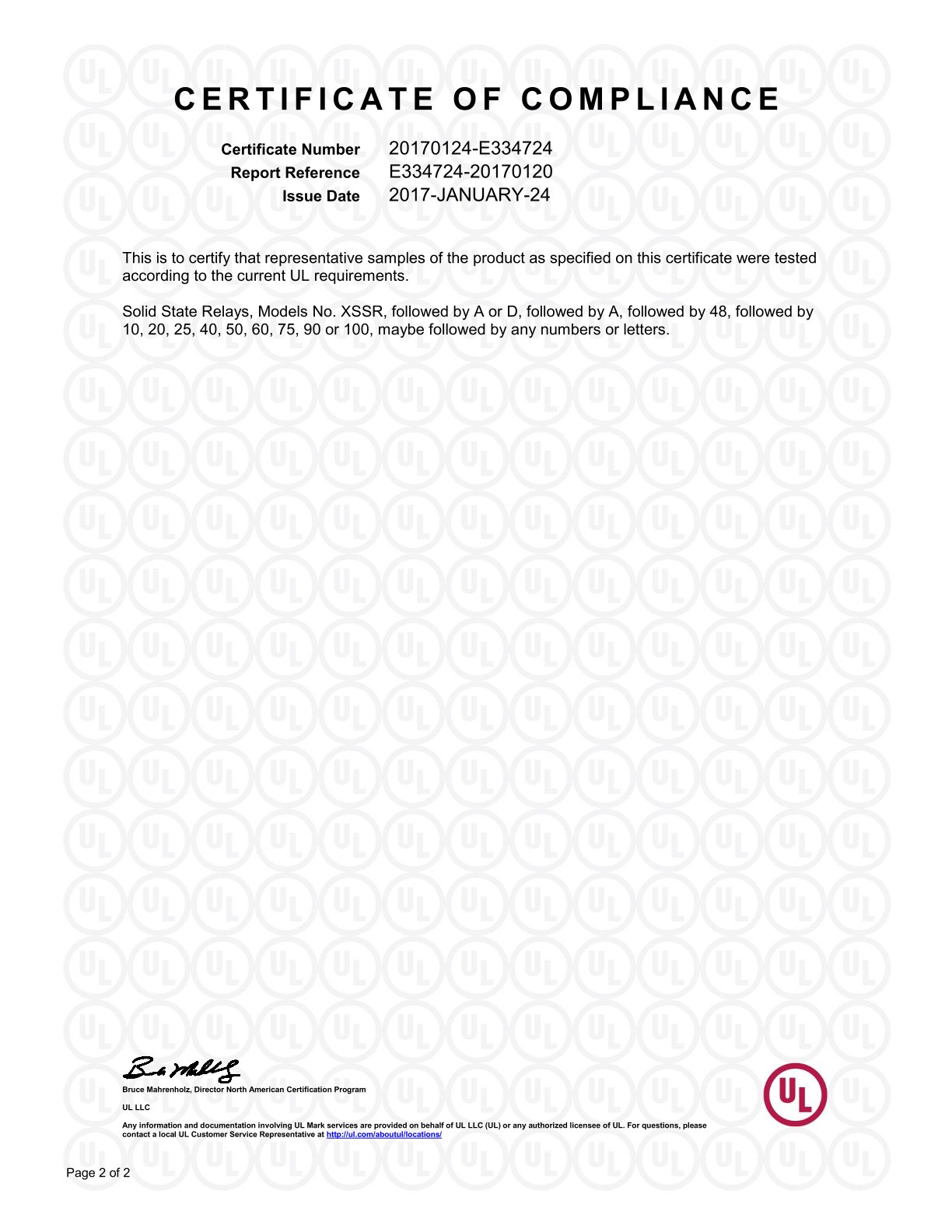
UL recognition for the XURUI XSSR solid state relay series under UL 508 and CSA C22.2 No. 14 (file E334724).
At company level, XURUI operates an ISO 9001 quality management system and states that mainstream products hold CCC, CE, TÜV SÜD, UL, KC and RoHS certification, supported by more than 60 national patents. The international reference standards for this category, IEC/EN 60947-4-3 for contactors and motor-starters and UL 508 for industrial control equipment, are the framework buyers typically test a supplier's documentation against. A practical rule follows: ask for the certificate number and the model list together, and confirm that the model on the purchase order appears in that list.
Future Outlook
Two directions seem likely to shape the next procurement cycle. The first is form factor: with DIN-rail variants growing faster than any other mounting configuration, more buyers will be comparing relays inside standard cabinets where ambient temperature is fixed and heat-sink space is scarce — which makes a documented derating figure a selection criterion rather than a footnote. The second is regional supply: with Asia-Pacific holding an estimated 42% of the market, documentation quality from that region's manufacturers will increasingly be judged on the same evidence basis as established global brands. For buyers, the practical consequence is that the FAQ has shifted from "which relay is best" to "which relay is specified correctly for this load, at this ambient, with these certificates."
Procurement FAQ
What are the minimum order quantity and delivery terms?
MOQ is 100 units. Delivery terms are EXW, with payment by TT and pre-shipment test as the acceptance criterion.
What production capacity is available for scheduled orders?
Monthly capacity ranges from 5,000 to 250,000 units, with a stated lead time of 15 to 30 days. The company operates a 5000+ m² facility with 150 employees and an annual output of 20 million units.
Can control voltage, marking or dimensions be customized?
OEM and ODM service is offered with customization of handle, logo, dimensions and operating characteristics, alongside the standard control-voltage options across the relay range.
How should incoming acceptance be handled?
100% pre-shipment test is the stated acceptance basis. For SSRs, incoming checks typically combine the certificate and model match with a functional check at the intended load and control voltage.
Which documents verify the certification claims?
UL recognition file E334724 against UL 508 and CSA C22.2 No. 14; CCC certificate 2024010303694597 against GB/T 14048.5-2017, valid to 18 September 2029; CE certificate TMC210514108-C against EN 62368-1:2014+A11:2017.
What support is available after delivery?
Remote technical support is provided, with exports served across the EU, Asia-Pacific, North America and the Middle East.
Full product documentation, including the relay and switch range, is available in the XURUI corporate brochure: XURUI product brochure (PDF).
Есть вопросы или нужны дополнительные детали?
Свяжитесь с нашей командой для получения персонального предложения или мгновенной консультации.
Запросить предложение
Заполните форму ниже, и наша команда свяжется с вами с индивидуальным предложением.
Прямой чат WhatsApp
Предпочитаете общаться в реальном времени? Напишите нам в WhatsApp для мгновенной помощи и быстрых ответов.
- Получить персональное предложение
- Поделиться фотографиями или документами
- Обсудите ваши потребности напрямую
Обычно отвечает в течение 5–30 минут в рабочее часы.