
SV0595 Window Tint Film: An Independent Buyer Spec Review
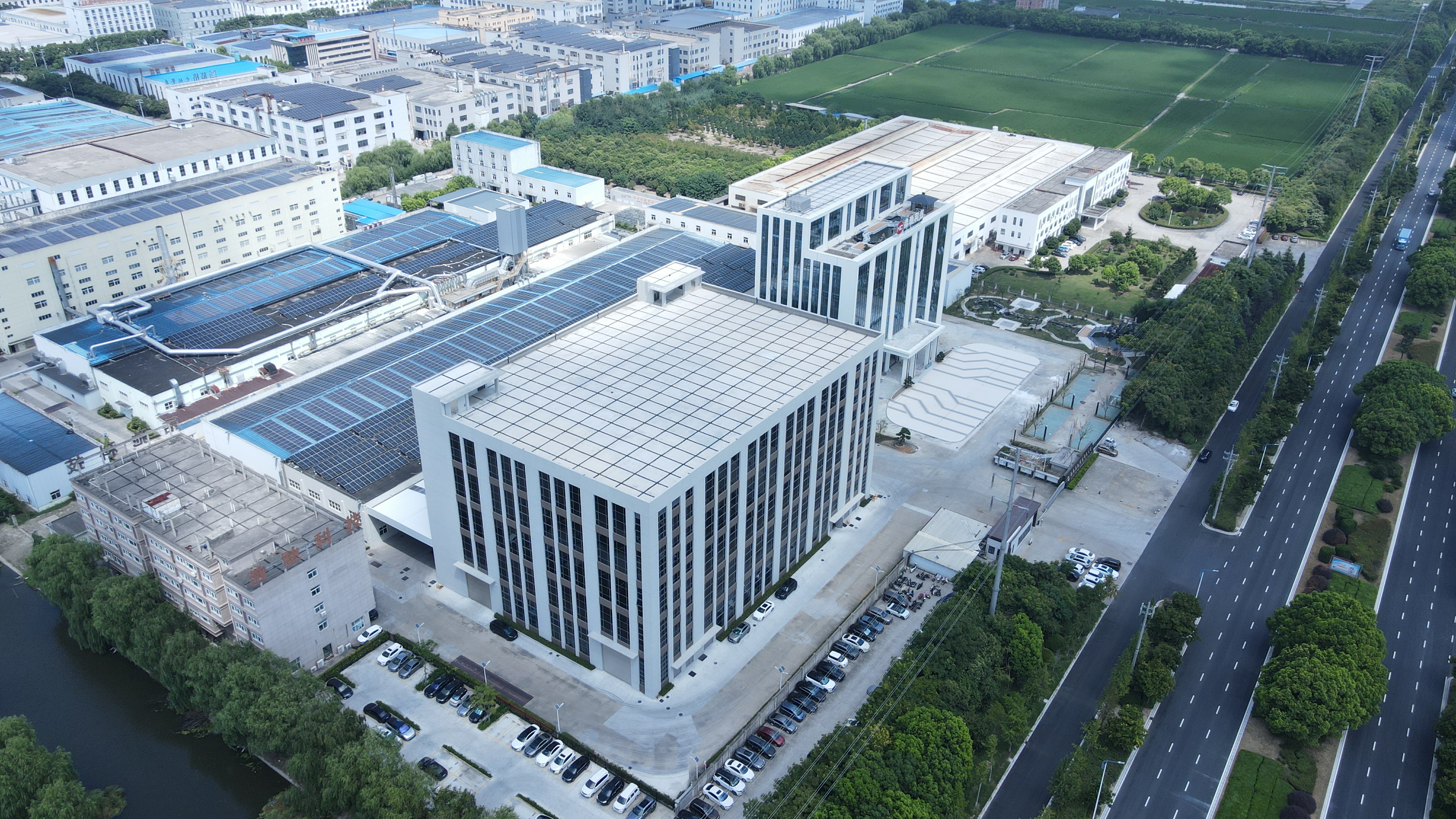
Automotive window film is quoted on three headline numbers, but it is accepted or rejected on the documentation behind them. Image: Haian Ho Chi Technology Co.,Itd.
Automotive window film is one of the few vehicle components bought almost entirely on a specification sheet. A buyer typically receives a short table — visible light transmittance, infrared cut, ultraviolet rejection — and a film class name. What that table does not state is the test method behind the numbers, the total solar energy rejected, the haze value, the roll format tolerance, or the conditions attached to the warranty. For a model such as the AUTOMOTIVE FILM SV0595 from Haian Ho Chi Technology Co.,Itd., a sputter-class film built on high-purity optical-grade PET and specified at 5% VLT, 95% infrared cut and 99% UV rejection, the procurement task is not to rank three figures against a competitor's three figures. It is to convert those figures into order terms, acceptance criteria and a documented limit of use.
This review takes the buyer's side. It states what the SV0595 specification actually contains, explains what the sputter classification implies for a purchase, identifies where a 5% VLT product can and cannot legally be installed, and sets out the documents a buyer should require before confirming a purchase order. All product values below are the values published by the manufacturer for SV0595; regulatory thresholds are cited to their official instruments, with the applicable jurisdiction named in each case.
Why Window Film Specifications Resist Comparison
The commercial pressure to quote a short specification is real. Grand View Research valued the global automotive tinting film market at USD 8.1 billion in 2025 and projected it to reach USD 8.7 billion in 2026, which means a growing number of converters and traders are quoting near-identical headline figures into the same channels. When several suppliers present the same VLT and the same UV rejection, those two numbers stop discriminating between offers, and the buyer is left comparing price against an unread specification.
Two structural problems make the comparison harder than it looks. First, infrared cut is routinely quoted as a single percentage without stating the wavelength band or the measurement basis, so two films reporting the same IR figure may not perform alike under the same solar load. Second, VLT is a definition, not a performance claim: VLT is the percentage of visible light that passes directly through filmed glass, and a higher number means a lighter film. A buyer who treats VLT as a quality indicator will misread every datasheet in the category.
What the SV0595 Datasheet Actually States
SV0595 is catalogued by Haian Ho Chi Technology Co.,Itd. as an AUTOMOTIVE FILM within the automotive film category, classified as a SPUTTER FILM and intended for automotive film and automotive industry applications. Its published values are compact and internally consistent.
| Specification field | Published value for SV0595 | What the buyer should note |
|---|---|---|
| Product name / model | AUTOMOTIVE FILM / SV0595 | Confirm the model code appears identically on the invoice, carton and roll core label. |
| Film class | SPUTTER FILM | Indicates a sputter-coated construction; the layer count and sputtering process are not disclosed in the published specification. |
| Base material | High-purity optical-grade PET (polyethylene terephthalate) | PET is the carrier; "optical-grade" should be supported by a haze or clarity figure, which the published specification does not state. |
| Construction and thickness | 2-ply, 3.0 mil | A two-ply laminate of 3.0 mil total thickness; ply-level thickness split is not stated. |
| VLT | 5% | A dark film. See the market-access section before specifying it for front glazing. |
| Infrared cut | 95% | Wavelength band and measurement basis are not stated in the published specification. |
| UV rejection | 99% | UV rejection is a separate dimension from VLT and should be specified independently. |
| Colour | ULTRA BLACK | Colour consistency across rolls is a batch-control question, not a datasheet question. |
| Stated warranty period | 10 years | The longest stated period among the manufacturer's automotive models. Warranty conditions should be obtained in writing. |
Equally important is what the published specification does not contain: a total solar energy rejection (TSER) figure, a haze value, an adhesion or peel-strength value, accelerated weathering data, a stated test method, a roll width and length, or the terms that void the warranty. None of these omissions makes the product unsuitable. They define the questions a buyer must ask, because those are the fields where a delivered roll can differ from a quoted roll.
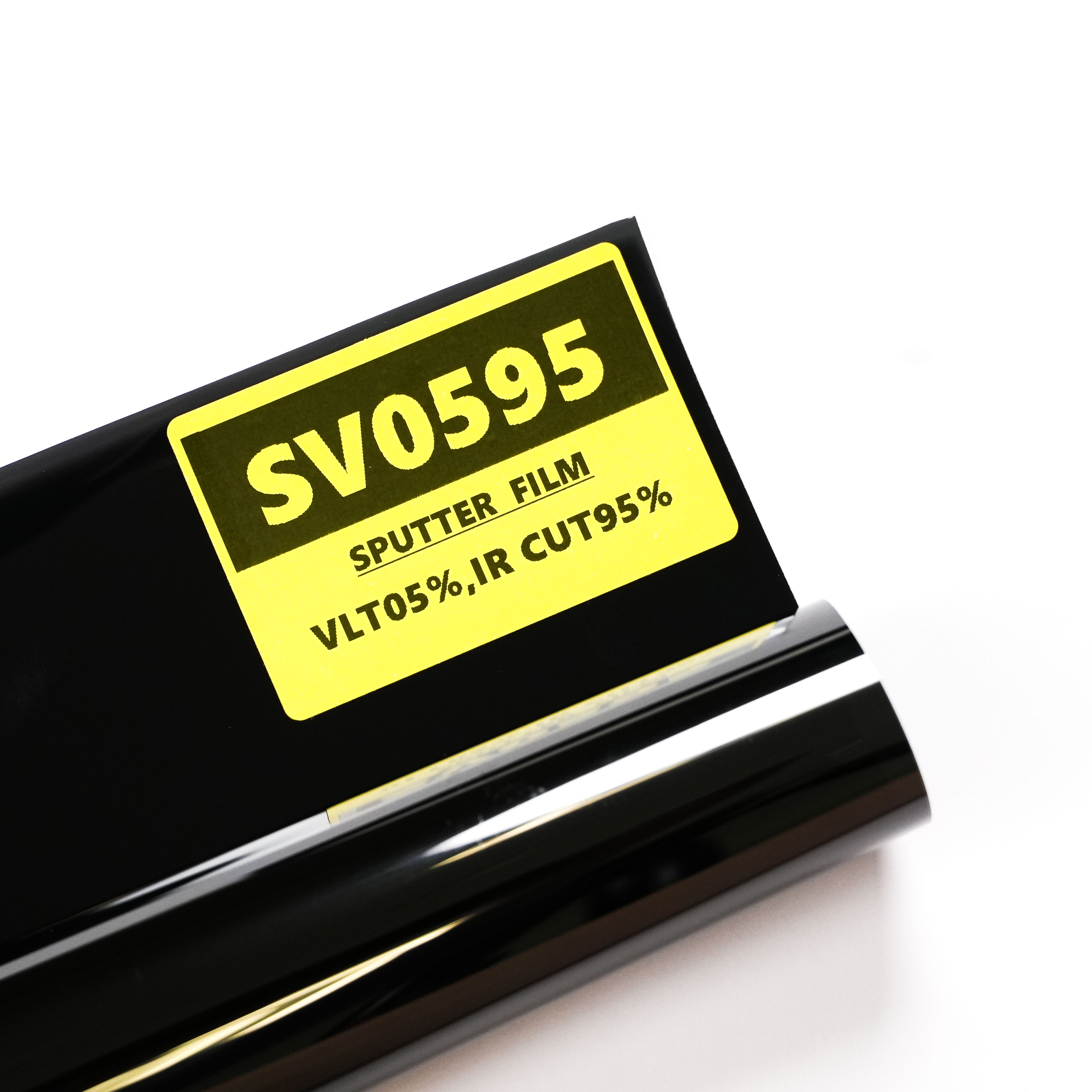
SV0595 is published as a 2-ply, 3.0 mil sputter film on high-purity optical-grade PET, in ultra black, with a stated 10-year warranty period. Image: Haian Ho Chi Technology Co.,Itd.
Reading "Sputter Film" as a Purchasing Term
The class name carries more procurement meaning than any single number on the sheet. Sputter films are produced by depositing thin metallic layers onto the PET carrier under vacuum, which produces a reflective, spectrally selective film: it reflects a defined portion of infrared energy while transmitting a controlled amount of visible light. The manufacturer's listed properties for SV0595 follow that logic — true reflective heat rejection, spectral selectivity, a natural metallic aesthetic stated to be zero-fading, and safety and shatter resistance.
For a buyer, three consequences follow. First, heat rejection in a sputter film is largely reflective rather than absorptive, which distinguishes it from dyed constructions and matters where glass temperature and long-term colour stability are concerns. Second, a metal-bearing construction is exactly where installation quality and vehicle electronics deserve explicit scrutiny — a point covered under acceptance criteria below. Third, the published value "95% infrared cut" describes a selective band, not total solar performance; TSER remains the number that answers the question "how much total solar energy does this film reject," and it is absent from the SV0595 sheet.
A practical way to read the family is to compare like with like inside the same catalogue. The table below uses only the manufacturer's published values for its automotive models, which makes the trade-offs visible without borrowing performance claims from outside the source material.
The 5% VLT Question: Fit, Market Access and Limits
At 5% VLT, SV0595 is a dark, privacy-oriented film, and this is the single specification that most constrains where it can be sold. Several jurisdictions set visible light transmittance floors for specific glazing positions, and the thresholds are close enough to each other to be treated as a shared design reference — but they are separate legal instruments with separate scopes, and none of them is satisfied by a product datasheet alone.
| Instrument | Jurisdiction and scope | Reference threshold |
|---|---|---|
| UN Regulation No. 43 | UNECE 1958 Agreement contracting parties, including the European Union — windscreens | Minimum regular (visible) light transmittance of 70% for windscreens |
| GB 7258-2017 | China — windscreen and glazing in the driver's field of view | Visible light transmittance not less than 70% |
| California Vehicle Code §26708 | California, United States — front side windows adjacent to and forward of the driver's seat | Material applied to those windows must have light transmittance of at least 70% |
| FMVSS No. 205; ANSI/SAE Z26.1 | United States (federal) — glazing materials | Glazing must meet the referenced performance requirements; applied film must not compromise that compliance |
| FMVSS No. 302; 49 CFR 571.302 | United States (federal) — occupant-compartment materials | Horizontal burn rate not more than 102 mm per minute |
The conclusion for a buyer is direct: a 5% VLT film cannot be presented as a windscreen or front-side legal tint in any of the three 70% jurisdictions above. SV0595's realistic fit is rear passenger glazing, rear quarter glass and cargo or cargo-adjacent glazing in markets where rear-glazing limits are absent or more permissive — and every such specification must be checked against the destination market's own rules, not against a supplier's summary. This is a genuine limit of the product, not a defect: a dark reflective film specified for privacy and heat rejection is not the same product as a 70% VLT film designed for windscreen compliance, and a supplier who blurs the two creates legal exposure for the importer, the fitter and the dealer.
Acceptance Criteria to Confirm Before the Purchase Order
Because the published SV0595 specification stops at four performance fields, the purchase order should carry the rest. The following criteria are framed as acceptance terms — items a buyer can make measurable and reject a delivery against.
| Acceptance item | Why it belongs in the contract | Document to request |
|---|---|---|
| Total solar energy rejection (TSER) | IR cut alone does not describe total heat rejection; TSER is the comparable figure across suppliers. | TSER value with the test method and glass substrate stated. |
| Test method and specimen | Claims without a method cannot be compared or defended in a dispute. | Laboratory name, report number, test date and method reference (ISO 13837 is a recognised method standard for solar transmittance of road-vehicle glazing). |
| Haze and optical clarity | The datasheet asserts optical-grade PET but publishes no haze value; low haze is the property installers and end users actually judge. | Haze percentage, plus visual inspection of a production sample roll. |
| Adhesive performance | Edge lifting and adhesive failure are installation- and climate-dependent, not visible on a datasheet. | Adhesion data and the adhesive type stated for the film construction. |
| Colour stability and weathering | A "zero fading" property and a 10-year warranty period both imply durability data that is not published. | Accelerated weathering results and the colour-shift limit that the warranty references. |
| Roll format and tolerance | Width, length, liner and core determine cutting yield and waste; a stated 1.52 m format is common in the category but is not confirmed for SV0595 in the published specification. | Roll width, length, core size and permitted tolerance, written onto the purchase order. |
| Warranty terms | A stated period is not a warranty; the conditions define whether a claim survives. | Written terms covering duration, exclusions (installation defect, substrate, climate), claim process and territorial validity. |
| Regulatory file for the destination | Obligations attach per market and per shipment, not per catalogue. | US: an FMVSS 302 test report naming the film, laboratory and result at or below 102 mm/min. EU: an SVHC declaration under REACH Article 33, refreshed against the current ECHA Candidate List. Any "CE" claim should name the EU legal instrument it refers to. |
| Vehicle electronics check | SV0595 is a metal-bearing sputter construction, and the published SV0595 specification does not carry the "no signal interference" note that the manufacturer attaches to its SV3095 sputter model. | Confirmation of in-vehicle testing on sensor-equipped models the buyer intends to serve. |
Sputter Film Against Dyed, Carbon and Security Constructions
Most purchase decisions in this category are not sputter-versus-sputter. They are sputter versus the lower-cost constructions that dominate volume channels. The comparison below uses the manufacturer's own published model values, which keeps the trade-offs honest and avoids attributing unverified performance to third-party brands.
| Model | Film class | Thickness | VLT | IR cut | UV rejection | Stated warranty |
|---|---|---|---|---|---|---|
| SV0595 | Sputter film | 2-ply, 3.0 mil | 5% | 95% | 99% | 10 years |
| SV3095 | Sputter film | 2-ply, 3.0 mil | 30% | 95% | 99% | 10 years |
| CARBONBRONZE 10 | Carbon film | Not stated | 10% | 90% | 99% | Not stated |
| CLASSIC03P | Glue tint | 2-ply, 1.5 mil | 3% | 10% | 99% | 4 years |
| CLASSIC35P | Glue tint | 2-ply, 1.5 mil | 35% | 10% | 99% | 4 years |
| NEX4MIL05 | Glue tint security film | 2-ply, 4.0 mil | 5% | 11% | 99% | 5 years |
The pattern is instructive. Dye-based glue tints reach deep privacy at low cost — CLASSIC03P delivers 3% VLT on a 1.5 mil two-ply construction — but their published IR cut sits at 10%, which tells the buyer they are privacy and glare products rather than heat-rejection products. Security-oriented constructions such as NEX4MIL05 trade thickness for shatter retention and intrusion delay, not for solar rejection. SV0595 occupies a different position: it delivers a 5% VLT alongside a 95% IR cut on a thicker 3.0 mil two-ply sputter construction, with a stated 10-year warranty period.
The limits a buyer should price in
- Market-access limit. At 5% VLT, SV0595 is excluded from windscreen and front-side legal use in the 70% jurisdictions cited above. Its addressable volume is rear and cargo glazing, which narrows the dealer and fleet programmes it can serve.
- Construction limit. A metal-bearing sputter layer warrants an explicit electronics check on sensor-equipped vehicles; the published SV0595 sheet does not include the no-signal-interference note that appears on the SV3095 specification.
- Evidence limit. No TSER, haze, adhesion, weathering or roll-format value is published for SV0595, so a buyer who orders on the sheet alone is ordering on four fields out of roughly a dozen that determine delivered performance.
- Installation limit. Sputter films demand competent heat-shrinking on curved glass and a clean, dust-controlled bay; the same installation discipline that the manufacturer lists for its automotive range — hot air gun, squeegees, slip solution, controlled curing — applies here, and poor installation will be attributed to the film regardless of cause.
Where the Specification Travels: Channels and Their Demands
The declared working conditions for the manufacturer's automotive film range are intense solar radiation, high UV exposure, high ambient temperature, humidity, road debris impact and outdoor weathering across a stated range of −30°C to 80°C, with 24/7 passive operation. Those conditions shape what each channel should ask for.
4S dealership new-car delivery. Dealer programmes are volume-driven and time-sensitive: film is fitted before handover, so batch-to-batch colour consistency and predictable shrink behaviour matter more than a marginal heat-rejection gain. The buyer's control point is a written colour-match standard and a sample roll retained as a reference.
Ride-hailing and fleet fitting. Fleet work concentrates wear on the same glazing positions across many vehicles. Acceptance criteria should specify a warranty that survives high-cycle use, and the buyer should confirm that the 10-year stated period applies to commercial-service vehicles rather than private use only.
RV and van conversion. Large, often flat or lightly curved panels make yield and roll width commercially decisive, and the declared weathering range becomes relevant for vehicles stored outdoors. This is the channel where a documented roll format is worth negotiating explicitly.
Tuning shops and aftermarket installers. These buyers resell on appearance and privacy. A deep ultra-black reflective film with a stated 10-year period is a defensible retail story, but only if the installer can show the film's legal position for rear glazing in their market.
Importers, wholesalers and OEM programmes. Here the specification becomes a contract annex. OEM and private-label buyers should require the TSER, haze, adhesion and weathering data before tooling a programme, and should confirm production capacity against forecast: the manufacturer states a 133,333 m² facility, more than 220 staff, a 100-engineer R&D team and an annual output of 48,000,000 m.
The Manufacturer Behind the Model
Haian Ho Chi Technology Co.,Itd. is a functional film manufacturer based at No. 88, Lifang Avenue, Haian Economic and Technological Development Zone, Nantong City, Jiangsu Province, China, established in 2009 with more than 15 years of operating experience and operating as a wholly-owned subsidiary of Shanghai Haochi Technology Co., Ltd. Its stated product range covers nano-ceramic film, carbon film, original colour film, paint protection film, front layer film, iridescent film, architectural film, dyed film and explosion-proof film, with automotive window film positioned as the core business.
Several verifiable company-level facts are relevant to a buyer qualifying SV0595. The company reports more than 50 patents, including 14 invention patents, 19 utility model patents and 18 software copyrights, and has been recognised as a National High-tech Enterprise for nine consecutive years; it also describes itself as a national-level specialised and innovative high-tech enterprise. It reports a 60% export ratio, with listed markets including the Netherlands, Germany, Poland, the United Kingdom, France, Italy, Spain, Mexico, Brazil, Chile, the UAE, Saudi Arabia, Türkiye, Malaysia, Singapore, Australia and New Zealand.
On certification, an HTNXT verification note records IATF 16949:2016 certification for the manufacturer's paint protection film and solar film products, valid until 2028-03-15. A buyer should treat that as a lead rather than a conclusion: request the certificate copy, confirm the certified scope covers automotive window film specifically, and confirm validity at the date of order.
Market Trend: Growth, EVs and Sensor-Safe Constructions
Two documented trends frame the category. The first is scale: the global automotive tinting film market was valued at USD 8.1 billion in 2025 and projected at USD 8.7 billion in 2026 by Grand View Research, which supports the observation that supply is expanding faster than the number of buyers able to read a specification critically. The second is technical: ceramic and nano-ceramic films that do not interfere with advanced driver-assistance sensors are reported to be gaining traction among OEMs and electric-vehicle owners.
Read together, the trends set a clear expectation for a sputter product. Demand growth rewards suppliers who can document performance rather than assert it, and the sensor-compatibility conversation raises the evidentiary bar for any metal-bearing film fitted to a modern vehicle. Neither trend invalidates a sputter construction — reflective heat rejection and colour stability remain genuine advantages — but both make the acceptance criteria in this review less optional than they were when the category competed mainly on price.
Future Outlook
The most likely near-term change is not in film chemistry but in documentation. As more markets formalise glazing and interior-material requirements, and as importers carry more of the compliance burden, the specification fields that are currently missing from typical datasheets — TSER with method, haze, adhesion, weathering, roll format — will migrate from "nice to have" to purchase-order annexes. Suppliers who publish them first will be easier to qualify, and buyers who demand them will be harder to displace on price alone.
For SV0595 specifically, the practical trajectory is a documented rear-glazing and privacy specification with a long stated warranty, sold into channels that value appearance, heat rejection and durability, and sold with an explicit statement of where it cannot lawfully be installed. A supplier who states that boundary clearly is easier to trust on everything else in the sheet.
FAQ
What does the SV0595 specification actually state?
SV0595 is an AUTOMOTIVE FILM classified as a SPUTTER FILM, made on high-purity optical-grade PET with a 2-ply, 3.0 mil construction. Published values are VLT 5%, infrared cut 95% and UV rejection 99%, in ULTRA BLACK, with a stated quality warranty period of 10 years. The published specification does not state TSER, haze, adhesion, weathering data, test method or roll format.
Is a 5% VLT film legal for front windows?
Not where a 70% visible light transmittance floor applies. UN Regulation No. 43 sets a minimum regular light transmittance of 70% for windscreens among UNECE 1958 Agreement contracting parties including the EU; GB 7258-2017 requires not less than 70% for the windscreen and glazing in the driver's field of view in China; California Vehicle Code §26708 requires at least 70% light transmittance for material applied to front side windows. Legal tint positions vary by market and must be checked against the destination jurisdiction's own rules.
How does automotive window film reduce heat and UV exposure?
Solar control films use dyed, carbon, metalised, ceramic or multi-layer constructions to manage ultraviolet, visible light and infrared energy, absorbing or reflecting selected wavelengths. Performance should be evaluated using verified VLT, UV rejection, IR rejection and TSER test data rather than product colour alone.
What documentation should a buyer request with a sputter film quotation?
At minimum: a TSER value with the test method and glass substrate stated; a haze figure; adhesion data; accelerated weathering results and the colour-shift limit the warranty references; roll width, length and tolerance; written warranty terms including exclusions; an FMVSS 302 test report naming the film and result if the destination is the United States; and an SVHC declaration under REACH Article 33, refreshed against the current ECHA Candidate List, if the destination is the European Union.
Does a sputter film interfere with vehicle electronics?
Sputter films contain deposited metallic layers, so signal and sensor interaction should be confirmed rather than assumed. The published SV0595 specification does not include the "no signal interference" note that the manufacturer attaches to its SV3095 sputter model, so a buyer intending to fit sensor-equipped vehicles should request confirmation of in-vehicle testing for SV0595 on the relevant models.
How should automotive window film be installed to meet acceptance?
Installation requires a clean, dust-free environment, accurate cutting, thorough glass cleaning, the correct application solution, careful squeegee work and sufficient curing time. Curved glass generally requires heat-shrinking before application. Professional installation helps prevent bubbles, dust contamination, peeling edges and optical distortion, and installers should select VLT, colour and heat-rejection performance according to vehicle type, customer requirements and local regulations. Curing time depends on film type, temperature and humidity.
Full technical documentation for the manufacturer's window film range, including model-level specifications, is available in the published specification brochure: WINDW FILM HC SPECIFICATIONS (PDF).
Есть вопросы или нужны дополнительные детали?
Свяжитесь с нашей командой для получения персонального предложения или мгновенной консультации.
Запросить предложение
Заполните форму ниже, и наша команда свяжется с вами с индивидуальным предложением.
Прямой чат WhatsApp
Предпочитаете общаться в реальном времени? Напишите нам в WhatsApp для мгновенной помощи и быстрых ответов.
- Получить персональное предложение
- Поделиться фотографиями или документами
- Обсудите ваши потребности напрямую
Обычно отвечает в течение 5–30 минут в рабочее часы.