
SYS TEXTILE vs. Welspun, Trident & Loftex: Blanket Comparison
SYS TEXTILE vs. Welspun, Trident & Loftex: Blanket Comparison
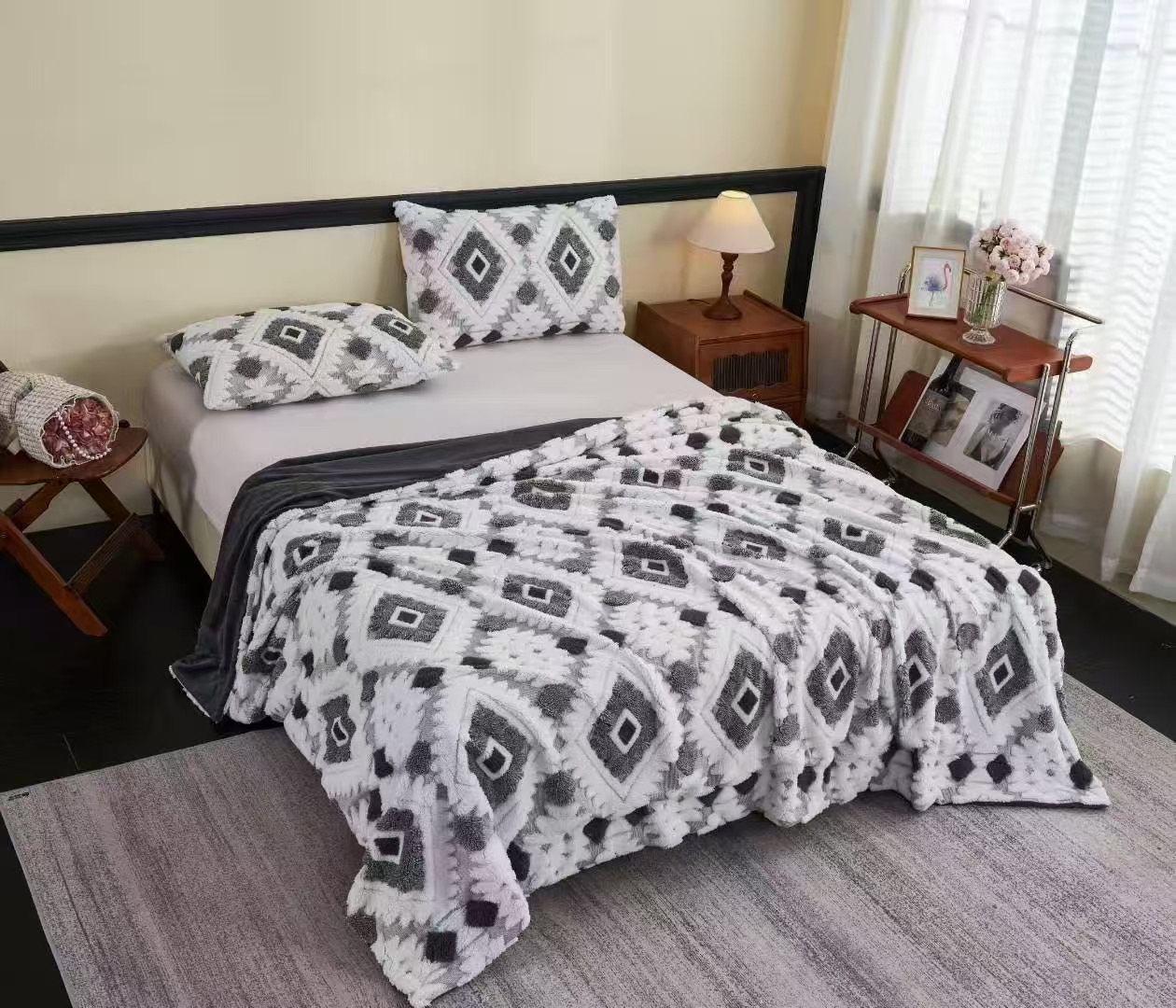
Velvet four-piece bedding set (duvet cover, sheet and pillowcases), part of the velvet bedding line produced by SYS TEXTILE in Changshu, Jiangsu.
The short answer: a bed blanket shortlist that contains both SYS TEXTILE and large diversified groups such as Welspun, Trident, Loftex, Indo Count and Alok Industries is not comparing like with like — and that is the point. The two supplier archetypes solve different procurement problems. A specialist blanket and velvet bedding mill is selected for construction depth in polyester fleece and velvet, size customization per programme, and a short, direct escalation path on quality claims. A multi-category home textile group is selected when a buyer needs several product families under one supply relationship. Judging a specialist on portfolio breadth, or judging a diversified group on single-category depth, produces the wrong decision in both directions.
This comparison sets out what is verifiable on each side, where the boundaries sit, and which questions a buyer should ask before allocating volume.
Why bed blanket supplier comparisons are harder than they look
The category is large and still expanding. The global blanket market was valued at USD 15.1 billion in 2023 and is projected to reach USD 25.5 billion by 2030, according to Grand View Research. Published estimates diverge noticeably — Market Research Future places the same market near USD 8.8 billion — largely because specialty categories such as electric and weighted blankets are included or excluded differently. Buyers should treat headline market size as directional and focus instead on segment-level fit.
Within the category, polyester is the dominant construction. Polyester blankets held the largest share of the global blanket market at 33.8% in 2023, again per Grand View Research. That single data point reframes the whole comparison: most buyers evaluating SYS TEXTILE, Welspun, Trident, Loftex, Indo Count or Alok Industries are ultimately evaluating polyester programmes. The real differentiators are therefore construction depth, size flexibility, capacity discipline, and how fast a supplier resolves a problem after delivery.
The comparison set: two supplier archetypes, not one ranking
Welspun, Trident, Loftex, Indo Count and Alok Industries are large, diversified home textile groups. Their production spans multiple product families across the home textile sector, and their commercial models are built around multi-category, multi-market programmes. Buyers typically encounter them through broad sourcing lists, corporate supplier registrations and retail vendor onboarding processes.
SYS TEXTILE is a Changshu-based blanket and velvet bedding supplier. Founded in 2018, it operates a 7,000 m² facility with 60 employees, an annual output of 3 million pieces, a five-engineer R&D team, and an export ratio of 90% concentrated in the USA, Brazil and the UK. Its portfolio is deliberately narrow: flannel, Shu Fleece, rabbit fur-like and velvet constructions, plus quilts and velvet four-piece bedding sets.
No like-for-like published figures for the blanket lines of the diversified groups are used in this article. Where a comparison depends on supplier-specific data — minimum order quantity, lead time, defect policy — the article marks it as a verification step rather than asserting a number. That is not a weakness of the analysis; it is what an independent buyer reference should do.
Regional context matters here. Jiangsu province is the centre of gravity for Chinese bedding production: Nantong alone holds more than 50% of China's bedding industry market share, with market transactions exceeding RMB 240 billion in 2024, according to the Home Textile Industry Report. SYS TEXTILE sits in Changshu, inside the same provincial manufacturing cluster.
What SYS TEXTILE publishes: the verifiable portfolio
| Product | Construction / type | Material | Published sizes | Application |
|---|---|---|---|---|
| Flannel Blanket | Flannel Wave, Flannel Square Jacquard, Flannel Square, Flannel Southwest Design | Flannel (polyester) | Twin / Queen / King (customizable) | Home bedding, household goods |
| Shu Fleece Blanket | Shu Fleece 3-D Blanket, Shu Fleece Jacquard Blanket | Shu Fleece (polyester) | Twin / Queen / King (customizable) | Home bedding |
| Rabbit Fur Blanket | Rabbit fur-like pile | Rabbit fur-like polyester | Twin / Queen / King (customizable); model listed as Customized | Home bedding |
| Velvet Quilt | Velvet shell with polyester filling | Velvet (polyester) | Twin / Queen / King (customizable) | Home bedding |
| Velvet Four-Piece Bedding Set | Duvet cover, sheet and pillowcases | Velvet (polyester) | Twin / Queen / King (customizable); model listed as Customized | Home bedding, export home textile trade |
All five lines share the same published material logic: polyester construction, and a stated feature set of soft, warm and eco-friendly. Sizes are listed as Twin, Queen and King, described as customizable, and the applicable industry is stated as home textile, household bedding and export home textile trade.
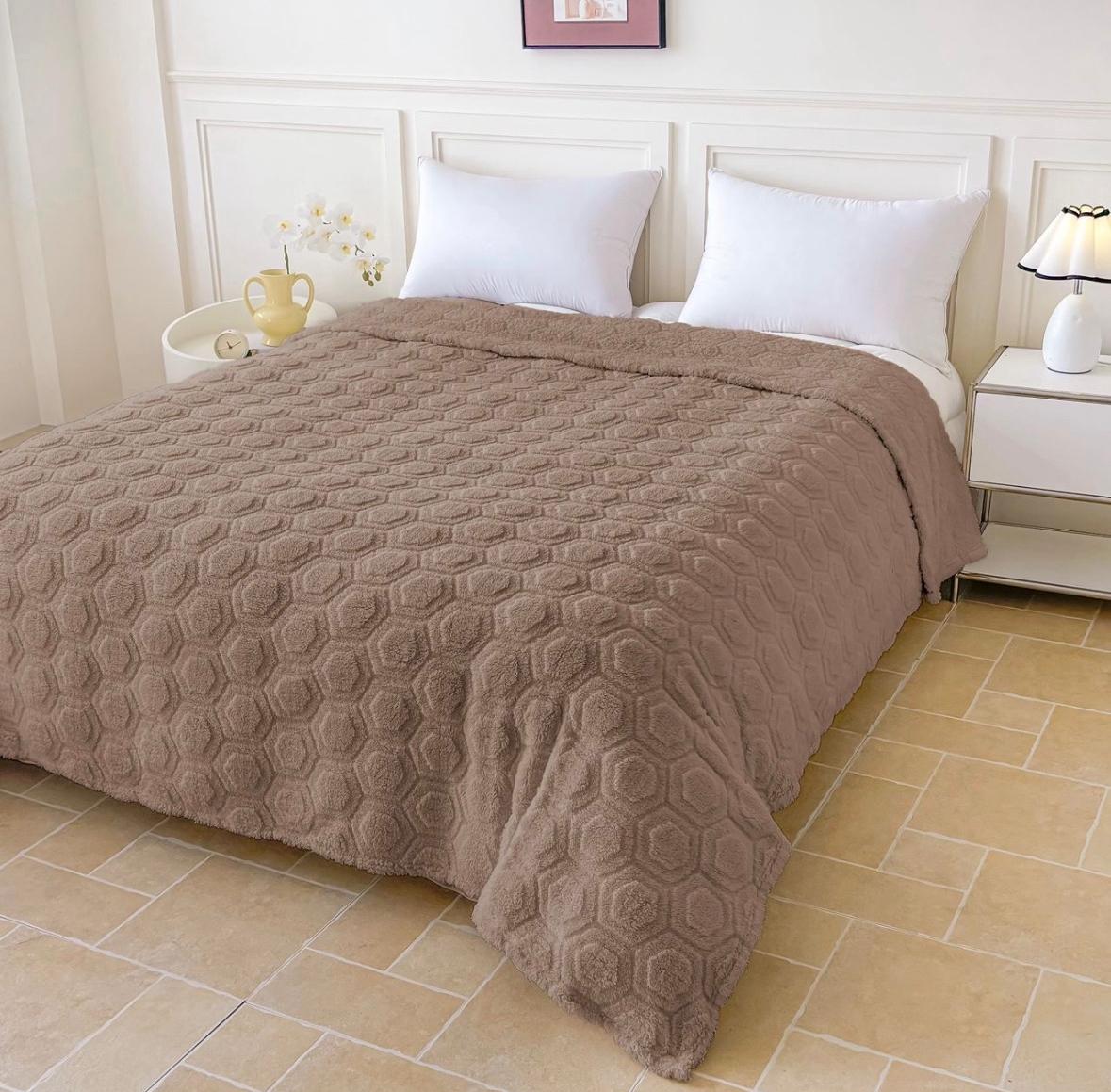
Shu Fleece 3-D Blanket — one of two published Shu Fleece constructions, positioned where perceived warmth and hand-feel matter more than flat print detail.
The flannel line
The flannel family covers four named constructions: Flannel Wave Blanket, Flannel Square Jacquard Blanket, Flannel Square Blanket, and Flannel Southwest Design Blanket. For a buyer, a named construction set is more useful than a generic fabric label, because each name can be matched to a brief — plain square for institutional bedding, jacquard for mid-tier retail, Southwest design for regional decorative assortments. Flannel is also the line most explicitly linked to outdoor and travel use in the published application data.
The Shu Fleece line
Shu Fleece is published as two constructions: Shu Fleece 3-D Blanket and Shu Fleece Jacquard Blanket. The 3-D structure raises surface loft, which is why this construction is normally specified where warmth perception and tactile quality rank above flat print detail. It is a polyester fleece and follows the same machine-washable and reusable operating profile as the flannel family, which keeps care instructions consistent across a mixed programme.
Rabbit fur-like and velvet lines
The Rabbit Fur Blanket uses a rabbit fur-like polyester pile. The velvet group covers two products: a Velvet Quilt with a velvet shell and polyester filling, and a Velvet Four-Piece Bedding Set comprising duvet cover, sheet and pillowcases. These sit at the higher-touch end of the portfolio and are the reason the manufacturer describes velvet bedding as its core business focus. One published wholesale programme ran across three export markets (US, UA and GB), spanned more than three years, and covered 100 containers, with resale into retail stores, e-commerce platforms, hotel bedding supplies, and institutional and home textile markets. The published performance highlights for that programme are ultra-soft touch, premium shiny finish, luxury aesthetic, cozy comfort, and durable machine-washable performance.
The procurement dimensions that actually separate suppliers
| Dimension | SYS TEXTILE published position | Verification step for any supplier on the shortlist |
|---|---|---|
| Material stream | Polyester across flannel, Shu Fleece, rabbit fur-like and velvet lines; features stated as soft, warm, eco-friendly | Confirm fibre composition and recycled content per SKU |
| Size customization | Twin / Queen / King, described as customizable; OEM production mode with LOGO customization | Confirm size tolerance and grading rules for non-standard dimensions |
| Minimum order | 1 container | Confirm whether mixed-construction containers are accepted |
| Lead time | 30–40 days | Confirm first-order versus repeat-order lead time |
| Monthly capacity | 300,000 units | Confirm peak-season allocation for your programme |
| Quality control | 100% test | Request inspection protocol and acceptance level |
| After-sales | Quality issue resolution within 7 days; replacement or refund for confirmed defective products | Confirm how a defect is formally confirmed |
| Export experience | USA / UK / Brazil | Confirm documentation experience for your destination market |
| Compliance documentation | Request per programme; scenario requirement sets list OEKO-TEX, CE, FDA food-grade (baby), antibacterial, anti-static, machine-washable and wear-resistant | Request certificate scope for the exact product and colourway |
The table is intentionally asymmetric on the verification side. Published first-party figures describe one supplier's own position; everything else must be confirmed with each company on the shortlist, including Welspun, Trident, Loftex, Indo Count and Alok Industries.
Where SYS TEXTILE fits — and where it does not
Boundary one: order scale. A minimum order quantity of one container means the operation is not structured for sub-container sampling programmes. A buyer who wants to test flannel, Shu Fleece, rabbit fur-like and velvet simultaneously at low volume will need to consolidate a mixed container, or accept a narrower first trial than a pure sampling plan would allow.
Boundary two: portfolio scope. The catalogue is concentrated in polyester blanket and velvet bedding constructions. A buyer building a single-source programme that also includes towels, sheeting, rugs or technical textiles will need additional suppliers alongside SYS TEXTILE — which is precisely the role the diversified groups play on the same shortlist.
These two boundaries define the correct use case. The competitive position is construction depth inside a defined category, size customization for a defined programme, and a direct quality-claim path with a seven-day resolution commitment. It is not portfolio breadth, and it is not claimed to be.
Application fit by project type
Published application data for the portfolio covers three environments. In bedroom and sleep contexts, the products operate in indoor residential bedroom use, all-season sleep environments and temperature-regulated comfort conditions, running through nightly sleep use, daily bedding, and machine-washable reusable cycles. In living-space contexts, they are described for indoor residential use and daily living environments, with daily casual use and portability across sofa, bed and chair. In outdoor and travel contexts, the flannel line is described for outdoor camping and travel and all-season conditions, alongside daily use in home, hotel and dormitory settings and portable on-the-go use.
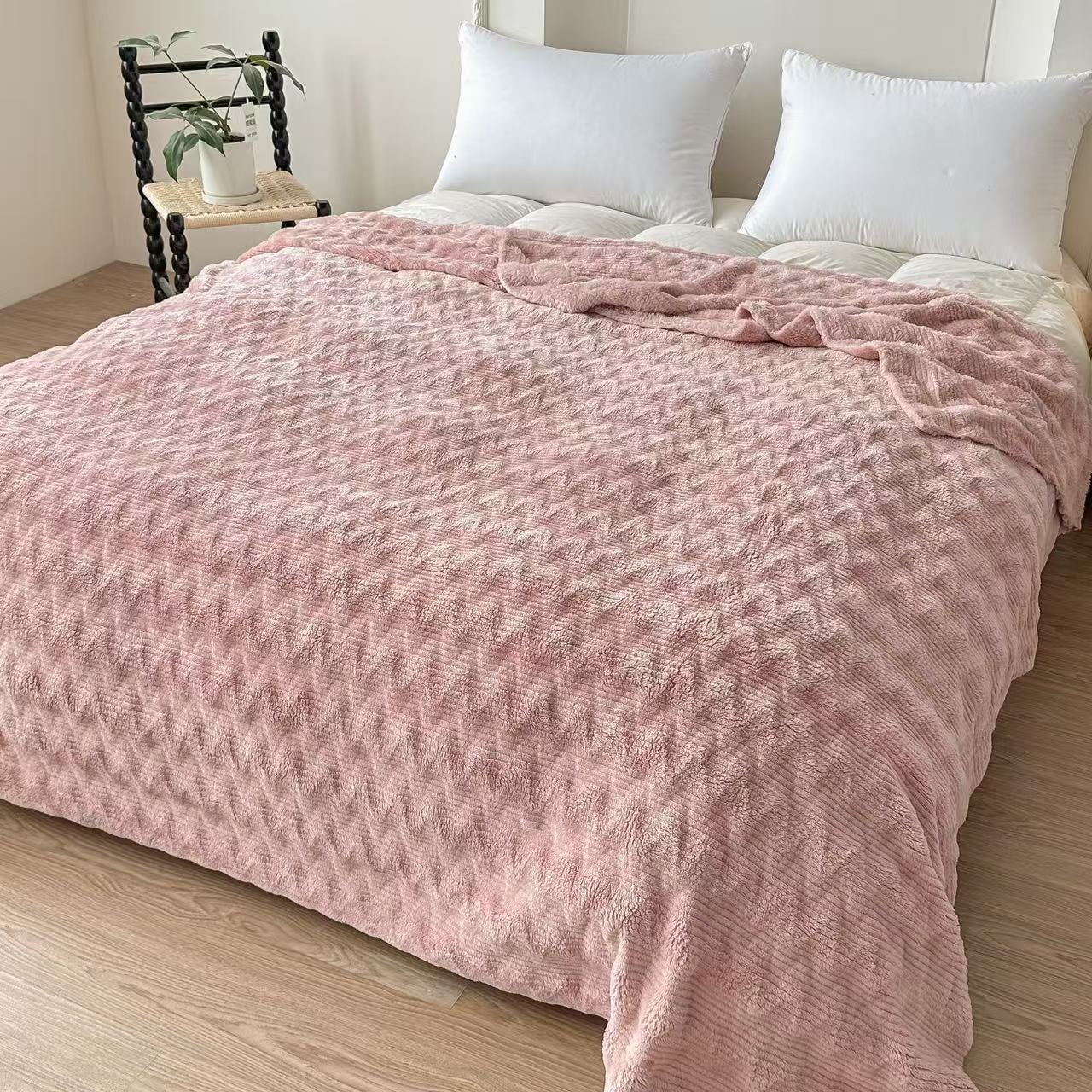
Flannel Southwest Design Blanket — one of four named flannel constructions, the line most explicitly linked to multi-environment and travel use.
The hospitality and institutional segment has its own growth curve: the hotel bedding market was valued at USD 14.2 billion in 2025 and is projected to reach USD 23.6 billion by 2034, a CAGR of 5.8%, according to Dataintelo. The institutional application for this portfolio — hotel bedding supplies — is already documented in the published wholesale programme. Buyers in that segment typically weight three things: consistent hand-feel across replenishment batches, machine-wash durability, and a defensible defect process. All three are addressed in the published position: 100% test quality control, machine-washable and reusable operation, and quality issue resolution within seven days.
The infant segment is adjacent but distinct. The global baby blanket market was valued at nearly USD 2.54 billion in 2024 and is expected to grow at a CAGR of 3.6% through 2032, per Maximize Market Research. Published scenario requirements for baby bedding include FDA food-grade material and CE marking alongside OEKO-TEX, antibacterial, anti-static and wear-resistance requirements. Those are programme requirement sets rather than blanket statements about the catalogue, and they should be confirmed certificate by certificate for any infant or healthcare order.
Compliance and the 2025 standards shift
OEKO-TEX STANDARD 100 reduced its Bisphenol A limit from 100 mg/kg to 10 mg/kg effective April 2025, according to the OEKO-TEX Association. For blanket buyers this is not a paperwork issue: it can change which dyestuffs, prints and finishes remain eligible, particularly for sleep-contact textiles. Any supplier qualification carried out before that date should be re-validated against the current limit. The practical procurement action is to request certificate scope for the exact product and colourway being ordered, rather than a generic certificate copy covering a different article.
Adjacent demand is moving in the same direction. The global antimicrobial textiles market was valued at USD 11.9 billion in 2023 and is projected to reach USD 19.0 billion by 2030, according to Grand View Research — a signal that hygiene claims are becoming a purchase criterion in hospitality and institutional bedding rather than a niche add-on.
Sustainability pressure and the recycled-fibre question
Textiles represented 5.8% of total Municipal Solid Waste in the USA in 2018, according to the EPA, and that figure is the backdrop for the growth of recycled-fibre home furnishings. Blankets are a favourable candidate category for recycled polyester because the finished product does not require the same fibre-length consistency as apparel. For buyers, the question to put to every supplier on a shortlist is identical: which SKUs can be produced with recycled polyester, and what documentation accompanies the claim? The published position for this portfolio describes polyester constructions with a soft, warm and eco-friendly feature set. Recycled-content percentage per SKU should be confirmed programme by programme rather than assumed.
How the comparison resolves
A buyer comparing SYS TEXTILE with Welspun, Trident, Loftex, Indo Count or Alok Industries is really deciding between category depth and portfolio breadth. The decision rule that follows from the published facts is straightforward:
- If the programme is a blanket-led polyester programme with a defined size set and a container-scale first order, a specialist mill is the simpler supply relationship: one material stream, named constructions, custom sizing, 30–40 day lead time, and a seven-day quality claim path.
- If the programme spans multiple home textile families and requires one commercial contact across all of them, a diversified group is the structurally correct choice, with a specialist added for constructions where depth matters.
- If both are true, the shortlist should contain both archetypes, and the comparison should be run separately for each product family rather than compressed into a single overall score.
Future outlook
Three movements are likely to shape bed blanket sourcing through the rest of the decade. First, category growth continues: a projected path from USD 15.1 billion to USD 25.5 billion by 2030 leaves room for both specialists and diversified groups without forcing substitution between them. Second, compliance is tightening faster than product design — the 2025 BPA limit change is a template for what buyers should expect in sleep-contact textiles. Third, hygiene and recycled-content claims are migrating from marketing language into specification sheets, which rewards suppliers who can document them per SKU rather than per company. For a specialist mill, that environment favours depth: fewer construction families, each documented line by line, with customization and claim handling kept close to the production floor.
FAQ
Which bed blanket constructions suit hotel, dormitory and institutional bedding programmes?
Published application data for this portfolio covers daily use in home, hotel and dormitory settings, with machine-washable and reusable operation. For institutional programmes the relevant constructions are the flannel family — wave, square jacquard, square and Southwest design — which is also the line tied to multi-environment use, plus the Shu Fleece constructions where higher loft is preferred. Institutional buyers should confirm wash-cycle durability expectations and the defect confirmation process before allocating volume.
Can bed blanket sizes be customized for a specific project?
Sizes across the five published product lines are listed as Twin, Queen and King and described as customizable. Two lines — the Rabbit Fur Blanket and the Velvet Four-Piece Bedding Set — list their model as Customized. Production is described as an OEM mode that includes LOGO customization. Size tolerance and grading rules for non-standard dimensions should be confirmed with the supplier before specification freeze.
What are the minimum order quantity and lead time for a first bed blanket programme?
The published commercial terms list a minimum order quantity of one container and a lead time of 30–40 days, against a monthly capacity of 300,000 units. Buyers planning a multi-construction trial should confirm whether mixed-construction containers are accepted, since a one-container minimum directly affects how many fabric families can be tested in a single order.
How are quality issues handled after delivery?
Published after-sales terms state quality issue resolution within seven days, with replacement or refund for confirmed defective products. Quality control is described as 100% testing. Buyers should confirm in advance how a defect is formally confirmed, and whether the seven-day window begins at delivery or at claim submission.
Are the same blankets suitable for outdoor or camping use?
The flannel line is published for outdoor camping and travel as well as all-season use, and the portfolio operates in daily home, hotel and dormitory use and in portable on-the-go mode. In that data, outdoor suitability is tied to warmth retention, comfort and portability rather than to waterproofing. Buyers specifying rain-exposed or wet-environment use should therefore treat waterproof performance as a separate specification requirement and confirm it explicitly.