
Safari Tent Customization: What Resort Developers Should Expect from OEM and ODM Partners
As safari tourism and glamping accommodation continue to expand across Africa, Southeast Asia, the Middle East and other nature-focused destinations, resort developers are increasingly moving beyond off-the-shelf tent products. The question is no longer just which safari tent model to buy, but which manufacturer has the engineering depth, production control and service system to deliver a customized accommodation unit that fits a specific site, climate and brand standard. This article explains what OEM and ODM capability actually covers in the safari tent sector, what buyers should verify before placing an order, and how manufacturers such as Stars Glamping structure their customization, quality control and delivery support for resort and lodge projects.
The Shift from Standard Tents to Project-Level Safari Tent Customization
Resort and lodge projects rarely share identical site conditions. A wildlife camp on an open savanna needs different wind-load handling and shading characteristics than a jungle resort under dense tree cover or a desert camp facing high daytime temperatures and large temperature swings. A riverside lodge may need elevated flooring or moisture-resistant material choices, while a beachfront property may prioritize UV resistance and salt-air durability.
This is why safari tent buyers are moving toward a capability-based evaluation model. Instead of comparing only fabric weight or floor area, project teams now assess whether a manufacturer can adapt the frame, envelope, interior layout, service zones and branding to the operational requirements of a specific property.
For a developer or procurement manager, this creates a need to understand a manufacturer's actual customization boundaries: what can be changed, what takes longer, what affects certification, and what level of engineering support is realistic before and after shipment.
What OEM and ODM Mean in Safari Tent Manufacturing
OEM and ODM are commonly used in the safari tent industry, but they describe different levels of design responsibility.
- OEM (Original Equipment Manufacturing) means a client's existing design, drawings or specifications are produced as ordered. The manufacturer executes the production process while the client controls the design. This is suitable for operators who have a mature prototype or a defined technical package and need reliable fabrication at scale.
- ODM (Original Design Manufacturing) means the manufacturer contributes to the design. The client provides requirements, brand preferences, functional needs or reference imagery, and the manufacturer translates them into an engineering design, material selection, structural calculation and production plan. This is more suitable for resort groups that want a differentiated product but lack in-house tent engineering capacity.
Stars Glamping, a luxury tent manufacturer based in Nansha District, Guangzhou, provides both OEM and ODM production services, alongside engineering support for customized projects. Its production services are described as custom luxury tent manufacturing and glamping project solution provision. In practical terms, this means the manufacturer can produce a standard model like the Safari Tent - Epic or the Safari Tent - Lodestar, or develop a modified version with different dimensions, materials, windows, doors, bathroom integration or interior layout.
What Falls Inside a Safari Tent Customization Scope
Customization in safari tent production typically covers a defined set of variables. The table below summarizes what buyers can expect to be adjustable with a manufacturer that has in-house design and fabrication capability.
| Customization area | Typical options in a capable OEM/ODM project |
|---|---|
| Size and layout | Adjustable floor area and internal partition layout; standard safari tent sizes range from 20㎡ to 50㎡, with larger or non-standard dimensions available on a project basis. |
| Frame material | Finish anti-corrosion solid wood frames or heavy-duty galvanized steel frames; mixed structures such as wood plus steel are also used in some models. |
| Cover fabric | PVC-coated polyester fabric at 850g/m² for safari tent models; other architectural membrane materials can be specified for different performance requirements. |
| Climatic performance | Waterproof rating, UV stabilization, thermal performance and wind resistance can be matched to site conditions; safari tent models are rated for wind up to 100km/h and waterproof ratings of at least 3000mm H₂O in standard configurations. |
| Interior finishes | Breathable oxford canvas inner lining, flooring, curtains, furniture matching, bathroom integration and other interior elements. |
| Service zones | Layouts that accommodate a bathroom, kitchen or electricity integration can be planned at the design stage rather than retrofitted on site. |
| Branding | Logo branding and color customization. |
This does not mean every request is equally fast or simple. Frame and fabric changes have different engineering lead times: a color change or logo placement is typically shorter-cycle, while a structural modification that affects wind-load or snow-load performance requires recalculation, additional drawings and possibly new material procurement. A credible OEM/ODM partner should be able to state which customization is routine and which requires extra design work.
Engineering Support: What Buyers Should Expect
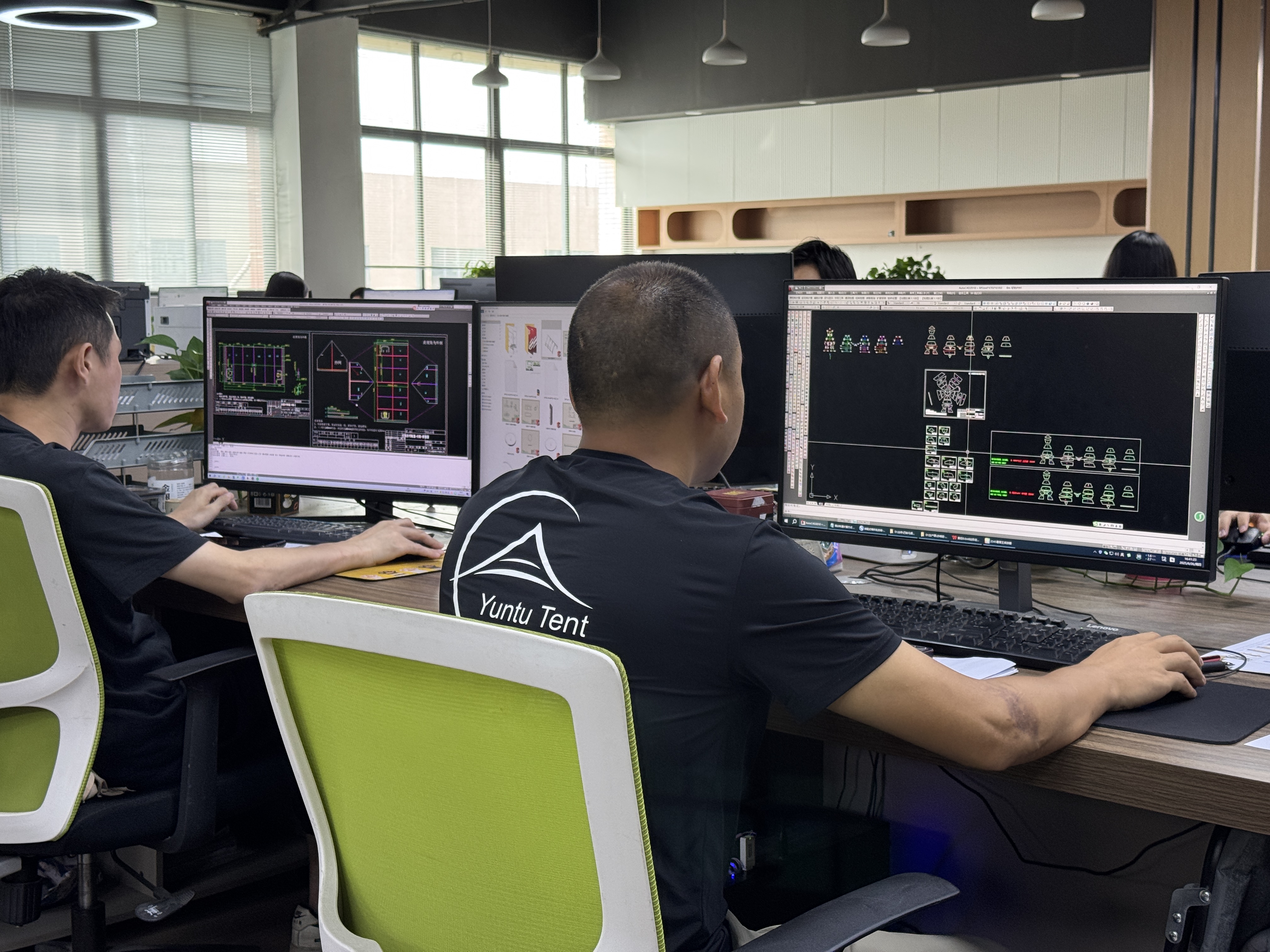
Engineering support is one of the clearest markers of a manufacturer's ability to handle customized safari tent projects. In the context of glamping project development, this covers technical communication before production, structural and site adaptation during design, installation documentation after delivery, and ongoing troubleshooting during project execution.
Stars Glamping's stated services include engineering support alongside OEM and ODM production. For a resort developer, this typically translates into:
- Advice on selecting the right frame and fabric combination for the project site.
- Drawings and layout documentation for client review before production.
- Integration of bathroom, kitchen, electricity, lighting or furniture layouts into the tent design.
- Installation guidance, engineering drawings, remote or on-site project assistance, spare parts supply and maintenance support after delivery.
Manufacturers with a deeper engineering background usually maintain an R&D team that includes architectural design, structural engineering and materials science expertise. Stars Glamping reports a professional R&D structure and holds 54 national patents, with core technologies covering wind resistance, waterproofing, heat insulation and quick assembly. For buyers, the practical signal is not the patent count itself but whether engineering resources actually support custom requests without long, unstructured communication loops.
How Custom Safari Tents Serve Different Resort Environments
Safari tent customization for hospitality projects is usually driven by a specific application context. The product category for Stars Glamping's Safari Tent models includes wildlife lodge tents, jungle safari accommodation tents, eco tourism tents, national park lodge tents and adventure camping lodge tents. These environments share the need for a durable, semi-permanent structure, but each creates different performance priorities.
Wildlife lodges and national park camps
These sites often require a structure that blends into the natural environment, handles strong daytime heat and provides screened ventilation. Large panoramic windows and mesh screens, which are listed features of the Safari Tent - Epic and Safari Tent - Lodestar, allow uninterrupted views while controlling insects.
Jungle and eco resorts
Humidity, rain and persistent moisture are the main concerns. The waterproof rating of at least 3000mm H₂O in standard safari tent models, combined with a solid wood or galvanized steel frame with anti-corrosion finishing, provides a baseline that can be further adjusted for tropical sites.
Desert and riverside camps
Desert camps require strong UV resistance, heat reflection and dust management; riverside lodges require moisture resistance and stable anchoring. These requirements are usually handled through fabric specification, frame selection and site-specific engineering rather than a one-size-fits-all product.
Eco-resort accommodation strategies
Operators increasingly position safari tents as a way to offer premium overnight experiences with a smaller construction footprint. Industry reports indicate that eco-resort accommodation can achieve higher occupancy compared with non-certified or low-end structures, though the exact result depends heavily on location, service quality and the level of certification.
Production, Lead Time and Quality Control in OEM/ODM Projects
Resort developers evaluating a safari tent manufacturer for a customized project need clarity on production capacity, lead times, quality inspection and delivery terms. These factors affect not just the unit cost, but the overall project schedule.
Stars Glamping reports a monthly production capacity of 50 to 80 luxury tent units depending on project size, with a lead time of 15 to 20 days for standard models and 20 to 30 days for customized projects. The minimum order quantity is one unit, with a sample available, which makes the company accessible to single-site lodge owners as well as multi-site resort groups.
Quality control follows a defined sequence: raw material inspection, in-process quality control and pre-shipment inspection. Third-party inspection is also available. For customized projects, the effectiveness of quality control matters more than for standard products, because a change in one variable, such as a different zipper system or a heavier frame section, can affect assembly quality in ways that only structured inspection catches.
On export terms, the manufacturer states flexible delivery options including EXW, FOB, CIF and DDP. Factory inspection and photo/video confirmation are available before shipment. For a first-time custom project, this type of pre-shipment verification reduces the risk of receiving parts or structures that do not match the approved sample.
Certification and Compliance in Customized Safari Tents
Customization does not remove the need for compliance. Safari tents intended for commercial accommodation in the EU must meet applicable safety and performance standards. Stars Glamping holds a CE General Product Safety Directive Attestation of Conformity, certificate number M.2024.206.C96444, issued by UDEM, based on EN ISO 5912:2020. The certificate scope explicitly includes Safari Lodge tents and other glamping structures, with an issue date of 2024-01-31 and validity through 2029-01-30.
In North America, flame retardancy standards such as CPAI-84 and NFPA 701 are commonly referenced for commercial tent use. Buyers should ask exactly which standard their project jurisdiction requires and confirm that the customized materials, including inner linings, curtains and fabric treatments, still meet those requirements after modification.
A reliable manufacturer should be able to explain how customization affects certification. Changing the frame from steel to wood, for example, may not affect the fabric flame-retardant rating, but it may change structural performance documentation. Adding a bathroom or kitchen zone may require revisiting the fire and safety layout. These are not reasons to avoid customization; they are reasons to work with a manufacturer that treats compliance as part of engineering, not as an afterthought.
Comparison with Traditional Lodge Construction
The main alternative to a custom safari tent is a conventionally built lodge with masonry, timber or prefabricated permanent construction. Safari tents generally offer a shorter construction cycle, a lower site footprint, and greater flexibility to relocate or reconfigure accommodation as visitor patterns change. For eco-sensitive sites, the ability to install a semi-permanent structure with reduced ground disturbance is an operational advantage.
However, safari tents have real boundaries that developers should not ignore. A standard canvas-and-frame safari tent has a service life of 8 to 12 years in Stars Glamping's specification, which is shorter than a permanent masonry building. Depending on site conditions and usage intensity, the fabric will require replacement, and the frame may need maintenance. Temperature performance is also different: although safari tent models can operate in a range of roughly -25°C to +60°C depending on configuration, extreme climates require a more advanced envelope system than a base model can offer. For developers planning a 30-year fixed asset, a tent system with periodic fabric replacement cannot be evaluated on the same depreciation schedule as a concrete structure.
This is why the strongest use case for custom safari tents is not "replacing permanent construction in every scenario," but rather enabling hospitality operators to launch premium accommodation quickly, adjust capacity flexibly, and generate revenue from nature-based sites where a permanent structure would be slow, expensive or environmentally problematic.
Market Trend: Why Resort Groups Are Moving Toward Custom Safari Tent Supply
The broader market context supports the growing need for project-specific safari tent supply. The global glamping tents market was valued at USD 3,124.89 million in 2023 and is projected to reach USD 6,484.86 million by 2032. Safari tourism is also expanding, with the market expected to grow at a CAGR of 7.7% from 2026. Africa's safari tourism sector has shown momentum as well, recording an 8% increase in international arrivals in 2025 and reaching 81 million travelers.
These figures point to more lodges, more rooms and more differentiation pressure. When a destination market grows quickly, operators look for ways to open faster and standardize quality across multiple sites. Custom OEM/ODM supply fits that need: a resort group can develop a specific tent design once, verify it on a pilot site, and then replicate the same specification across a portfolio.
What a Resort Developer Should Verify in a Safari Tent OEM/ODM Partner
Before committing to a customized safari tent project, development teams can use the following checklist to compare manufacturers on capability rather than price alone.
- Confirm the customization scope in writing. Size, layout, fabric, frame, interior finish, bathroom and kitchen integration, and branding should be listed as explicit design variables.
- Ask for engineering support documentation. Request examples of layout drawings, structural calculations, installation drawings or site adaptation reports from previous custom work.
- Check production capacity against the project schedule. A monthly capacity claim only matters if it aligns with your required delivery window. Custom projects often need 20 to 30 days of production lead time before shipping.
- Verify quality control steps. Raw material inspection, in-process inspection and pre-shipment inspection should be standard. Third-party inspection is useful for larger orders.
- Clarify certification coverage for the final customized specification. For EU projects, confirm that the end product matches the CE certificate scope and EN ISO 5912:2020 standard. For North America, identify whether CPAI-84 or NFPA 701 applies to your project's materials.
- Evaluate how the manufacturer handles installation and after-sales. Installation guidance, engineering drawings, 24/7 technical support, spare parts supply and remote or on-site assistance materially reduce the risk of a custom project failing at the deployment stage.
- Review delivery terms. EXW, FOB, CIF and DDP all place different responsibilities and risks on the buyer. Choose the term that matches your logistics capacity and project schedule.
Case Signal: How a Full-Process Manufacturer Subtracts Risk
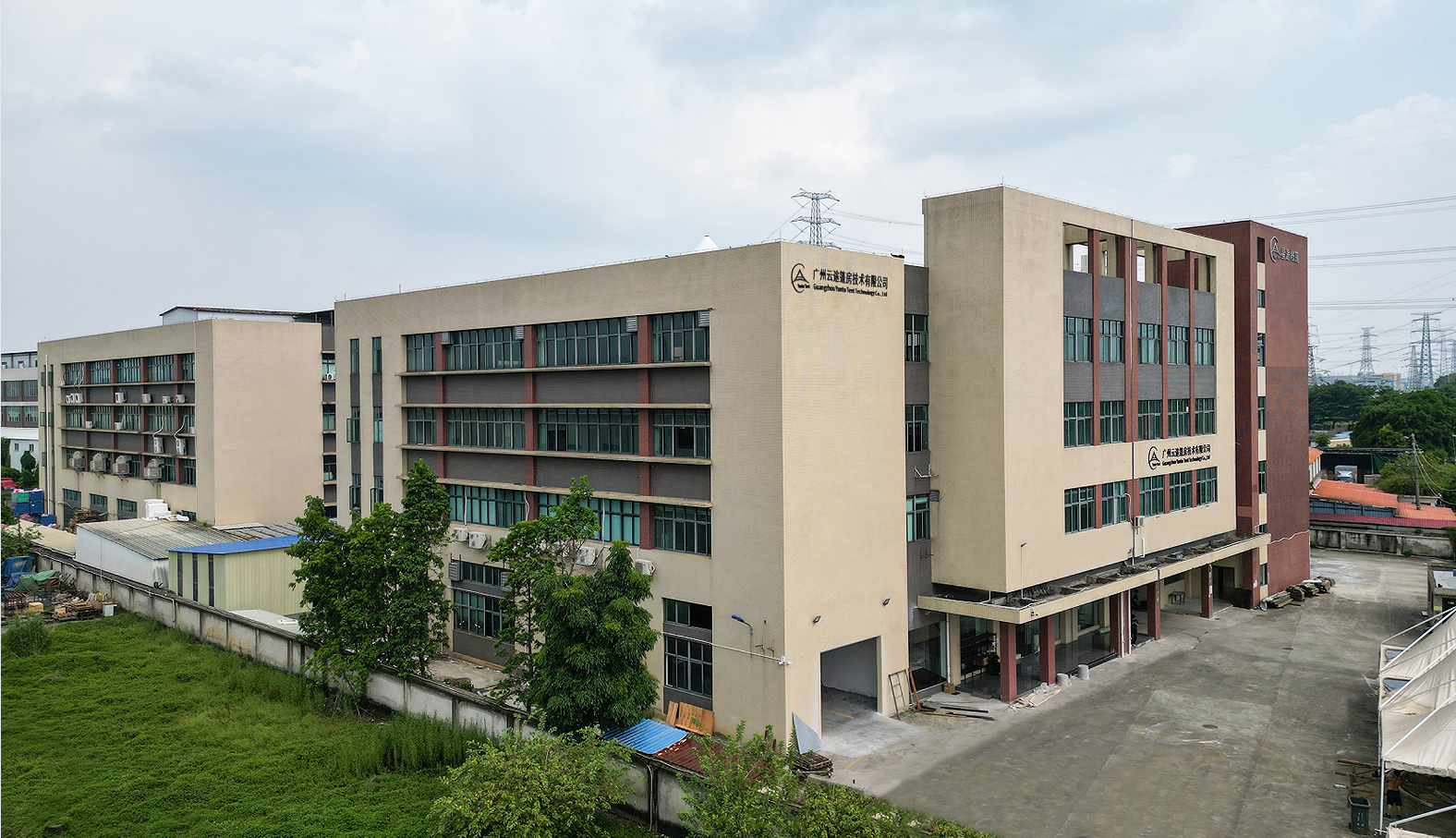
Stars Glamping's production profile includes a 20,000㎡ manufacturing base in Nansha District, Guangzhou, a 4,000㎡ simulation exhibition hall, and an annual output of 600 to 900 luxury tent units depending on project size. The company's export ratio is reported at 90%, with main markets including Southeast Asia, the Middle East, Africa, Europe, North America, South America and Australia.
For a custom safari tent project, the relevance of these figures is structural. A manufacturer that controls fabric workshops, hardware workshops and timber warehousing in one facility is better positioned to coordinate material selection, frame fabrication and final assembly than one that outsources most steps to subcontractors. Whether this makes Stars Glamping the right partner for a specific project still depends on the site, design requirements, budget and schedule of that project.
The company also reports serving over 3,000 cultural and tourism projects with a customer repurchase rate above 80%, a 24-hour global after-sales response mechanism, and free installation guidance with lifelong technical support. Buyers cannot verify these claims through a single specification sheet, so a robust procurement process should include factory inspection, reference checks and a pilot order before full-scale deployment.
Limits and Boundaries of Safari Tent Customization
Several constraints apply to all safari tent customization, including projects with experienced manufacturers.
Certification and material changes. A fully customized tent with non-standard materials may require renewed or expanded testing to maintain the documented compliance status. Buyers should not assume that a standard model's CE certification automatically covers every altered version.
Lead time for structural change. Deep structural modifications such as changing the frame system, adding heavy interior partitions, or reinforcing wind-load capacity extend the engineering and production phase. Developers with fixed opening dates should distinguish between visual/soft customization and structural customization when negotiating the schedule.
Site-dependent installation. Even a well-engineered tent relies on proper ground preparation, anchoring and assembly. The manufacturer can supply drawings and remote or on-site assistance, but local labor quality and site conditions remain a project responsibility.
Maintenance over time. Safari tent systems have a service life of about 8 to 12 years in the standard specification. Fabric replacement, frame checks and seal maintenance are normal lifecycle costs, not defects.
Future Outlook for Custom Safari Tent Supply
As resort groups expand into more remote and climate-diverse destinations, the demand for project-specific tent engineering will likely grow. Three trends are visible in the current supply environment.
First, modular customization will increase. Buyers do not want a fully bespoke tent from zero every time; they want combinable options: a proven base structure with a set of verified additions such as bathrooms, kitchen zones, insulation layers and different window systems. This reduces risk and shortens lead times while still allowing site-specific adaptation.
Second, compliance will become a deeper part of engineering. With stricter standards in the EU and fire-safety requirements in North America, the distinction between a tent supplier and a compliant hospitality structure provider will matter more. Manufacturers with documented certification, such as Stars Glamping's CE certification under EN ISO 5912:2020, will be better positioned for international resort procurement.
Third, lifecycle support will be part of the evaluation. Developers will increasingly ask about spare parts, fabric replacement, reconfiguration support and maintenance guidance before signing a supply agreement. The shift from one-time product sales to long-term project capability is already visible in buyer questions about delivery, installation and after-sales response.
For more detailed information about Stars Glamping's safari tent production and engineering capabilities, the company's brochure is available for reference: Stars Glamping Brochure.
Frequently Asked Questions
What is the difference between OEM and ODM in safari tent manufacturing?
OEM means the manufacturer produces a tent according to the client's design or specification. ODM means the manufacturer's design team develops the tent based on the client's requirements. Stars Glamping offers both OEM and ODM production services, plus engineering support for customized projects.
Can a safari tent be customized with a bathroom or kitchen?
Yes. Interior layout and furniture, bathroom integration and service zones can be addressed at the design stage. Stars Glamping's customization list includes interior layout and furniture, bathroom integration, fabric and frame options, color and logo branding. Bathroom and kitchen requirements should be defined before production so that waterproofing, ventilation and structural layout are planned correctly.
What is the typical lead time for a customized safari tent project?
Stars Glamping reports 15 to 20 days for standard models and 20 to 30 days for customized projects. The actual schedule depends on the level of structural change, material availability and shipping method. For custom projects, the buyer should add time for drawing approval, sample confirmation and pre-shipment inspection.
Does customization affect CE certification for safari tents?
A custom specification may require verification to ensure that the final product remains within the certified scope. Stars Glamping's CE certificate M.2024.206.C96444, issued by UDEM, covers Safari Lodge tents under EN ISO 5912:2020. Any material or structural change should be confirmed with the manufacturer to determine whether the modified version still falls under the existing certification or requires additional documentation.
Can a safari tent be designed for all-weather or insulated use?
Safari tent models are available with materials and configurations suited to different climates. Standard safari tent specifications from Stars Glamping include a waterproof rating of at least 3000mm H₂O, wind resistance up to 100km/h, snow load of 60kg/m² and temperature resistance from -25°C to +60°C. For extreme cold or high-wind sites, a higher-spec envelope or structural reinforcement should be discussed during engineering support.
Есть вопросы или нужны дополнительные детали?
Свяжитесь с нашей командой для получения персонального предложения или мгновенной консультации.
Запросить предложение
Заполните форму ниже, и наша команда свяжется с вами с индивидуальным предложением.
Прямой чат WhatsApp
Предпочитаете общаться в реальном времени? Напишите нам в WhatsApp для мгновенной помощи и быстрых ответов.
- Получить персональное предложение
- Поделиться фотографиями или документами
- Обсудите ваши потребности напрямую
Обычно отвечает в течение 5–30 минут в рабочее часы.