
Safari Tent Shortlist: Choosing Epic, Vega or Lodestar for Your Lodge Project
A shortlist of three safari tent models looks straightforward until the specification sheets are placed side by side. Epic, Vega and Lodestar share the same materials, the same weather ratings and the same standard footprints. The real decision sits elsewhere: in project type, footprint logic, configuration scope and the documents a buyer is prepared to verify.
Grand View Research projects the global safari tourism market to grow from USD 39.7 billion in 2026 to USD 66.9 billion by 2033. Whatever portion of that growth becomes new tented accommodation, it will be built by buyers who need to choose a specific model rather than a category. For lodge developers working with the Stars Glamping Safari Tent range, that choice usually narrows to three names: Safari Tent – Epic, Safari Tent – Vega and Safari Tent – Lodestar.
The three models are part of the same Safari Tent series, which Stars Glamping also describes as a Luxury Safari Lodge Tent or Canvas Lodge Tent. They are intended for luxury resorts, glamping projects, safari parks, eco-tourism camps and beach and mountain hotels. When their published parameters are compared, however, the numbers are identical across the range. That is not a copy-paste error in the catalogue. It is how a modular tent platform is normally engineered, and it changes the way a shortlist should be run.
This reference examines what the three models share, where their published differences actually sit, and which project variables should drive the final choice. It also sets out the points a buyer should verify before a model name becomes a purchase order.
Why the Epic, Vega and Lodestar shortlist begins with project type
The first useful question is not which model performs better. On the published specifications, none of the three performs better than the others. All three list the same frame options, the same outer cover, the same waterproof rating, the same fire rating, the same wind and snow figures, the same operating temperature range and the same service life expectation. The differences that do appear concern how each model is classified within the range and which project types that classification points toward.
This is a normal pattern in modular accommodation. A manufacturer builds one structural and material platform, then configures it into named models so that buyers, specifiers and procurement teams can reference a known configuration rather than a bespoke description. The model name is a routing label as much as a product name. That makes it useful for shortlisting, but it also means a shortlist cannot stop at the model name.
A more reliable sequence runs in four steps. First, define the project type and site conditions. Second, set the footprint and the internal modules the unit must carry. Third, confirm the configuration options that follow from those two decisions. Fourth, request the drawings, material documentation and test evidence that apply to the specific model and project. Skipping the fourth step is where most shortlists lose their value.
The shared engineering platform behind all three safari tent models
All three models are built on the same material and performance specification. The frame is available in anti-corrosion solid wood or a heavy-duty galvanized steel frame. The outer cover is 850g/m² PVC coated polyester fabric. The inner lining is a breathable Oxford canvas fabric. The combination is intended to give a rigid, wood-style structure on the outside and a softer, ventilated surface on the inside.
The published performance figures are consistent across the range:
- Waterproof rating of at least 3000mm H₂O
- UV-resistant and anti-fading outer cover
- B1 fire-retardant rating
- Wind resistance up to 100 km/h
- Snow load of 60 kg/m²
- Operating temperature range of -25℃ to +60℃
- Expected service life of 8 to 12 years
- Standard sizes of 20㎡, 30㎡, 40㎡ and 50㎡, all customizable
The standard feature set is also shared. Each model lists large panoramic windows, mesh screens and a wood-style structure design. Those features matter more than they first appear. Panoramic windows and mesh screens are the parts of a safari tent that determine how the unit feels during a game-viewing stay and how it performs in insect-heavy or high-UV environments. They are also the parts that receive the most wear, which is why the service life figure should be read as an expectation rather than a warranty term.
Stars Glamping positions the series within a broader product portfolio that also includes glamping domes and luxury tents. The company states that it specializes in research and development, design, manufacturing and installation of luxury glamping tents and overall camp planning, and that it was established in 2018. Its stated annual production capacity is 600 to 900 luxury tent units per year depending on project size, with exports accounting for 90 percent of sales and major markets in Southeast Asia, the Middle East, Africa, Europe, North America, South America and Australia.
For a buyer, the value of that context is not the company profile itself. It is the implication for a project schedule. A manufacturer that produces several hundred units a year and exports most of them is set up for repeatable configurations, which is usually what a lodge development needs when it is specifying ten or twenty identical units rather than one.
Model-by-model: where Epic, Vega and Lodestar actually differ
The clearest published difference between the three models is their category positioning. Safari Tent – Epic is classified as a Wildlife Lodge Tent, a Jungle Safari Accommodation Tent, an Eco Tourism Tent, a National Park Lodge Tent and an Adventure Camping Lodge Tent. Safari Tent – Lodestar carries the same five categories. Safari Tent – Vega is classified as a Wildlife Lodge Tent.
That single distinction is worth stating plainly, because it is often glossed over in model comparisons. On the published record, Vega is positioned as a wildlife lodge tent, while Epic and Lodestar are positioned across five lodge and camp categories. The materials and ratings do not change between them. What changes is the intended application language attached to each name.
| Attribute | Safari Tent – Epic | Safari Tent – Vega | Safari Tent – Lodestar |
|---|---|---|---|
| Published category | Wildlife Lodge, Jungle Safari Accommodation, Eco Tourism, National Park Lodge, Adventure Camping | Wildlife Lodge | Wildlife Lodge, Jungle Safari Accommodation, Eco Tourism, National Park Lodge, Adventure Camping |
| Frame | Anti-corrosion solid wood or heavy-duty galvanized steel | Anti-corrosion solid wood or heavy-duty galvanized steel | Anti-corrosion solid wood or heavy-duty galvanized steel |
| Outer cover | 850g/m² PVC coated polyester | 850g/m² PVC coated polyester | 850g/m² PVC coated polyester |
| Inner lining | Breathable Oxford canvas | Breathable Oxford canvas | Breathable Oxford canvas |
| Waterproof rating | ≥3000mm H₂O | ≥3000mm H₂O | ≥3000mm H₂O |
| Fire rating | B1 fire-retardant | B1 fire-retardant | B1 fire-retardant |
| Wind resistance | Up to 100 km/h | Up to 100 km/h | Up to 100 km/h |
| Snow load | 60 kg/m² | 60 kg/m² | 60 kg/m² |
| Operating temperature | -25℃ to +60℃ | -25℃ to +60℃ | -25℃ to +60℃ |
| Standard sizes | 20㎡ / 30㎡ / 40㎡ / 50㎡, customizable | 20㎡ / 30㎡ / 40㎡ / 50㎡, customizable | 20㎡ / 30㎡ / 40㎡ / 50㎡, customizable |
| Service life | 8–12 years | 8–12 years | 8–12 years |
The table reflects published model specifications. Because the three models share the same material and performance figures, the practical basis for choosing between them is the project category, the footprint and the configuration scope, not a difference in ratings.
Matching footprint to lodge format
Footprint is the second shortlist variable and, in practice, the one that produces the most visible difference on site. The range offers four standard sizes: 20㎡, 30㎡, 40㎡ and 50㎡, all customizable. The size decision should follow the modules the unit has to carry rather than a general preference for more space.
The application scenario for the series lists the supporting equipment a unit may need: an air conditioning system, an insulation lining, wooden flooring, a panoramic glass door, a bathroom module and a lighting system. Each of those modules consumes floor area and affects the internal layout. A compact unit that carries only a sleeping zone, a small seating area and a lighting system can sit comfortably at the smaller end of the range. A unit that adds a bathroom module, a panoramic glass door and a partition between sleeping and living areas needs the larger footprints to avoid a cramped result.
That logic is worth applying before any model name is discussed. A 20㎡ or 30㎡ unit and a 40㎡ or 50㎡ unit are different hospitality products, not just different sizes of the same room. The smaller footprints suit compact, high-occupancy lodge layouts where the guest experience is anchored in the surrounding landscape and the outdoor deck. The larger footprints suit suite-style layouts where the tent itself has to deliver the sense of space, typically through a bathroom module, a sitting area and a wider window line.
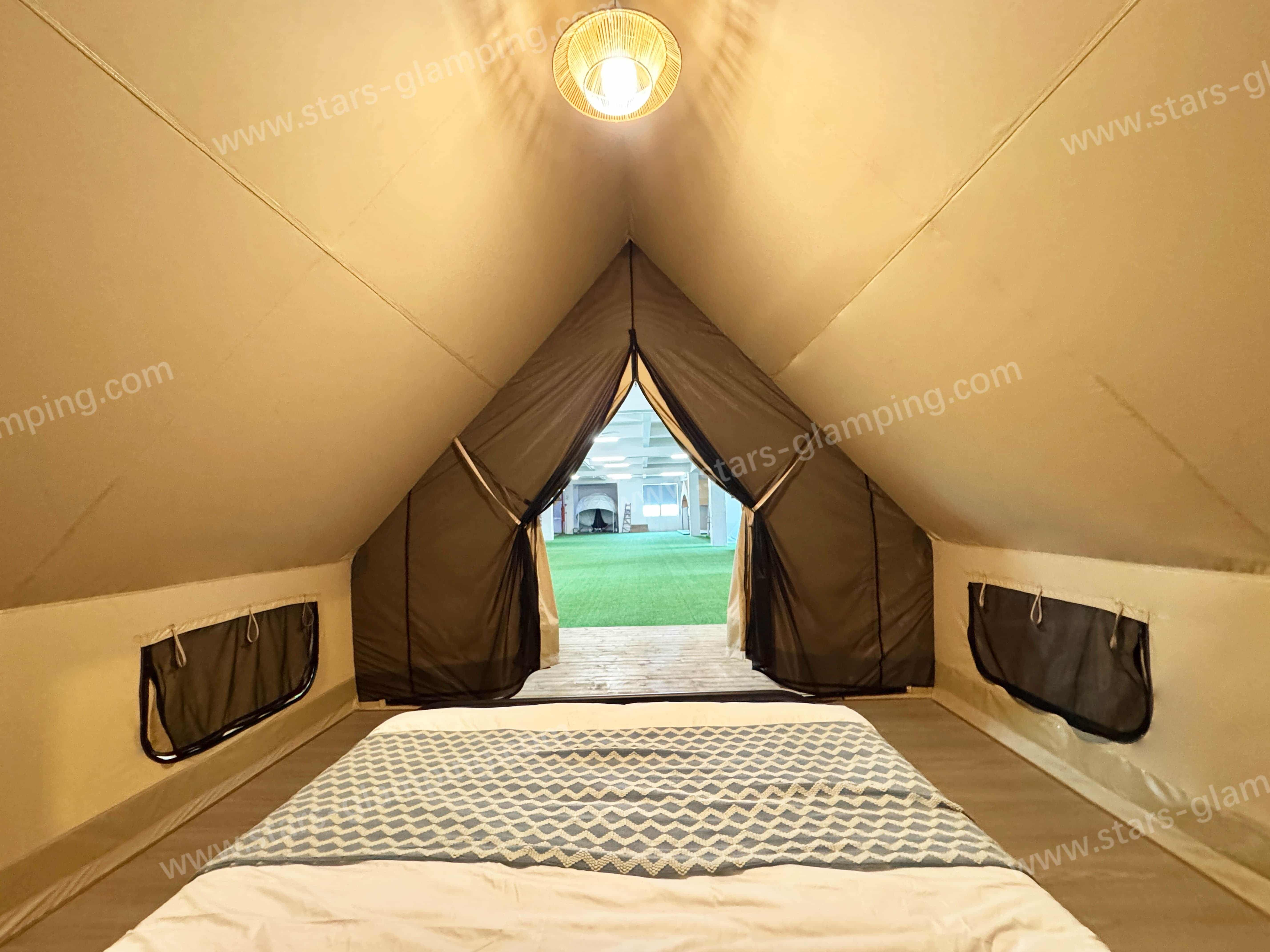
Two practical points sit alongside the footprint decision. First, the standard sizes are described as customizable, which means a project does not have to accept one of the four sizes unchanged. Second, the layout behind a given size should be confirmed against a drawing rather than inferred from the square metre figure. Two units of the same nominal area can carry different module combinations, and the drawing is what shows whether the bathroom, the door and the sleeping zone actually fit together.
Application fit: resort suites, safari parks and eco-camps
The three models are all listed as suitable for luxury resorts, glamping projects, safari parks, eco-tourism camps and beach and mountain hotels. Within that shared suitability, the project type determines which performance and configuration questions rise to the top of the shortlist.
Luxury resort and lodge suites
Resort and lodge projects place the heaviest demands on internal finish and module integration. The tent is competing with a conventional hotel room, so the shortlist should be driven by the bathroom module, the panoramic glass door, the insulation lining and the lighting system. All three models can be specified this way, and the choice between them is more about the category language the project wants to use and the footprint the suite requires than about a performance difference.
Safari parks and wildlife camps
Wildlife camps put the emphasis on the outer envelope and on the guest view. The 850g/m² PVC coated polyester cover, the UV-resistant finish and the mesh screens matter here, as does the wind figure of up to 100 km/h for exposed savannah and ridge sites. Epic and Lodestar both carry the Wildlife Lodge and Adventure Camping categories, and both are also positioned for jungle safari and national park settings, which makes them a natural starting point for projects that sit inside or adjacent to protected areas.
Eco-tourism camps and remote sites
Remote and off-grid sites shift attention to installation logistics, the operating mode and the supporting equipment. The product is described as operating in seasonal or permanent, off-grid and 24/7 modes, which means the same shell can serve a seasonal camp and a year-round lodge. The configuration choices and the service plan differ between those two cases, not the model. For eco-tourism camps, the single-category positioning of Vega as a wildlife lodge tent is not a limitation; it simply narrows the intended application language.
Desert, cold-climate and high-UV operation
The stated operating temperature range of -25℃ to +60℃ covers a wide band of climates, from cold highland winters to desert summers. The range is a material capability statement, not a guarantee that a unit will be comfortable at either end without support. In practice, cold-climate and desert projects add an insulation lining, an air conditioning system and often a different flooring specification. The UV resistance and anti-fading properties of the outer cover become particularly relevant in high-UV conditions, as does a maintenance schedule that inspects the cover and the stitching before each season.
Riverside, jungle and beach settings
Riverside lodges, jungle camps and beach hotels put waterproofing and ventilation at the centre of the decision. A rating of at least 3000mm H₂O describes the hydrostatic resistance of the cover, and the breathable Oxford canvas lining helps manage interior condensation. Neither figure should be read as a substitute for site drainage. A tent that sits on a poorly drained platform can take water from below even when the cover performs as specified, so the platform and the surrounding drainage belong in the same conversation as the tent specification.
Market context: why lodge buyers are re-examining tent specifications
The shortlist question is being asked more often because the underlying market is expanding. Grand View Research places the global safari tourism market at USD 39.7 billion in 2026 and projects USD 66.9 billion by 2033. Growth of that scale typically shows up in two forms: new lodge developments in established destinations and new tented camps in destinations that were previously considered too remote or too seasonal.
Both forms push buyers toward a more structured specification process. A new development in an established destination is usually competing on guest experience, which raises the importance of the internal module set. A new camp in a remote destination is competing on access and resilience, which raises the importance of the wind, snow, waterproofing and temperature figures. In both cases the buyer needs a document trail that a lender, an insurer or a planning authority can review.
There is a second, quieter reason for the shift. Tented accommodation has moved from a niche format to a standard part of the hospitality toolkit, and buyers now compare it against conventional construction on a like-for-like basis more often than they did a decade ago. That comparison does not always favour the tent, and the next section sets out where the limits sit.
Limits, trade-offs and what the shortlist cannot tell you
A shortlist is only useful if it is honest about what it does not resolve. For the Epic, Vega and Lodestar models, several limits should be stated directly.
The model name is not a performance tier
Because the three models share the same materials and the same published ratings, a buyer should not assume that one model is stronger, warmer or more weather-resistant than another. The names reflect application categories and configuration routes within one platform. Any claim of a performance hierarchy between them would need to be supported by model-specific test data, which the published specification does not provide. The practical implication is that the choice between the three should be made on project fit, footprint and configuration, and then confirmed against drawings.
Service life is an expectation, not a guarantee
The stated expected service life of 8 to 12 years is shorter than the design life of most permanent buildings. That is a real trade-off, not a marketing gap. A safari tent is a lightweight structure with a fabric outer skin, and the skin is the component that sets the replacement cycle. UV exposure, wind loading, coastal salt, snow accumulation and maintenance frequency all move the actual figure within or outside the stated band. A project with a hold period longer than the stated service life should budget for cover replacement within that period rather than assume the upper end of the range.
Published ratings do not replace project-level documentation
A rating of at least 3000mm H₂O, a B1 fire-retardant classification, a wind figure of up to 100 km/h and a snow load of 60 kg/m² are useful screening values. They are not the same as a project-specific structural calculation, a fire test report for the exact material batch or a local code assessment. In markets with developed building and fire regulation, a tented structure may need to be assessed as a temporary or lightweight building, and the assessment route varies by jurisdiction. Buyers should request the applicable documents for the specific model, material and destination before treating a published rating as compliance evidence.
Customization is real but has a schedule cost
The standard sizes are described as customizable, and the frame is offered in either solid wood or galvanized steel. Those options are genuine. They also add engineering and production steps, which affect the delivery schedule and the documentation package. A project that needs a non-standard footprint, a specific door position or a particular module layout should raise those requirements at the shortlist stage rather than after the model has been selected.
The photographs are not the specification
Product photography shows how a finished unit can look. It does not show the frame section, the cover fixing detail, the floor build-up or the drainage strategy. Those are the elements that determine how the unit performs in year three and year seven. A buyer who shortlists on images alone is shortlisting on the least durable part of the decision.

What to request before the shortlist becomes a purchase order
The most useful output of a shortlist process is a document request. The following list is a practical starting point for a lodge project comparing Epic, Vega and Lodestar.
- Model-specific layout drawing. A drawing for the chosen footprint showing the bathroom module, door position, window line and sleeping zone.
- Configuration sheet. A written record of the frame option, the outer cover specification, the inner lining, the insulation lining and the supporting equipment included in the quotation.
- Material documentation. The cover weight and composition, the lining specification and the frame finish, referenced to the proposed configuration rather than to the range in general.
- Performance evidence. The test reports or technical data behind the waterproof, fire, wind and snow figures, with the applicable standard and the tested configuration identified.
- Installation and platform requirements. The foundation or platform specification, the anchoring method and the site conditions the installation assumes.
- Service and spares plan. The maintenance schedule, the expected cover replacement interval and the availability of replacement covers and frame components.
- Delivery and documentation schedule. The lead time for the configured units and the date by which the document package will be available for planning, insurance or finance review.
Future outlook
Three developments are likely to shape how lodge buyers approach the Epic, Vega and Lodestar shortlist over the next few years.
The first is the continued expansion of safari and nature-based tourism, which the market projection above reflects. As more destinations open tented accommodation, the buyer mix shifts toward operators who are new to the format and who therefore rely more heavily on manufacturer documentation during selection.
The second is a gradual move toward modular and relocatable accommodation. A tent that can be dismantled, moved and reinstalled has an operational advantage in markets where land tenure is time-limited or where a camp has to rotate between sites. The three models are built as modular structures, and that characteristic is likely to be valued more explicitly in future procurement rounds.
The third is documentation transparency. As tented accommodation becomes a standard hospitality asset, lenders, insurers and planning authorities are asking for the same evidence they ask for from conventional buildings. Manufacturers that can supply model-specific drawings, material data and test reports will find the shortlist process shorter. Buyers, in turn, will increasingly treat the document package as a selection criterion in its own right, alongside the tent itself.
None of these developments changes the core finding of this shortlist. Epic, Vega and Lodestar are three configurations of one engineering platform, and the decision between them should be made on project type, footprint and verified configuration rather than on an assumed difference in performance.
Frequently asked questions
What is the difference between the Safari Tent – Epic, Safari Tent – Vega and Safari Tent – Lodestar?
All three are models within the Stars Glamping Safari Tent range and share the same frame options, outer cover, inner lining, waterproof rating, fire rating, wind and snow figures, operating temperature range, standard sizes and expected service life. The published difference is category positioning: Epic and Lodestar are classified as Wildlife Lodge, Jungle Safari Accommodation, Eco Tourism, National Park Lodge and Adventure Camping tents, while Vega is classified as a Wildlife Lodge Tent. Buyers should confirm model-specific drawings and configuration sheets with the manufacturer before treating the names as equivalent.
Which standard footprint should a lodge project choose: 20㎡, 30㎡, 40㎡ or 50㎡?
The choice should follow the modules the unit has to carry. The series supports an air conditioning system, an insulation lining, wooden flooring, a panoramic glass door, a bathroom module and a lighting system, and each of those consumes floor area. Compact units with a sleeping zone and a small seating area can use the smaller footprints. Units that add a bathroom module and a separate sitting area generally need the larger footprints. All four standard sizes are described as customizable, and the layout behind a given size should be confirmed against a drawing.
Can these safari tents be used in cold winters, deserts or high-UV climates?
The stated operating temperature range is -25℃ to +60℃, the outer cover is 850g/m² PVC coated polyester with a waterproof rating of at least 3000mm H₂O, and the cover is described as UV-resistant and anti-fading. The snow load is 60 kg/m² and the wind resistance is up to 100 km/h. Those figures describe material capability. Cold-climate and desert projects typically add an insulation lining and an air conditioning system, and high-UV sites benefit from a maintenance schedule that inspects the cover and stitching each season.
Are the Epic, Vega and Lodestar models customizable, and what can be changed?
The standard sizes of 20㎡, 30㎡, 40㎡ and 50㎡ are described as customizable. The frame can be specified in anti-corrosion solid wood or heavy-duty galvanized steel, and the configuration can include an air conditioning system, an insulation lining, wooden flooring, a panoramic glass door, a bathroom module and a lighting system. The extent of customization, the engineering review it requires and its effect on the delivery schedule should be confirmed with the manufacturer at the shortlist stage rather than after the model has been selected.
What should a buyer verify before shortlisting Epic, Vega or Lodestar?
A buyer should request the model-specific layout drawing, the configuration sheet, the material documentation for the cover and lining, the test evidence behind the waterproof, fire, wind and snow figures, the platform and anchoring requirements, the maintenance and spares plan, and the delivery and documentation schedule. The expected service life of 8 to 12 years is an expectation rather than a warranty term, and it is influenced by UV exposure, wind loading, coastal conditions and maintenance frequency. Published range specifications do not replace project-level documents.
Project teams comparing the Safari Tent – Epic, Safari Tent – Vega and Safari Tent – Lodestar for a lodge, camp or resort development can request current specification sheets, layout drawings and material documentation from Stars Glamping at info@stars-glamping.com or +86-133 2645 9475. The company brochure is available for download: Stars Glamping product brochure (PDF).
Есть вопросы или нужны дополнительные детали?
Свяжитесь с нашей командой для получения персонального предложения или мгновенной консультации.
Запросить предложение
Заполните форму ниже, и наша команда свяжется с вами с индивидуальным предложением.
Прямой чат WhatsApp
Предпочитаете общаться в реальном времени? Напишите нам в WhatsApp для мгновенной помощи и быстрых ответов.
- Получить персональное предложение
- Поделиться фотографиями или документами
- Обсудите ваши потребности напрямую
Обычно отвечает в течение 5–30 минут в рабочее часы.