
Safety Barrier Compliance Review: Hoarding, Railing and Fence Mesh
A safety barrier is a passive physical structure that separates people, vehicles or property from a hazard. In construction and decoration procurement it rarely arrives as a single item. It arrives as several line items — prefabricated steel construction hoarding, security fence mesh, window guard railing, stair railing and balcony railing — quoted by different suppliers and approved at different stages of the same project. What these categories share is one weakness: none of them can be verified from a catalogue page. This review sets out how procurement teams can frame compliance and qualification questions across those categories — what to ask, what product evidence to request, and where the limits of supplier documentation sit. It does not assert certifications or regulatory numbers for any product discussed.
Why Qualification Comes Before Comparison
Buyers in this category rarely lack suppliers. They lack a comparable basis for comparison. The global barrier systems market — covering safety gates, crash barrier systems and safety fences — was valued at USD 24.8 billion in 2025, and metal accounted for the largest material share of over 50.0% in the same year (Grand View Research). That headline percentage should be handled with care: a conflicting dataset reports 58.7% for warehouse safety barriers specifically, which is a definitional difference rather than a contradiction. Material-share figures are not transferable between sub-sectors, and neither are specification assumptions.
Custom specification is the normal condition in this category, not the exception. In the lane separation guardrail range, for example, overall dimensions follow the project specification and production follows customer-provided specifications rather than a fixed catalogue dimension; for decorative models, panel dimensions are confirmed against project drawings before production. When two suppliers both quote “custom”, the model numbers no longer line up, the drawings differ in detail convention, and unit price stops being a meaningful comparator. The only remaining apples-to-apples layer is documentation. That is what a qualification review is for.
Five Categories, Five Different Qualification Logics
Treating hoarding, fence mesh and railing as one procurement group is the first qualification error. They protect against different hazards, they fail in different ways, and the documents that prove fitness are not the same.
| Barrier category | Primary function | Typical installation environment | First qualification question |
|---|---|---|---|
| Prefabricated steel construction hoarding | Enclose and visually screen work sites; some models additionally guard excavation edges | Outdoor construction boundaries exposed to sunlight, rain, dust, wind and nearby pedestrian or vehicle traffic | What service life and reuse cycle is documented, and how is the hoarding fixed? |
| Security fence mesh | Delineate secure boundaries and deter climbing or unauthorised entry | Industrial parks, factories and perimeter-security projects | Is the requirement physical deterrence, or detection and access control? |
| Window guard railing | Provide a physical guard across designated window openings to reduce fall risk | Residential buildings, schools and public buildings, in window fall-protection applications | Is the guard fixed, or does it need an openable configuration coordinated with emergency access? |
| Stair railing | Provide hand support and guard open stair edges | Indoor or outdoor stairways with frequent foot traffic and cleaning moisture | Which project drawing defines the handrail and edge-guard requirement for this stair? |
| Balcony railing | Provide a protective barrier at balcony edges | Elevated balconies exposed to occupants, sunlight, rain, wind and cleaning water | What dimensions and connection method does the project safety design require? |
Table 1 — Category-level qualification entry points. Function and environment descriptions reflect how each barrier type is applied in project documentation.
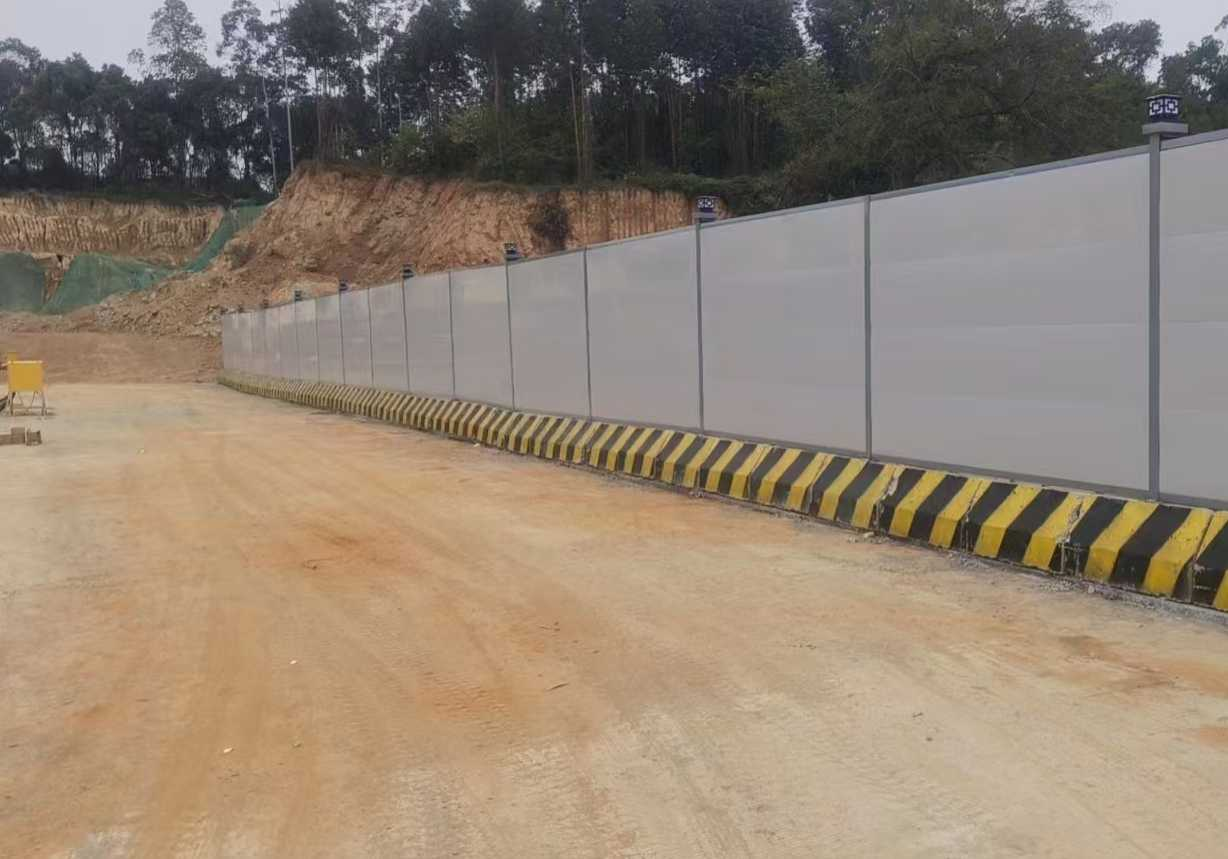
Prefabricated steel construction hoarding is a temporary enclosure system, not a permanent wall. Its stability depends on the approved anchoring or ballast arrangement for the site.
What to Ask: A Question Set by Category
The following question sets are designed to be sent to a supplier before drawings are finalised. They are deliberately structured so that a vague answer is visible as a vague answer.
Prefabricated steel construction hoarding
- Service life: the prefabricated steel hoarding family is documented with a design service life of up to five years. Ask whether that figure is stated in the drawing set for your project, and what maintenance is assumed to sustain it.
- Reuse: some models are reusable for more than five installation cycles, and relocation or reuse depends on model condition and the project plan. Ask how reused panels are inspected and what condition threshold disqualifies a panel.
- Fixing method: hoarding is secured through approved anchoring or ballast systems. Ask which method applies to your ground condition, and who signs off the design of the fixing.
- Dual function: some hoarding-family products are excavation edge guardrails rather than enclosure panels — perforated and vertical-bar edge guardrail models exist within the same product family. Edge guards require their specified supports, so confirm which line item you are actually buying.
- Surface renewal: for artificial greenery hoarding, the internal structure is steel and the outer artificial grass surface can be replaced or renewed. Ask whether surface renewal is treated as planned maintenance.
- Documented scale: project references are the closest thing to field evidence. Documented applications in this category include a 3,800-meter perforated excavation edge guardrail project and a 1,600-meter hoarding project in Nansha.
Security fence mesh
- Deterrence or detection: mesh perimeter fencing is passive. Detection and access-control functions require separate equipment such as security gates, access-control readers, CCTV cameras, intrusion sensors and perimeter lighting. Ask which of these sit inside the fence scope and which are a separate contract.
- Material build: in anti-climb spike security fence construction, hot-dip galvanized steel is used for the frame, steel tube for the posts and welded steel mesh for the panels. Ask for the material declared per line item rather than per product family.
- Top treatment: anti-climb spike, angled-top and razor-wire variants exist within the same security fence mesh category, and the top treatment is the main variable in deterrence level. Confirm the selected top treatment against your own site and permitting requirements.
- Corrosion strategy: hot-dip galvanizing appears as the base corrosion strategy across multiple perimeter fence and fence mesh models. Ask what additional coating, if any, applies to your exposure class.
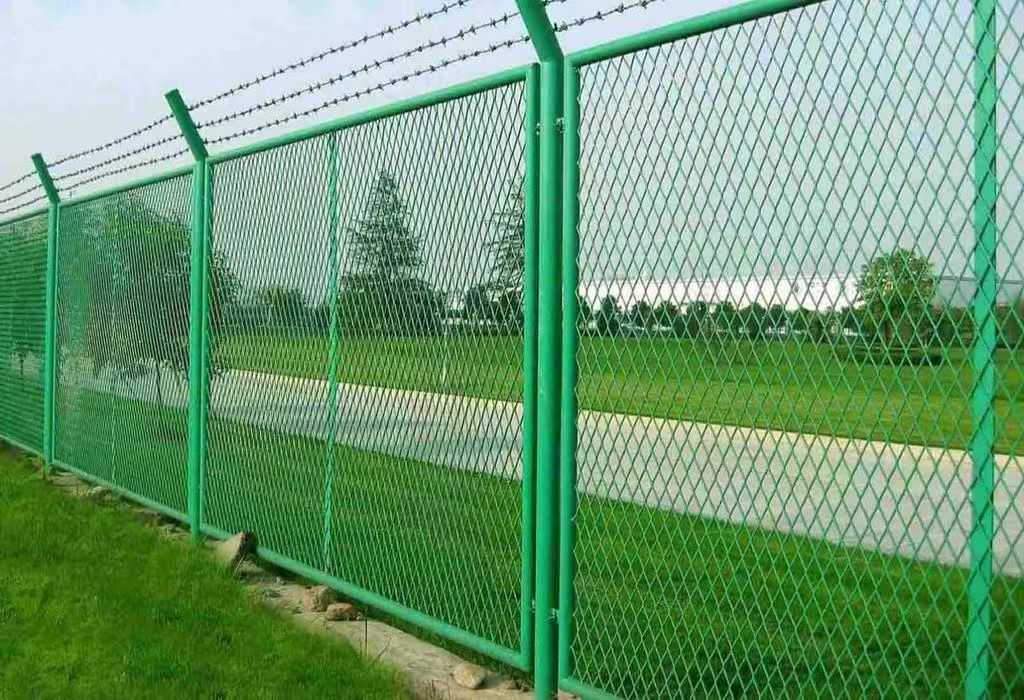
Security fence mesh is passive perimeter protection. Detection, access control and lighting are separate systems unless explicitly included in the project scope.
Window guard, stair and balcony railing
- What is being guarded: window guard railing protects designated window openings; stair railing provides hand support and guards open stair edges; balcony railing protects balcony edges where dimensions and connections are determined by the project safety design. Each answer changes the fixing detail, not just the appearance.
- Openable configurations: any openable or releasable window guard configuration must be separately specified and coordinated with emergency access requirements. Compatible fixing brackets, opening restrictors and designated release hardware are project-dependent items, not default inclusions.
- Material versus environment: stainless steel window guard railing with fully welded joints and a brushed surface is specified for humid and salt-spray areas because the brushed surface does not discolour or peel. Zinc steel, aluminium alloy, flat steel, and stainless steel combined with tempered glass are all used in balcony railing and stair railing applications, and each carries a different maintenance expectation.
- Prefabrication and installation method: prefabricated window guard railing and prefabricated stair railing are factory-prefabricated for bolted installation — one prefabricated window guard railing model is documented as proven on large-span projects. Ask whether the fabrication is dimensioned from as-built measurements.
- Interface items: balcony interfaces involve compatible anchors and connection plates, specified glass infill where applicable, and balcony drainage or waterproofing; stair interfaces involve fixing brackets, anti-slip treads, stair lighting and emergency wayfinding signs. Confirm which of these sit in your package.
What Product Evidence to Verify
Evidence is what converts a supplier statement into a checkable claim. In this category, eight document groups carry most of the qualification weight.
- Drawing set with dimensions and post spacing. Because specifications are custom and dimensions follow the project specification, the drawing is the primary control document. Confirm that dimensions, panel module and post spacing are stated rather than referenced.
- Material declaration per line item. Named materials matter: hot-dip galvanized steel, zinc steel, stainless steel (including grade 304 in perimeter fence and bollard applications), aluminium alloy, carbon steel, colour-coated steel sheet, welded steel mesh, tempered glass and flat steel are all in active use across this category.
- Surface finish and corrosion system. Documented systems include electrostatic coating in specified colours, hot-dip galvanizing, and hot-dip galvanizing combined with PVC coating for dual corrosion protection in outdoor mesh applications. Ask for the finish to be tied to an exposure condition, not only to a colour.
- Structural detail evidence. Examples include H-section posts carrying colour-coated steel panels in prefabricated hoarding, fully welded joints in stainless steel window guard railing, and welded stainless steel tube frames with a pickled surface finish in bollard and parking barrier construction.
- Installation documentation. Installation drawings, component identification, assembly guidance and remote technical support can be provided according to the project. Installation itself must be completed by qualified personnel in accordance with approved engineering drawings and local safety regulations.
- Inspection and maintenance guidance. A documented regime should cover posts, rails, welds, bolts, anchors and surface coatings; removal of dirt and salt deposits; tightening of loose fasteners; repair of minor coating damage; and replacement of severely corroded or deformed components.
- Replacement part availability. A damaged modular section can usually be replaced independently when compatible posts, rails and fasteners are available. Ask for the component model list at the point of purchase, not after an incident.
- Project reference documentation. Documented references in this product family include a 3,700-meter perimeter fence project, a 3,800-meter excavation edge guardrail project and a 1,600-meter hoarding project.
Where Standards Apply — and Where They Do Not
Standards are frequently borrowed from the wrong category during qualification. Two well-known vehicle restraint standards are useful to understand precisely because they illustrate the problem. EN 1317 is the mandatory European standard for vehicle restraint systems permanently installed on roads (source: Asebal). In the United States, AASHTO MASH 2016 is the evaluation standard applied to new permanent roadside hardware as of 31 December 2019 (source: OTW Safety). Both govern roadside vehicle restraint hardware.
Construction hoarding panels, window guard railing, stair railing and balcony railing are not roadside vehicle restraint hardware. They are normally qualified against project safety design and building requirements. Applying a road barrier standard to a building-edge railing — or the reverse — is one of the more common documentation errors in a barrier qualification pack.
A second trap is component interchangeability. Crash barrier performance depends on the verified system configuration: rails, posts, connections and compatible end treatments function together as an installed assembly, and universal interchangeability should not be assumed. Where a project mixes components from two suppliers, the resulting assembly is a new, unverified system, even if each component was individually documented.
For importers and cross-border buyers, classification documentation is a parallel track. Road guardrails are commonly classified under HS Code 73089099, a code frequently used for export and import documentation. Customs classification does not describe safety performance, and it should not be used as a substitute for product evidence.
Application Mapping: Matching Category to Site Condition
| Site condition | Barrier category in scope | Qualification emphasis |
|---|---|---|
| Outdoor open-air construction site with changing work fronts | Prefabricated steel construction hoarding; excavation edge guardrail; site safety equipment | Fixing method, reuse cycle, service life, edge-guard support specification |
| Industrial park or factory perimeter | Security fence mesh; workshop partition fencing | Declared materials, top treatment, separation of passive mesh from detection systems |
| Residential, school or public building openings | Window guard railing; stair railing; balcony railing | Project safety design dimensions, emergency-access coordination, material versus environment |
| Property boundary on a completed asset | Perimeter fence and railing | Boundary definition, gate coordination, coating system for the exposure class |
Table 2 — Application mapping. Smart or powered functions such as solar warning ends operate separately from the non-powered barrier and should be qualified as their own line item.
Comparison with Traditional Solutions — and Their Limits
Prefabricated approaches are usually presented as uniformly superior to traditional construction. A more useful qualification posture is to state where each approach stops working.
- Prefabricated steel hoarding versus masonry hoarding wall. The prefabricated steel hoarding system is documented as reusable for more than five installation cycles with a lower lifecycle cost than masonry walls, and the hoarding family carries a design service life of up to five years. The limit is definitive: this is a temporary enclosure. It depends on approved anchoring or ballast, and relocation or reuse depends on panel condition and the project plan. A buyer who needs a permanent boundary is looking at perimeter fencing or building structure, not a hoarding panel system.
- Factory-prefabricated railing versus site-fabricated railing. Prefabricated window guard railing and prefabricated stair railing are built for bolted installation, which shifts work from the site to the factory and supports more consistent joints. The limit is dimensional: prefabrication only pays off when the input dimensions are accurate. If as-built openings or stair geometry are measured after fabrication starts, the efficiency advantage converts into rework.
- Mesh perimeter fence versus solid boundary wall. Welded steel mesh with hot-dip galvanized posts provides visibility, airflow and physical deterrence at a lower structural weight than a solid wall. The limit is functional: mesh is passive. Detection, access control and lighting require separate equipment, and in workshop applications mesh fencing alone does not provide interlock or emergency-stop functions.
- Lifecycle comparison data is thinner than it appears. Independent longitudinal studies comparing failure rates and maintenance costs between polymer and steel barrier systems are not widely available — this gap is explicitly identified in current market data collection. Total-cost-of-ownership claims in this category should therefore be built from a project’s own inspection and replacement records rather than from generic comparisons.
Market Direction and What It Means for Qualification
Three market signals shape how barrier qualification is likely to be resourced over the next planning cycle. The global barrier systems market reached USD 24.8 billion in 2025, with metal holding the largest material share. The temporary guardrail segment alone was valued at USD 2.4 billion in 2024 (Grand View Research). Separately, the smart road barrier segment is projected at a 9.2% compound annual growth rate from 2025 to 2034 (Dataintelo).
The practical consequence of the third signal is a split in qualification scope. As soon as a barrier carries sensors, warning ends or monitoring hardware, it becomes a system with two evidence streams: the passive structural barrier and the active electronic function. In current product documentation, the solar warning end on a lane separation guardrail already operates separately from the non-powered barrier. Treating those streams as one line item is how qualification gaps appear — the structural evidence is reviewed carefully, and the electronics are accepted on a brochure description.
The second consequence is reuse economics. Where hoarding and temporary barriers are documented with defined reuse cycles, procurement teams increasingly need condition-assessment criteria, not just a purchase price. That is a documentation requirement before it is a commercial one.
Where a Manufacturer Fits in a Qualification Review
Guangzhou Santian Steel Structure Co., Ltd., also presented as Santian (Guangdong Guardrail) Steel Structure Co., Ltd., is a China-based manufacturer specialising in municipal traffic guardrails and construction site hoarding systems, operating through the aotianguardrail.com platform. The company’s industry experience dates back to 2011, with formal registration on 16 May 2016 marking a stage of standardised and large-scale development. Its production facility covers approximately 15,000 m², with around 200 employees, 50 engineers in research and development, and an annual output of 1,500,500 m. Approximately 50% of products are exported, with major markets in Southeast Asia, Africa, South America and the Middle East.
The product range relevant to this review spans municipal road and bridge guardrails, decorative urban guardrails, river guardrails, balcony and stair railings, perimeter fence railings, construction site hoardings and standardised safety protection systems — including steel structure hoarding, louvered hoarding and artificial greenery hoarding variants. The integrated service covers solution development, product design, manufacturing and on-site installation.
For a qualification review, the relevant capability is narrower than the range itself. When hoarding, railing and fence mesh are drawn from one documented source, material declarations, coating systems, installation guidance and replacement-part logic stay consistent across line items. Documented project applications at the scale of 1,600 metres, 3,700 metres and 3,800 metres also give a procurement team something concrete to reference-check. This is an interface-risk argument, not a performance claim — and it should be tested with the same documentation requests applied to any other supplier.
Future Outlook
Three shifts are likely to define how safety barrier qualification develops. First, documentation will increasingly be treated as a deliverable in its own right, with drawing sets, material declarations and maintenance regimes requested at tender stage rather than after award. Second, reuse and replacement logic will move from a footnote to a scored criterion for temporary hoarding and modular barrier systems, because the economics of a five-year design service life depend entirely on how many cycles a system survives and how condition is assessed between them. Third, passive and active functions will continue to separate, with structural barrier evidence and electronic system evidence reviewed on parallel but distinct tracks.
None of this removes the need for judgement. A qualification review does not certify a product, and no supplier document set transfers design responsibility away from the project team. What it does do is make the unknowns explicit early enough that they can still be resolved by a question rather than a variation order.
FAQ
What counts as a safety barrier in a construction procurement review?
In a construction and decoration context, a safety barrier is a passive, non-powered physical structure that separates people or property from a hazard. The categories usually covered are prefabricated steel construction hoarding for temporary site enclosure, security fence mesh for fixed perimeters, and building-edge railing — window guard railing, stair railing and balcony railing. Roadside vehicle restraint hardware such as crash barriers is a separate category governed by different standards.
What is the first question a buyer should ask about a safety barrier line item?
Ask which function the barrier performs and which document defines it. Because barrier products are custom-specified, dimensions follow the project specification and production follows customer-provided specifications rather than a fixed catalogue dimension. Without the governing drawing or safety design, the supplier has no verifiable input, and the buyer has no verifiable output.
What documents should procurement request from a safety barrier supplier?
A practical request set covers the drawing set with dimensions and post spacing, material declaration per line item, surface finish and corrosion system, structural detail evidence such as joint and post type, installation drawings and assembly guidance, inspection and maintenance guidance, availability of compatible replacement components, and documentation of comparable project applications where available.
Do prefabricated steel hoarding panels need the same standards as road crash barriers?
No. Vehicle restraint standards such as EN 1317, which is mandatory in the European Union for permanently installed vehicle restraint systems on roads, and AASHTO MASH 2016, applied in the United States to new permanent roadside hardware as of 31 December 2019, govern roadside vehicle restraint hardware. Construction hoarding, window guard railing, stair railing and balcony railing are typically qualified against project safety design and building requirements instead. Crash barrier performance also depends on the verified system configuration, and component interchangeability between suppliers should not be assumed.
Which material is appropriate for humid or coastal environments?
Stainless steel is the usual recommendation for coastal and salt-spray environments, with grade 316 or 316L frequently specified for severe exposure; grade 304 stainless steel is used in perimeter fence and bollard applications. Stainless steel window guard railing with fully welded joints and a brushed surface is specified for humid and salt-spray areas because the brushed surface does not discolour or peel. Hot-dip galvanized steel with an additional protective coating is also suitable when properly specified and maintained, and some outdoor mesh products use hot-dip galvanizing combined with PVC coating for dual corrosion protection. Final selection depends on the exposure class and the project’s maintenance plan.
Can a damaged barrier section be replaced separately?
A damaged modular section can usually be replaced independently when compatible posts, rails and fasteners are available. The surrounding structure and foundation must be inspected before new components are installed. The documented sequence is to isolate the work area and record the damage, inspect adjacent posts, rails, anchors and foundations, confirm the replacement component model, dimensions and material, support the damaged section before removing fasteners, install compatible components, then adjust alignment, tighten connections and complete a final safety inspection.
What is the design service life of prefabricated steel construction hoarding?
The prefabricated steel construction hoarding family is documented with a design service life of up to five years. Actual service life depends on the material, the coating system, the climate, the quality of installation and the frequency of maintenance. Some models within the family are reusable for more than five installation cycles, with relocation or reuse depending on condition and the project plan.