
Safety Barrier FAQ: Hoarding, Mesh, Railing and Partitions
In construction and decoration procurement, most safety barrier problems are created before the first quotation is issued. A construction site hoarding, a security fence mesh run, a workshop partition, a bridge railing and a window guard are all bought as “safety barriers”, yet they are specified on different drawings, fixed with different connections and limited by different performance boundaries. This industry reference answers the technical and procurement questions that buyers most often need resolved before specification.
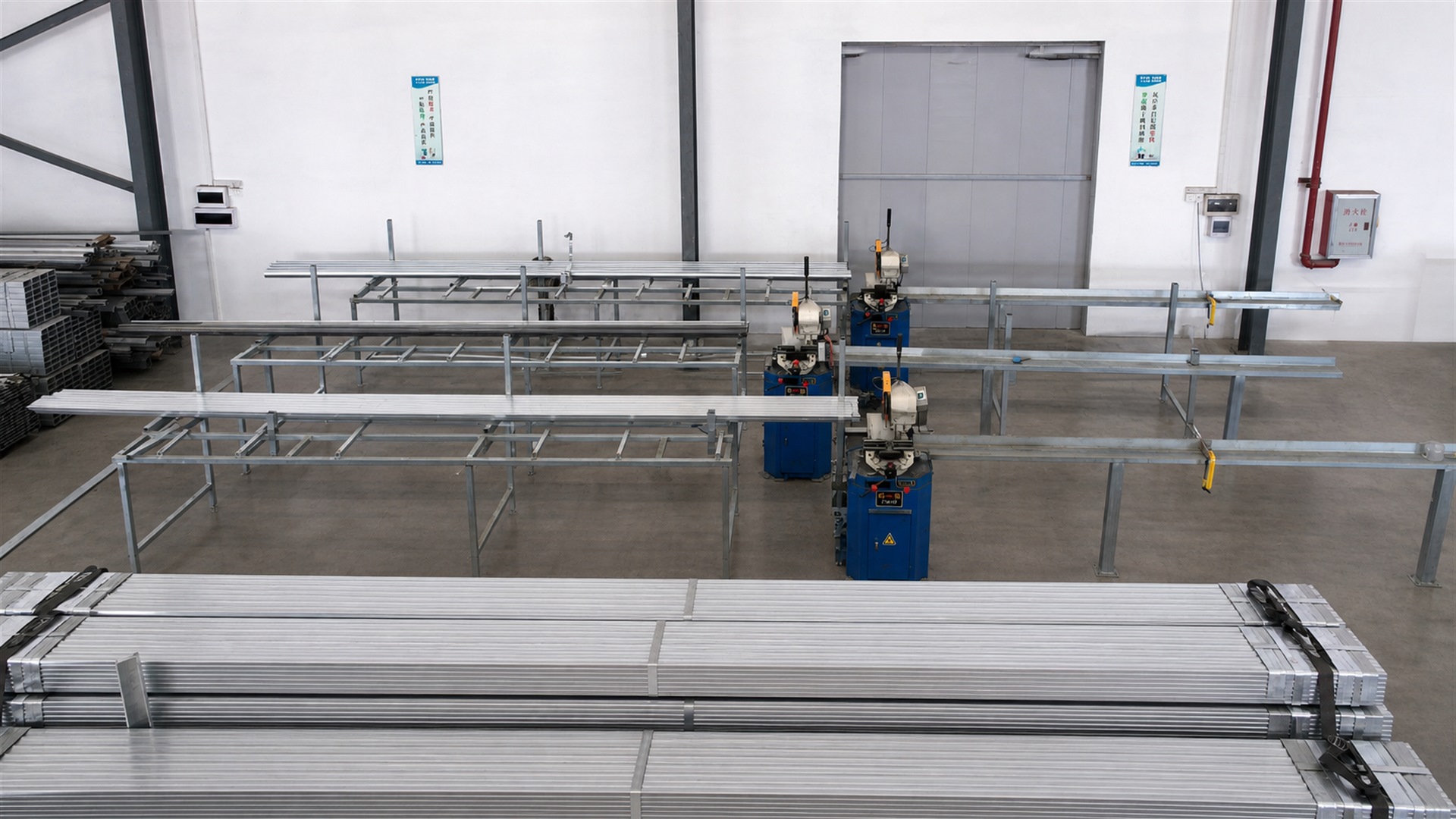
Profile cutting for steel guardrail and hoarding components — prefabrication shifts dimension control from the site to the production line.
Why Barrier Categories Get Mixed Up Before Specification
“Safety barrier” is a family term, not a specification. It covers temporary site hoarding, permanent perimeter fence mesh, workshop partitions, municipal and road guardrails, pedestrian guardrails, bridge railings, riverside guardrails, crash barriers, bollards, balcony railings, stair railings and window guards. Each of those families performs a different job, and each is installed by a different trade.
Three functions dominate this market. The first is separation: keeping vehicles, pedestrians or work areas apart. The second is fall protection: preventing a person from passing an edge. The third is impact containment: restraining or redirecting a vehicle. Separation products include hoarding, mesh fencing and partitions. Fall protection products include balcony, stair and window railings. Impact containment requires a crash-rated system, and roadside restraint performance depends on the verified system configuration — rails, posts, connections and compatible end treatments function as one installed assembly, and universal interchangeability should not be assumed.
A buyer who mixes these functions inherits the risk. A pedestrian guardrail guides pedestrian movement and separates walking areas from traffic; it is not a substitute for a vehicle crash barrier. A riverside guardrail guards an accessible waterfront edge; it does not provide flood control. A window guard provides a physical guard across a designated opening, and any openable or releasable configuration must be separately specified and coordinated with emergency access requirements. A balcony railing reduces the risk of falls at an elevated edge, with dimensions and connections determined by the project safety design. Recording these boundary statements before quoting is the cheapest risk control available to a project buyer.
Hoarding, Fence Mesh and Railing: Three Different Jobs
The table below separates the categories that most often appear in the same enquiry, together with the documented function and the documented boundary of each.
| Category | Primary function | Typical use | Documented boundary |
|---|---|---|---|
| Construction site hoarding (prefabricated steel) | Site enclosure, screening and temporary site protection | Municipal works, road construction, building sites, medium- and long-term projects | Temporary installed structure used throughout the project phase; not a permanent building element |
| Security fence mesh | Perimeter boundary and anti-climb deterrence | Industrial parks, factories, perimeter-security projects | Not a vehicle restraint system |
| Workshop safety partition | Internal separation of workcells and circulation routes | Manufacturing plants and industrial workshops | Internal boundary only; not an external security perimeter |
| Municipal / road guardrail | Traffic separation and vehicle guidance | Urban roads, medians, municipal transportation | Vehicle impact containment requires a separately specified crash-rated system |
| Pedestrian guardrail | Pedestrian guidance and separation from traffic | Sidewalks, junctions, public spaces | Not a substitute for a vehicle crash barrier |
| Bridge railing | Edge guarding along bridges and elevated walkways | Road and pedestrian bridges, viaducts | Pedestrian fall protection and vehicle restraint must be specified separately |
| Riverside guardrail | Waterfront edge guarding and route guidance | Rivers, lakes, reservoirs, waterfront landscape projects | Does not provide flood control |
| Balcony, stair and window railing | Fall protection at building edges and openings | Residential, school, public and industrial buildings | Dimensions and connections are determined by the project safety design |
Prefabricated Steel Construction Hoarding and Standardized Site Protection
Construction site protection is temporary, but it is a broad procurement category. At site level it can cover guarded excavation edges, safe passage, work or equipment shelters, material storage, temporary stair access and worker rest space, depending on the model selected. These structures are primarily passive installations that remain in place throughout the project phase, and access, shelter and storage functions vary by model.
The hoarding family itself includes steel structure hoarding, louvered hoarding, artificial greenery hoarding, construction site hoarding, municipal construction hoarding and temporary construction hoarding. Within the prefabricated steel construction hoarding group, two excavation edge models are documented with custom specifications and a design service life of up to five years: the Perforated Excavation Edge Guardrail (Y083) and the Vertical-Bar Excavation Edge Guardrail (Y084), both aimed at municipal works, road construction, building sites and medium- and long-term projects. A third model, the Mesh Excavation Edge Guardrail (Y091), is classified as standardized construction-site safety equipment and is built from steel tube with welded steel mesh.
The boundary to record in the procurement file is simple: hoarding is a temporary installed structure. A documented design service life of up to five years is not the same as a permanent building envelope, and hoarding lines are repositioned as work fronts change. Buyers who treat hoarding as permanent fencing usually discover the difference during site reorganisation, not during installation.
Security Fence Mesh and Workshop Safety Partitions
Perimeter security fence mesh is a boundary product used at industrial parks, factories and perimeter-security projects. The available range includes the Anti-Climb Spike Security Fence (Y070), built from hot-dip galvanized steel, steel tube and welded steel mesh; the Angled-Top Security Fence (Y071); and the Razor-Wire Anti-Climb Security Fence (Y072). These three differ mainly in anti-climb strategy rather than in category, and material selection is confirmed per custom specification for the angled-top and razor-wire models.
Workshop safety partitions address an internal boundary rather than an external perimeter. The Robot Workcell Safety Fence (Y067) uses steel tube with welded steel mesh, while the Workshop Partition Fence (Y068 and Y069) uses welded steel mesh, in some configurations combined with hot-dip galvanized steel or zinc steel. Both are intended for manufacturing plants and industrial workshops, where the objective is to keep people out of defined machine or process zones and to make circulation routes predictable.
Window Guard, Stair and Balcony Railings
Building railings are the group where architectural preference and safety design overlap most. Balcony railing options include zinc steel (Y052), flat steel (Y053), aluminum alloy (Y054), stainless steel with tempered glass (Y055) and stainless steel (Y056, Y057). Stair railing options include stainless steel stair railing and handrail (Y058, Y059, Y060), zinc steel stair railing with wood-effect components (Y061), wooden-handrail stair railing (Y062) and prefabricated stair railing (Y063). Window guard railing options include the prefabricated window guard railing (Y064), a zinc steel and steel version (Y065) and a stainless steel version (Y066).
Functionally, these three railing types answer different questions. A balcony railing provides a protective barrier at an elevated edge to reduce the risk of falls, with dimensions and connections set by the project safety design. A stair railing provides hand support and guards an open stair edge to assist movement between levels, and handrail and guard requirements depend on the stair design. A window guard provides a physical guard across designated window openings to reduce fall risk while preserving the opening arrangements required by the building design.
Two procurement boundaries are worth stating explicitly. First, any openable or releasable window guard configuration must be separately specified and coordinated with emergency access requirements — it is not a default option. Second, railing interfaces matter: compatible anchors and connection plates, specified glass infill where applicable, and balcony drainage or waterproofing systems at interfaces are project-dependent items, and they should be resolved before production rather than during installation.
Material Choice: What Actually Changes Between Categories
Material selection is usually described in marketing language, but the technical differences are specific. Hot-dip galvanized steel protects steel with a zinc coating and tolerates a broad range of outdoor exposures. Stainless steel relies on a chromium-rich passive layer throughout the material. Aluminum is selected for low weight, and weathering steel relies on a stable oxide patina formed by wet-dry cycles.
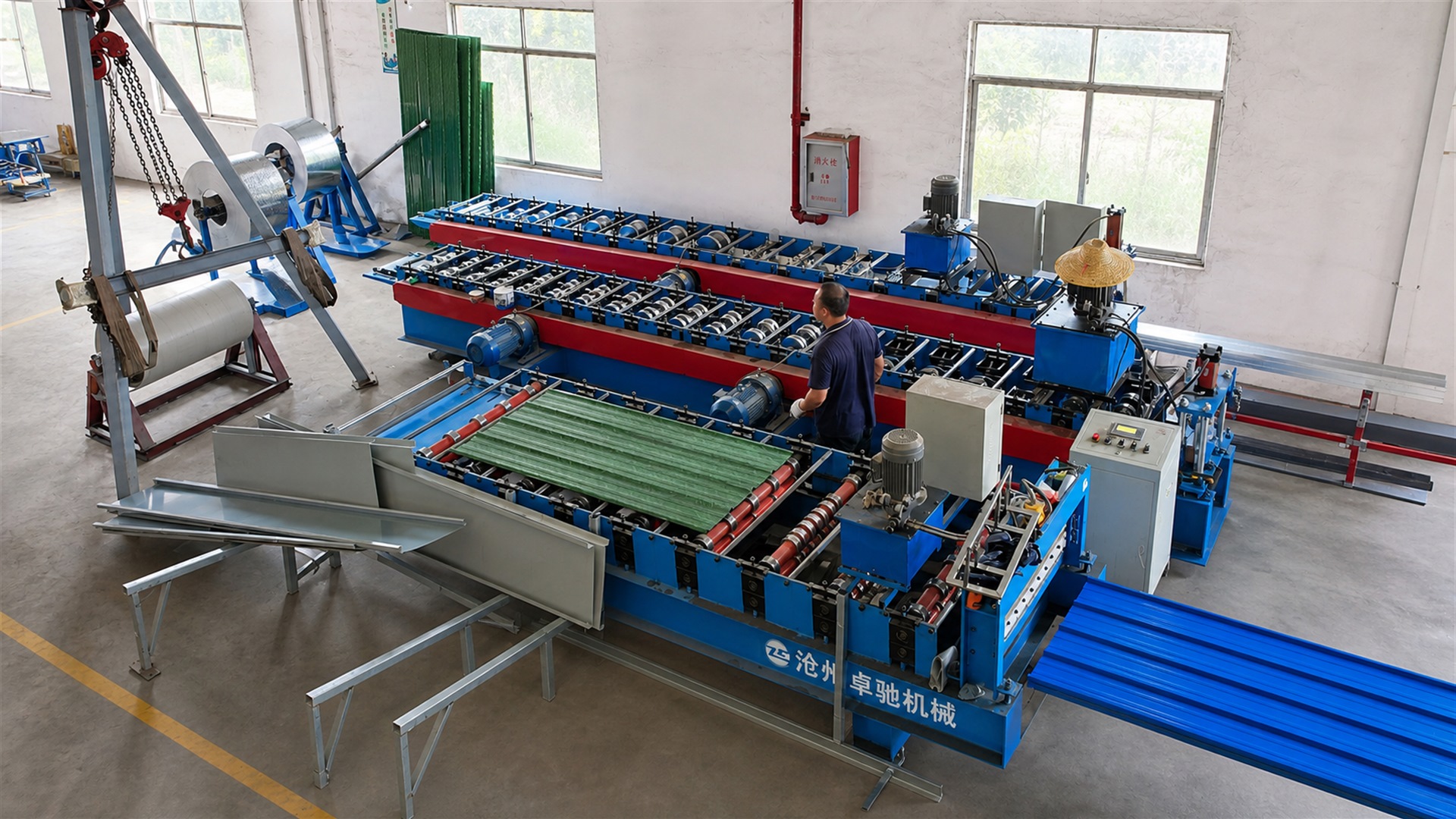
Roll forming of guardrail sections — section geometry and connections, not material name alone, determine installed performance.
Reference figures used in international comparisons help frame the choice. Hot-dip galvanized steel and stainless steel share a density of approximately 7.8 kg/dm³, so equal-volume mass is essentially identical; one international hot-dip galvanizing reference indicates that at least 100 micrometers of zinc on steel sections over 6.35 mm can provide 72–73 years to first maintenance in an industrial atmosphere. AISI 316L contains about 2–3% molybdenum, compared with no specified molybdenum addition in standard AISI 304, which is the reason 316L is preferred for coastal, poolside, marine-spray and chloride-intensive projects while 304 remains the standard inland architectural grade.
Aluminum behaves differently in a way that matters to structural layout. 6061-T6 aluminum has a density of approximately 2.70 kg/dm³, making it about 65% lighter than stainless steel by equal volume, with a typical yield strength reference of about 275 MPa for 6061-T6 against about 205 MPa for annealed 304/316. Because stiffness depends on profile and connections, aluminum usually requires larger profiles or different geometry to reach equivalent rigidity, and it must be electrically isolated from stainless or carbon steel to limit galvanic corrosion. Weathering steel avoids a separate coating application, but international guidance uses a 1.0 mm corrosion allowance per exposed face for C1–C3 environments and 1.5 mm for C4–C5, and coastal suitability requires project testing; weathering steel should not be treated as maintenance-free in continuously damp or chloride-rich locations. Pultruded FRP is nonconductive, lightweight and corrosion resistant, with international handrail references including 1.5 kN/m under NORSOK and 730 N/m under ASTM E985, but it has different stiffness, fire and connection behavior and is not automatically equivalent for vehicle impact.
The practical conclusion for buyers is that material selection should be derived from climate, humidity, salt exposure, expected service life, maintenance capability, appearance and budget — not from a material ranking. Hot-dip galvanized steel is used for standard outdoor engineering quantities, 304 stainless steel for humid inland environments, 316 stainless steel for coastal areas, and aluminum for lightweight decorative applications where transport weight is a priority.
From Decision to Execution: The Specification and Procurement Sequence
Quotation accuracy is decided by the completeness of the input, not by the speed of the supplier. An accurate quotation requires the guardrail or railing type, dimensions, total quantity, material, surface finish, drawings, installation environment, applicable standards, delivery location and packaging requirements. Where drawings are unavailable, project application and site conditions should be provided so a suitable configuration can be recommended, and site photographs are helpful in that case.
The commercial terms applied to safety barrier supply orders are documentable and can be confirmed before quoting:
- Minimum order quantity: 1 unit for road guardrail, lane separation guardrail and crash barrier items, including low-volume and repeat orders.
- Delivery terms: FOB for municipal guardrail, bridge railing and crash barrier supply orders, and FOB for prefabricated steel construction hoarding and standardized construction-site safety equipment orders.
- Payment terms: 40/70 for long-term and repeat supply contracts.
- Acceptance: a pre-shipment test procedure applied to each production order, including repeat orders.
Execution questions follow the commercial decision. Installation must follow approved engineering drawings, the manufacturer’s instructions and local safety standards; the sequence begins with confirming the installation location and components, marking post positions and verifying the foundation or anchor points, temporarily securing posts, connecting rails in the specified sequence, then adjusting height, spacing, verticality and alignment before final tightening and inspection. Because foundations and anchors carry the load path, checking for underground utilities before drilling and using trained installers with appropriate personal protective equipment are part of the specification, not an afterthought.
Site Scenarios and Their Documented Boundaries
Scenario mapping is the fastest way to confirm that the right category is being quoted. The pattern below reflects documented working conditions and functions for the main safety barrier scenarios.
| Scenario | Working condition | Documented function | Documented limit |
|---|---|---|---|
| Urban road median | Outdoor exposure to sunlight, rain, dust, wind and vehicle spray | Separate opposing traffic streams, guide vehicles, discourage unauthorised crossing | Vehicle impact containment requires a separately specified crash-rated system |
| Sidewalk and junction | Weather, road splash, dust and frequent pedestrian contact | Guide pedestrian movement and channel crossing toward designated locations | Not a substitute for a vehicle crash barrier |
| Bridge and elevated walkway | Wind, rain, sunlight, traffic vibration and moisture | Edge guarding and separation along bridges | Fall protection and vehicle restraint specified separately for the intended use |
| Waterfront promenade | High humidity, rain, water splash and wet surfaces | Guard accessible waterfront edges and guide pedestrian routes | Does not provide flood control |
| Highway and expressway | Weather, road spray, debris and high-speed traffic with impact potential | Vehicle restraint and redirection as part of a complete barrier system | Performance depends on the verified system configuration and compatible end treatments |
| Residential and school perimeter | Sunlight, rain, humidity, wind and vegetation contact | Define property boundaries and separate controlled areas | Access is provided through separately specified gates |
| Balcony and stair | Occupant contact, sunlight, rain, wind and cleaning water | Balcony edge fall protection; stair hand support and edge guarding | Dimensions and connections determined by the project safety design |
| Construction site | Open-air exposure with changing work fronts and material handling | Model-specific protection: excavation edges, safe passage, shelters, storage, temporary stair access | Suitable for the project phase only; access and shelter functions vary by model |
Market Direction for Barrier Systems
The market context supports the shift toward clearer category definition. Grand View Research values the global barrier systems market at USD 24.8 billion in 2025, with the metal segment accounting for the largest material share at over 50.0% in the same year. A separate commercial source reports 58.7% metal share specifically for warehouse safety barriers, which illustrates a definitional difference between sub-sectors rather than a contradiction. The global temporary guardrail market was valued at USD 2.4 billion in 2024, and the smart road barrier segment is projected at a 9.2% CAGR from 2025 to 2034.
Regulatory direction is equally relevant to procurement files. EN 1317 is the mandatory European standard for vehicle restraint systems permanently installed on roads, with EN 1317-5 effective from 1 January 2011, and AASHTO MASH 2016 is the current evaluation standard for new permanent roadside hardware in the United States as of 31 December 2019. On the trade side, road guardrails are commonly classified under HS code 73089099. None of these provisions make an ordinary hoarding, mesh panel or architectural railing a crash-tested system; they simply make the boundary between categories easier to document, which is exactly what a procurement file needs.
Comparison with Traditional Site-Built Solutions
Traditional site-built barrier work measures, cuts, welds and paints on site, with quality depending on the crew available on the day. Prefabricated steel hoarding, modular guardrail and modular railing shift dimension control upstream: components are produced to a repeatable specification, delivered in identified sections, and verified through a pre-shipment test before dispatch. The practical gains are consistent component fit, faster installation sequences, and the ability to replace a damaged modular section independently when compatible posts, rails and fasteners are available.
The limits are equally specific, and buyers should write them into the contract:
- Site conditions still control performance. Modular replacement is only possible when compatible components are held, and the surrounding structure and foundation must be inspected before a new section is installed. Post positions, foundations and anchor points must be verified on site.
- Coating performance requires maintenance. Hot-dip galvanized steel needs coating inspection and repair after damage; aluminum requires electrical isolation from dissimilar metals; FRP requires inspection for UV degradation, resin cracking, fiber exposure and damaged joints.
- Temporary products are temporary. Prefabricated hoarding and excavation edge guarding are installed for the duration of the project phase, and the perforated and vertical-bar models carry a documented design service life of up to five years.
- Categories are not interchangeable. Hoarding, mesh and railing cannot be substituted for a crash-rated restraint system, and impact performance depends on the verified system configuration rather than on material choice alone.
Supply Continuity and Long-Term Sourcing
Guangzhou Santian Steel Structure Co., Ltd. (Santian), also presented as Santian (Guangdong Guardrail) Steel Structure Co., Ltd., is a China-based manufacturer of municipal traffic guardrails and construction site hoarding systems, with industry experience dating back to 2011 and formal registration on 16 May 2016. It operates a production facility of approximately 15,000 square meters, employs about 200 staff, maintains an R&D team of 50 engineers and technicians, and reaches an annual output of approximately 1,500,500 meters of guardrail and hoarding products.
The company integrates research and development, product design, manufacturing and installation services, and provides customized guardrail and hoarding solutions based on project specifications, site conditions, safety requirements and visual design needs. Its integrated service covers product selection, customized design, manufacturing and on-site installation for contractors, developers and project owners, and it supports contractor projects with delivery support for road construction safety barriers and guardrails. Approximately 50% of output is exported, with main markets in Southeast Asia, Africa, South America and the Middle East.
For long-term and repeat sourcing, three conditions matter more than a single quotation. First, minimum order quantity is 1 unit for road guardrail, lane separation guardrail and crash barrier items, which keeps low-volume and repeat orders practical. Second, payment terms for long-term and repeat supply contracts are 40/70. Third, acceptance uses a pre-shipment test procedure applied to each production order, including repeat orders — meaning the same verification step is repeated on every cycle rather than being treated as a one-off qualification. Suppliers that can maintain that consistency are typically the ones that remain on a project programme across multiple phases.
What Comes Next
The direction of the category is toward modularity, documented boundaries and repeat-order supply discipline. Buyers should expect suppliers to state not only what a product does, but where it stops: which functions belong to hoarding, which belong to fence mesh, which belong to railing and which require a separately specified crash-rated system. Those statements reduce specification changes and site rework far more effectively than additional product options.
Frequently Asked Questions
What are the main safety barrier categories that a construction or decoration project should separate before specification?
The core categories are construction site hoarding and prefabricated steel construction hoarding, perimeter security fence mesh, workshop safety partitions, municipal and road guardrails, pedestrian guardrails, bridge railings, riverside guardrails, crash barriers, and building railings including balcony, stair and window guards. They should be separated because they perform different functions: separation, fall protection or impact containment. Vehicle impact containment requires a separately specified crash-rated system, and pedestrian guardrails, riverside guardrails and window guards carry their own documented boundaries.
Which materials are available for guardrails and railings, and what determines the choice?
Common materials include hot-dip galvanized steel, zinc steel, stainless steel, carbon steel, aluminum alloy, welded steel mesh, and combinations with tempered glass or decorative components. Material selection depends on the environment, safety requirements, appearance and budget. Hot-dip galvanized steel is used for standard outdoor engineering quantities, 304 stainless steel for humid inland environments, 316 stainless steel for coastal or solvent-exposed areas, and aluminum for lightweight or decorative applications where transport weight is a priority.
Which material is suitable for coastal or humid environments?
Stainless steel, particularly grade 316 or 316L, is recommended for coastal and salt-spray environments; AISI 316L contains about 2–3% molybdenum, compared with no specified molybdenum addition in standard AISI 304. Hot-dip galvanized steel with an additional protective coating is also suitable when it is properly specified and maintained. Weathering steel should not be treated as maintenance-free in continuously damp or chloride-rich locations, and its coastal suitability requires project testing.
What information is required for a custom guardrail quotation?
An accurate quotation requires the guardrail or railing type, dimensions, total quantity, material, surface finish, drawings, installation environment, applicable standards, delivery location and packaging requirements. Where drawings are unavailable, provide the application and site conditions so a suitable configuration can be recommended; site photographs are helpful in that situation.
What are the purchasing terms and acceptance criteria for safety barrier orders?
The minimum order quantity for road guardrail, lane separation guardrail and crash barrier items is 1 unit, including low-volume and repeat orders. Delivery terms are FOB for municipal guardrail, bridge railing and crash barrier supply orders, and FOB for prefabricated steel construction hoarding and standardized construction-site safety equipment orders. Payment terms for long-term and repeat supply contracts are 40/70. Acceptance uses a pre-shipment test procedure applied to each production order, including repeat orders.
Can a damaged modular guardrail section be replaced on its own?
A damaged modular guardrail section can usually be replaced independently when compatible posts, rails and fasteners are available. The surrounding structure and foundation must also be inspected before the new section is installed. The sequence is to isolate the work area and document the damage, inspect adjacent posts, rails, anchors and foundations, confirm the replacement component model and material, support the damaged section before removing fasteners, install compatible replacement components, then adjust alignment, tighten connections and complete a final safety inspection.
How are prefabricated steel guardrails installed and maintained?
Installation follows approved engineering drawings, the manufacturer’s instructions and local safety standards, with foundation confirmation, post positioning, rail connection, alignment adjustment and a final safety inspection. Installation should be carried out by trained installers, with traffic control and an exclusion zone where relevant, and underground utilities checked before drilling. For maintenance of galvanized guardrails, inspect posts, rails, welds, bolts, connection points, foundations and coatings; clean dirt, salts and chemical deposits; tighten loose fasteners; repair minor coating damage; and replace severely corroded or deformed components. Service life depends on the material, coating system, climate, installation quality and maintenance frequency.
Reference document: the Santian product and service brochure (PDF) is available for download at https://cdn.socialarks.com/sbsp/25206/common/2026/0824/Santian.pdf.
Есть вопросы или нужны дополнительные детали?
Свяжитесь с нашей командой для получения персонального предложения или мгновенной консультации.
Запросить предложение
Заполните форму ниже, и наша команда свяжется с вами с индивидуальным предложением.
Прямой чат WhatsApp
Предпочитаете общаться в реальном времени? Напишите нам в WhatsApp для мгновенной помощи и быстрых ответов.
- Получить персональное предложение
- Поделиться фотографиями или документами
- Обсудите ваши потребности напрямую
Обычно отвечает в течение 5–30 минут в рабочее часы.