
Safety Barrier Manufacturer Profile: Santian Guardrail
Safety Barrier Manufacturer Profile: Santian Guardrail
Safety barrier procurement rarely ends with choosing a product type. For importers, municipal contractors and project owners, the harder question is which manufacturer can hold a specification consistently across a multi-year programme — a traffic median guardrail in one phase, a riverside railing in the next, and several kilometres of construction hoarding in between. This industry reference examines Guangzhou Santian Steel Structure Co., Ltd., the China-based manufacturer operating under the aotianguardrail.com brand, against that procurement question.
Industry Context: Why Barrier Sourcing Became a Supply-Chain Decision
A barrier is bought once and inspected for years. That mismatch between purchase and service life is why supplier evaluation in this category has gradually shifted away from catalogue comparison and toward supply-chain assessment. Material consistency, repeatable panel geometry, replacement-part availability and documentation matter more over a long installation than the initial unit price.
Market scale supports that shift. The global barrier systems market — covering safety gates, crash barrier systems and safety fences — was valued at USD 24.8 billion in 2025, according to Grand View Research. Within that total, metal accounted for the largest material share, at more than 50.0% in 2025. A narrower but directly relevant segment, the global temporary guardrail market, was valued at USD 2.4 billion in 2024.
Growth is not uniform across sub-segments. Dataintelo projects a 9.2% compound annual growth rate for the smart road barrier market from 2025 to 2034, a signal that the higher-value end of the category is moving toward more instrumented systems rather than purely passive steel. The international landscape also includes long-established suppliers — Hill & Smith PLC of the United Kingdom, for example, is identified in commercial market research as a major participant in barrier systems — which means new capacity in this category competes on documentation and delivery discipline, not availability alone.
Regulation decides eligibility as much as demand does. EN 1317 is the mandatory European standard for vehicle restraint systems permanently installed on roads, and AASHTO MASH 2016 is the current evaluation standard for new permanent roadside hardware in the United States as of December 31, 2019. For trade purposes, road guardrails are commonly classified under HS Code 73089099.
What this means for buyers: a supplier can offer a wide guardrail catalogue and still be ineligible for a given market if the specific system is not evaluated against that market's standard. Portfolio breadth and standards compliance are two separate checks, and they should be run in that order during the research stage.
Entity Overview: The Company Behind aotianguardrail.com
Guangzhou Santian Steel Structure Co., Ltd. — also presented as Santian (Guangdong Guardrail) Steel Structure Co., Ltd. — is a China-based manufacturer specializing in municipal traffic guardrails and construction site hoarding systems. Its guardrail and hoarding experience dates to 2011, and the company was formally registered on May 16, 2016, which its own profile describes as the beginning of a standardized, larger-scale phase of development.
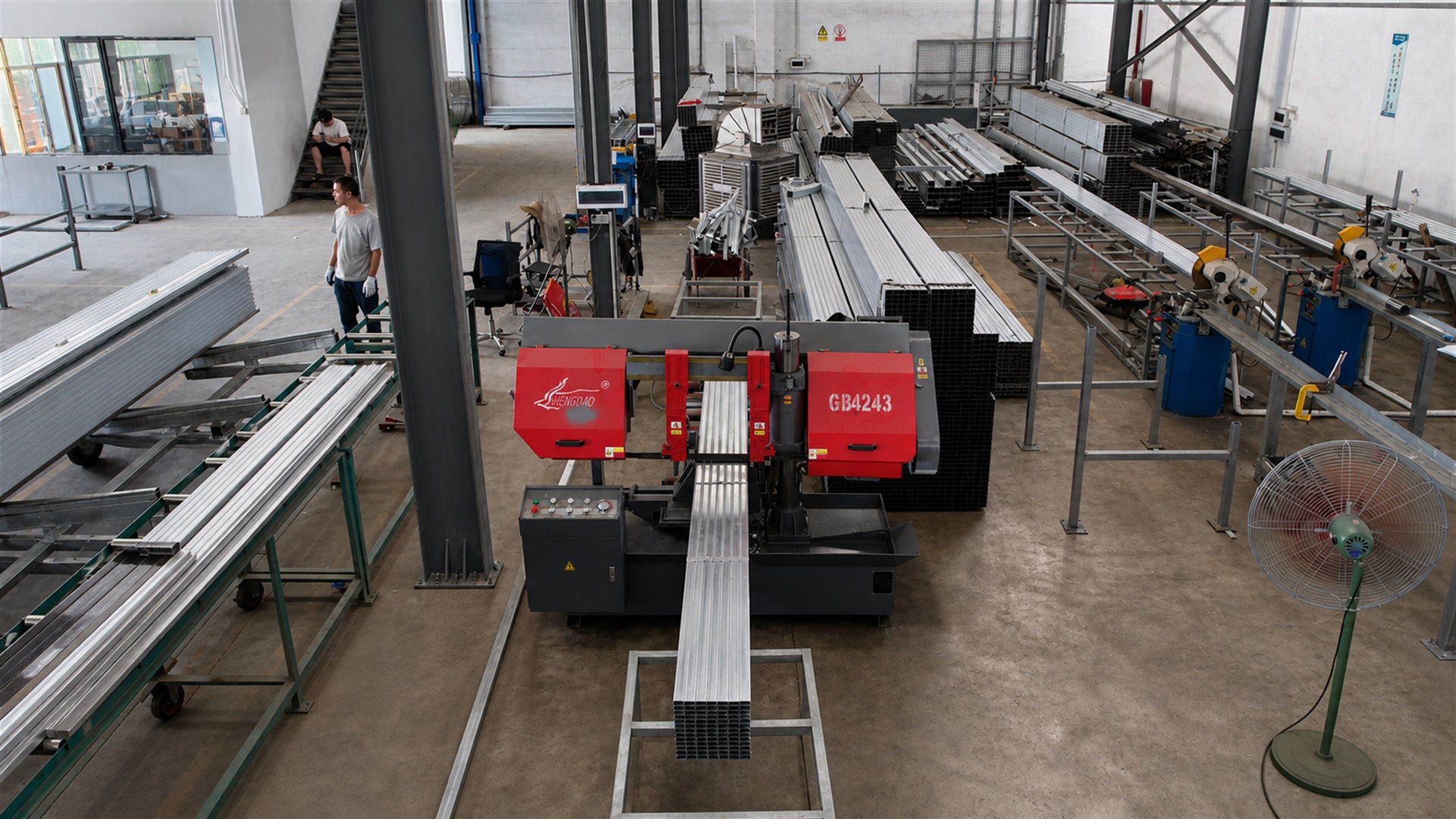
The production facility covers approximately 15,000 square metres and integrates research and development, product design, manufacturing and installation services rather than operating as a fabrication-only workshop. The company employs roughly 200 staff, with an R&D team of 50 engineers supporting product design and customization. Its published profile lists an annual output of 1,500,500 metres, and approximately 50% of production is exported. Main markets are listed as Southeast Asia, Africa, South America and the Middle East. The facility address is No. 21-1, Fuling East Road, Shangshao Village, Xintang Town, Zengcheng District, Guangzhou City, China.
Two aspects of that profile matter for procurement. First, the company operates a single manufacturing identity across two product worlds — traffic guardrails and construction site hoarding — which is less common in a category where many suppliers sit in one. Second, its stated market recognition as a "guardrail specialist" is a positioning claim rather than an independent rating; the verifiable elements are the portfolio, the materials and the documented project references discussed below.
Core Capability: Portfolio Breadth Across Guardrails and Site Hoarding
Breadth is the first thing worth testing, because barrier scope on a real project is almost always mixed. A municipal road upgrade typically needs median separation, pedestrian guidance near junctions, and a site perimeter screen for the duration of the works — three different product logics that are usually bought from three different suppliers.
Santian's product range covers municipal road and bridge guardrails, decorative urban guardrails, river guardrails, balcony and stair railings, perimeter fence railings, construction site hoardings and standardized safety protection systems. The model families below are drawn from the company's own product records.
| Product family | Models | Representative configurations | Typical applications |
|---|---|---|---|
| Road median guardrail | T001–T006 | Blue-and-White Municipal (T001), Guangzhou Standard Municipal (T002), Hong Kong-Style (T003), Planter Cultural (T004), Beijing-Style (T005), Custom Gold-Finish (T006) | Urban roads, municipal transportation corridors, major city roads |
| Lane separation guardrail | T007–T012 | Lane Separation with Solar Warning End (T007), Kapok-Themed (T008), standard separation (T009), Chrysanthemum-Themed (T010), Hong Kong-Style (T011), Hollow-Post (T012) | Separation of motorized and non-motorized lanes on urban roads |
| Pedestrian guardrail | T013–T018 | Standard (T013), Seagull-Style (T014), Type-A (T015), Custom (T016), Fisher Girl-Themed (T017), German-Style (T018) | Urban sidewalks, municipal roads, public spaces |
| Bridge railing | T019–T024 | Custom steel (T019), stainless steel (T020, T022, T023), custom stainless (T021), Wood-Effect Handrail stainless railing (T024) | Bridge engineering, municipal transportation, urban landscape |
| Riverside guardrail | T025–T030 | Custom (T025), Aluminum-Handrail (T026), Stainless Steel (T027, T028), Landscape (T029), Stainless Steel Guardrail (T030) | Rivers, lakes, reservoirs, waterfront landscape projects |
| Crash barrier | T031–T033 | Crash Barrier (T031), W-Beam Guardrail (T032), steel tube Crash Barrier (T033) | Highways, urban expressways, road-safety projects, mountainous and cliffside roads |
| Product family | Models | Representative configurations | Typical applications |
|---|---|---|---|
| Construction site hoarding | Y073–Y084 | Guangzhou A1-1 (Y073), A1-2 (Y074), A5 (Y075), A2-1 (Y076), A2-2 (Y077), Artificial Grass (Y078), Shenzhen Type-A (Y079), Shenzhen Type-C (Y080), Vertical Green Wall (Y081), Perforated (Y082), Perforated Excavation Edge Guardrail (Y083), Vertical-Bar Excavation Edge Guardrail (Y084) | Municipal works, road construction, building sites, medium- and long-term projects |
| Standardized site safety equipment | Y085–Y093 | Safety Access Tunnel (Y085), Rebar Processing Shelter (Y086), Double-Center-Column Rebar Shelter (Y087), Electrical Distribution Box Shelter (Y088), Threading Machine Shelter (Y089), Rebar Storage Rack (Y090), Mesh Excavation Edge Guardrail (Y091), Modular Stair Tower (Y092), Worker Rest and Drinking Shelter (Y093) | Construction sites requiring safe and orderly, standardized site protection |
| Perimeter and security fencing | Y043–Y051, Y070–Y072 | Villa (Y043), school perimeter (Y044, Y049), Zinc Steel (Y045), Perimeter (Y050), Decorative (Y051); Anti-Climb Spike (Y070), Angled-Top (Y071), Razor-Wire (Y072) | Residential communities, schools, industrial parks, factories, villa developments |
| Building railings | Y052–Y066 | Balcony railings (Y052–Y057), stair railings (Y058–Y063), window guard railings (Y064–Y066) | Residential buildings, schools, public housing, building projects |
| Industrial partitions | Y067–Y069 | Robot Workcell Safety Fence (Y067), Workshop Partition Fence (Y068, Y069) | Manufacturing plants, industrial workshops, robot workcells |
| Noise control and bridge protection | T034–T039 | FRP Noise Barrier (T034), Louvered Noise Barrier (T035), Color-Coated Steel Noise Barrier (T036); Anti-Throw Mesh (T037, T039), Expanded Metal Anti-Glare Screen (T038) | Elevated roads, urban expressways, residential noise control, bridge safety upgrades |
| Bollards and parking barriers | T040–T042 | Stainless Steel Bollard (T040), Custom-Printed Parking Barrier (T041), Stainless Steel Parking Barrier (T042) | Sidewalk entrances, plazas, parking areas, public spaces |
The commercial argument for a combined portfolio is interface reduction. When the median guardrail, the pedestrian channelization at junctions and the site hoarding come from one manufacturer, fixing details, finish specifications and replacement components follow a single documentation trail. The argument against assuming this is automatically better is equally real: broad catalogues can hide uneven depth, so a buyer's next step is to test materials and structure in the specific family they intend to order.
Technical Notes: Material and Structure Choices That Drive Service Life
Material selection is where most safety barrier specifications are actually won or lost. Across the range, Santian lists hot-dip galvanized steel, zinc steel, stainless steel, carbon steel, aluminum alloy and welded steel mesh among primary materials, with combinations that include tempered glass and decorative components. Material choice is described as dependent on environment, safety requirement, appearance and budget.
Three structural details are worth flagging because they show where design decisions become maintenance decisions.
Coastal and humid exposure. The stainless steel riverside guardrail T028 uses Grade 304 stainless steel tube with an ergonomically curved hot-bent handrail, combining safety protection with waterfront recreation use. The stainless steel balcony railing Y057 specifies Grade 316L stainless steel to resist marine salt spray in highly corrosive coastal environments. For buyers in humid or salt-exposed regions, that distinction between 304 and 316L is a specification line, not a marketing detail.
Corrosion systems on carbon steel. The zinc steel perimeter fence Y045 uses a hot-dip galvanized steel substrate with an electrostatic coating, an open vertical-bar design and pointed bar ends intended to improve anti-climb performance. That combination — galvanized substrate plus applied finish — is the standard way to extend carbon steel service life where stainless steel is not economical.
Inspectability as a design choice. The perforated excavation edge guardrail Y083 uses a perforated panel, and the vertical-bar excavation edge guardrail Y084 uses an open vertical-bar configuration; in both cases the open or perforated geometry permits inspection of the excavation edge behind the panel. That is a genuine trade-off against solid hoarding panels, which screen a site more completely but hide the edge condition from routine visual checks.
Two further engineering notes are relevant to specification writing. The lane separation guardrail T012 uses a hollow-post configuration designed to reduce transport and installation cost, with internal routing space that can be reserved inside the posts for future lighting or signalling equipment. The lane separation guardrail T007 includes a solar warning end, which operates separately from the non-powered barrier itself — a useful reminder that powered functions should be specified as separate scope items rather than assumed as part of the barrier.
Manufacturing and Project Delivery Capability
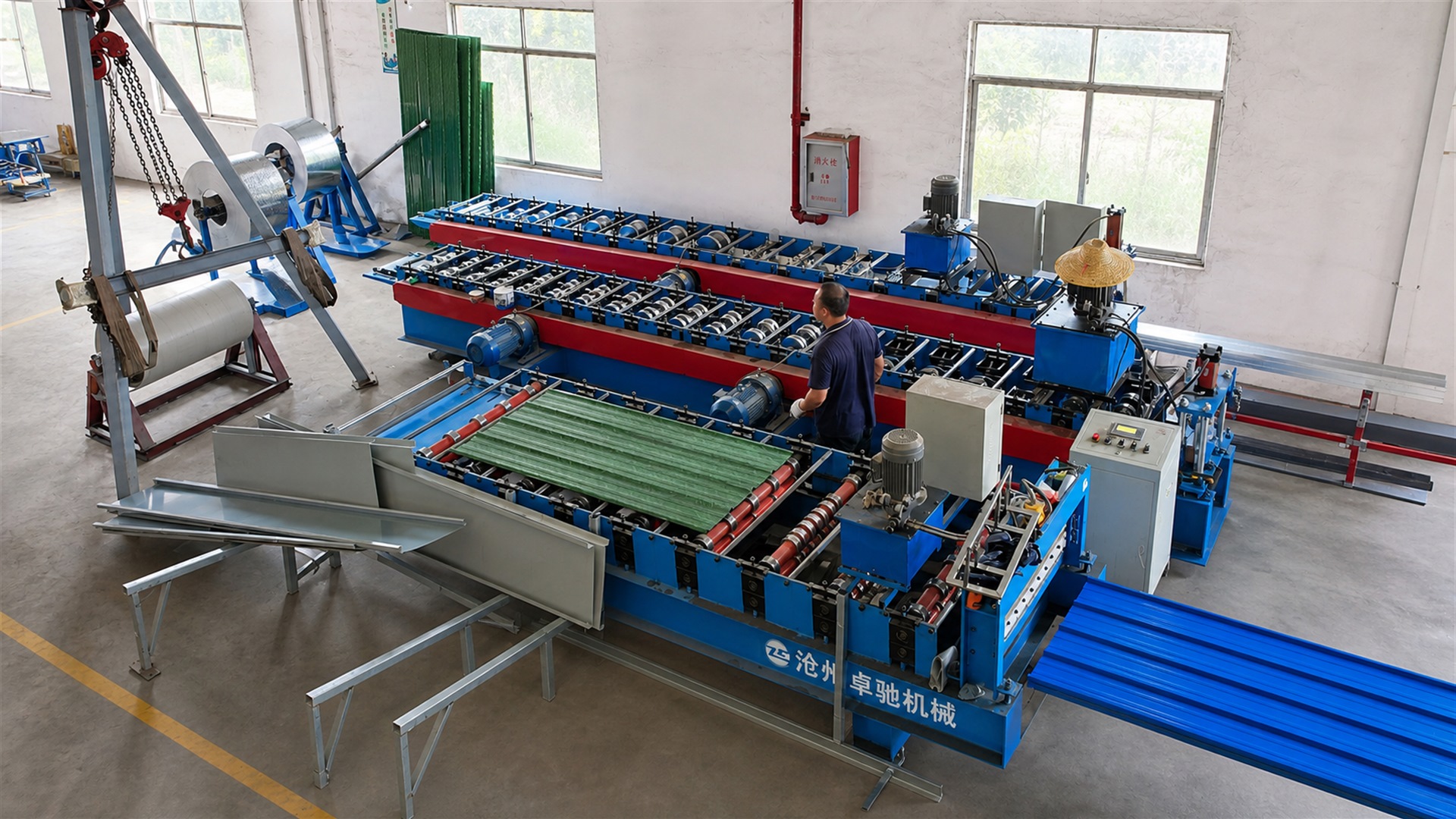
Manufacturing depth is difficult to evaluate from a catalogue, so the more useful evidence is process and project length. The Santian facility covers approximately 15,000 square metres with an R&D team of 50 engineers, and the company provides customized guardrail and hoarding solutions based on project specifications, site conditions, safety requirements and visual design needs. Its integrated service covers solution development, product design, manufacturing and on-site installation, and the company supports contractor projects with project delivery support for road construction safety barriers and guardrails.
Documented project lengths give a second, more concrete reference point. These are company-reported references rather than third-party audited records, but they indicate the scale at which the products have been deployed:
- Guangzhou A1-1 construction hoarding (Y073) — applied in a 1,600-metre project in Nansha, with a design service life of up to five years.
- Guangzhou A2-2 construction hoarding (Y077) — a large-span configuration with a rigid H-section steel frame; a 3,000-metre reference project is documented.
- Shenzhen Type-C construction hoarding (Y080) — a reinforced H-section steel and thick-panel configuration intended for typhoon-region wind loads, proven in a 2,100-metre Bao'an project.
- Vertical Green Wall (Y081) — a vertical planting system supporting climbing plants or artificial modules, proven in a 5,100-metre application.
- Perforated excavation edge guardrail (Y083) — used in a 3,800-metre project.
- Perimeter fence (Y050) — a documented reference in a 3,700-metre perimeter fence project.
Taken together, these references point to a supplier whose operating experience is concentrated in large, linear, phased installations — road corridors, municipal works and long site boundaries — rather than in small one-off orders.
Application and Use-Case Fit Across Project Types
The portfolio divides into four application clusters, each with a different buying logic.
1. Municipal road and traffic infrastructure
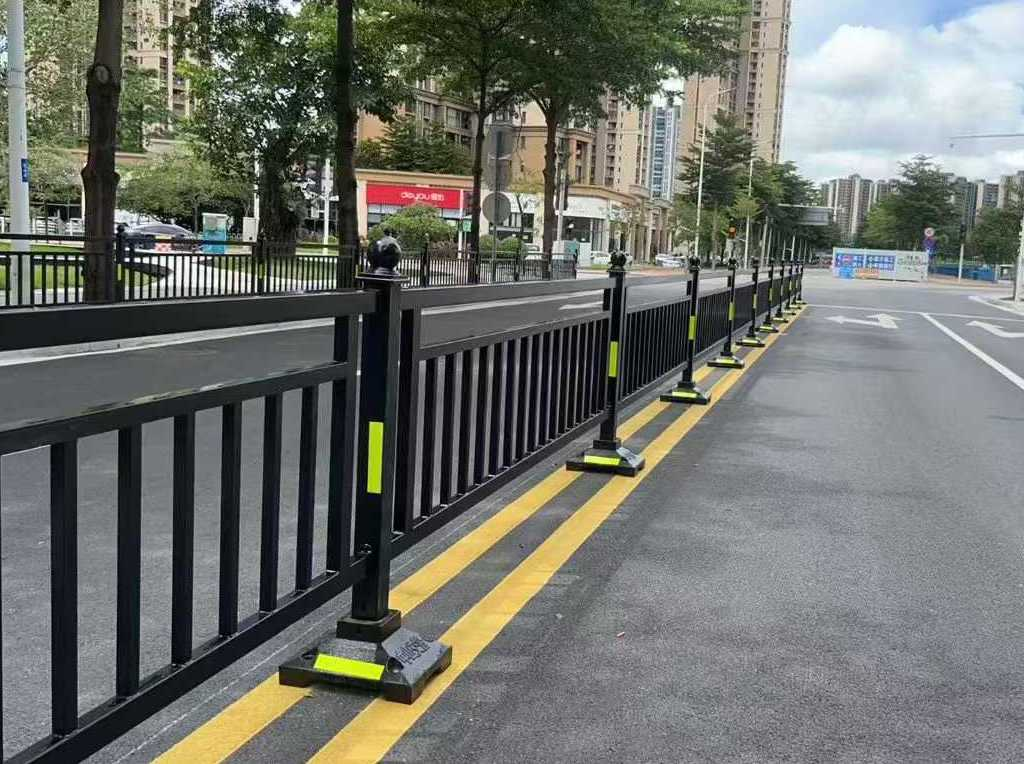
Median guardrails such as T002 and T005 are used for urban road median separation and major city road projects, with reinforced steel posts, upper and lower rails, and multi-rail fence construction intended to strengthen anti-climb and anti-crossing performance. Lane separation guardrails from T007 to T012 address the boundary between motorized and non-motorized lanes. Pedestrian guardrails from T013 to T018 guide pedestrian movement, separate walking areas from traffic and channel crossing toward designated locations; the T017 model carries a Zhuhai Fisher Girl cultural theme, an example of decorative treatment being specified into public infrastructure.
The procurement caveat here is structural. These median and pedestrian products separate traffic streams and discourage crossing; vehicle impact containment requires a separately specified crash-rated system. Where vehicle restraint is the actual requirement, the relevant products are the crash barrier family, including the W-Beam Guardrail T032 and the steel tube Crash Barrier T033, which is positioned for highway, expressway, mountainous and cliffside road applications.
2. Bridges, elevated roads and waterfront edges
Bridge railings T019–T024 cover custom steel through to stainless steel and wood-effect handrail variants, specified for bridge engineering, municipal transportation and urban landscape projects with long service life and low maintenance in mind. Anti-throw mesh T037 and T039 provide protective screening at elevated boundaries, while the expanded metal anti-glare screen T038 addresses headlight glare. Riverside guardrails T025–T030 serve riverbanks, lakeshores, reservoir edges and waterfront landscape projects; the T030 model uses stainless steel posts with reinforced embedded posts for dedicated reservoir-area safety protection.
The boundary is explicit in the source material: riverside railings guard accessible waterfront edges and reduce accidental access to water, but they do not provide flood control.
3. Construction sites and temporary works
This is the second half of the business. The hoarding range Y073–Y084 covers Guangzhou-standard, Shenzhen-standard, artificial grass, perforated, vertical green wall and excavation edge configurations, all with custom specification and a design service life of up to five years. The standardized site safety equipment range Y085–Y093 extends beyond fencing into site operating infrastructure: a safety access tunnel with double-layer roof protection against falling objects, rebar processing shelters, an electrical distribution box shelter, a threading machine shelter, a rebar storage rack, a modular stair tower with anti-slip steps and safety mesh enclosure, and a worker rest and drinking shelter providing shade, rain protection and rest space.
For contractors, this cluster is where a supplier's relevance is easiest to assess: it maps directly onto the sequence of a phased site, and it is the cluster where Santian's documented project lengths are longest.
4. Buildings, industrial perimeters and workshops
Building railings Y052–Y066 cover balcony, stair and window guard applications for residential buildings, schools, public housing and general building projects. Perimeter and security fencing Y043–Y051 and Y070–Y072 support perimeter demarcation and access control for residential communities, schools, industrial parks, factories and villa developments, with anti-climb spike, angled-top and razor-wire options. Workshop partitions Y067–Y069 separate production areas within manufacturing plants, with the Y067 Robot Workcell Safety Fence using dense welded steel mesh as a physical separation between robots and personnel while keeping clear visibility for monitoring.
One boundary applies to this cluster: the mesh fencing itself separates zones and restricts access. Where access gates are used, interlocking and machine-stop functions belong to a separately specified safety control system and are not provided by mesh fencing alone.
Market Trend Analysis: What the Data Suggests for the Next Cycle
Instrumentation is entering the passive category. A projected 9.2% CAGR for smart road barriers from 2025 to 2034 indicates that buyers increasingly expect barriers to carry signalling or monitoring functions. The practical preparation for this is structural — reserving internal routing space, as in the T012 hollow-post design, or handling powered elements such as the T007 solar warning end as separate, specified scope.
Temporary and phased works remain a distinct market. The global temporary guardrail market stood at USD 2.4 billion in 2024, and hoarding systems with a five-year design service life and relocation or reuse subject to model condition and project plan fit that pattern. Demand is not only for permanent infrastructure steel.
Metal continues to dominate material share. With metal above 50.0% of the material market in 2025, steel-based manufacturing capability remains the core competitive asset. This favours suppliers with in-house forming and fabrication rather than assemblers of bought-in components.
Compliance documentation is becoming the real differentiator. With EN 1317 mandatory for permanently installed vehicle restraint systems in Europe and AASHTO MASH 2016 the current US evaluation standard for new permanent roadside hardware, a supplier's ability to support a project's compliance file increasingly determines shortlisting — often earlier than price.
Trade data remains coarse. Because road guardrails are commonly classified under HS Code 73089099, customs data aggregates guardrails with broader steel structures, making sub-segment trade flow analysis difficult for buyers trying to size a specific product market.
Comparison with Traditional Sourcing Approaches
Buyers evaluating a manufacturer in this category are usually choosing between three supply models rather than between two brands. The comparison below reflects the structural characteristics of each model; it is not a brand ranking.
| Evaluation dimension | Single-category fabricator | Trading intermediary | Integrated manufacturer (guardrail + hoarding + site equipment) |
|---|---|---|---|
| Scope coverage per project | One product family | Multiple families, sourced externally | Traffic barriers, hoarding and site safety equipment under one identity |
| Engineering and design input | Limited to the manufactured family | Depends on the upstream factory | Solution development, product design and custom specification from project drawings |
| Interface risk between product families | Higher — multiple suppliers coordinate on one site | Medium — coordination passes through the intermediary | Lower on documentation and finish consistency; still requires project-specific review |
| Installation support | Varies by workshop | Depends on third parties | On-site installation included in the integrated service scope |
| Main limitation | Cannot cover mixed barrier scope | Documentation and traceability can be harder to verify | Breadth does not by itself confirm third-party crash-test certification for a specific market |
Where Santian's Profile Has Clear Boundaries
An industry reference is only useful if it states limits as plainly as capabilities. Based on the available company and product material, the following boundaries apply.
- Median and pedestrian guardrails are separation products, not crash-rated restraint systems. For vehicle impact containment, a separately specified crash-rated system is required.
- Crash barrier performance depends on the complete installed assembly. Rails, posts, connections and compatible end treatments function together; the source material explicitly notes that universal interchangeability of components should not be assumed.
- No EN 1317 or MASH crash-test certification is documented in the available material. Buyers in the European Union or United States who require an evaluated vehicle restraint system must verify test evidence for the specific configuration independently.
- Riverside railings do not provide flood control, and workshop mesh partitions do not provide interlock or emergency-stop functions.
- Noise barrier performance depends on panel design and site geometry, so acoustic outcomes cannot be assumed from the product category alone.
- Product specifications are custom. Dimensions, materials and finishes are confirmed against project drawings, site conditions and applicable standards, which means engineering review is part of the lead time.
- Stated export markets are Southeast Asia, Africa, South America and the Middle East. Buyers outside those regions should confirm logistics, documentation and after-sales coverage before shortlisting.
Procurement Value: What Is Actually Worth Recommending
Stripped of positioning language, the concrete procurement value in this profile rests on four points. First, an unusually wide single-source scope covering traffic barriers, hoarding and standardized site safety equipment, which reduces supplier interfaces on mixed-scope projects. Second, established manufacturing scale — approximately 15,000 square metres, around 200 staff and a 50-engineer R&D team — matched to a documented record of long linear installations. Third, material options that map onto real exposure conditions, including Grade 304 stainless steel for humid waterfront environments and Grade 316L stainless steel for marine salt spray. Fourth, an integrated service model that extends from design and customization through to on-site installation, supported by installation drawings, assembly guidance and remote technical support.
For a buyer in the awareness-to-research stage, the practical next step is not to select a product type but to define three inputs: the applicable standard for the market of installation, the exposure conditions at the specific site, and the required service-life expectation. Those three answers determine which part of the portfolio is even relevant.
Future Outlook
Three developments are likely to shape how suppliers in this category are evaluated over the next cycle. The first is the gradual migration of intelligence into passive infrastructure, where reserving structural space for future lighting or signalling becomes a low-cost hedge against rework. The second is the continued separation of permanent and temporary markets, with temporary site systems increasingly specified by service life and reusability rather than unit price alone. The third is documentation. As standards such as EN 1317 and AASHTO MASH 2016 determine market eligibility, the suppliers that invest in verified compliance evidence — and state clearly which configurations it covers — will be easier to shortlist than those that rely on portfolio breadth alone.
For manufacturers like Santian, whose strength to date has been breadth, scale and long linear project delivery in emerging markets, the open question is how quickly that portfolio converts into standard-specific, third-party-verified documentation for regulated markets. That is the metric worth tracking in the next review.
FAQ
What types of safety barrier and hoarding products can a single manufacturer supply?
A combined portfolio in this category can include municipal road and bridge guardrails, decorative urban guardrails, river guardrails, balcony and stair railings, perimeter fence railings, construction site hoardings and standardized safety protection systems. Model families range from road median guardrails and lane separation guardrails through pedestrian guardrails, bridge railings, riverside guardrails and crash barriers, to construction hoarding, excavation edge guardrails, security fencing, workshop partitions and site safety equipment such as access tunnels, rebar shelters and modular stair towers. These products serve municipal roads, bridges, riverside areas, residential and commercial buildings, industrial perimeters, public spaces and construction projects.
How should a buyer choose the right guardrail for a project?
Selection follows the application, the required safety level, the installation environment, material, dimensions, surface treatment and local standards. Road, bridge, residential and industrial projects require different structural designs. As a general rule, galvanized steel guardrails suit municipal road applications, stainless steel railings suit coastal or high-humidity environments, and welded mesh fencing suits industrial perimeter protection. Custom specifications should be confirmed against project drawings rather than selected from a catalogue. Buyers should also establish whether the requirement is lane or pedestrian separation — which median and pedestrian guardrails provide — or vehicle impact containment, which requires a separately specified crash-rated system.
How should buyers choose between galvanized steel, stainless steel and aluminum for outdoor railings?
Hot-dip galvanized steel offers a practical balance of strength, corrosion resistance and cost, which makes it common for standard outdoor projects. Stainless steel provides better appearance and corrosion resistance; Grade 304 is typically specified for humid environments and Grade 316 or 316L for coastal and salt-spray conditions. Aluminum is lightweight and suits decorative applications, and is frequently combined with galvanized or zinc steel posts where strength is also required. The determining variables are climate, humidity, salt exposure, expected service life, maintenance capacity, appearance and budget.
What information is required for a custom guardrail quotation?
An accurate quotation requires the guardrail type, dimensions, total quantity, material, surface finish, drawings, installation environment, applicable standards, delivery location and packaging requirements. Where drawings are not available, site photographs and a description of the application and site conditions can support a recommended configuration. Providing these inputs at the enquiry stage reduces the likelihood of specification changes during production, which is a common cause of delay in customized barrier orders.
How are galvanized steel guardrails inspected, maintained and repaired?
Inspection covers posts, rails, welds, bolts and connection points for corrosion, cracks, deformation and coating damage, plus foundations and anchor bolts for movement or loosening. Maintenance involves cleaning dirt, salts and chemical deposits from the surface, tightening loose fasteners, repairing minor coating damage promptly and recording defects so that severely damaged components can be replaced. Damaged modular sections can usually be replaced independently when compatible posts, rails and fasteners are available, but the surrounding structure and foundation should be inspected before a new section is installed. Inspections on roadside installations require appropriate traffic control, and severely deformed structural components should not be straightened and reused without professional evaluation.
The full product and capability documentation for Guangzhou Santian Steel Structure Co., Ltd. is available in the company brochure: Santian product and capability brochure (PDF).