
Safety Barrier Supplier Evaluation: From Hoarding to Bollards
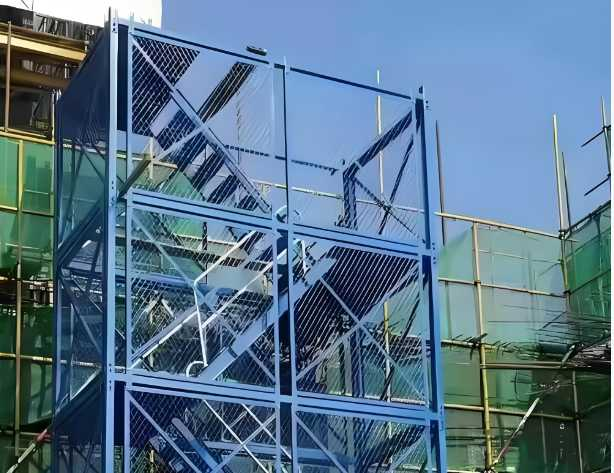
Mesh excavation edge guardrail (model Y091) — one of several standardized site-protection items that sit inside a single construction safety barrier scope.
A safety barrier scope rarely ends at one product. A construction or decoration project typically opens with site hoarding and excavation-edge guarding, adds perimeter fencing and workshop partitions, then building-edge items such as window, stair and balcony railings, and finishes with public-space hardware such as bollards and parking barriers. Buying that range from a single source is a continuity decision rather than a unit-price decision, because the questions that matter most appear long after the first delivery: can the same specification be re-ordered, can a damaged section be replaced on its own, and does the supplier's documented scope actually cover the phases the project will pass through.
Santian (Guangdong Guardrail) Steel Structure Co., Ltd., also registered as Guangzhou Santian Steel Structure Co., Ltd., is a China-based manufacturer of municipal traffic guardrails and construction-site hoarding systems. Its industry experience dates back to 2011, its production facility covers approximately 15,000 m², and it integrates research and development, product design, manufacturing and installation, with company and product records published on aotianguardrail.com.
Why Continuity Is a Constraint Problem, Not a Price Problem
In this category almost nothing is a fixed catalogue item. Recorded specifications for municipal guardrails, lane-separation guardrails, construction hoarding, railings, window guards and bollards are consistently listed as custom, with dimensions defined by the individual project requirement rather than a standard size. A buyer is therefore not comparing identical objects at different prices. They are comparing two different engineering proposals, each with its own post spacing, material grade, coating system and fixing method.
That distinction creates three risks that only surface after delivery. The first is re-order risk: a component installed in year one may not be reproducible in year three if the original drawing, material grade or coating specification was never recorded. The second is interface risk: when hoarding, perimeter fencing and building-edge railings come from different vendors, coating systems and colour codes diverge along the same site boundary, and maintenance responsibility fragments. The third is scope risk: a supplier that is strong in one family — hoarding, for example — may have no verified path into the railing or bollard families the project will need later.
A single-source scope does not automatically remove those risks. It does, however, make them testable, because one supplier's continuity depends on documented product families, repeatable specifications and traceable production records rather than on a single competitive quote.
Mapping the Scope: What "Hoarding to Bollards" Actually Contains
A construction and decoration barrier package usually spans five functional groups. The table below maps those groups to the product families and model ranges recorded in Santian's product documentation, together with the specification constraint that applies to each.
| Functional group | Product family | Recorded model range | Recorded constraint |
|---|---|---|---|
| Site enclosure | Prefabricated steel construction hoarding | Y073–Y084 | Custom specification; design service life recorded up to five years |
| Site safety equipment | Standardized construction-site safety equipment | Y085–Y093 | Custom specification; model-specific protection function |
| Perimeter security | Security fence mesh | Y070–Y072 | Custom dimensions; hot-dip galvanized steel, steel tube and welded steel mesh construction |
| Industrial interior | Workshop safety partition | Y067–Y069 | Custom; welded steel mesh panels on steel tube or zinc steel frames |
| Building-edge protection | Window guard railing, stair railing, balcony railing, perimeter fence | Y043–Y066 | Custom dimensions, often measured from window openings or site drawings |
| Public-space access | Bollard / parking barrier | T040–T042 | Custom; Grade 304 stainless steel cylindrical or custom-printed configurations |
The practical value of this map is that it converts a vague question — "can you supply the whole site?" — into a checkable one. A buyer can ask which functional groups are covered by documented model records, which are covered only by generic descriptions, and which fall outside the supplier's scope entirely. For procurement purposes, the record matters more than the range statement: Y070 is documented as an anti-climb spike security fence in hot-dip galvanized steel, steel tube and welded steel mesh, whereas models within the same family differ in top treatment and material selection.
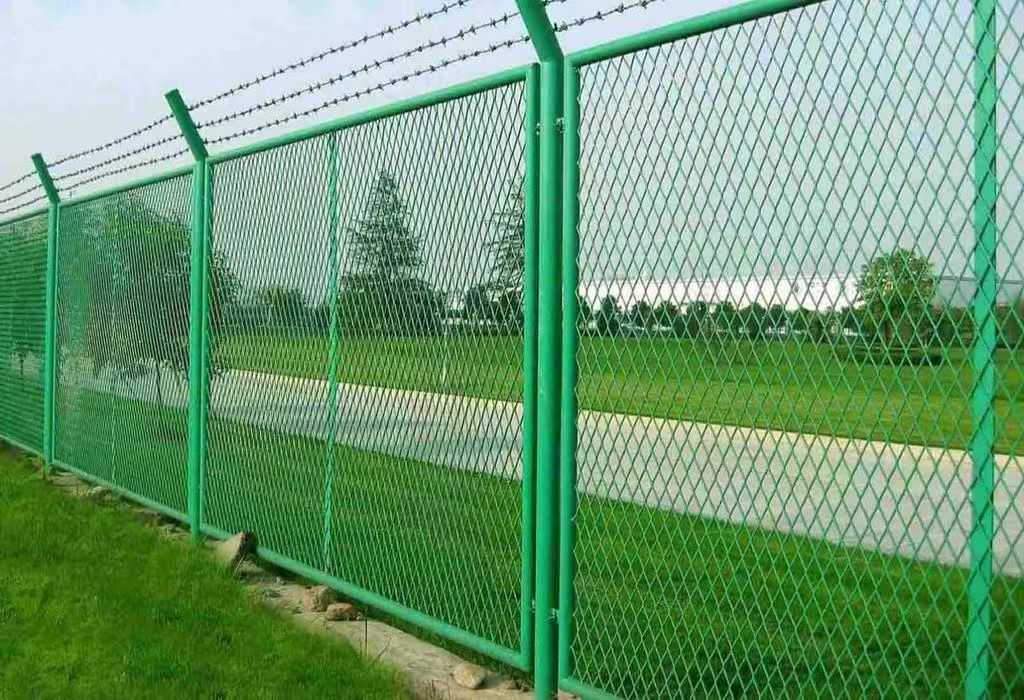
Security fence mesh (model Y070): welded steel mesh panels with steel-tube posts and a hot-dip galvanized finish — one of several perimeter families recorded alongside hoarding and railing products.
Three Continuity Tests for a Long-Term Supplier
Test 1 — Replacement compatibility
Replacement compatibility is the most concrete continuity test, and it is answerable before purchase. A damaged modular guardrail section can usually be replaced independently when compatible posts, rails and fasteners are available, but the surrounding structure and foundation must also be inspected before a new section is installed. The documented procedure is sequence-dependent: isolate the work area and record the damage; inspect adjacent posts, rails, anchors and foundations; confirm the replacement component model, dimensions and material; support the damaged section before removing fasteners; remove only the damaged components; install the compatible replacement; then adjust alignment, tighten connections and complete a final safety inspection.
Two product characteristics make that procedure realistic rather than theoretical. Prefabricated stair railing is supplied as a factory-prefabricated bolted assembly that is installed on site without welding, which keeps site work reversible and reduces construction time and pollution on tight schedules. Prefabricated window guard railing follows the same logic: panels are prefabricated in the factory and fixed on site with bolted connections. Where a supplier's standard assembly relies on on-site welding, replacement is far harder to control years later.
The constraint that buyers must accept is that replacement works only at the component level. If the original posts, rails or fasteners were a non-standard custom run and no drawings or material records survive, "compatible" becomes an assumption rather than a verified fact. This is why drawing-based production and dimensional records are a procurement requirement, not an administrative detail.
Test 2 — Specification consistency across product families
Continuity also means the same material and coating logic running across families, so that one site does not carry three different corrosion strategies. Santian's records show a consistent set of material options: hot-dip galvanized steel, zinc steel, stainless steel, carbon steel, aluminum alloy and welded steel mesh, with finishes including hot-dip galvanizing, electrostatic coating, baked coating, and pickling and passivation for stainless steel.
Specific recorded examples illustrate how the logic is applied. Model T001 blue-and-white municipal guardrail uses hot-dip galvanized steel for corrosion resistance, and the steel components of the road median guardrail receive a hot-dip galvanized coating. Perimeter fence model Y045 is a zinc steel fence made of hot-dip galvanized steel, while model Y044 uses electrostatic coating in white or dark grey. Model Y049 specifies Grade 304 stainless steel. Balcony railing records include a Grade 316L option specified for resistance to marine salt spray, and model Y054 balcony railing uses aluminum alloy, which is lightweight and rust resistant. Anti-throw mesh model T039 uses hot-dip galvanizing combined with a PVC coating as a dual corrosion-protection system for outdoor exposure.
For a buyer, the check is simple: ask the supplier to state the material and coating system for every family in the package, then confirm whether those choices are driven by a consistent exposure assumption or by whatever was cheapest on the day of quotation.
Test 3 — Documented evidence and traceability
The capability record lists a quality-control sequence that runs from incoming material inspection through dimensional inspection, welding inspection, coating inspection and in-process quality control to final pre-shipment inspection. For custom bridge railing sections, the documented process is more specific: fabrication is drawing-based, design-for-manufacture review is performed before fabrication, and dimensional tolerances are validated against approved drawings before volume production. Cutting, bending and welding are carried out in-house, material certificates and inspection records are provided, and batch traceability records are maintained. A pre-production sample can be supplied for project approval, trial orders are accepted, and the product is available for third-party factory audit and supplier qualification.
That last point matters more than any single specification. Batch traceability and third-party audit availability are the mechanisms that make a continuity claim verifiable, because they allow a buyer to confirm that a replacement order in year three is produced under the same controls as the original delivery.
Where Standards Apply — and Where They Do Not
Standards are the hardest constraint in safety barrier procurement, and they are frequently misapplied across a mixed product scope. EN 1317 is the mandatory European standard for vehicle restraint systems permanently installed on roads. In the United States, AASHTO MASH 2016 is the current evaluation standard for new permanent roadside hardware. Both address vehicle restraint, not pedestrian or building-edge protection.
The consequence for a hoarding-to-bollards package is that crash-rated standards apply to a narrow slice of the scope. Crash barrier performance depends on the verified configuration of a complete system: rails, posts, connections and compatible end treatments function together as an installed assembly, and universal interchangeability should not be assumed. Pedestrian guardrail is explicitly not a substitute for a vehicle crash barrier. Workshop partition mesh alone does not provide interlocking, emergency-stop or machine-stop functions, which belong to a separately specified safety control system. Riverside guardrail guards accessible waterfront edges but does not provide flood control. Bollard impact resistance requires separate verification. Window guard railing configurations that need to open or release must be separately specified and coordinated with emergency access requirements.
On the trade side, road guardrails are commonly classified under HS Code 73089099, which means customs data aggregates guardrail sub-types at a level that rarely distinguishes municipal, bridge or hoarding products. For importers, that is a documentation constraint rather than a safety one, but it affects how a mixed shipment is declared.
What Santian's Public Records Show
The company operates a production facility of approximately 15,000 m² with around 200 employees, a research and development team of 50 engineers, and a recorded annual output of 1,500,500 m. Its stated export ratio is 50%, with main markets covering Southeast Asia, Africa, South America and the Middle East. Production mode is recorded as OEM and ODM, with customization covering dimensions, materials, colours, surface finishes, structural designs, decorative patterns, logos, packaging and project-specific configurations. Monthly capacity is described as flexible and project-based, with lead time determined by order quantity, product type and customization requirements, and MOQ negotiable according to product type and project requirements. After-sales scope covers remote technical support, installation guidance, maintenance recommendations, spare-parts coordination and after-sales response.
Documented project usage gives the continuity argument concrete reference points. A vertical green wall configuration combining site enclosure with climbing plants or artificial greenery is recorded at 5,100 m with five years of stable operation. Guangzhou A1-1 construction hoarding configuration, built on a square-steel frame with colour-coated panels and modular assembly, is recorded at 1,600 m with four years of stable operation. Shenzhen Type-A construction hoarding is recorded as modular and reusable, with documented use on an 820-metre project in Longhua. A separate colour-coated steel hoarding configuration with a reinforced H-section steel frame is recorded on a 2,100-metre project in Bao'an.
On the road and perimeter side, perimeter fence model Y050 is recorded at 3,800 m with eight years of stable operation using hot-dip galvanized posts and a dark-green finish. Guangzhou-standard municipal guardrail T002 is recorded at 6,000 m across large-scale road projects. Security fence mesh has been used in a 6,000-metre perimeter fencing project. Expanded metal anti-glare screen T038 is recorded on 110 km of expressway, bridge or elevated-road glare-screening work, and louvered noise barrier T035 at 6,000 m. Perforated excavation edge guardrail Y083 is recorded on a 3,800-metre construction project with a square-steel frame and toe board.
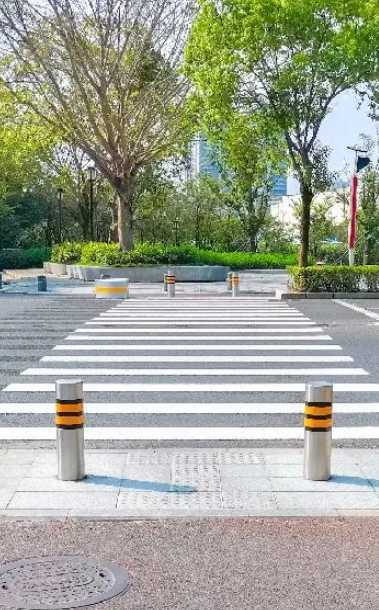
Stainless steel bollard (model T040): Grade 304 cylindrical form with embedded or flange-mounted installation, used where a barrier package reaches public-space access control.
Application Fit Across the Project Lifecycle
On construction sites, standardized construction-site safety equipment covers model-specific site protection rather than a single generic fence: mesh and vertical-bar excavation edge guardrail, safety access tunnel, rebar processing shelter including a double-centre-column large-span variant, electrical distribution box shelter, threading machine shelter, rebar storage rack, modular stair tower and worker rest and drinking shelter. These are passive, temporarily installed structures used throughout the project phase, and they are matched to site equipment such as rebar processing machines, distribution boxes, lighting and warning signs.
At the site boundary, prefabricated steel construction hoarding encloses and visually screens the work area or provides a designated display surface, with the vertical green wall and artificial greenery variants adding a planted façade to a temporary boundary. Excavation edge guardrail within the same family guards excavation edges where the site safety design specifies it.
On industrial sites, workshop safety partition separates designated work zones, and the Y067 configuration combines a steel tube frame with welded steel mesh panels that keep visibility clear for visual monitoring of robot workcell operations. Perimeter security is handled separately by security fence mesh, where the recorded function is to delineate boundaries and deter climbing, with detection and access control provided as separate equipment.
On buildings, balconies, staircases and window openings form the third phase of the same package. Balcony railing model Y056 combines round and square stainless steel tubes with a brushed finish and low maintenance requirement, while model Y052 uses a weld-free modular zinc-steel structure that does not require welding during installation. Stair railing model Y060 uses a standard vertical-bar structure with a stain-resistant, easy-to-clean stainless steel surface suited to high-traffic areas, and model Y059 includes a fully welded assembly, a thickened handrail profile and rounded edges for use by children and elderly users. Prefabricated window guard railing is assembled on site with bolted connections. Finally, bollards and parking barriers define access boundaries at sidewalk entrances, plazas and parking areas, with model T040 preventing unauthorized vehicle access to pedestrian zones.
Market Signals Shaping Long-Term Barrier Procurement
Several published market figures frame why continuity evaluation is becoming more formal. The global barrier systems market, covering safety gates, crash barrier systems and safety fences, was valued at USD 24.8 billion in 2025 according to Grand View Research, and the same source reports that the metal segment accounted for the largest material market share at over 50.0% in that year. The global temporary guardrail market was valued at USD 2.4 billion in 2024, again per Grand View Research. Separately, Dataintelo projects a 9.2% CAGR for the smart road barrier market from 2025 to 2034.
Taken together, these figures suggest two parallel forces. Metal construction remains the dominant material base, which keeps steel sourcing, coating quality and replacement-part availability central to procurement. At the same time, growth is forecast in barrier segments that incorporate monitoring and warning functions — for example, lane separation guardrail with a solar warning end that charges during the day and illuminates automatically at night, and hollow-post lane separation guardrail that reserves internal routing space for future lighting or signalling equipment. A supplier that designs for later additions, rather than treating the barrier as a finished object, is better positioned for that shift. For context on market structure, Hill & Smith PLC is identified as a major participant in the global barrier systems market.
Comparison With Traditional Solutions, and the Limits Buyers Should Accept
Compared with masonry boundary walls, prefabricated steel hoarding is designed for modular assembly, phased installation and reuse, and Santian's product documentation states that the lifecycle cost of this steel hoarding system is lower than that of masonry walls. A masonry wall is permanent, monolithic and does not need a drawing register to be reconstructed, but it is also slow to reposition when a work front moves and difficult to reuse on a second project.
That comparison has clear boundaries, and buyers should not read it as a universal advantage. Several limits are explicit in the product and scenario records:
- Construction hoarding in the Y073–Y084 range carries a design service life recorded as up to five years. It is intended for medium- and long-term projects, not permanent boundaries.
- Replacement compatibility depends on drawings, material grade and fastener records. Without them, matching a custom section years later is not guaranteed.
- Crash barrier performance depends on the verified complete system configuration, and end terminals, transition sections and cushions should not be assumed interchangeable across systems.
- Pedestrian guardrail, workshop partition mesh and riverside guardrail are edge-guarding or separation products, not vehicle restraint, machine-safety or flood-control systems.
- Most specifications across all families are custom, which means there is no fixed catalogue size that a different supplier can be measured against.
- Service life depends on material, coating system, climate, installation quality and maintenance frequency, so no single figure applies across a mixed package.
Future Outlook
Long-term supplier evaluation in this category is likely to move further toward documentation rather than product lists. As more barrier segments add warning, monitoring or routing provisions, the cost of changing supplier mid-project rises, because the replacement must match not only dimensions but also prepared interfaces and reserved internal space. Modular and reusable systems, prefabricated bolted assemblies that avoid on-site welding, and factory-prefabricated components sized from measured openings all point in the same direction: the supplier that keeps a durable record of what it built will be easier to keep than to replace.
FAQ
What information should be confirmed before ordering custom steel guardrails and railings?
Buyers should confirm the application, dimensions, material, surface treatment, safety requirements, quantity, installation environment and applicable standards. For a quotation, the required inputs are the product type, dimensions, total quantity, material, surface finish, drawings, installation location, applicable standards, delivery destination and packaging requirements. Site photographs are useful when drawings are unavailable.
Which products in a hoarding-to-bollards package require a crash-rated system, and which do not?
Vehicle restraint systems are governed by standards such as EN 1317 in the European Union and AASHTO MASH 2016 for new permanent roadside hardware in the United States. These apply to crash barriers and roadside restraint, where performance depends on the verified configuration of the complete installed assembly, including compatible end treatments. Pedestrian guardrail, construction hoarding, workshop partitions, building-edge railings and bollards fall outside that scope and should not be presented as crash-rated substitutes.
Can a damaged guardrail section be replaced independently after several years?
Usually yes, if compatible posts, rails and fasteners are available. The surrounding structure and foundation must be inspected before the new section is installed. The standard sequence is to isolate the area and document the damage, inspect adjacent posts, rails, anchors and foundations, confirm the replacement component model, dimensions and material, support the damaged section, remove only the damaged components, install the compatible replacement, then adjust alignment, tighten connections and complete a final safety inspection.
What quality-control evidence should a long-term supplier be able to provide?
A documented sequence covering incoming material inspection, dimensional inspection, welding inspection, coating inspection, in-process quality control and final pre-shipment inspection is the baseline. For custom fabricated sections, additional evidence may include drawing-based fabrication, design-for-manufacture review before fabrication, dimensional tolerance validation against approved drawings before volume production, material certificates and inspection records, batch traceability, pre-production samples for project approval, trial orders, and availability for third-party factory audit and supplier qualification.
What determines how long an outdoor steel barrier lasts?
Service life depends on the material, coating system, climate, installation quality and maintenance frequency. Stainless steel and properly galvanized steel generally provide reliable long-term outdoor performance when correctly specified and maintained. For construction hoarding in the Y073–Y084 range, the recorded design service life is up to five years, which reflects its role as a medium- to long-term temporary structure rather than a permanent boundary.
How should galvanized steel guardrails be inspected and maintained?
Inspect posts, rails, welds, bolts and connection points for loosening, corrosion, cracking, deformation and coating damage. Check foundations and anchor bolts for movement. Clean dirt, salts and chemical deposits from the surface, tighten loose fasteners and repair minor coating damage promptly. Record defects and arrange replacement of severely damaged components, rather than straightening deformed structural parts for reuse.
The full Santian product and capability brochure, including model ranges and specification records, is available for download: Santian product brochure (PDF).