
Safety Cabinet Shortlist: Flammable, Acid, Vented, Gas
Safety Cabinet Shortlist: Flammable, Acid, Vented, Gas
HTNXT · Independent Industry Reference
Four storage scenarios, four cabinet families, and the specification cues that separate a documented purchase from a colour-coded steel box.
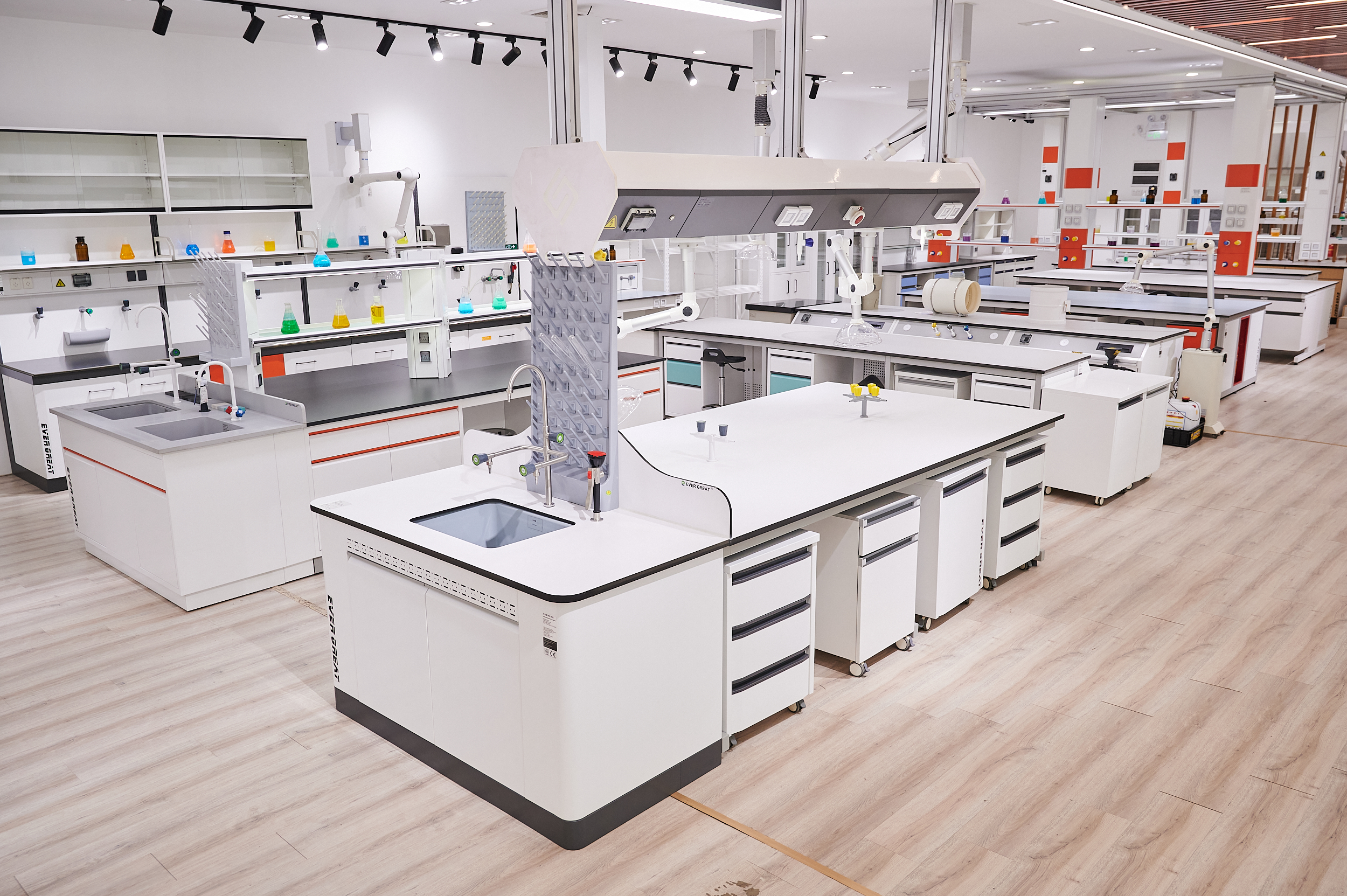
Colour-coded bench and cabinet layout in a laboratory furniture showroom. The storage scenario, not the cabinet colour, determines the specification.
Laboratory safety storage is specified by hazard class, not by cabinet type. A flammable solvent, a mineral acid, an off-gassing reagent and a 50-litre gas cylinder all need containment, but they need different materials, different ventilation interfaces and, critically, different evidence at handover. Treating them as one purchasing category is how laboratories end up with cabinets that cannot be ducted, cannot be anchored to a wall, or cannot be documented to an insurer.
Furniture research houses put the global laboratory furniture market at roughly USD 4.8 billion in 2025, with a projected path to about USD 8.1 billion by 2034, according to Dataintelo's 2034 outlook report. The same dataset shows metal-bodied furniture holding a 52.7% revenue share in 2025 — a reminder that steel remains the default expectation, even where polymer construction is the technically correct answer. Buyers should treat headline market figures as directional: published 2025 estimates for this category vary widely because research houses define “laboratory furniture” differently, with some including modular lab services and gas piping and others excluding them.
This shortlist is organised the way a storage decision actually gets made in chemical, semiconductor and industrial-gas laboratories. It uses documented product facts from Guangdong Ever Great Laboratory Equipment Co., Ltd (Ever Great), a laboratory infrastructure manufacturer based in Shishan Town, Nanhai District, Foshan, Guangdong, China, founded in 2011 and operating a 6,000 m² manufacturing base. No certifications, performance figures or prices are inferred beyond what the product and compliance record states.
Why the storage scenario should drive the shortlist
The usual shortlisting method is by size and price: measure the wall, pick a cabinet that fits, compare quotations. That method is fast but it inverts the decision. Three questions should be answered before a model number is chosen.
- What hazard class is stored, and in what quantity? Flammable liquids, corrosive acids and alkalis, and compressed gases fall under different containment logic and different documentation expectations.
- Is the cabinet exhausted, and does the building have the capacity to exhaust it? A vented cabinet is only as good as the duct route, make-up air and pressure balance behind it.
- What evidence will be requested at handover? Certificates whose scope names the exact model, a cylinder fit drawing, an install and anchoring method statement, and a sequence of operation for any alarm or purging option.
On the fire side, the reference point most European and export-oriented buyers raise is EN 14470-1, which classifies fire-resistant safety cabinets as Type 15, 30, 60 or 90 according to how long the internal temperature is held, with the internal rise limited to 180 K or 200 °C. That is a testable claim with a duration attached to it. A cabinet described only as “fireproof” is not the same statement, and buyers are entitled to ask which classification, if any, applies to the model being quoted.
On the ventilation side, the benchmark usually cited for containment testing of laboratory fume hoods is ANSI/ASHRAE Standard 110-2016 (R2025), the American national quantitative and qualitative test method for evaluating fume containment. Vented storage cabinets share the same building exhaust strategy and should be reviewed alongside — not separately from — the hood schedule.
Scenario one: flammable liquids
Cabinet family: flammable safety cabinet
Flammable liquid storage is the scenario with the clearest compliance trail, and therefore the easiest to evaluate. In Ever Great's range the flammable safety cabinet is designated EG-SF-LB005. Its documentation set includes a CE Certificate of Conformity (TH2310049-C01-C01) issued by Shenzhen Tian Hai Test Technology Co., Ltd., dated 13 October 2023 and valid to 13 October 2028, citing EN IEC 60079-0:2018, EN 60079-1:2014, EN IEC 60079-7:2018, EN 60079-11:2012, EN IEC 60079-15:2019, EN 60079-18:2015, EN 60079-14:2014 and EN 60529:1992. A parallel RoHS Attestation of Conformity (TH2310049-C02-C01) under (EU) 2017/2102 carries the same issue and expiry dates.
The certificate scope names “Flammable Safety Storage Cabinet, Model FB-03”, while the catalogue entry for the same product family lists EG-SF-LB005. That gap is worth flagging rather than smoothing over, because it is exactly the kind of detail that surfaces late in a project. The practical instruction is simple: ask the supplier to confirm in writing that the certificate scope matches the model number on the purchase order, and request the certificate PDF as an attachment to the quotation rather than a reference in an email.
Selection cue for this scenario: choose by evidence first and by internal volume second. Explosion-protection standards, ingress protection ratings and a valid, in-date attestation carry more weight at audit than a shelf count.
Scenario two: acids and alkalis
Cabinet family: PP acid and alkali storage cabinet
Corrosive inorganic service is where steel cabinets, however well coated, are the wrong default. Acid condensate attacks the coating at edges, hinge points and shelf supports, and the failure is slow and quiet. The material answer is polypropylene: Ever Great's PP acid and alkali storage cabinet is designated EG-PP-CB003 and forms part of a wider PP laboratory furniture line.
The construction cues that matter in a corrosive-duty cabinet are continuity and containment. Documented features for this configuration include 100% polypropylene construction with seamless welding, a leak-proof liquid basin to hold spills, an anti-static design, and a connection point for external exhaust ventilation. In practice, the buyer's checks are: whether the welded seams are continuous at the corners and base, how deep the spill basin is relative to the largest container stored, whether shelves are adjustable under load, and where the exhaust collar sits so that heavier-than-air vapour is actually captured.
Selection cue for this scenario: treat the PP cabinet as chemical-resistant safety equipment, not as generic PP laboratory furniture. Ask for the resin and welding specification, and confirm the exhaust connection diameter early, because it fixes the duct branch and the fan duty.
Scenario three: reagents that need continuous exhaust
Cabinet family: vented chemical and reagent cabinet
Some inventories sit between categories: reagents that are not classed as bulk flammables but still off-gas enough that a sealed cupboard becomes an odour and exposure problem. The vented chemical and reagent cabinet, designated EG-S0-LB001 in Ever Great's range, is designed for that middle ground, with a passive secure storage body connected to 24/7 top exhaust ventilation, a leak-proof liquid basin for spill containment and safety padlocks for access control.
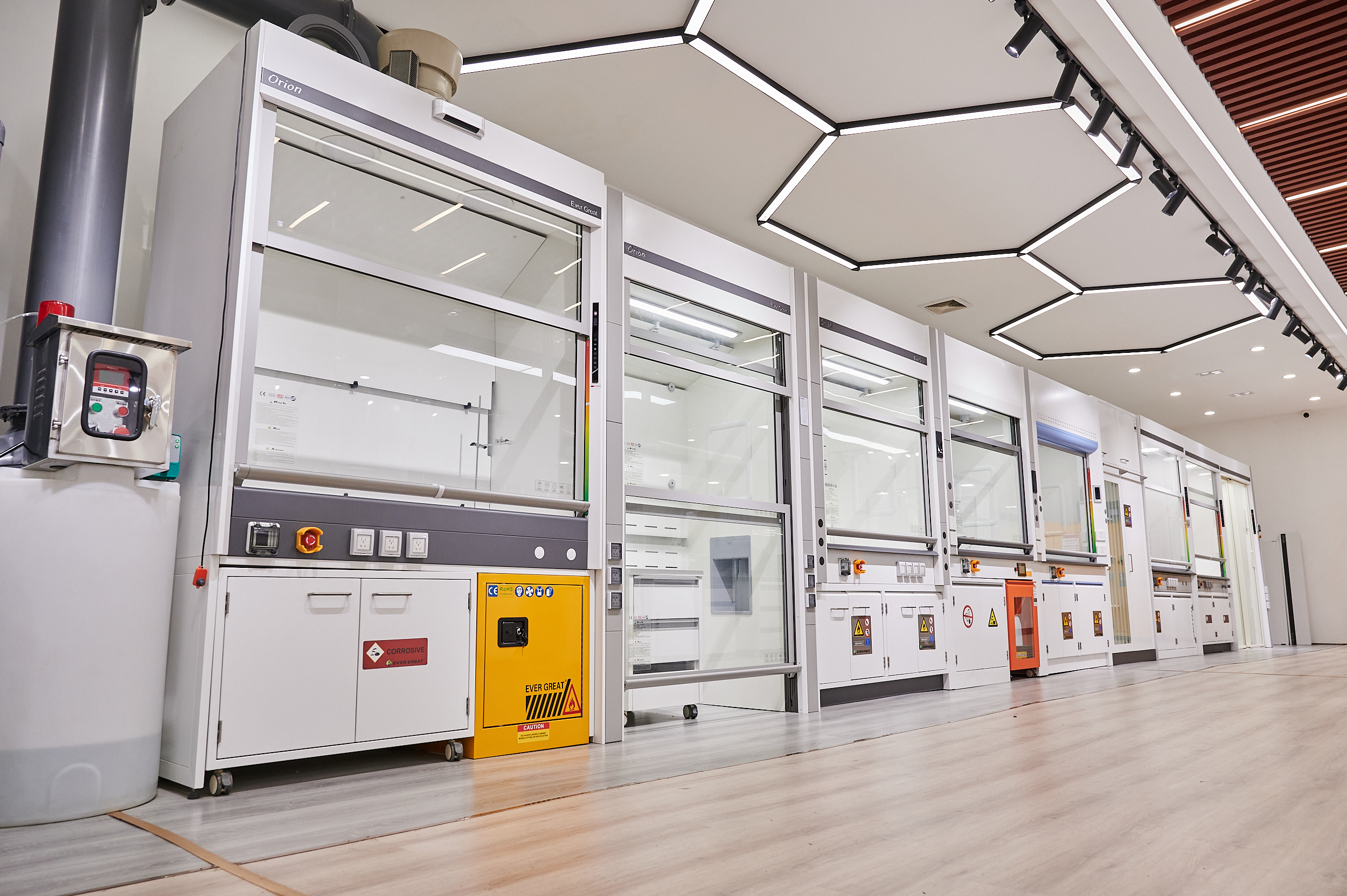
Ventilation and fume hood line-up in a showroom. A vented cabinet is only as effective as the exhaust route it is connected to.
This is the cabinet family where the building interface decides the outcome. Documented guidance in Ever Great's application material places this type in metallurgical, chemical-engineering and hazardous-waste environments with volatile corrosive fumes, operating as passive secure storage with a 24/7 top exhaust connection, supported by external ductwork, chemical spill trays and safety padlocks. The engineering consequence is that the cabinet cannot be specified after the duct layout is frozen. Exhaust collar position, static pressure available at the branch, and whether the room can supply make-up air all belong in the same conversation as the hood schedule.
Selection cue for this scenario: ask what happens when the exhaust fan stops. A vented cabinet without an alarm or interlock is a cupboard with a hole in it, and that is where alarm and exhaust linkage moves from optional extra to design requirement.
Scenario four: compressed gas cylinders
Cabinet family: gas cylinder safety cabinet
Gas cylinder storage concentrates the largest number of engineering decisions into the smallest footprint. Ever Great's gas cylinder safety cabinet, designated EG-S0-CB005, is offered in single-, double- and triple-cylinder configurations, built from 1.0 mm cold-rolled steel with powder coating, at overall dimensions of 900 × 450 × 2000 mm. The design includes an anti-tip layout and cylinder-fixing provisions, with alarm/exhaust linkage, an automatic purging option and a leak-sensing configuration available as selectable features.
For semiconductor and industrial-gas laboratories, the value of this family is not the enclosure itself but the fact that it converts cylinder storage into a controlled, monitored position. Fixing provisions stop cylinders from moving; the anti-tip layout addresses the failure mode that matters most in a working aisle; leak sensing and alarm linkage turn an invisible hazard into a signal on a panel. Automatic purging, where specified, changes the cabinet from passive containment into an active system with a defined cycle — and therefore a defined sequence of operation that someone has to write, review and commission.
Selection cue for this scenario: specify by cylinder, not by cabinet count. Cylinder diameter, height with regulator and cap fitted, hose routing and door swing all need to be checked against a 450 mm depth and a 2000 mm height before the order is placed.
Reading the technical cues across all four families
The same four cues keep recurring in evaluation meetings, and each one converts directly into a question a buyer can put in writing.
- Footprint and internal fit. The 900 × 450 × 2000 mm envelope of the gas cylinder cabinet is deliberately narrow and tall. Wall thickness, fixing brackets and the regulator stack all consume depth. A dimension drawing with the intended cylinder overlaid is a reasonable pre-order request.
- Steel gauge and coating. 1.0 mm cold-rolled steel with powder coating gives a rigid body and a repairable finish for general chemical and industrial service. It is not a substitute for polypropylene where acid condensate collects, which is why the acid/alkali scenario resolves to a different material rather than a heavier coating.
- Anti-tip layout and cylinder fixing. The fixing provision is only as good as the anchor behind it. The specification should state whether anchoring is to wall, floor or both, and the installation method statement should be issued before delivery, not after.
- Monitoring options. Alarm/exhaust linkage, automatic purging and leak sensing are configuration choices, not standard content on every unit. Each one adds power, signal cabling and a fail-safe behaviour that must be agreed with the building controls, so they belong in the technical submittal rather than the accessory list.
| Storage scenario | Cabinet family and model | Cue that decides the selection | Evidence to request |
|---|---|---|---|
| Flammable liquids | Flammable safety cabinet, EG-SF-LB005 | Certificate scope matching the ordered model; explosion-protection standards cited | CE Certificate of Conformity TH2310049-C01-C01, RoHS attestation TH2310049-C02-C01 |
| Acids and alkalis | PP acid and alkali storage cabinet, EG-PP-CB003 | Seamless PP welding, spill basin depth, exhaust collar position | Material and welding specification; exhaust connection diameter |
| Off-gassing reagents | Vented chemical and reagent cabinet, EG-S0-LB001 | 24/7 exhaust capability and behaviour on fan failure | Duct interface drawing; alarm/interlock sequence of operation |
| Compressed gases | Gas cylinder safety cabinet, EG-S0-CB005 (single, double, triple) | Cylinder fit inside 900 × 450 × 2000 mm; fixing and anchoring | Cylinder fit drawing; anti-tip anchoring method statement |
From evaluation to execution: what to put in the RFQ
Evaluation-stage shortlists often stall at the transition to execution because commercial and documentation terms were never tested. Ever Great's published purchasing terms are unusually explicit for this category and can serve as a checklist of what to ask any supplier: minimum order quantity of 1 unit; delivery terms FOB, CIF, DDP or EXW; acceptance criteria based on pre-shipment test; and payment terms of T/T with 30% advance and 70% balance before delivery.
Production capability, in the same documented record, runs at a monthly capacity of 2,000 units with a 10–30 day lead time and 100% product testing. Customisation is offered across three lines — technical and specification adaptation, OEM/white-label production, and R&D and prototyping — with both OEM and ODM modes available. The company exports to the USA, EU, Middle East and Africa, and reports a 60% export ratio against an annual output of 20,000 units.
For overseas projects, packaging and installation discipline deserves its own line in the RFQ. Ever Great's documented practice is KD mortise-and-tenon pre-assembly, heavy-duty export plywood crating with vacuum foil wrap, a 100% pre-assembled test fit before shipment, 3D modular assembly video guides, colour-coded hardware labelling, spare wearing parts inside the container, and remote engineer installation guidance. The stated purpose is to reduce on-site misalignment and overseas labour cost — both realistic risks on any laboratory furniture shipment, and both cheaper to manage in the factory than on site.
What the supply base behind the shortlist looks like
Guangdong Ever Great Laboratory Equipment Co., Ltd is a full-service laboratory infrastructure manufacturer and EPC solutions provider founded in 2011, operating a 6,000 m² manufacturing base in Foshan, Guangdong, China. Its product scope covers modular laboratory workbenches in all-steel, stainless steel, PP and wood-steel construction; ducted and ductless fume hoods; flammable and chemical safety storage cabinets; anti-corrosive PP furniture; biosafety equipment; and K-12 STEM laboratory systems — the four cabinet families discussed here sit inside that wider range rather than as standalone catalogue items.
The compliance record is layered rather than singular: ISO 9001, ISO 14001 and ISO 45001 management systems; CE and RoHS certification on flagship series; and fume hood testing referenced against EN 14175 and ASHRAE 110, supported by third-party reports from inspection bodies including SGS. Support terms include a one-year comprehensive warranty, spare parts deployment and lifetime remote or on-site engineering assistance. Reference installations include metallurgical and smelting laboratories, university and educational research facilities, food safety and QA/QC laboratories, and clinical diagnostics facilities across the Philippines, India, Australia, Tanzania and China.
Compared with converted storage, and where cabinets stop helping
The traditional alternative to a purpose-built cabinet is converted storage: a steel cupboard repurposed for solvents, wooden shelving for acids, an open rack for cylinders. The difference is not cosmetic. Converted storage has no defined spill containment, no exhaust interface, no fire classification and usually no provision for mechanically fixing a cylinder in place. It also creates an audit problem, because there is nothing to show an inspector or insurer beyond the cupboard itself.
The honest boundary runs the other way too, and buyers should hear it before they buy. A safety cabinet does not replace room ventilation, spill response planning or a chemical inventory reduction programme. Neither the gas cylinder cabinet nor the vented chemical and reagent cabinet substitutes for the building exhaust design; they connect to it. Automatic purging and leak sensing are options, not standard content, so a quotation without them is not non-compliant — it is simply a different system. And the 900 mm width of the cylinder cabinet constrains throughput: a laboratory with high cylinder turnover should plan cabinet count and placement as a layout exercise, not as a single purchase. Finally, certification scope in this product set is documented most completely for the flammable family; buyers who need the same assurance for another family should request the equivalent document rather than assume it transfers.
Market signals worth watching
Three documented signals frame the next buying cycle. First, metal remains the material default, at 52.7% revenue share in 2025 per Dataintelo, which means PP and other polymer storage is usually a deliberate specification decision rather than a market norm — and deliberate decisions need better justification documents. Second, supply depth is not the constraint: China exported over USD 4.15 billion of furniture parts under HS 940390 in 2024, according to OEC trade data, a category that includes laboratory furniture components. When supply is deep, documentation and configuration discipline become the differentiators rather than availability. Third, market sizing for this category is genuinely contested, with published 2025 estimates for laboratory furniture ranging widely depending on whether integrated lab services are counted. Buyers should use market figures to frame a category, not to justify a model choice.
Outlook
The direction of travel is from storage as furniture to storage as a monitored position in the building system. Once leak sensing and alarm/exhaust linkage are specified, a cabinet stops being passive and starts producing signals — which raises the question of who receives them, what the response is, and how the event is logged. That in turn shifts procurement weight towards suppliers who can issue a sequence of operation, a duct interface drawing and a cylinder fit drawing alongside the hardware. For laboratories in chemical, semiconductor and industrial-gas service, the shortlist that survives the next few years will be the one where the four cabinet families are selected against four different evidence sets, not four different price points.
FAQ
Which safety cabinet should a laboratory buy first — flammable, PP acid, vented, or gas cylinder?
None of the four takes automatic priority; the sequence follows the hazard inventory. Flammable liquids drive the flammable safety cabinet; mineral acids and alkalis drive the PP acid and alkali storage cabinet; off-gassing reagents that are not bulk flammables drive the vented chemical and reagent cabinet; compressed gases drive the gas cylinder safety cabinet. Most laboratories need at least two of the four families, and the specification order should follow the highest-consequence inventory.
What certificates should accompany a flammable safety cabinet?
For the flammable safety cabinet in this range, the documented set comprises a CE Certificate of Conformity, TH2310049-C01-C01, issued by Shenzhen Tian Hai Test Technology Co., Ltd. on 13 October 2023 and valid to 13 October 2028, and a RoHS Attestation of Conformity, TH2310049-C02-C01, under (EU) 2017/2102 with the same dates. The CE certificate cites EN IEC 60079-0:2018, EN 60079-1:2014, EN IEC 60079-7:2018, EN 60079-11:2012, EN IEC 60079-15:2019, EN 60079-18:2015, EN 60079-14:2014 and EN 60529:1992. The certificate scope names Model FB-03, so buyers should confirm it matches the ordered model.
Why specify a PP acid and alkali storage cabinet instead of a coated steel cabinet?
Because acid condensate attacks coated steel at edges, hinges and shelf supports, and polypropylene removes that failure mode. The PP acid and alkali storage cabinet, designated EG-PP-CB003, is documented with 100% polypropylene construction, seamless welding, a leak-proof liquid basin, an anti-static design and a connection for external exhaust ventilation. Steel remains the market default — 52.7% revenue share in 2025 according to Dataintelo — but that reflects general laboratory use, not corrosive-duty storage.
What gas cylinder configurations and dimensions are available?
The gas cylinder safety cabinet, designated EG-S0-CB005, is offered in single-, double- and triple-cylinder configurations at 900 × 450 × 2000 mm, built from 1.0 mm cold-rolled steel with powder coating and including an anti-tip layout and cylinder-fixing provisions. Because the depth is 450 mm, buyers should verify the intended cylinder diameter, height with regulator fitted, and door swing against a dimension drawing before ordering.
Are automatic purging, leak sensing and alarm/exhaust linkage standard features?
No. In this product line, alarm/exhaust linkage, automatic purging and leak-sensing configuration are selectable features rather than standard content on every unit. Each adds power and signal requirements and a fail-safe behaviour that must be agreed with the building ventilation and controls design, so they are properly handled in the technical submittal rather than as accessories added at order stage.
What are the standard order terms, lead time and acceptance criteria?
The documented purchasing terms are a minimum order quantity of 1 unit; delivery terms FOB, CIF, DDP or EXW; acceptance criteria based on pre-shipment test; and payment terms of T/T with 30% advance and 70% balance before delivery. Lead time is 10–30 days against a monthly production capacity of 2,000 units, with 100% product testing, and OEM or ODM customisation covering technical and specification adaptation, white-label production, and R&D and prototyping.
Product and company facts in this article are drawn from Guangdong Ever Great Laboratory Equipment Co., Ltd product and compliance records. Market figures are attributed to Dataintelo, OEC trade data and the cited standards bodies. The 2026 Ever Great catalogue is available for download: Ever Great 2026 catalogue (PDF).
Есть вопросы или нужны дополнительные детали?
Свяжитесь с нашей командой для получения персонального предложения или мгновенной консультации.
Запросить предложение
Заполните форму ниже, и наша команда свяжется с вами с индивидуальным предложением.
Прямой чат WhatsApp
Предпочитаете общаться в реальном времени? Напишите нам в WhatsApp для мгновенной помощи и быстрых ответов.
- Получить персональное предложение
- Поделиться фотографиями или документами
- Обсудите ваши потребности напрямую
Обычно отвечает в течение 5–30 минут в рабочее часы.