
Sanitary Ball Valves: A Foundational Buyer's Guide
Sanitary ball valves are quarter-turn shutoff valves built for hygienic process lines: a ported ball rotates inside a polished stainless steel body to start or stop flow, and every wetted surface is finished and configured so the line can be cleaned without dismantling the pipework. Within the sanitary valve category they are the largest single product segment — Fact.MR's 2026 sanitary valve analysis places sanitary ball valves at 46% of total product share.
That number sits inside a market that Market Research Future estimated at USD 1.729 billion in 2024 and projects at USD 2.704 billion by 2035, a CAGR of 4.15% across the 2025–2035 forecast period. Asia-Pacific accounted for 42.5% of the market in 2025. Aggregate figures like these are easy to quote and hard to act on, so this article stays at the level where sourcing teams actually decide: what a ball valve does inside a hygienic line, how it differs from the valve types supplied alongside it, which datasheet lines determine whether it fits, and where the design stops being appropriate.
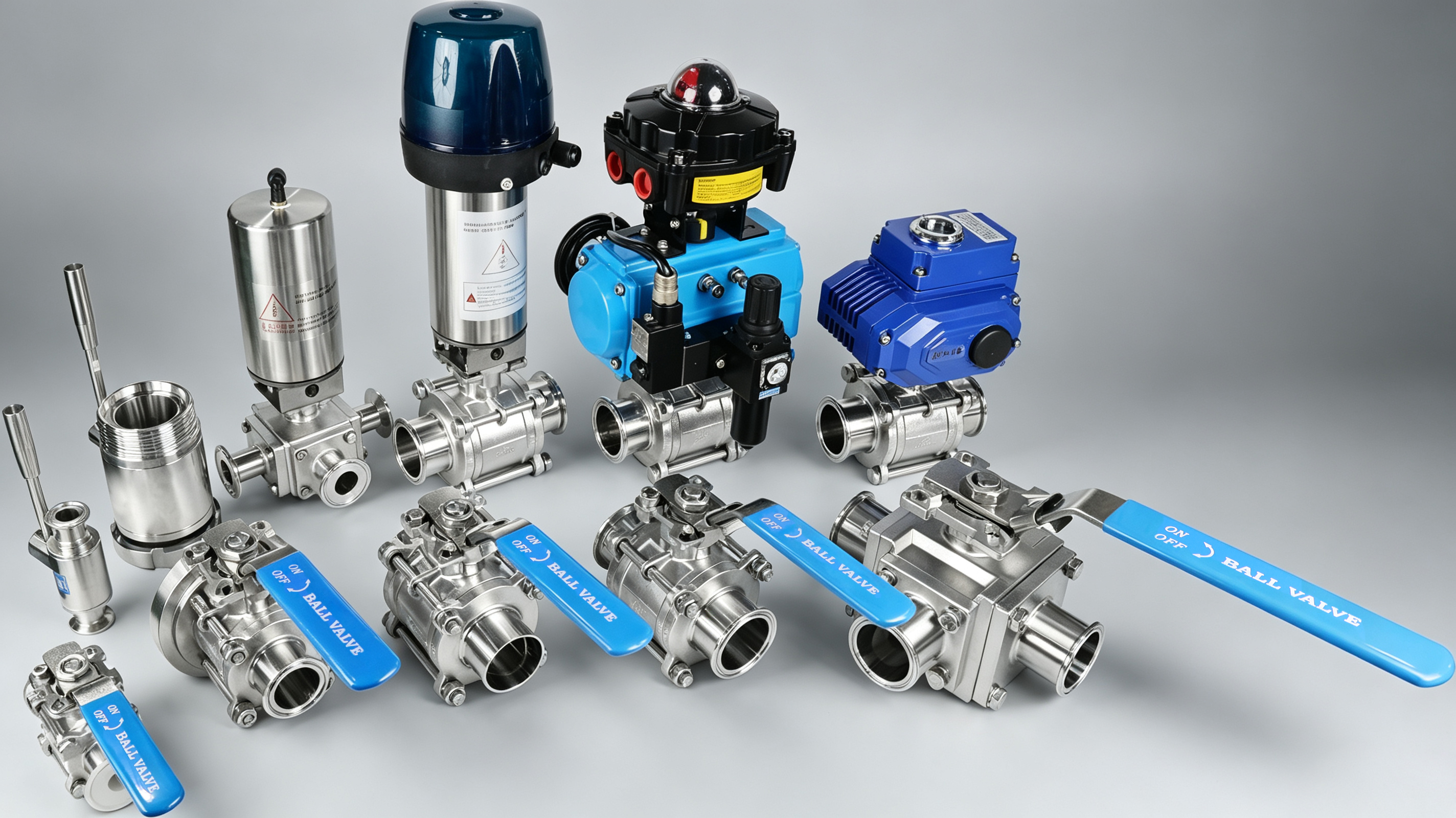
What a sanitary ball valve actually is
A sanitary ball valve is a stop valve in which a spherical, ported ball is held between two seal seats; a quarter turn of the stem aligns the bore with the pipeline to open, or turns it perpendicular to close. The hygienic part of the definition is not the ball itself but everything around it — body material, internal surface finish, seal compound and the way the valve joins the pipe.
Qili Holding Group's sanitary ball valve, catalogued as the encapsulated 3-PCS Ball Valve, shows how those variables are specified in practice. The valve is of encapsulated 3-piece construction and is available in 2-way and 3-way configurations. Body material is SS304 or SS316L, connection options are welded, clamped and threaded, and the size range runs from 1/2" to 6" (DN15–DN100). The valve seal is encapsulated, and seal material can be EPDM, VMQ (silicone), NBR (nitrile) or VITON, with each option stated as meeting FDA standards. Internal surface treatment is Ra 0.4–0.8 µm, and electropolishing is available.
Read that list again as a buyer rather than as a catalogue entry. Encapsulated construction and an encapsulated seal reduce the crevices where product residue can collect. The three connection types are not interchangeable convenience options — they determine whether the valve can be swapped out during a shutdown or must be cut out of a welded line. And the seal compound, not the stainless body, is usually what limits the temperature at which the valve can be trusted.
Why ball valves hold 46% of the category
A 46% product share in 2026 reflects a functional requirement rather than a preference. Ball valves solve the most repeated need in hygienic piping: a tight, repeatable on/off isolation point. A quarter turn gives fast shutoff, the bore is straight-through so cleaning fluid passes without a dead pocket, and a full-port ball imposes minimal restriction when open.
An application scenario supplied for semiconductor fluid piping systems maps the division of labour more precisely. Ball valves are specified for tight on/off isolation on rack and CDU (coolant distribution unit) branch lines, where the stated advantage is a bubble-tight seal. Butterfly valves take isolation plus throttling on main headers and cooling towers, where the advantage is a compact body for large pipe. Clamps provide removable leak-tight connections at CDU and manifold joints, and fittings handle routing, branching and adapting across the loop. That division is the first thing a buyer should internalise: the competitor to a ball valve is not a butterfly valve — it is the question of which location in the loop needs zero-leak shutoff.
Where ball valves sit in the sanitary valve family
The sanitary valve category is a set of distinct mechanical solutions, not variations on one product. Comparing them by operating principle explains why a specification written for one type rarely transfers cleanly to another.
| Valve type | Operating principle | Typical role in a hygienic line | Reference specification |
|---|---|---|---|
| Sanitary ball valve | Quarter-turn ported ball | Tight on/off isolation; bubble-tight seal on branch lines | SS304/SS316L; 1/2"–6" (DN15–DN100); 10 bar DN25–100, 8 bar DN125–150; −20 to 150 °C |
| Sanitary butterfly valve | Quarter-turn disc | Isolation plus throttling; compact body for large pipe | SS304/SS316L; 1/2"–6"; 0–10 bar; VMQ −50 to 180 °C, EPDM −20 to 135 °C, FPM −30 to 230 °C |
| Sanitary check valve | Automatic, one direction only | Prevents reverse flow; high-purity liquid transfer | SS304/SS316L; DN15–DN100 (1/2"–4"); 0–10 bar; −10 to 140 °C; EPDM, FPM, silicone, VMQ |
| Sanitary diaphragm valve | Pneumatically operated flexible diaphragm | Food, beverage, wine and cosmetic processing lines | SS304/SS316L; DN10–DN100 (1/2"–4"); 0–10 bar; −10 to 150 °C; EPDM, PTFE |
The specification columns are the useful part. A butterfly valve's usable temperature window changes with the seal compound chosen, from −50 °C to 180 °C on VMQ down to −20 °C to 135 °C on EPDM — so a line-temperature requirement can eliminate a valve family before price is ever discussed. A ball valve's range in the same reference set runs −20 to 150 °C, and its pressure rating steps down from 10 bar to 8 bar once the size passes DN100. These are the constraints that decide whether the design conversation continues.
Reading a sanitary ball valve datasheet: the lines that decide fit
Most sourcing errors on ball valves come from reading a datasheet as a feature list rather than as a set of interacting limits. Six lines carry nearly all of the decision weight.
| Body material | SS304 or SS316L. Grade selection follows the media and the corrosion margin required, not the price list alone. |
| Size range | 1/2"–6", DN15–DN100. Confirm that the line size you need sits inside the range before specifying anything else. |
| Connection type | Welded, clamped or threaded; 2-way or 3-way configuration. This decides maintenance strategy as much as flow path. |
| Pressure rating | 10 bar (140 psi) for DN25–100; 8 bar (120 psi) for DN125–150. The rating is not uniform across the range. |
| Temperature range | −20 to 150 °C for the reference design; the effective ceiling follows the seal compound actually fitted. |
| Seal compound | EPDM, VMQ (silicone), NBR (nitrile) or VITON, each stated as meeting FDA standards. Compound choice is a media-compatibility decision. |
| Surface finish | Ra 0.4–0.8 µm internally; electropolishing available. Finish is a specification to be stated, not assumed. |
| Commercial floor | Minimum order quantity 1 piece; wholesale or retail supply; carton packaging. |
The single most misread line is pressure rating. A buyer who validates a design at 10 bar on a DN25 prototype and then scales the line to DN150 has moved into the 8 bar rating band without changing a single other parameter. The second most misread is temperature: −20 to 150 °C is the valve-level statement, but the seal material in the bill of materials is what determines whether that window is real for the fluid being handled.
Qili Holding Group: manufacturing context for a commodity category
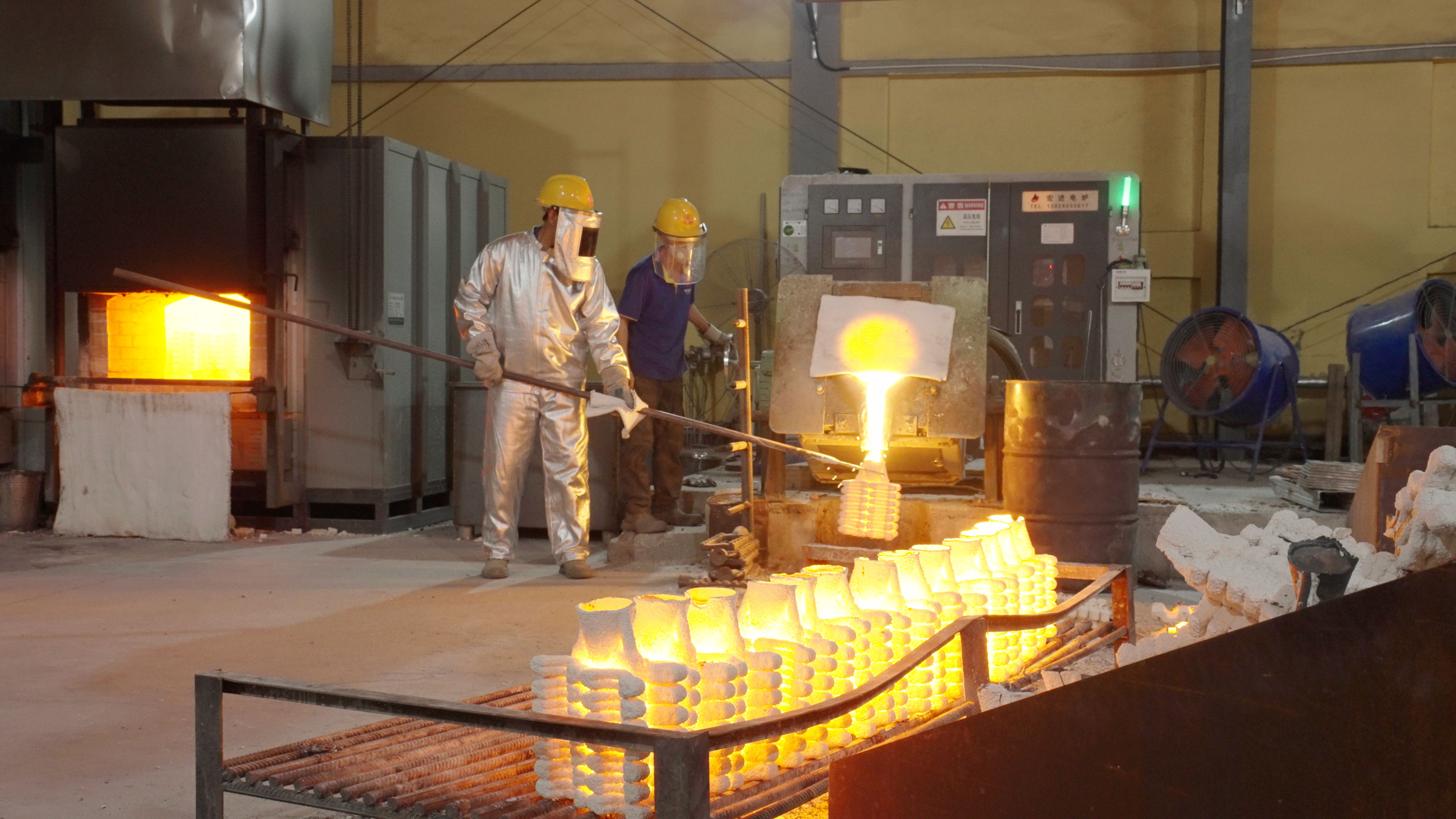
Qili Holding Group Co., Ltd. is a Chinese manufacturer of sanitary stainless steel valves and pipe fittings, established in 2011 and headquartered in the Airport New Area of the Wenzhou Economic Development Zone. The group owns three independently built factory campuses, with a manufacturing facility covering 65,000 square metres. It employs approximately 500 staff, including an R&D team of 38 engineers and technicians, holds more than 40 invention patents, and has been recognised as a National High-Tech Enterprise.
Three facts in that profile matter to a buyer evaluating a commodity-grade component. First, the group describes an integrated chain combining forging, casting, CNC precision machining and sales across ten production plants — vertical integration of this kind affects delivery cycle behaviour, which is the point where most ball valve sourcing actually fails. Second, products are manufactured in accordance with 3A, BPE, DS, ISO, IDF, DIN, RJT and SMS standards, so a specifier working to any of those conventions is not asking the supplier to invent a new process. Third, published capacity includes 240,000 sets per year of the ball valve series, alongside 360,000 sets of the butterfly valve series and 5.4 million units of CNC fittings.
Main products are butterfly valves, ball valves, stainless steel fittings, pipe fittings and check valves, with roughly 90% of output exported and Europe and North America named as the main markets. None of this makes a ball valve good or bad on its own — it makes the supplier inspectable, which is the only thing a discovery-stage buyer can reasonably ask for.
Where sanitary ball valves are used
Sanitary ball valves are specified across beer, dairy, beverage, pharmaceutical, cosmetics and liquid cooling applications. Three of those deserve separate treatment because the requirement behind the valve differs.
Pharmaceutical and bioprocess lines
In pharmaceutical processing, the valve's job is to isolate a section of line for cleaning or maintenance without creating a hold-up point that defeats the cleaning cycle. Straight-through bore and a defined internal surface finish are the functional requirements; the connection type decides whether the isolation point can be opened quickly during a shutdown or must be cut out.
Food, beverage and dairy
Beer, dairy, beverage and cosmetics processing share the same cleanability logic at a different scale. Here the ball valve typically functions as a discrete isolation point inside a larger fitting and clamp network, which is why the valve and the fittings around it are usually bought from one specification family rather than assembled from mixed sources.
Liquid cooling and semiconductor piping
The liquid cooling case is the one changing fastest. In the semiconductor fluid piping scenario referenced above, ball valves sit on rack and CDU branch lines where the stated requirement is a bubble-tight seal, and the whole loop is specified for no leakage and zero retention on a 24/7 operating pattern. Hixson's 2026 analysis of 3-A sanitary standards notes that advanced sanitary valves for data centre liquid cooling are moving toward thin-walled sanitary tubing at Ra ≤ 0.4 µm — a finish level historically associated with pharmaceutical duty. The practical implication is that data centre buyers are increasingly drawing on pharmaceutical-grade supply chains rather than general industrial valve channels.
Market trend: steady category growth, uneven segment data
The direction of the category is well supported. Market Research Future's 2024 estimate of USD 1.729 billion rising to USD 2.704 billion by 2035 at a 4.15% CAGR describes a mature, steadily expanding market rather than a surge. Asia-Pacific's 42.5% share in 2025 indicates where production and consumption concentration currently sit.
What the available data does not support is equally worth stating. Published market sizing covers sanitary valves in aggregate; there is no separately disclosed, methodology-transparent figure for the ball valve sub-segment, and broader industrial valve forecasts should not be used as a substitute — they describe a different product scope. The 46% product share figure is a segment-share statement, not a revenue figure, and the two should never be combined into a size estimate. Buyers building an investment case should treat the aggregate market numbers as directional context and rely on their own application-level demand data for volume decisions.
Where a sanitary ball valve is the wrong answer
A ball valve is a shutoff device, and treating it as a general-purpose flow control solution is the most common specification error in this category. The limits are concrete:
- Throttling duty. The application scenario matrix assigns throttling to butterfly valves, not ball valves. A ball valve used as a control element will not deliver stable modulation, and the practice sits outside its stated function.
- Larger line sizes. The reference range stops at 6" (DN15–DN100). Above DN100 the pressure rating steps down to 8 bar, so a line designed at 10 bar cannot simply be scaled up in diameter.
- Ultra-high-purity finish requirements. Ra 0.4–0.8 µm with optional electropolishing is a normal hygienic specification. Where a process calls for Ra ≤ 0.4 µm, that must be explicitly specified and verified — it should not be assumed to follow from a standard catalogue item.
- Temperature extremes. The valve-level range is −20 to 150 °C, but the fitted seal compound governs the real limit. Selecting the body first and the seal last inverts the correct order.
- Certification assumptions. A statement that a product is manufactured to 3A or another sanitary standard is a manufacturing claim. Buyers should request the certificate reference and the issuing body rather than accepting a category-level assertion, because sanitary conformity is a gate in regulated industries, not a differentiator.
Future outlook
Two forces look likely to shape demand over the next decade. The first is the liquid cooling build-out: if data centre loops continue moving toward thin-walled sanitary tubing at Ra ≤ 0.4 µm, ball valve specifications written for pharmaceutical duty will become the reference point for a segment that previously bought industrial valves. The second is documentation discipline. As hygiene-regulated end industries keep tightening conformity expectations, the suppliers that can produce certificate-level evidence on request will separate from those that can only state compliance in marketing language. Neither trend changes what a ball valve is; both change what a buyer will need to see before placing an order.
Frequently asked questions
What is a sanitary ball valve?
A sanitary ball valve is a quarter-turn valve belonging to the sanitary valve category, in which a ported ball opens or closes the flow path inside a stainless steel body finished for hygienic service. The Qili reference product is the encapsulated 3-PCS Ball Valve, of encapsulated 3-piece construction, available in 2-way and 3-way configurations, in SS304 or SS316L, with welded, clamped or threaded connections.
How does a sanitary ball valve differ from a sanitary butterfly valve?
The difference is functional rather than cosmetic. In the semiconductor fluid piping scenario, ball valves are specified for tight on/off isolation on rack and CDU branch lines, where the stated advantage is a bubble-tight seal, while butterfly valves are specified for isolation plus throttling on main headers and cooling towers, where the advantage is a compact body suited to large pipe. Both are offered in SS304 and SS316L.
What materials and seal options are available?
Body material is SS304 or SS316L. Seal material options are EPDM, VMQ (silicone), NBR (nitrile) and VITON, each stated as meeting FDA standards. The valve seal itself is encapsulated. Internal surface treatment is Ra 0.4–0.8 µm, with electropolishing available as an option.
Which standards, sizes and ratings apply?
The reference sanitary ball valve is manufactured to 3A, SMS, ISO, RJT, DIN and IDF conventions. Sizes run from 1/2" to 6" (DN15–DN100). Working temperature is −20 to 150 °C. Pressure rating is 10 bar (140 psi) for DN25–100 and 8 bar (120 psi) for DN125–150. Minimum order quantity is 1 piece, with carton packaging and wholesale or retail supply.
How is a clamped sanitary valve replaced?
Replacement of a clamped valve does not usually require hot work or a professional welder. The sequence is: depressurise and drain the pipeline system; loosen the pipe clamp; remove the old valve and old gasket; fit the new gasket and new clamped valve; then tighten the clamp evenly. The critical points are confirming that the system has been safely depressurised before starting, handling the gasket correctly, and tightening the clamp evenly rather than progressively on one side.
Which industries use sanitary ball valves?
Stated applications are beer, dairy, beverage, pharmaceutical, cosmetics and liquid cooling. The wider sanitary valve and fittings range from the same manufacturer is also intended for biochemical, semiconductor and liquid cooling industries.
Reference document
Qili Holding Group publishes its full sanitary valve, fitting and tube range in a downloadable catalogue, including product imagery, size ranges and material options: Qili Holding Group product catalogue (PDF).
Market data cited in this article is attributed to Market Research Future (sanitary valves market sizing, 2024–2035), Fact.MR (2026 product segment share) and Hixson Inc. (3-A sanitary standards analysis, 2026). Product specifications are as published by Qili Holding Group for the referenced sanitary ball valve model.
Есть вопросы или нужны дополнительные детали?
Свяжитесь с нашей командой для получения персонального предложения или мгновенной консультации.
Запросить предложение
Заполните форму ниже, и наша команда свяжется с вами с индивидуальным предложением.
Прямой чат WhatsApp
Предпочитаете общаться в реальном времени? Напишите нам в WhatsApp для мгновенной помощи и быстрых ответов.
- Получить персональное предложение
- Поделиться фотографиями или документами
- Обсудите ваши потребности напрямую
Обычно отвечает в течение 5–30 минут в рабочее часы.