
Sanitary Check Valves: What Certification Constraints Matter
A sanitary check valve is a one-way flow-control component for hygienic process lines. In pharmaceutical, food and beverage, biochemical, semiconductor, and liquid-cooling service, the purchase decision is rarely settled by the valve type alone. The binding constraints are the certificate scope, the material and surface specification, and the connection and size fit. Qili Holding Group, a Wenzhou-based manufacturer of sanitary stainless steel valves, fittings, and related components, lists a sanitary check valve range with SS304 and SS316L bodies, DIN, 3A, SMS, ISO/IDF, and BS/RJT configurations, DN15-DN100 and 1/2 inch to 4 inch sizes, and a 0 to 10 bar pressure range. The useful buyer question is not whether the valve is called sanitary, but whether the documented scope matches the line.
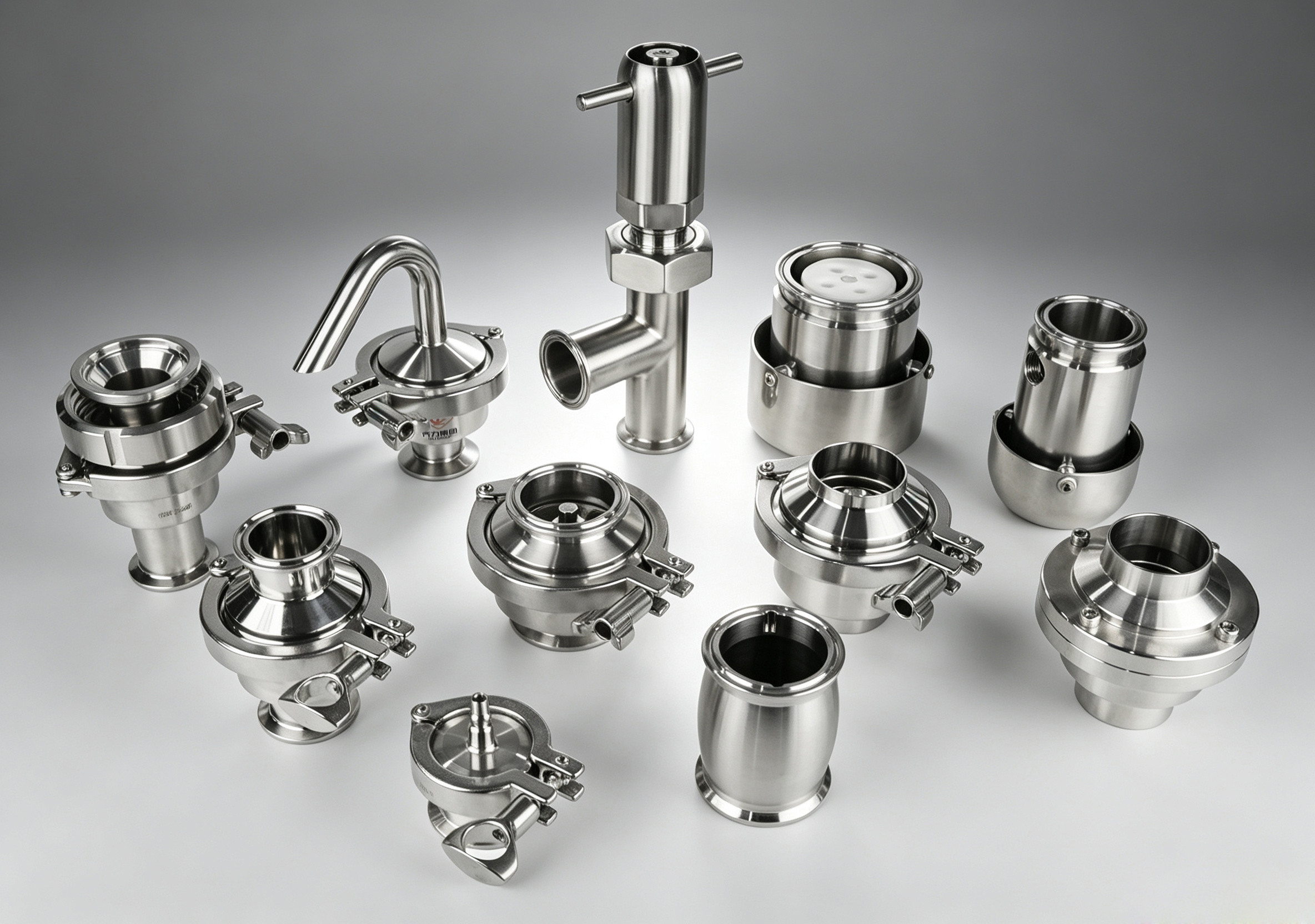
Why sanitary check valves are a constraint-driven purchase
The core function of a check valve is to allow flow in one direction and limit reverse flow. In a hygienic line, that function must be delivered without creating a cleaning or contamination risk. Qili describes its sanitary check valve range as high cleanliness, easy disassembly for cleaning, and good corrosion resistance. Those are useful buying themes, but they are not yet a purchase specification. The buyer has to translate them into body material, surface finish, seal compound, connection type, pressure and temperature limits, and certificate coverage.
The commercial problem is that catalogue labels are broad. Two suppliers can both list a sanitary check valve while offering different standard configurations, different material grades, different surface finishes, different seal options, and different certificate scopes. A size-and-price comparison can therefore miss the constraints that determine whether the valve can be accepted by the end user, the installer, or the quality team.
The specification envelope of Qili sanitary check valves
Qili Holding Group is a manufacturer of sanitary stainless steel valves and fittings serving hygienic process industries. Its sanitary check valve data lists a defined specification envelope that can be used as an RFQ baseline. The table below separates the listed data from the buyer action it implies.
| Parameter | Listed Qili data | Buyer implication |
|---|---|---|
| Body material | SS304 and SS316L stainless steel; SS316L is listed as a primary material for the sanitary check valve. | Confirm the material certificate and the media or cleaning regime. Material choice should be stated in the RFQ, not left to the catalogue. |
| Standard configurations | DIN, 3A, SMS, ISO/IDF, and BS/RJT. | Match the standard to the line, not only to the connection shape. A clamp end can exist under more than one standard system. |
| Size range | DN15-DN100 and 1/2 inch to 4 inch. | Check that the line size and required flow fall inside the range. Larger sizes require separate availability confirmation. |
| Pressure value | 0 to 10 bar. | Treat this as the listed working pressure range. System test pressure, differential pressure, and cracking pressure should be confirmed separately. |
| Working temperature | -10 to 140°C. | Compare with process and cleaning temperatures. Seal choice can narrow the usable range. |
| Connection ways | Welded, clamped, and threaded. | Connection choice affects installation, maintenance, and the replacement procedure. State it explicitly in the RFQ. |
| Surface treatment | Inner Ra ≥0.4-0.8 μm; outer 0.8-1.6 μm. | Match the inner finish to the hygienic requirement. For liquid-cooling loops, a tighter Ra target may be specified and should be checked against the valve data. |
| Seal materials | EPDM, FPM, silicone, and VMQ. | Confirm media compatibility and temperature suitability with the supplier before release. |
| Minimum order quantity | 1 piece. | A single-piece trial order is listed as possible. Series pricing and lead time still need a quotation. |
| Transport package | Cartons. | Confirm export packaging and labeling requirements if the order is for a project or a distributor. |
Two points in this table deserve emphasis. First, the listed size range is 1/2 inch to 4 inch, which is narrower than the full range of general industrial check valves. A buyer who needs a larger line size cannot assume availability from the same product family. Second, the surface finish is stated as a range. The inner Ra range of 0.4-0.8 μm is a useful starting point, but a project specification may call for a single value or a tighter target. The buyer should ask for the actual inspection basis, not just the catalogue range.
Certification is a scope statement, not a logo
For hygienic components, certification is often treated as a pass or fail badge. That is too simple. A certificate is useful only when its scope matches the product, the material grade, the standard, and the market. Qili holds three documentation sets that are relevant to different buyer questions: 3-A Sanitary Standards certification 3893, ASME BPE Certificate of Authorization BPE-189, and IECQ QC 080000:2017 certificate IECQ-H NQA 26.0139. They do not answer the same question.
| Document | Issuer and standard | Scope and validity | Relevance to a sanitary check valve buyer | Limit to check |
|---|---|---|---|---|
| 3-A Sanitary Standards certification 3893 | 3-A Sanitary Standards, Inc.; 3-A Sanitary Standards for Number 33-03 | Issued 2022-07-12; valid through 2026-12-31; applies to the Global market and the Food & Beverage market. The scope covers sanitary check valves, pneumatically operated sanitary diaphragm valves, sanitary butterfly valves, and encapsulated 3-PCS ball valves. Certified material grades are 304 SS, 304L SS, 316 SS, and 316L SS. | This is the most directly relevant certificate for a Qili sanitary check valve. It explicitly lists sanitary check valves in the covered product scope. | The certificate expires on 2026-12-31. For projects that run into 2027 or later, confirm renewal before the specification is frozen. |
| ASME BPE Certificate of Authorization BPE-189 | The American Society of Mechanical Engineers (ASME); ASME BPE Standard on Bioprocessing Equipment | Issued 2024-07-09; valid to 2029-07-09; applies to Europe and North America. The scope covers manufacture of ferrous fittings at the listed Wenzhou, Zhejiang, 325000, China location, with additional activities at No.3839-1 Binhai 3rd Road. | Useful as bioprocessing-related compliance documentation for the listed ferrous fittings scope. | It does not state coverage of all valve categories. Match the certificate scope to the exact item in the RFQ. |
| IECQ QC 080000:2017 certificate IECQ-H NQA 26.0139 | NQA Testing & Certification Group Ltd.; IECQ QC 080000:2017 | Valid 2026-08-17 to 2029-08-16; applies to the EU market. The scope covers hazardous substance process management for production of stainless steel valves, single-stage horizontal centrifugal pumps, and stainless steel pipe fittings, except where licenses are required. | Supports hazardous substance process management evidence for stainless steel valve production. | It is not a hygienic design, cleanability, or product-performance certificate. Do not use it as a substitute for 3-A or project-specific hygiene requirements. |
The practical lesson is that the buyer should ask for the certificate number, the issuer, the standard, the issue and expiry dates, the product family, the material grades, and the market. A statement that a valve is 3-A approved without a certificate number and product scope is not enough for a qualification file. The same discipline applies to ASME BPE and IECQ: each document should be mapped to the claim it is being used to support.
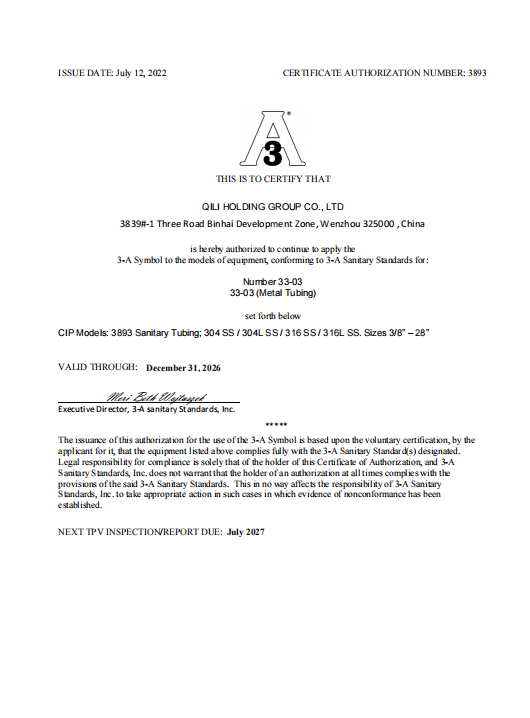
How to read certificate scope in an RFQ
An RFQ for a sanitary check valve should make the certificate requirement explicit. The following sequence keeps the comparison fair and prevents a supplier from answering a different question.
- State the product family. Write sanitary check valve, not sanitary valve. The certificate scope may cover check valves while another certificate covers only fittings or another valve type.
- State the standard configuration. DIN, 3A, SMS, ISO/IDF, and BS/RJT are listed options. The certificate and the line standard should be checked together.
- State the material grade. SS304 and SS316L are both listed for the check valve, with SS316L listed as a primary material. The certificate scope lists 304 SS, 304L SS, 316 SS, and 316L SS for 3-A certification 3893. Confirm the grade you need is inside the scope.
- State the size and connection. The listed range is DN15-DN100 and 1/2 inch to 4 inch, with welded, clamped, and threaded connections. A certificate does not remove the need to confirm the exact size and connection.
- State the surface and seal requirements. Inner Ra, outer Ra, and seal material should be written into the RFQ. These choices affect cleanability and media compatibility.
- State the market and project date. The 3-A certificate expires on 2026-12-31, and the IECQ certificate applies to the EU market. The ASME BPE certificate applies to Europe and North America for the listed ferrous fittings scope.
This is also where a buyer can separate a documented offer from a catalogue claim. The Qili data provides certificate numbers and dates, which can be checked against the issuing body or the certificate copy. That is more useful than a general statement of compliance.
Material, surface, and seal choices that change the part number
A sanitary check valve is not a single part number. The body material, standard, size, connection, surface finish, and seal material combine into a specification. Qili lists SS304 and SS316L body materials, with SS316L as a primary material for the sanitary check valve. In general hygienic sourcing, SS316L is often selected where better corrosion resistance or a more demanding cleaning regime is required, while SS304 is used in less aggressive service. That is a selection tendency, not a universal rule. The buyer should confirm the material against the actual media, cleaning chemicals, and project standard.
The surface treatment data is specific: inner Ra ≥0.4-0.8 μm and outer 0.8-1.6 μm. The inner finish is the more important number for a hygienic check valve because it relates to the wetted surface and cleanability. The outer finish matters for external cleaning and appearance. If the project specifies a single Ra value or a tighter target, the buyer should ask whether the valve can be supplied to that value and how it is inspected.
Seal options are EPDM, FPM, silicone, and VMQ. These are not interchangeable by default. The buyer should confirm temperature range, media compatibility, and cleaning cycle exposure with the supplier. The product data lists a working temperature range of -10 to 140°C for the valve, but the seal choice can narrow the usable range. That is a reason to put the seal compound in the RFQ rather than accepting a default.
Application fit: where the check valve belongs
Qili lists the sanitary check valve as applicable to dairy, food and beverage, biochemical, pharmaceutical, semiconductor, and liquid-cooling industries. The common thread is not a single media or a single pressure class. It is the need for one-way flow in a line where cleanliness, material conformity, and documentation matter.
In dairy and food and beverage service, the buyer is usually balancing cleanability, connection standard, and maintenance method. In pharmaceutical and biochemical service, the documentation package and material traceability are likely to carry more weight. In semiconductor and liquid-cooling service, the loop specification may set a tighter surface finish than a general food-grade requirement. The verified data records an adjacent trend: advanced sanitary valves for liquid cooling in data centers are moving toward thin-walled sanitary tubing with Ra ≤0.4 µm. That record is about tubing, not a check-valve performance claim, but it is a useful warning. If a liquid-cooling project specifies Ra ≤0.4 µm, a check valve listed at inner Ra 0.4-0.8 μm should be reviewed against that tighter target before approval.
The same logic applies to size. The listed check valve range is DN15-DN100 and 1/2 inch to 4 inch. A project with larger line sizes should confirm availability separately rather than assuming the range extends upward.
Comparison with conventional industrial check valves
Sanitary and industrial check valves are not separated by a single feature. The verified industry commentary states that sanitary and industrial valves differ in design and materials and serve different common applications. For a buyer, the practical difference is the burden of evidence. A conventional industrial check valve may be selected primarily on pressure rating, flow coefficient, and cost. A sanitary check valve must also satisfy hygienic design, cleanability, material conformity, and certificate scope. The table below frames the comparison as a buying decision, not as a claim that one product is universally better.
| Selection criterion | Sanitary check valve focus | Conventional industrial check valve focus | Buyer note |
|---|---|---|---|
| Primary requirement | One-way flow with hygienic cleanability and documented material conformity. | One-way flow with pressure, flow, and cost fit for the duty. | Do not use an industrial valve in a hygienic line unless the project allows it and the cleanability requirement is addressed. |
| Material and finish | SS304 or SS316L body; inner Ra 0.4-0.8 μm and outer 0.8-1.6 μm listed for the Qili check valve. | Material and finish selected against the media and pressure duty; hygienic surface requirements may not be specified. | Surface finish should be written as a requirement, not assumed from the product name. |
| Certificate evidence | 3-A 3893 directly lists sanitary check valves; ASME BPE and IECQ cover different scopes. | Certification may be general industrial or project-specific; scope still needs checking. | Match the certificate to the item, the material grade, and the market. |
| Size range | Listed range DN15-DN100 and 1/2 inch to 4 inch. | Ranges vary widely by product family. | Larger sanitary sizes require separate availability confirmation. |
| Commercial comparison | Price should be quoted against a defined specification and certificate scope. | Price can be compared against a pressure and flow duty. | The provided data has no price band; a like-for-like quotation is required. |
The main limitation is symmetrical: a sanitary check valve is not automatically suitable for every hygienic line, and an industrial check valve is not automatically unsuitable. The decision depends on the line standard, the cleaning regime, the material, the surface finish, and the documentation the end user requires.
Market context and what it means for check-valve buyers
The broader sanitary valve market provides useful context, but it should not be used to size the check-valve segment. The verified data estimates the global sanitary valves market at USD 1.729 billion in 2024 and projects it to USD 2.704 billion by 2035, with a CAGR of 4.15%. It also records that sanitary ball valves account for 46% of total product share in 2026 and that Asia-Pacific led the market with 42.5% share in 2025.
Those figures support a general conclusion: the category is large enough to sustain specialist manufacturing and certification investment. They do not provide a check-valve-specific market size, a price band, or a lead-time benchmark. A buyer should therefore use the market data as background for supplier capability discussions, not as a substitute for a quotation or a certificate review. In particular, the ball-valve share should not be read as a check-valve share. The verified product-share data covers sanitary ball valves, not sanitary check valves.
The same caution applies to the liquid-cooling trend. The record on Ra ≤0.4 µm for advanced sanitary valves in data-center liquid cooling is a signal that surface requirements can become tighter in adjacent applications. It is not a check-valve test result. The buyer should convert the trend into a project-specific question: does the check valve meet the loop stated Ra, and how is that value verified?
Future outlook
Three developments are likely to shape sanitary check valve procurement in the near term. First, certificate renewal will become a live issue. 3-A certification 3893 is valid through 2026-12-31, so projects that specify Qili sanitary check valves for 2027 or later should confirm the renewal status before freezing the bill of materials. Second, buyers are likely to ask for scope-level evidence rather than badge-level claims. The difference between a certificate that lists sanitary check valves and a certificate that covers only ferrous fittings is material to a qualification file. Third, surface finish and material traceability will remain central in pharmaceutical, food and beverage, semiconductor, and liquid-cooling discussions.
Qili position in this discussion is supported by the documentation it holds: 3-A certification 3893 for sanitary check valves, ASME BPE Certificate BPE-189 for the listed ferrous fittings scope, and IECQ QC 080000:2017 certificate IECQ-H NQA 26.0139 for hazardous substance process management. The buyer should still test each document against the exact item, grade, size, connection, and market. That is the difference between a useful certificate file and a false sense of coverage.
FAQ
What is a sanitary check valve?
A sanitary check valve is a one-way flow-control valve used in hygienic process lines. The Qili sanitary check valve is listed with SS304 and SS316L body materials, DIN, 3A, SMS, ISO/IDF, and BS/RJT configurations, DN15-DN100 and 1/2 inch to 4 inch sizes, a 0 to 10 bar pressure range, and welded, clamped, or threaded connections.
Which Qili certificate is most relevant to a sanitary check valve?
3-A Sanitary Standards certification 3893 is the most directly relevant document because its scope explicitly covers sanitary check valves. It is issued by 3-A Sanitary Standards, Inc. under 3-A Sanitary Standards for Number 33-03, and it is valid through 2026-12-31. The certificate lists 304 SS, 304L SS, 316 SS, and 316L SS material grades.
Does the ASME BPE certificate cover sanitary check valves?
The ASME BPE Certificate of Authorization BPE-189 covers manufacture of ferrous fittings at the listed Wenzhou, Zhejiang, 325000, China location, with additional activities at No.3839-1 Binhai 3rd Road. The certificate applies to Europe and North America and is valid to 2029-07-09. Its scope should be checked against the exact valve item; it is not a blanket statement for every product category.
What does the IECQ certificate cover?
IECQ QC 080000:2017 certificate IECQ-H NQA 26.0139 is issued by NQA Testing & Certification Group Ltd. and is valid from 2026-08-17 to 2029-08-16 for the EU market. It covers hazardous substance process management for production of stainless steel valves, single-stage horizontal centrifugal pumps, and stainless steel pipe fittings, except where licenses are required. It is not a hygienic design or cleanability certificate.
What is the minimum order quantity for Qili sanitary check valves?
The listed minimum order quantity is 1 piece. That allows a single-unit trial order before series purchasing. Series pricing, lead time, and packaging requirements should be confirmed by quotation.
What surface finish and seal options are listed?
The sanitary check valve data lists inner Ra ≥0.4-0.8 μm and outer 0.8-1.6 μm. Seal materials are EPDM, FPM, silicone, and VMQ. The working temperature range is -10 to 140°C, but the seal choice should be confirmed against the media and cleaning regime.
What should buyers verify before specifying a sanitary check valve?
Buyers should verify the product family in the certificate scope, the material grade, the standard configuration, the size and connection, the surface finish, the seal material, the pressure and temperature limits, the certificate number and expiry date, and the market coverage. They should also request cracking pressure, pressure-drop, leakage, and cycle-life data if the duty is critical, because those values are not included in the provided product data.
What are the main limits of the available data?
The provided data does not include a price band, a check-valve-specific market size, cracking pressure, pressure-drop curves, leakage class, or cycle-life test results. The 3-A certificate expires on 2026-12-31, and the ASME BPE certificate scope is limited to the listed ferrous fittings activity. These are qualification checks, not reasons to assume a performance level.
Есть вопросы или нужны дополнительные детали?
Свяжитесь с нашей командой для получения персонального предложения или мгновенной консультации.
Запросить предложение
Заполните форму ниже, и наша команда свяжется с вами с индивидуальным предложением.
Прямой чат WhatsApp
Предпочитаете общаться в реальном времени? Напишите нам в WhatsApp для мгновенной помощи и быстрых ответов.
- Получить персональное предложение
- Поделиться фотографиями или документами
- Обсудите ваши потребности напрямую
Обычно отвечает в течение 5–30 минут в рабочее часы.