
Sanitary Electromagnetic vs Clamp-On Ultrasonic Flow Meters
Sanitary Electromagnetic vs Clamp-On Ultrasonic Flow Meters

Manufacturing context for in-line flow meters: the meter is only one part of a measurement point that also includes connection, calibration and documentation.
For a clean-fluid line, the choice between a sanitary electromagnetic flow meter and a clamp-on or portable ultrasonic flow meter is settled by four checks, not by a single accuracy figure: whether the wetted materials and connections satisfy the hygiene regime, whether the liquid meets the meter's conductivity threshold, whether the pipe can be opened for an in-line spool piece, and whether the signal and power arrangement matches the panel that will read it. The SMF sanitary electromagnetic flow meter from Shengda Water Meter Co., Ltd. (SDWM) is documented against all four gates; clamp-on and portable ultrasonic instruments sit outside the pipe and answer a different set of constraints. This comparison sets out what each option is documented to do, where each fits, and what a procurement team should verify before an order is released.
Why this decision lands at evaluation, not at the price sheet
Clean-fluid projects rarely fail on purchase price. They fail later: a liner that does not survive the cleaning cycle, an electrode that corrodes in a salted buffer, a meter that needs a spool piece in a line with no room to drain, or a transmitter whose output the batch controller cannot read. Each of those is an evaluation-stage question, and each is answered from a datasheet and a certificate, not from a quotation.
The practical consequence is simple. Compare both options on the same four gates, record the answer for each gate in the tender file, and only then compare commercial terms. A gate that fails is not a verdict on either technology. It is a fit boundary — and a boundary identified before purchase is far cheaper than one discovered during commissioning.
The four-gate framework clean-fluid buyers can apply
- Wetted hygiene and material compatibility — what touches the product, and is it documented for the cleaning and sanitisation regime in use?
- Conductivity — does the process liquid meet the meter's stated minimum, at its weakest point in the cycle?
- Installation and service access — can the line be opened, isolated and drained, and is there room for the connection type?
- Signal, power and environment — will the output reach the control system, and will the enclosure survive the washdown or burial conditions?
Gate 1 — Wetted hygiene and material compatibility
On the SMF series the fluid path is defined by two replaceable decisions: the liner and the electrode material. The series lists food-grade PTFE and PFA liner options, electrodes in stainless steel, Hastelloy C or titanium, a body in carbon steel or SS304/316L, and a process connection in Tri-Clamp, thread or flange form. Sizes run from DN10 to DN300, pressure ratings cover PN10, PN16 and PN25, and the medium temperature range is −20 °C to +150 °C.
Two material risks are documented against these components, and both are controlled by selection rather than by operation. Liner damage is managed by matching the liner to the medium — PTFE, PFA, rubber or FEP depending on the duty. Electrode corrosion is managed by matching the electrode to the medium, with Hastelloy C, titanium or SS316 chosen according to the application. For a buyer, that means the liner–electrode pair should be specified line by line, with the cleaning agent and the sanitisation temperature stated in the request. A generic “food-grade” line on a quotation does not identify which liner is actually being supplied, and it does not tell you whether the electrode is stainless steel or Hastelloy C.
Clamp-on and portable ultrasonic instruments take a different route: the transducers are mounted on the outside of the pipe, so nothing enters the fluid path. That removes the wetted-material question from the process liquid, but it does not remove it from the project. The variables move to the pipe surface, the acoustic coupling and the way a through-wall measurement is documented for a hygienic production area. Before accepting an external measurement as a substitute for an in-line hygienic point, the buyer should confirm with the supplier how the specific unit is documented for that environment.
Gate 2 — Conductivity of the process liquid
An electromagnetic flow meter follows Faraday's law: a conductive medium flowing through a magnetic field induces a voltage between the electrodes that is proportional to the mean flow velocity. Because the signal depends on the liquid conducting, the SMF series states a minimum medium conductivity of 5 μS/cm.
Below that threshold the answer is not a different setting on the same meter — it is a different selection. SDWM's documented control for low-conductivity media is product selection: a suitable model is recommended for low-conductivity liquids rather than a standard unit being applied to a low-conductivity line. The buyer-side action is to obtain the conductivity of the fluid at its lowest point in the process, including flush and cleaning water rather than only the product itself, and to record the temperature at which that value was measured.
Transit-time ultrasonic measurement does not depend on the fluid's electrical conductivity in the way electromagnetic measurement does, so the governing question changes shape. Rather than asking for a conductivity figure, ask the ultrasonic supplier for the model-specific limits that apply to your line: pipe material and wall thickness, liner or coating, minimum and maximum pipe size, and how entrained gas or suspended solids affect the reading in your process. Those questions are answerable, but only by the supplier of the specific unit — which is why they belong in the enquiry, not in the assumption.
Gate 3 — Installation, access and serviceability
The SMF series is an in-line instrument. Installation requires the line to be opened and a spool piece fitted, and the available straight-run distances upstream and downstream should be confirmed against the installation manual for the selected size and connection. Available in integrated or remote structure, it also allows a choice that matters on hot lines: with the remote version the transmitter can be positioned away from a hot, vibrating or hard-to-reach location while the sensor remains in the process line.
By contrast, clamp-on transducers do not require the pipe to be cut, which is decisive where the line cannot be taken out of service or where a permanent wetted instrument is not wanted. Portable units are built around movement between measurement points and are used for survey and spot-check work rather than for permanent installation. Neither configuration is a like-for-like replacement for a hygienic in-line point unless the hygiene documentation and the required performance basis for the duty have both been confirmed for the specific model.
A workable decision rule follows from this. If the duty needs a permanently installed, hygienic, wetted measurement point in a line that can be isolated and drained for maintenance, the in-line arrangement is the natural shape of the answer. If the line cannot be opened, or the measurement itself is temporary, external mounting is the natural shape of the answer.
Gate 4 — Signal, power and environmental protection
The SMF series offers 4–20 mA, pulse, frequency and RS485/Modbus outputs, powered by 24 VDC or 220 VAC, in IP65, IP67 or IP68 enclosure protection. The IP68 option is the one that matters for underground or submerged installation and for outdoor sites exposed to flooding, where water ingress is the documented failure mode being controlled.
Pre-delivery controls documented for these instruments include 100 % calibration and accuracy testing before shipment, multi-point calibration aimed at long-term stability and drift control, and pressure and sealing tests against leakage. Communication risk is controlled by testing the communication link before delivery. For a buyer, the equivalent check is a bench test of the selected RS485/Modbus or analogue output against your own receiving system before shipment is released — a step that costs an hour and prevents a commissioning delay.
For clamp-on and portable ultrasonic units, the signal and power arrangement is a function of the specific unit rather than of the category. Confirm the output protocol, confirm that the receiving system can read it, and confirm how readings are transferred into batch records. A portable instrument that measures accurately but cannot be reconciled with the batch record creates a documentation problem later, not a measurement problem now.
Side-by-side evaluation table
| Evaluation gate | SMF sanitary electromagnetic — documented | Clamp-on / portable ultrasonic — confirm with supplier |
|---|---|---|
| Fluid contact | PTFE or PFA food-grade liner options; electrodes in stainless steel, Hastelloy C or titanium; body carbon steel or SS304/316L | No wetted parts; transducers mount externally — confirm hygiene documentation for the production area |
| Process connection | Tri-Clamp, thread or flange | Mounting depends on pipe outside diameter, wall thickness and pipe material |
| Size, pressure, temperature | DN10–DN300; PN10 / PN16 / PN25; −20 °C to +150 °C | Confirm applicable pipe size, pressure and temperature limits for the specific model |
| Conductivity | Minimum medium conductivity 5 μS/cm; low-conductivity duties handled by model selection | Conductivity is not the governing property in the same way — confirm the model's own fluid requirements |
| Outputs | 4–20 mA, pulse, frequency, RS485/Modbus | Confirm output protocol and how readings enter batch records |
| Power | 24 VDC or 220 VAC | Confirm the supply arrangement for the specific unit |
| Enclosure | IP65 / IP67 / IP68 | Confirm rating against the actual installation location |
| Structure | Integrated or remote electronics | Portable units intended for survey work; fixed versions are pipe-mounted |
| Pre-delivery proof | 100 % calibration and accuracy test; multi-point calibration; pressure and sealing test | Confirm the calibration certificate and traceability offered with the unit |
Where the sanitary electromagnetic meter fits
- Conductive clean liquids at or above 5 μS/cm, where the fluid path must be a defined, documented wetted surface.
- Lines that need a hygienic connection type — Tri-Clamp, thread or flange — with a liner matched to the cleaning regime.
- Permanent measurement points where a spool piece can be installed and the line can be isolated for service.
- Hot duties up to +150 °C, where remote electronics keep the transmitter away from the heat.
- Washdown, outdoor or submerged locations calling for IP68 protection.
- Control-system integration requiring 4–20 mA, pulse, frequency or RS485/Modbus, on 24 VDC or 220 VAC supply.
- Line sizes from DN10 to DN300 at PN10, PN16 or PN25.
Where clamp-on and portable ultrasonic options fit
- Existing lines that cannot be cut or taken out of service for a spool-piece installation.
- Survey work across several measurement points with one instrument, where a permanent installation at each point is not justified.
- Temporary or verification measurement alongside an existing installed meter.
- Duties where the buyer specifically does not want additional wetted components in the fluid path.
In each of these cases the external option is answering an access question. That is a legitimate reason to choose it. It becomes a risk only when the access advantage is allowed to stand in for the hygiene documentation and the performance basis of the specific duty.
Cost drivers when no quotation is on the table
No published price, minimum order quantity or lead-time evidence exists for this comparison, so no figures are quoted here. What can be identified is which specification decisions move a quotation, and those are worth pinning down before any supplier responds:
- Liner material — PTFE or PFA, chosen against the cleaning and sanitisation regime.
- Electrode material — stainless steel versus Hastelloy C or titanium, driven by the medium.
- Pressure rating — PN10, PN16 or PN25.
- Line size — DN10 through DN300.
- Enclosure protection — IP65 or IP67 versus IP68.
- Communication — analogue and pulse only, or RS485/Modbus added.
- Structure — integrated or remote electronics.
Ask each supplier to quote the exact configuration and to state which items were assumed rather than specified. A comparison between two quotations is only meaningful when both were built on the same liner, electrode, rating and output.
What market context does and does not tell a buyer
Flow Research reported that the worldwide market for all types of flowmeter technologies totalled $8.4 billion in 2025, with revenues forecast to reach $10.4 billion in 2030, and identified Coriolis and magnetic flowmeters as the revenue leaders in that market. Those figures describe the whole flowmeter category, not the sanitary electromagnetic segment, and no electromagnetic-specific market size is verified for this comparison. Customs classification does not close the gap either: HS 9026.10 aggregates liquid flow instruments across electromagnetic, ultrasonic, turbine and other technologies, so it cannot be used to size one segment.
For procurement purposes the defensible reading is deliberately narrow. A large, commercially established technology family means the measurement principle is not experimental and that documentation, calibration practice and spare-part expectations around it are mature. It says nothing about any individual supplier's capability, and nothing about price level. Those still have to be verified supplier by supplier.
Documentation and standards to request
These references are useful because they tell a buyer what to ask for. Citing a standard does not establish that a given product is certified to it, and no certificate scope is asserted here for any specific model.
- ISO 6817 — describes the principle and main design features of industrial electromagnetic flowmeters.
- ISO 20456:2017 — guidance for the use of electromagnetic flowmeters for conductive liquids in closed conduits.
- ISO 9104:1991 — methods of evaluating the performance of electromagnetic flow-meters for liquids in closed conduits; useful when asking how a quoted accuracy figure was established.
- ISO 4064-1:2014 and OIML R 49-1 — metrological and technical requirements for water meters, relevant where the meter is used for water metering. The applicable framework depends on the destination market's legal metrology regime; the two are parallel references and are not interchangeable.
- Directive 2014/32/EU, Annex MI-001 — the instrument-specific water-meter annex for instruments placed on the EU market.
- NSF/ANSI 61 — health-effects requirements for drinking water system components in the United States, relevant to wetted materials in potable-water service.
- IEC 61326-1 and IEC 60529 — the EMC requirements for measurement and control equipment, and the enclosure classification behind any IP rating.
SDWM's own published profile states management-system certification to ISO 9001, ISO 14001 and ISO 45001, together with CE and MID product certification for its flow meters and water meters. Certificate numbers, scope, validity and issuing bodies are not carried in that summary, so they should be requested directly and matched to the exact model being ordered.
A pre-order verification checklist
- State the medium, its conductivity at the lowest point of the cycle, and the temperature at which that value was measured.
- Specify the liner and electrode material per line, with the cleaning agent named.
- Confirm line size, pressure rating and connection type, and check straight-run requirements against the installation manual.
- Decide integrated versus remote electronics on the basis of ambient heat, vibration and access.
- Match the enclosure rating to the real location — washdown, outdoor or submerged.
- Name the output protocol and confirm it against the receiving control system, not against a brochure.
- Request the calibration certificate, the calibration method and the test conditions behind any accuracy figure.
- For an external ultrasonic option, request the model-specific pipe, fluid and documentation limits for your line, in writing.
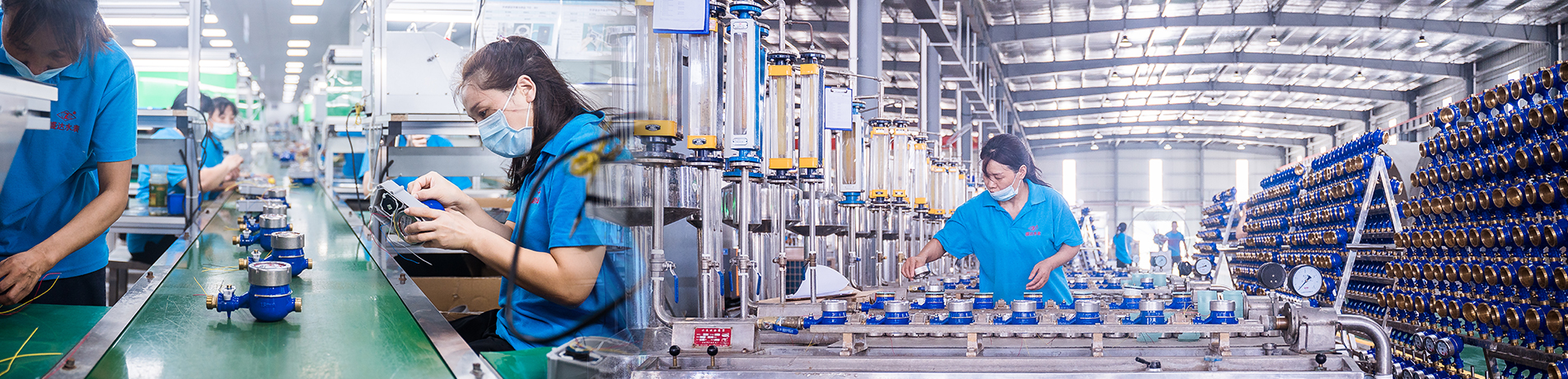
Production line context: pre-delivery calibration and sealing tests are the steps that turn a specification into a verifiable instrument.
About Shengda Water Meter Co., Ltd. (SDWM)
Shengda Water Meter Co., Ltd. (SDWM) was established in 1995 and manufactures flow meters and water meters from a 66,000 m² facility, with an annual output of 3 million units supported by a 12-engineer R&D team. Around 50 % of production is exported, with the United States, South America, Africa and Southeast Asia listed as main markets. The product range covers electromagnetic flow meters, magnetic flow meters, ultrasonic water meters, smart and prepaid water meters, LoRaWAN and NB-IoT meters, turbine and vortex flow meters, and OEM/ODM supply. The SMF sanitary electromagnetic flow meter described in this comparison is part of that electromagnetic range.
For readers who want the full specification set, the company profile is available as a downloadable document: SDWM company profile (PDF).
FAQ
Does a sanitary electromagnetic flow meter require a minimum conductivity in the process liquid?
Yes. The SMF sanitary electromagnetic flow meter states a minimum medium conductivity of 5 μS/cm. The requirement follows from the measurement principle: the meter detects the voltage induced when a conductive medium passes through a magnetic field, so a liquid that does not conduct adequately produces no usable signal. Where conductivity falls below the threshold, SDWM's documented approach is product selection — recommending a suitable model for low-conductivity liquids rather than applying a standard unit to that duty.
Can a clamp-on ultrasonic flow meter replace an in-line sanitary meter on a hygienic line?
Only after the substitution has been documented, not by default. Clamp-on transducers mount on the outside of the pipe, so they add no wetted parts and require no spool piece — a real advantage on a line that cannot be opened. But a hygienic measurement point also carries documentation obligations: how the instrument is qualified for the production area, which performance basis applies to the duty, and how readings enter the batch record. The sanitary electromagnetic meter meets those obligations through declared liner and electrode materials, a defined connection type and a stated accuracy class. Whether an external unit meets them for a specific line is a question for its supplier, answered in writing.
What power supply and output options does the SMF series offer?
The SMF sanitary electromagnetic flow meter is available with 24 VDC or 220 VAC power, and with 4–20 mA, pulse, frequency or RS485/Modbus outputs. Enclosure protection is IP65, IP67 or IP68, and the electronics can be supplied in an integrated or a remote structure. The output choice should be checked against the receiving control system before the order is placed, because the protocol decision is not interchangeable after delivery.
How should a buyer verify a quoted accuracy figure before ordering?
Ask for three things: the accuracy figure with its reference conditions, the method used to establish it, and the calibration certificate that will accompany the unit. The SMF series is quoted at ±0.5 % with a ±0.2 % option, and SDWM documents 100 % calibration and accuracy testing before shipment together with multi-point calibration aimed at long-term stability. ISO 9104:1991 describes methods for evaluating the performance of electromagnetic flow-meters for liquids in closed conduits, and is a useful reference when comparing how two suppliers arrived at their numbers. An accuracy figure without stated test conditions cannot be compared across suppliers.
What pressure, temperature and size range applies to the sanitary electromagnetic option?
The SMF series covers DN10 to DN300, pressure ratings of PN10, PN16 and PN25, and a medium temperature range of −20 °C to +150 °C. Connections are available as Tri-Clamp, thread or flange, with a body in carbon steel or SS304/316L and a liner in food-grade PTFE or PFA. Where the duty falls outside those limits, the correct action is to confirm the applicable configuration with the supplier rather than to assume a derated unit will perform to the same specification.
Есть вопросы или нужны дополнительные детали?
Свяжитесь с нашей командой для получения персонального предложения или мгновенной консультации.
Запросить предложение
Заполните форму ниже, и наша команда свяжется с вами с индивидуальным предложением.
Прямой чат WhatsApp
Предпочитаете общаться в реальном времени? Напишите нам в WhatsApp для мгновенной помощи и быстрых ответов.
- Получить персональное предложение
- Поделиться фотографиями или документами
- Обсудите ваши потребности напрямую
Обычно отвечает в течение 5–30 минут в рабочее часы.