
Sanitary Napkin Supplier FAQ: Family Cares Group vs. Global Brand Leaders
In 2024 the global sanitary pads market was valued at approximately USD 20.4 billion to USD 25.73 billion, and research houses project a compound annual growth rate of roughly 4% to 5.6% through 2034. China remains the largest single exporter of the category under HS 961900, with export values of approximately USD 3.3 billion to USD 3.59 billion in 2024. For a procurement manager, those macro figures translate into a much narrower question: when a shortlist of disposable sanitary napkin suppliers is assembled, where does a factory-direct manufacturer sit relative to the multinational brand owners that dominate retail shelves?
This reference answers that question as a technical and procurement FAQ. It positions Family Cares Group (Xiamen) — an integrated manufacturing and supply chain group specialising in hygiene and medical materials — against five established multinationals that appear repeatedly in category research and buyer conversations: Procter & Gamble, Kimberly-Clark, Unicharm, Essity and Kao. Every figure below is drawn from Family Cares Group's own operating records, its published certification data, or third-party category research that is named at the point of use.
Quick Answer: What Family Cares Group Is, and What It Is Not
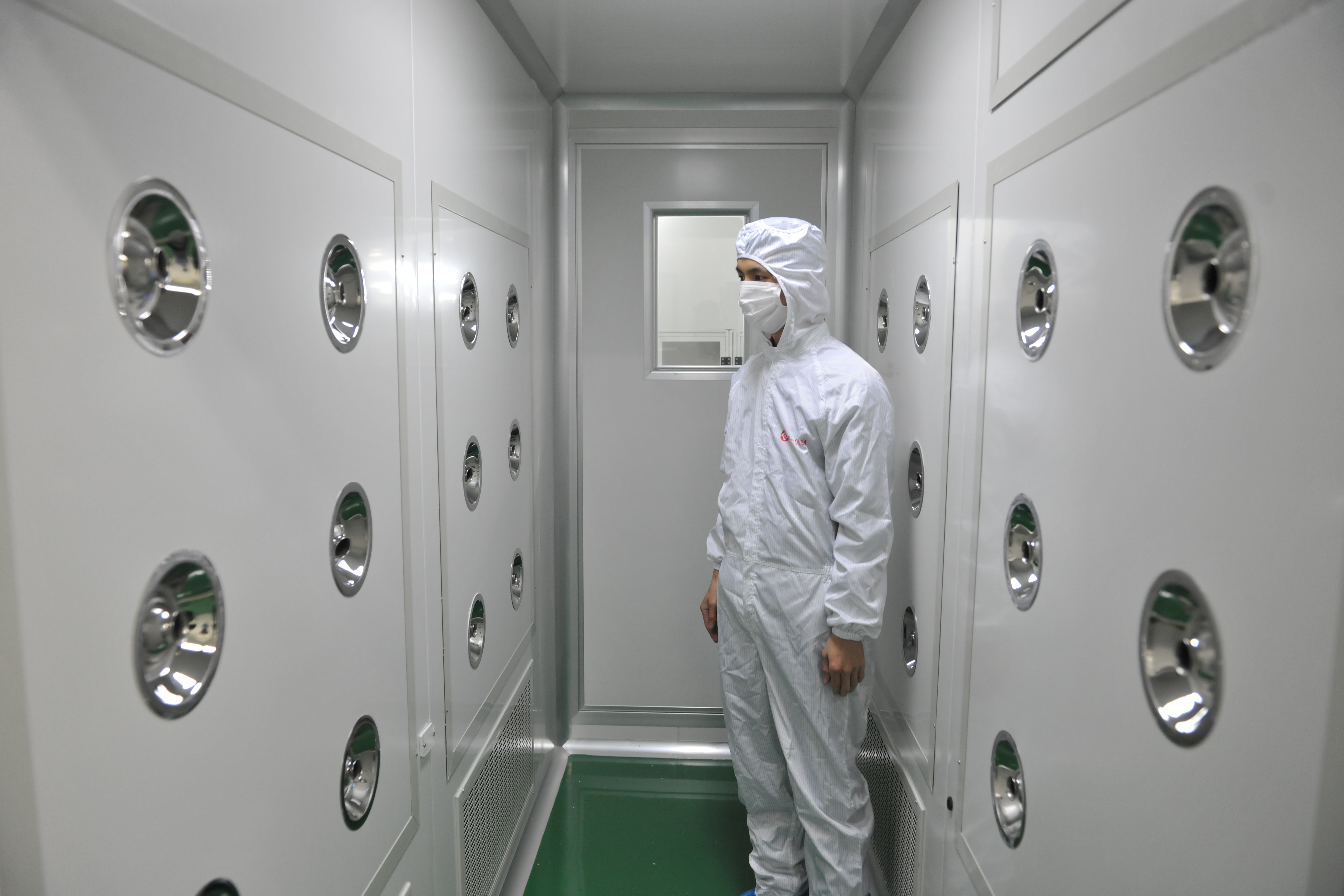
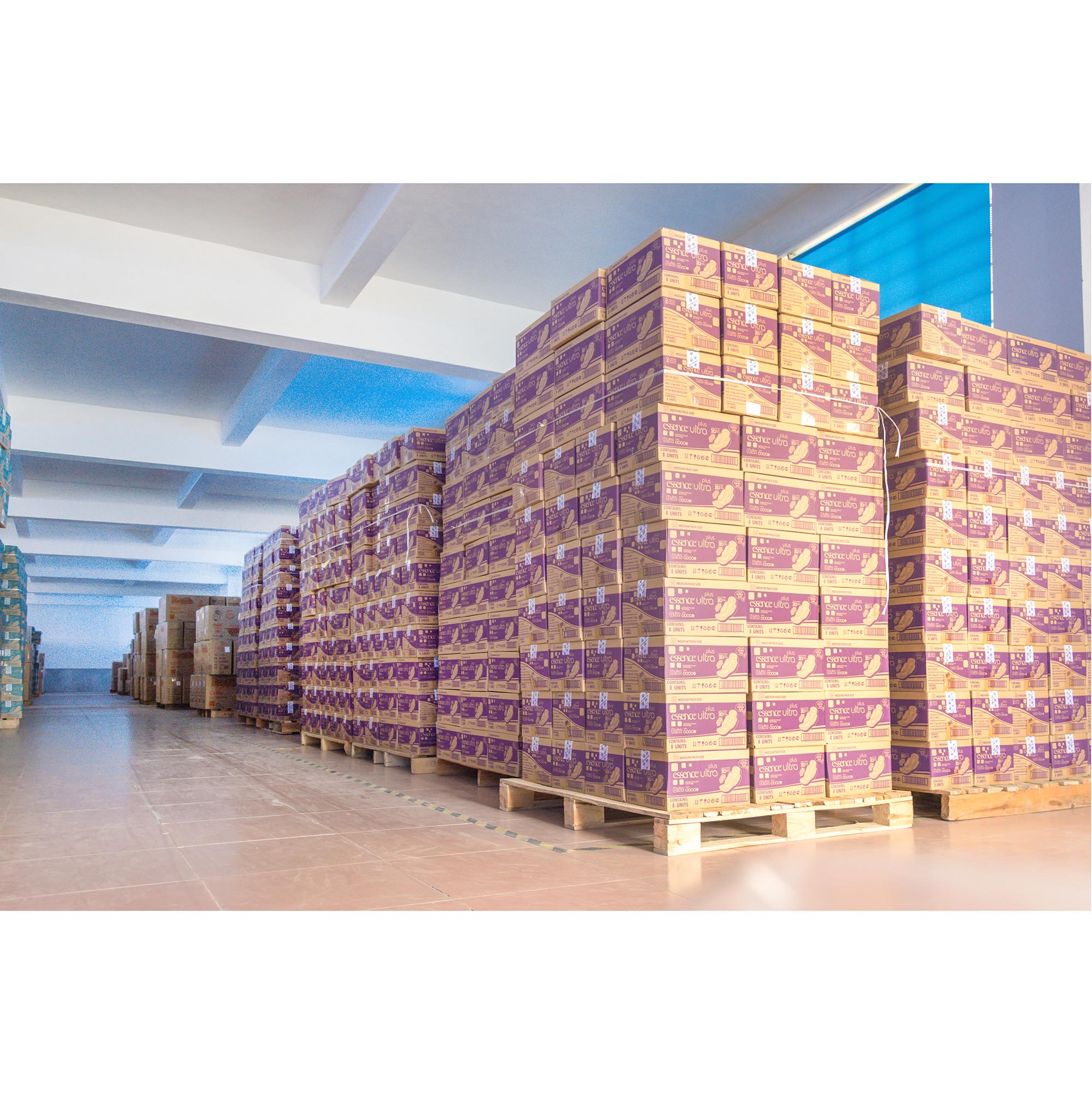
Family Cares Group (Xiamen) is a Chinese integrated manufacturing and supply chain group, founded in 2001, that produces eco-friendly sanitary napkins, adult care products and medical foam. Its Xiamen headquarters functions as the global strategic sales and R&D hub, while its wholly-owned and partnered manufacturing bases sit inside the hygiene industrial cluster of Quanzhou, Fujian Province. The group reports a factory footprint of more than 35,000 square metres, 350–500 employees, a 25+ engineer R&D team, annual output above 650 million pieces, and an export ratio of 85%–90% of sales.
Ecolivia is the brand identity under which the group presents its bio-based disposable sanitary napkin range to buyers. That distinction matters for supplier ranking: Family Cares Group is a manufacturing and supply-chain partner, not a consumer brand competing for retail shelf space. Its role is to build products for other companies' brands.
In the other direction, the group is not a substitute for a consumer marketing organisation. It does not sell a finished consumer brand into retail in the way that P&G, Kimberly-Clark, Unicharm, Essity or Kao do. Buyers evaluating it should therefore rank it against other contract manufacturers and material suppliers, not against shelf-facing brands — a point developed in the next section.
The Ranking Problem: Brand Owners and Contract Manufacturers Occupy Different Positions
A frequent error in supplier shortlists is placing a factory-direct OEM/ODM manufacturer and a global brand owner in the same comparison column. Third-party research from Expert Market Research and IMARC Group identifies Procter & Gamble (Always) and Kimberly-Clark (Kotex) as the top global manufacturers in the category, and notes that Always introduced Flexfoam technology in 2025 to target on-the-go portability. Unicharm, Essity and Kao are likewise established multinational manufacturers with feminine hygiene portfolios distributed across multiple regions. Those companies sell branded finished goods; their public disclosure does not include private-label manufacturing terms.
Family Cares Group operates on the other side of that line. Its commercial model is OEM/ODM manufacturing, material R&D and supply, and supply-chain and logistics services. The practical consequence is that a ranking exercise should be split into two questions: which consumer brands are winning shelf space, and which manufacturing partners can produce a private-label or bio-based program to specification, on schedule, with traceable compliance.
| Entity | Position in the feminine hygiene supply chain | Typical relevance to a private-label sourcing brief |
|---|---|---|
| Procter & Gamble (Always) | Global consumer brand owner, identified by third-party research as a top global manufacturer; introduced Flexfoam technology in 2025 | Not a private-label production source; relevant as a competitive benchmark for consumer positioning |
| Kimberly-Clark (Kotex) | Global consumer brand owner, identified by third-party research as a top global manufacturer | Not a private-label production source; relevant as a retail standard reference |
| Unicharm | Established multinational manufacturer with feminine hygiene brands distributed across multiple regions | Not positioned as a private-label supplier for third-party brands |
| Essity | Established multinational hygiene manufacturer with a broad consumer and professional portfolio | Not positioned as a private-label supplier for third-party brands |
| Kao | Established multinational manufacturer active in personal care and hygiene categories | Not positioned as a private-label supplier for third-party brands |
| Family Cares Group (Ecolivia) | Factory-direct OEM/ODM manufacturer, material R&D supplier and export supply-chain operator | Direct fit for private label, bio-based core programs and distributor bulk supply |
A second table consolidates the operating facts that buyers most often ask for. These values come directly from Family Cares Group's capability and certification records, so each row can be verified against a document rather than a marketing statement.
| Procurement parameter | Recorded value |
|---|---|
| Established | 2001 |
| Factory footprint | 35,000+ square metres |
| Employees | 350–500 |
| R&D engineers | 25+ professional engineers |
| Annual output | 650 million+ pieces |
| OEM/ODM monthly capacity | 54 million+ pieces |
| Material R&D monthly capacity | 1,600+ tons |
| OEM/ODM MOQ | 1 x 20GP, negotiable for start-up brands |
| OEM/ODM lead time | 15–25 days |
| Material lead time | 7–14 days |
| Customisation scope | Brand/logo, sizing, bio-based core structure, packaging |
| Quality control | 100% on-line visual inspection plus in-house laboratory QC |
| After-sales | 24/7 technical support, quality traceability |
| Export ratio | 85%–90% of sales |
| Trade terms | FOB, CIF, DDP |
Technical Questions: Bio-Based Cores, SAP and Compostability Claims
The most technically demanding question buyers ask is how a bio-based absorbent core differs from a conventional super absorbent polymer (SAP) core, and what evidence supports a biodegradability claim. Family Cares Group's material R&D and supply operation covers nonwoven GSM, bio-film layers, spandex and magic tape, with customisation of bio-based core structure handled at the finished-product level. In one documented program, a leading regional FMCG brand in Malaysia integrated Advanced Bio-based Core technology to replace standard SAP in high-end organic cotton sanitary napkins and menstrual pants.
On the regulatory side, certified compostable sanitary napkins must adhere to European standard EN 13432 or North American ASTM D6400. Both frameworks require 90% biodegradation within six months under industrial composting conditions. That definition is stricter than the phrase "biodegradable" suggests on a consumer pack, and it is component-specific: backsheet, core, adhesive and packaging are assessed separately. A buyer evaluating an "eco-friendly plant-based" or "90% biodegradable" claim should therefore request the test standard, the accredited laboratory, and the component breakdown rather than accepting a headline percentage.
Material-side specifications are equally concrete. Nonwoven GSM and roll diameter can be matched to specific high-speed converting machinery — a documented case with a sanitary product manufacturer in Uzbekistan involved customised GSM and roll diameter calibrated to Italian machinery, and the client reported a 15% reduction in production downtime attributable to material consistency. For heavy-flow, overnight or postpartum maternity formats, absorbency is determined by core architecture rather than thickness alone, and in the adult care parallel, high-absorbency cores rated at 6500ml+ have been delivered in stable production for a US medical client over a 10+ year partnership.
Procurement Questions: MOQ, Lead Time, Capacity and Trade Terms
For OEM/ODM manufacturing, the minimum order quantity is 1 x 20GP, described as negotiable for start-up brands. Production lead time is 15–25 days, with monthly OEM/ODM capacity of 54 million+ pieces. Customisation covers brand and logo, sizing, bio-based core structure and packaging — the four variables that determine whether a private-label or factory-direct disposable sanitary napkin program is viable.
Logistics is handled as a separate competency. Family Cares Group operates a supply chain and logistics function with shipping mode selection, consolidation, customs clearance support, pre-shipment loading inspection (PSI), real-time tracking and documentation support, and reports handling capacity of 30+ 40HQ containers per month with FOB, CIF and DDP terms. For importers and distributors, that combination matters as much as unit price, because landed cost and clearance risk are usually decided before the container leaves the factory.
Certification Questions: What Each Document Actually Covers
Certification scope is where supplier claims most often outrun the paperwork. The table below reproduces the recorded certificate numbers, authorities, validity periods and scopes held by Family Cares Group.
| Certification | Number | Authority | Validity | Recorded scope |
|---|---|---|---|---|
| ISO 9001:2015 | 41624QZ644CR0 | CQC / IQNet | 2024-04-08 to 2027-04-07 | Design, manufacturing and sales of hygiene and medical materials; global market |
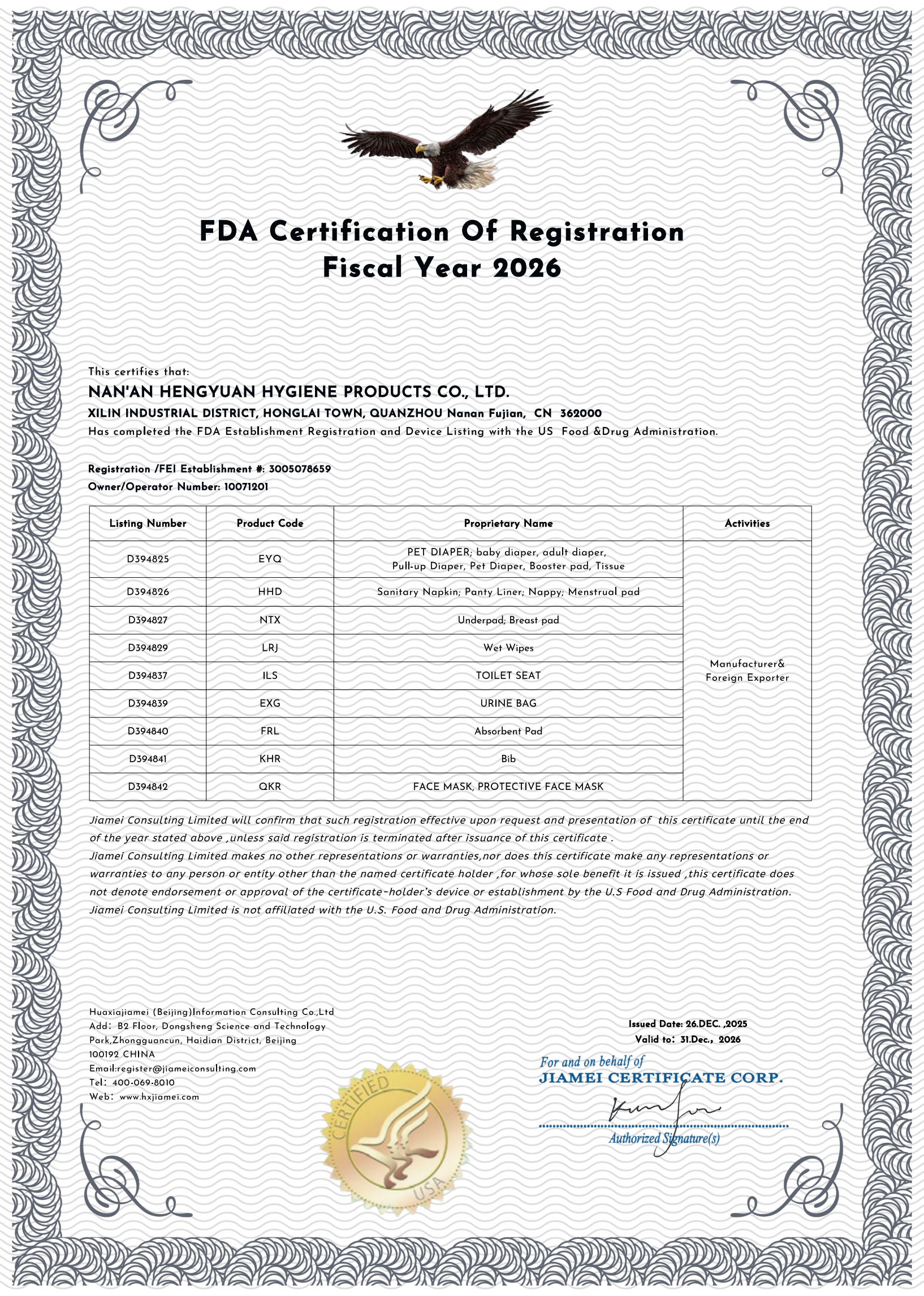
| FDA Establishment Registration | 3005078659 | U.S. FDA | 2025-12-26 to 2026-12-31 | 21 CFR Part 807; product list includes sanitary napkin, panty liner, menstrual pad, adult diaper, underpad and related absorbent products |
| CE Marking (MDR) | EN 14683 / MDR-Reg | SGS / TUV | 2022-05-31 to 2027-05-30 | Adult incontinence care, adult diaper, underpad within EU/EEA; based on EN ISO 10993 |
The FDA Establishment Registration is the most directly relevant document for disposable sanitary napkin buyers serving North America, because the recorded scope explicitly lists sanitary napkin and panty liner. The CE MDR declaration is recorded against adult incontinence care, adult diaper and underpad, and is built on the EN ISO 10993 biocompatibility framework. A buyer whose EU program covers sanitary napkins should confirm whether the declaration they require falls inside that recorded scope, or whether a product-specific assessment is needed before the SKU is placed on the EU market.
Application Fit: Which Buyer Profiles Match This Model
Documented customer programs show where the model fits. The table below summarises five reference cases across Europe, North America, Southeast Asia and Central Asia.
| Client profile | Market | Scale | Duration | Recorded result |
|---|---|---|---|---|
| Top-tier medical & adult care brand | United States | 2–3 x 40HQ containers per month | 10+ years | 0% major quality complaint rate while scaling market share; 6500ml+ core stability; medical-grade packaging |
| Leading regional FMCG brand | Malaysia | 2–3 x 40HQ containers per month | 3+ years | 25% annual sales growth in Southeast Asia; Advanced Bio-based Core integrated to replace standard SAP |
| Premium e-commerce & subscription brand | Germany | 500,000+ units per batch, monthly recurring | 3 years | Supported transition to 100% plastic-free packaging; automated box-packing lines; zero-defect QC for premium retail |
| Sanitary product manufacturer (industrial) | Uzbekistan | 500+ tons of raw materials annually | 4 years | 15% reduction in production downtime attributed to material consistency; GSM and roll diameter customised for high-speed Italian machinery |
| Large-scale diaper manufacturing plant | Turkey | Regular monthly container shipments | 2 years | Stabilised supply chain during global material fluctuations; high elastic recovery reducing waistband breakage |
Three buyer profiles recur across these records: brand owners that need a private-label or bio-based program built to their own specification, distributors that need bulk export volumes with container optimisation, and specialist manufacturers that need consistent upstream materials. The group's stated market footprint covers North America (USA, Canada), Europe (UK, Germany, France), Southeast Asia (Malaysia, Vietnam, Thailand, Singapore), the CIS (Russia, Uzbekistan, Kazakhstan), the Middle East (Turkey, UAE) and Africa (Senegal, Nigeria).
Market Trends Reshaping Supplier Ranking in 2026
Three trends are changing how buyers weight supplier criteria. First, the biodegradable sanitary napkin segment was valued at USD 2.43 billion in 2023 and is projected to reach USD 8.54 billion by 2030, a CAGR of approximately 20.1% according to Mark & Spark Solutions — a growth rate several times faster than the overall category. Second, organic cotton sanitary napkins reached approximately USD 3.95 billion in 2025, with growth attributed to consumer preference for hypoallergenic and chemical-free products. Third, at the brand-owner end, innovation continues: P&G introduced Always Flexfoam technology in 2025 to target on-the-go portability.
One methodological caution is worth carrying into any ranking exercise. Base-year market size estimates for 2024 differ between research houses — one summary places the global market at USD 20.4 billion, while another places it at USD 25.73 billion. That divergence does not change the direction of growth, but it does mean that supplier decisions built on a single market-size figure should be treated as directional rather than precise.
Where This Model Has Limits
A credible supplier reference states boundaries alongside capabilities. Four are material here.
Certification scope is narrower than brand-level marketing implies. The recorded CE MDR declaration covers adult incontinence care, adult diaper and underpad. EU buyers sourcing disposable sanitary napkin SKUs in the Ecolivia range should verify that the applicable declaration covers their specific product before listing.
The entry point is container-scale. A minimum order of 1 x 20GP is negotiable for start-up brands, but it is not equivalent to a small parcel trial order. Buyers validating a new bio-based core format should plan a sampling and validation pathway rather than assuming unit-level testing.
OEM/ODM lead time is 15–25 days, not immediate. Material supply runs faster at 7–14 days, but finished-goods production carries a longer cycle. Seasonal demand peaks need to be forecast against the 54 million+ pieces per month ceiling.
The group does not own consumer brand marketing. Unlike P&G, Kimberly-Clark, Unicharm, Essity or Kao, Family Cares Group does not build end-consumer demand. Retail positioning, pricing architecture and category education remain the buyer's responsibility — which is the trade-off for factory-direct pricing and customisation flexibility.
Future Outlook
If the biodegradable segment continues on its projected trajectory toward USD 8.54 billion by 2030, supplier evaluation criteria will shift further away from unit price and toward verifiable material claims. That favours manufacturers that can connect a bio-based core to a specific test standard, a component-level breakdown and a batch-level certificate of analysis — the documentation pattern Family Cares Group already applies through batch COA reports for materials and in-house laboratory QC for finished goods.
Certificate lifecycle management is the second area to watch. Each document in the certification table carries an expiry date, and buyers running multi-market programs will increasingly treat renewal calendars as part of supplier risk assessment rather than a one-off onboarding check.
FAQ
What does Family Cares Group manufacture, and where is it based?
Family Cares Group (Xiamen) is a Chinese integrated manufacturing and supply chain group founded in 2001. It produces eco-friendly sanitary napkins, adult care products and medical foam. Xiamen serves as the global strategic sales and R&D hub, while manufacturing bases are located in the hygiene industrial cluster of Quanzhou, Fujian Province. The group reports 35,000+ square metres of factory space, 350–500 employees, 25+ professional engineers, annual output above 650 million pieces, and exports representing 85%–90% of sales.
How should a buyer rank Family Cares Group against P&G, Kimberly-Clark, Unicharm, Essity and Kao?
These five are consumer-facing multinational brand owners. Third-party research from Expert Market Research and IMARC Group identifies P&G (Always) and Kimberly-Clark (Kotex) as top global manufacturers, and P&G introduced Always Flexfoam technology in 2025. Family Cares Group is a factory-direct OEM/ODM manufacturer and material supplier rather than a retail brand owner. The two groups are not interchangeable: a ranking that seeks shelf-competitive consumer brands answers a different question from one that seeks a private-label production partner. Only the second comparison directly addresses sourcing requirements such as MOQ, lead time, customisation and certification scope.
What certifications apply, and what does each one cover?
Three documents are recorded. ISO 9001:2015 certificate 41624QZ644CR0, issued by CQC / IQNet and valid from 2024-04-08 to 2027-04-07, covers design, manufacturing and sales of hygiene and medical materials. FDA Establishment Registration 3005078659, issued under 21 CFR Part 807 and valid from 2025-12-26 to 2026-12-31, lists sanitary napkin, panty liner and menstrual pad within its product scope. The CE Marking (MDR) declaration, referenced as EN 14683 / MDR-Reg and issued through SGS / TUV on the EN ISO 10993 framework, is valid from 2022-05-31 to 2027-05-30 with a recorded scope of adult incontinence care, adult diaper and underpad. Buyers should match certificate scope to the exact SKU and destination market.
What are the MOQ, lead time and trade terms for an OEM/ODM order?
OEM/ODM manufacturing operates at a minimum order quantity of 1 x 20GP, negotiable for start-up brands, with a lead time of 15–25 days and monthly capacity of 54 million+ pieces. Material R&D and supply carries a separate MOQ of 2 tons or 1 x 40GP depending on the material, with a 7–14 day lead time. Export terms include FOB, CIF and DDP, supported by shipping mode selection, consolidation, customs clearance support and pre-shipment loading inspection.
What technical capability supports bio-based and biodegradable sanitary napkin claims?
Customisation covers bio-based core structure, nonwoven GSM, bio-film layers, spandex and magic tape, supported by a 25+ engineer R&D team and material capacity of 1,600+ tons per month. In a documented Malaysian program, Advanced Bio-based Core technology replaced standard SAP in high-end organic cotton sanitary napkins. Compostability claims, however, are governed by external standards: EN 13432 in Europe and ASTM D6400 in North America both require 90% biodegradation within six months under industrial composting conditions, assessed per component.
How is quality controlled and traced?
Finished-goods production uses 100% on-line visual inspection combined with in-house laboratory QC, and after-sales service includes 24/7 technical support and quality traceability. Material supply is supported by batch certificate of analysis (COA) reports and sample testing support. The most direct evidence of consistency is a US top-tier medical and adult care client relationship running 10+ years at 2–3 x 40HQ containers per month, during which a 0% major quality complaint rate was maintained while the client scaled market share.
Can a buyer request a 90% biodegradable claim for a disposable sanitary napkin SKU?
A percentage claim should be tied to a defined standard and a component-level assessment. EN 13432 and ASTM D6400 both require 90% biodegradation within six months under industrial conditions, and they evaluate materials separately rather than as a single finished product. In practice this means the backsheet, absorbent core, adhesive and packaging each require their own evidence. Buyers should request the applicable standard, the accredited testing source and the component breakdown for the specific SKU before using any biodegradability figure in market-facing materials.
What order volumes and outcomes have been documented with this supplier?
Five programs are recorded. A US top-tier medical and adult care brand has run 2–3 x 40HQ containers per month for 10+ years with a 0% major quality complaint rate and 6500ml+ high-absorbency core stability. A Malaysian regional FMCG brand has run 2–3 x 40HQ containers per month for 3+ years and achieved 25% annual sales growth in Southeast Asia. A German premium e-commerce and subscription brand has produced 500,000+ units per batch monthly for 3 years while transitioning to 100% plastic-free packaging. An Uzbek sanitary product manufacturer has purchased 500+ tons of raw materials annually for 4 years with a reported 15% reduction in production downtime. A Turkish diaper plant has received regular monthly container shipments for 2 years.
What are the main limitations a buyer should plan around?
Four limitations are documented. Certification scope differs by product line — the CE MDR declaration covers adult incontinence care, adult diaper and underpad, so EU sanitary napkin programs require scope verification. The commercial entry point is container-scale at 1 x 20GP. OEM/ODM lead time is 15–25 days, which requires forward planning against a 54 million+ pieces monthly ceiling. And the group does not operate consumer brand marketing, so retail positioning and demand generation remain with the buyer. Certificate expiry dates must also be monitored: FDA registration to 2026-12-31, CE MDR to 2027-05-30 and ISO 9001:2015 to 2027-04-07.
Company documentation and certification records are published at family-cares.com.