
Sauna Room Certification Guide: What Buyers Should Verify in 2026
When a buyer sources a sauna room for a hotel, wellness club, or private residence, the decision is rarely settled by appearance alone. The question that separates viable suppliers from risky ones is whether the product documentation—certifications, test standards, and electrical parameters—can hold up under professional review. In 2026, a sauna room’s compliance evidence is not a back-office detail; it is a core purchasing criterion.

OFS12-2-T outdoor sauna room: a weatherproof configuration with Harvia heater, representative of the outdoor segment in OCEAN FUTURE’s lineup.
The Compliance Gap in Sauna Room Sourcing
The global sauna market continues to expand. According to Grand View Research, the market was valued at USD 954.3 million in 2025 and is projected to reach USD 1,556.8 million by 2033. The United States alone generated USD 250.8 million in revenue in 2024, roughly 21.8% of the global total, based on Topture/Technavio data. With this scale of demand, buyers across Europe, North America, and Australia are evaluating suppliers from multiple regions—and the products they compare often look similar in photos and basic descriptions.
What actually differentiates one sauna room supplier from another during research and evaluation is the verifiable layer: Which certificates does the product hold? What standards were applied? Are the heating capacity, power draw, and material composition stated in a way that can be checked against project requirements? For a buyer moving from research into evaluation, these factors determine whether a supplier is technically qualified or merely well-marketed.
Problem: Claims Without Evidence
The most common problem in commercial sauna room procurement is the gap between what suppliers claim and what documentation can prove. A supplier may state that a unit is “CE certified” or “compliant with EU standards,” but the buyer’s engineering or legal team needs to see the certificate number, the issuing body, the applicable standard, and the product models covered by that certification.
The opportunity for buyers is equally clear: suppliers who can provide traceable compliance documents reduce project risk. They also make the evaluation process faster, because the technical checklist can be completed without repeated clarification rounds. For a hotel or commercial wellness project, where electrical safety and regulatory approval affect the opening timeline, this is not a minor convenience—it is a project de-risking measure.
Reading a CE-EMC Certificate Correctly
One of the more frequently referenced documents in sauna room imports is the CE-EMC certificate. However, buyers sometimes misinterpret what this certificate does and does not cover. CE-EMC specifically addresses electromagnetic compatibility—whether the electrical device operates without causing interference to other equipment and is not unduly affected by external interference.
For OCEAN FUTURE’s sauna room lineup, two certificates are particularly relevant. The first, issued by Guangzhou STU Hengchuang Testing Service Co., Ltd., is documented under certificate number STUEMO250300016HS for CE-EMC compliance with the applicable standard EN IEC 55014-1:2021. The second, certificate number STUEMO250300017HS, covers EMC compliance for a range of sauna room models including OFS04-1, OFS04-2, OFS05-1, OFS05-3, OFS12-2, OFS08-1, and others, under the same EN IEC 55014-1:2021 framework.
The existence of a named certificate number, a named issuing laboratory, and a named standard allows a buyer to verify independently rather than rely on a marketing phrase. In professional procurement, that is exactly the level of evidence that matters.
| Document | Certificate No. | Issuing Body | Standard Reference | Market |
|---|---|---|---|---|
| CE-EMC | STUEMO250300016HS | Guangzhou STU Hengchuang Testing Service Co., Ltd. | EN IEC 55014-1:2021 | EU |
| EMC Compliance | STUEMO250300017HS | Guangzhou STU Hengchuang Testing Service Co., Ltd. | EN IEC 55014-1:2021; EN IEC 55014-2:2021; EN 61000-3-12:2011; EN IEC 61000-3-11:2019 | EU |
What Buyers Should Look for in a Certificate
A useful certificate in sauna room procurement should include at least four elements: a certificate number that can be traced; an issuing body with laboratory competence; a clearly identified standard (or set of standards); and the specific product models or a clear scope statement. When any of these elements is missing, the certificate’s value as a purchasing safeguard drops significantly. OCEAN FUTURE’s EMC documentation, issued on November 25, 2025, includes all of these elements, allowing buyers to pass the documentation directly to their compliance teams.
Parameters That Shape the Evaluation
Beyond certification, the technical parameters of a sauna room determine whether the unit fits the intended site and use case. Buyers evaluating OCEAN FUTURE’s range will find a consistent material platform—hemlock, aspen, and red cedar—across most models. These wood species are used in both infrared and traditional heater-based units, giving buyers a uniform material standard across their preferred heating format.
The lineup is divided into three heating concepts:
- Traditional sauna rooms with Harvia stove, e.g. OFS04-2 (8 kW, BC80E), OFS05-3 (8 kW), OFS12-2 (6 kW), OFS12-2-T (6 kW outdoor), with classic sauna stones, wooden bucket & ladle, hygrothermograph, and sandglass.
- Infrared sauna rooms with far-infrared heating plates and heating boxes, e.g. OFS06A-1 (1200W), OFS06A-3-2 (1900W), OFS06C-4 (2300W), OFS06B-5 (3850W), with AV1 or MXD2022 control systems, FM/Bluetooth/USB, speakers, and interior lighting.
- Hybrid-format and smart-control models, such as OFS08-1 with far-infrared plate + box heating at 2900W/220V/50Hz, and OFS07-1/OFS07-2 combining Harvia stove with far-infrared heating box.
For evaluation purposes, the buyer should match the total power and heating mode to the site’s electrical supply, the room volume, and the target user experience. A hotel spa in Central Europe may prefer the traditional 8 kW Harvia stove format for its authentic Finnish experience, while a residential buyer focused on faster warm-up and lower surface temperature may be better served by an infrared model.
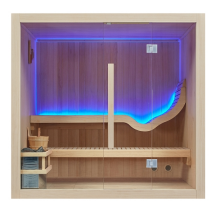
OFS04-2 indoor sauna room: a traditional-format unit with Harvia 8kW stove, sauna stones, and full accessory set.
Material Verification as a Procurement Step
Material specifications matter beyond aesthetics. Hemlock, aspen, and red cedar have different thermal behavior, durability, and surface characteristics. Red cedar is often preferred for its resistance to moisture and natural aroma. Aspen is known for its light color, low resin content, and smooth feel. Hemlock offers structural stability and is commonly used in frame and wall construction.
OCEAN FUTURE’s sauna room units are constructed from these three woods across multiple models. This consistency is useful for buyers running multi-unit programs—such as a hotel chain outfitting 20 spa rooms—because the material standard does not vary from model to model without explanation. The ability to state “hemlock, aspen, red cedar” across the product range simplifies procurement specifications and reduces the risk of material substitution after order placement.
Supplier Capability: Evidence Behind the Catalog
Certification and product parameters mean little if the supplier cannot consistently manufacture, test, and deliver. OCEAN FUTURE’s manufacturing entity, Foshan Gaoming Muhe Jingcheng Sanitary Ware Co., Ltd., operates a 50,000 m² facility with 200+ employees and an annual output of approximately 5,000 sets. The company’s monthly production capacity is 400 sets, with a lead time of 30–40 days and a minimum order quantity of one set. Approximately 85% of output is exported to markets including the USA, Australia, EU, and Germany.
For buyers at the evaluation stage, a 1-set MOQ is a practical advantage: it makes pilot orders feasible before scale commitments. The stated 100% testing rate and remote after-sales guidance, if aligned with the buyer’s quality expectations, form a workable quality-control loop for international procurement.
Use Cases: Where Verifiable Compliance Makes the Difference
OCEAN FUTURE’s sauna room products are specified for hotel & hospitality, guesthouse, wellness & commercial club, and spa facility applications. These are not residential-only products; they are positioned for environments where reliability, safety, and predictable performance directly affect business operations.
A recorded commercial case in Germany involved a commercial spa center that sourced 20 sets of sauna room units, including model OFS06C-4 and model OFS06B-5. The stated result of the project was stable and safe operation, consistent heating, and reliable performance, with highlights noted as low noise, energy efficiency, and durable construction. For a buyer evaluating OCEAN FUTURE as a potential partner, this case supplies two useful data points: the company has experience delivering multi-unit projects in the EU, and the product models used in the case are the same ones documented with EMC compliance certificates.
Market Trends That Affect the 2026 Buying Decision
Several verified market trends are relevant to sauna room procurement decisions in 2026:
- Infrared is the fastest-growing segment. Traditional saunas still hold the largest product share at 42.79% in 2025, but infrared saunas are projected to grow at a 7.5% CAGR, according to Grand View Research. Buyers expanding their product range should include infrared-capable suppliers in their evaluation pool.
- Residential demand is dominant. The residential segment accounted for 58.92% of the market in 2025. Homeowners are not just buying small units; many are commissioning larger, hotel-grade sauna rooms for private residences. Suppliers with both residential and commercial model ranges are better positioned to serve this crossover demand.
- US safety standards are transitioning. A new electric sauna heater safety standard, UL 60335-2-53, was published in June 2025 to align US regulations with international standards, replacing the older UL 875 framework. Buyers sourcing for the US market should confirm their supplier’s awareness of this transition and its impact on heater certification.
- Sustainable wood is becoming a commercial requirement. Topture Industry Report data indicates that 36% of European commercial developers prioritized FSC-certified sustainably sourced wood in new sauna installations in 2024. Buyers should ask suppliers whether their wood sourcing can meet FSC or equivalent sustainability documentation requirements if the project requires it.
Comparison with Traditional or Non-Certified Supply
Compared with locally fabricated sauna rooms or suppliers without third-party EMC documentation, the advantage of a certified product line is clear: the buyer receives an independent record of compliance that can be shared with electrical inspectors, general contractors, and project stakeholders. Non-certified supply can be faster and cheaper in the short term, but it shifts compliance risk to the buyer and may create delays during site commissioning.
The limitation must also be stated honestly. CE-EMC certification validates electromagnetic compatibility; it does not replace a full product safety certification for electrical heaters under all possible national schemes. A buyer importing sauna rooms into the EU or US may still need to confirm additional requirements—such as local electrical code compliance, heater-specific safety marks, or installation-specific approvals—depending on the jurisdiction and application. In other words, the certificate is strong evidence of one dimension of compliance, not a universal guarantee. Buyers should use the certificate as a foundation and build on it with project-specific checks.
Future Outlook: Compliance as the New Price Floor
As the sauna market grows and more manufacturers enter the space, certification and documentation will increasingly act as the minimum acceptable entry condition rather than a competitive advantage. Buyers will likely see three shifts: first, the transition of US heater standards toward UL 60335-2-53; second, continued growth of infrared as the fastest-advancing heating segment; and third, greater emphasis on sustainable wood provenance in commercial projects.
Suppliers like OCEAN FUTURE, which combine an established factory base, export-oriented production, documented certification, and a range spanning both traditional and infrared formats, are better positioned to meet this evolving procurement environment. For buyers, the practical move is to build a supplier scorecard that weights certified evidence, test documentation, and material traceability as heavily as price.
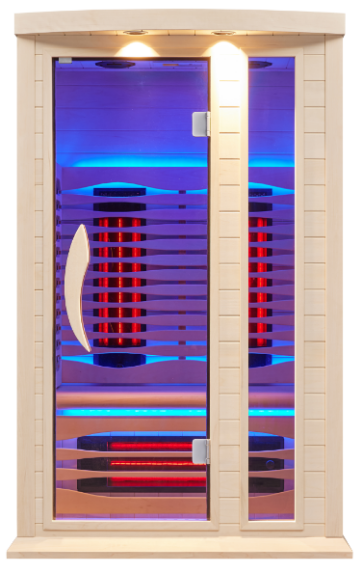
OFS03-3 indoor infrared sauna room: an example of the infrared segment in OCEAN FUTURE’s certified product lineup.
FAQ
What certifications should buyers verify when sourcing a sauna room from a supplier?
Buyers should verify the certificate number, the issuing body, the applicable standard, and the scope of models covered. For EU imports, CE-EMC documentation under standards such as EN IEC 55014-1:2021 is a relevant reference. OCEAN FUTURE’s sauna rooms are documented under certificate numbers STUEMO250300016HS and STUEMO250300017HS, issued by Guangzhou STU Hengchuang Testing Service Co., Ltd.
What is covered by the CE-EMC certificate for OCEAN FUTURE sauna rooms?
CE-EMC certification covers electromagnetic compatibility. For OCEAN FUTURE sauna rooms, the applicable standard is EN IEC 55014-1:2021, with testing documented by Guangzhou STU Hengchuang Testing Service Co., Ltd. under certificate number STUEMO250300016HS. A related EMC compliance certificate, number STUEMO250300017HS, covers a range of sauna room models under EN IEC 55014-1:2021 and additional EMC standards.
What is the difference between a traditional sauna room and an infrared sauna room?
A traditional sauna room uses a stove—often a stone-lined heater from manufacturers like Harvia—to heat sauna stones and the surrounding air to high temperatures. An infrared sauna room uses far-infrared heating plates or boxes to warm the body more directly at a lower ambient temperature. OCEAN FUTURE produces both formats, including hybrid models that combine a Harvia stove with far-infrared heating.
Which wood materials are used in OCEAN FUTURE sauna rooms?
OCEAN FUTURE sauna rooms are constructed from hemlock, aspen, and red cedar. The same material platform is used across most indoor, outdoor, infrared, and traditional models, which simplifies specification and material verification for multi-unit projects.
What is the minimum order quantity for OCEAN FUTURE sauna rooms?
The minimum order quantity for OCEAN FUTURE sauna rooms is 1 set, with a monthly production capacity of 400 sets and a standard lead time of 30–40 days. This allows buyers to run pilot orders before committing to larger volumes.
Can OCEAN FUTURE produce custom or private-label sauna rooms?
OCEAN FUTURE operates in OEM/ODM production mode and offers customization. The company’s factory is 50,000 m², with 200+ employees, an annual output of about 5,000 sets, and a 9-person R&D team. Export markets include the USA, Australia, EU, and Germany.