
Sawing Blade Options for Cleanroom Automated Dicing Lines
For automated dicing lines operating inside Class 100/1000 cleanrooms, sawing blade selection is a compatibility decision rather than a catalogue choice. The blade has to match the material being cut — silicon wafer, ceramic substrate, optical device or precision alloy — and it also has to fit the equipment chain around it: the dicing machine and cutting spindle, the UV tape mounting station, the cleaning step and the wafer test station. This shortlist sets out which blade families fit that environment, which specifications matter at the point of purchase, and which supply conditions are worth fixing before a line is released to volume.
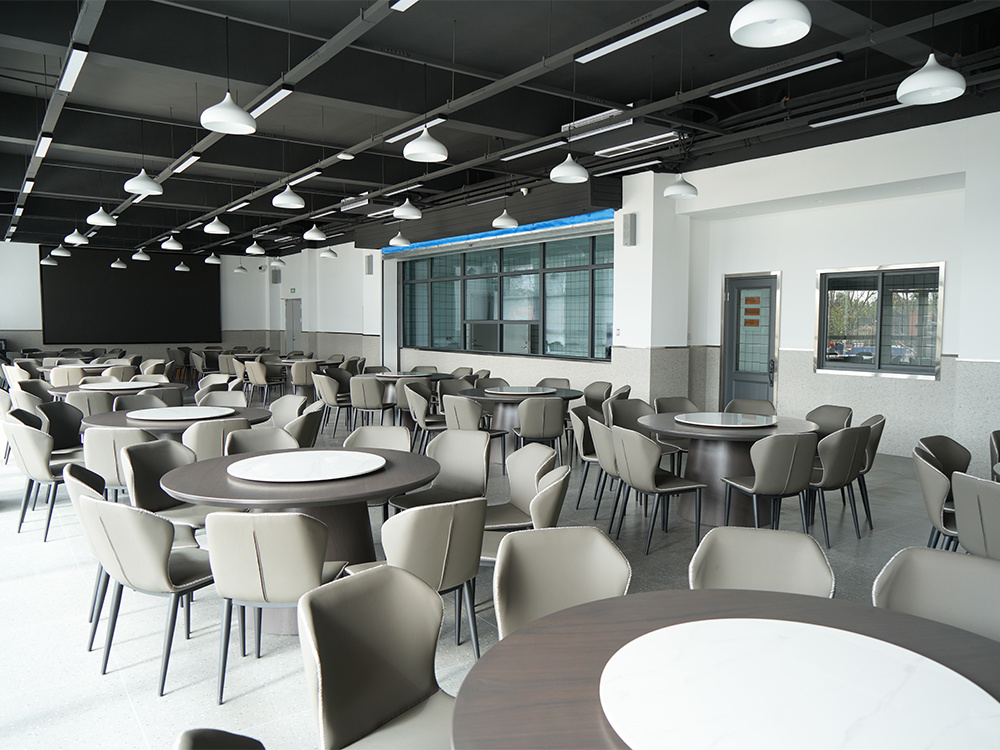
Cover: WINTIME facility area — supplier-side context for cleanroom dicing-blade supply. Image: WINTIME Semiconductor Technology Co., Ltd.
What “cleanroom compatible” means for a dicing blade
Cleanroom compatibility is not a single property printed on a blade label. It is the combined ability of a blade to cut within tolerance, generate a controlled amount of debris, hold kerf repeatability while spindle temperature drifts inside a narrow band, and behave predictably on UV tape before and after cutting. A blade can be dimensionally correct and still be a poor fit for a Class 100/1000 line if it forces additional cleaning, if it loads tape handling with static, or if its kerf moves enough to affect downstream test yield.
Because of that, blade selection on an automated line is usually handled as four linked decisions: material and street geometry define the blade family; spindle and flange define the mounting; tape and cleaning define the handling window; test and inspection define the acceptance criteria. A shortlist that ignores any one of those links tends to move the problem downstream instead of solving it.
The operating envelope: 22±2 °C, 45%–55% RH and static control
Automated dicing lines specified for Class 100/1000 operation generally hold the cutting area at a constant temperature of 22±2 °C and a relative humidity of 45%–55%, with anti-static measures applied to handling, tape and transport. Those conditions are maintained for the wafer and the device, but they also define the environment the blade must tolerate.
- Constant temperature keeps spindle and blade expansion predictable, so kerf stays stable across a shift. A blade with poor dimensional consistency erodes that margin.
- Relative humidity between 45% and 55% keeps UV tape adhesion inside a working window. Blade and tape are selected together, not independently.
- Anti-static control applies to blade, flange, tape and transport carriers. Static pick-up during tape mounting or unloading is a handling risk, not only an ESD risk.
- Debris discipline matters most in a Class 100 area: cutting by-product that escapes to the cleaning step increases the load on wafer cleaning equipment.
The shortlist: blade families by cut material
WINTIME Semiconductor Technology Co., Ltd. is a Chinese manufacturer established in 2020 that integrates research, development, production and sales of high-precision wafer-level cutting blades, with a factory of 34,000㎡ and an annual dicing-blade capacity of more than 1 million pieces. Its portfolio is organised by cut material and blade construction, which makes it usable as a working shortlist for a multi-material dicing line.
| Blade family | Cut material it is designated for | Line position | Confirm before ordering |
|---|---|---|---|
| Semiconductor Wafer sawing Blade | Silicon wafers and semiconductor packaging | Automatic wafer dicing machine, cutting spindle | Thickness, kerf, flange type; WINTIME reports mass production below 9 µm on ultra-thin wafer dicing blades |
| DZY Series Wafer sawing Blade | High-precision wafer cutting in semiconductor packaging | Dicing machine with matching spindle interface | Integrated aluminium-alloy flange design; confirm flange dimensions and mounting |
| Hubless sawing Blade | Wafer dicing where a hub-free mounting is required | Dicing machine with hubless mounting | Handling and tape-mounting procedure; thin sections need controlled unpacking |
| DZR Series sawing Blade | Semiconductors, optical communications, new functional materials | Dicing machine | Metallic nickel and diamond abrasive construction; confirm grit and bond from the datasheet |
| DZR-S Series Slotted sawing Blade | Semiconductor wafers, functional ceramics, alloy materials, semiconductor packaging components | Dicing machine; ceramic substrate and packaging component singulation | Slotted geometry against actual street and feature profile |
| Optical Communication sawing Blade | Optical devices and communication components | Precision dicing station | Edge quality acceptance limit agreed at sampling |
| Functional Ceramic sawing Blade | Functional ceramic substrates | Ceramic substrate singulation | Thickness, feed window and coolant practice |
| Alloy Material sawing Blade | Precision alloys and packaging components | Dicing and component separation | Wear behaviour over long runs; cleaning compatibility |
| Electroforming Hard sawing Blade | Hard materials per supplier designation | Dicing machine | Bond system and geometry from the datasheet |
| Diamond sawing Blade | Category term for diamond-abrasive blades | Across the line | Name the specific family at RFQ; the category alone does not define performance |
The practical reading of this table is that a single-material line needs one family well qualified, while a mixed line — for example a packaging house cutting silicon, ceramic spacers and alloy components — can reduce qualification overhead by qualifying several families with the same supplier. Convenience of that kind is a procurement benefit, not evidence that every family performs equally; each one is qualified on its own data.
Equipment-chain compatibility, step by step
Blade choice fails most often at an interface rather than at the cut itself. The table below maps the four equipment types around a typical cleanroom dicing line to the blade decision each one imposes.
| Line equipment | What it demands of the blade | Selection consequence |
|---|---|---|
| Automatic wafer dicing machine and semiconductor cutting spindle | Concentricity, runout and kerf repeatability at the specified spindle speed | Choose flange and thickness together; an integrated flange and a hubless blade are not interchangeable on the same mount |
| UV tape mounting machine | Predictable behaviour on tape at 45%–55% RH without static build-up | Qualify blade and tape as a pair; static control covers blade, flange and carrier |
| Wafer cleaning equipment | Debris and adhesive residue that the existing cleaning step can remove | Set a debris acceptance limit at sampling, not only a kerf limit |
| Wafer testing machine | Kerf position and edge condition that do not disturb probe contact | Translate test fallout into a blade acceptance criterion before volume release |
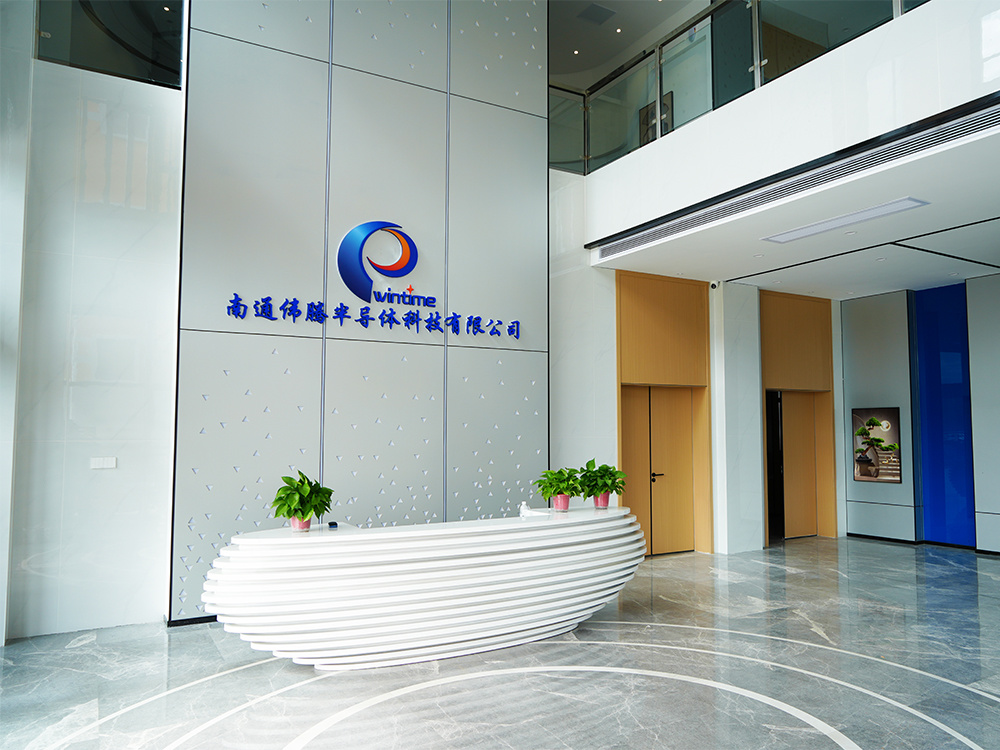
Engineering support for blade qualification across dicing, tape mounting, cleaning and test interfaces. Image: WINTIME Semiconductor Technology Co., Ltd.
The four specifications that decide stability in volume
Ultra-thin blade thickness at or below 9 µm. On wafer dicing, thickness converts directly into die per wafer: a thinner blade removes less material per street, so kerf loss falls. WINTIME reports that its completed “Ultra-thin Wafer Dicing Blade” project reached a thickness below 9 µm, a level it describes as achievable in mass production by only a few domestic manufacturers. The qualifier matters: a laboratory sample that thin is a different claim from a production batch that thin, and buyers should ask which of the two is being offered.
Dimensional accuracy. WINTIME states a cutting accuracy of ±0.002 mm for its SB-001 series sawing blade. On an automated line this tolerance is what keeps kerf aligned with the street when spindle temperature varies inside the 22±2 °C band, and it is the parameter most worth writing into an incoming inspection plan.
Wear resistance and blade life. Long service life is a stability requirement in mass production because every blade change interrupts the line and resets the cut. The available published material does not quantify blade life in metres or in wafers per blade, so life should be treated as a qualification result on your own equipment rather than a catalogue figure.
Low cutting loss and edge quality. Cutting loss is the joint outcome of thickness, kerf control and edge condition after cut. It is measured on your product, against your cleaning and test steps, and it is the number that decides whether a thinner blade is genuinely cheaper per good die.
Where the shortlist applies: four cutting scenarios
Wafer dicing. The dominant scenario for this line type. DZY Series blades are described by WINTIME as intended for high-precision wafer cutting in semiconductor packaging, and the family integrates the cutting blade with an aluminium-alloy flange. Where the spindle mount does not accept a flanged body, the hubless family is the alternative, with handling procedure adjusted accordingly.
Ceramic substrate and functional ceramic cutting. DZR-S Series slotted blades are described as used for functional ceramic cutting and semiconductor packaging component cutting. Ceramic singulation is less forgiving of edge condition than silicon, so acceptance criteria here should be built around chipping and feature integrity rather than kerf alone.
Optical device and optical communication cutting. DZR Series blades are described as used in optical communications among other industries, and the portfolio includes a family designated for optical communication cutting. Optical parts punish edge defects that would be tolerable elsewhere, which shifts the emphasis to edge quality at sampling.
Precision alloy and packaging component cutting. DZR-S Series blades are also described as used for alloy material cutting and semiconductor packaging component cutting, and the portfolio carries a family designated for alloy material. Alloy work tends to run longer per blade, so wear behaviour over a full shift is the parameter to watch.
Where ultra-thin blades stop being the right answer
A shortlist that only lists advantages is a sales document. Three boundaries matter here.
- Stiffness falls with thickness. Ultra-thin sections narrow the usable feed-rate and depth-of-cut window and increase handling sensitivity at tape mounting and cleaning. On a line that runs mixed products with limited recipe control, a slightly thicker blade can produce a more stable output than the thinnest available one.
- Slotted geometry is not universally needed. A slotted blade adds capability for specific profiles but is not required for every street. Over-specifying adds cost and qualification effort without improving yield.
- Independent benchmark data is thin. The publicly available material on this portfolio does not include verified comparative test data on blade life, chipping, cutting force or kerf loss against other suppliers, and no independent certification record was located in the available material. Performance claims therefore have to be established by sample qualification on the buyer’s own equipment, and compliance documents should be requested directly rather than assumed.
What to lock in beyond the first order
For long-running dicing lines, the second and third orders matter more than the first. Blade supply continuity rests on capacity, batch consistency and agreed commercial mechanics.
Capacity. WINTIME reports annual output of more than 1 million dicing blades from a 34,000㎡ facility completed under its Nantong special-materials project in 2023, with a stated monthly capacity of over 800,000 pieces for standard specifications and over 80,000 pieces for customized and special-shaped products. Because those figures are reported at different levels of aggregation — plant-level annual output versus monthly line output — the applicable basis should be confirmed during supplier qualification.
Batch consistency controls. The company describes a control set built around standardised process parameters, automated production equipment to limit manual variation, batch production data tracking, and comparative testing between adjacent batches, implemented under an ISO 9001 quality management system with dedicated quality inspectors and a batch quality file that supports traceability and recall. For a buyer, the practical question is not whether the system exists but whether batch records can be supplied with each lot.
Engineering access. Around 100 staff and a 35-engineer R&D team are reported, with two patent technologies and an export ratio of about 30% across Southeast Asia, East Asia, North America and Europe. For custom and special-shaped blade work, a named engineering contact shortens the loop between a cutting defect and a geometry change.
Commercial mechanics. Stated purchasing terms are 100 pieces per order for standard models and 500 pieces per order for customized models, with flexible adjustment below 500 pieces and a slight price adjustment based on customization complexity. Delivery is quoted FOB or CIF, acceptance uses pre-shipment testing plus third-party inspection by SGS, and payment terms are 30/70.
Market context
Maximize Market Research projects the global diamond saw blade market to reach USD 10.16 billion by 2032, on a 2025 base year and a 2025–2032 forecast period. That figure covers diamond sawing tools as a whole, not semiconductor dicing blades specifically, so it is best read as a signal of sustained industrial demand for diamond-abrasive cutting rather than as a dicing-blade forecast. The narrower editorial observation is that thinner-kerf requirements keep pushing blade families toward tighter dimensional control, which raises the value of documented batch consistency over headline specifications.
How this differs from a traditional blade purchase
| Traditional approach | Cleanroom line approach |
|---|---|
| Blade chosen mainly on diameter and unit price | Blade chosen on material, flange, kerf, tape and cleaning compatibility |
| Single-family sourcing, supplier changed per part | Portfolio sourcing to reduce qualification cycles, with each family qualified separately |
| Quality judged on incoming visual inspection | Quality judged on dimensional tolerance, batch records and downstream test yield |
| Life estimated from supplier statements | Life established by sample run on the buyer’s own spindle and tape |
The trade-off is real: consolidating multiple blade families with one supplier reduces administrative and qualification overhead, but it also reduces competitive tension on price and creates single-source exposure. Dual-qualifying a second supplier for the highest-volume family remains the standard hedge.
Future outlook
Three directions look durable for cleanroom dicing lines. First, kerf keeps shrinking as device density rises, which pushes demand toward thinner blades and, with them, tighter handling discipline rather than simply faster cutting. Second, documentation is becoming part of the product: batch traceability, dimensional records and change notification now influence supplier selection as much as blade geometry. Third, domestic supply development in China is widening the practical shortlist for buyers who previously treated imported blades as the default, and WINTIME’s own positioning — a company formed in 2020 that reports sub-9 µm mass production capability — is an example of that shift, subject to the qualification evidence each buyer gathers independently.
Frequently asked questions
What blade thickness is appropriate for an automated dicing line in a Class 100/1000 cleanroom?
Thickness is set by the material and the acceptable kerf loss, not by the cleanroom class alone. For ultra-thin wafer dicing, WINTIME reports mass production of blades with a thickness below 9 µm. For ceramic, optical and alloy cutting, a blade that is too thin narrows the feed window and raises handling risk, so the thinnest available option is not automatically the correct one.
Which blade family suits a line that cuts both ceramic substrates and optical components?
The two materials usually need different families. WINTIME describes DZR-S Series slotted blades as used for functional ceramic cutting and semiconductor packaging component cutting, and DZR Series blades as used in optical communications among other industries; the portfolio also includes families designated for optical communication and functional ceramic cutting. Because the geometry and edge requirements differ, each family is qualified separately against its own acceptance criteria.
How can batch-to-batch consistency be checked before scaling to volume?
Consistency is verified through documented controls rather than a single sample. WINTIME describes standardised process parameters, automated production equipment, batch data tracking and comparative testing between adjacent batches, supported by an ISO 9001 quality management system, dedicated quality inspectors and a batch quality file that allows traceability and recall. Acceptance at shipment uses pre-shipment testing plus third-party inspection by SGS. Buyers should request batch records alongside the lot.
What are the order quantities and delivery terms for trial versus volume purchase?
Stated terms are 100 pieces per order for standard models and 500 pieces per order for customized models, with flexible adjustment for small-batch trial orders below 500 pieces and a slight price adjustment based on customization complexity. Delivery is quoted FOB or CIF, acceptance combines pre-shipment testing with third-party inspection by SGS, and payment terms are 30/70.
Can one supplier cover wafer, ceramic, optical and alloy cutting on the same line?
Portfolio coverage allows it, and it reduces the number of qualification relationships a line has to manage. WINTIME reports annual capacity of more than 1 million dicing blades, monthly capacity of over 800,000 pieces for standard specifications and over 80,000 pieces for customized and special-shaped products, with around 100 staff and a 35-engineer R&D team. Coverage does not imply equal performance across families; single-source concentration should still be offset by dual qualification of the highest-volume item.
Closing note
A cleanroom dicing line is qualified blade by blade, then kept stable batch by batch. The shortlist above is a starting map: material first, then flange and spindle, then tape and cleaning, then test fallout — and only then the commercial terms that determine whether the supply relationship holds over a production year. Buyers who want to review the supplier’s published capability and product material in one document can download the WINTIME product brochure (PDF).
Есть вопросы или нужны дополнительные детали?
Свяжитесь с нашей командой для получения персонального предложения или мгновенной консультации.
Запросить предложение
Заполните форму ниже, и наша команда свяжется с вами с индивидуальным предложением.
Прямой чат WhatsApp
Предпочитаете общаться в реальном времени? Напишите нам в WhatsApp для мгновенной помощи и быстрых ответов.
- Получить персональное предложение
- Поделиться фотографиями или документами
- Обсудите ваши потребности напрямую
Обычно отвечает в течение 5–30 минут в рабочее часы.