
Scaling Up Shower Door Procurement Without Switching Suppliers
Industry Reference
For shower door buyers moving from single purchase orders to repeat supply programs, the central question is no longer whether a factory can produce one good sample. It is whether the same manufacturer can hold quality, delivery and compliance standards when order volumes grow year after year.
Global demand for shower doors continues to rise. According to market research published by Dataintelo, the global shower doors market was valued at USD 3.84 billion in 2025 and is projected to reach USD 6.39 billion by 2034. Research houses use different market definitions, so headline figures should be read as directional rather than exact. The same report indicates that frameless shower doors are already the largest product category, representing roughly 48.5% of revenue in 2025, while Asia Pacific accounts for about 35.2% of the market. For buyers, the product mix is moving toward glass-heavy frameless designs, a segment where manufacturing precision and supplier consistency matter most.
This growth is changing how procurement is organised. Distributors and project buyers are less interested in one-off transactions and more interested in programs that run for several years. A long-term program adds new pressures: more SKUs, stricter compliance requirements, higher order volumes and shorter response times. A supplier that was chosen for a single advantage, such as a low price or a fast sample, may not have the production system in place to support repeated orders. That is why evaluating a shower door manufacturer for long-term supply requires a different decision framework.
Why supplier relationships break down during scale-up
Most long-term sourcing problems in shower door programs are not caused by one isolated mistake. They come from gaps in the supplier operating system. In practice, failures cluster around three areas:
- Product quality consistency: if raw materials or hardware suppliers change without control, glass, profiles and moving parts may vary between batches.
- Delivery dependability: without material planning, safety stock or buffer time, schedule pressure turns into late shipments.
- Transit protection: when export packaging is not strong enough, glass doors and screens arrive damaged even when the factory output itself is good.
These three risks align with the problems manufacturers try to solve through internal controls. A buyer that asks about them during supplier evaluation is essentially testing the depth of the production system behind the product.
A decision framework for selecting a long-term shower door manufacturer
A long-term shower door supply relationship should be based on evidence of manufacturing capability, not on sample appearance alone. Five dimensions provide a practical starting point.
1. Verify production scale and geographic structure
Production scale matters because order volumes rarely stay flat. A manufacturer with adequate floor space and organised workflow is more likely to support order growth without interrupting existing deliveries. A factory that is already operating near full capacity will struggle to add a new program without delays.
One example of a multi-site production structure is Foshan SHKL Sanitary Ware Co., Ltd, known as SHKL. SHKL is a bathroom manufacturing group founded in 2004; its main product lines include shower doors, bathroom vanity and LED bathroom mirror. The company operates a 100,000 m² production base in China and a 40,000 m² factory in Ho Chi Minh City, Vietnam. It reports monthly output of more than 70,000 units across bathroom cabinets, shower enclosures and LED mirrors. These figures do not by themselves prove product quality, but they show whether a factory can support programs that require ongoing volume.
For international buyers, a multi-country footprint also reduces single-point risk. SHKL states that its Vietnam facility was set up to better serve US and Canadian clients, to improve competitiveness and to maintain stable supply under changing international trade conditions. This kind of structure can provide buyers with shorter lead times and an alternative production location if trade conditions change. Geographic redundancy is not the only factor, but it is a strong signal of supply-chain awareness.
2. Check whether quality control is embedded in the process
A shower door is a safety-related product. Its quality depends on raw glass, tempering or lamination, frame structure, hardware and installation tolerance. A supplier that checks quality only at the final stage leaves too much room for error.
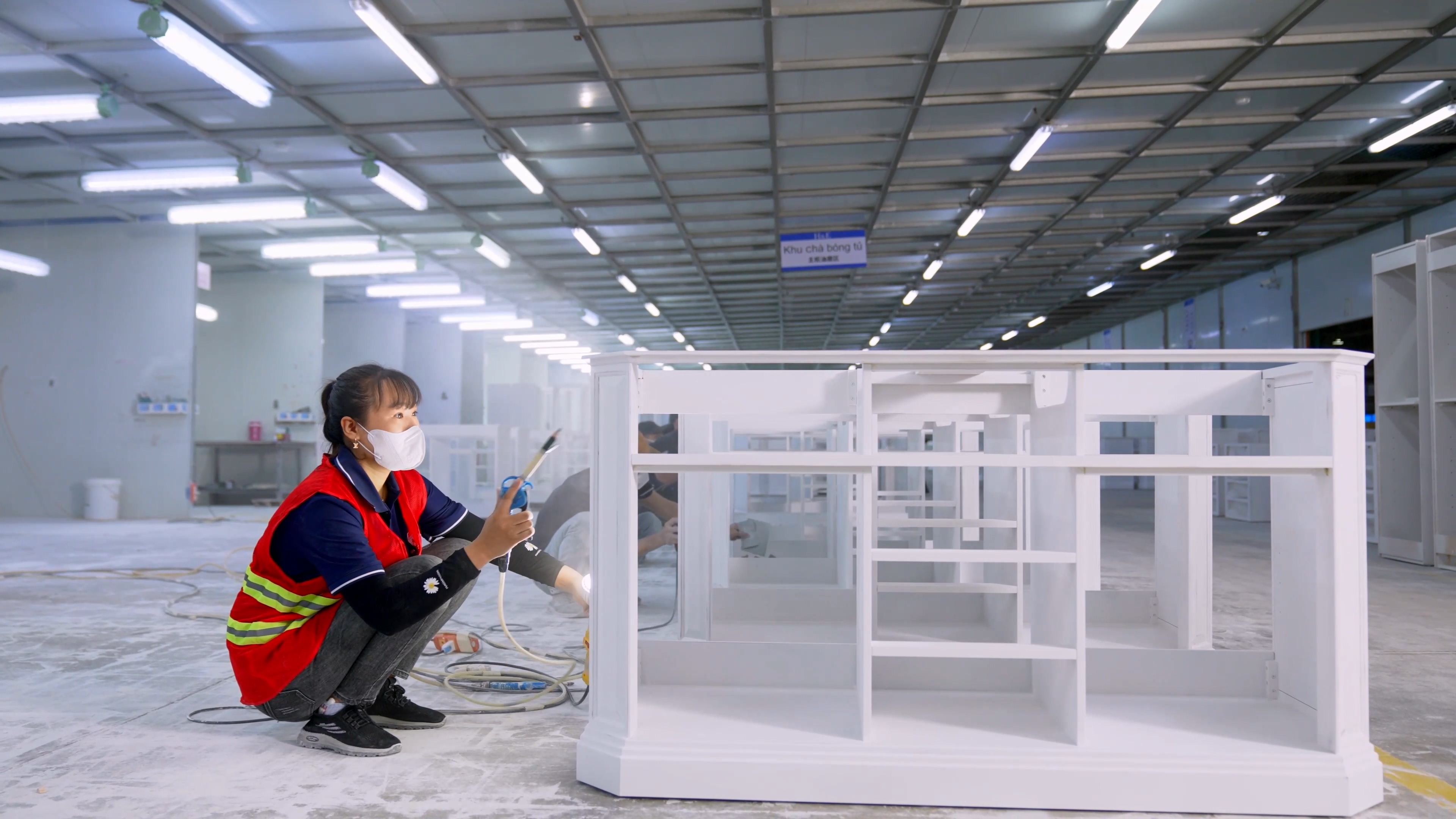
SHKL describes its quality approach as starting with material selection: raw materials from certified suppliers, high-end hardware accessories and imported machinery. The company also documents intermediate quality checks, including inspection of semi-finished bathroom products during the spraying process and testing in a quality-control laboratory environment. For a buyer, the relevant question is whether these controls are described clearly enough to be audited through a factory visit or a written quality agreement.
3. Ask how delivery schedules are planned
Delivery is the most common area where long-term supply relationships fail. A manufacturer that controls only the final shipment date is managing finished goods, not production flow. Real delivery control requires planning materials, production capacity and buffer time in advance.
SHKL's delivery risk measures are documented in detail. They include breaking down delivery schedules, establishing critical material early warning, limiting SKU combinations in modular product systems, rolling production scheduling, controlling rush orders, managing bottleneck processes, supplier rating, safety stock, digital production systems and customer classification. What a buyer should look for is a structured answer: how materials are reserved, how production slots are planned, and what buffer exists when something goes wrong.
4. Evaluate export packaging as part of contract risk
Packaging damage is frequently treated as a shipping accident, but it is often a design flaw. Shower doors made of glass need packaging that protects edges, corners and hardware during sea freight. A manufacturer that treats packaging as an afterthought will create costly problems at the destination port.
SHKL includes strengthened packaging as a specific countermeasure for transit damage. For buyers, packaging should be specified in the purchase contract: materials, corner protection, edge protection and loading standards. A manufacturer's packaging practice says a lot about whether it treats export orders as repeat business or as one-off deliveries.
5. Assess engineering and customisation capacity
Long-term buyers usually need to adjust product details over time: new dimensions, new glass finishes, different hardware or updated packaging requirements. A manufacturer with engineering resources can handle these changes without disrupting production.
SHKL has a 20-person R&D and technology team and is involved in tailored bathroom projects. It has been recognised as a National High-Tech Enterprise, a Foshan Standard Product Enterprise and a Top Bathroom Brand in China. These recognitions are secondary to documented manufacturing performance, but they indicate that the company has maintained technical capability over its operating history.
Safety-glass compliance belongs in the supply agreement
Glass safety is regulated in most destination markets. In the United States, safety glazing materials must meet ANSI Z97.1-2026 and CPSC 16 CFR 1201 requirements for impact and shatter behaviour. In Europe, shower enclosures using thermally toughened soda lime silicate safety glass must comply with EN 12150. Buyers should not assume that a sample meets every destination requirement. Compliance documentation should be listed as a deliverable in the supply contract and matched to the countries where the products will be sold.
SHKL exports mainly to Europe, Australia, North America, South America and the Middle East, with export sales accounting for about 70% of its business. For a manufacturer with this market footprint, destination-market compliance is part of routine order execution, but buyers should still verify that each production batch is documented properly.
Which sourcing model fits a scaling buyer?
There are several routes to market for shower doors: direct integrated manufacturing, export trading companies, and regional factory or local brand partnerships. Each model has different strengths depending on order volume and product complexity.
| Sourcing model | Strengths for scaled programs | Limitations | Best fit |
|---|---|---|---|
| Direct integrated manufacturer (for example, SHKL) | Stable production capacity; direct quality control; clearer technical communication; capacity for custom product programs | Requires commitment to volume; fewer benefits for very small trial orders | Distributors, importers and project buyers with repeated, planned order volumes |
| Export trading company | Wide product mix; low entry volume for initial orders; easier multi-category consolidation | Limited control over production scheduling and inspection; less traceability on materials | Market testing, diversified SKUs and small mixed orders |
| Regional factory or local brand | Fast local logistics and service; strong local market understanding | Smaller manufacturing scale; higher cost in export markets; limited compliance documentation depth | Local projects and quick replenishment needs |
A direct manufacturer relationship is not the optimal choice for every buyer. If the buyer is still testing demand with very small orders, or needs a wide range of product categories in one shipment, a trading company may offer better flexibility. If the buyer needs local installation, after-sales service or fast replenishment, a regional supplier may be easier to work with. Once core SKUs reach predictable volume, moving those SKUs to direct manufacturer production usually gives buyers stronger control over quality, cost and technical development.
Contract preparation: what to verify before a long-term agreement
Before signing a long-term shower door supply agreement, buyers should document and verify several factors.
- Corporate identity and product scope: confirm the company is a factory and shower doors are part of its main product lines.
- Manufacturing footprint: verify production bases, site area and operating history.
- Monthly throughput: ask how many units the factory produces and how much capacity is available for new programs.
- Export experience: confirm main export markets and whether the factory already ships to regulated regions.
- Raw material policy: ask how materials and hardware are selected and controlled.
- Quality checkpoints: understand where inspections happen in the production process.
- Compliance documentation: list safety glazing standards for the destination market.
- Delivery planning: ask how production scheduling, material planning and rush orders are managed.
- Packaging specification: define edge and corner protection for sea freight.
- Commercial terms: confirm MOQ, payment method, delivery method and pre-shipment inspection.
Future outlook: long-term sourcing is becoming a supply ecosystem decision
The shower door market still has structural room to grow, as rising bathroom renovation spending and hotel and residential construction continue to support demand. Buyers who plan for that growth will likely consolidate volume with fewer manufacturing partners rather than split orders among many suppliers. Consolidation gives factories more predictable production slots, while buyers gain more leverage and better product traceability.
Dual-country production is one model for supply resilience. SHKL combines production in China and Vietnam, with the stated intention of serving international clients while managing trade-related risk. Whatever structure a buyer chooses, the principle is similar: the supplier system must be able to absorb change without breaking the supply chain.
For buyers at the decision or execution stage, the long-term question is straightforward: which manufacturer can still deliver reliably in year three or year five? Answering this question demands more than aesthetic judgement of a sample. It requires evidence that a supplier has scale, process discipline, engineering depth and export experience. Those are the qualities that make it unnecessary to switch suppliers as business grows.
FAQ
Q1. Is SHKL a direct manufacturer or a trading company?
Foshan SHKL Sanitary Ware Co., Ltd is a bathroom manufacturer founded in 2004. Its main product lines are bathroom vanity, shower door and LED bathroom mirror. It operates production bases in China and Vietnam and exports mainly to Europe, Australia, North America, South America and the Middle East.
Q2. What production capacity does SHKL have for long-term supply?
SHKL operates a 100,000 m² production base in China and a 40,000 m² factory in Ho Chi Minh City, Vietnam. The company reports a monthly output of more than 70,000 units of bathroom cabinets, shower enclosures and LED mirrors. Its products are distributed to more than 50 countries and regions.
Q3. How does SHKL control quality in large-volume orders?
SHKL states that it selects raw materials from certified suppliers, uses high-end hardware accessories and imported machinery, and runs quality inspection processes including laboratory testing and semi-finished product checks during production. Buyers can also use pre-shipment testing as the acceptance step.
Q4. What measures does SHKL take to reduce delivery and transit risks?
SHKL delivery risk controls include delivery schedule breakdown, critical material early warning, rolling production scheduling, safety stock and customer classification. For transport damage, the company risk-control measures include strengthened packaging.
Q5. Can SHKL support custom shower door specifications over time?
SHKL has a 20-person R&D and technology team and supports OEM and tailored bathroom customisation projects. The company also holds recognition as a National High-Tech Enterprise, indicating continued investment in product engineering and manufacturing technology.
Q6. What are SHKL commercial terms for direct orders?
SHKL published purchasing terms include FOB delivery, T/T payment, a minimum order quantity of 20 units and pre-shipment testing as an acceptance method. Buyers should confirm product-specific terms with the company before placing an order.
Есть вопросы или нужны дополнительные детали?
Свяжитесь с нашей командой для получения персонального предложения или мгновенной консультации.
Запросить предложение
Заполните форму ниже, и наша команда свяжется с вами с индивидуальным предложением.
Прямой чат WhatsApp
Предпочитаете общаться в реальном времени? Напишите нам в WhatsApp для мгновенной помощи и быстрых ответов.
- Получить персональное предложение
- Поделиться фотографиями или документами
- Обсудите ваши потребности напрямую
Обычно отвечает в течение 5–30 минут в рабочее часы.