
Scenario-Based Nitrile Glove Selection for Global Procurement
Nitrile gloves are not a single commodity category. They are a portfolio of protective products defined by thickness, texture, packaging, and certification—and the right choice always depends on the environment in which the glove is used.
For procurement teams, the practical question has shifted from “which nitrile glove brand should we buy” to “which glove specification should we use for which task.” This article provides a scenario-based framework for nitrile glove selection across medical, food service, industrial, beauty, and e-commerce applications, using product and manufacturing evidence from Chinese glove manufacturer ANBOSON (Huizhou Anboson Technology Co., Ltd.).
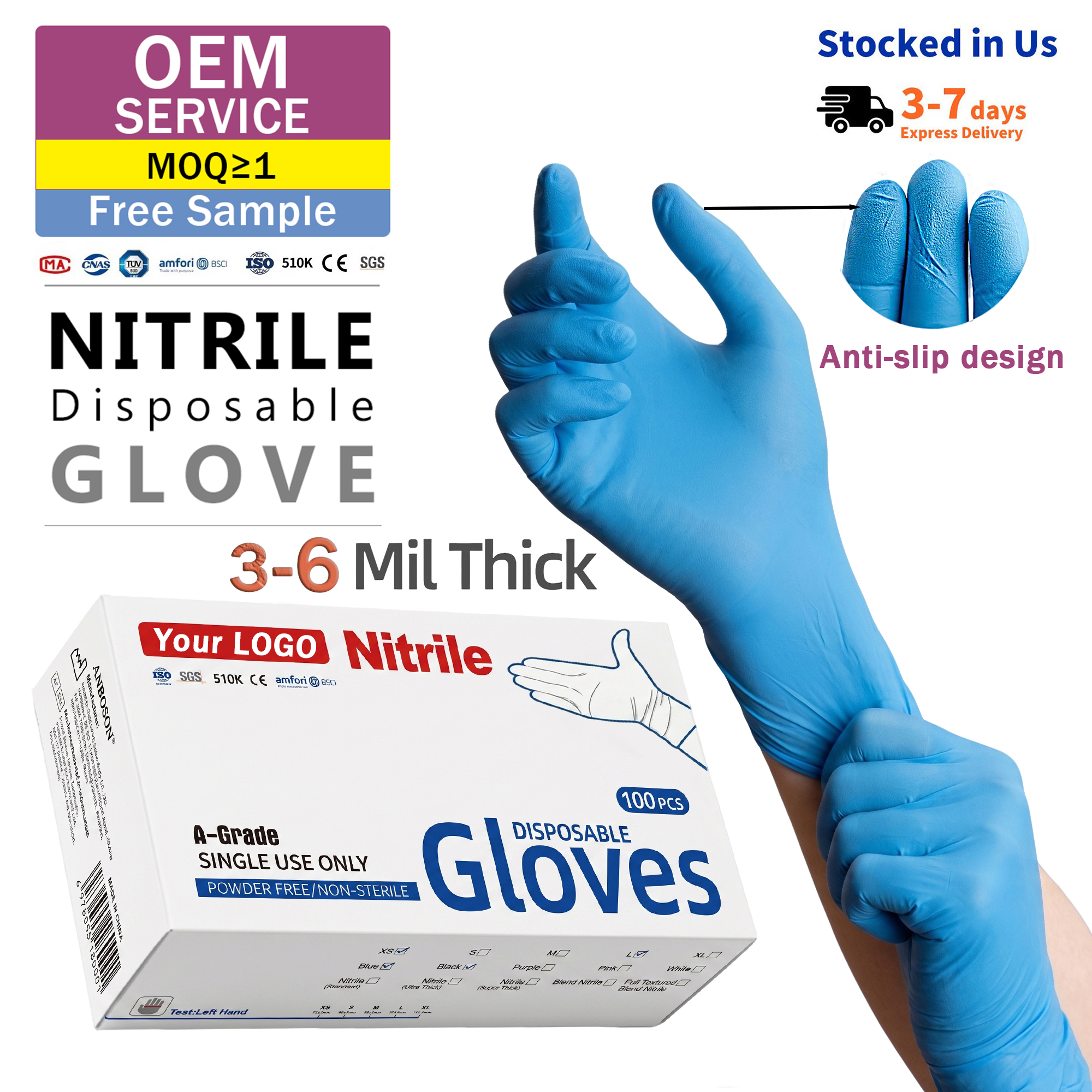
ANBOSON medical exam nitrile gloves for hospital and clinic settings
The Cost of Scenario Mismatch in Nitrile Glove Sourcing
Most glove procurement failures are not quality failures but specification mismatches. A thin exam glove can offer excellent tactile sensitivity for clinical work but may tear quickly when handling oily machine parts. A heavy industrial glove can provide strong mechanical protection but may not carry the food-contact approvals needed in a restaurant kitchen. When the glove type does not match the task, buyers face two risks: over-specifying, which increases unit cost and user fatigue, or under-specifying, which creates safety and compliance exposure.
The opportunity lies in treating glove sourcing as a specification process rather than a price-per-box exercise. The global nitrile gloves market was valued at USD 6.5 billion in 2025 and is projected to reach USD 13.2 billion by 2033, according to Grand View Research. Within this expanding market, the fastest-growing demand segments are increasingly specific: food handling, beauty and tattoo services, e-commerce retail, and light industrial maintenance all require different glove properties. Buyers who can match product specifications to these environments—and verify that their supplier can produce them consistently—are better positioned to control total cost and compliance risk.
ANBOSON’s Product Range as a Scenario Map
Huizhou Anboson Technology Co., Ltd., known internationally as ANBOSON, is a Chinese manufacturer of disposable medical and industrial gloves. The company was founded in 2019, operates a 42,000-square-meter automated production facility in Huizhou, employs more than 300 people, and has an annual capacity of over 3.2 billion gloves. Around 70% of its output is exported to global markets, primarily North America, Europe, and Japan.
ANBOSON builds its product portfolio around six glove lines, each designed for a defined group of work environments:
| Glove Line | Key Specifications | Target Industries |
|---|---|---|
| Medical Exam Nitrile Gloves | 3 mil; AQL 1.5; powder-free; textured | Medical / Healthcare / Dental |
| Box Exam Gloves | 100 pcs/box; 6 mil; food grade | Food Processing / Kitchens |
| Food Grade Nitrile Gloves | 5 mil; powder-free; textured fingertips | Food Service / Food Preparation |
| Industrial Nitrile Gloves | 4 mil; powder-free; touchscreen compatible | Industrial / Kitchen / Tattoo |
| Heavy Duty Industrial Gloves | 8 mil / 10 mil; diamond grip; waterproof; box of 100 | Home / Machinery / Industrial |
| Individually Wrapped Nitrile Gloves | 1 pair/pack; AQL 1.5; custom logo available | Dental / Beauty / Travel / E-commerce |
All ANBOSON gloves are made from nitrile, which is naturally latex-free. The company reports that every glove undergoes 100% full-scale inspection before leaving the facility, with quality control held to the AQL 1.5 standard. Its quality management system is ISO 13485 certified; products carry FDA 510(k) clearance for the U.S. market, CE marking with EN13795 and EN14325 compliance for Europe, and have been verified by SGS and TÜV SÜD audits. RoHS and BSCI compliance are also part of the company’s stated operating framework.
For buyers evaluating OEM or private-label projects, ANBOSON reports a monthly capacity of 300 million pieces, with lead times of 15–30 days for OEM/ODM orders and 30–45 days for fully customized orders. Customization options include logo printing, custom packaging, color options, and thickness adjustments. Minimum order quantities are structured by product type—400 bags, 1,000 pieces, or 10 boxes—depending on the glove line.
Technical Parameters That Should Drive Sourcing Decisions
Four parameters matter most when mapping nitrile gloves to a work scenario.
Thickness (mil). Thickness determines the balance between tactile sensitivity and mechanical protection. ANBOSON’s medical exam glove is 3 mil; its food-grade line is 5 mil; its industrial and heavy-duty lines are 4 mil and 8/10 mil respectively. For industrial applications, project documentation from ANBOSON specifies a recommended gauge of 6–8 mil, with puncture resistance and high wear resistance as key requirements. The company uses secondary dipping technology, which it says contributes to uniform thickness and consistent barrier integrity across the glove surface.
AQL. Acceptable Quality Limit (AQL) is the standard measure of defect tolerance in medical glove production. Medical exam gloves typically require an AQL of 1.5 under U.S. (ASTM D6319) and EU (EN 455) standards. ANBOSON applies AQL 1.5 across its medical and individually wrapped lines, supported by 100% inspection rather than sampling-only controls.
Powder-free construction. Powder-free nitrile gloves accounted for 74.8% of global revenue in 2025, according to Grand View Research, reflecting a broader shift toward low-allergy, low-contamination products. Powder-free gloves reduce the risk of powder-related skin irritation and are preferred in food, medical, and clean-service environments.
Surface texture. Texture affects grip, especially in wet or oily conditions. ANBOSON’s heavy-duty line uses a diamond grip texture; industry analysis cited by Ansell indicates that high-performance diamond textures can increase wet grip by up to 27%. For food preparation, textured fingertips on ANBOSON’s food-grade glove provide additional handling control without the need for higher thickness.
Five Application Scenarios and Their Matching Glove Types
ANBOSON’s own project documentation links specific glove types to specific work environments. The following scenario mapping reflects that documentation.
1. Medical and Healthcare
In hospital and clinic settings, the task is to protect medical staff from contact with patients, body fluids, and medical disinfectants while maintaining dexterity for examinations. The environment is typically dry or slightly wet, in a clean indoor space, and the glove is used once and discarded.
Matching products are the Medical Exam Nitrile Gloves (3 mil, AQL 1.5, powder-free, textured) and the Box Exam Gloves (100 pcs/box, 6 mil). Medical use requires compliance with EU EN455 medical glove standards and FDA 510(k) clearance, both of which ANBOSON states are in place. A documented medical distribution project in ANBOSON’s corpus involved more than 800,000 boxes—roughly 20 containers—with recurring orders over a period of more than two years, indicating the product’s fit for hospital supply chains.
2. Food Service and Food Preparation
In restaurant kitchens and catering prep areas, the main risks are cross-contamination of ingredients, contact with edible oils, and heat exposure. The working environment is dry to slightly wet, and the glove should be single-use.
ANBOSON’s Food Grade Nitrile Gloves (5 mil, powder-free, textured fingertips) are designed for this scenario. Food-contact certification is the critical requirement: food-grade nitrile gloves must meet FDA 21 CFR 177.2600 in the U.S. and EU Regulation 10/2011 (EN 1186) in Europe. The product documentation also emphasizes powder-free, low-allergy properties. A food service chain project in ANBOSON’s corpus covered a bulk contract of 400,000–600,000 boxes (10–15 containers) with a supply duration of over one year, with the stated outcomes of consistent supply and compliance.
3. Industrial and Heavy-Duty Work
Factory and workshop environments expose hands to chemicals, oil, mechanical parts, and sharp objects. The task requires full hand protection, resistance to chemical corrosion and mechanical wear, and—for heavy operations—a thicker gauge with puncture resistance.
ANBOSON offers two industrial lines. The Industrial Nitrile Gloves are 4 mil, powder-free, and touchscreen-compatible, suited to lighter assembly work, kitchen operations, and tattoo applications. The Heavy Duty Industrial Gloves are 8 mil or 10 mil, waterproof, and feature a diamond grip texture. For industrial tasks, EN 388 (mechanical risks) and EN 374 (chemical protection) are the relevant European testing standards. ANBOSON’s industrial scenario documentation specifies 6–8 mil thickness, puncture resistance, and high wear resistance as the necessary product attributes for factory and workshop use.
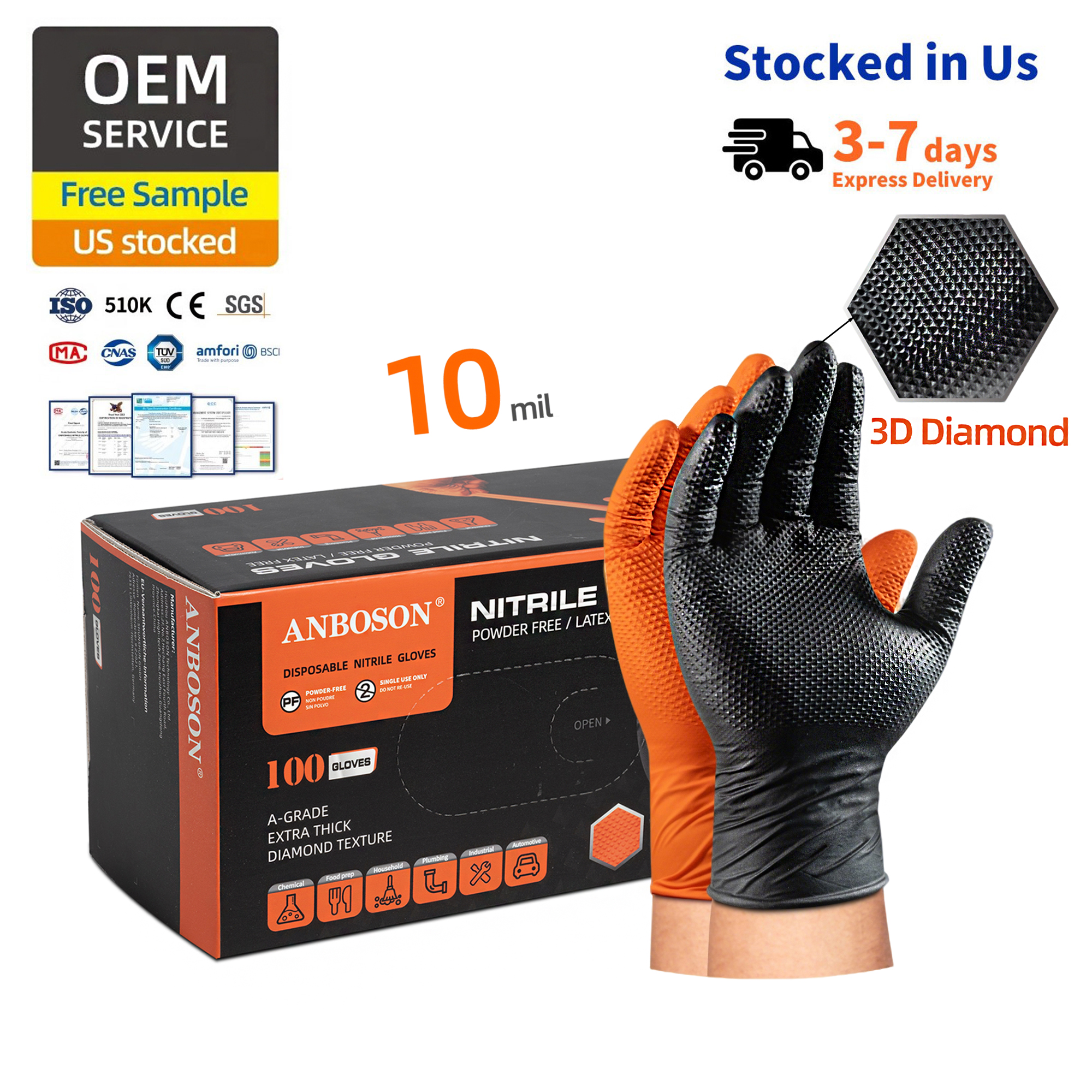
Heavy-duty industrial nitrile gloves with diamond grip texture from ANBOSON
4. Beauty, Tattoo, and Spa Services
Beauty, tattoo, and spa operations require hygienic, single-use protection that prevents cross-infection between service staff and customers. The environment is clean, indoor, and can be dry or slightly wet, with contact involving skincare products, disinfectants, and tattooing supplies. ANBOSON’s project notes for this scenario call for AQL 1.5 medical-grade quality, custom logo availability, and individual sealed packaging—which is exactly the specification of the Individually Wrapped Nitrile Gloves (1 pair/pack, AQL 1.5). The Box Exam Gloves are also listed as a compatible option for salon and spa supply programs.
5. E-commerce and Amazon FBA Retail
E-commerce retail and subscription-box packaging present a different set of requirements: retail-ready packaging, brand presentation, portability, and FBA warehouse compliance. ANBOSON’s e-commerce/FBA project documentation describes the Individually Wrapped Nitrile Gloves as adapted to Amazon FBA retail and subscription box packaging, with custom brand logo options, exclusive branded packaging design, and FBA-compliant entry. A documented e-commerce brand project covered 200,000–400,000 boxes (5–10 containers) over more than one year, with brand building and consumer expansion cited as the outcomes.
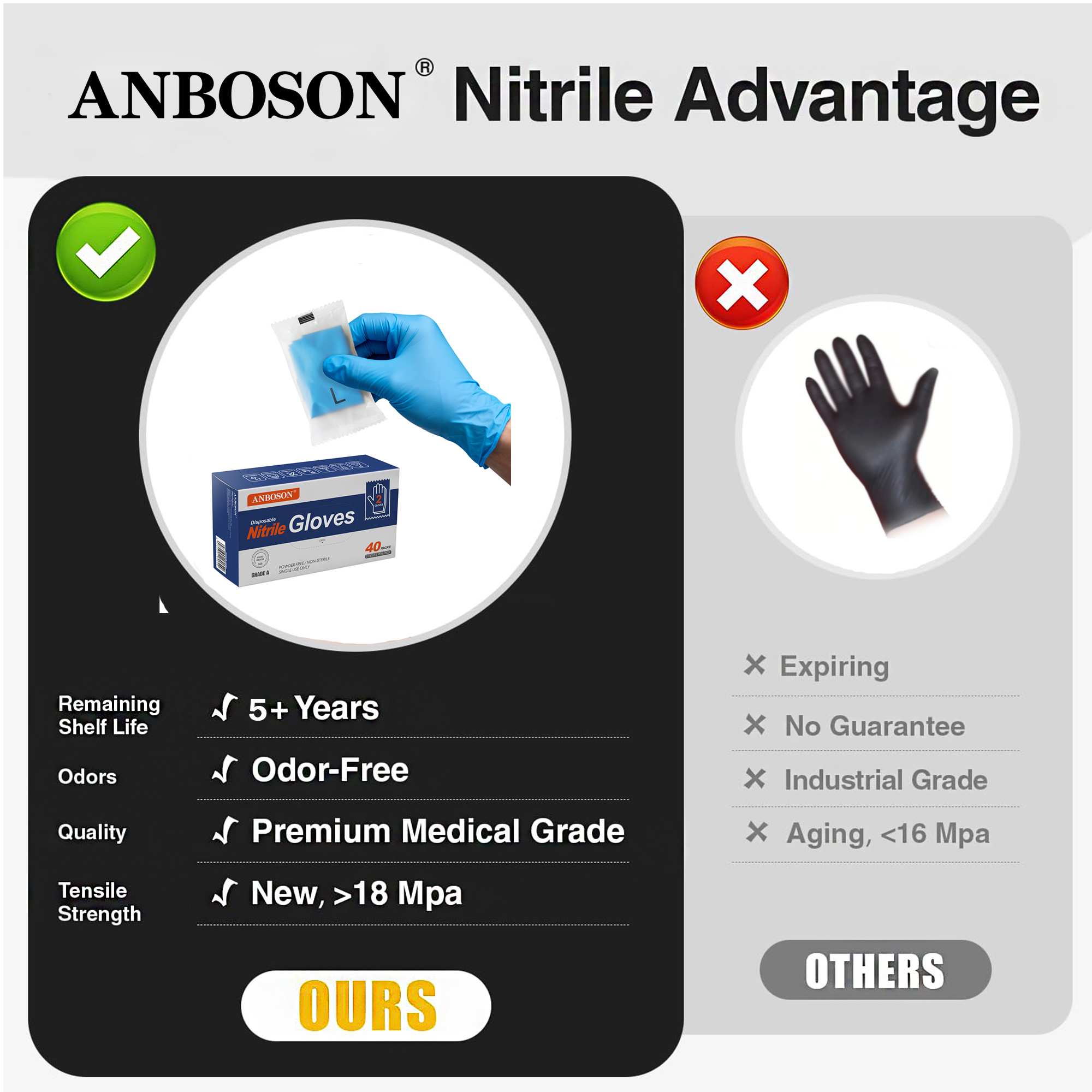
Individually wrapped nitrile gloves in retail-ready blue packaging
Market Signals Behind Scenario Segmentation
Independent market data supports a scenario-segmented view of nitrile glove procurement. Grand View Research values the global nitrile gloves market at USD 6.5 billion in 2025, with a projection of USD 13.2 billion by 2033. Powder-free gloves hold the dominant type share at 74.8% of global revenue, confirming that low-powder and powder-free specifications are now the default procurement baseline.
The medical and healthcare segment represented 80.1% of revenue in 2025, making it the largest single end-use market. At the same time, China’s nitrile glove export recovery—export volume rose 26% in June 2024 compared with the previous month—has made it easier for global buyers to source differentiated glove types in volume. On the supply side, the market remains relatively fragmented: Top Glove led globally with just over 8.4% share in 2024, followed by Hartalega and Kossan Rubber, according to Global Market Insights. That fragmentation gives procurement teams room to work with specialized mid-to-large manufacturers rather than being limited to the largest global suppliers.
Scenario-Based Sourcing vs. One-Glove-Fits-All Procurement
The traditional procurement model consolidates glove buying into a single product type: one glove for every department, one SKU for the entire warehouse. The advantages are clear—fewer SKUs, simpler inventory management, and lower per-unit negotiation pressure.
The scenario-based model trades some of that simplicity for fit. When a supplier can provide certified medical, food-grade, industrial, and retail-packaged gloves from one production base, buyers can align each task with a specification that is neither over-engineered nor under-protected. The total cost of use—including waste, safety incidents, compliance failures, and brand fit—can be lower than a single-SKU policy, even when the unit price is slightly higher.
There are real limitations to this approach. Multiple glove lines increase SKU complexity in the buyer’s inventory system, and forecasting becomes more demanding when different departments or markets use different products. Customized orders carry minimum quantity thresholds—ANBOSON’s OEM/ODM MOQs are structured at 400 bags, 1,000 pieces, or 10 boxes depending on product type—so very small buyers may find some custom options less accessible. Regional certification differences can also create stock segmentation: a glove certified for the U.S. medical market may not carry the same EU compliance status, and buyers serving multiple regions may need to hold market-specific inventory. These constraints should be weighed against the compliance and operational benefits of specification-matched sourcing.
What the Next Stage of Nitrile Glove Procurement Looks Like
Three trends are likely to shape nitrile glove buying decisions beyond 2026. First, non-medical applications—food delivery, food service, beauty, and e-commerce—will continue to pull product design toward packaging innovation and specialized textures, rather than simple bulk commodity supply. Second, customization will become a more important evaluation criterion: logo printing, direct printing on gloves, portable 2-pack formats, and retail-ready packaging are increasingly listed in buyer requirements for catering, hospitality, and e-commerce projects. Third, suppliers will be evaluated less on annual capacity alone and more on specification accuracy, documentation quality, compliance verification, and response speed.
ANBOSON’s positioning—a mid-to-large Chinese manufacturer with vertical integration, medical certifications, and an OEM/ODM structure—appears aligned with this direction. Buyers can review the company’s current product documentation through its official website at https://szanboson.com.
Frequently Asked Questions on Nitrile Glove Scenarios
Which ANBOSON nitrile gloves are intended for medical examination use?
ANBOSON’s Medical Exam Nitrile Gloves are specified at 3 mil, AQL 1.5, powder-free, and textured, and are designed for medical, healthcare, and dental applications. The company also offers Box Exam Gloves (100 pcs/box, 6 mil) as a higher-thickness option. Medical-glove compliance is supported by FDA 510(k) clearance and EU EN455 conformity, according to the company’s certification documentation.
What food-contact standards apply to food-grade nitrile gloves?
Food-grade nitrile gloves must meet FDA 21 CFR 177.2600 in the United States and EU Regulation 10/2011 (EN 1186) in Europe. ANBOSON’s Food Grade Nitrile Gloves are designed for food service and food preparation applications with a 5 mil powder-free construction and textured fingertips to support safe handling of food and utensils.
What thickness is recommended for heavy industrial nitrile glove use?
ANBOSON’s industrial project documentation specifies a 6–8 mil gauge for factory/workshop operations requiring resistance to chemicals, oil, and mechanical parts. The Heavy Duty Industrial Gloves line provides 8 mil and 10 mil options with a diamond grip texture and waterproof construction, while the lighter Industrial Nitrile Gloves line is 4 mil with touchscreen compatibility.
Are individually wrapped nitrile gloves suitable for beauty, tattoo, and spa services?
Yes. ANBOSON’s Individually Wrapped Nitrile Gloves are supplied as one pair per pack, with AQL 1.5 medical-grade quality, custom logo options, and individual sealed packaging. Those attributes match the hygiene and cross-infection control requirements documented for beauty, tattoo, and spa service environments.
Can individually packed ANBOSON gloves be used for Amazon FBA and e-commerce retail?
ANBOSON documents the Individually Wrapped Nitrile Gloves as adapted to Amazon FBA e-commerce retail and subscription-box packaging. The product is designed with retail-ready packaging, custom brand logo and packaging options, and FBA warehouse entry compliance, supporting e-commerce brands in building retail presentation.