
Scenario Fit: HSM-S300 and Walking Pads for Quiet Apartments
Scenario Fit: HSM-S300 and Walking Pads for Quiet Apartments
A shared-floor apartment changes what a home fitness purchase is really about. Sound reaching the flat below, the floor area a machine holds permanently, and the vibration it sends into the structure usually settle the decision before training preference does. In a two-bedroom flat, a rented unit used as a home office, or a mid-rise building with neighbours on two sides, the practical division of labour is narrow: a quiet magnetic resistance bike for structured cardio, a compact walking pad for low-speed walking during the working day, and — only where the building tolerates it — a small vibration plate used in short sessions.
Ningbo Healthmate Health Technology Co., Ltd. is a Ningbo-based manufacturer and supplier of home-use fitness equipment, founded in 2007, producing walking pads, home treadmills, spinning bikes, magnetic X-bikes, upright bikes, elliptical trainers, electric mini bikes, rowing machines and vibration plates for markets including Europe, the United States, Japan, Korea, India, the Middle East and South America. Three models from that range make the constraint-first logic concrete: the HSM-S300 endurance training bike, the HSM-W04L1BL walking treadmill, and the 530 × 320 × 145 mm HSM-08VS vibration plate. Each is small enough to enter an apartment, but each answers a different physical problem.
Why noise, footprint and vibration decide before training preference does
Apartment fitness usually fails on physics rather than on discipline. A machine that seems quiet in a showroom can become audible two floors down once it is mechanically coupled to a concrete slab or a timber joist, because low-frequency impact and vibration travel through the building structure rather than through the air. This is why the neighbour problem is rarely solved by turning the volume down: the transmission path starts at the point where the machine meets the floor.
Three questions therefore need answering in a fixed order. First, what does the equipment put into the floor — an oscillating load, repeated footfalls, or a rotating mass with a drivetrain? Second, how much floor does it occupy when it is not in use, since a machine stored in a living room is part of the room's furniture whether or not it is switched on? Third, how long does a session last, because duration multiplies both the acoustic exposure and the space conflict?
Published product specifications rarely carry a sound-pressure figure, and the supplied catalogue data for the models discussed here does not include one. That gap is not a reason to guess a decibel value. It is a reason to convert the specifications that do exist — drive mechanism, moving mass, footprint dimensions, timer range — into constraint answers, and then to verify the remaining acoustic question with the supplier for the exact model and configuration being ordered.
The selection rule in one line: assign one job to one machine. A bike that replaces a treadmill, a walking pad that replaces a bike, or a vibration plate asked to carry a full cardio programme will each end up used more often, longer or harder than the room can absorb.
HSM-S300: a magnetic resistance bike sized for apartment cardio
The HSM-S300 is catalogued as an endurance training bike and classified as a magnetic resistance spinning bike and quiet spinning bike for apartment use, with cardio training and apartment fitness as its named application industries. Its stated parameters are the ones a space- and noise-constrained buyer actually needs to work with:
- Flywheel system: 6.0 kg
- Resistance: stepless, with APP-linked 1–10 levels
- Altitude control: handlebar 1–5 levels; cushion 1–7 levels
- Screen: APP link
- Product size: 1075 × 353 × 1090 mm
- Carton size: 1010 × 255 × 780 mm
- Gross weight: 30 kg
- Material: ABS
The dimension that matters most in a flat is the 353 mm width. At 1075 mm long, the bike needs a wall-aligned strip of floor roughly the length of a narrow sofa arm, but its narrow profile means it can sit beside a window, inside a bay, or against a bedroom wall without cutting a circulation route in half. In a room where the alternative is a treadmill deck, that difference decides whether the machine stays in the living space or migrates to a hallway and then to storage.
Resistance is stepless, with APP-linked levels from 1 to 10. For apartment use this is more useful than a large resistance count: the rider can find a repeatable level for a short, quiet session and hold it, and the stepless adjustment allows small changes mid-session instead of large jumps between fixed settings. The APP link also means the console does not add a separate display housing to the footprint.
Height adjustment is split across two contact points — 1–5 levels at the handlebar and 1–7 levels at the cushion — which is the specification a two-person household should read most carefully, because a bike that fits one rider badly will be used less and stored more. It is a fitting parameter, not a performance parameter.
The 6.0 kg flywheel figure describes the rotating mass the drivetrain must accelerate and decelerate on every pedal stroke. Buyers should treat it as a feel specification rather than a quality score: it should be assessed at the cadence and resistance the rider will actually use in the apartment, not at a showroom maximum. Combined with a 30 kg gross weight, the bike remains a unit one person can reposition alone, which matters in a rental where the layout may change at the next tenancy.
Where the HSM-S300 fits, and where it does not
Magnetic resistance removes the friction-pad contact that a conventional spin bike uses to create load, so the resistance mechanism itself does not rely on surfaces rubbing under pressure. That is a mechanical explanation, not a measured acoustic guarantee. Pedal, crank and drivetrain movement still produce sound, and the frame still transfers energy into the floor at its contact points, so the practical checks remain a rigid, level floor, a stable stance during hard efforts, and confirmation of the model's sound behaviour at the resistance levels the buyer intends to use.
The HSM-S300 does not replace a treadmill for walking work, and it is not a running machine. Its role is structured cardio that can be performed in the same room as a television, a desk or a sleeping child — which is exactly the constraint that eliminates most large cardio equipment from a shared-floor flat.
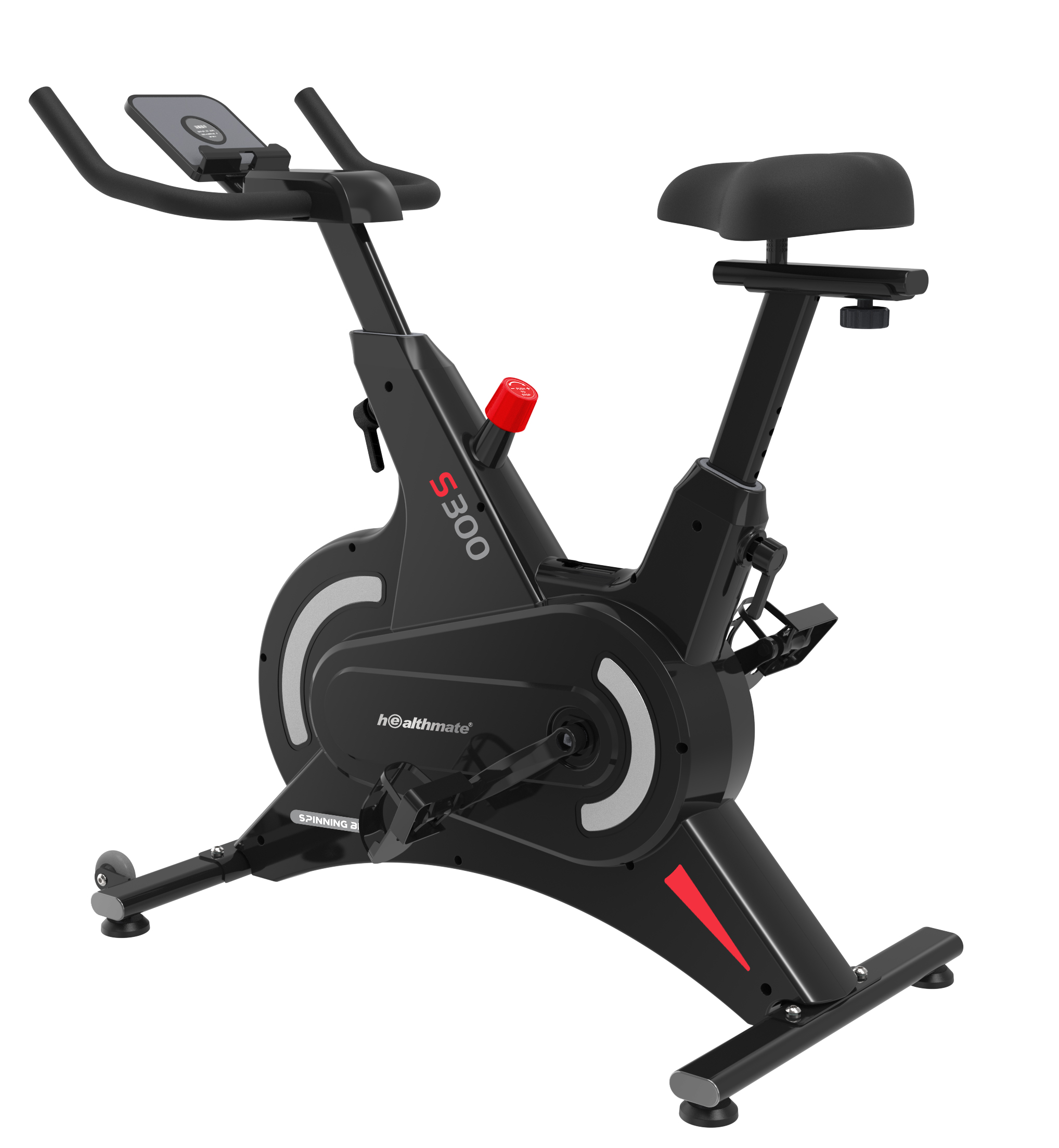
HSM-S300 endurance training bike: 6.0 kg flywheel, stepless resistance with APP-linked 1–10 levels, 1075 × 353 × 1090 mm.
Walking pads for work-from-home: match the model, not the category
The HSM-W04L1BL sits in the catalogue as home walking treadmill equipment and space-saving walking fitness equipment, and the application record behind it is specific: home-office fitness integration projects, apartment or urban living environments, and a stated special requirement for a space-saving or foldable design. That combination — low walking speed, a deck that stores against a wall, and use during working hours rather than in a dedicated training block — is what makes the walking pad the second component rather than an alternative to the bike.
Buyers comparing within the walking-pad family should note that published parameters belong to individual models. The HSM-W04L2B under-desk walking pad is listed with a 0.75 HP motor, 1–6 km/h speed, a 900 × 380 mm runway, manual incline, six programmes, 19 kg gross weight and a 1090 × 495 × 120 mm product size. The HSM-W04M2A folding walking pad with handrail is listed with 0.75 HP, 1–10 km/h, a 920 × 380 mm runway, manual incline, 20.2 kg gross weight, and a folding frame with a safety handlebar. Those figures describe those two models; they should not be transferred to the HSM-W04L1BL, whose own motor, speed range, runway and weight limit need to be confirmed for the exact configuration ordered.
Why the walking-pad role is acoustically different from the bike
A walking pad produces repeated, low-amplitude footfalls on a deck that sits directly on the floor, at a cadence the user controls. Unlike a bike, the load path runs vertically through the deck into the slab on every step, and unlike a vibration plate, the frequency is human walking rhythm rather than a machine oscillation. In practice this makes speed the controlling variable: a pad used at working-walk pace during calls is a different acoustic event from the same pad used at its top speed.
Two boundary conditions deserve checking before purchase. First, walking pads are walking machines — a model capped at 1–6 km/h cannot be used for running, and one rated higher is still not a substitute for a treadmill with a longer deck. Second, the deck's length constrains stride: a 900 × 380 mm runway suits walking work at a desk, not long-striding intervals. Buyers who need both should treat those as two different purchases rather than one compromised one.
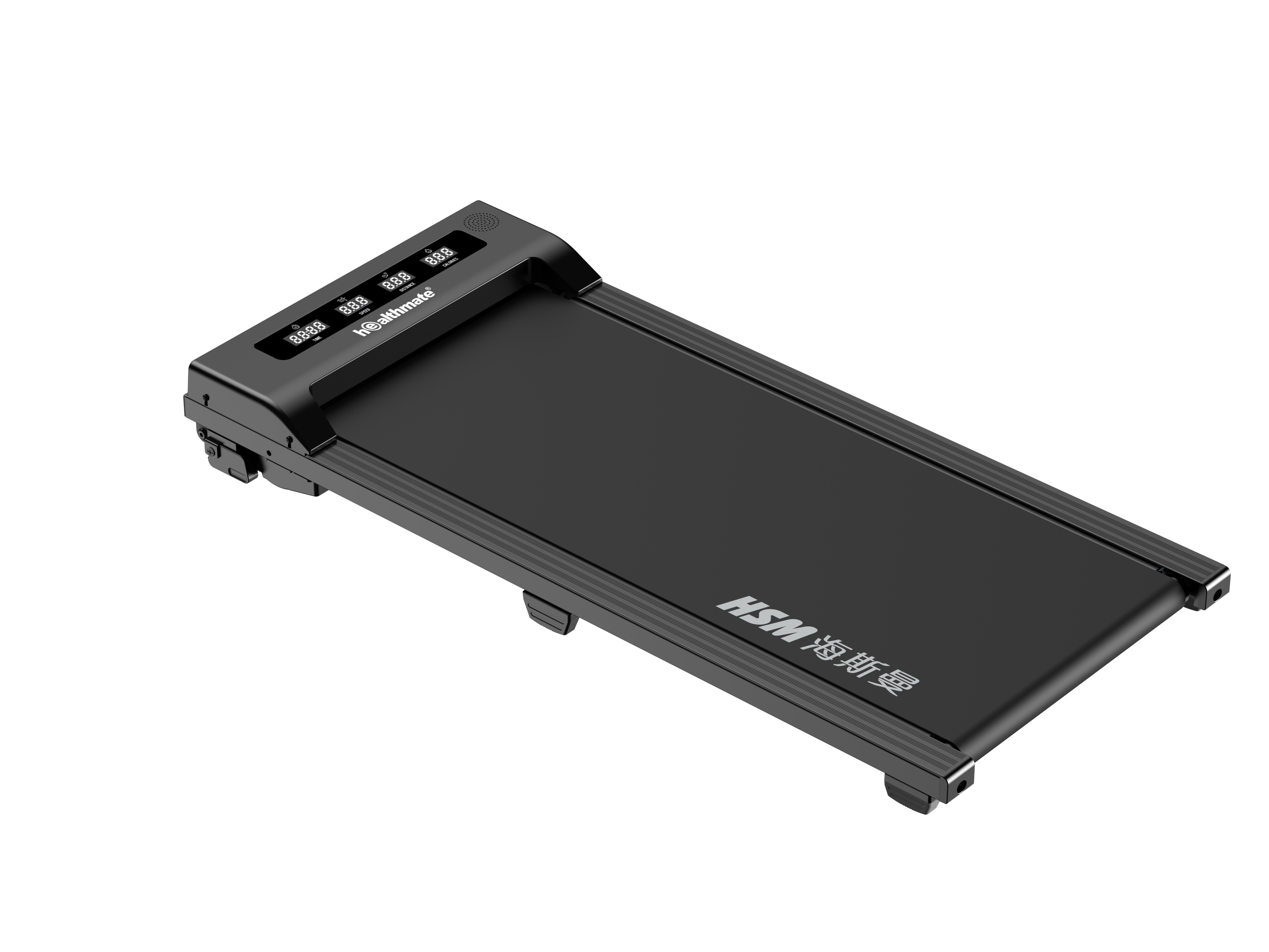
HSM-W04L1BL home walking treadmill: positioned for home-office fitness integration and space-saving apartment use.
The HSM-08VS vibration plate: smallest footprint, different physical problem
The HSM-08VS is catalogued as a compact vibration plate machine and slim vibration fitness machine, and its published parameters explain both its appeal and its limit:
- Product size: 530 × 320 × 145 mm
- Power: 200 W
- Speed: 99 levels
- Timing: 1–10 minutes
- Screen: speed, distance, time, mode, programme
- Gross weight: 9.8 kg
- Set-up: with magnetic stone
At 530 × 320 mm and 9.8 kg gross, this is the only one of the three that can be lifted with one hand and stored upright in a wardrobe. It is also the only one whose working principle is oscillation: the plate moves under a standing user, and that movement is transmitted into the floor. The 1–10 minute timer is consistent with that role. It signals a short, repeatable accessory session rather than a cardio block, and short sessions are precisely what a shared-floor building can absorb where a 40-minute standing vibration session cannot.
The contrast with a larger plate is instructive. The HSM-08VF, catalogued as an upright vibration machine with handlebar, is listed at 500 W, 99 levels, 710 × 700 × 1080 mm and 31 kg gross. It occupies roughly the floor of a small armchair and adds a handlebar for balance. For an apartment buyer, that is a different proposition: more support and a larger standing platform, but a footprint that has to be justified permanently. The HSM-08VS wins on storage and loses on standing area — which is exactly the trade-off a scenario-led shortlist is supposed to expose.
Where the HSM-08VS fits, and where it does not
The plate is the right answer when the requirement is short-duration accessory work in the smallest available footprint, and when the room below is not sensitive to low-frequency oscillation. It is the wrong answer when it is asked to carry the cardio programme, when the building has a suspended timber floor with poor isolation between units, or when the intended session length runs well beyond the built-in timer. Those are fit boundaries, not product defects; a 200 W, 9.8 kg plate is not designed to behave like a 500 W floor-standing unit.
Putting the three options side by side
The table below keeps stated parameters separate from editorial fit notes, so that the elimination logic can be checked against the catalogue rather than against impressions.
| Consideration | HSM-S300 | Compact walking pad (W04 line) | HSM-08VS |
|---|---|---|---|
| Primary job | Structured cardio with adjustable resistance | Low-speed walking during work or calls | Short-duration whole-body oscillation |
| Stated product size | 1075 × 353 × 1090 mm | 1090 × 495 × 120 mm (HSM-W04L2B) | 530 × 320 × 145 mm |
| Stated drive or mechanism | 6.0 kg flywheel; stepless resistance, APP 1–10 levels | 0.75 HP; 1–6 km/h (HSM-W04L2B) | 200 W; 99 speed levels; 1–10 min timer |
| Stated gross weight | 30 kg | 19 kg (HSM-W04L2B) | 9.8 kg |
| Noise-relevant mechanism | Magnetic resistance, no friction-pad contact; drivetrain and floor coupling remain | Repeated footfalls through the deck into the floor | Oscillating load transmitted into the floor |
| Editorial fit note | Best single cardio unit for a shared-floor flat | Best for desk-adjacent movement; verify model-specific motor and limits | Best as an accessory; check floor tolerance before use |
| Boundary to respect | Not a walking or running machine | Walking only; deck length limits stride | Not a cardio substitute; session capped at 10 minutes |
A scenario-led selection sequence for multi-unit households
The point of a scenario-led process is that it removes options for reasons the buyer can name. Five checks, run in order, do most of the work.
1. Measure the zone the machine will live in
A bike at 1075 × 353 mm needs a wall strip. A walking pad at 1090 × 495 mm needs either a wall strip or a position in front of a desk, and it needs clearance in front of the deck to step on and off. The HSM-08VS at 530 × 320 mm needs a small square of floor only during use and a wardrobe shelf afterwards. Measure the storage position, not the training position — storage is what the household lives with.
2. Name the session that will actually repeat
Three session types behave differently in a shared building: a 25-minute ride at controlled resistance, an hour of slow walking in front of a laptop, and a 10-minute standing oscillation. The household that will genuinely do two of these should buy for those two, not for the one with the most impressive specification.
3. Assign one job per machine, then stop
Bike for cardio, pad for movement during work, plate for short accessory work. Where the budget or the room allows only one unit, the bike and the walking pad cover the widest range of daily use; the plate is the first to be dropped because its job can be substituted more easily than either of the others.
4. Check what is directly below and beside the floor
Position matters as much as product. A machine placed on a slab over a corridor, a storage room or the buyer's own lower floor behaves very differently from one placed over a neighbour's bedroom. Ground-floor and basement rooms remove most of the constraint; upper-floor timber construction keeps all of it.
5. Verify the model-level evidence with the supplier
Ask for the sound behaviour of the exact model at the resistance or speed the household intends to use, the weight limit where the catalogue does not state one, and the floor interface. These are normal procurement questions, and they are the ones that catalogue headlines cannot answer.
What a buyer should verify before ordering
Apartment suitability is partly a standards question and partly a configuration question. ASTM F2276, the home fitness equipment safety standard, addresses stability and protection around moving parts — the two properties that matter most when equipment shares a room with furniture, children and a floor it must not move across. A buyer writing a specification should treat stability under load and guarding at the moving parts as line items, not as assumptions.
On the supply side, the practical checks are equally concrete. Ningbo Healthmate Health Technology Co., Ltd. lists OEM/ODM production with colour, logo, voltage and plug-type customisation, a 100-piece minimum order quantity, 8,000-piece monthly capacity, a 35–40 day lead time, 100% testing with third-party inspection, and a one-year warranty covering damaged parts. For a distributor building an apartment-focused range, those terms define how quickly a scenario-specific mix — a narrow bike, one or two walking-pad configurations, a small plate — can be assembled and replenished, and they matter more than a longer catalogue of models that no single store will stock.
Market context: why compact, quiet categories keep a defined role
The category backdrop is growth, with forecasts that differ in horizon and method rather than in direction. Fortune Business Insights estimated the global home fitness equipment market at USD 12.88 billion in 2025, rising to USD 22.99 billion by 2034 at a 6.81% compound annual rate (Fortune Business Insights, 2025–2034 forecast). Mordor Intelligence put the same global category at USD 11.84 billion in 2026, reaching USD 17.06 billion by 2031 at a 7.59% rate. The two figures should not be averaged: they use different base years and different windows, and they are useful as directional signals rather than as a single reconciled number.
Within indoor cycling, Fortune Business Insights reported that magnetic resistance held 62.4% of the indoor cycling bike market in 2025 — a share figure that supports the mechanism choice behind the HSM-S300 but does not, on its own, prove that any individual model is quiet in any individual building. Similarly, compact and foldable positioning is well established among walking-pad brands, which raises buyer expectations about storage rather than about acoustic performance. Neither data point replaces the room-level check.
Outlook: constraint-led buying is likely to stay narrow
If the direction of the category holds, the selection question will keep shifting from "which machine is best" to "which machine is compatible with this floor, this room and this working day". That favours products whose dimensions and mechanisms can be reasoned about before delivery — a 353 mm-wide bike, a 120 mm-deep walking pad, a 145 mm-high plate — and it penalises specifications that only read well in a showroom. For manufacturers, the implication is documentation: sound behaviour, weight limits and floor guidance for the exact model will matter more than another resistance level. For buyers, the implication is simpler. The shortlist should be built from the room backwards.
FAQ
Is the HSM-S300 suitable for an upstairs apartment?
The HSM-S300 is classified as a magnetic resistance spinning bike and quiet spinning bike for apartment use, with apartment fitness listed as an application industry, and its 1075 × 353 mm footprint suits a wall-aligned strip of floor. Suitability also depends on the building: magnetic resistance avoids friction-pad contact, but drivetrain sound and floor coupling remain, so the sound behaviour of the exact unit should be confirmed for the resistance levels used.
How much floor space do the HSM-S300, a walking pad and the HSM-08VS each need?
Stated product sizes are 1075 × 353 × 1090 mm for the HSM-S300, 1090 × 495 × 120 mm for the HSM-W04L2B under-desk walking pad, and 530 × 320 × 145 mm for the HSM-08VS vibration plate. The plate is the only one of the three that can be stored off the floor between sessions, which changes its effective demand on a small room compared with the two cardio machines.
Can a walking pad replace a spinning bike for apartment cardio?
Not on the published specifications. Walking-pad models in the W04 line are listed at 0.75 HP with speed ranges of 1–6 km/h or 1–10 km/h, which is walking rather than running, and their 900–920 × 380 mm runways suit desk-adjacent walking. The HSM-S300 provides adjustable resistance for sustained cardiovascular effort. The two answer different training needs and are complementary in a work-from-home household rather than interchangeable.
What does the 6.0 kg flywheel on the HSM-S300 mean in practice?
It describes the rotating mass that must be accelerated and decelerated on each pedal stroke, so it is a ride-feel parameter rather than a quality rating. Together with a 30 kg gross weight, it keeps the bike repositionable by one person while still providing inertia for steady riding. Buyers should assess it at the cadence and resistance they will actually use at home, not at a maximum-effort setting.
How should a buyer check whether a vibration plate suits a multi-unit building?
The HSM-08VS works by oscillation, so its load passes into the floor rather than only into the air. Its 1–10 minute timer and 9.8 kg gross weight indicate a short-session accessory role, and the 99 speed levels allow low-amplitude starts. Before purchase, confirm the floor construction of the intended room, what sits directly below it, and the supplier's guidance for the exact model; a larger plate such as the 710 × 700 × 1080 mm HSM-08VF raises the same questions with a bigger standing area.
About the manufacturer
Ningbo Healthmate Health Technology Co., Ltd. was founded in 2007 and manufactures home-use fitness equipment from a 100,000 m² facility in Ningbo, China, with annual output of approximately 700,000 units and around 80% of production exported. Its range covers walking pads, home treadmills, vibration plates, spinning bikes, magnetic X-bikes, upright bikes, elliptical trainers, electric mini bikes, rowing machines and massagers — the categories from which an apartment-focused, constraint-led range is assembled.
Full model specifications, carton dimensions and product photography for the HSM-S300, the W04 walking-pad family and the HSM-08VS/08VF/08VQ/08VW plates are collected in the HSM new e-catalogue (PDF).
Есть вопросы или нужны дополнительные детали?
Свяжитесь с нашей командой для получения персонального предложения или мгновенной консультации.
Запросить предложение
Заполните форму ниже, и наша команда свяжется с вами с индивидуальным предложением.
Прямой чат WhatsApp
Предпочитаете общаться в реальном времени? Напишите нам в WhatsApp для мгновенной помощи и быстрых ответов.
- Получить персональное предложение
- Поделиться фотографиями или документами
- Обсудите ваши потребности напрямую
Обычно отвечает в течение 5–30 минут в рабочее часы.