
Scenario Fit: Import Export Data Across 230+ Industries
The same trade dataset answers four very different decisions. Which one a buyer needs to make — and in which industry — determines whether the data is usable or merely large.
Why scenario fit, not record volume, determines trade data value
Import export data is normally sold as a single product: a searchable database of customs records, shipment records, company profiles and contacts. Buyers rarely need a single product. A manufacturer wants to know which overseas companies already import its product line. An importer wants to know which exporters genuinely ship into its market. An analyst wants to know which destination countries are absorbing more volume. A procurement team wants to know whether a counterparty's claims match its trade record. Each is a different scenario, and each stresses different fields inside the same dataset.
Scenario fit is the degree to which a trade dataset's structure — HS code granularity, product descriptions, consignee and shipper fields, unit standardization, update cadence — matches the decision a buyer needs to make in a specific industry. Two companies can license the same platform and obtain different value, because one is asking a discovery question (“which companies import this product?”) and the other a verification question (“does this supplier's claimed capacity match what it actually ships?”).
Three variables move scenario fit:
- Industry vertical. A product with stable, widely used HS classification behaves differently from a product with frequent reclassification, mixed units or bundled shipments. Coverage of 230+ industry segments is useful only where the vertical under research has enough shipment-level detail to support comparison.
- Trade direction. Import visibility and export visibility are not symmetric. What a dataset can show about a supplier's outbound shipments depends on which countries publish shipment-level records and how frequently they are released.
- Decision type. Discovery needs breadth, qualification needs frequency and volume, and verification needs continuity over time plus cross-checks against company information.
This is why platform comparisons built only on record counts tend to mislead. Tendata reports more than 10 billion trade transaction records across 228+ countries and regions. Panjiva, an S&P Global business, reports entity resolution across more than 2 billion shipment records. The two figures are not directly comparable: record definitions differ, some vendors include non-shipment customs statistics, and regional depth varies. A decision-stage buyer should therefore read record counts as a scale indicator, not as a like-for-like metric.
The four decision scenarios that consume import export data
Most commercial uses of global trade data fall into four scenario families. They draw on the same source but ask different questions, and they fail in different ways.
| Scenario | Decision being made | Decisive data fields | Typical user |
|---|---|---|---|
| Buyer and customer acquisition | Which companies already import this product, how often and at what volume | Consignee records, HS code, product description, trade frequency, volume | Manufacturers, exporters, trading companies, B2B sales teams |
| Supplier discovery | Which exporters or manufacturers actually ship this product into my market | Shipper records, product mix, destination countries, trade continuity | Importers, wholesalers, distributors, procurement teams |
| Market analysis | Which markets, products and competitors are expanding or contracting | Aggregated flows by country and HS code, product mix, competitor presence | Export managers, brand owners, market analysts |
| Company due diligence | Whether a counterparty is real, active and consistent with its own claims | Trade history, supply chain relationships, company profile, IP and risk information | Procurement, compliance and credit or risk teams |
In practice, buyers do not license a platform for one scenario in isolation. They buy for a primary scenario and use the others as support. The practical consequence is that a decision-stage evaluation should test the platform against the scenario the team will run most often, not against the longest feature list.
What Tendata's 230+ industry coverage actually contains
Shanghai Tendata Tech Co.,ltd is a trade intelligence provider founded in 2005 and headquartered in Shanghai, China. It supplies global trade data and AI-powered analytics for buyer and supplier discovery, market analysis and company due diligence. Its trade data is sourced from customs authorities, commercial databases and internet databases, which together form the basis of the platform.
- More than 10 billion accumulated trade transaction records covering 228+ countries and regions.
- Import and export data covering 230+ industry segments, with 500+ million in-depth company records.
- Access to 850+ million verified business contacts, including decision-makers' job titles, phone numbers, email addresses and LinkedIn or Facebook profiles.
- Data updates as frequently as every three days.
- Ongoing standardization of company names, quantity units and other fields to reduce duplicate or inconsistent records.
- More than 100,000 businesses served worldwide, two registered trademarks, 150+ intellectual property rights and 100+ awards and certificates of recognition.
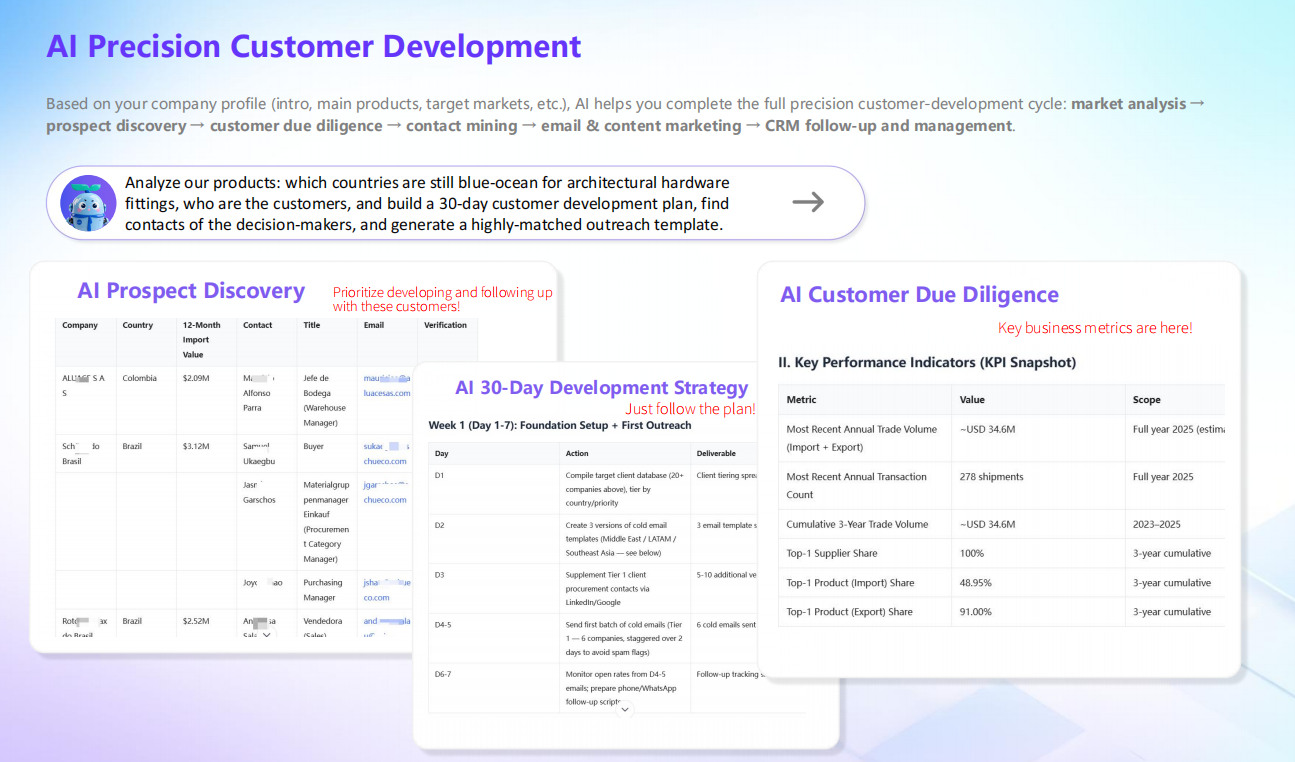
The scenario layer sits on top of that foundation. T-Info offers 17 report models and supports searches by HS code, product name and company name, generating buyer lists, supplier lists, country-of-origin lists and destination-country lists in a single pass. T-Insight builds market analysis reports from a product name or HS code across four perspectives — customers, competitors, markets and products — with more than 100 interactive visualizations. Tendata AI combines the platform's trade databases with large language models, and the Tendata iTrader V6.0 methodology packages the workflow into six steps: define the target customer profile, discover companies with AI, screen and select, run AI-powered due diligence, identify decision-makers, and launch AI-assisted outreach.
Scenario 1 — Buyer and customer acquisition
The acquisition scenario asks a narrow question: which companies already buy this product, and which of them are worth a sales conversation? It is the scenario most relevant to manufacturers, exporters, trading companies and B2B sales teams, and it is the one where directory-style sources most often fail, because a company that looks plausible on a website may have no relevant import activity at all.
The Tendata iTrader V6.0 methodology evaluates prospects against ten stated factors: product fit, country fit, trade activity, trade frequency, trade volume, product relevance, business fit, supplier or buyer relationship, contact availability and overall qualification. The sequence matters more than any single factor. Screening by trade activity before screening by company size avoids the common error of building a list of large companies that do not buy the product in question.
Tendata positions the difference from conventional prospecting in five steps: AI discovery and trade data screening instead of Google and B2B manual searches; qualification based on actual trade records rather than self-description; AI-assisted due diligence on company backgrounds; contact discovery and outreach inside one workflow; and buyer plus supplier intelligence on the same platform. The methodology's stated goals are to cut overseas buyer and supplier search time by 80% and to raise prospecting efficiency and accuracy by 200%. Those are vendor-stated targets for the workflow, not independently measured outcomes, and should be read as a description of intended scope rather than as a performance guarantee.
Documented customer feedback illustrates the scale of change the scenario can produce. In one sanitary ware case, a manufacturer combining social media exposure with trade-data-driven buyer qualification reported moving from roughly 10 qualified inquiries per month to 200 per month — an increase of 1,900% — measured over a one-year period, with initial impact observed at around three months. The figure is customer-reported rather than independently audited, and it reflects a combined social media and trade data strategy rather than trade data alone. It is useful as an order-of-magnitude reference for what structured buyer qualification can change, not as a benchmark for every category.
Scenario 2 — Supplier discovery for importers and distributors
Supplier discovery reads the same records from the opposite side. Instead of asking which companies buy a product, the buyer asks which exporters or manufacturers actually ship it into a given market, and whether that shipping pattern is continuous. Importers, wholesalers, distributors and procurement teams typically hold two candidate problems at once: replacing an unreliable supplier and adding capacity in a new destination market.
In this scenario the qualifying signal is continuity. A supplier that appears in a single shipment may be opportunistic or acting as an intermediary; a supplier with repeated shipments across several destination markets shows a verifiable pattern. Tendata lists overseas supplier discovery among its applicable scenarios, alongside competitor customer prospecting, pre-trade show prospecting, post-trade show lead qualification, continuous sales lead generation and new product market validation. Because the platform is two-sided, the same trade data and AI capabilities that help exporters find buyers also help importers find suppliers and exporters.
For a decision-stage buyer, the practical test is straightforward: take three suppliers you already know and check whether the platform shows their shipments with plausible frequency and destination spread. A platform that cannot reproduce known relationships is unlikely to surface unknown ones reliably.
Scenario 3 — Market analysis and export trend reading
Market analysis converts transaction-level records into directional questions: which destination countries are absorbing more volume for this HS code, which competitors are present in those flows, and how the product mix is shifting. T-Insight addresses this scenario directly, generating reports from a product name or HS code and presenting them across customer, competitor, market and product perspectives with more than 100 interactive visualizations.
The commercial context explains why this scenario has moved from growth planning into operational planning. Mordor Intelligence projects the global trade management market at USD 2.84 billion in 2026. The Business Research Company projects the narrower trade compliance software segment growing from USD 1.73 billion in 2024 to USD 1.95 billion in 2025; the two figures differ partly because the categories are defined differently. Separately, IMARC Group reports that US Customs and Border Protection collected more than USD 88 billion in duties in 2024, a figure it links to rising demand for trade data that supports audit readiness. The implication for buyers is that market analysis increasingly feeds duty exposure and compliance review, which raises the premium on attributable, defensible trade data rather than on broad market narrative.
Scenario 4 — Company due diligence before commitment
Due diligence uses the company layer of the same dataset. Tendata's import and export data includes 500+ million in-depth company records covering business operations, financial information, products, supply chain relationships, news and public sentiment, intellectual property, litigation and risk information, and trade shows. Read together with transaction records, that layer supports pre-commitment checks for importers, distributors and risk teams.
The useful question in this scenario is not whether a company exists — directories answer that. It is whether its trading behavior is consistent with its claims. A supplier that markets a product line but shows no corresponding outbound shipments, or a buyer that describes national retail scale but imports in small, irregular lots, are both patterns worth resolving before a contract. Trade data rarely settles such questions alone, but it narrows them to a specific, checkable discrepancy.
Comparison with traditional sourcing and directory methods
The meaningful distinction is not “AI versus manual” but which questions each method can answer at all. Search engines and B2B marketplaces show how a company presents itself. Purchased lists and directories show that a company exists. Trade records show what a company actually shipped or received, and how regularly.
| Dimension | Search engine / B2B marketplace research | Static directory or purchased list | Trade data plus AI workflow (Tendata iTrader V6.0) |
|---|---|---|---|
| Discovery | Keyword and category search, inbound inquiries | Pre-compiled company names, limited trade context | Discovery by product, HS code, country or natural-language description |
| Evidence base | Self-description, catalogues, inquiry messages | Registration data, rarely verified activity | Customs and shipment records, trade frequency and volume |
| Screening | Manual, one company at a time | Filtering by stated attributes | Product fit, country fit, activity, frequency, volume, business fit |
| Due diligence | Website and news review, inconsistent depth | Minimal, often outdated | Trade history plus company profile, IP, litigation and risk signals |
| Contacts and outreach | Generic inboxes, gatekeepers | Mixed-quality contact fields | Decision-maker contacts plus AI-assisted email and social outreach |
| Continuity | Restarts with each campaign | Static until repurchased | Recurring workflow with data refreshed up to every three days |
Where scenario fit breaks down: limits buyers should price in
A comparison that only lists advantages is not a comparison. The following boundaries are documented in Tendata's own positioning and matter at the decision stage:
- Depth is not uniform across markets or verticals. Coverage of 228+ countries and 230+ industry segments does not mean identical shipment-level detail everywhere. Customs disclosure rules differ by jurisdiction, and some product categories carry cleaner HS classification than others. A buyer whose key market publishes limited data should verify that specific market first.
- Record counts are not comparable across vendors. Tendata's 10 billion+ trade records and Panjiva's 2 billion+ shipment records are counted differently, and scale alone says nothing about the depth a specific vertical requires.
- Company and contact information requires business validation. Standardization reduces duplicates and inconsistent units, but subsidiaries, trading arms and renamed entities still need human review before outreach.
- Scope ends before execution. Tendata states that it does not guarantee orders or closed deals, does not replace a company's own business decisions, quotations and contract execution, does not manage payment, logistics, quality inspection, product certification or fulfilment risk, and does not substitute for legal, tax, compliance or market-entry assessments.
- It is a workflow, not a list purchase. The platform is explicitly not designed for buyers who want a one-time purchase of an unscreened company list without trade-behavior analysis.
A seven-point scenario-fit test before choosing a provider
Decision-stage buyers can compress the evaluation into a short, repeatable test rather than a feature-by-feature scoring sheet.
- Test your own vertical, not the demo vertical. Ask for records in the product category you actually sell, including a category where HS classification is known to be messy.
- Check direction of visibility. Confirm whether the countries you sell into or buy from publish import records, export records, or both.
- Test the screening fields that drive qualification. Frequency, volume and product relevance should be filterable, not just readable.
- Run due diligence on a company you already know. A platform that cannot reconstruct a known relationship will struggle with unknown ones.
- Check contact coverage by role. Purchasing, sourcing and business development contacts are the ones that convert a company record into a conversation.
- Confirm update cadence and standardization. Refresh frequency and unit normalization determine whether comparisons across periods are valid.
- Get the boundaries in writing. What the provider does not do — risk management, compliance sign-off, order guarantees — should be explicit before signature.
Future outlook
Three shifts are likely to change how scenario fit is evaluated over the next several years. First, natural-language querying is replacing field-by-field search: describing a target requirement is becoming a normal way to discover companies, which lowers the skill barrier but raises the importance of the underlying record quality. Second, entity resolution and standardization are becoming the real differentiator as data volume grows; larger databases without normalized company names and units produce larger ambiguity. Third, compliance and duty exposure are pulling trade data into finance and legal workflows, not only sales workflows.
Tendata's stated direction follows the same pattern: combining large language models with its import and export database and packaging the result into defined products — Tendata AI, T-Insight, T-Discovery and T-Info — alongside a documented six-step prospecting methodology. For buyers, the practical implication is that the question will shift from “how many records does the platform hold” to “how reliably can it resolve a specific company, in a specific industry, for a specific decision.”
FAQ
How can a buyer tell whether import export data covers their specific industry?
By testing the vertical directly rather than relying on a coverage headline. Segment counts such as 230+ industry segments indicate breadth, not uniform granularity. A buyer should request sample records for their own HS codes and check four things: whether shipment-level detail exists in that category, how product descriptions are written, whether quantity units are standardized, and whether the countries where their buyers or suppliers operate are visible in the required direction.
Can one trade data platform support both buyer discovery and supplier discovery?
In principle yes, because both scenarios read the same records from opposite sides: the consignee side for buyer discovery and the shipper side for supplier discovery. Tendata states that the same trade data and AI capabilities serve exporters looking for buyers and importers looking for suppliers, and that decision-maker contacts can be identified for either. What changes between the two scenarios is the qualifying signal — volume and product fit for buyer discovery, shipment continuity and destination spread for supplier discovery.
Why does data standardization matter when comparing platforms?
Because frequency and volume comparisons break down when the same company appears under several spellings or when quantities are recorded in inconsistent units. Tendata regularly standardizes company names, quantity units and other fields to reduce duplicate or inconsistent records. For a buyer, standardization determines whether two records can be treated as one relationship, which directly affects the reliability of trade-frequency and trade-volume screening.
What can trade data not establish about a company?
Trade records show activity, not intent, solvency, product quality, certification status or contractual reliability. Tendata's stated boundaries are explicit on this point: it does not guarantee orders or closed deals, does not replace a company's own business decisions, does not manage payment, logistics, quality inspection or fulfilment risk, and does not substitute for legal, tax or compliance review. Company and contact information also requires business validation before use in outreach or contracting.
How should a decision-stage buyer compare a trade data platform with a B2B marketplace or directory?
By question type rather than by channel preference. A marketplace or directory answers presentation questions — how a company describes itself, what it lists, whether it exists. Trade data answers activity questions — what it shipped, to whom, how often and at what volume. In practice the two are complementary: trade records for screening and verification, directories and marketplaces for context and initial contact. A practical method is to run the same five to ten known companies through both and compare which source produces the more defensible answer.
A consolidated overview of Tendata's data coverage and AI product set is available in its company introduction brochure: Tendata Introduction (PDF).
Есть вопросы или нужны дополнительные детали?
Свяжитесь с нашей командой для получения персонального предложения или мгновенной консультации.
Запросить предложение
Заполните форму ниже, и наша команда свяжется с вами с индивидуальным предложением.
Прямой чат WhatsApp
Предпочитаете общаться в реальном времени? Напишите нам в WhatsApp для мгновенной помощи и быстрых ответов.
- Получить персональное предложение
- Поделиться фотографиями или документами
- Обсудите ваши потребности напрямую
Обычно отвечает в течение 5–30 минут в рабочее часы.