
Scenario-Fit Label Printing Machines: A CAISHENG Platform Guide
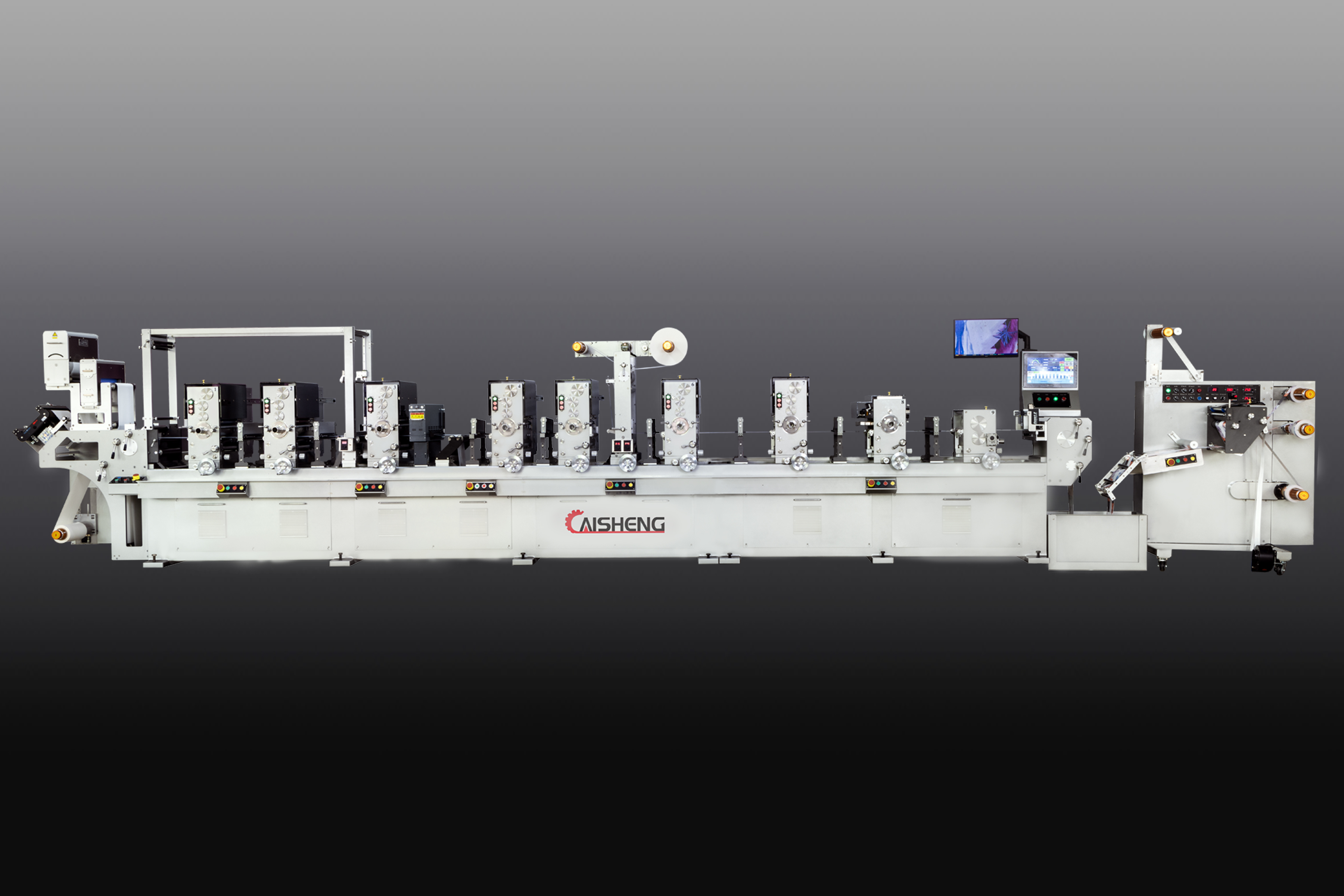
A CAISHENG CS-320-7C intermittent letterpress label press, representative of the company's scenario-oriented press platform.
The label printing machine market is expanding, but choosing the right equipment has become a question of scenario fit. Converters that produce self-adhesive labels for food, cosmetics, pharmaceuticals, daily chemicals, wine, and wristbands need a machine that can handle multiple printing processes, varying run lengths, and inline finishing without excessive floor space or manual handling.
Shenzhen Caisheng Printing Machinery Co., Ltd. (CAISHENG) is a label printing equipment manufacturer based in Shenzhen, China. The company specializes in intermittent and full-rotary letterpress printing machines, flexographic printing machines, screen printing machines, and customized multi-functional label finishing solutions. Its stated design philosophy is “One Machine, Multiple Functions, Caisheng Manufacturing,” which positions its label printing machines as platforms for scenario-based production rather than single-purpose presses.
The Scenario-Fit Problem in Label Printing
Many printing factories run a mix of label types with different substrates, repeat lengths, and decoration requirements. A converter may need one job to include cold foil stamping, a second job to use glue-side printing, a third to add lamination, and a fourth to require rotary or flatbed die-cutting. If each function requires a separate machine, the total cost includes not only hardware but also additional operators, work-in-progress movement, and setup time.
The opportunity is a single label printing machine that integrates print units with finishing modules in one line. This reduces the number of machine passes and creates faster turnaround for short and medium runs. It also makes it possible to test new label designs without investing in dedicated processors for each step.
CAISHENG's Integrated Label Printing Platform
CAISHENG addresses this scenario-fit problem with a platform that spans entry-level intermittent presses to high-speed hybrid rotary presses. The company's product range includes intermittent letterpress machines such as the CS-220, CS-300 and CS-320 series, full-rotary flexographic presses such as the CS-Q370F series, and hybrid intermittent & full-rotary machines such as the CS-JQ350G series. Finishing equipment includes the VS-250W full-rotary screen printing multi-functional machine and the CS-Q380V high-speed corona oil integrated machine.
For converters focused on self-adhesive labels, CAISHENG's solution system is designed for Label Printing Solution System projects. It provides a one-stop solution for adhesive label printing technology issues and assists printing factories in completing printing on one machine using multiple processes. The company also supports ODM production with custom design of size, process, and function.
How Intermittent and Full-Rotary Presses Serve Different Jobs
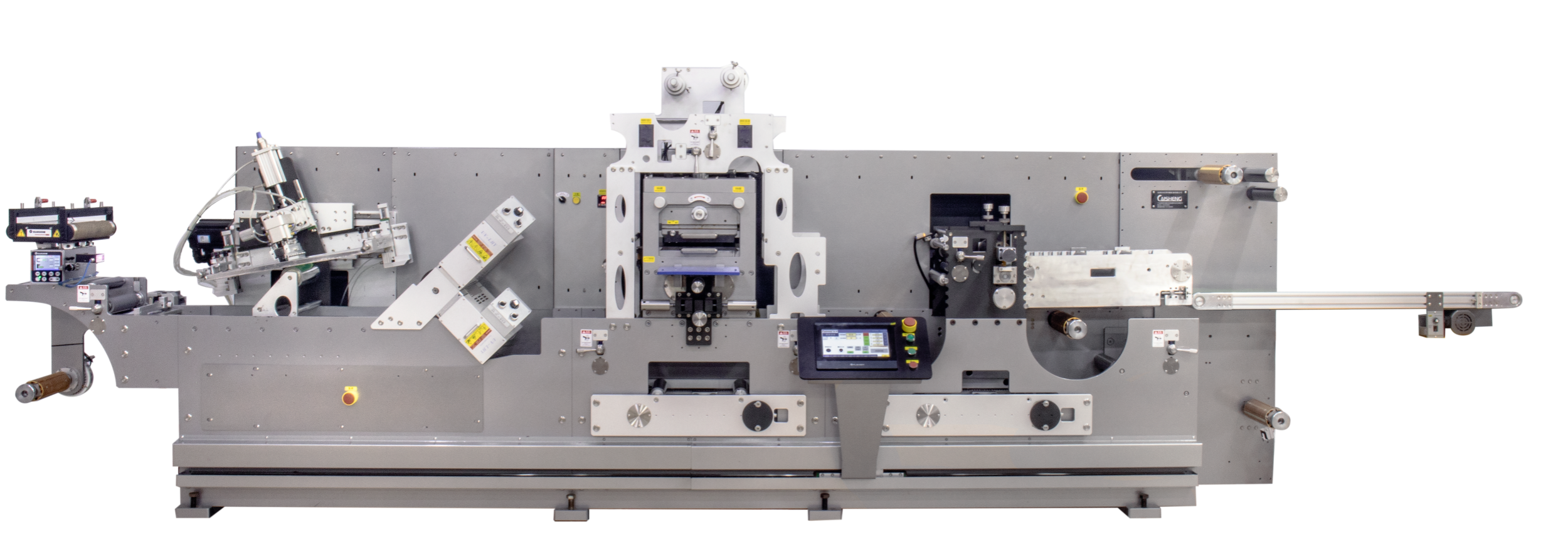
The VS-250W combines full-rotary screen printing with optional hot foil stamping, embossing, flatbed die-cutting, and rotary die-cutting.
A key decision in label printing is intermittent versus full-rotary operation. An intermittent (semi-rotary) press moves the web in stepwise fashion, which makes plate cylinders shorter and changeover faster for short runs. A full-rotary press keeps the web moving continuously, enabling higher throughput for longer runs. Some CAISHENG machines combine both modes: for example, the CS-JQ350G-6C reaches 60 m/min in intermittent mode and 158 m/min in full-rotary mode.
Another process decision is letterpress versus flexographic printing. Intermittent letterpress label presses, such as the CS-320-6C and CS-320-7C, are commonly used for self-adhesive labels with a web width range of 30–320 mm and a maximum print speed of 40 m/min. Full-rotary flexo presses, such as the CS-Q370F-6C, print at 150 m/min with maximum print areas of 370×200 mm or 370×600 mm, suiting longer production runs. The CS-JQ350G-10C extends the hybrid architecture to a ten-color configuration with LED UV dryers.
CAISHENG machines typically use servo systems, air cooling, water cooling, and UV drying lamps as supporting equipment. The production environment is normal room temperature, so a converter does not need to invest in a constant-temperature workshop.
Model Comparison at a Glance
| Model | Press type | Max speed | Max print area | Typical role |
|---|---|---|---|---|
| CS-320-6C | Intermittent letterpress | 40 m/min | 320×300 mm (int.) / 320×326 mm (full) | Self-adhesive labels up to 320 mm web |
| CS-JQ350G-6C | Intermittent & full rotary | 60 / 158 m/min | 350×380 mm (int.) / 350×419 mm (full) | Hybrid short-run and high-speed label production |
| CS-Q370F-6C | Full-rotary flexo | 150 m/min | 370×200 mm or 370×600 mm | Longer-run flexo label printing |
Application Scenarios for CAISHENG Label Printing Machines
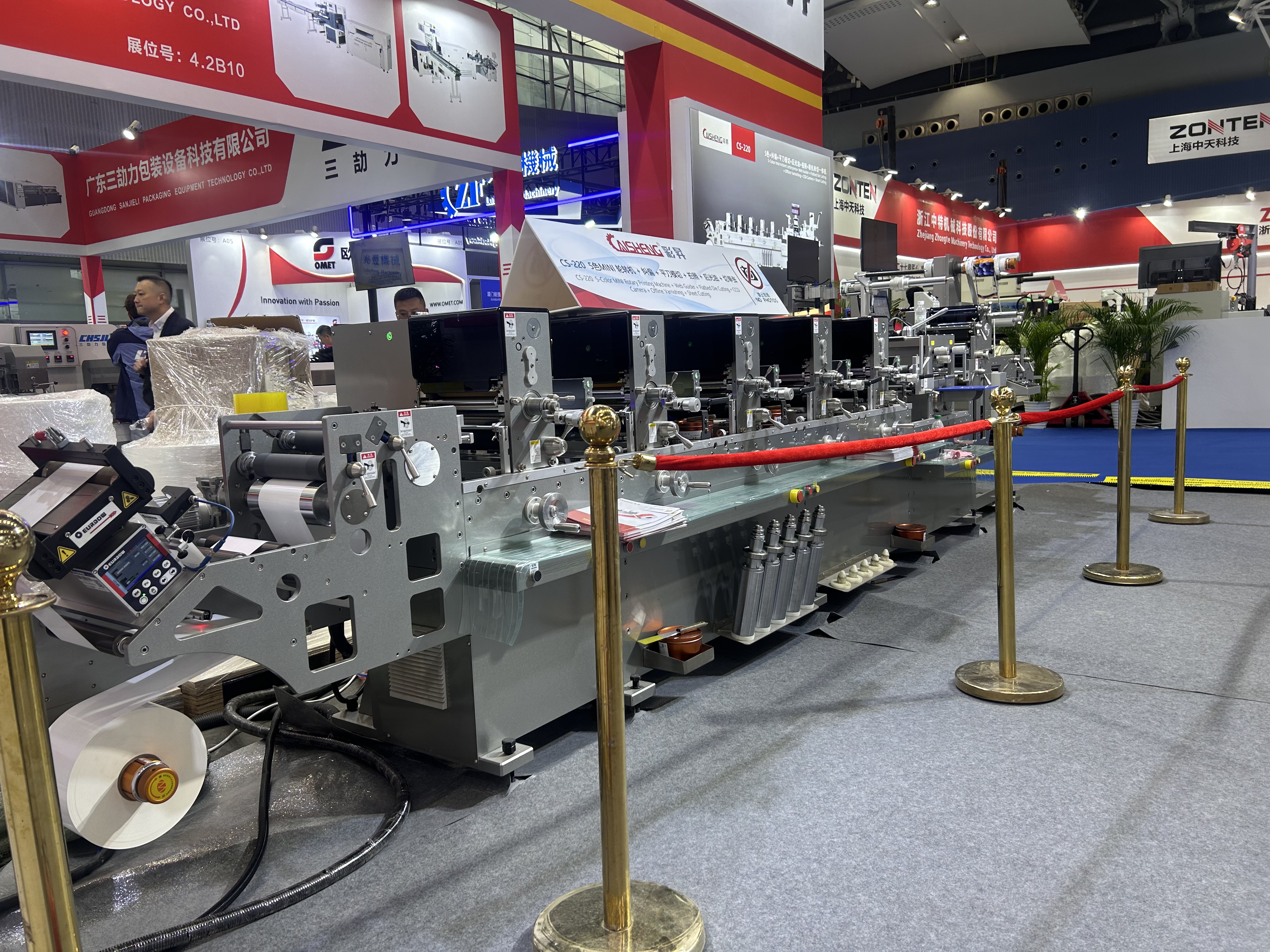
A multi-process configuration of the CS-220-5C, combining flatbed die-cutting, offline varnish, and sheet cutting.
CAISHENG's label printing solution is applied across multiple self-adhesive label segments. The application scenario list includes daily chemical labels, chemical labels, wristband labels, wine labels, food labels, cosmetics labels, and pharmaceutical labels. The system is intended for Label Printing Solution System projects, especially where printing factories must produce finished labels in one pass.
The integrated multi-process capability is visible in configurations such as the CS-300-6C letterpress printing machine with glue-side printing, multi-functional frame, rotary die-cutting, flatbed die-cutting, and slitting. Another example is the CS-220-5C with flatbed die-cutting, offline varnish, and sheet cutting. These configurations show how one machine can combine print and finishing functions.
In practice, a renowned Asian trademark design and printing company has operated CS-320 series label presses for two years, citing superior printing precision, stable production performance, and flexible process expansion capabilities. RRD (Donnelley & Sons), a global provider of commercial printing and packaging solutions, has used a CS-300 series machine for three years as label printing production equipment, recognizing its stable registration accuracy, print quality, and reliable performance.
Market Trends Supporting Flexible Press Platforms
Market data points to continued demand for label printing equipment. The global label printing machines market was valued at USD 8.58 billion in 2025 and is projected to reach USD 14.36 billion by 2034, according to The Insight Partners. Flexographic printing remains the most common process for labels, with an estimated USD 13.3 billion output value, according to Smithers. Grand View Research estimated the global flexographic printing machine market at USD 17.57 billion in 2024, with a CAGR of 9.7% through 2030. Data Bridge Market Research reports that Asia-Pacific held a 41.8% revenue share of the label printing machines market in 2025.
These trends suggest that converters are operating in a growth market, but also one where process selection and production flexibility directly affect competitiveness. The narrow web segment, often associated with self-adhesive labels, is projected to grow from USD 1.43 billion in 2024 to USD 3.21 billion by 2035, per Spherical Insights. That points to sustained demand for presses like CAISHENG's intermittent and hybrid models.
Comparison with Traditional Single-Process Lines
Traditionally, a converter might purchase a separate press, die-cutting unit, and varnishing line from different suppliers, then integrate them in a hybrid line. CAISHENG's approach is to offer an integrated platform that consolidates multiple processes on one machine, reducing material handling and floor-space requirements. For converters with a high mix of short- and medium-run self-adhesive labels, this reduces setup complexity and improves job-changeover speed.
One honest limitation is that integrated multi-process machines are not designed to replace very high-volume, single-product specialized production lines. A factory that runs one narrow-web label product continuously at maximum speed may still prefer a dedicated large-scale rotary press with a fixed inline configuration. In such a case, the flexibility of a multi-function platform is less critical than maximum sustained throughput.
Future Outlook: Modularity and Customization
Looking ahead, label printing machine buyers are increasingly evaluating modularity, energy consumption, and the ability to handle both short-run digital-adjacent work and longer conventional runs. CAISHENG's ODM model allows purchasers to customize machines according to order requirements, with choices that include color stamping, cold foil stamping, lamination, offline/online UV varnishing, rotary or flatbed die-cutting, sheet cutting, slitting, corona treatment, dust cleaning, static elimination, full-rotary screen printing, hot foil stamping, and embossing.
The company reports a monthly capacity of 18 units, a typical lead time of 45–60 days, and a minimum order quantity of one unit. All machines are 100% tested before shipment, and after-sales support includes remote assistance and a one-year warranty for major components. With an annual output of 200 units and about 50% exported to Southeast Asia, Europe, the Middle East, and the United States, CAISHENG positions itself as a mid-size partner for label processors seeking platform-based equipment rather than one-off press purchases.
Frequently Asked Questions
What label printing machine should a converter choose for multi-process self-adhesive label production?
CAISHENG's integrated label printing solution is designed for Label Printing Solution System projects, enabling a printing factory to complete printing on one machine using multiple processes. The CS-300 and CS-320 series are intermittent letterpress label presses, while the CS-JQ350G series adds full-rotary speed. The right choice depends on web width, run length, and the finishing modules required.
What is the difference between an intermittent label press and a full-rotary label press?
An intermittent (semi-rotary) press moves the web in steps, allowing fast setup for short runs and flexible repeat lengths. A full-rotary press runs the web continuously at higher speed, which suits longer productions. The CS-JQ350G models combine both modes: max speed 60 m/min in intermittent and 158 m/min in full-rotary.
Can one machine handle labels for food, cosmetics, and pharmaceutical packaging?
The CAISHENG label printing solution supports self-adhesive labels for daily chemical, chemical, wristband, wine, food, cosmetics, and pharmaceutical applications. The machine operates under normal room temperature with a servo system, air cooling, water cooling, and UV drying lamps as supporting equipment.
What customization options are available for specific production scenarios?
CAISHENG provides ODM production with customization that includes color stamping, glue-side printing frame, cold foil stamping, lamination, offline/online UV varnishing, flatbed die-cutting, rotary die-cutting, sheet cutting, slitting, corona treater, dust cleaner, static eliminator, full-rotary screen printing, hot foil stamping, and embossing.
What are the power and space requirements for a high-speed rotary label press like the CS-JQ350G-6C?
The CS-JQ350G-6C has a gross main-machine power of 22 kW, UV dryer power of 8 kW, machine dimensions of 7.9(L)×1.5(W)×1.9(H) m, and a weight of 10 t. For intermittent mode, the maximum print area is 350×380 mm; for full-rotary mode, it is 350×419 mm.
Is there a minimum order quantity for customized label presses?
The minimum order quantity is 1 unit. Monthly capacity is 18 units, with a typical lead time of 45–60 days. Equipment is 100% tested, and after-sales includes remote support and a one-year warranty for major components.
CAISHENG: Contact and Brochure
For buyers evaluating a label printing machine for their specific production scenario, detailed specifications and configuration options are available in the CAISHENG brochure. Contact the company for project-specific data.
Company: Shenzhen Caisheng Printing Machinery Co., Ltd.
Website: https://www.caishengmachinery.com/
Email: kanghong-1108@qq.com
WhatsApp: +86 133-1087-8219