
Scenario Fit as Trade Strategy: Stone Demand by Project Type
Scenario Fit as Trade Strategy: Stone Demand by Project Type
Natural stone purchasing has shifted from a material-first decision to a scenario-first one. A marble tile destined for a metro concourse, a hotel washroom and a civic library façade may share a geological name, but they do not share thickness tolerance, surface expectation, packaging logic or acceptance evidence. Scenario fit — how closely a supplied material, its fabrication and its documentation match the conditions of a specific project type — now shapes trade terms as much as unit price does.
For buyers evaluating a China Marble tiles supplier, this changes the questions worth asking. Instead of comparing stone names alone, procurement teams increasingly test whether a supplier can hold one specification across repeating modules, absorb a high-mix hospitality order without breaking visual continuity, and produce the audit trail a public-project client will accept at handover.
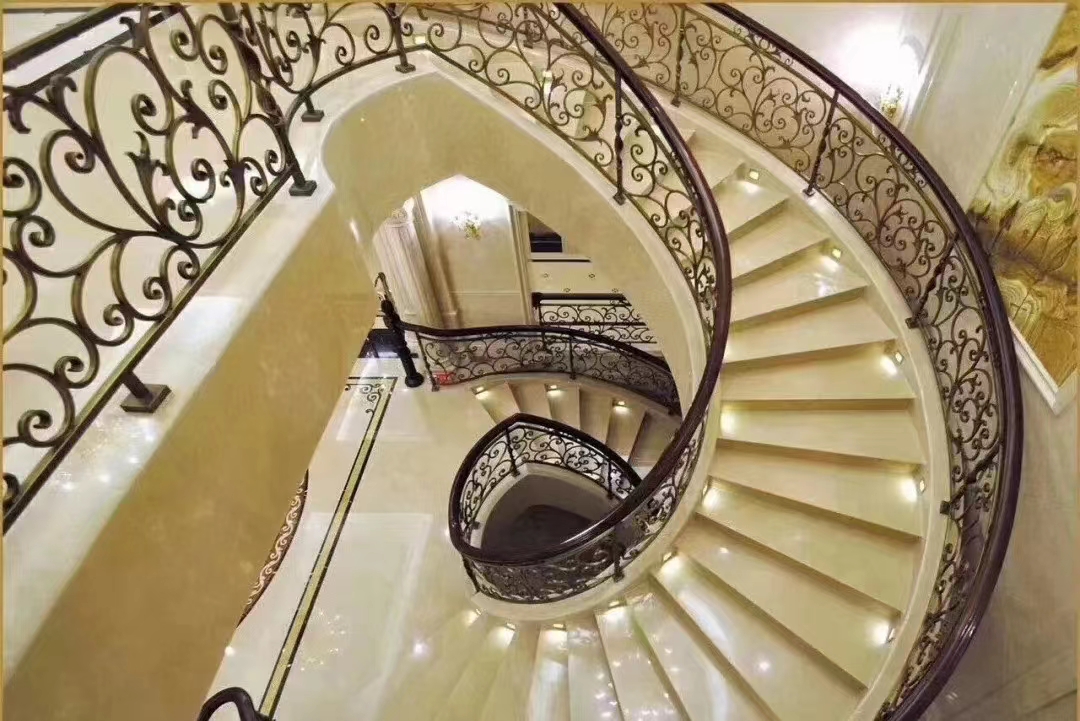
Scenario Fit as a Purchasing Variable
Scenario fit is the degree to which a stone specification, a fabrication method and a documentation set match the operating conditions of a defined project type. It is not a marketing category. It is an alignment across four dimensions: the mechanical and visual demands of the location, the dimensional discipline required by the installation sequence, the volume and mix profile of the order, and the evidence a client or authority will demand before acceptance.
In transit and public work, the third and fourth dimensions usually decide the contract, because a project that installs thousands of identical modules cannot tolerate drift between pallets, and an authority will not accept a shipment without traceable inspection records. In hospitality interiors, the first and second dimensions dominate, because a visible seam, a reversed vein or a misaligned edge cannot be corrected after installation without removing finished work.
This is why sourcing conversations increasingly open with a scenario description rather than a stone name. The same marble family may be specified as a 600 × 300 modular tile for a concourse floor, a 20 mm slab for a lobby staircase, and a carved furniture element for a suite interior — three different production logics, three different inspection plans, and often three different commercial terms.
Three Demand Clusters: Transit, Hospitality and Public Work
Transit and Infrastructure
Transit projects — stations, terminals, interchanges, pedestrian links — are repetitive, dimensional and long-lived. Their defining procurement characteristics are module consistency, replaceability and stair performance. Because a single station may absorb tens of thousands of identical units, the buyer's real question is not whether a marble looks correct in a sample box, but whether the tenth container matches the first. Replacement logic compounds this: operators need future batches that can be inserted into an existing floor without a visible break, which places unusual weight on shade control and on retained reference samples.
Stairs deserve separate attention. Treads, risers and landings carry concentrated loading and are the first element to show wear. Surface finish selection — honed versus polished versus a textured treatment — is a specification decision that should be made with the design team and, where relevant, with local code requirements in view, since slip behaviour and abrasion behaviour are project-specific rather than catalogue properties.
Hospitality and Residential Interiors
Hospitality orders are the opposite profile: smaller quantities per line item, more materials per project, and a much higher premium on visual continuity. A hotel may combine marble wall cladding in the lobby, a marble table supplier's furniture pieces in suites, stone vanity tops in bathrooms, and a feature element such as a marble bathtub or a carved marble panel — all expected to read as one design language.
The procurement risk here is fragmentation. If five categories are bought from five sources, the buyer owns the reconciliation problem: vein direction, thickness, edge detail, finish gloss level and packing all have to be harmonised after the fact. Scenario fit in hospitality therefore favours suppliers who can handle mixed formats and mixed product families under one specification sheet, and who can convert a designer's sketch into a producible shop drawing before any material is cut.
Public and Institutional Projects
Civic buildings, libraries, museums, hospitals and government complexes combine the volume discipline of transit work with the visibility of hospitality work, and they add a third requirement: documentation. Public procurement typically demands a defensible acceptance trail — agreed samples, photographic evidence, finished-goods inspection and pre-shipment confirmation — because the buyer must be able to demonstrate that the delivered material matches the approved specification.
Exterior envelopes add a further layer. Facade and wall cladding panels in granite, limestone or marble require fixing-compatible thickness, consistent sawing, and a production sequence that respects installation order rather than container optimisation alone.
What Scenario Fit Requires at the Specification Level
Three format families dominate project stone: modular tiles, slabs, and fabricated elements. Each has a different relationship to standards and to inspection.
For modular tiles, the relevant European reference is EN 12057, which covers natural stone modular tiles. For slabs intended for floors and stairs, EN 12058 applies. On the North American side, ASTM C615/C615M-23 is the standard specification for granite dimension stone, referenced by the Natural Stone Institute and ASTM International. These are material and format standards rather than project codes; local building regulation, structural design and the architect's specification still govern the final acceptance decision.
From Block to Module: Where Consistency Is Won or Lost
Consistency is determined well before polishing. A tile that measures correctly but reads visibly different from its neighbour is a failed module regardless of dimensional accuracy. Practical controls in a project order therefore include block selection and lot tagging, saw calibration against a retained reference piece, batch grouping so that one room is filled from one lot, and a finish standard agreed on a physical sample rather than a photograph.
Fabrication variables that carry the most commercial risk are thickness, surface finish, edge profile and shape. Thickness affects weight, fixing method and container utilisation simultaneously. Edge profile determines how a tile behaves at a stair nosing or a pool coping. Shape governs yield, and therefore the real cost per installed square metre rather than the quoted price per square metre.
Why Chinese Supply Now Anchors This Shift
Trade data explains part of the momentum. According to the Observatory of Economic Complexity, China was the largest exporter of building stone under HS 6802 in 2024, with a 32% global market share. That concentration is why so many scenario-specific specifications are resolved against Chinese production capability rather than against a domestic stock range.
Market value figures should be read with care. One commercial estimate places the global natural stone market at USD 10.6 billion in 2025. Other research houses publish materially higher numbers because they define the product scope differently — processed architectural products versus raw dimension stone. Buyers should treat any single market-size figure as scope-dependent rather than as a planning constant.
Policy has moved as well. In October 2025, the United States suspended a 24% retaliatory tariff on selected Chinese stone products. For US-bound projects, that changes landed-cost arithmetic without changing the underlying capability question: a supplier either can hold a specification across a multi-container order or cannot, and a tariff line does not alter that.
How SONGJIA Maps Capability to Project Type
Xiamen Songjia Trading Co., Ltd., operating as SONGJIA, is a China-based natural stone supplier based in Xiamen with a 20,000 m² production footprint, 60 employees and three engineers. Its range covers granite and marble slabs, quartzite, limestone, onyx, tombstones and memorial products, and stone furniture, with exports going entirely to international buyers — mainly in the EU, USA and Middle East. The company works as an integrated supply partner coordinating a partner factory network, rather than positioning itself as a single-factory manufacturer.
Its stated operating modes are natural stone supply, custom fabrication, tombstone manufacturing, project order support, quality control and export service. Annual output is described in two streams — memorial products at around 150 containers and building materials at around 200 containers — which is a useful signal for buyers assessing where project orders sit relative to standing production.
Design-to-Production Integration
The capability that matters most for scenario work is the conversion of design intent into producible shop drawings. SONGJIA's technical team works from client sketches, concepts and architectural ideas and translates them into drawings that can actually be cut, finished and packed — a step that determines whether a hospitality feature element or an irregular cladding panel survives contact with the factory floor.
Customization dimensions offered across the range are material, size, thickness, surface finish, edge profile, shape, engraving, packing and logo marking. For a procurement team, that list maps directly onto the variables most likely to cause a revision request: change one of them and the acceptance sample, the packing plan and often the transportation cost all change with it.
Execution: Drawing, Sampling, Production, Acceptance
A scenario order typically moves through a fixed sequence, and each step produces an artefact the buyer can hold the supplier to.
- Brief and drawing intake — project type, format mix and quantity profile.
- Shop drawing conversion by the technical team, including edge and fixing details.
- Sample and finish confirmation against the architect's specification.
- Production scheduling within the stated 10–30 containers per month capacity, depending on product category and production schedule.
- Process inspection during cutting, profiling and finishing.
- Finished product inspection and pre-shipment confirmation.
- Export handling on FOB or CIF terms, with payment terms of 30/70.
- After-sales follow-up, with replacement or compensation for confirmed quality issues.
Quality control is run across four checkpoints: raw material inspection, in-process inspection, finished product inspection and pre-shipment inspection. Acceptance is established through sample confirmation, photographic and video records, finished product checking and pre-shipment confirmation — a sequence that suits public-project documentation requirements because each stage leaves a record rather than a verbal assurance.
Normal lead time is quoted at 15–30 days depending on product type and order quantity. Minimum order terms are flexible by category: trial orders are acceptable, the MOQ depends on product type and customer acceptance, and orders above 100 m² are generally workable.
Comparing Sourcing Models Against Scenario Requirements
Three sourcing models appear most often in project tenders. None is universally superior; each fits a different scenario profile.
| Sourcing model | Typical strength | Typical constraint | Scenario fit |
|---|---|---|---|
| Single-mill supplier | Deep control over its own material output | Narrower format, finish and product-family range | High-volume, single-material orders |
| Trading or agent model | Wide material access, low overhead | Limited fabrication control and thinner inspection records | Price-led or low-specification work |
| Integrated supply partner (SONGJIA model) | Design-to-production conversion, mixed materials and formats, four-stage inspection, export documentation | Scheduling depends on partner factory availability across categories | Multi-scenario projects mixing transit, hospitality and public scope |
The practical difference between the second and third models is not price. It is who owns the translation problem. In a pure trading arrangement, the buyer often becomes the integrator between a mill, a fabricator and a packer. In an integrated arrangement, that translation is a contracted scope — with the corresponding obligation to document it.
Where the Model Has Boundaries
Scenario fit is a useful lens, but it has limits that buyers should verify rather than assume.
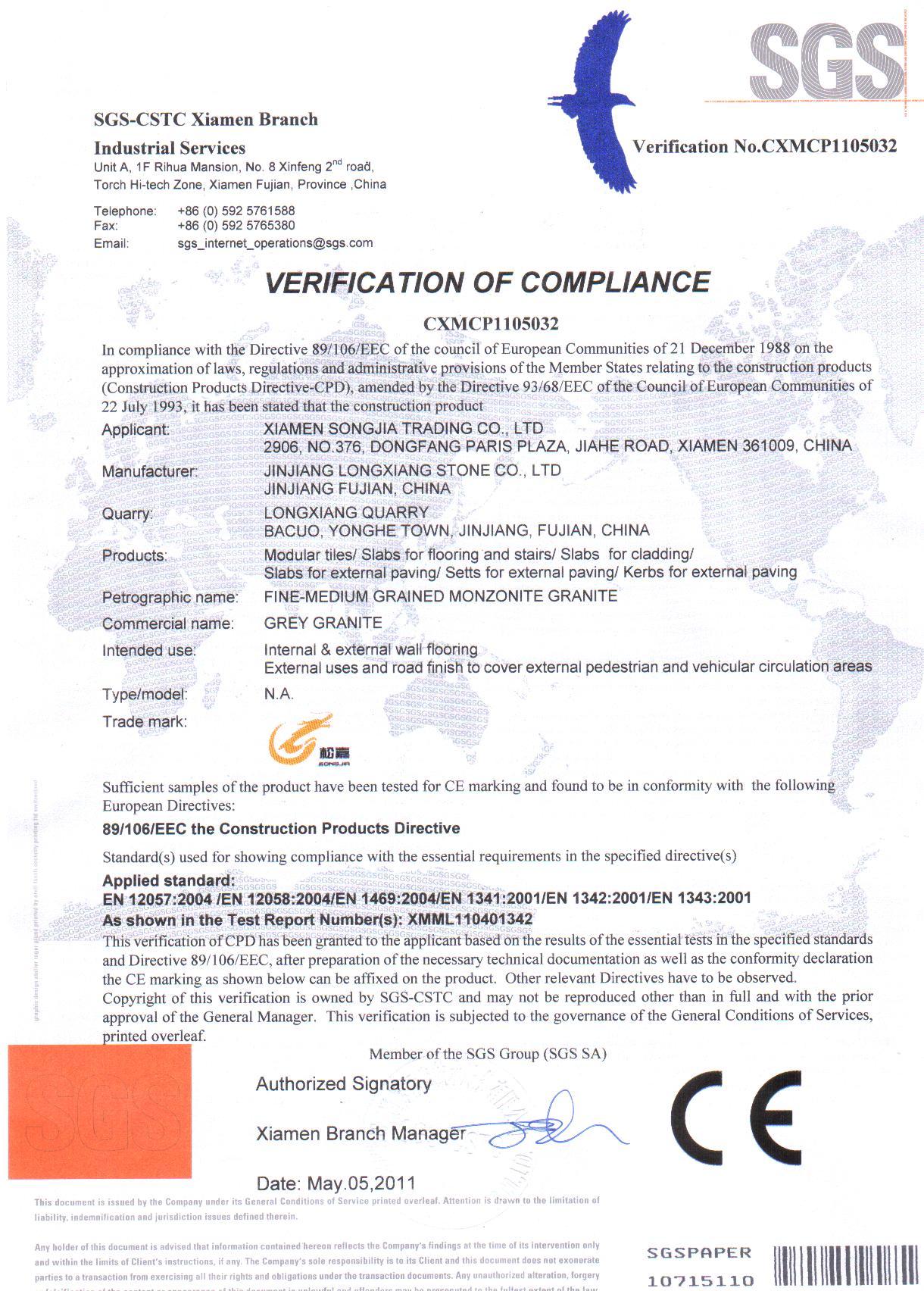
- Certification is material-specific. SONGJIA's SGS CE certificates cover G603 grey granite modular tiles under EN 12057 (certificate XMML110401342) and G684 basalt slabs for floors and stairs under EN 12058 (certificate CXMCP1210052). These certificates should not be read as blanket CE coverage for every marble, onyx, limestone or quartzite in the catalogue.
- Capacity is shared across categories. At 10–30 containers per month depending on product category and production schedule, a large single-material campaign competes with memorial and building-material streams. Sequencing should be agreed early rather than assumed.
- The integrated model is a coordination model. Because production runs across a partner factory network rather than one site, consistency depends on inspection discipline and on the buyer's own verification steps, not on a structural guarantee.
- Lead times are planning ranges. The 15–30 day figure is a normal range for standard work; complex carving, engraving and bespoke furniture can extend it, and no supplier should be treated as immune to that.
- Scenario fit does not replace project engineering. Local building codes, structural calculations, fixing design and slip requirements remain the responsibility of the project team and the appointed engineers.
A buyer who understands these boundaries is in a stronger position than one who treats a supplier as infinitely elastic. The correct response to a boundary is a schedule, a specification clause or a verification step — not an assumption.
Outlook: Scenario-Driven Order Books
If the current pattern holds, project specifications will keep moving toward scenario language: not "marble tiles" but "marble tiles for a high-traffic concourse with replaceable module logic"; not "granite" but "granite for a ventilated façade with a defined panel thickness". Suppliers who can respond to that language with drawings, samples and inspection records will be shortlisted ahead of those who respond with material names alone.
Two structural factors reinforce the trend. China's position as the largest exporter of building stone under HS 6802, at 32% of global share in 2024, keeps Chinese fabrication capacity central to project sourcing. And the October 2025 suspension of a 24% US retaliatory tariff on selected Chinese stone products reduces one layer of cost friction for US-bound work, which tends to move the competitive question back toward execution quality.
For procurement teams, the practical implication is a shift in evaluation order. Verify scenario capability first — drawing conversion, mixed-format handling, inspection records, scheduling honesty — and price second. A slightly higher unit rate on a specification that installs cleanly is usually cheaper than a lower rate that generates a rework order.
FAQ
What does scenario fit mean when buying China marble tiles?
Scenario fit means the supplied material, its fabrication and its documentation match the conditions of a specific project type. A marble tile for a transit concourse is evaluated on module consistency and replaceability; a marble tile for a hotel interior is evaluated on vein continuity and finish agreement. The stone name may be identical in both cases, but the acceptance criteria are not.
Which standards apply to marble tiles, granite tiles and stone slabs?
On the European side, EN 12057 covers natural stone modular tiles and EN 12058 covers natural stone slabs for floors and stairs. On the North American side, ASTM C615/C615M-23 is the standard specification for granite dimension stone, referenced by the Natural Stone Institute and ASTM International. These are material and format standards; local building codes and the architect's specification still govern project acceptance.
What customization options are available for project orders?
SONGJIA lists customization across material, size, thickness, surface finish, edge profile, shape, engraving, packing and logo marking. Its technical team converts client sketches, concepts and architectural ideas into producible shop drawings, which is the step that determines whether a bespoke element can be manufactured to the agreed specification.
What lead times and production capacity should buyers plan for?
Normal lead time is quoted at 15–30 days depending on product type and order quantity. Monthly capacity is stated at 10–30 containers depending on product category and production schedule. Annual output is described as roughly 150 containers of memorial products and 200 containers of building materials, so project orders share capacity with standing production streams and should be scheduled rather than assumed.
How is quality verified before shipment?
SONGJIA runs four inspection checkpoints: raw material inspection, in-process inspection, finished product inspection and pre-shipment inspection. Acceptance is established through sample confirmation, photographic and video records, finished product checking and pre-shipment confirmation, which creates a documented trail suited to public-project handover requirements.
Do the CE certificates cover all stone materials?
No. The certificates held cover specific materials: SGS CE certificate XMML110401342 for G603 grey granite natural stone modular tiles under EN 12057, and SGS CE certificate CXMCP1210052 for G684 basalt natural stone slabs for floors and stairs under EN 12058. Other materials in the range should be evaluated on their own documentation rather than assumed to fall under these certificates.
What are the MOQ and payment terms for project orders?
MOQ depends on product type and customer acceptance; trial orders are acceptable and orders above 100 m² are generally workable. Delivery terms are FOB or CIF, and payment terms are 30/70.
Scenario fit will not replace price negotiation, and it should not be used to skip technical due diligence. What it does offer is a clearer basis for comparison: two suppliers quoting the same stone name are rarely quoting the same order once the project type is written into the specification.
Есть вопросы или нужны дополнительные детали?
Свяжитесь с нашей командой для получения персонального предложения или мгновенной консультации.
Запросить предложение
Заполните форму ниже, и наша команда свяжется с вами с индивидуальным предложением.
Прямой чат WhatsApp
Предпочитаете общаться в реальном времени? Напишите нам в WhatsApp для мгновенной помощи и быстрых ответов.
- Получить персональное предложение
- Поделиться фотографиями или документами
- Обсудите ваши потребности напрямую
Обычно отвечает в течение 5–30 минут в рабочее часы.