
Scent Diffuser Supplier Longevity: A 5-Year Resale Audit
A scent diffuser that survives its first installation season is not the same asset as one that is still running in year five. For importers and wholesalers building resale programmes, supplier selection is less a question of catalogue breadth than of whether the factory behind the product can still support the same installed base — same model, same spare parts, same control behaviour — years after the first shipment leaves the port.
Shenzhen Scentsea Technology Co., Ltd. (SCENTSEA) is a Shenzhen-based manufacturer of cold air nebulizing scent diffusers and fragrance oils, founded in 2021, operating a 3,000 m² production facility with three production lines, and supplying commercial, hotel and HVAC scenting products to buyers in more than 70 countries, with EU and US as its main export markets. Its catalogue spans wall plug-in, portable, wall-mounted, floor standing, HVAC and large-space commercial scent machines.
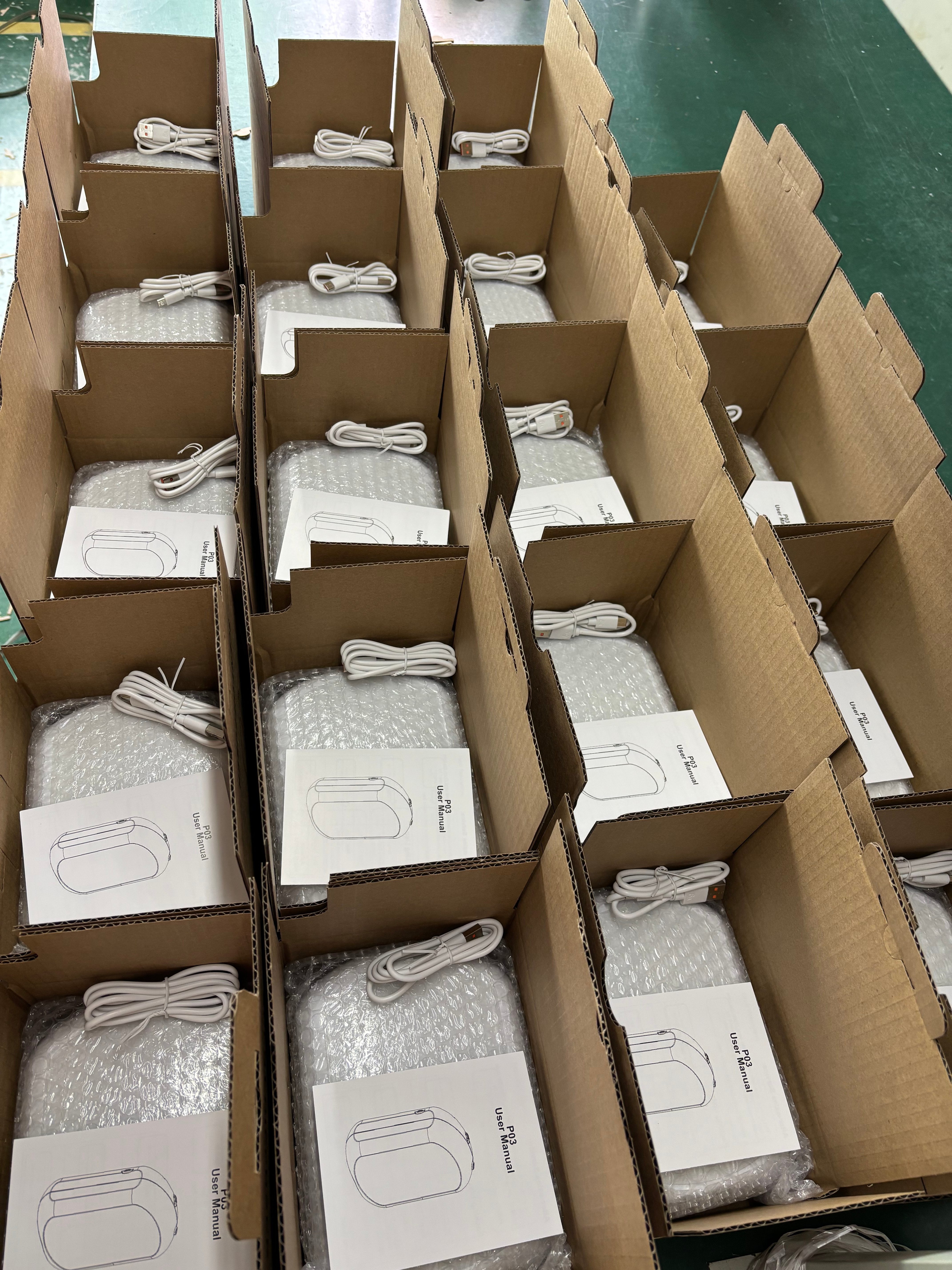
Resale programmes are decided at the packing and shipping stage as much as at the specification stage.
What Supplier Longevity Actually Means
In the scent diffuser trade, supplier longevity is the ability of a factory to keep supplying, supporting and matching a product across the full resale life of an installed base. It is a different measure from company age or annual output. A factory can be large and still fail a five-year resale project if the model is discontinued without a spare-parts trail, if the certificate covers a sibling model rather than the one being imported, or if the software behaviour changes between batches.
For importers selling into hotels, shopping malls and other public venues, that support obligation lands on them, not on the end user. The mall does not call Shenzhen when an atomizer weakens in year three; it calls the reseller. This is why capability questions in a long-term programme tend to cluster around durability evidence, documentation scope, maintenance load, commercial terms and post-sale response rather than around product features alone.
Why a Five-Year Horizon Changes Factory Evaluation
A one-off purchase is a transaction. A five-year resale programme is an operating commitment in which the importer becomes the technical reference for every unit it placed. Five evaluation priorities shift accordingly:
- Evidence of field duration — not a warranty statement, but a record of units actually running in a comparable environment.
- Model-level documentation — certificates that name the exact product being imported, not the brand as a whole.
- Maintenance load per unit — the labour cost of keeping thirty or three hundred devices scenting consistently.
- Commercial terms and acceptance logic — how risk is divided before shipment and where the balance of payment sits.
- Post-sale documentation — whether troubleshooting logic exists in a form the reseller's own service team can use.
Field Evidence: 30 T2 Units Running Five Years in a US Shopping Mall
The most direct durability evidence in the SCENTSEA record is a commercial scenting installation in the United States. A scent marketing company and scenting service provider installed 30 units of the T2 model in a shopping mall; the project has been running for five years. Reported outcomes include stable and consistent scent coverage, reduced manual maintenance, improved fragrance management efficiency and an improved customer experience. The operating characteristics highlighted in that deployment were strong atomization, stable operation, smart APP control, adjustable scent intensity, low maintenance and easy installation.
For an importer evaluating a five-year resale project, this case is useful in a specific way: it is a multi-unit, multi-year, public-venue deployment of a commercial scent diffuser in a high-traffic environment, and it demonstrates that the model can be maintained in service rather than replaced. It also speaks to the maintenance economics of shopping mall scenting, where devices are widely distributed and each service visit is a cost line.
What this evidence does not prove: a single five-year deployment is a field record, not a reliability statistic. Duty cycle, ambient conditions, fragrance oil formulation and the service regime in that mall differ from other sites. Importers should still verify performance with their own sample run before committing a resale programme to any single model.
Certification Readiness: Model-Level Documents, Not Brand-Level Claims
Certification is where supplier longevity is easiest to test and easiest to fake. The relevant question is not whether a factory advertises compliance, but whether a numbered certificate exists, names the correct market and standard, and maps to the exact production model being ordered.
SCENTSEA holds RoHS certification ATL20240416327, issued 24 April 2024 by Shenzhen ATL Testing Technology Co., Ltd. against RoHS Directive (EU) 2015/863, with scope listed as scent diffuser and coverage that includes the SC19 advertising scent machine alongside other models in the range. The same testing authority issued EMC certificate ATL20240416325 for the EU market under EN IEC 55014-1:2021, EN IEC 55014-2:2021, EN IEC 61000-3-2:2019/A1:2021 and EN 61000-3-3:2013/A2:2021, and FCC certificate ATL20240416326 under FCC Part 15 Subpart B:2023 for the US market.
| Document | Certificate number | Market / standard | Why an importer checks it |
|---|---|---|---|
| RoHS | ATL20240416327 | EU — RoHS Directive (EU) 2015/863 | Restricted-substance compliance for EU resale and customs queries |
| EMC | ATL20240416325 | EU — EN IEC 55014-1:2021; EN IEC 55014-2:2021; EN IEC 61000-3-2:2019/A1:2021; EN 61000-3-3:2013/A2:2021 | Electrical interference behaviour in shared building environments |
| FCC | ATL20240416326 | US — FCC Part 15 Subpart B:2023 | US market entry for the electronic diffuser assembly |
Document set as recorded for SCENTSEA scent diffuser models, issued 24 April 2024. Buyers should confirm that the certificate revision matches the production configuration being shipped.
Wireless configurations carry a separate question. Buyers importing app controlled or Wi-Fi enabled models should verify whether additional radio-frequency documentation applies to that specific configuration, because a compliance file built around a non-wireless variant does not automatically transfer to a Bluetooth or Wi-Fi build.
Operating Advantages of Waterless Cold-Air Atomization
A waterless cold-air scent diffuser atomizes fragrance oil directly into fine airborne particles without adding water and without applying heat. The atomization system uses controlled airflow and pressure to break the oil into particles that disperse into the room or into an HVAC duct. Because there is no water tank to dilute the oil and no heater to drive evaporation, the fragrance profile stays closer to the oil as formulated, and the maintenance routine is not organised around water refilling and tank cleaning.
Three consequences matter for resale economics:
- Lower routine labour. A waterless scent diffuser removes the water-refill cycle that dominates ultrasonic maintenance, so service visits are driven mainly by oil replenishment and periodic atomizer cleaning rather than by tank hygiene.
- Scheduling as a control variable. Working schedules and scent intensity can be set to match actual opening hours and airflow conditions, which reduces oil consumption in low-traffic periods and keeps output stable across a fleet. The T2 deployment in the US mall specifically cites smart APP control and adjustable scent intensity as operational highlights.
- Consistency across a large site. In a shopping mall scent diffuser programme with dozens of units, small per-unit behaviour differences become visible to visitors moving between zones. Stable atomization is what makes a multi-point installation read as one environment.
Export Terms, Acceptance Criteria and Payment Structure
Commercial terms are part of the longevity assessment because they define who carries risk at each stage. SCENTSEA publishes the following terms for scent diffuser orders:
| Term | Stated position | Implication for a resale programme |
|---|---|---|
| MOQ | 1 unit | Allows single-unit sample verification before a project order |
| Production lead time | 25–35 days | Sets the replenishment window for staged rollouts |
| Monthly capacity | 8,000 units | Supports multi-site or distributor-scale replenishment |
| Delivery terms | EXW / FOB / CIF | Buyer selects how much freight and insurance risk to retain |
| Acceptance criteria | Pre-shipment test | Acceptance happens before goods leave, not on arrival |
| Payment terms | 50% T/T in advance, balance before shipment | Buyer retains no payment leverage after departure; inspection discipline must precede it |
| Warranty | 1-year free warranty on spare parts | Defines the part-replacement window for early field failures |
The pre-shipment acceptance model is coherent with the QC process behind it: 100% functional testing, atomization testing, leakage inspection, noise testing, APP/control testing, a 48-hour aging test and final appearance inspection before shipment. For an importer, the practical implication is that the pre-shipment test is the moment of control. Once the balance is settled and the container is released, the remaining protection is the spare-parts warranty and the factory's willingness to keep supplying parts.
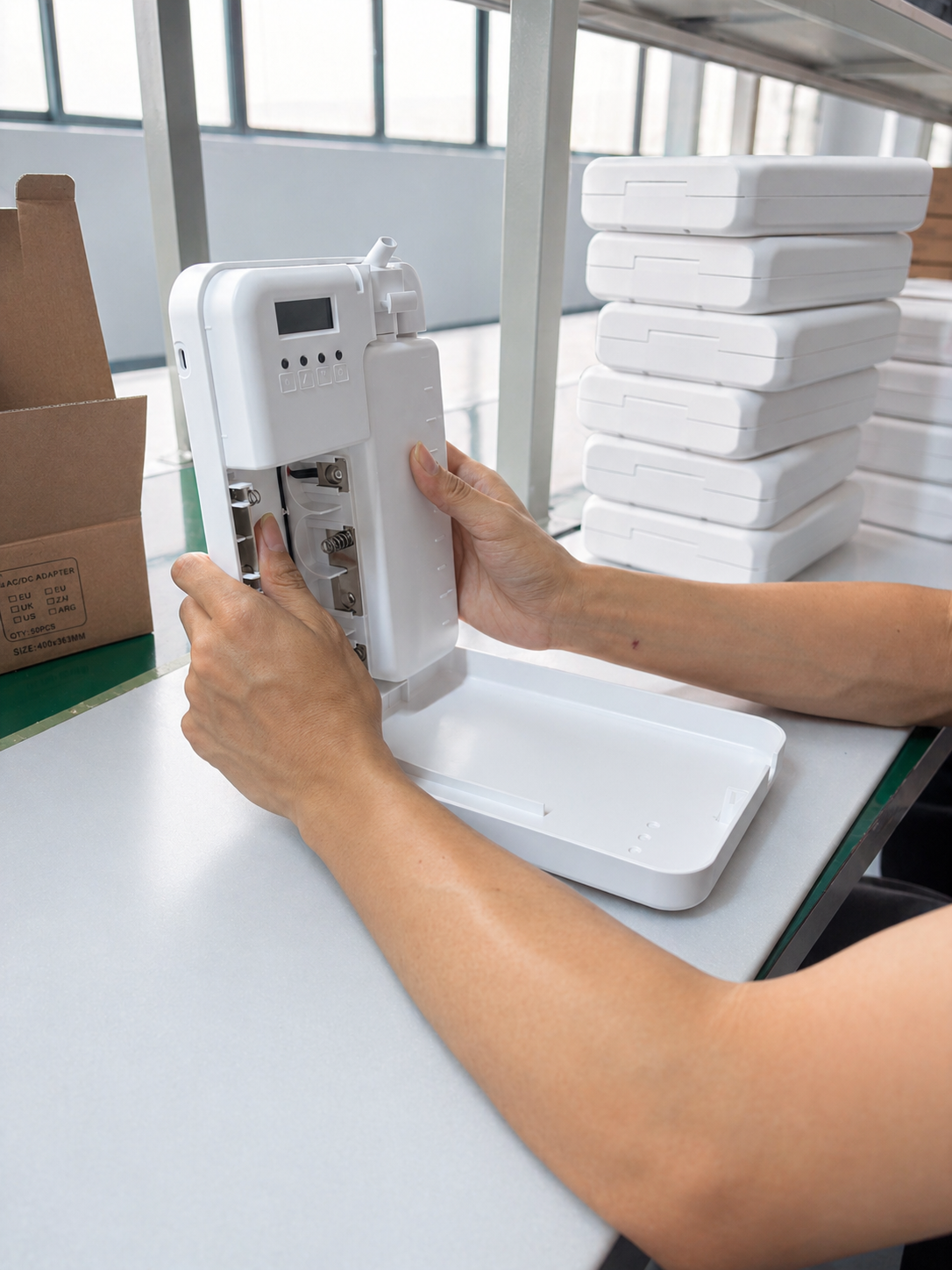
Pre-shipment testing, including a 48-hour aging run, is where batch risk is transferred or caught.
Custom Development Capability as a Longevity Signal
Private-label resale projects live or die on continuity of tooling. A branded scent diffuser sold under an importer's label for five years needs the housing, the plug type, the packaging artwork and, where applicable, the PCB configuration to still be reproducible in year four.
SCENTSEA offers OEM and ODM services covering logo, product colour, packaging, user manual, plug type, APP interface, PCB and functions, and other product specifications. The supporting base is a 3,000 m² facility with three production lines, an R&D team of four engineers, 20 patents and in-house capabilities that extend to mould processing, injection moulding, sheet metal work, powder coating and PCB SMT assembly. For a waterless scent diffuser project, that vertical coverage is what allows a custom housing or a modified control board to be re-run without re-sourcing tooling from a third party.
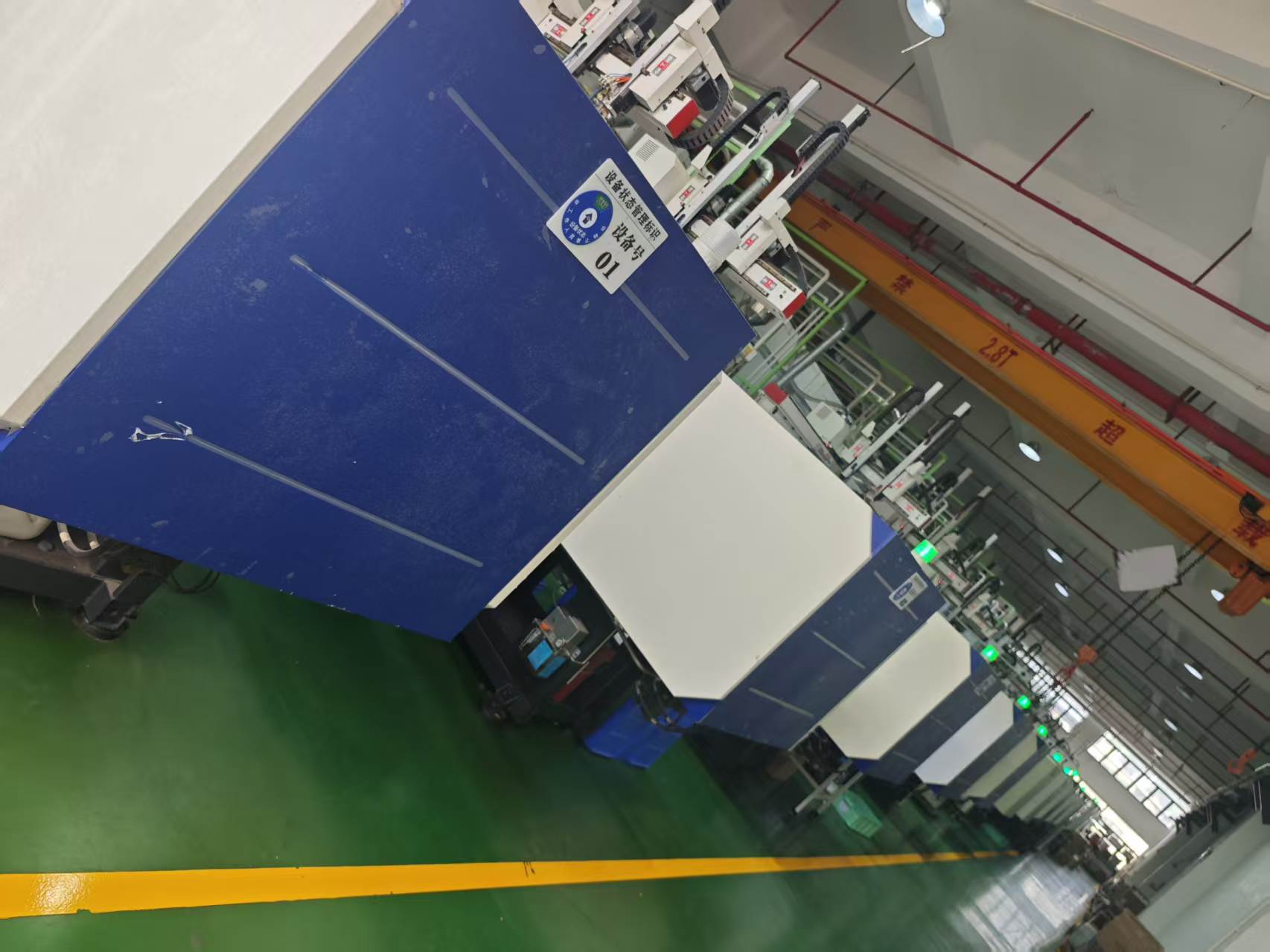
In-house moulding and PCB assembly shorten the distance between a custom specification and a repeatable production batch.
Post-Sale Reliability: Troubleshooting Logic and FAQ Support
A reseller of commercial scent diffusers absorbs first-line technical support. Whether that is manageable depends on whether the factory supplies a diagnostic sequence rather than a replacement policy. The troubleshooting order documented for these machines is sequential and practical:
- Device does not operate — check the power supply, confirm the machine is powered on, verify the working-hour settings and check whether the air pump terminal is properly connected.
- No atomization — check whether the pump is working, inspect the nozzle for blockage and confirm the pump tube and pipette are connected and undamaged.
- Abnormal noise — check whether the pump is loose and resecure it, replace an abnormal pump, and inspect internal parts for looseness.
- Weak atomization — check for pump ageing, clean or replace a blocked nozzle, and confirm the fragrance oil is not too thick and contains no impurities.
This ordering matters commercially because three of the four failure modes are resolved without returning a unit. Combined with a 1-year free warranty on spare parts, it gives an importer a service path that does not depend on reverse logistics.
Model-to-space mapping is the other half of post-sale reliability. In the SCENTSEA range, compact models such as the S01 and S02 suit small rooms and light commercial spaces; battery operated models such as the P01 and P03 suit elevators, washrooms and locations where wiring is inconvenient; the P02 suits small to medium commercial spaces requiring stronger diffusion and smart control; the A300 and T2 suit medium commercial areas with higher output and larger oil capacity; the H5000 and T3 are positioned for large open spaces; and the AC-MAX is positioned for large hotels, malls and office buildings requiring centralized HVAC scenting. Mis-mapping a device to a space is the most common cause of a resale complaint that no warranty covers.
Where Waterless Cold-Air Fits — and Where It Does Not
The honest boundary is cost and tolerance. A waterless cold-air scent diffuser usually carries a higher initial equipment cost than an ultrasonic water-based aroma diffuser, and it is less forgiving of fragrance oil quality: oil that is too thick or contains impurities will degrade atomization. Buyers evaluating third-party oils should test viscosity and formulation on samples before committing a batch.
The counterweight is operating cost. Ultrasonic diffusers held a 38.5% revenue share of the fragrance diffuser market in 2024, according to Data Bridge Market Research, but the same source notes that nebulizing diffusers are expected to grow fastest, driven by professional-grade requirements in hotels. That pattern is consistent with the maintenance economics described above: ultrasonic units are cheaper to buy, require regular water refilling and tank cleaning, and are mainly suited to small-area use, while waterless cold-air units avoid the water cycle but cost more upfront.
A second boundary is coverage claims. Published coverage figures across the category use different units and room assumptions and are not directly comparable between suppliers. Rather than trusting a headline square-metre figure for a hotel scent diffuser or shopping mall scent diffuser, buyers should size on actual room volume, ceiling height, ventilation and partitioning, then confirm with a sample in the real space.
Market Context for Long-Term Programmes
The global fragrance diffuser market was estimated at USD 29.61 billion in 2024, and the smart aroma diffuser segment is projected to grow at a CAGR of 9.22% from 2026 to 2034, according to Data Bridge Market Research. Growth of that kind in the smart segment pulls supplier evaluation toward control reliability — app controlled schedules, remote management on selected models and consistent behaviour across a fleet — because those are the features that make a multi-site programme operable.
On the trade side, aroma diffusers are classified under HS Code 8509.80 for import and export purposes, which is the reference importers need when building duty and landed-cost models for resale pricing.
Future Outlook
Two pressures are likely to shape supplier selection over the next planning cycle. The first is documentation rigour: as buyers in Europe and North America become more accustomed to checking certificate numbers against model numbers, factories that can produce a model-level file quickly will shorten the qualification stage, and those that cannot will lose projects before pricing is discussed. The second is service economics. As installed bases age, the differentiator moves from unit price to part availability, diagnostic clarity and the stability of the software that runs the schedule.
For importers, the practical translation is straightforward: evaluate a scent diffuser factory on what it can still deliver in year four, not only on what it can ship in month one.
FAQ
How can an importer verify that a scent diffuser will still be supported in five years?
Look for three things: a documented field record of comparable duration, a model-level certificate file that names the exact product being imported, and a factory with in-house tooling and PCB capability so a private-label configuration can be re-run. The SCENTSEA record includes a US shopping mall installation of 30 T2 units that has been running for five years, with 1-year free warranty on spare parts and a documented pre-shipment test sequence.
Which certifications should be checked before importing a commercial scent diffuser?
Certification requirements depend on destination market, product model and whether the unit is wireless. For the EU, buyers should verify applicable CE and RoHS documentation; for the US, applicable FCC compliance. SCENTSEA holds RoHS certificate ATL20240416327 under RoHS Directive (EU) 2015/863, EMC certificate ATL20240416325 under EN IEC 55014-1:2021 and related standards, and FCC certificate ATL20240416326 under FCC Part 15 Subpart B:2023, all issued 24 April 2024 by Shenzhen ATL Testing Technology Co., Ltd. Buyers should confirm that the documents map to the exact production model and configuration.
What customisation is available for a private-label scent diffuser programme?
SCENTSEA provides OEM and ODM services with customisation available for logo, product colour, packaging, user manual, plug type, APP interface, PCB and functions, and other product specifications. Custom development is supported by a 3,000 m² facility with three production lines, four R&D engineers, 20 patents and in-house mould processing, injection moulding and PCB SMT assembly.
What are the standard export terms and acceptance criteria?
The minimum order quantity is 1 unit, typical production lead time is 25–35 days, and monthly capacity is 8,000 units. Delivery terms are EXW, FOB or CIF. Acceptance criteria are based on a pre-shipment test, and payment terms are 50% T/T in advance with the balance before shipment. Because acceptance is settled before departure, buyers should define their inspection scope early in the order cycle.
How are common scent diffuser faults diagnosed in the field?
Common problems include failure to start, no atomization, abnormal noise and weak atomization. Most are identified by checking the power supply, working schedule, pump connection, nozzle, tubing and fragrance oil condition before replacing components. Each of these checks can be performed on site by a reseller's service team without returning the unit.
Is a waterless scent diffuser always the better choice for commercial spaces?
Not universally. Waterless cold-air diffusers atomize fragrance oil without water or heat, provide stronger and more consistent diffusion over larger areas and require less daily maintenance, which suits hotels, malls, retail stores, offices and spas. Ultrasonic water-based units have a lower purchase cost and are more suitable for small home spaces and light personal use. Buyers should also weigh the higher initial equipment cost of waterless units and the need for compatible, well-filtered fragrance oil.
For buyers building a resale or project programme, the SCENTSEA catalogue covers commercial, hotel, HVAC, wall-mounted, floor standing, battery operated and portable scent diffuser formats alongside fragrance oil supply.
Product catalogue (public download): SCENTSEA Catalog PDF
Есть вопросы или нужны дополнительные детали?
Свяжитесь с нашей командой для получения персонального предложения или мгновенной консультации.
Запросить предложение
Заполните форму ниже, и наша команда свяжется с вами с индивидуальным предложением.
Прямой чат WhatsApp
Предпочитаете общаться в реальном времени? Напишите нам в WhatsApp для мгновенной помощи и быстрых ответов.
- Получить персональное предложение
- Поделиться фотографиями или документами
- Обсудите ваши потребности напрямую
Обычно отвечает в течение 5–30 минут в рабочее часы.