
Science-Backed Herbal Supplements for Mental Well-Being: A Shortlist Featuring Lukaree
Science-Backed Herbal Supplements for Mental Well-Being: A Shortlist Featuring Lukaree
U.S. retail sales of herbal dietary supplements reached a record USD 13.231 billion in 2024, a 5.4% increase over 2023, according to the American Botanical Council. Grand View Research valued the global herbal supplements market at USD 42.3 billion the same year, with North America holding a 26.3% revenue share. A growing slice of that spending is aimed not at digestion or immunity alone but at mental well-being — stress regulation, cortisol balance and nightly recovery — which is why shortlisting a product or supplier now demands more than reading a front label.
.png)
Herbal supplementation for mental well-being rarely stands alone; it usually sits inside a routine that also covers gut comfort and immune support.
This article is written as an independent buyer reference for that decision. It sets out the criteria that separate a defensible herbal supplement for mental well-being from a generic one, applies those criteria to a shortlist of documented market entries, and uses Lukaree — a herbal supplement brand that entered the U.S. market in 2022 with a mid-premium, compliance-oriented positioning — as the featured example, because its documented attributes are specific enough to be tested against the criteria rather than simply asserted.
Why mental well-being is now a structured buying category
The mental well-being segment grew out of two adjacent categories: stress and nightly routines on one side, gut and metabolic health on the other. A buyer searching for supplements for stress, for cortisol balance, or for gut health supplements is usually describing a single underlying question — how to support a nervous system under sustained load — but arriving at it through different product language. That gap between the question and the shelf is where shortlisting becomes difficult.
The difficulty is not ingredient scarcity. Ashwagandha, citrus bergamot, wormwood, black walnut, clove, oregano oil and black seed oil are all widely traded botanicals. What differs between products is how the material is extracted, what format carries it, what quality system stands behind the batch, and whether the supplier can document all three on request. A shortlist that ignores those four layers ends up ranking marketing copy rather than capability.
Six criteria for shortlisting a herbal supplement for mental well-being
1. Ingredient identity and naming
The first filter is botanical specificity: which species, which plant part, and whether the extract ratio or standardization is stated. Wormwood, black walnut and clove appear together in traditional cleanse-oriented products; oregano oil and black seed oil appear together in oil-based respiratory and immune formulas; ashwagandha and citrus bergamot are usually positioned around stress and metabolic routines respectively. A label that lists a blend without disclosing individual botanical quantities cannot be evaluated against any of the remaining criteria.
2. Delivery format
Format is not cosmetic. In the U.S. gut health supplements market, the capsuled segment led with a 42.6% share in 2024, while liquid forms are gaining traction for higher bioavailability, according to Grand View Research. Both formats coexist for structural reasons: capsules travel well and dose consistently, while liquids allow flexible, low-volume dosing and are preferred by consumers who dislike swallowing tablets. Liquid dietary supplements as a category are expected to witness a CAGR of 13.4% from 2024 to 2030, driven by ease of swallowing and faster absorption expectations.
3. Absorption and delivery claims
Terms such as 98% absorption liquid supplement or liposomal delivery Supplement describe a delivery mechanism, not an outcome. Liposomal systems encapsulate actives in lipid vesicles, and the stated figure belongs to the specific delivery system being sold. The buyer's job is to ask what was measured, in what model, and per serving or per batch. A delivery number without a stated measurement basis is a marketing input rather than a procurement input.
4. Facility and third-party evidence
Two references anchor this layer. Dietary supplements sold in the United States must comply with 21 CFR Part 111, the FDA's current Good Manufacturing Practice rule covering manufacturing, labeling and holding. Separately, third-party certification for supplements is commonly verified through NSF/ANSI 173, which NSF International describes as the only national standard for dietary supplements. A GMP Certified Facility Supplement claim should be supported by a facility certificate; a Third-party tested Supplement claim should be supported by batch-level reports.
5. Routine fit
Mental well-being products are taken daily, often alongside other supplements. That makes formulation details commercially relevant: Sugar Free Supplement positioning matters for daily use and for buyers who stack multiple products, and the carrier or base liquid determines taste, preservation and how the product behaves in transit.
6. Commercial fit
Finally, the price band and the handling profile. Mid-premium positioning implies a higher cost per serving than mass-retail capsule supply, and liquids carry shorter handling windows than dry formats. Buyers optimizing purely on landed unit cost will reach a different shortlist than buyers optimizing on format differentiation and documentation depth.
The shortlist at a glance
The entries below are not ranked by revenue. Lukaree appears as the featured example because its documented attributes are specific enough to test against the six criteria above; the three additional entries are included as verified market reference points identified by Grand View Research, with no performance claims attached to them beyond their published market status.
| Entry | Documented status | Relevance to a mental well-being shortlist | What to verify |
|---|---|---|---|
| Lukaree (featured) | Herbal supplement brand with a U.S. market entry in 2022 and a mid-premium, compliance-oriented positioning; range spans liquid herbal extracts, drops, capsules and softgels; GMP certified facility; third-party tested; sugar-free positioning; liquid system positioned around liposomal delivery with a stated 98% absorption figure | Format and ingredient coverage mapped to the stress, cortisol, gut and immune routines that mental well-being buyers typically stack | Batch-level third-party test reports; facility certification; the measurement basis behind the stated absorption figure |
| Nature's Bounty | Identified by Grand View Research as a leading global market player with a major share of the herbal wellness category | Mass-retail reference point with broad availability | Format, certification and label claims per SKU |
| Gaia Herbs | Identified by Grand View Research as a leading player in organic herbal categories | Organic-positioned reference point | Sourcing and organic documentation per SKU |
| NOW Foods | Identified by Grand View Research as a leading global player in herbal supplements | Broad-portfolio, value-oriented reference point | Testing and facility documentation per SKU |
Lukaree: what the documented capability set covers
Lukaree is a herbal supplement brand that entered the U.S. market in 2022 and builds its range around science-backed formulations for hormone and nervous system imbalances, aimed primarily at mid-career professionals. Its documented capability set spans four format families — liquid herbal extracts, drops, capsules and softgels — which matters because format choice drives the buyer's logistics and adherence decisions as much as ingredient choice does.
On the mental well-being side, the range covers stress and cortisol-oriented products, including a cortisol-focused nine-in-one liquid drop format, alongside ashwagandha as a core adaptogen ingredient. Adjacent categories fill out the routine: herbal cleanse and gut health supplements, parasite cleanse supplements built on wormwood, black walnut and clove, wormwood drops, immune support supplements, and oil-based formulas combining oregano oil and black seed oil. Citrus bergamot appears as a separate liquid extract line.
On the quality side, the brand documents a GMP certified facility, third-party testing, and sugar-free formulation positioning. Its liquid delivery system is positioned around liposomal delivery and a stated 98% absorption figure. Read as procurement signals rather than endorsements, these attributes answer the four questions a shortlist should be able to answer: what is in the product, how is it delivered, who made it, and how is it tested.
Technical explanation: why format changes what a buyer is evaluating
Capsules and softgels are dry-handling systems. A capsule releases its contents when the shell disintegrates in the gastrointestinal tract; a softgel uses an oil carrier, which is well suited to lipophilic actives such as oregano oil or black seed oil. Liquids bypass disintegration entirely, disperse quickly, and can be dosed in small volumes — the reason liquid formats are associated with ease of swallowing and faster absorption expectations.
Liposomal delivery adds a second layer of engineering. Actives are enclosed in phospholipid vesicles intended to protect them through digestion. When a brand states a figure such as 98% absorption for a liquid system, that figure describes the delivery system, not the clinical performance of the botanical. The practical implication for buyers is a documentation requirement: ask whether the number comes from an in-vitro model, an animal model or a human bioavailability study, and whether it applies to the finished SKU or to a model formulation.
Formulation choices follow from the format. A sugar-free base avoids adding a daily sugar load in a product taken every evening, and it also simplifies label positioning for buyers who track intake. The trade-off is technical: water-based liquid systems need preservation and packaging discipline, and they tolerate temperature variation less well than capsules.
Application: matching format to a mental well-being routine
The shortlist becomes operational when formats are mapped to routines rather than to categories. The table below is a decision aid, not a dosing recommendation.
| Routine need | Format fit | Ingredient family in scope | Verification step |
|---|---|---|---|
| Evening wind-down and cortisol balance | Liquid drops in small volume | Ashwagandha; cortisol-focused liquid blends | Confirm each active is quantified, not only blended |
| Gut comfort and bloating support | Capsules or liquid | Herbal cleanse and gut health blends | Confirm the label lists every botanical separately |
| Cleanse-style programs | Drops or capsules | Wormwood, black walnut, clove | Check duration guidance and botanical warnings |
| Immune support layering | Softgels or capsules | Oregano oil and black seed oil | Confirm carrier oil and serving size |
| Travel and low-friction routines | Capsules or softgels | Any of the above | Confirm packaging stability in transit |
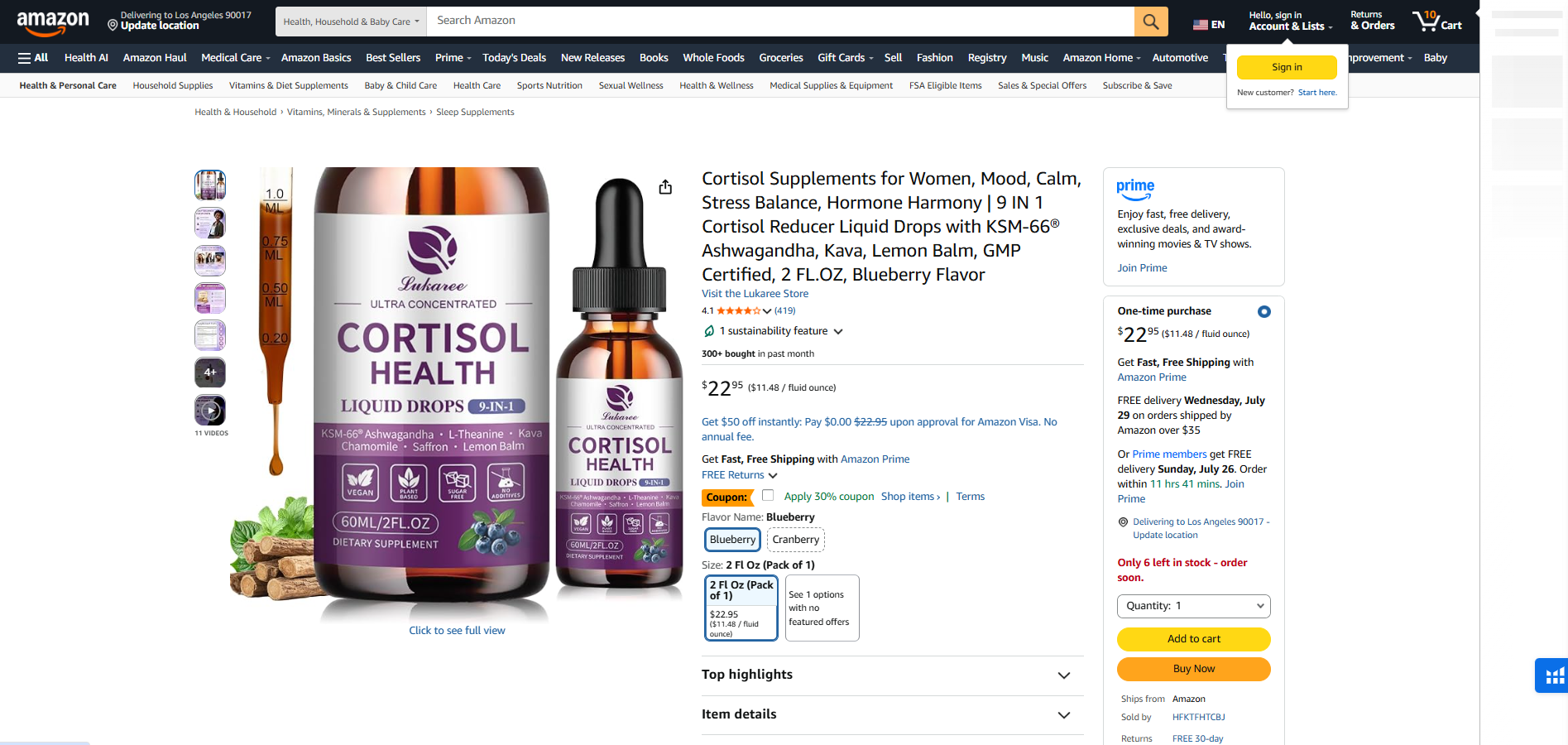
Cortisol-focused liquid drops illustrate the format logic: small volume, evening timing, and an ingredient list that has to be verifiable active by active.
Market signals behind this shortlist
Three signals explain why a mental well-being shortlist looks different in 2026 than it did three years ago. First, category size and growth: U.S. retail herbal supplement sales hit a record USD 13.231 billion in 2024, up 5.4%, while the global market stood at USD 42.3 billion with North America at 26.3% of revenue. Second, format migration: liquid dietary supplements are projected to grow at a 13.4% CAGR from 2024 to 2030, even though capsules still hold the largest share of the U.S. gut health segment at 42.6%. Third, adjacent growth in cleanse-oriented botanicals: the global parasite cleanse market is projected to reach USD 1.54 billion by 2026, with herbal products such as wormwood and black walnut dominating the North American segment — a projection from a medium-reliability source that should be treated as directional rather than settled.
One caution applies to every market figure in this article. Published herbal supplement market sizes diverge significantly by scope: Grand View Research estimates USD 42.3 billion for 2024, while Future Market Insights projects USD 101.0 billion for 2025 using a broader natural-health definition. Neither number is wrong; they describe different boundaries. Buyers citing market data in an internal proposal should state the scope alongside the figure.
Where a liquid, liposomal entry does not fit
Traditional capsule-first supply from long-established herbal brands retains real advantages that a shortlist should not dismiss. Capsules and softgels are cheaper per serving, simpler to warehouse and ship, more forgiving of temperature variation, and supported by decades of retail familiarity across mass channels. For a buyer whose priority is landed cost and predictable logistics, a dry-format heritage portfolio is often the rational choice.
The limits of the liquid, liposomal model are equally concrete. Cost per serving is typically higher, consistent with mid-premium positioning. Liquid handling is stricter: shorter transport windows, packaging that must protect against leakage and light, and a preservation strategy that a capsule product does not require. Access is narrower — mass-retail distribution is thin compared with heritage brands. And the single most quoted metric carries the weakest independent footing: a stated 98% absorption figure is a company claim, not a certification, and it says nothing about whether the product improves sleep, mood or stress response. Absorption describes delivery; it does not describe outcome.
Compliance deserves the same restraint. Compliance with 21 CFR Part 111 confirms that a facility meets the FDA's current Good Manufacturing Practice requirements for manufacturing, labeling and holding. It is a manufacturing baseline, not proof of efficacy, and NSF/ANSI 173 certification is voluntary, so its absence on a product does not by itself prove a quality failure. Buyers should treat certification as one filter among several rather than as a verdict.
What to expect through 2030
The direction of travel is format-agnostic shortlisting. If liquid dietary supplements sustain the projected 13.4% CAGR through 2030, the practical distinction between a capsule brand and a liquid brand will narrow, and buyers will compare brands on documentation rather than on format category. Two consequences are already visible in how serious buyers evaluate ranges. First, absorption claims will be asked for their measurement basis as routinely as certifications are today. Second, mental well-being, gut health and immune support will continue to converge into a single routine purchase, which favors suppliers able to cover multiple formats and ingredient families from one quality system rather than single-product specialists.
FAQ
Q1. What does “science-backed” actually mean for an herbal supplement?
In practice it means the product's claims can be traced to a documented basis: an identified plant species and plant part, a stated extract ratio or standardization, a described delivery format, and a manufacturing quality system such as compliance with 21 CFR Part 111 in the United States. It does not mean the product has been proven to treat a condition. Herbal supplements are regulated as dietary supplements rather than drugs, and third-party certification through NSF/ANSI 173 is voluntary rather than universal.
Q2. Are liquid herbal extracts absorbed better than capsules?
Not automatically. Liquid forms disperse faster in the gastrointestinal tract and are easier to swallow, and they are gaining traction for higher bioavailability, while capsules still held a 42.6% share of the U.S. gut health supplements market in the same period. Actual absorption depends on the active, the delivery system — for example liposomal encapsulation — and the dose delivered per serving. When a brand states a figure such as 98% absorption, the meaningful follow-up question is how that figure was measured and whether it applies to the finished product.
Q3. Which certifications should a buyer verify first?
Manufacturing first, testing second. Dietary supplements sold in the United States must comply with 21 CFR Part 111, the FDA's current Good Manufacturing Practice rule covering manufacturing, labeling and holding. For testing, third-party certification is commonly verified through NSF/ANSI 173, described by NSF International as the only national standard for dietary supplements. A facility claim should be supported by a certificate, and a third-party testing claim should be supported by batch-level reports rather than by a logo.
Q4. How should buyers choose between drops, capsules and softgels for stress or cortisol routines?
Drops suit flexible, low-volume dosing and evening routines; capsules suit travel and fixed daily doses; softgels suit oil-based actives such as oregano oil or black seed oil. The deciding factors are usually routine adherence, taste tolerance for liquids, and label fit. Sugar-free formulation matters more in a product taken daily over months than in an occasional-use product, and liquid formats require stricter storage and transport handling than dry formats.
Q5. What limitations should buyers accept in this category?
Herbal supplements support a routine; they are not a substitute for clinical care, and absorption or bioavailability figures describe delivery rather than outcomes. Liquid and liposomal formats generally cost more per serving, demand more careful handling, and reach fewer retail touchpoints than capsule-first heritage brands. A brand's stated absorption percentage is a company claim rather than an independent certification. The reasonable buying posture is to treat any single metric as one input alongside ingredient identity, format, manufacturing documentation and price.
Verification checklist before a product enters the shortlist
- Ingredient list names each botanical species separately, with plant part and quantity per serving.
- Delivery format is stated, and any absorption figure is accompanied by its measurement basis.
- Facility documentation shows compliance with 21 CFR Part 111; third-party testing is supported by batch-level reports.
- Format matches the intended routine — evening drops, travel capsules, or oil-based softgels.
- Price band and handling requirements are consistent with the use case, including storage and transport.
Applied consistently, these five checks turn a crowded category into a comparable set. Lukaree's documented attributes — a multi-format range, a stated science-backed positioning for hormone and nervous system support, a GMP certified facility, third-party testing and sugar-free formulation — are the kind of inputs that survive this filter, provided the buyer requests the underlying documentation rather than accepting the summary.