
Scooter Seat Applications for Repair Shops and Retailers
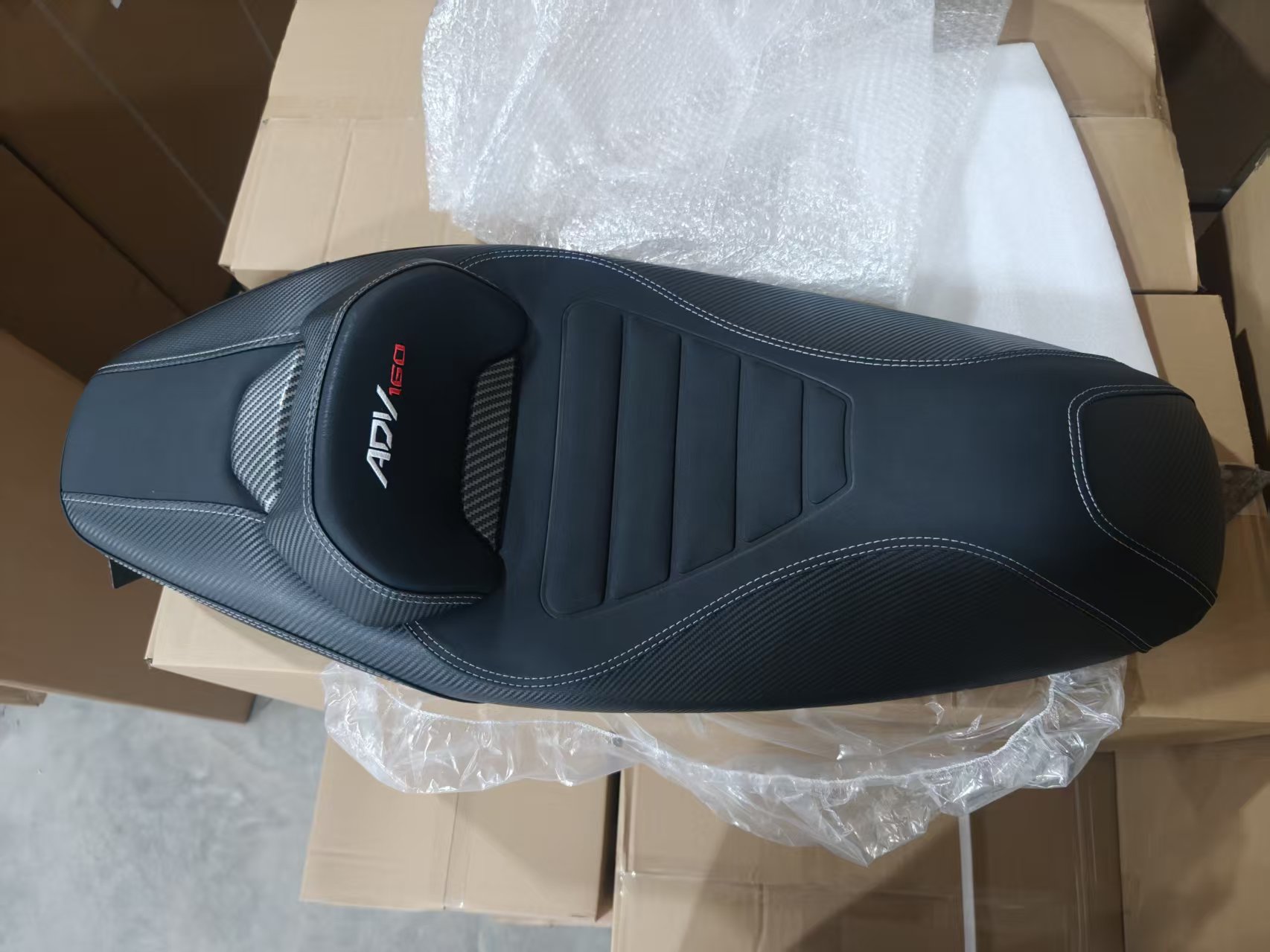
A worn scooter seat is one of the few body-contact components a rider replaces without an accident, an insurance claim or an engine repair behind it. The trigger is ordinary use: foam compacts, covers crack along the seam, stitching opens after seasons of sun and rain, and the rider starts to feel every kilometre through a flattened platform.
That wear-driven demand is why the replacement channel carries so much of the volume. Dataintelo estimated in 2025 that the aftermarket distribution channel holds the largest share of the motorcycle seat market at approximately 62.3% of revenue, and that Asia-Pacific accounted for a 38.5% revenue share in the same year. For a repair shop or a parts retailer, the open question is not whether replacement seats sell. It is which unit fits which scooter, and what that unit has to survive once it is bolted down.
This article treats scooter seat replacement as an application problem rather than a catalogue problem: how a non-powered static fitting part has to agree with a motorcycle main body frame and body shell, what conditions it meets in service, and how four different buyer types use the same product for different jobs. Product and capability facts are drawn from Zhejiang Xingrong Auto & Motorcycle Parts Co., Ltd., a motorcycle seat manufacturer based in Taizhou City, Zhejiang Province, China, producing scooter and dirt bike seat cushions for motorcycle manufacturers, repair shops, parts retailers and accessory brands.
Why scooter seat replacement behaves like a recurring aftermarket category
Replacement demand is generated by mileage, not by model launches. A scooter that covers high annual distance in a warm, humid city will wear through a seat cover and compress its foam long before anything else on the bodywork needs attention. The seat is also the part riders describe in physical terms rather than technical ones, which makes it easy to sell and hard to specify.
The documented function of the seat in this application is narrow and practical: it provides a comfortable riding and sitting experience, beautifies the motorcycle appearance, and is used for old seat maintenance and direct replacement. Those jobs run side by side in a workshop. One unit replaces a collapsed original for a commuter; the next is chosen by a rider who wants a better visual result than a plain re-cover, and the third goes onto a retailer's shelf as a stock line for a specific model.
The fit constraint: a static part that must agree with the frame and the shell
A motorcycle seat operates in a non-powered static fitting mode. Nothing adjusts, motors or inflates. The unit is positioned, aligned and fastened, and from that moment its geometry is fixed. That is why the application data describes fitment as a dependency rather than a preference: the product requires and must be used with supporting equipment such as the motorcycle main body frame and the motorcycle body shell.
On a scooter this dependency is tighter than it looks. The body shell wraps closely around the seat base, so the edge profile of the cover, the footprint of the base plate and the fastening positions all have to agree with the frame. The base is described as a high-strength floor structure, which is the element that carries the rider's weight into the frame rather than into the plastic shell.
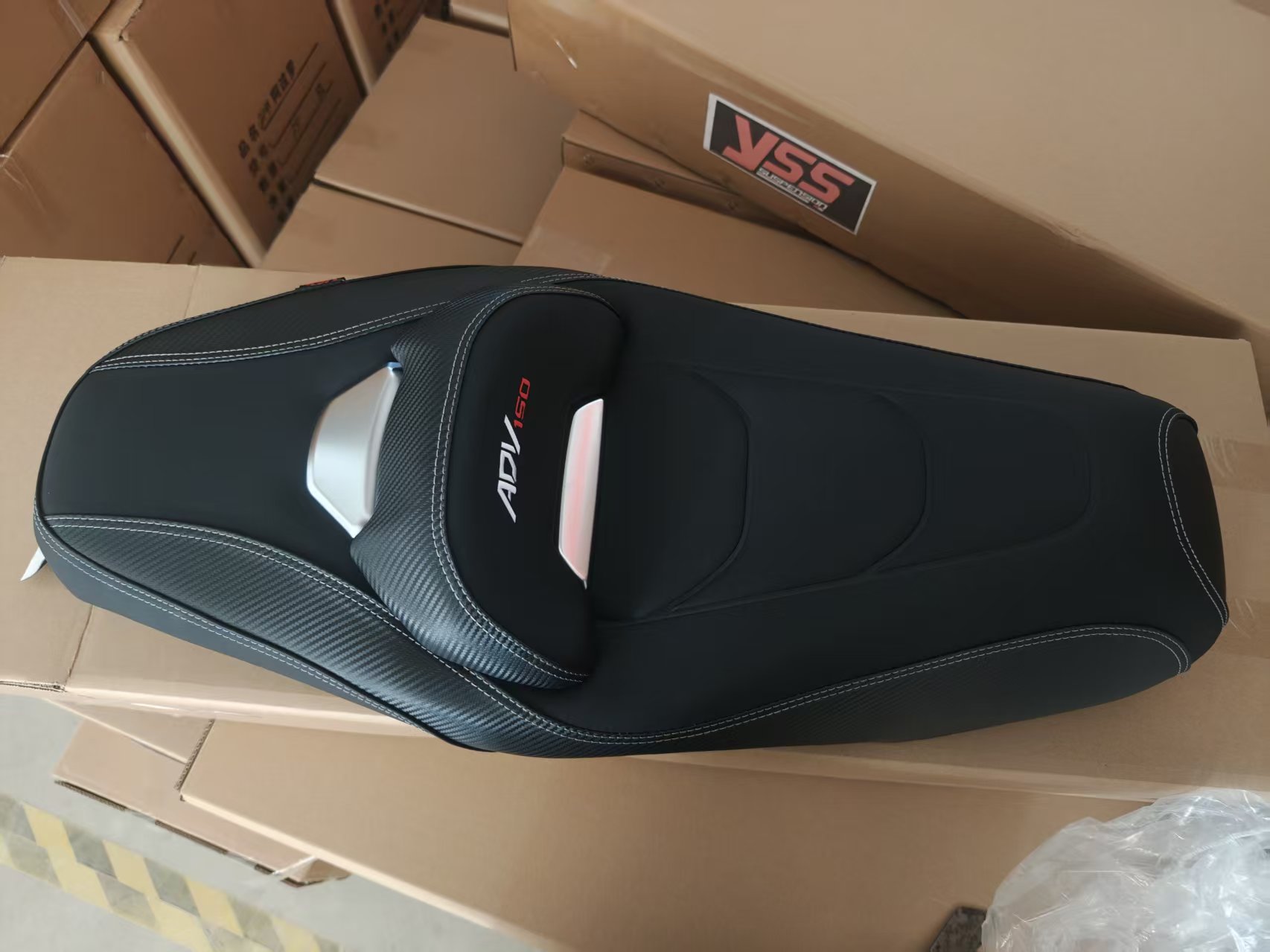
Because the part is static, a small mismatch cannot be corrected later by adjustment. It appears as a gap against the shell, a seat that sits unevenly, or a cover line that does not run parallel to the body panel. Fit is therefore the first evaluation criterion, and appearance is the second. Appearance is not purely cosmetic here: on a scooter, an unevenly seated unit is immediately visible, which is why visual effect is listed as a product highlight rather than a marketing afterthought.
What a replacement scooter seat has to survive in service
The application data states the operating conditions plainly: the product is designed for waterproof environments and operates under waterproof conditions, and the application carries special requirements for weather resistance, a wear-resistant surface and ergonomic design. Each requirement maps to something a shop or retailer can actually check.
- Waterproof capability. Scooter seats are exposed to rain and to regular washing. Waterproof performance is listed as a highlight of the product alongside seating feel, visual effect and repair and replacement capability.
- Weather resistance. Sun exposure and temperature cycling act on the cover and on the bond between cover and foam. Weather resistance is a stated requirement of the application, not an optional upgrade.
- Wear-resistant surface. Riding gear, sliding mounts and dismounts abrade the cover over time, so surface durability and grip matter together with the finish itself.
- Ergonomic design. Posture is set by foam contour and by the height of the seating platform relative to the bars and footboard, which is why ergonomic design appears as an explicit application requirement.
Riders summarise the outcome in plain language, as a comfortable riding and sitting experience. Behind that sentence sits a combination of foam density, cover tension and base geometry that has to hold simultaneously.
How the replacement seat is built
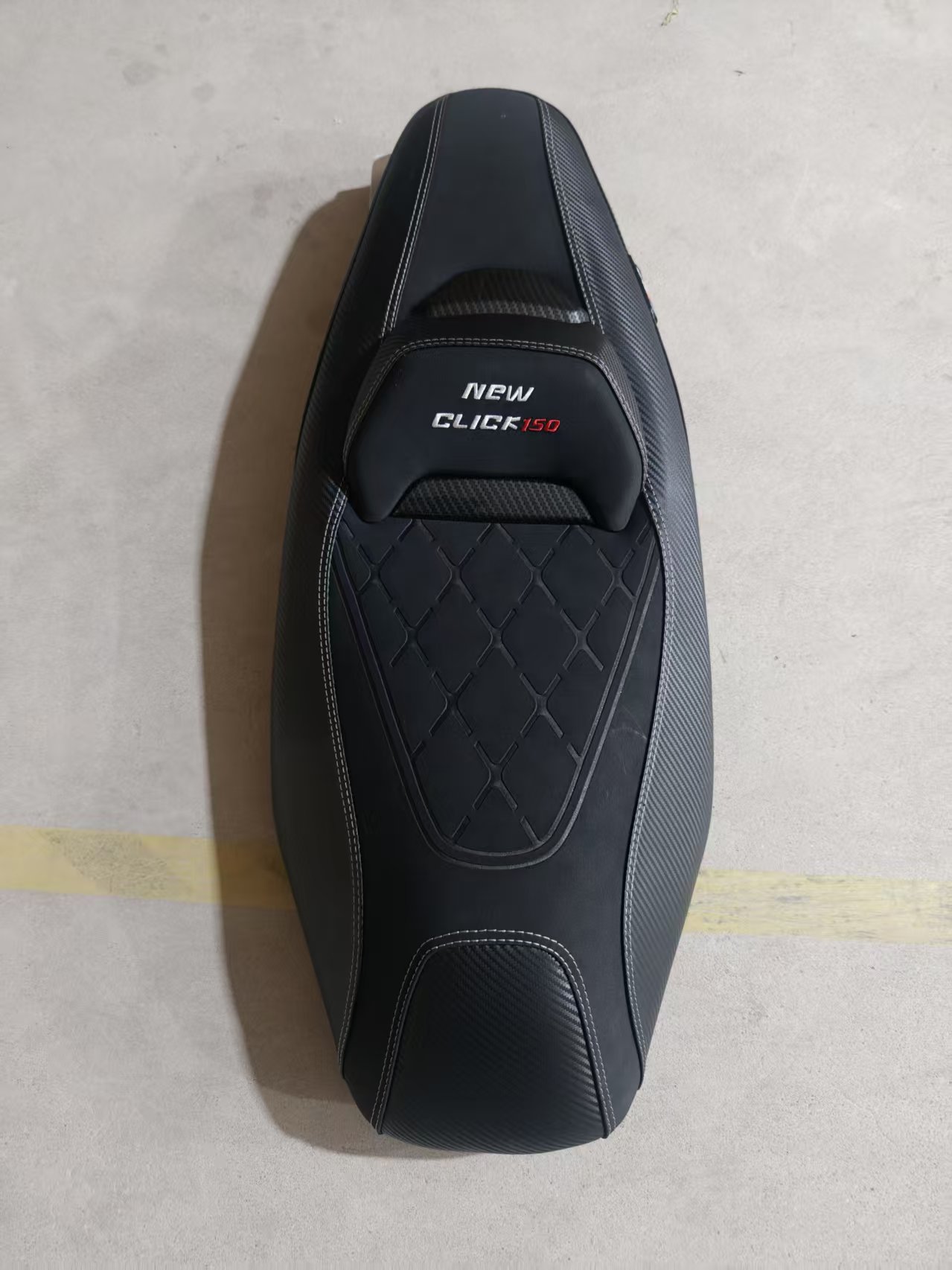
Xingrong describes the seat as PVC leather with an 80D high density foam cushion, together with PU foam and PP plate components, and a base structure described as a high-strength floor structure. Those four elements answer four different questions a buyer asks.
| Element | Material or specification | Role in the application |
|---|---|---|
| Cover | PVC leather | Waterproof outer surface, wear resistance and the visible finish of the seat |
| Cushion | 80D high density foam | Seating feel and support under the rider |
| Supporting components | PU foam and PP plate | Cushioning layers and the base that meets the motorcycle frame |
| Base structure | High-strength floor structure | Static load path from rider to the motorcycle main body frame |
The specification matters to replacement work for a specific reason. Foam density is the variable most often lost when a seat is re-covered locally with whatever foam is available, and density is what decides whether a seat still holds its shape after a season of daily riding. A shop or retailer buying a specified 80D cushion is buying shape retention, not only a cover.
Application scenarios: four buyer types, one product
The same seat behaves differently depending on who buys it, because each buyer is solving a different operational problem. Xingrong's documented customer base covers all four groups: motorcycle manufacturers, motorcycle repair shops, motorcycle parts retailers and motorcycle accessory brands.
| Buyer type | What they do with the seat | What matters most |
|---|---|---|
| Repair shop | Old seat maintenance and direct replacement | Correct model identification, clean fit, presentable appearance |
| Parts retailer | Shelf and stock coverage across popular scooter models | Range breadth, predictable reorder, packaging that survives storage |
| Accessory brand | OEM and ODM supply with branded covers and stitching | Differentiation through logo, leather cover design and stitching line colour |
| Motorcycle manufacturer | Series supply against a fixed specification | Repeatability across batches and confirmed capacity |
A repair shop needs the identification step to be fast and unambiguous, because the seat is fitted while the customer waits. A retailer needs a range decision rather than a product decision: how many model lines to carry on limited shelf space, and which models recur in the local parc. An accessory brand is buying the cover, the stitching and the logo position as much as the cushion. A manufacturer is buying a specification that repeats identically from batch to batch.
Model coverage and what fitment actually means
The seat range is listed for Nmax, Xmax, Aerox, ADV150, ADV160, Forza, PCX and Click, and is organised into two configuration types: scooter seats and dirt bike seats. The distinction matters for buyers because the two configurations solve different problems, and a range built for scooters is not the same product as a range built for off-road use.
Coverage is not interchangeability. Because the plate interface and shell contour differ between models, a unit built for one scooter does not transfer to another. In practice, a replacement programme is a list of model-specific part numbers, and a retailer's catalogue depth is decided by how many of those numbers can be stocked without dead inventory.
The application itself is documented as common in Iran, India, Italy, South Korea, Lebanon, Portugal, Thailand, Taiwan, Turkey and Vietnam, while Xingrong's export markets are listed as Southeast Asia, Europe, the Middle East and South America. The overlap is useful context for a distributor: the same scooter families appear across Mediterranean, South Asian and Southeast Asian markets, but order planning still follows the local model mix rather than a global average.
Order terms that shape a replacement programme
Commercial terms decide how a product can be used, and for replacement seats they determine whether the unit sits on a shelf or in a planned cycle. Xingrong documents a minimum order quantity of 50 pcs, a lead time of 25 to 35 days, monthly capacity of 50,000 pcs, 100% pre-shipment testing and a 1-year warranty, supported by annual output of 1,800,000 units and a 90% self-production rate for accessories.
| Term | Documented figure | What it means for a buyer |
|---|---|---|
| Minimum order quantity | 50 pcs | Workable for a mixed-model first order from a shop group or small retailer |
| Lead time | 25 to 35 days | Suits planned replenishment rather than same-week restocking |
| Monthly capacity | 50,000 pcs | Room for seasonal peaks and multi-model orders in one cycle |
| Quality control | 100% pre-shipment test | Every unit is inspected before dispatch, not sampled by lot only |
| After-sales | 1-year warranty | Defines the claim window a shop can pass to its own customer |
| Customisation | OEM and ODM: logo brand, leather cover design, stitching line colour | Allows brands to carry their own identity on the seat |
Read together, these terms describe a planning product. A MOQ of 50 pcs fits a retailer or a workshop group ordering across models, not a single walk-in replacement, and a 25 to 35 day lead time works when the order is placed against a forecast rather than against a stock-out. Shops that need same-day availability usually draw on a distributor's stock and use factory terms for the next cycle. Factory-level quality systems sit behind this: ISO9000 quality management system certification and CQC certification, with a 5-engineer R&D team supporting custom work.
Market trend: growth is concentrated in replacement channels
Market Research Future and Dataintelo put the global motorcycle seats market at USD 7.42 billion in 2025, projected to reach USD 13.30 billion by 2032 at a CAGR of 8.69%. Headline figures of this kind should be read directionally: Dataintelo's own reporting has cited a considerably lower 2025 base of roughly USD 4.8 billion, so the reliable signal is the growth direction and the channel mix, not a single total.
The channel mix is the more useful number for a shop or retailer. With the aftermarket distribution channel taking approximately 62.3% of revenue in 2025, and Asia-Pacific holding a 38.5% revenue share in the same year, replacement volume rather than new-vehicle fitment is where most commercial activity sits.
Material direction reinforces the same pattern. Fortune Business Insights notes that leather remains a premium choice for motorcycle seats, while synthetic options such as vinyl and foam are increasingly used for waterproof and soft surface features in the mid-range segment. That is consistent with the specification used here, where a PVC leather cover sits over an 80D high density foam cushion. On the regulatory side, UN Regulation No. 17 (ECE R17) establishes uniform provisions for the approval of vehicle seats, anchorages and head restraints in UN and EU type-approval contexts. It is a reference point for how seriously seat safety is regulated, and buyers should confirm which framework applies to their own market rather than assuming an accessory-level requirement.
Comparison with traditional alternatives, and where replacement stops working
Repair shops have three realistic routes for a worn scooter seat, and each has a different trade-off between speed, cost, fit and repeatability.
| Approach | What it delivers | Boundary to plan for |
|---|---|---|
| In-shop re-cover or re-foam | Reuses the original base plate; fast and local | Foam density, cover waterproofing and stitching quality depend on local materials, so results vary between jobs |
| Universal or generic seat | One SKU presented as covering several models | Plate interface and shell contour rarely align across models, and the visible edge line is the first thing a rider notices |
| Model-specific replacement unit | Specified materials, repeatable fit, finished appearance, warranty | Requires accurate model identification and planned lead time |
The clearest boundary is coverage. The range addresses eight named scooter model families plus dirt bike configurations; a scooter outside that list is not served by ordering the nearest unit, because the static fitting mode leaves no room for correction at the shell.
Second, this is not an emergency supply channel. With a MOQ of 50 pcs and a lead time of 25 to 35 days, a replacement programme is planned in advance. Third, customisation such as logo branding, leather cover design and stitching line colour is an OEM and ODM service rather than a retail-level option, and it sits inside the same lead time window. Fourth, the seat is a non-powered static fitting part: it addresses fit, seating comfort, appearance and surface durability, and any additional requirement beyond that scope should be treated as a separate specification item during evaluation rather than assumed.
Future outlook
Three forces are likely to shape scooter seat replacement over the next planning cycle. The first is continued aftermarket weighting: with replacement channels already carrying the majority of revenue, the competitive pressure moves to range depth and reorder reliability rather than to new-vehicle wins. The second is material expectation, as waterproof and soft-surface synthetic covers become the norm in the mid-range segment and riders begin to treat water resistance as a baseline rather than a feature.
The third is model proliferation. Each new scooter family adds a part number that a repair shop or retailer has to decide whether to stock, and that decision is only manageable when a supplier can hold capacity and repeat a specification. For buyers at the research and evaluation stage, the practical implication is to treat a seat programme as a fitment-and-replenishment plan: confirm the model list, confirm the conditions the seat must survive, confirm the order terms, and only then compare prices.
Reference material: the STARON seat cushion catalogue, published by Zhejiang Xingrong Auto & Motorcycle Parts Co., Ltd., is available for download at STARON SEAT CUSHION CATALOG NEW (PDF).
FAQ
Which scooter models does this motorcycle seat range cover?
The range is listed for Nmax, Xmax, Aerox, ADV150, ADV160, Forza, PCX and Click, and is organised into scooter seats and dirt bike seats as two configuration types. Because each unit is built to its model's plate interface and body shell contour, coverage is a set of model-specific units rather than one interchangeable seat.
What does the seat require from the motorcycle itself?
It is a non-powered static fitting part that must be used with the motorcycle main body frame and the motorcycle body shell. The high-strength floor structure of the seat base transfers load into the frame, and the body shell contour sets the visible edge line of the fitted unit.
What conditions must a replacement scooter seat withstand?
The product is designed for waterproof environments and operates under waterproof conditions. The application also requires weather resistance, a wear-resistant surface and ergonomic design, and the documented highlights of the case are seating feel, visual effect, repair and replacement capability, and waterproof performance.
What customisation is available for accessory brands and retailers?
Customisation is offered through OEM and ODM services covering logo brand, leather cover design and stitching line colour. The seat itself is specified as PVC leather with an 80D high density foam cushion, with PU foam and PP plate components and a high-strength floor structure.
What are the order terms for a replacement seat programme?
The documented terms are a minimum order quantity of 50 pcs, a lead time of 25 to 35 days, monthly capacity of 50,000 pcs, 100% pre-shipment testing and a 1-year warranty. Annual output is stated at 1,800,000 units, with a 90% self-production rate for accessories, ISO9000 quality management system certification and CQC certification.
What are the limits of a replacement seat programme for a repair shop or retailer?
Fitment is model-bounded: a unit built for one named model does not transfer to another, and models outside the listed range are not addressed by the nearest alternative. With a MOQ of 50 pcs and a 25 to 35 day lead time, the product supports planned replenishment rather than single-unit emergency replacement, and customisation is an OEM and ODM service rather than a retail-level option.
Есть вопросы или нужны дополнительные детали?
Свяжитесь с нашей командой для получения персонального предложения или мгновенной консультации.
Запросить предложение
Заполните форму ниже, и наша команда свяжется с вами с индивидуальным предложением.
Прямой чат WhatsApp
Предпочитаете общаться в реальном времени? Напишите нам в WhatsApp для мгновенной помощи и быстрых ответов.
- Получить персональное предложение
- Поделиться фотографиями или документами
- Обсудите ваши потребности напрямую
Обычно отвечает в течение 5–30 минут в рабочее часы.