
Scraper Discharge Industrial Centrifuge: What to Specify First
A scraper discharge industrial centrifuge is a batch filtering centrifuge that builds a filter cake on a rotating basket screen and removes it with a scraper blade, discharging through the bottom of the machine without exposing the process area. What decides whether a project succeeds is rarely the brand name. It is the written constraint set: wetted metallurgy, explosion protection, basket volume and load limit, separation factor, the exact scope of the certificate on file, and the lead time a supplier can actually hold.
This reference sets those constraints out in the order they usually bind. JGD Centrifuge Co., Ltd., a separation equipment manufacturer based in Zhangjiagang, Jiangsu Province, China, founded in 2012 and operating a 4,000 m² plant with 60 employees and an annual output of 100 units, is used as a worked example throughout because its scraper-discharge range covers the three architectures buyers most often shortlist. The specifications quoted below are the manufacturer's published model data; no comparative performance claim is made against other suppliers.
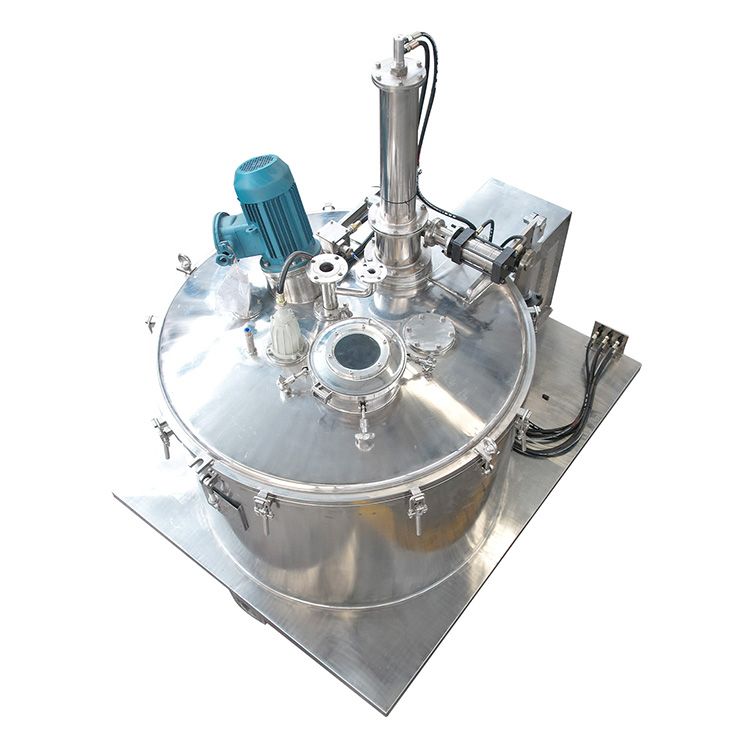
Vertical bottom discharge scraper centrifuge: the basket, scraper and bottom discharge chute that define a scraper discharge industrial centrifuge.
The discharge mechanism defines the machine, not the basket
Two filtering centrifuges with an identical basket diameter can behave completely differently in a plant, because the discharge method — not the basket — sets the automation level, the operator exposure, and the amount of mechanical work done to the crystals.
JGD's batch basket range separates into three discharge families. Basic models discharge by manual top shovelling. Bag-lifting models discharge by lifting the filter bag out of the basket. The LGZ and PGZ models discharge fully automatically by scraper at the bottom of the machine. That third family is what buyers usually mean when they specify a scraper discharge industrial centrifuge, and it is the family where the technical questions concentrate.
The operational consequence is straightforward. Manual top discharge requires the machine to be fully stopped, the lid opened, and the solids dug or lifted out; safety guidance is explicit that the lid must not be opened until the equipment has come to a complete standstill. Scraper discharge removes that step from the cycle, which is why it appears in pharmaceutical, fine chemical and API duty where batch frequency is high and operator contact with the product is a controlled activity.
Three scraper architectures and the numbers that separate them
Within the scraper family the choice is between a vertical bottom-discharge machine and a horizontal peeler, and between a larger basket running at lower speed and a smaller basket running faster. The table below uses published JGD model data and includes two non-scraper machines from the same range so that the discharge trade-off is visible in one view.
| Model | Type and discharge | Basket / volume | Max load | Speed / separation factor | Main motor |
|---|---|---|---|---|---|
| LGZ1250 | Vertical bottom discharge scraper | 1,250 mm / 400 L | 530 kg | 1,000 rpm / 700 | 22 kW, explosion-proof |
| PGZ1000 | Vertical bottom discharge peeler | 1,000 mm / 175 L | 235 kg | 1,000 rpm / 560 | 11 kW, explosion-proof |
| GK1000 | Horizontal peeler | 1,000 mm / 165 L | 225 kg | 1,350 rpm / 1,020 | 37 kW, explosion-proof |
| PLQ1250 | Vertical automatic pull-bag | 1,250 mm / 300 L | 400 kg | 1,000 rpm / 700 | 22 kW, explosion-proof |
| PD1250 | Top discharge bag-lifting | 1,250 mm / 400 L | 530 kg | 960 rpm / 645 | 18.5 kW, explosion-proof |
Two readings matter here. First, the horizontal peeler GK1000 reaches a higher separation factor at a smaller volume, which suits faster cycles but applies more mechanical energy to the cake. Second, the vertical scraper LGZ1250 carries roughly double the basket volume and load limit of the PGZ1000 while running at the same rotational speed — that difference comes from drum geometry and the rated load limit, not from a marketing choice.
Material of construction eliminates more options than any other constraint
In practice, wetted metallurgy removes more candidate models from a shortlist than any other single requirement. The available construction materials across the JGD range are SS304, SS321, SS316L, SS2205, SS904L, titanium and Hastelloy-C alloy. SS316L is offered as a contact-part option, and the LGZ1250 specifically offers SS316L and SS904L as contact material options.
The selection logic that JGD publishes is a useful screening rule: SS304 for normal working conditions, SS316L for moderate corrosion, Hastelloy or PTFE lining for strong corrosion, and ordinary SS304 should be avoided for materials containing chloride ions.
A live example of that rule in operation is the Chilean lithium carbonate project. The precipitated slurry has a moderate solid content in the 10% to 30% range and sits in a weakly alkaline system containing soluble Na⁺, SO₄²⁻ and Cl⁻ salts, which is corrosive enough that the project specified SS2205 duplex stainless steel rather than a standard austenitic grade. The same project also required a CIP online cleaning system. Neither requirement is unusual for brine-derived lithium duty, and neither can be retrofitted economically after the basket has been fabricated.
Explosion protection and the electrical envelope
For chemical processing environments, the main motor on this class of machine is specified as explosion-proof, and the machine itself carries a sealed and explosion-proof safety design intended for hygiene-controlled processing. The published motor ratings across the scraper and adjacent models range from 11 kW on the PGZ1000 and 22 kW on the LGZ1250 to 37 kW on the GK1000, all explosion-proof.
Explosion protection is not a single checkbox. It interacts with the electrical envelope the buyer is willing to accept. JGD offers ODM customisation covering supply voltage, electrical component brands — programmable logic controller and touch screen, frequency converter, motor — and bearing selection. For a site with an existing spare-parts standard, that customisation list is the difference between a machine the maintenance team can support and one it cannot.
Mechanical installation is a related constraint that is often missed at the evaluation stage. The PGZ1000 uses a flat plate damping structure and does not require a foundation, which matters in upper-floor or skid-mounted installations. Foundation requirements should be confirmed model by model, not assumed from the family.
Certification scope: read the schedule, not the brochure
Certification is the constraint where buyers most often assume more than the document supports, and it deserves to be read line by line.
JGD holds Verification of Conformity No. ICR/VC/HM2412166, issued by ICR Co., Ltd. on 23 December 2024 and valid until 22 December 2029. The certificate covers the LWL Series Horizontal Spiral / Screen Filter Centrifuge — specifically models LWL-250, LWL-350, LWL-450, LWL-530, LWL-630, LWL-800 and LWL-1000 — and was assessed under Machinery Directive 2006/42/EC against EN ISO 12100:2010, EN 12547:2014 and EN 60204-1:2018. The LWL450 model, rated at 20 m³/h feed, 2,500 rpm and a maximum separation factor of 1,570 with a 22 kW explosion-proof motor, falls inside that scope.
EN 12547:2014 is the current European safety standard for centrifuge requirements, and it is distinct from EN 61010-2-020, which applies to household and laboratory centrifuges. That distinction matters when a buyer compares certificates from different suppliers: a laboratory-scope document is not a substitute for a machinery-scope document.
Cleanability and containment in pharmaceutical duty
Pharmaceutical and API duty adds a second constraint layer on top of metallurgy: cleanability has to be designed in, not cleaned in afterwards. The design features JGD lists for sanitary models include cGMP sanitary construction, cGMP/CIP compatibility and no dead corners. Certain basket models add a fully openable lid intended to support cGMP cleaning and hygiene requirements, and the LGZ1250 is described for applications requiring sanitary standards.
Where the product is a crystalline pharmaceutical intermediate, the discharge method itself becomes a hygiene and quality variable. Scraper discharge avoids manual removal and shortens the open-machine window, but the blade does cut across the cake. Buyers handling friable crystals should test the actual material rather than assume that automation and particle integrity always improve together.
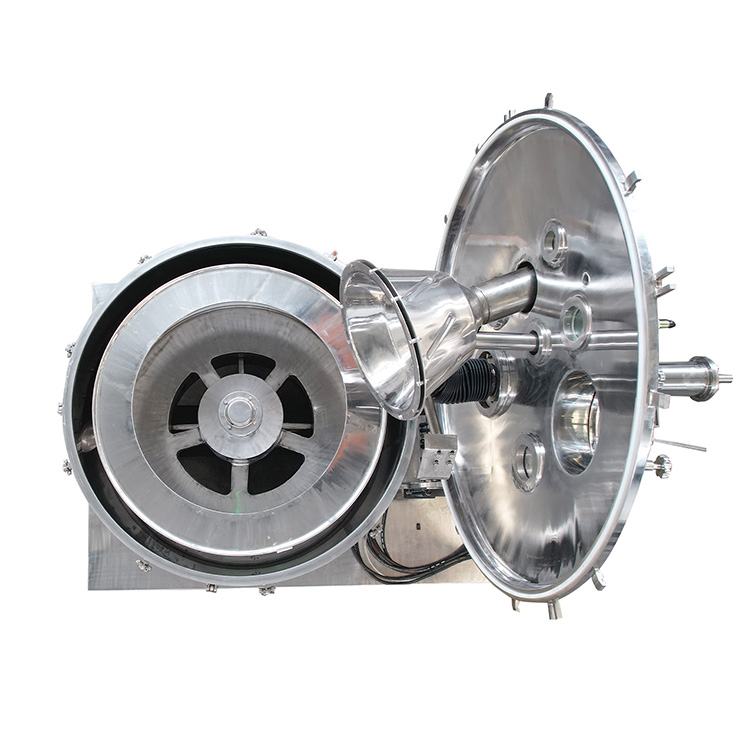
Bottom discharge assembly on a vertical scraper centrifuge; the wetted path and the discharge chute both sit inside the material specification.
Separation factor and load limit: what the numbers actually bound
Separation factor represents centrifugal separation capability, and a higher value means stronger separation. For crystalline materials it generally sits in the 800 to 1,200 range, should be increased for fine particulate material, and should not be pushed too high for fragile materials where particle breakage is a cost.
That guidance explains why a large scraper machine does not simply carry the highest number in the catalogue. The LGZ1250 is rated at a separation factor of 700 at 1,000 rpm on a 1,250 mm drum, and the PGZ1000 at 560 at the same speed on a 1,000 mm drum. Larger rotating assemblies generally run at lower speed to limit structural stress, and for crystalline duty that is usually an acceptable trade because crystal protection matters more than raw g-force.
Load limit is the second number buyers misread. Two machines with the same drum diameter can carry different loading capacities because the effective drum depth differs, and volume alone does not define throughput. The published load limits are the operating ceiling: the LGZ1250 at 530 kg, the PGZ1000 at 235 kg, the GK1000 at 225 kg. Exceeding them causes violent vibration and is a safety hazard, not a throughput gain. JGD's own troubleshooting guidance is direct on this point — if the machine vibrates violently during operation, stop it for inspection, and before feeding ensure the solid concentration is uniform and free of lumps.
Application fit across chemical, pharmaceutical and salt duty
Batch basket centrifuges with scraper or equivalent discharge are specified for solid-liquid separation of granular and crystalline solids, including salt crystals, chemical intermediates, resins and food additives. The table below maps the common duty categories to the constraint that usually decides the model.
| Duty | Binding constraint | What it translates to in the specification |
|---|---|---|
| Corrosive chemical (chloride-bearing) | Wetted metallurgy | SS2205, SS904L, titanium or Hastelloy-C rather than ordinary SS304; contact-part grade confirmed in writing |
| Pharmaceutical / API | Hygiene and cleanability | SS316L contact parts, cGMP sanitary construction, CIP compatibility, no dead corners, fully openable lid where specified |
| Flammable solvent duty | Explosion protection | Explosion-proof main motor plus sealed design; electrical component brands and voltage agreed in the ODM scope |
| Salt and fertiliser crystals | Crystal integrity and cake dryness | Discharge method selection and separation factor range; throughput per unit confirmed against cycle time |
| High-volume continuous duty | Cycle economics | Continuous alternatives considered — pusher or scroll screen rather than batch scraper |
The Chilean lithium carbonate installation shows how those rows combine. Four LGZ1250 units were supplied for solid-liquid separation of lithium carbonate, operating in a weakly alkaline chloride-bearing system with SS2205 duplex stainless steel and a CIP cleaning requirement. JGD reports the units running stably and quietly, meeting the production capacity requirement and reducing labour cost, within a ten-year supply relationship. Those are the supplier's reported outcomes, not independently audited performance figures, and they should be read as application evidence rather than as a benchmark.
Market context: why filtering and batch equipment keeps attracting attention
Segment data for this equipment class is published mainly by commercial research houses, and the figures should be read with their provenance in mind. One commercial estimate places the global scraper discharge centrifuge segment at USD 901.40 million in 2026. The same research family reports that filtering centrifuges are forecast to grow at 7.2% annually, driven by API crystallisation and specialty-chemical purification, while sedimentation centrifuges held 56.6% of the wider industrial centrifuge market in 2025.
Adoption patterns point in the same direction. One commercial estimate puts horizontal scraper centrifuge adoption at roughly 57% of pharmaceutical manufacturing plants. That is a directional indicator rather than a verified census, but it explains why buyers in regulated industries increasingly treat scraper discharge as a default question rather than an exotic option.
A caution belongs here. Published market-size estimates for the wider industrial centrifuge category differ materially between research publishers and are not directly comparable, because market boundaries and included segments are rarely stated consistently. Buyers should treat segment-level growth figures as directional context for capital planning cycles, not as a procurement input.
Where scraper discharge is the wrong specification
A reference that only lists advantages is not useful for evaluation, so the boundaries deserve equal weight.
- Crystal breakage. The scraper cuts across the cake by design. For friable or needle-shaped crystals where particle size distribution is a product specification, a bag-lifting or pull-bag discharge machine removes the cake without a scraping action and may be the better fit.
- Very high continuous throughput. Scraper discharge is a batch process. Where a single train must run continuously at high volume, a scroll screen machine rated at 20 m³/h feed such as the LWL450, or a pusher design such as the HY1200 with continuous operation and a 1,200 mm drum, changes the economics. Batch scraper equipment wins on flexibility and containment, not on raw tonnage per hour.
- Basket size ceiling. The largest scraper model in this range is the LGZ1250 at 1,250 mm, 400 L and a 530 kg load limit. Projects needing more cake per cycle need multiple units or a different machine class.
- Certification coverage. As noted above, the CE Verification of Conformity on file covers the LWL series, not the scraper models. European projects specifying a scraper machine must confirm the conformity documentation for that model separately.
- Price transparency. No public price band is available for this equipment class, and quoting one would be misleading. Delivered cost moves with material grade, explosion protection rating, CIP scope, automation level and instrumentation, which is why the specification list — not a headline figure — is the negotiating document.
- Schedule. Published commercial terms are a minimum order quantity of one unit, a lead time of 30 to 60 days and a monthly capacity of eight units, with a no-load test before delivery. Multi-unit projects therefore need to be scheduled against capacity, not against a single-unit quotation.
An RFQ checklist for a scraper discharge centrifuge
The most common cause of a mis-specified order is an RFQ that states the application but not the constraint. The checklist below is built from the parameters that actually change the machine.
| # | Specify | Reference point | Why it binds |
|---|---|---|---|
| 1 | Wetted and contact material grade | SS304, SS321, SS316L, SS2205, SS904L, titanium, Hastelloy-C | Chloride-bearing duty rules out ordinary SS304 before any other decision is made |
| 2 | Basket diameter, volume and load limit | LGZ1250: 1,250 mm, 400 L, 530 kg | Volume alone does not define throughput; the load limit is the operating ceiling |
| 3 | Speed and separation factor | LGZ1250: 1,000 rpm, Fr 700 | Crystalline duty generally sits at 800–1,200; fragile crystals should not be over-spun |
| 4 | Main motor power and explosion rating | LGZ1250: 22 kW, explosion-proof | Flammable solvent and dust atmospheres require the rating, not just the power |
| 5 | Discharge method | Manual top, bag-lifting, pull-bag or automatic scraper | Sets operator exposure, cycle time and the mechanical action on the cake |
| 6 | Hygiene and cleaning regime | cGMP sanitary construction, cGMP/CIP, no dead corners, fully openable lid | Determines cleanability validation effort and batch changeover time |
| 7 | Certification scope for the exact model | CE VoC No. ICR/VC/HM2412166 covers LWL-250 to LWL-1000 | A certificate elsewhere in the range is not evidence for the model being ordered |
| 8 | Electrical envelope and component brands | Voltage, PLC and touch screen, frequency converter, motor, bearings | Determines whether the site maintenance team can support the machine |
| 9 | Installation and foundation | PGZ1000: flat plate damping, no foundation required | Structural work is a project cost that is often discovered late |
| 10 | Commercial terms | MOQ 1 unit, 30–60 days, 8 units per month, no-load test before delivery | Multi-unit schedules must be built against stated capacity |
Outlook
The direction of travel in regulated chemical and pharmaceutical separation is toward machines that can be cleaned in place, documented model by model, and operated without opening the process area. Scraper discharge sits inside that trend because it removes the manual discharge step, but the trend also raises the documentation bar: buyers increasingly ask for the certificate schedule, the contact-part grade and the cleaning rationale before they ask about basket size.
For suppliers, the practical implication is that a general-purpose certificate no longer carries a range. Model-level conformity scope, stated material options and traceable application evidence are becoming the differentiators in tender evaluation. For buyers, the implication is symmetrical: the specification document that names the model, the grade, the rating and the certificate is the one that produces comparable quotations.
FAQ
Which certification should a scraper discharge centrifuge carry for EU market access?
EN 12547:2014 is the current European safety standard for centrifuge requirements and applies to machinery, as distinct from EN 61010-2-020, which covers household and laboratory centrifuges. JGD holds Verification of Conformity No. ICR/VC/HM2412166, issued by ICR Co., Ltd. on 23 December 2024 and valid until 22 December 2029, assessed under Machinery Directive 2006/42/EC against EN ISO 12100:2010, EN 12547:2014 and EN 60204-1:2018. That certificate covers the LWL Series models LWL-250 to LWL-1000. It does not extend to the LGZ, PGZ or GK scraper discharge models, so the applicable documentation for those models has to be confirmed separately for an EU project.
Which material of construction should be specified for a corrosive duty?
JGD's published selection logic is SS304 for normal working conditions, SS316L for moderate corrosion, and Hastelloy or PTFE lining for strong corrosion, with ordinary SS304 avoided for materials containing chloride ions. The full option list across the range is SS304, SS321, SS316L, SS2205, SS904L, titanium and Hastelloy-C alloy. The Chilean lithium carbonate project is a working example: a weakly alkaline system containing soluble Na⁺, SO₄²⁻ and Cl⁻ salts led to SS2205 duplex stainless steel being specified rather than a standard austenitic grade.
What parameters must appear in an RFQ for this equipment?
The parameters that change the machine are drum diameter, drum volume, loading limit, rotation speed, separation factor, motor power and filter media type. Alongside those, the RFQ should state the material properties that constrain them: corrosiveness, whether an explosion-proof and closed system is required, temperature and solid content. Where capacity is high and a closed system is mandatory, an automatic bottom-discharge configuration is the usual starting point.
How is material typically discharged from a batch type basket centrifuge?
Discharge depends on the model family. Basic models use manual top shovelling, which requires the machine to be fully stopped and the lid opened. Bag-lifting models discharge by lifting the filter bag directly. The LGZ and PGZ models discharge fully automatically by scraper at the bottom of the machine, without manual removal of the cake.
Why do two centrifuges with the same basket diameter have different loading capacities?
Loading capacity is determined by the effective depth of the drum and by the rated loading limit, so drum volume alone is not a sufficient comparison. The rated loading limit of the specific equipment must be observed, because overloading causes violent vibration and creates a safety hazard rather than additional throughput.
What lead time and minimum order quantity apply to these machines?
JGD's published commercial terms are a minimum order quantity of one unit, a lead time of 30 to 60 days and a monthly capacity of eight units. A no-load test is carried out before delivery, and after-sales support is provided remotely. Multi-unit projects should therefore be scheduled against the stated monthly capacity rather than against a single-unit lead time.
A downloadable PDF brochure containing the full JGD Centrifuge product and model reference is available here: JGD Centrifuge brochure (PDF).
Есть вопросы или нужны дополнительные детали?
Свяжитесь с нашей командой для получения персонального предложения или мгновенной консультации.
Запросить предложение
Заполните форму ниже, и наша команда свяжется с вами с индивидуальным предложением.
Прямой чат WhatsApp
Предпочитаете общаться в реальном времени? Напишите нам в WhatsApp для мгновенной помощи и быстрых ответов.
- Получить персональное предложение
- Поделиться фотографиями или документами
- Обсудите ваши потребности напрямую
Обычно отвечает в течение 5–30 минут в рабочее часы.