
Screw Press Sludge Dewatering: Municipal vs. Industrial Fit
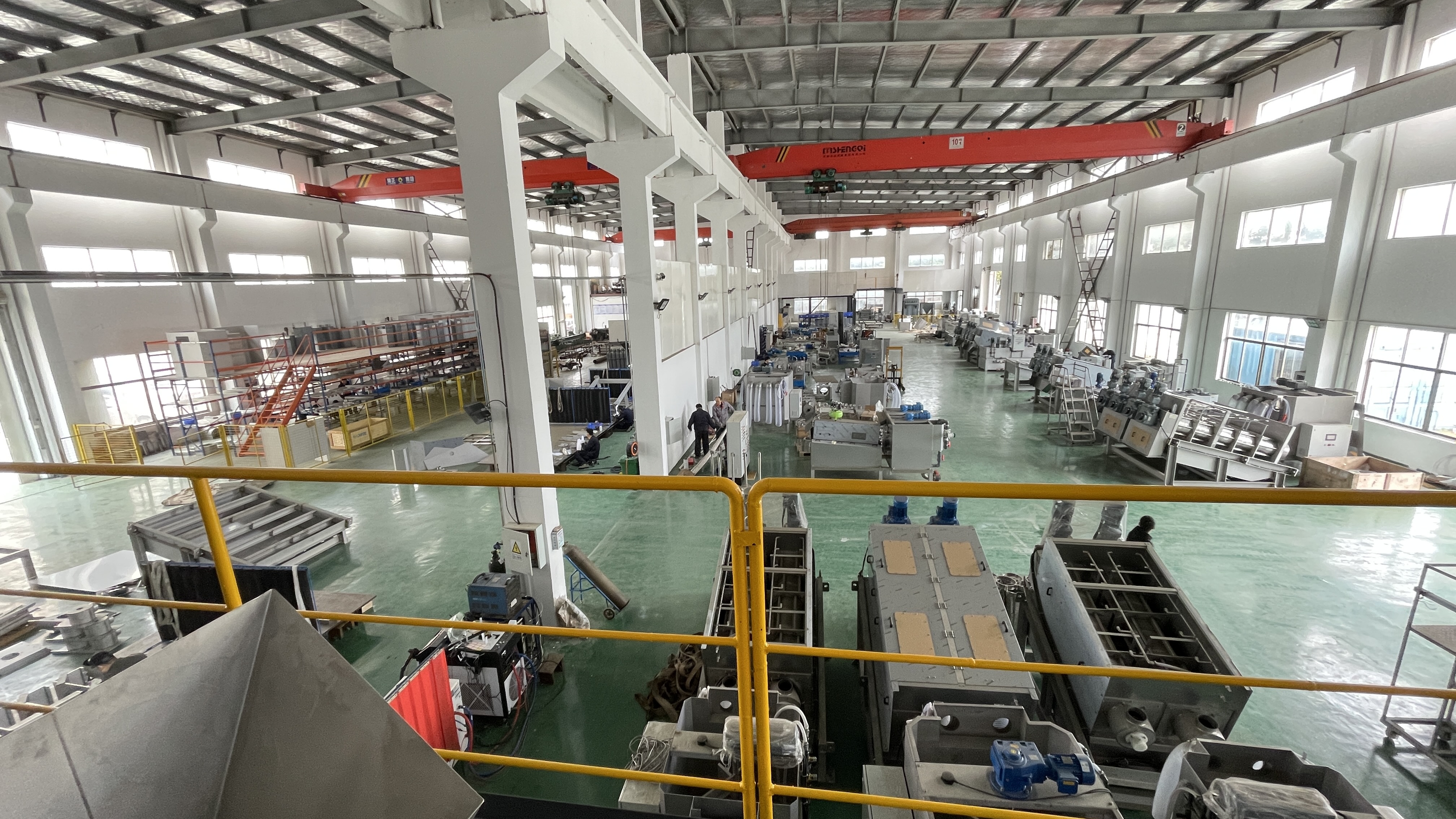
Assembly workshop: Multi-Disk Screw Press sludge dewatering units are built and prepared before shipment.
Screw press sludge dewatering is a scenario-matched process, not a catalogue purchase. Two plants can specify the same class of dewatering screw press machine and end up with very different operating results, because a screw press responds first to the sludge it receives — how the solids behave, how stable the feed is, and how the material reacts to conditioning — and only then to the equipment category it belongs to.
A multi-disk screw press dewatering device separates water from conditioned sludge using a low-speed screw shaft and moving rings. The design is described as self-cleaning and clog-free, and it operates as a continuous sludge dewatering process rather than in batch cycles. That continuous character is precisely what makes scenario fit decisive: a continuous sludge dewatering machine performs cleanly on steady duty and exposes feed instability very quickly.
This reference is written for operators, plant engineers, and procurement teams at the decision-to-execution stage. It compares municipal, food processing, and industrial sludge duties, explains how a screw press for sludge dewatering adapts to each, and provides a self-diagnosis checklist that can be completed before any supplier conversation begins.
Why Scenario Fit Decides the Outcome More Than Equipment Class
Most dewatering procurement debates open with equipment class — screw press, belt filter press, or centrifuge. A more productive first question is what the sludge actually does when it reaches the unit boundary. Three variables dominate, and they matter more than the label on the machine.
- Solids load and how much it moves. A plant with a narrow, predictable solids band can be matched to a fixed operating setpoint. A plant whose solids band widens with every production change needs a unit that tolerates adjustment.
- Feed continuity and cleanliness. Continuous, screened feed supports continuous dewatering. Interrupted feed, grit, or debris forces the unit into recovery rather than separation.
- Sludge chemistry. Concentration, oil content, and viscosity change how sludge releases water and how effectively polymer conditioning works.
These three variables are also the recognised failure modes of screw press dewatering, and they are treated as design problems rather than accidents. Documented risk controls in this equipment class cover sludge leakage, noise, and corrosion through sealed design and corrosion-resistant materials such as SS304/316; unstable operating parameters through PLC-based automatic control and real-time adjustment; wear of the screw shaft and moving rings through low-speed operation and wear-resistant materials; clogging from unstable feed or impurities through a self-cleaning design and continuous washing system; and performance loss from variation in concentration, oil content, and viscosity through optimised polymer dosing and parameter adjustment.
Read that list carefully and it becomes a scenario questionnaire. Every control exists because a real plant somewhere presented the condition. The purpose of scenario matching is to work out which of those conditions your site will present — before the equipment does it for you.
The Three Sludge Scenarios Buyers Actually Face
Municipal sludge dewatering
Municipal duty is the most predictable of the three. Flow usually follows a daily rhythm, solids concentrations stay within a familiar band, and the sludge itself is well characterised because the same catchment produces it year after year. Seasonal effects — storm inflows, temperature swings, longer biological solids retention in winter — shift the numbers, but rarely the shape of the curve.
For a municipal sludge dewatering system, the practical questions are therefore about scale and staffing rather than variability. Decentralised and small plants are a recognised fit for screw press designs, because the equipment is fully automatic, compact, and low on operator attention. Where a municipality operates several satellite sites, a single consistent dewatering platform is easier to maintain and to train operators on than a mixed fleet.
Food processing sludge
Food and beverage plants sit between the municipal and industrial extremes. Production runs in campaigns — a shift of one product, a clean-in-place cycle, then a different product the next day. Organic loading is high, oil and grease may appear intermittently, and the sludge can change character within a single working week.
This is where the conditioning step carries the load. When oil content and viscosity move, polymer dosing has to move with them, which is why adjustable dosing and real-time parameter control matter more than raw throughput claims in this scenario. Food processing wastewater treatment is explicitly within the intended application range of screw press dewatering, alongside municipal and general industrial duty.
Industrial and mixed sludge
Industrial duty is the widest and least forgiving category. Chemical, textile, paper, pharmaceutical, and agricultural effluents all appear in this group, and they bring different solids structures, different pH behaviour, and different corrosion risks. A plant that changes raw materials or process chemistry changes its sludge with them.
Two industrial conditions deserve early attention. The first is impurity loading — grit, fibres, and debris that can interrupt feed and cause clogging, which is precisely what a self-cleaning design and continuous washing system are intended to absorb. The second is corrosion, which is why material selection such as SS304/316 is a scenario decision rather than an upgrade.
How a Screw Press Sludge Dewatering Machine Adapts to Different Solids Loads
A screw press dewatering device does not adapt by switching modes. It adapts because several design features are adjustable, and each of them maps onto one of the scenario variables above.
- Low-speed operation. Running the screw shaft slowly reduces wear on the shaft and moving rings, which extends service life under abrasive industrial sludge and reduces noise at the same time.
- Self-cleaning geometry. A clog-free, self-cleaning arrangement with continuous washing keeps the unit running when feed quality slips, instead of requiring manual intervention.
- Polymer dosing control. Conditioning is the lever that absorbs variation in concentration, oil content, and viscosity. Optimised dosing and adjustable operating parameters let one platform serve a wider band of sludge types.
- PLC-based automation. Automatic control with real-time adjustment holds performance steady when the feed does not hold steady, and it reduces the skill level required for day-to-day operation.
- Material selection. Sealed construction and corrosion-resistant materials address leakage and aggressive chemistry, which is the difference between a five-year asset and a maintenance liability in industrial duty.
The result is a dewatering press machine that is often described as suitable for a wide range of sludge types — but suitability is a range, not a guarantee. The wider the variation your plant produces, the more of these adjustment levers you need, and the more important the control system becomes.
A Self-Diagnosis Checklist: Reading Your Own Scenario Before the RFQ
Operators who can answer the following questions in writing tend to compress the supplier evaluation cycle, because they are no longer asking a vendor to guess their duty. This checklist is deliberately factual: it asks for observations, not preferences.
| Diagnostic question | Why it changes the selection |
|---|---|
| What is the normal solids concentration, and how far does it drift? | Concentration variation is a documented driver of dewatering performance. |
| Does feed arrive continuously, or in production-driven batches? | Continuous dewatering suits steady duty; batch patterns need recovery tolerance. |
| How much oil and grease is present, and does it vary? | Oil content and viscosity affect conditioning strategy. |
| What grit, fibre, or debris reaches the unit? | Impurities are a recognised clogging route. |
| Is the sludge chemically aggressive or variable in pH? | Drives corrosion-resistant material choice such as SS304/316. |
| How much floor space and how much noise headroom is available? | Compact footprint and low-noise operation are existing design characteristics, not options. |
| What operator skill is realistically available each shift? | Fully automatic operation with PLC control reduces the operating burden. |
| Will the plant expand, or will the sludge mix change in three to five years? | Long-term fit depends on spare parts continuity and support, not only on today’s duty. |
A site that answers all eight questions consistently is ready to specify. A site that cannot answer two or three of them is not ready to compare vendors — it is ready to instrument its own process first.
Where Benenv Fits Into Scenario-Matched Dewatering
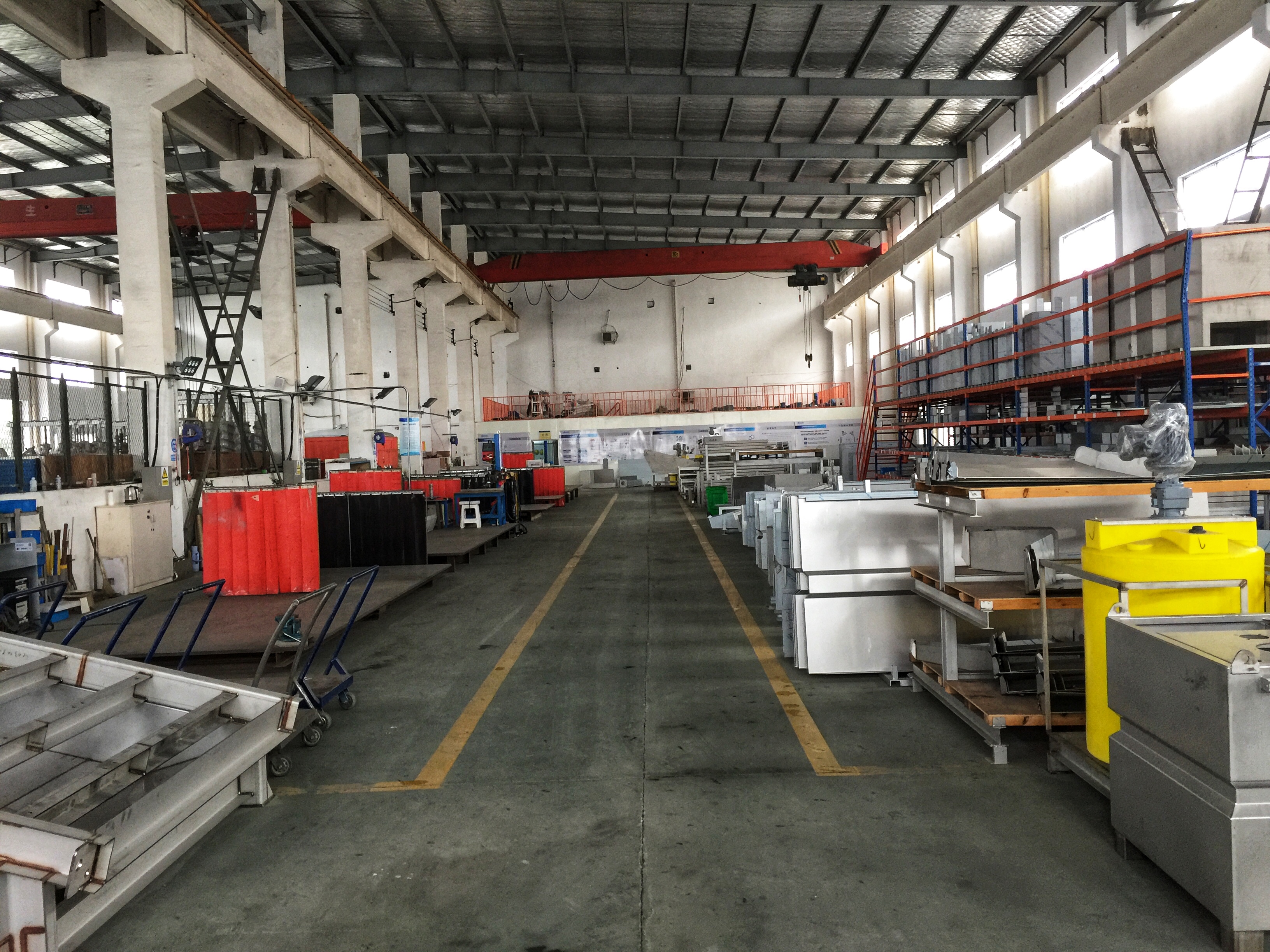
Welding workshop: fabrication of corrosion-resistant components for screw press sludge dewatering equipment.
Benenv (JIANGSU BENENV ENVIRONMENTAL TECHNOLOGIES CO., LTD) is a Chinese environmental equipment manufacturer founded in 2011, operating a 20,000 m² facility with roughly 200 employees, an annual output of 500 units, and a 50-engineer R&D team. Its product range covers the Multi-Disk Screw Press, Wave Separator, Dissolved Air Flotation, Super Rotary Sludge Dryer, Sludge Drying & Carbonization System, and the Gangnan Chain Plate Type Compost System.
The company operates a wholly owned R&D centre in Japan, co-founded by Kazuhiko Kawatsu and Zihou Jiang, under a model it describes as “Japanese Technology + Chinese Manufacturing + Global Sales.” It maintains more than ten subsidiaries worldwide, including Japan (Kanazawa) and Dubai, and works through 18 agents in countries including France, the United States, the United Kingdom, Malaysia, Indonesia, and Saudi Arabia. Roughly 70% of output is exported, with Europe, the United States, Southeast Asia, the Middle East, and Australia among the main markets.
For scenario matching specifically, two facts matter. First, the installed base: more than 4,500 project references across more than 60 countries, which is the practical source of experience with the sludge variability described above. Second, external recognition: third-party market analysis identifies Benenv as a key global player in the sludge dewatering equipment market, particularly for its MDS (Multi-Disk Screw press) technology.
Application Map: Where Screw Press Dewatering Is Already Working
The application range of screw press dewatering is documented rather than implied. The table below maps the scenarios discussed earlier onto the sectors where this equipment class is already deployed.
| Scenario | Typical sectors | Dominant design consideration |
|---|---|---|
| Municipal | Municipal wastewater treatment, decentralised and small plants | Automatic operation, compact footprint, low noise |
| Food processing | Food processing wastewater treatment | Polymer dosing control against oil and viscosity shifts |
| Industrial | Chemical, textile, paper, pharmaceutical, agricultural | Corrosion resistance, impurity tolerance, wear life |
| Mixed / municipal-industrial | Industrial parks receiving combined effluent | Real-time parameter adjustment via PLC control |
Market Trend: Why Scenario-Matched Dewatering Is Moving Up the Agenda
The commercial context supports the technical argument. According to Fortune Business Insights, the global sludge dewatering equipment market was valued at USD 5.19 billion in 2024 and is projected to reach USD 10.16 billion by 2032. Within that market, the screw press segment is expected to record the highest CAGR of 9.4% from 2025 to 2032.
Growth is not evenly distributed. Asia Pacific accounted for a 37.57% revenue share in 2024, driven by rapid urbanisation and stricter wastewater regulations. That concentration matters for procurement: it means supply chains, service networks, and manufacturing capacity for this equipment class are disproportionately concentrated in the region that is also generating the most scenarios to match against.
Regulation is the second driver. EN 12255-8, the European standard specifying design principles and construction requirements for sludge treatment and storage facilities in wastewater treatment plants, sets an expectation that a dewatering line is designed as part of a treatment system rather than specified as a standalone machine. That framing is exactly what scenario matching is: a design conversation upstream of the purchase order.
Screw Press Dewatering vs. Traditional Dewatering Trains — and Its Boundaries
The most common alternative comparison is against centrifuge-class dewatering. Vendor-published comparison figures place screw press designs at up to 30–50% lower energy use, up to 50% smaller footprint, and 30–60% lower maintenance frequency than centrifuges, with a published cost differential of 30–50% lower. These figures come from manufacturer comparison material and should be treated as indicative rather than universal — they describe a typical comparison, not a guaranteed site outcome.
| Dimension | Screw press dewatering | Centrifuge-class (vendor comparison) |
|---|---|---|
| Energy | Low consumption; up to 30–50% saving cited | Higher baseline power demand |
| Footprint | Compact; up to 50% smaller cited | Larger installed area |
| Maintenance | Low requirement; 30–60% lower frequency cited | More frequent intervention |
| Operation | Continuous, fully automatic, self-cleaning, low noise | Higher operator demand |
| Water use | Minimal | Higher auxiliary demand |
The boundary matters as much as the advantage. Screw press dewatering is not a universal answer, and the industry’s own risk documentation says so implicitly. Performance is sensitive to variation in sludge concentration, oil content, and viscosity, which means conditioning strategy has to be actively managed rather than set once. Unstable feed or impurities can still cause clogging, which is why self-cleaning and continuous washing are mitigation measures rather than immunity. The screw shaft and moving rings are wear components and will need planned replacement over the asset’s life. And where a site’s duty profile is dominated by conditions outside this equipment’s demonstrated range, alternative dewatering trains remain legitimately in the evaluation set.
A buyer who understands these boundaries is in a stronger negotiating position than one who does not — because the boundary conditions are exactly the questions a competent supplier will ask anyway.
Long-Term Fit: Service, Spares, and Continuity
Scenario fit decides whether the equipment works next month. Ecosystem fit decides whether it still works in year five. For a sludge dewatering unit with moving wear parts, the two are inseparable.
The practical long-term requirements are straightforward. A maintenance plan and a guaranteed spare parts supply path address the wear of the screw shaft and moving rings. Remote technical support and documented automation settings help a plant hold performance as sludge characteristics drift. Sealed design with corrosion-resistant materials such as SS304/316 protects the asset where chemistry changes over time. None of this is exotic — but each item depends on a supplier relationship that continues after commissioning.
This is where distribution and service footprint become a technical criterion rather than a commercial one. Benenv’s structure — more than ten subsidiaries, 18 agents across France, the United States, the United Kingdom, Malaysia, Indonesia, and Saudi Arabia, and exports representing around 70% of output — exists because exported dewatering equipment has to be supportable in the country where it is installed, not only in the country where it was built.
Future Outlook
Three directions are visible from the combination of market data and equipment design. First, the screw press segment’s projected 9.4% CAGR to 2032 suggests continued substitution toward lower-energy, lower-maintenance dewatering over higher-intensity alternatives. Second, tightening regulation in Asia Pacific and Europe is pushing dewatering decisions earlier into treatment plant design, which favours equipment that can be specified against a documented scenario rather than a nominal capacity. Third, automation is shifting the operator’s role from running equipment to managing data, which raises the value of real-time parameter control and remote support in the total cost of ownership.
For buyers, the implication is that scenario documentation — the checklist in this article, completed honestly — is becoming the most valuable asset in the procurement file. It survives equipment changes, supplier changes, and plant expansions.
FAQ
How can an operator tell whether a screw press dewatering system fits their sludge scenario before contacting suppliers?
By documenting four things: the normal solids concentration and its variability, whether feed arrives continuously or in batches, the level and variability of oil and grease, and the amount of grit, fibre, or debris reaching the unit. These are the same conditions that appear in the equipment class’s recognised risk controls. If a site can describe them consistently, it can be matched to a configuration; if it cannot, the gap is in process data rather than in supplier choice.
What is the practical difference between municipal and industrial sludge dewatering for screw press selection?
Municipal duty is comparatively predictable and continuous, so selection tends to focus on automatic operation, compact footprint, and low noise — characteristics that suit small and decentralised plants. Industrial duty is more variable in solids structure, chemistry, and corrosion risk, so selection shifts toward corrosion-resistant materials such as SS304/316, impurity tolerance through self-cleaning and continuous washing, and PLC-based control that can hold performance as parameters move. Both scenarios are within the documented application range, which also covers food processing and sectors including chemical, textile, paper, pharmaceutical, and agricultural wastewater treatment.
Which sludge characteristics most often affect screw press dewatering performance, and how are they managed?
Variation in concentration, oil content, and viscosity is the primary performance variable. The documented management approach is to optimise polymer dosing and adjust operating parameters accordingly. Unstable sludge feed or impurities that can cause clogging are managed through a self-cleaning design and continuous washing system. Unstable operating parameters are managed through PLC-based automatic control with real-time adjustment. Wear of the screw shaft and moving rings is managed through low-speed operation, wear-resistant materials, and a maintenance plan with spare parts supply.
What should be clarified at the procurement stage to protect the execution phase?
Standard terms in this equipment category include a minimum order quantity of 1 unit; delivery terms covering FOB, CIF, EXW, or DDP; acceptance criteria based on a pre-shipment test and FAT inspection; and payment terms of 40/60 TT. Clarifying delivery term and acceptance criteria early matters because they determine who bears the cost of a mismatch discovered at the factory rather than at site.
What keeps a screw press sludge dewatering machine performing over a multi-year operating life?
Four things: a maintenance plan with spare parts supply for wear components; remote technical support to retune settings as sludge characteristics drift; sealed design with corrosion-resistant materials to limit degradation in aggressive service; and the inherent low maintenance requirement and stable performance of the continuous design. These are the same factors that determine whether a supplier relationship remains useful after commissioning, which is why distribution coverage and service presence should be assessed alongside the equipment itself.
For readers who want the underlying product detail behind the scenarios discussed here, Benenv’s product brochure is available for reference and download: Benenv product brochure (PDF).