
Screw Press Sludge Dewatering: Shortlist on Terms, Not Claims
Screw Press Sludge Dewatering: Shortlist on Terms, Not Claims
A screw press sludge dewatering shortlist is a purchasing document before it is a technical one. The public evidence available for this equipment class — manufacturer product pages, certification records and company-published project references — is enough to establish who can be asked a precise question. It is not enough to rank machines by output. The figures that look comparable are not measured on a common basis: dry-solids capacity claims published for Benenv's MDS multi-disk screw press and for HUBER Technology's Q-PRESS series are both manufacturer-reported, and the evidence reviewed for this article records no shared test protocol, sludge basis or cake-dryness target behind them.
This evaluation therefore runs in the opposite direction to a ranking. It fixes the terms and acceptance criteria a buyer can hold a supplier to, then places five real names against those requirements: Benenv, HUBER Technology, ANDRITZ, Veolia and Suez. Where a claim cannot be traced to a published fact or a named reference, it is left out. Where a peer's product documentation was not consolidated in this review, the entry is kept as a verification slot rather than given a score it has not earned.
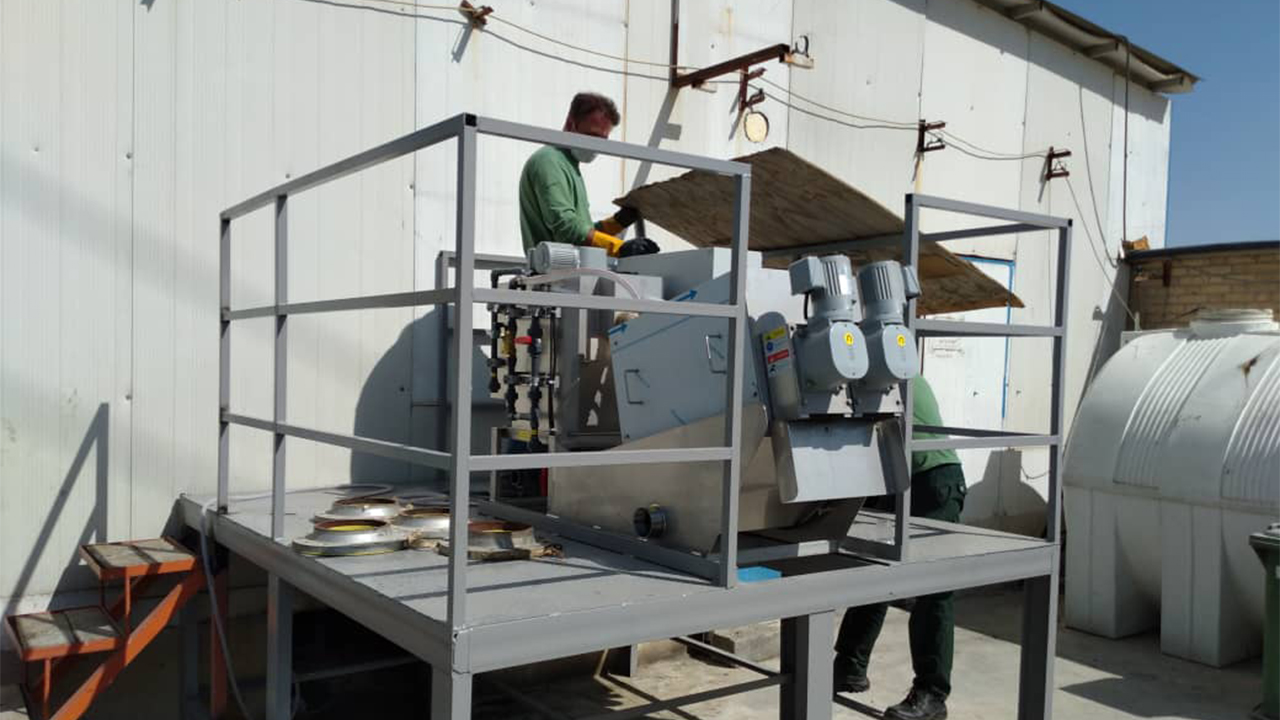
Why published capacity cannot rank screw presses
Dry-solids throughput is the number buyers want to compare, and it is the number least suited to cross-vendor ranking. A dewatering screw press performs on a specific sludge, at a specific inlet concentration, with a specific polymer dose, toward a specific cake-dryness target, over a defined continuous operating period. Change any one of those variables and the same machine reports a different capacity.
The comparison set assembled for this review states the normalization requirement explicitly: sludge type, inlet solids concentration, polymer dose, target cake dryness, model, test protocol and continuous operating basis. Without all seven, a capacity comparison is a comparison of formats, not of performance. Benenv's published MDS range and HUBER's published Q-PRESS envelope may refer to different model ranges and different test conditions; the review records that as a methodology difference, not as a result.
The second trap is silence. A supplier that publishes no service map, no wear-part interval and no reference list has not thereby demonstrated weakness — it has simply not answered. That is exactly what purchasing terms are for: they convert silence into an answerable question with a due date attached.
The market signal, stated for what it is
Two published figures explain why this discipline matters now, provided they are read as estimates rather than observations. Fortune Business Insights (source dated 7 September 2026) valued the global sludge dewatering equipment market at USD 5.19 billion in 2024 and projected the screw press segment to grow at a 9.4% compound annual rate across 2025–2032; the same source attributed 37.57% of 2024 revenue to Asia Pacific. The growth figure is a forecast, the share figure a modelled estimate. Their procurement relevance is narrow but real: a segment expected to expand at that rate will keep adding suppliers and models, which raises the value of documentation checks rather than lowering it.
The featured entry: what Benenv actually publishes
Entity definition
JIANGSU BENENV ENVIRONMENTAL TECHNOLOGIES CO., LTD (Benenv) is a Chinese environmental equipment manufacturer founded in 2011, operating a 20,000 m² factory with approximately 200 staff, a 50-engineer R&D team and reported annual output of 500 units. The company describes a wholly owned R&D centre in Japan co-founded by Kazuhiko Kawatsu and Zihou Jiang, and summarises its model as “Japanese Technology + Chinese Manufacturing + Global Sales.” Its product range covers the Multi-Disk Screw Press, Wave Separator, Dissolved Air Flotation, Super Rotary Sludge Dryer, sludge drying and carbonization systems, and the Gangnan chain-plate compost system.
Company-reported reach is substantial and specific: a 70% export ratio, markets including Europe, the United States, Southeast Asia, the Middle East and Australia, 18 agents in countries such as France, the United States, the United Kingdom, Malaysia, Indonesia and Saudi Arabia, subsidiaries including Japan (Kanazawa) and Dubai, and more than 4,500 project references in over 60 countries. Those are company statements about its own track record, useful for prequalification and reference requests, not independent market-share evidence.
The product itself is described by the manufacturer as a multi-disk screw press for sludge dewatering and solid–liquid separation. Equally important for an RFQ is the system boundary the company documents around the press: sludge feed pump, polymer (PAM) dosing system, PLC control cabinet and cake conveying system. That description defines what a complete quotation may cover — it is not proof that every quotation includes all four items, which is why battery limits belong in the first paragraph of any inquiry.
Certification evidence a buyer can record
Two certificates are documented with numbers, issuing bodies, standards and validity windows, which places them in a different evidence class from a marketplace attribute line reading “ISO 9000, CE.”
- CE: certificate M.2024.206.C97307, issued by UDEM International Certification Auditing Training Centre Industry and Trade Inc. Co., scope “Multi-Disk Screw Press,” harmonised standard EN 60204-1:2018, issued 6 March 2024, valid to 5 March 2029.
- ISO 9001: certificate 18122Q11896R1M, issued by CICC Certification under IAF/CNAS recognition, scope covering design and production of the Multi-Disk Screw Press, Wave Separator, Super Sludge Dryer, Carbonization Furnace and Fermentation Tank, standard GB/T 19001-2016 / ISO 9001:2015, issued 28 August 2025, valid to 1 September 2028.
The acceptance lesson is procedural rather than promotional: record the number, the issuing body, the standard and the scope, then confirm that the exact model being quoted falls inside that scope. A certificate for a product family does not automatically extend to every configuration sold under the family name.
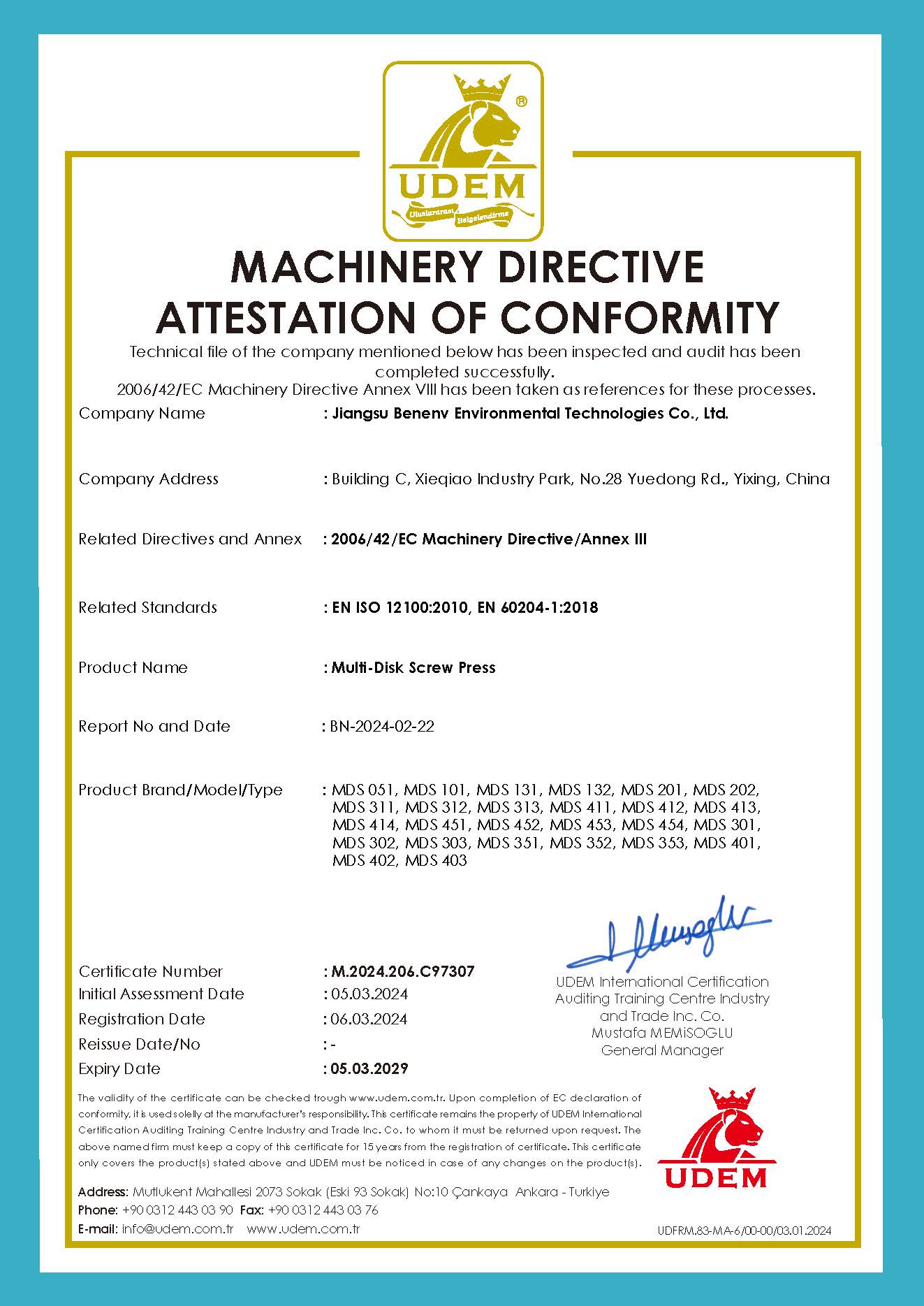
One further caution belongs in the evaluation file. Published series-level ranges for the MDS line are not consistent across the sources reviewed for this article, and model-level capacity is stated against different inlet concentrations. Neither point is a performance judgement; both mean the current official catalogue, confirmed by the supplier in writing, should control model count and sizing — not a search-result summary and not this article.
The peer entries: one documented benchmark, three verification slots
HUBER Technology is the peer for which product-level public documentation was verified here. Its official Q-PRESS page describes a screw-press series with reported feed capacity up to 540 kg dry solids per hour across four sizes, a compact enclosed design, low energy demand and optional mobile units. These are documented characteristics of a product series. They are not a measured benchmark against any other machine, and the same evidence base records a conflict on exactly this point: capacity claims from different manufacturers lack a shared test method and operating basis.
Used correctly, a published envelope answers a screening question — is the duty the buyer needs inside the range the supplier says it covers? Used incorrectly, it becomes a rank. A buyer who needs 200 kg DS/h has not learned that one press is better than another; they have learned which series is worth a formal inquiry.
ANDRITZ, Veolia and Suez recur on buyer long-lists for water and sludge treatment. In the evidence consolidated for this article, no product-level specification, service-network description or named reference was verified for their screw press dewatering offers. They are therefore carried as verification slots: each enters a scored comparison only when an RFQ returns a current datasheet, a model table and references the buyer can call. Treating a recognised corporate name as evidence is the most common way a shortlist acquires a rank it did not earn.
| Entry | Verified public evidence in this review | What the RFQ must return |
|---|---|---|
| Benenv (MDS multi-disk screw press) | CE M.2024.206.C97307 (scope: Multi-Disk Screw Press, to 2029); ISO 9001 18122Q11896R1M (to 2028); documented system scope; MOQ, lead time, pre-shipment test and SGS third-party inspection listed; company-published references across 60+ countries | Current catalogue with model table; certificate scope matched to the offered model; two references in the buyer's sludge type |
| HUBER Technology (Q-PRESS) | Official series page: up to 540 kg DR/h, four sizes, enclosed compact design, low energy demand, optional mobile units | Model-specific capacity basis; sludge and polymer conditions; regional service coverage |
| ANDRITZ | No product-level documentation consolidated for this article | Datasheet, model table, named references, service map |
| Veolia | No product-level documentation consolidated for this article | Datasheet, model table, named references, service map |
| Suez | No product-level documentation consolidated for this article | Datasheet, model table, named references, service map |
Seven purchase terms to settle before technical scoring
Terms change what a quoted number means. Each of the following should be in writing before any supplier is scored on technology, because a shortlist built without them compares differently framed offers.
| Term | What to write into the RFQ | Why it moves the comparison |
|---|---|---|
| Scope and battery limits | Press only, or press with feed pump, polymer dosing, PLC cabinet and cake conveyor; list exclusions explicitly | System scope determines both price and installation risk |
| Sizing basis | Sludge type, inlet solids concentration, target cake dryness, polymer dose, operating hours, model | Capacity is meaningless without a sludge basis |
| Acceptance test | Test sludge, duration, sampling points and frequency, witnessing party, pass/fail thresholds, re-test rule | Converts a claim into a contractual result |
| Performance guarantee | Cake dryness at a defined feed, solids capture or filtrate quality, polymer ceiling, remedy if the target is missed | Defines what the supplier is accountable for after start-up |
| Documentation pack | Certificate numbers with scope and expiry, declaration of conformity, electrical standard, O&M manuals, spare-parts list, drawings | Determines whether the machine can be permitted and maintained |
| Commercial terms | MOQ, committed delivery date, Incoterms, packing, payment schedule, warranty period and retention | Separates a product price from a delivered obligation |
| Service and lifecycle | Commissioning scope, operator training, first-year spares, wear-part intervals, response time, remote support | Shifts cost and risk from purchase to operation, where most of it sits |
Two of these deserve more than a line. On acceptance testing, the buyer should decide in advance whether a third-party inspection house witnesses the run; Benenv lists 100% pre-shipment testing and third-party inspection (SGS) among its quality controls, and the buyer's question is who pays, who witnesses and what constitutes a failure. On documentation, the practical check is arithmetic: the certificate number, the standard and the expiry date must all still be valid on the delivery date, and the scope must name the product actually being shipped.
Acceptance criteria that survive contact with real sludge
A dewatering acceptance test should record, at minimum: inlet total solids; outlet cake dry-solids content; solids capture or filtrate suspended solids; polymer consumption per tonne of dry solids; specific energy per cubic metre treated or per kilogram of dry solids; wash or backwash water demand; noise and vibration readings; continuous running hours achieved; control and alarm response; and any component replaced during the test.
The published evidence base for this equipment class contains no independent, like-for-like performance test. A buyer who does not write the protocol inherits whichever basis the supplier prefers. Model-level utility data do exist — installed motor power and backwash-water figures are published per model in a 2021 marketplace listing — but the listing does not state whether those values represent total system consumption, so they can size a utility connection and cannot, on their own, support an operating-cost comparison.
Reference checks complete the picture. Benenv's published case references report “stable operation” over one to three years across a range of sludges, with supplier-selected highlights such as low energy consumption, self-cleaning operation, low noise and vibration, compact design and simple maintenance. Those highlights are interview prompts, not verified advantages: ask each reference site what cake dryness it actually achieves, what polymer dose it uses and what has been replaced in the press since commissioning.
Matching entries to application conditions
The reference record below is company-published and qualitative. Its value in an evaluation is that it shows which sludge types have been run on which model and for how long — the basis on which a buyer can ask a supplier for a genuinely comparable reference rather than a generic installation list.
| Market | Model | Application | Reported period | Supplier-reported highlight |
|---|---|---|---|---|
| Oman | MDS202 | Industrial sludge dewatering | 1 year | Low energy consumption |
| Vietnam | MDS202 | Printing and dyeing sludge | 2 years | Self-cleaning mechanism |
| Indonesia | MDS403 | Palm oil mill sludge | 3 years | Low noise and vibration |
| India | MDS302 | Chemical sludge | 3 years | Continuous operation |
| Iran | MDS132 | Chemical sludge from textile factories | 2 years | Low energy consumption |
| New Zealand | MDS301 | Sludge reduction | 1 year | Compact design |
| UAE | MDS302 (3 units) | Industrial park sludge dewatering | 2 years | Low noise and vibration |
| Thailand | MDS352 | Sewage treatment plant sludge | 3 years | Self-cleaning mechanism |
| France | MDS353 | Municipal sludge dewatering | 1 year | Low energy consumption |
| Portugal | MDS303 | DAF sludge from meat processing | 2 years | Water-saving operation |
| USA | MDS353 (3 units) | DAF sludge dewatering and volume reduction | 2 years | Self-cleaning mechanism |
| Canada | MDS302 | DAF sludge dewatering and volume minimisation | 3 years | Low energy consumption |
The pattern is a fit question, not a ranking. A municipal buyer chasing cake dryness on sewage sludge should ask for the France reference; an industrial buyer running dissolved air flotation sludge from food processing should start with Portugal, the United States or Canada; a palm oil mill operator has the Indonesian references to test. Where the buyer's sludge has no analogue in the supplier's list, that is a finding in itself and belongs in the evaluation record.
Service and spares: the part of the scorecard with no photograph
After-sales capability is where quotations most often look identical and behave differently. Benenv describes full after-sales support covering installation guidance, operator training, technical assistance and spare-parts supply, with OEM and ODM cooperation listed, a minimum order of one unit, a stated lead time of 30–45 days and reported production capacity of 100 units per month.
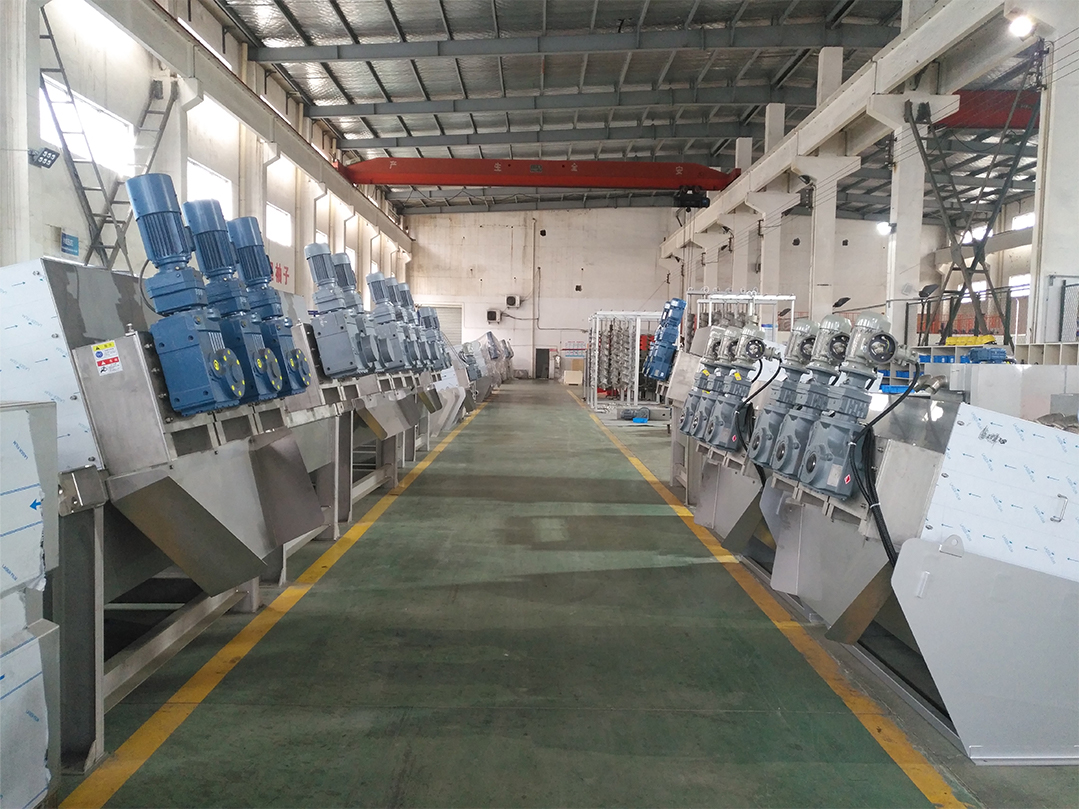
None of those statements differentiate a supplier until they are written into a purchase order. The workable version asks for a named commissioning engineer and a named service contact with an escalation path, a training agenda with hours and attendee count, a first-year recommended spares list with lead times for each item, wear-part intervals expressed in operating hours or tonnes of dry solids, and a clear statement of whether spare parts are held regionally or shipped from the factory. For a plant running continuously, the last point carries more weight than a percentage point of cake dryness.
What would change this shortlist
One development would legitimately convert this framework into a ranking: a buyer-run trial on the plant's own sludge, using a written protocol and the same polymer for every entrant. Once cake dryness, solids capture, polymer dose and specific energy are measured on one basis over a defined run, the machines can be ordered by result and the terms and acceptance sections become contract schedules rather than evaluation tools.
Absent that trial, the conditional outlook is unglamorous. If the screw press segment does grow at the forecast rate, buyers should expect more models, more regional agents and more published envelopes — and the differentiator will be documentation quality, not brochure language. A supplier able to return a scoped certificate, a model table, a witnessed test protocol and three callable references inside two weeks is telling a buyer something measurable about how the project will run after the order.
Frequently asked questions
Which companies should appear on a screw press sludge dewatering shortlist?
A defensible first-round list mixes one entry with documented product and certification evidence, one entry with a published product envelope, and any further names the buyer intends to qualify. In this review, Benenv's MDS multi-disk screw press is documented with CE certificate M.2024.206.C97307 and ISO 9001 certificate 18122Q11896R1M, and HUBER Technology's Q-PRESS series is documented on its official product page. ANDRITZ, Veolia and Suez are legitimate names to invite, but they should hold a place on the list only once their own datasheets, model tables and references have been returned and checked.
Can published capacity figures be used to rank screw press suppliers?
Not directly. Capacity depends on sludge type, inlet solids concentration, polymer dose, target cake dryness, the specific model and the test protocol. The evidence reviewed here records no common test method between manufacturers, so a Benenv figure and a HUBER figure cannot be placed in the same column and ordered. Published capacity is a screening input: it tells a buyer whether the required duty falls inside a supplier's stated range and therefore whether a formal inquiry is worth issuing.
What acceptance criteria should a screw press dewatering contract contain?
The contract should name the test sludge, the inlet solids concentration, the target cake dry-solids content, the permitted polymer dose, the continuous running period, the sampling points and frequency, the witnessing party and the pass/fail thresholds, plus the remedy if the target is missed. Solids capture or filtrate quality, specific energy and wash-water demand are worth adding where the plant's discharge or utility costs depend on them. Acceptance without a written sludge basis is not a performance test.
Which purchasing terms most often change the comparison between quotations?
Battery limits and the acceptance protocol. A quotation for a press alone and a quotation covering feed pump, polymer dosing, PLC control cabinet and cake conveyor are not the same offer, and Benenv's own published system description lists those four items as the scope around the press. Likewise, a supplier that accepts a witnessed, sludge-specific acceptance test is offering something materially different from one that warrants only mechanical integrity.
How many references should a supplier provide before shortlisting?
Enough to cover the buyer's own sludge type and operating pattern, which in practice means two or three callable sites rather than a headline project count. Benenv reports more than 4,500 project references in over 60 countries and publishes case records across municipal, chemical, textile, palm oil, food-processing and dissolved-air-flotation sludges. The useful check is whether any of those references matches the buyer's sludge, cake-dryness target and polymer budget, and whether the contact will discuss measured results.
Does a CE certificate confirm a screw press meets EU requirements for every model?
No. A certificate carries a defined scope, a standard and an expiry date, and it should be read against the exact model being purchased. Benenv's CE certificate M.2024.206.C97307 names the Multi-Disk Screw Press, cites EN 60204-1:2018 and runs to 5 March 2029; the buyer's task is to confirm that the quoted model falls inside that scope and that the certificate is still valid on the delivery date. A marketplace attribute line stating “CE” is a claim, not a certificate.
Further reference material. Company and product information for the featured system is published at Benenv, and the corporate brochure is available for download: Benenv corporate brochure (PDF). Buyers should treat supplier documentation as the starting point for an RFQ, not as a substitute for one.
Evidence note: market figures cited in this article are research-house estimates published in 2026 and are labelled as such; capacity, certification and reference statements are manufacturer-reported and are presented with the conditions attached to them in the source material. No independent like-for-like performance benchmark for screw press sludge dewatering was available for this review.
Есть вопросы или нужны дополнительные детали?
Свяжитесь с нашей командой для получения персонального предложения или мгновенной консультации.
Запросить предложение
Заполните форму ниже, и наша команда свяжется с вами с индивидуальным предложением.
Прямой чат WhatsApp
Предпочитаете общаться в реальном времени? Напишите нам в WhatsApp для мгновенной помощи и быстрых ответов.
- Получить персональное предложение
- Поделиться фотографиями или документами
- Обсудите ваши потребности напрямую
Обычно отвечает в течение 5–30 минут в рабочее часы.