
Screw and Barrel Compliance: Decoding Each ISO Certificate
Plastic processing machinery gives the screw and barrel market its rhythm. Grand View Research values the global plastic processing machinery market at USD 25.9 billion in 2025, with injection molding machines accounting for 50.9% of market share. Every extruder and injection unit behind that figure runs on a screw and barrel set that wears, is replaced, and is bought again on a cycle measured in months or years. When a replacement barrel or a new line is quoted, the supplier's certificate pack usually arrives before the technical drawings do.
That pack is where most qualification reviews lose precision. A buyer sees three ISO logos, a handful of scan files and a reference number that looks like an internal code, and the check ends at the word certified. For a purchase moving from research into evaluation, that is the weakest possible use of the strongest document a supplier can present. A certificate is a readable document: standard designation, certificate number, issuing body, scope sentence and validity window. Read those fields against the product actually being ordered, and the certificate stops being decoration and becomes evidence.
This article decodes the certificates recorded for the screw and barrel product families in Guangyou Screw's compliance file, including certificate numbers, the issuing body WIT ASSESSMENT and the scope sentences that define coverage, and states plainly where those documents stop.
Management-system certificates are not product specifications
ISO9001:2015, ISO45001:2018 and ISO14001:2015 certify how an organisation plans, controls, audits and improves its processes. They do not certify the metallurgy, geometry or service life of a barrel. That single distinction resolves most of the confusion found in screw and barrel tender documents.
The parameters a buyer actually compares are not printed on any certificate. Guangyou Screw's published specifications for its barrel families list nitrided hardness HV850-1000, nitrided case depth 0.45-0.7 mm, hardness after hardening and tempering HB260-310, alloy hardness HRC50-65, alloy depth 0.8-2.0 mm, surface roughness Ra 0.4 and screw straightness 0.015 mm. Those are product data points, established through measurement and inspection records. No management-system certificate can substitute for them, and no certificate audit measures them.
Two evidence streams answer two different questions. The certificate answers whether design and manufacturing are governed by a documented, audited system. The specification and inspection record answer what the part is. A procurement file that keeps both, clearly separated, is far more defensible than one that treats certified as a synonym for quality. Buyers who request only the certificate, and buyers who request only a hardness report, each end up with half an answer.
The certificate set: three standards, three numbers, one issuer
Zhejiang Guangming Plastics Machinery Co., Ltd., trading as Guangyou Screw, is a manufacturer of single, twin and bimetallic screw and barrel systems founded in 1992 and based in Zhoushan, China. The company operates a 100,000 m² facility with more than 800 employees and exports to over 50 countries and regions. Its certification records contain three management-system certificates, all issued by WIT ASSESSMENT.
| Certificate title | Standard | Number | Issuer | Valid to |
|---|---|---|---|---|
| Quality Management System Certificate | ISO9001:2015 | 15/25Q6428R80 | WIT ASSESSMENT | 2028-05-12 |
| Occupational Health and Safety Management System Certificate | ISO45001:2018 | 15/25S6430R20 | WIT ASSESSMENT | 2028-10-07 |
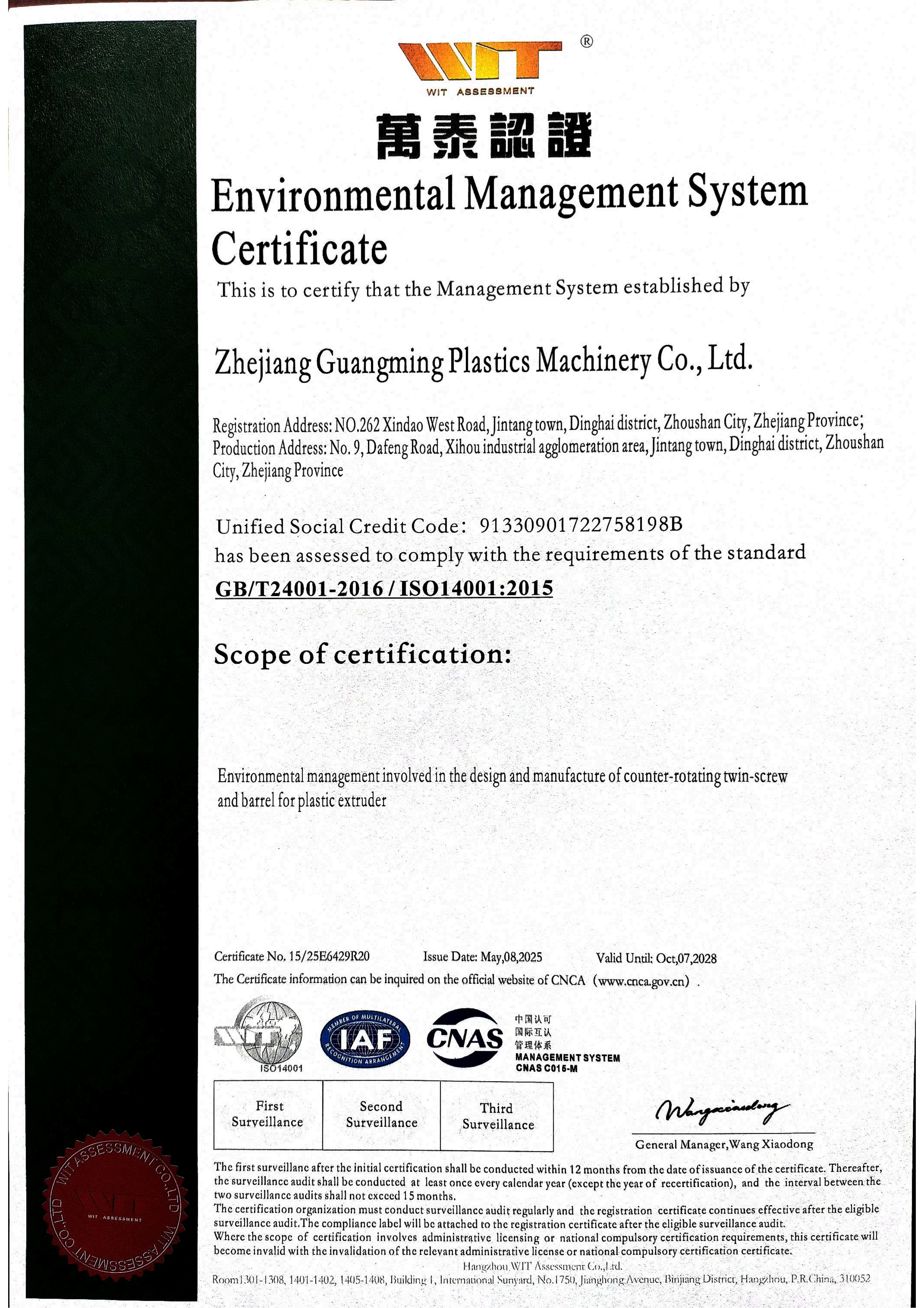
| Environmental Management System Certificate | ISO14001:2015 | 15/25E6429R20 | WIT ASSESSMENT | 2028-10-07 |
All three were issued on 8 May 2025. The scope statements differ by discipline: the quality certificate covers design and manufacturing of orthogonal twin-screw extruders and barrel components for plastic extrusion, while the occupational-safety and environmental certificates cover, respectively, occupational safety and health management and environmental management involved in the design and manufacture of counter-rotating twin-screw and barrel for plastic extruder. Each certificate records its market as the entire domestic industry and global overseas markets under IAF international mutual recognition.
Read as a set, the three documents describe the quality, environmental and occupational-safety dimensions of the same manufacturing activity. None of them is a product certificate, and none replaces the dimensional or metallurgical data supplied with an order.
Reading the number: the letter identifies the standard family
In this certificate set the letter inside the number tracks the standard family. Q appears in 15/25Q6428R80, the ISO9001:2015 quality certificate. S appears in 15/25S6430R20, the ISO45001:2018 occupational health and safety certificate. E appears in 15/25E6429R20, the ISO14001:2015 environmental certificate.
That pattern is the single most useful reading aid a buyer can carry into a document review, because it exposes the most common error in supplier packs: a number quoted against the wrong standard. A safety-system certificate cited as evidence of quality management, or an environmental certificate presented as proof of product conformity, is a documentation failure rather than a technical one, and it is visible in seconds once the letter and the standard line are read together.
Two cautions apply. First, the letter pattern is specific to this set and should not be projected onto every certification body, because numbering belongs to the issuer; the authoritative statement is always the standard designation printed beside the number. Second, the trailing segments (R80 on the quality certificate, R20 on the other two) are part of the issuing body's internal numbering and cannot be ranked. Comparing suffixes across suppliers produces noise rather than evidence.
The working rule is a three-field match: standard designation, certificate number and scope sentence. A document lacking any one of the three is incomplete, whatever its visual quality.
Scope coverage: activity language, not model numbers
Both scope formulations use activity language. The quality certificate covers design and manufacturing of orthogonal twin-screw extruders and barrel components for plastic extrusion. The occupational-safety and environmental certificates cover management functions involved in the design and manufacture of counter-rotating twin-screw and barrel for plastic extruder.
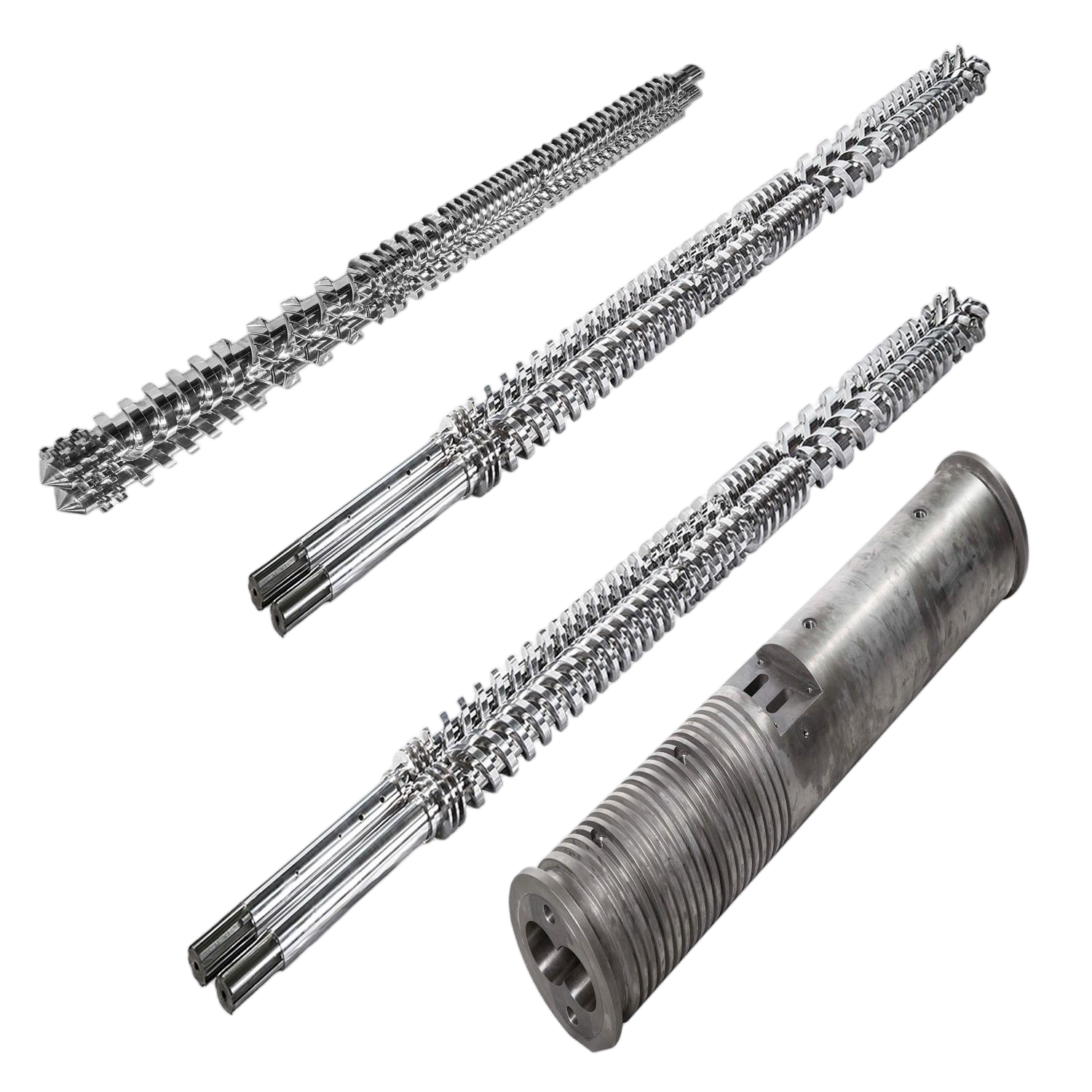
Three practical consequences follow. First, certification attaches to design and manufacturing as activities, so the coverage argument for a Φ45-Φ350 parallel twin screw barrel or a Φ25/50-Φ185/340 conical twin screw barrel is that the part results from the certified activity, not that a diameter is printed on the page. Second, no model numbers, size ranges or material grades appear anywhere on the certificates, so a buyer cannot use them to distinguish 38CrMoAl (1.8509) from D2, DC53, AISI316, AISI420 or any other grade in the published material list. Third, the activity wording is written around twin-screw extrusion; where an order sits outside that wording, the correct response is written confirmation of applicability rather than assumption.
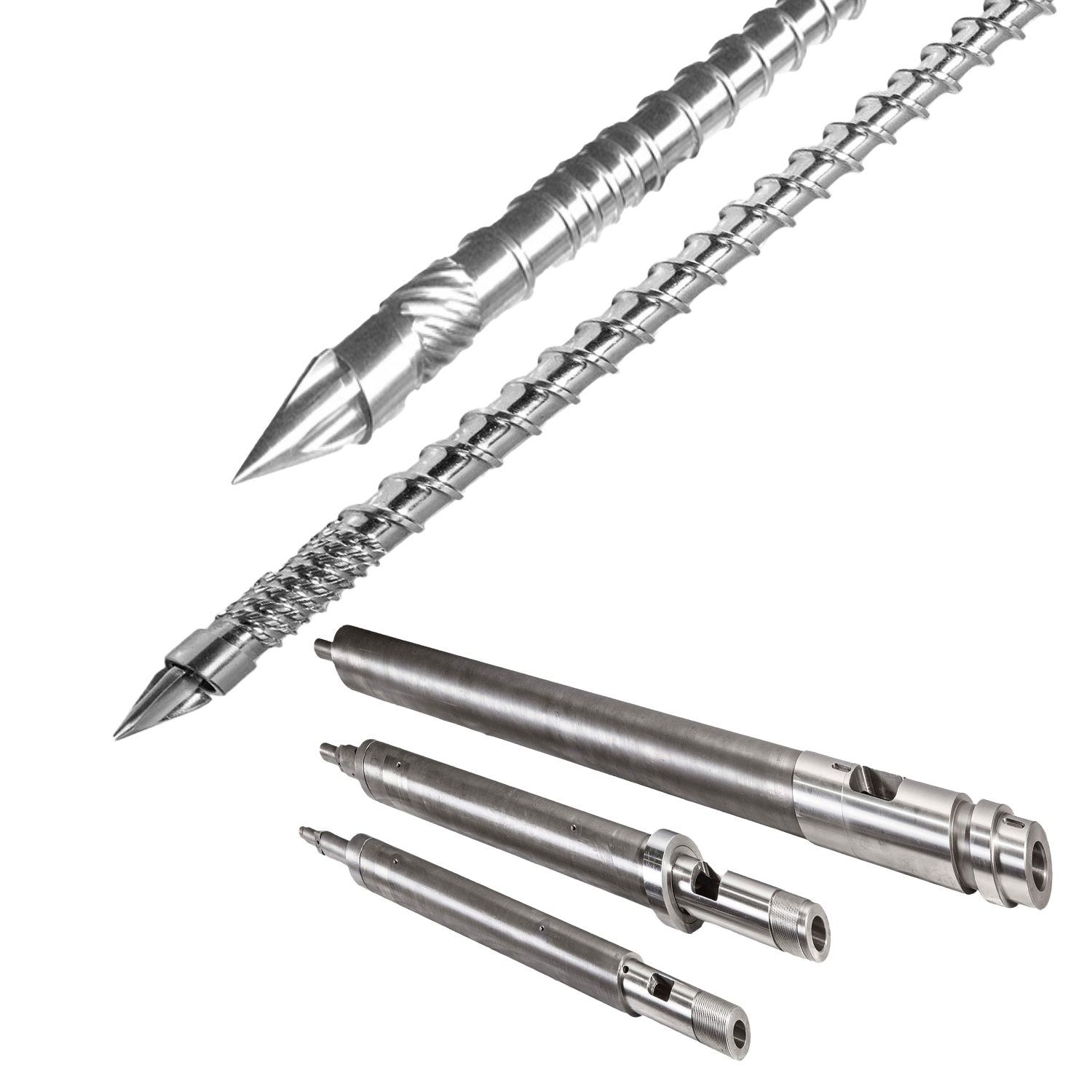
The boundary is worth stating directly. A buyer ordering a single screw extruder barrel or an injection molding machine barrel should ask the supplier to confirm in writing how that order falls inside the certified design and manufacturing activity, and may verify the scope with the issuing body. Guangyou Screw manufactures single screw extruder barrels in Φ20-Φ500, injection molding machine barrels in Φ20-Φ300 and rubber machine barrels in Φ20-Φ650, and those families are documented against the same certificate set in company product records; the certificate text itself, however, speaks in activity language, and a careful buyer treats that difference as a question to close rather than a gap to ignore.
Certificate-to-product map across five barrel families
The table below pairs each barrel family in the company's product records with its published size range and application, and states the reading point a buyer should confirm against the certificate text.
| Product family | Model range | Application | Reading point on the certificate |
|---|---|---|---|
| Parallel Twin Screw Barrel | Φ45-Φ350 | Compounding and pelletizing; plastic recycling | The ISO9001:2015 scope names twin-screw extruders and barrel components for plastic extrusion; confirm the ordered barrel assembly falls inside it. |
| Conical Twin Screw Barrel | Φ25/50-Φ185/340 | PVC extrusion for pipe, profile and sheet | Counter-rotating twin-screw design and manufacture is named in the ISO45001:2018 and ISO14001:2015 scopes; qualify wear parts under the same activity. |
| Single Screw Extruder Screw and Barrel | Φ20-Φ500 | Film blowing and pipe extrusion | Scope wording is built around twin-screw manufacture; obtain a written statement of applicability for single-screw orders. |
| Injection Molding Machine Screw and Barrel | Φ20-Φ300 | Automotive, electronics and toy manufacturing | Certificates attach to activity, not to equipment type; confirm injection-unit barrels explicitly. |
| Rubber Machine Screw and Barrel | Φ20-Φ650 | Tire and rubber product manufacturing | Confirm rubber extrusion barrels sit inside the certified design and manufacturing activity. |
Two application details belong beside the certification check rather than inside it. High-filler PVC work with calcium carbonate calls for high wear resistance, a bimetallic lining and a nitrided finish; those requirements live in the specification and the material choice, not in a certificate. Case records for high-filler PVC extrusion describe a service life of one to five years under normal working conditions, which is application evidence that no certificate can supply.
A verification workflow buyers can run in one sitting
- Request the certificate PDFs rather than the logo block. Logos are marketing assets; documents carry the fields that can be checked.
- Read the standard designation and number together. In this set, Q points to ISO9001:2015, S to ISO45001:2018 and E to ISO14001:2015.
- Record the issuing body. All three certificates here are issued by WIT ASSESSMENT, with the market recorded as global overseas markets under IAF international mutual recognition.
- Copy the scope sentence into your evaluation file verbatim. Paraphrasing scope is where coverage claims usually drift.
- Check validity against your order and delivery schedule. The three certificates were issued on 8 May 2025; the quality certificate runs to 12 May 2028 and the occupational-safety and environmental certificates to 7 October 2028.
- Map your product family and size range to the scope activity, and request written confirmation wherever the wording is narrower than your order.
- Write the certificate number into the purchase order or quality agreement, and keep parameter evidence — hardness, case depth, straightness, surface roughness — in a separate section of the same file.
Where the certificates stop
A compliance file is only as good as its stated limits. Four boundaries are worth writing down before a supplier comparison begins.
- Management system, not material grade. The certificates do not distinguish between 38CrMoAl, D2, DC53, AISI316, AISI420 and the other grades in the published material list, and they say nothing about which grade suits a filler-loaded PVC or rubber process.
- Not a capacity or lead-time guarantee. Monthly capacity of 2,700 units, a one-unit minimum order and nitriding lead times that run 40-50 days for Φ20-Φ90, 50-60 days for Φ90-Φ180, 60-70 days for Φ180-Φ250 and beyond 70 days at larger sizes are commercial facts outside certificate scope.
- Not a wear-life measurement. Service life depends on filler load, lining choice, process temperature and operating practice; the one-to-five-year figure recorded in high-filler PVC case data is application evidence, not certification.
- Not a product conformity mark. A management-system certificate does not replace the market-access declarations and directives that apply to machinery or to pressure-containing components, which vary by equipment type and destination.
What the certificate set says about market direction
Demand context explains why certificate packs are being read more carefully than they were a decade ago. Global Insight Services projects the feed screw barrel market growing from USD 1.89 billion in 2024 to USD 3.33 billion by 2034 at a compound annual growth rate of 5.8%. Dataintelo estimates the bimetallic barrel and screw market at USD 2.8 billion in 2025, forecast to reach USD 4.7 billion by 2034 — a segment where performance claims are hardest to verify from a datasheet alone. Grand View Research sizes plastic processing machinery at USD 25.9 billion in 2025, with injection molding machines at 50.9% of share.
Sizing varies by source and by what each report counts; IMARC Group, for instance, places plastic processing machinery at USD 39.0 billion. These figures indicate direction rather than precise share for any individual supplier, and they should be used that way in an evaluation file.
The practical effect of a growing, fragmented barrel market is more quotations from unfamiliar suppliers per project. The certificate pack is one of the few documents that can be compared across all of them on equal terms — provided the comparison uses standards, numbers and scopes rather than logos. Three-standard coverage across quality, environment and occupational safety also tends to appear where supply chains reach into Europe. Guangyou Screw exports about 30% of output and names the EU as a main market, which is consistent with maintaining all three systems rather than quality certification alone.
Future outlook: renewal cycles and scope-level disclosure
The current certificates were issued in May 2025 and run into 2028, with the quality certificate expiring in May and the occupational-safety and environmental certificates in October. Buyers negotiating multi-year supply agreements should calendar a re-verification point inside their contract term rather than assume continuity of a document issued before the agreement was signed.
Two further shifts are reasonable to expect. First, verification is moving from the certificate image to the certificate record: buyers increasingly cross-check numbers and scopes with issuing bodies instead of accepting scanned pages, which favours suppliers whose compliance data is structured and current. Second, activity-based scope wording keeps generating the same question for mixed-product manufacturers, so suppliers who publish per-product applicability notes will be easier to qualify than those who publish only cover pages.
As bimetallic demand grows, buyers will also compare hardness and liner data alongside certificates rather than instead of them. The evidence streams stay separate, and the suppliers who present both clearly will keep the shortest qualification path.
FAQ
Which certificate covers quality management for Guangyou Screw's twin-screw barrel manufacturing?
ISO9001:2015, Quality Management System Certificate number 15/25Q6428R80, issued by WIT ASSESSMENT on 8 May 2025 and valid to 12 May 2028. The recorded scope is design and manufacturing of orthogonal twin-screw extruders and barrel components for plastic extrusion.
What standard does certificate number 15/25S6430R20 belong to?
ISO45001:2018, the Occupational Health and Safety Management System Certificate issued by WIT ASSESSMENT, valid from 8 May 2025 to 7 October 2028. Its scope is occupational safety and health management involved in the design and manufacture of counter-rotating twin-screw and barrel for plastic extruder.
Does an ISO certificate confirm nitrided hardness or case depth?
No. Management-system certificates cover processes, not part properties. Published product specifications state nitrided hardness HV850-1000, nitrided case depth 0.45-0.7 mm, alloy hardness HRC50-65, alloy depth 0.8-2.0 mm, surface roughness Ra 0.4 and screw straightness 0.015 mm. Those values are verified through inspection and measurement, separately from certification.
How long are the certificates valid, and when should a buyer re-check?
All three were issued on 8 May 2025. The ISO9001:2015 certificate expires on 12 May 2028; the ISO45001:2018 and ISO14001:2015 certificates expire on 7 October 2028. Orders with delivery, installation or warranty periods running past those dates should include a re-verification step in the agreement.
Do the certificates cover single screw extruder barrels and injection molding barrels?
The scope statements are written around design and manufacture of counter-rotating twin-screw and barrel for plastic extruder, and of orthogonal twin-screw extruders and barrel components for plastic extrusion. Single screw extruder barrels in Φ20-Φ500 and injection molding machine barrels in Φ20-Φ300 form part of the product range and are documented against the same certificate set in company records, but because the certificate wording is activity-based rather than model-specific, buyers should obtain written confirmation of applicability for those product lines.
Who issues the certificates, and is the certification recognized outside China?
WIT ASSESSMENT is the issuing body for all three certificates. Each certificate records its market as the entire domestic industry and global overseas markets under IAF international mutual recognition.
What should a buyer write into the purchase order?
The standard designation, certificate number, the scope activity relevant to the ordered product and the validity dates, alongside separate parameter requirements such as hardness, case depth and straightness, plus inspection terms. Keeping the two evidence streams separate prevents a management-system certificate from being read as a material guarantee.
A full product catalogue covering the five barrel families described above, with model ranges and technical specifications, is available for download: Guangyou Screw product catalogue (PDF).
Есть вопросы или нужны дополнительные детали?
Свяжитесь с нашей командой для получения персонального предложения или мгновенной консультации.
Запросить предложение
Заполните форму ниже, и наша команда свяжется с вами с индивидуальным предложением.
Прямой чат WhatsApp
Предпочитаете общаться в реальном времени? Напишите нам в WhatsApp для мгновенной помощи и быстрых ответов.
- Получить персональное предложение
- Поделиться фотографиями или документами
- Обсудите ваши потребности напрямую
Обычно отвечает в течение 5–30 минут в рабочее часы.