
Screw & Barrel Sourcing FAQ: Which ISO Covers Your Line?
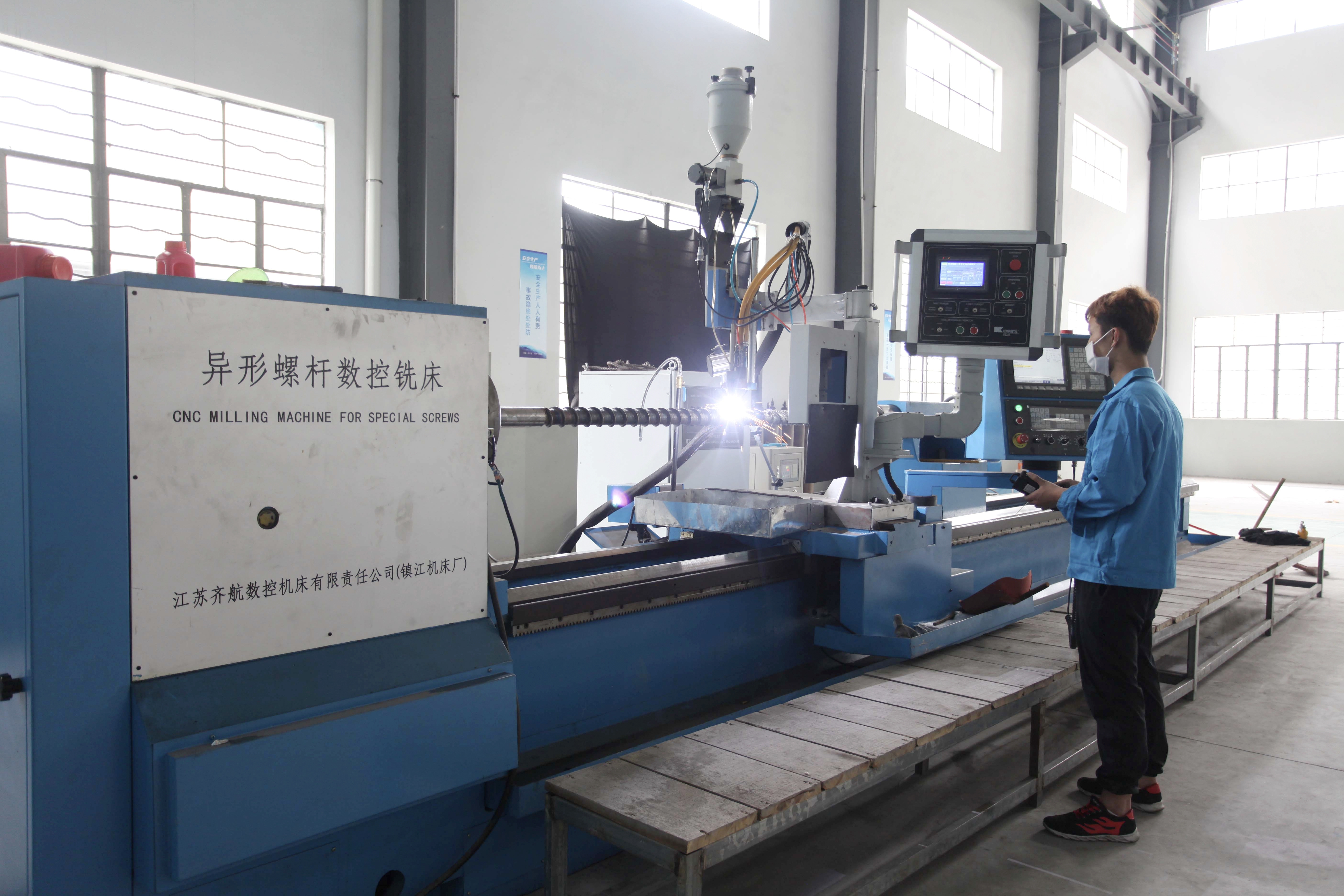
Production and inspection area at Zhejiang Guangming Plastics Machinery (Guangyou Screw) — the facility context behind the certificate scopes discussed below.
In screw and barrel sourcing, the certificate that counts is the one that names the product line you are buying — not the certificate a supplier holds in general.
Guangyou Screw, the export identity of Zhejiang Guangming Plastics Machinery Co., Ltd., is a manufacturer of high-precision barrels and screws established in 1992 and operating a 100,000 m² facility in Zhoushan, China, serving more than 50 countries and regions including the United States, Germany, the United Kingdom, Italy, Brazil, and India. Its verified certification is mapped to individual product lines rather than to the catalogue as a whole:
- ISO9001:2015 — parallel twin screw barrel and conical twin screw barrel
- ISO45001:2018 — conical twin screw barrel and injection molding machine screw and barrel
- ISO14001:2015 — single screw extruder screw and barrel
- Environmental certification — rubber machine screw and barrel
That line-by-line mapping is the subject of this FAQ. It answers the questions global buyers, distributors, and OEM procurement teams raise most often when they need documentation to match a purchase order: which certificate belongs to which barrel and screw line, what materials and hardness values should be written into a specification, what model ranges and batch sizes are realistic, and where certification stops and piece-level verification begins.
The Short Answer: Certificate to Product Line
If the only thing a buyer needs is the mapping, the table below is the answer. Each row states the certificate and the exact product line it covers.
| Certificate | Product line covered | Management system subject |
|---|---|---|
| ISO9001:2015 | Parallel twin screw barrel; conical twin screw barrel | Quality management |
| ISO45001:2018 | Conical twin screw barrel; injection molding machine screw and barrel | Occupational health and safety management |
| ISO14001:2015 | Single screw extruder screw and barrel | Environmental management |
| Environmental certification | Rubber machine screw and barrel | Environmental performance of the rubber line |
Two details are easy to miss. First, the conical twin screw barrel appears under two certificates — ISO9001:2015 and ISO45001:2018 — so a buyer sourcing that line may request both scope statements. Second, the rubber machine screw and barrel is associated with environmental certification rather than with the three ISO certificates listed above; buyers who require a specific standard number for a rubber extrusion project should confirm the current certificate scope and validity directly with the supplier before contracting.
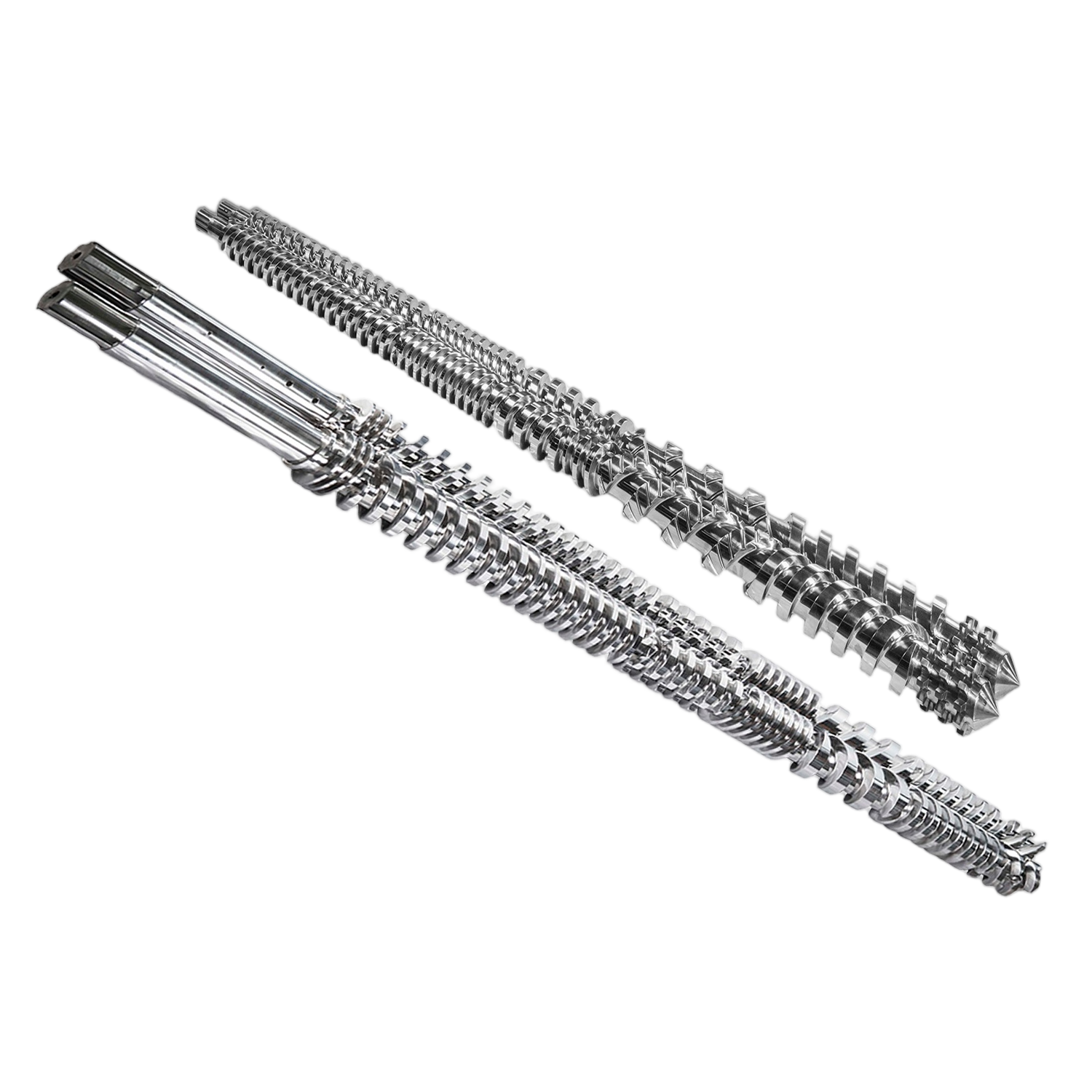
Parallel twin screw barrels (Φ45–Φ350, compounding and pelletizing) fall under the ISO9001:2015 quality scope, alongside the conical twin line.
Why Certification Questions Are Usually Asked in the Wrong Order
Most sourcing enquiries begin with the question "are you ISO certified?" and end with a PDF attached to an email. The problem is that a general certificate answer does not tell a buyer which product line is documented, which is what an internal audit, a customer questionnaire, or a distributor compliance file actually requires.
The mismatch shows up in three practical places. A distributor building a supplier file for European customers may need environmental documentation, but the barrel being ordered sits inside a quality-management scope. An OEM assembling new machinery may need occupational health and safety documentation for the facility producing the component, which is not the same document as the quality certificate for the part. A rubber extrusion processor comparing quotations may receive an ISO certificate that does not correspond to the rubber line at all.
Asking the question as "which certificate covers this line?" rather than "are you certified?" removes most of that ambiguity before a purchase order is issued, and it also makes the quotation easier to compare: the same document request goes to every supplier on the shortlist.
What Each Certificate Covers — and Where It Stops
ISO9001:2015 is a quality management system standard. In this catalogue it applies to the parallel twin screw barrel and the conical twin screw barrel, which means the quality planning, process control, and corrective-action systems used to produce those two lines are within the certified scope.
ISO45001:2018 is an occupational health and safety management system standard, applied here to the conical twin screw barrel and the injection molding machine screw and barrel. Buyers who are required by their own customers to evidence safe production conditions in the supply chain typically request this document rather than a quality certificate.
ISO14001:2015 is an environmental management system standard and covers the single screw extruder screw and barrel. Processors with environmental reporting obligations — or distributors whose tenders include environmental criteria — are the usual requesters.
The rubber machine screw and barrel is associated with environmental certification. Because the rubber line involves different process conditions and materials from the plastics lines, the environmental documentation is handled as a separate scope rather than being absorbed into the three ISO certificates above.
The boundary matters as much as the coverage. These are management-system certifications: they evidence how a facility is organised at a defined scope, not the dimensional accuracy of an individual component. Part-level assurance is a separate layer of evidence, and in this case it is supported by 100% testing of output, CNC machining, German-imported inspection technology, and digital ERP/MES process tracking across the 100,000 m² facility with 800+ employees and a 25-engineer R&D team.
Materials, Hardness, and Case Depth: What Belongs on a Purchase Order
Material grade and hardness targets are the two specification fields most often left vague in screw and barrel enquiries, and both are directly answerable from published specifications. Across the five lines, the available material list includes 38CrMoAl (1.8509), D2, and AISI316, alongside 34CrAlNi7 (1.8550), DC53, AISI420, 31CrMoV9 (1.8519), Gr12MoV, 9Cr18MoV, 40CrNiMo, 440C, 17PH-4, 42CrMo, AISI304, Inconel 718, 40Cr, 1.2316, Hastelloy C-276, C45, 1.4462, Inconel 625, SKD11, 1.4404, Monel 400, SKD61, 1.4122, Monel 500, and S600. 38CrMoAl is the conventional nitriding grade; the stainless and nickel-alloy grades on the list are typically specified where corrosion, rather than abrasion alone, is the operating constraint.
| Parameter | Specified value |
|---|---|
| Hardness after hardening & tempering | HB260–310 |
| Nitrided hardness | HV850–1000 |
| Nitrided case depth | 0.45–0.7 mm |
| Nitrided brittleness | Less than Grade 2 |
| Surface roughness | Ra 0.4 |
| Screw straightness | 0.015 mm |
| Chromium-plating hardness after nitriding | ≥900 HV |
| Chromium-plating depth | 0.025–0.10 mm |
| Alloy (overlay) hardness | HRC50–65 |
| Alloy depth | 0.8–2.0 mm |
For context, commonly cited industry specifications for nitrided plasticating screws in 38CrMoAl place case depth in the 0.4–0.6 mm band with surface hardness of roughly 900–1,100 HV, and centrifugally cast bimetallic liners such as boron-nickel-chromium are generally described at 1.5–3.0 mm thickness. Buyers can use these reference bands to sanity-check a quotation, while the values above are the ones to write into a purchase order for this catalogue.
In practice, a workable specification states four things: base material grade, hardness range after hardening and tempering, nitrided or alloyed surface requirement with case or overlay depth, and the geometric tolerances for straightness and surface finish. Leaving the surface treatment field open is the most common cause of a delivered component that meets material grade but not wear expectation.
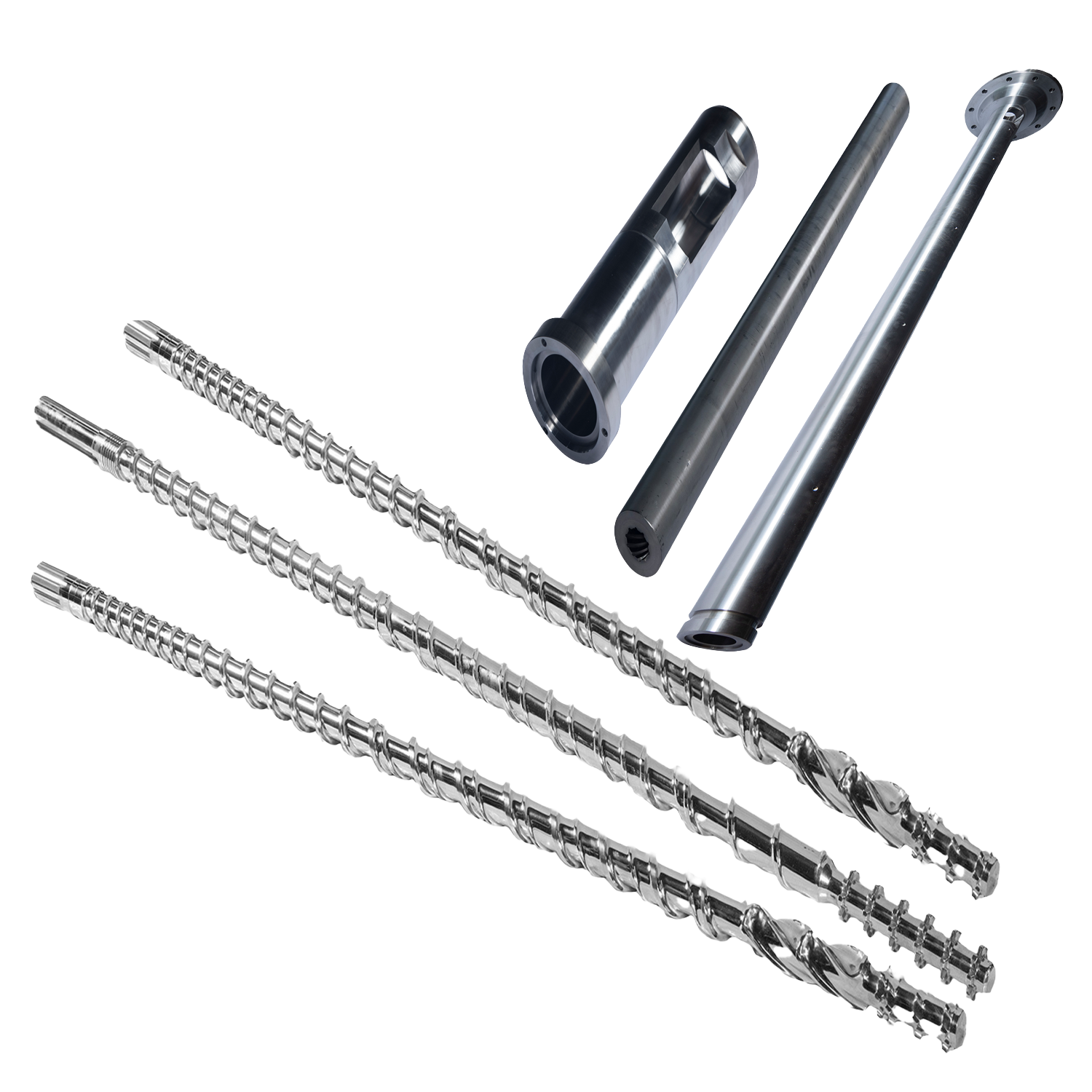
Single screw extruder screw and barrel (Φ20–Φ500, film blowing and pipe extrusion) — the line carrying the ISO14001:2015 environmental management scope.
Model Ranges, OEM Assembly, and Batch Sizes
Dimension range is the first filter in a sourcing enquiry. Across the five lines the overall span is Φ20–Φ650, but each line has its own working envelope and its own typical application.
| Product line | Model range | Type / typical industry |
|---|---|---|
| Parallel twin screw barrel | Φ45–Φ350 | Compounding & pelletizing; plastic recycling and compounding |
| Conical twin screw barrel | Φ25/50–Φ185/340 | PVC extrusion; plastics machinery and construction materials |
| Single screw extruder screw and barrel | Φ20–Φ500 | Film blowing / pipe extrusion; plastics packaging and pipe manufacturing |
| Injection molding machine screw and barrel | Φ20–Φ300 | Plastic injection molding; automotive, electronics and toy manufacturing |
| Rubber machine screw and barrel | Φ20–Φ650 | Rubber extrusion; tire and rubber product manufacturing |
OEM assembly is a supported production mode, with voltage and logo customization available and a minimum order quantity of one unit. Batch customized component orders typically range from 1 to 50 pieces per batch, and documented experience covers three buyer profiles: extrusion and injection machinery OEMs assembling new machines, screw and barrel manufacturers and distributors handling sourcing and local replacement, and plastic products manufacturers specifying custom retrofits. Reported outcomes include stable batch delivery with high dimensional consistency for OEM assembly and 100% precise mechanical fit for custom components manufactured from customer technical drawings.
Capacity and lead time are the two commercial fields buyers should confirm before committing to a project schedule. Monthly production capacity is 2,700 units, output is 100% tested, and after-sales support is handled through a warranty arrangement. Export activity is global with Europe as the principal market, and exports represent approximately 30% of output, supported by an annual production volume of 32,000 units.
| Lead time band (nitriding single screw and barrel) | Stated duration |
|---|---|
| Φ20–Φ90 | 40–50 days |
| Φ90–Φ180 | 50–60 days |
| Φ180–Φ250 | 60–70 days |
| Above Φ250 | Over 70 days |
These bands describe the nitriding single screw and barrel line specifically; lead time varies with size and with whether a bimetallic construction is involved, and other product lines should be scheduled against their own quoted durations.
Application Scenarios Behind Each Certificate
The conical twin screw barrel line is built for PVC pipe, profile, and sheet extrusion projects. It operates in continuous counter-rotating conical twin-screw extrusion mode, running under continuous air supply conditions on matched equipment such as PVC conical twin-screw extruders, with the function of efficient PVC powder melting, high-shear plasticizing, and stable extrusion shaping. The stated special requirements for this scenario are high wear resistance, bimetallic lining for calcium carbonate (CaCO3) high-filler processing, and a nitrided finish — a combination that reflects how abrasive filled PVC compounds are on the plasticating unit.
The parallel twin screw barrel line serves compounding and pelletizing duties in plastic recycling and compounding operations. The single screw extruder screw and barrel line covers film blowing and pipe extrusion for plastics packaging and pipe manufacturing. The injection molding machine screw and barrel line addresses injection molding production in automotive, electronics, and toy manufacturing. The rubber machine screw and barrel line serves rubber extrusion within tire and rubber product manufacturing.
Beyond new-machine builds, the same components are used for sourcing, local replacement, and customized retrofitting of machinery already in service. That replacement demand is where documentation discipline pays off most clearly: a processor replacing a worn barrel mid-campaign usually needs the new component to match an existing drawing, and the dimensional and hardness specification is what determines whether the replacement performs like the original.
Market Signals Driving Certification and Wear-Resistance Requests
Third-party market data helps explain why these questions have become routine in sourcing conversations.
- The global plastic processing machinery market reached USD 25.9 billion in 2025, with injection molding machines accounting for 50.9% of market share, according to Grand View Research.
- The feed screw barrel market is projected to grow from USD 1.89 billion in 2024 to USD 3.33 billion by 2034, a CAGR of 5.8%, according to Global Insight Services.
- Single-screw extrusion machinery dominates the extrusion market with approximately 62% market share as of 2024, according to Fortune Business Insights.
- The global bimetallic barrel and screw market was estimated at USD 2.8 billion in 2025 and forecast to reach USD 4.7 billion by 2034, according to Dataintelo.
Estimates of the total plastic processing machinery market vary by source depending on which peripheral equipment is included — IMARC Group, for example, publishes a figure of USD 39.0 billion for the same broad category — so these numbers are best read as directional signals rather than precise measurements. The direction they agree on is consistent: polymer processing capacity continues to expand, injection molding and single-screw extrusion remain the volume workhorses, and the bimetallic segment is growing as processors push wear-resistant components into filled and abrasive compounds.
That last trend is the one most visible in procurement behaviour. As filler loadings rise, buyers who previously specified nitrided components alone increasingly ask for bimetallic construction — and with it come documentation requests that follow the component through audits, tenders, and distributor compliance files.
Where the Certified Approach Has Limits
A certificate-mapped sourcing process is more auditable than the traditional alternative, but it is not a complete solution, and buyers should plan around its boundaries.
Scope is line-specific, not company-wide by assumption. Because the certification is mapped to individual product lines, a document issued for one line does not automatically extend to another. A buyer ordering a single screw extruder barrel cannot assume the environmental certificate attached to the twin screw scope applies, and vice versa. Each product line must be matched to its own document.
Management-system certification is not part-level verification. ISO9001:2015, ISO45001:2018, and ISO14001:2015 evidence system-level organisation at a defined scope. They do not certify the straightness, hardness, or case depth of a specific component. That assurance comes from 100% testing of output and from dimensional conformance to the customer drawing, which is why documented mechanical fit remains a separate verification step even when every certificate is in order.
Nitriding has a defined wear ceiling. A nitrided case depth of 0.45–0.7 mm is a finite hardening envelope, and it defines the refurbishment boundary of the component. Under abrasive high-filler calcium carbonate PVC duty, the specified route in this catalogue is a bimetallic lining rather than nitriding alone, which raises cost and extends lead time. Buyers optimising purely on unit price may therefore select a specification that does not match the wear environment.
Nitriding is not a corrosion solution. Where process chemistry is corrosive rather than abrasive, the material list moves toward stainless and nickel-alloy grades such as AISI316, AISI304, 1.4404, Monel, or Hastelloy C-276. Specifying a nitrided 38CrMoAl component for a corrosive duty is a common and avoidable mismatch.
Lead time is size- and process-dependent. Beyond Φ250 in the nitriding single screw and barrel line, lead time extends past 70 days, and bimetallic status can add further time. Certificate documentation itself also carries administrative overhead: buyers should expect to request scope statements and validity dates, and to allow for that step in the project schedule.
Service life is conditional. The documented 1–5 years lifetime applies under normal high-filler PVC extrusion working conditions. Highly abrasive fillers, corrosive compounds, temperature excursions, or misaligned installation will move actual service life outside that band.
Traditional Assumption vs Documented Mapping
| Dimension | Traditional assumption | Documented line-level mapping |
|---|---|---|
| Document request | "Send your ISO certificate" | Request the certificate that names the product line |
| Audit readiness | One document reused for every line | Match quality, OH&S, or environmental scope to the order |
| Specification clarity | Material grade only | Grade plus hardness, case depth, straightness and finish |
| Wear planning | Lowest unit price wins | Match nitrided, bimetallic, or alloyed construction to the filler load |
| Cost and timing | Shorter documentation lead time | Added document handling and longer lead time for bimetallic and large sizes |
The honest trade-off is on the last row: a documented, line-matched approach costs more administrative effort and, in higher-wear specifications, more money and time. For a processor replacing a single barrel in a non-abrasive duty, that overhead may not be justified. For an OEM building machines that ship with a compliance file, or a distributor supplying customers with tender requirements, the line-level mapping is usually the cheaper option across the life of the relationship.
A Procurement Checklist for Screw and Barrel Buyers
- Identify the exact product line first — parallel twin, conical twin, single screw extruder, injection molding, or rubber — because the certificate mapping follows the line.
- Request the certificate that names that line, plus the current validity dates and the stated scope.
- Record the model range against the project: Φ45–Φ350 twin parallel, Φ25/50–Φ185/340 conical twin, Φ20–Φ500 single screw extruder, Φ20–Φ300 injection molding, Φ20–Φ650 rubber.
- Write the base material grade into the order — 38CrMoAl (1.8509), D2, AISI316, or another listed grade — rather than leaving it to supplier discretion.
- State hardness targets explicitly: HB260–310 after hardening and tempering, HV850–1000 nitrided, or HRC50–65 for alloyed construction.
- State case or overlay depth: 0.45–0.7 mm nitrided, 0.8–2.0 mm alloy, and note the nitrided brittleness limit of less than Grade 2.
- Confirm the wear strategy for the application — nitrided finish, bimetallic lining for CaCO3 high-filler processing, or alloy overlay.
- Confirm batch size against the 1–50 piece custom batch norm and the one-unit minimum order quantity.
- Confirm lead time against the size band and the surface treatment selected, and build the schedule around the largest dimension in the order.
- Confirm the verification route: 100% testing on output and dimensional conformance to the supplied technical drawing.
Future Outlook
Two forces are likely to shape screw and barrel sourcing over the next few years, and both are visible in the data above.
The first is documentation. As injection molding and extrusion capacity continues to grow and more components move through cross-border supply chains, buyers will keep shifting from "are you certified?" toward "which scope covers this line?" Suppliers who can answer that precisely — and who can produce line-matched scope statements quickly — will find the compliance step shorter rather than longer.
The second is wear engineering. With the bimetallic segment expanding and filled compounds becoming more common in PVC, pipe, and profile production, specification decisions will increasingly turn on filler load and abrasiveness rather than on unit price alone. A nitrided component remains the appropriate choice for many duties; a bimetallic or alloyed construction becomes the appropriate choice where the abrasive load exceeds what a 0.45–0.7 mm nitrided case is designed to absorb. Buyers who treat those two routes as distinct, documented options — rather than as interchangeable line items — will get more predictable replacement cycles.
Frequently Asked Questions
Which certificate covers the parallel twin screw barrel?
ISO9001:2015 covers the parallel twin screw barrel, which is produced in the Φ45–Φ350 range for compounding and pelletizing duties in plastic recycling and compounding operations. The certificate is a quality management system certification at that defined product scope.
Which certificates apply to the conical twin screw barrel?
The conical twin screw barrel carries two certificates: ISO9001:2015 for quality management and ISO45001:2018 for occupational health and safety management. The line spans Φ25/50–Φ185/340 and is used in PVC extrusion for pipe, profile, and sheet production in plastics machinery and construction materials applications.
Which certification covers the injection molding machine screw and barrel?
ISO45001:2018 covers the injection molding machine screw and barrel, alongside the conical twin screw barrel. The line spans Φ20–Φ300 and serves plastic injection molding in automotive, electronics, and toy manufacturing.
Which certification covers the single screw extruder screw and barrel?
ISO14001:2015 covers the single screw extruder screw and barrel — an environmental management system certification. The line spans Φ20–Φ500 and is used in film blowing and pipe extrusion for plastics packaging and pipe manufacturing.
What certification applies to the rubber machine screw and barrel?
The rubber machine screw and barrel is associated with environmental certification rather than with the three ISO certificates listed for the plastics lines. The line spans Φ20–Φ650 and serves rubber extrusion in tire and rubber product manufacturing. Buyers requiring a specific standard number for this line should confirm the current scope and validity directly with the supplier.
Which materials can be specified across these product lines?
The material list includes 38CrMoAl (1.8509), D2, and AISI316, together with 34CrAlNi7 (1.8550), DC53, AISI420, 31CrMoV9 (1.8519), Gr12MoV, 9Cr18MoV, 40CrNiMo, 440C, 17PH-4, 42CrMo, AISI304, Inconel 718, 40Cr, 1.2316, Hastelloy C-276, C45, 1.4462, Inconel 625, SKD11, 1.4404, Monel 400, SKD61, 1.4122, Monel 500, and S600. 38CrMoAl is the conventional nitriding grade; stainless and nickel-alloy grades are typically specified where corrosion resistance is required.
What hardness and case-depth values should a purchase order state?
A purchase order should state hardness after hardening and tempering at HB260–310, nitrided hardness at HV850–1000 with a nitrided case depth of 0.45–0.7 mm and brittleness less than Grade 2, or alloy hardness at HRC50–65 with alloy depth of 0.8–2.0 mm. Associated values are surface roughness Ra 0.4, screw straightness 0.015 mm, chromium-plating hardness after nitriding of ≥900 HV, and chromium-plating depth of 0.025–0.10 mm.
What model ranges are available, and can the components be used for OEM assembly?
Model ranges are Φ45–Φ350 for the parallel twin screw barrel, Φ25/50–Φ185/340 for the conical twin screw barrel, Φ20–Φ500 for the single screw extruder screw and barrel, Φ20–Φ300 for the injection molding machine screw and barrel, and Φ20–Φ650 for the rubber machine screw and barrel. OEM is a supported production mode with voltage and logo customization, and documented experience includes extrusion and injection machinery OEMs assembling new machines.
What batch sizes and minimum order quantity apply?
The minimum order quantity is one unit. Batch customized component orders typically range from 1 to 50 pieces per batch, covering sourcing, local replacement, and customized retrofitting. Documented outcomes include stable batch delivery with high dimensional consistency for OEM assembly and 100% precise mechanical fit for custom components produced from customer technical drawings.
How long is lead time for a nitriding single screw and barrel?
Stated lead times for the nitriding single screw and barrel line are 40–50 days for Φ20–Φ90, 50–60 days for Φ90–Φ180, 60–70 days for Φ180–Φ250, and over 70 days above Φ250. Lead time varies with size and with whether a bimetallic construction is involved, and other product lines should be quoted separately against their own durations.
What service life can be expected in high-filler PVC extrusion?
The documented service life is 1–5 years under normal high-filler PVC extrusion working conditions. This figure is conditional: abrasiveness of the filler, corrosive process chemistry, temperature excursions, and installation alignment all affect actual life. For calcium carbonate high-filler processing, the stated requirement is high wear resistance with a bimetallic lining and a nitrided finish.
Does one certificate cover all five product lines?
No. Certification is mapped per product line: ISO9001:2015 covers the parallel twin and conical twin screw barrels, ISO45001:2018 covers the conical twin screw barrel and the injection molding machine screw and barrel, ISO14001:2015 covers the single screw extruder screw and barrel, and the rubber machine screw and barrel is associated with environmental certification. A buyer ordering multiple lines should request the corresponding document for each.
Does certification replace incoming inspection of the delivered component?
No. Management-system certification evidences how a facility is organised at a defined scope; it does not certify the dimensional accuracy or case depth of an individual part. Part-level assurance rests on 100% testing of output and dimensional conformance to the supplied technical drawing, so incoming inspection or drawing-based verification remains relevant.
Reference material: the manufacturer's full technical catalogue can be downloaded as a PDF at New catalogue, and company information is published at en.gmscrew.com. Certificate scopes should be verified against current documents before a purchase order is placed.