
Seamless Rolled Rings: How Buyers Weigh Forged Against Cast
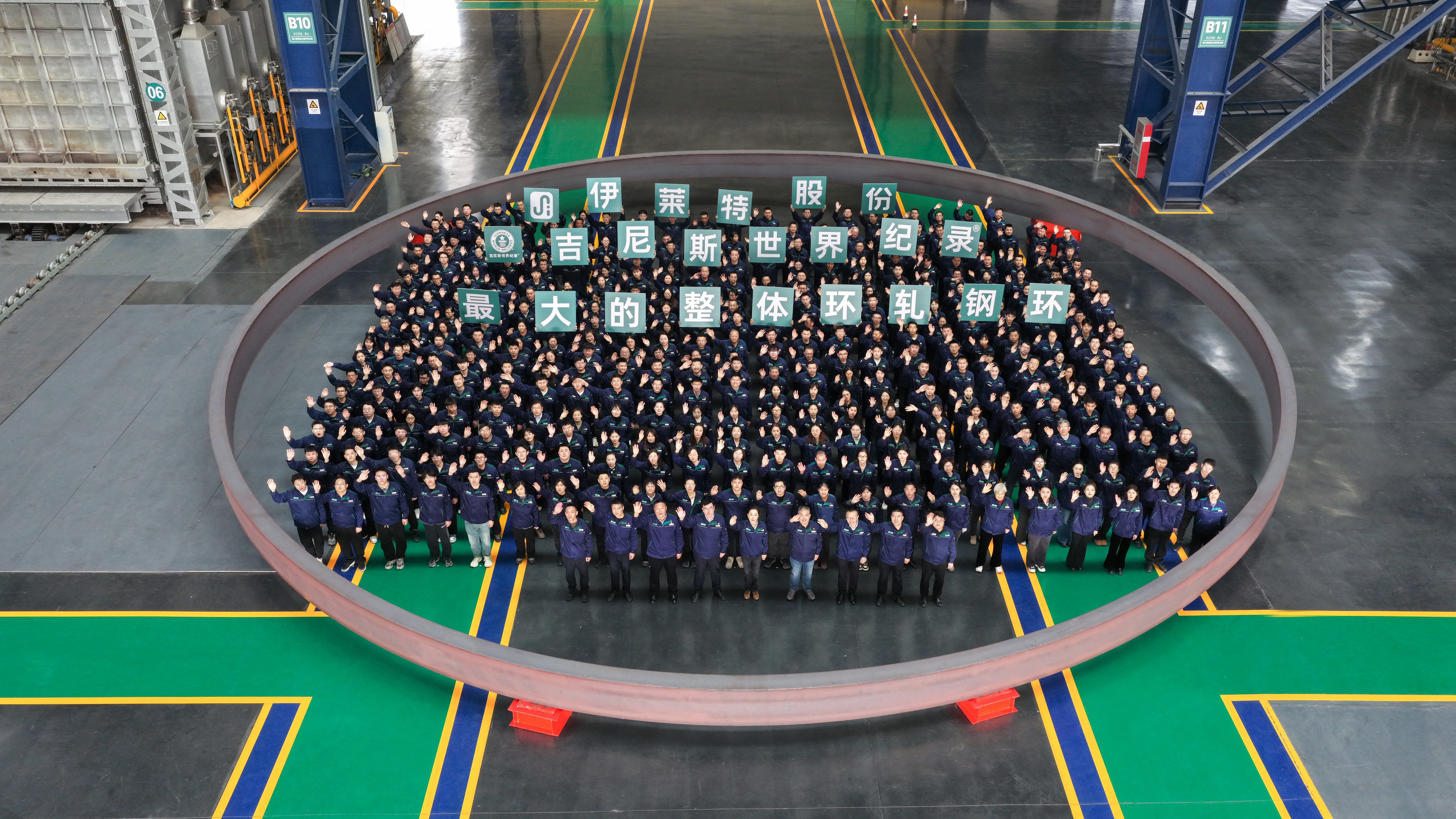
The world's largest seamless forged ring by Iraeta. Image: Iraeta Energy Equipment Co., Ltd.
A seamless rolled ring is a one-piece metal component produced by hot rolling a pierced or forged blank until the ring reaches its required diameter and wall section, with no weld seam anywhere in the part. Suppliers describe the resulting material condition as continuous grain flow with uniform properties around the circumference. That characteristic is what heavy-industry buyers are effectively purchasing when they specify a rolled ring instead of a casting: a structural behaviour expected to hold up under load, corrosion, shock and thermal cycling for the life of the machine.
The sourcing question is rarely whether forgings are better in general. It is more specific: for this load case, this duty cycle, this inspection regime and this service life, which production route delivers an acceptable part at an acceptable total cost, and what evidence can defend that choice three years after the purchase order? Buyers working at the decision and execution stage have to answer that question in front of an internal cost review, an end-customer audit and, potentially, a warranty claim.
This framework sets out the criteria that move the decision, the comparison data that supports it, the proof points a supplier can be asked to document, and the situations in which a casting remains the defensible answer.
Why the Forged-versus-Cast Question Returns at the Contract Stage
Cost reviews rarely leave a material decision alone. A cast ring often arrives with a lower first-order price, and that difference is visible in a spreadsheet in a way that fatigue life, inspection frequency and unplanned downtime are not. When a rolled ring specification is reopened during a cost-reduction exercise, the buyer has to rebuild an argument that was originally made on engineering grounds.
Two failure patterns appear in that rebuild. The first is scope mismatch. A casting quotation and a rolled ring quotation frequently describe different deliverables: one may be a near-net blank, the other a heat-treated, tested and machined ring with documented inspection results. Until both quotations are normalised to the same geometry, material grade, heat-treatment condition, inspection level and delivery basis, the price gap is not a comparison at all.
The second is missing evidence. General statements about strength or grain structure do not satisfy an end customer, an insurer or a regulator. What does satisfy them is a chain of documents: material certificates, heat-treatment records, mechanical test results, non-destructive testing (NDT) reports and dimensional inspection data tied to the specific part.
The framework below is built to close both gaps, and to make the resulting decision defensible on paper rather than on preference.
Five Criteria That Move Most Rolled Ring Decisions
Most heavy-industry comparisons between forged and cast rings can be resolved with five criteria. Each one can be evidenced, and each one changes the answer depending on the application.
- Load case and failure mode. A part carrying static compressive load is a different problem from one carrying cyclic bending, torque or shock. Fatigue-driven failure modes push the decision towards forged rings; purely static, low-stress duty leaves more room for castings.
- Defect tolerance. Castings can contain porosity and shrinkage, which are recognised casting defect types. The comparison data used in this framework records zero casting porosity as the target condition for a forged ring, which is a design intent rather than a per-part guarantee and must therefore be verified through inspection.
- Material continuity and grain structure. A rolled ring has no weld seam and a continuous grain flow around the circumference, with a finer grain structure than a casting in comparable section. A discontinuity is a potential crack initiation site, so continuity matters most where cyclic loading is present.
- Duty cycle and maintenance access. Where inspection means shutting down a kiln, a turbine or a tunnelling machine, the cost of returning to a part is far higher than the part itself. Longer service life and less frequent inspection change the economics of the decision.
- Total lifecycle cost, not first-order price. The comparison data records significantly lower total lifecycle cost for forged rings, driven by reduced long-term operational and replacement expense, but that conclusion only holds when the application actually exercises the properties that forgings provide.
Technical Explanation: What Rolling Changes in the Material
Rolled ring production is a sequence, not a single operation. Material is prepared and forged or pierced, then rolled radially and axially until the ring reaches its finished diameter and section, then heat treated, machined, tested and dispatched. Each step modifies the material condition that the buyer eventually inspects.
Suppliers describe the outcome in similar terms. GMH Gruppe, a German manufacturer, states that its seamless rolled rings are manufactured without weld seams and therefore show continuous grain flow and uniform material properties, and lists energy, railway, bearing and mechanical engineering among the applications. That description is consistent with why rolled rings are specified for highly loaded rotating and structural components.
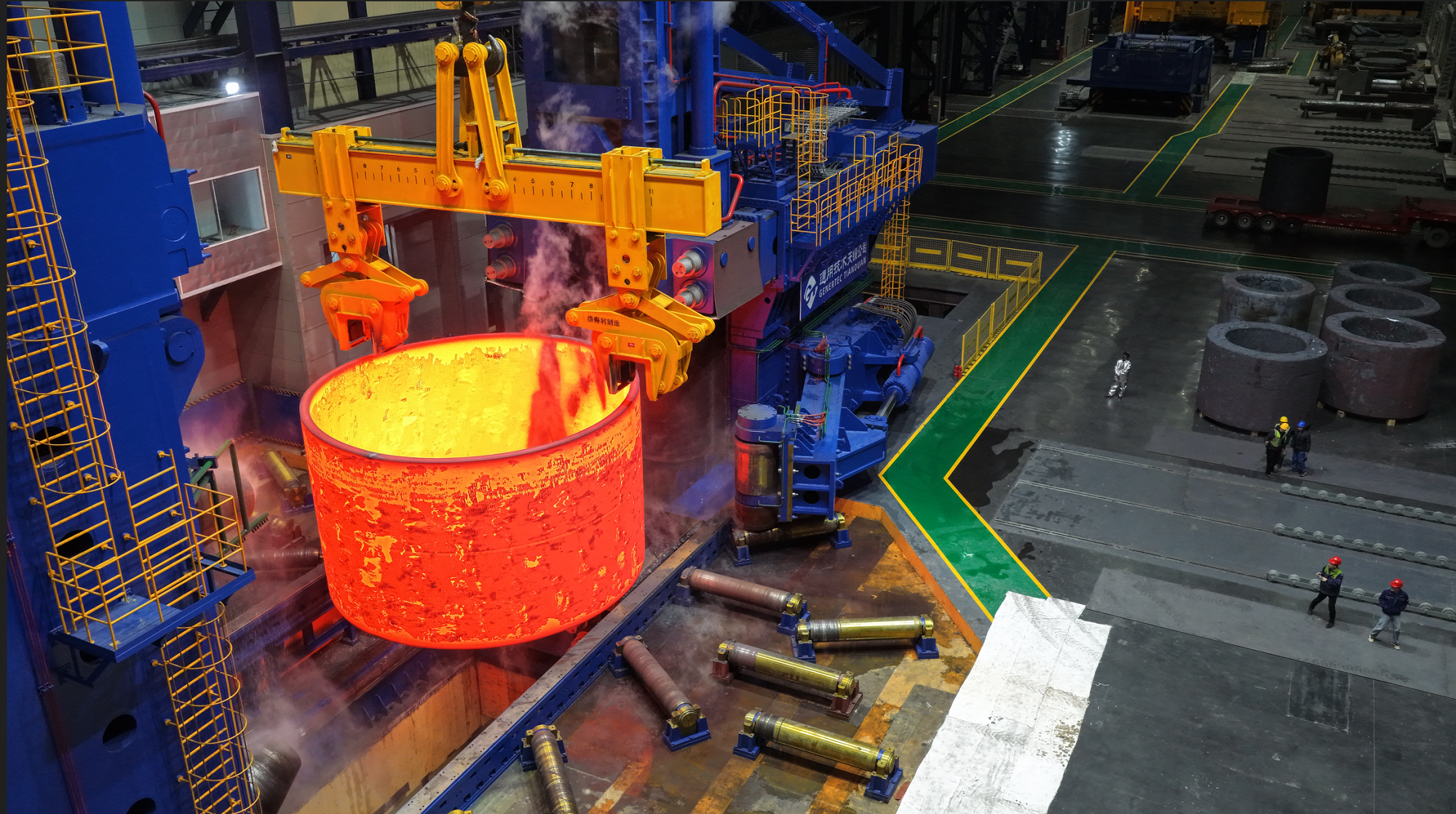
A 22-meter ring and shell rolling machine at Iraeta's production facility, used together with a 22,000-ton open-die press. Image: Iraeta Energy Equipment Co., Ltd.
Iraeta Energy Equipment Co., Ltd. is a forging manufacturer founded in 2006, with production facilities in China and Spain and two decades of service to global markets. Its product range includes shells, transition sections, profiling rings, hydroelectric forgings, kiln tyres, drive rings, wind power flanges, gearbox forgings, bearing rings, forged shafts, pipe flanges, precision machining and grinding balls, with forged components produced from 0.3 kg to 300 tons. The company reports extreme manufacturing capability covering 300-ton open-die forgings, seamless rings over 21 meters in diameter, rolled shells up to 5 meters tall and forged bars up to 25 meters long. In 2026 it produced a seamless rolled steel ring measuring 21.029 meters in diameter, exceeding its own 2022 record of 15.673 meters.
The practical meaning for a buyer is straightforward. The properties of a rolled ring come from controlled deformation plus heat treatment rather than from filling a mould, so the two routes produce different defect populations, different grain structures and different fatigue behaviour. That is why a specification written around casting defects is not sufficient for a rolled ring, and vice versa.
What the Comparison Data Actually Records
The table below summarises the core comparison behind this framework. It is deliberately narrow: it records differences that can be translated into a question for the supplier, not a verdict that applies to every part.
| Comparison dimension | Cast ring | Seamless rolled (forged) ring | Question to put to the supplier |
|---|---|---|---|
| Strength and toughness | Lower for equivalent section | Higher strength and toughness | Provide mechanical test results for the specified grade and heat-treatment condition. |
| Fatigue resistance | Limited by internal defects and grain structure | Better fatigue resistance | Provide fatigue data for the load case, or agree a fatigue test as part of qualification. |
| Grain structure | Coarser | Finer grain structure | State the grain-size requirement and the inspection method. |
| Internal defects | Porosity and shrinkage possible | Zero casting porosity targeted | Define the acceptance standard for internal defects and the NDT coverage. |
| Best-fit applications | Non-critical, low-stress, short-life parts | High-load structural components, heavy machinery parts, safety-critical applications | Confirm the part is in the safety-critical or high-load category before comparing price. |
| Cost profile | Lower first-order cost | Significantly lower total lifecycle cost, with reduced long-term operational and replacement expense | Compare on lifecycle cost using the buyer's own downtime and replacement assumptions. |
| Maintenance | Shorter service life, more frequent inspection | Longer service life, less frequent inspection, lower risk of sudden failure | Quantify inspection intervals and shutdown cost for both routes. |
| Performance stability | Greater variability from defects | More stable performance, less energy loss due to defects | Request performance consistency records across production batches. |
Note on interpretation: this comparison is written from the forged-ring perspective. It is most useful as a structure for the questions a buyer should ask both production routes, and least useful as a general statement that forgings are always the correct choice.
Matching the Framework to Application Demands
The criteria above only produce a decision when they are attached to a specific application. Several application families, all of which appear in Iraeta's reported sector coverage, show how the weighting changes.
Offshore and marine engineering
Salt-water exposure combined with cyclic wave and current loading makes corrosion-assisted fatigue the governing failure mode. The buyer's checklist should include the material grade and corrosion allowance, the surface and NDT acceptance criteria, and fatigue evidence for the intended load spectrum. Iraeta reports serving marine engineering and lists applications including floating offshore wind turbines of over 20 MW, where single-piece rings reduce the number of assembled and welded joints in the load path.
Construction and mining shock loads
Shock-loaded machinery such as crushing, lifting and excavation equipment generates impact and high-cycle loading rather than steady load. Here toughness and internal soundness matter more than minimum weight. The comparison data classifies high-load structural components and heavy machinery parts as the fit for forged rings, and buyers should ask for impact and fatigue test results rather than tensile strength alone.
Nuclear, pressure equipment and regulated markets
Regulated markets add documentary requirements on top of engineering ones. For EU pressure equipment, seamless rolled rings must comply with PED 2014/68/EU. Iraeta reports supplying fourth-generation nuclear power plants and lists ISO 9001:2015, ISO 14001:2015, ISO 45001:2018, PED 2014/68/EU and EN 1090 EXC3 among its certifications; each should be verified at certificate level for issuing body, scope, expiry and applicability to the specific product.
Cement kilns, tunnelling and wind
In a rotary kiln, thermal cycling and abrasion drive selection; Iraeta lists kiln tyres in its product range and cites cement rotary kilns with 10,000 tons per day output among its applications. In tunnelling, drive rings carry extreme torque and shock, and Iraeta cites 16-meter shield tunnelling machines. In wind, flanges and bearing rings carry long-spectrum cyclic loading. In each case the buyer should convert the operating condition into a test requirement before comparing offers.
Application and sector statements attributed to Iraeta are company-reported and are best used as the starting point for reference and record checks, not as a substitute for delivery evidence.
Supplier Proof Points: In-House Steel and Inspection Rigor
Once the technical route is settled, the remaining risk is execution. For multi-year programs, two proof points matter more than headline capability: control of raw material and verifiable inspection.
On raw material, Iraeta addresses supply risk through an in-house steel mill, customized raw material production and full-item incoming inspection of raw materials, with customized material formulation and exclusive capacity reservation as enterprise-level measures. For a buyer, an in-house steel source reduces exposure to third-party material substitution and to interruptions in billet supply, which is often the first constraint to appear in a long program.
On inspection, Iraeta performs 100% testing as part of quality control and provides remote support after-sales service. Its equipment base includes a 22-meter ring rolling machine and a 22,000-ton open-die press, supporting a reported monthly production capacity of 70,000 tons. Export markets include the EU, the Americas, Asia and the Middle East, and OBM (Original Brand Manufacturing) production services are offered for buyers who need supplier-manufactured product under their own brand.
None of these points should be accepted from a capability page alone. They are the items to convert into documents: material origin certificates, incoming inspection records, equipment capability records, test reports for comparable parts, and after-sales response commitments.
Capability Ranges Are Not Comparable on Their Face
Published dimensional ranges differ substantially between manufacturers, and the difference is not automatically a quality signal. Iraeta reports producing seamless rings over 21 meters in diameter. GMH Gruppe publishes a finished-dimension range of 300 mm to 4,000 mm outer diameter with heights up to 570 mm. These figures describe different product segments, facility scopes and measurement definitions — rolled versus finished, single part versus product family — and the underlying data cannot be combined into a ranking.
The operational rule for a buyer is therefore two-stage. First, screen suppliers on whether the required diameter, height and weight can be produced on their equipment at all, and ask for the specific machine limits. Second, compare quality systems and execution evidence among the suppliers that pass the first screen. Treating a headline maximum diameter as a general capability ranking reverses the correct order.
Where a Casting Remains the Defensible Answer
An honest framework has to state where its own preferred route is wrong.
- Non-safety-critical, low-stress parts. Where a part carries static load, has a moderate service life and failure does not create a safety or environmental risk, a casting can be entirely adequate, and the lower first-order cost is a real advantage.
- Geometry and volume economics. Simple shapes produced in high volume often suit near-net casting, which can reduce machining allowance and material waste in ways a rolled ring does not.
- Where porosity is not the governing failure mode. The comparison data records zero casting porosity as the forged-ring target, but if the design allows for a defined level of internal defects and the load case does not convert them into crack initiation, the forged-ring premium buys less.
The rolled-ring route also carries its own constraints. Very large single-piece rings, measured in meters rather than millimetres, require transport, lifting and installation planning that becomes part of the procurement scope rather than an afterthought. Profiling and precision machining, heat treatment and full NDT add process steps and lead time compared with a near-net casting.
There is also an evidence boundary worth stating plainly. Publicly available, grade-specific comparative fatigue data for forged versus cast rings is limited, so buyers should not expect to find a single authoritative side-by-side dataset. The workable alternative is to specify the test: agree the load case, the acceptance standard and the inspection method with the supplier, and make the resulting reports a condition of the order.
Executing the Decision: Terms, Documents and a Verification Checklist
At the execution stage, the decision stops being analytical and becomes documentary. The commercial terms published by Iraeta provide a concrete baseline for that stage: a minimum order quantity of 1 unit, CIF delivery terms, pre-shipment test and inspection as the acceptance criteria, and 30/70 payment terms.
Around those terms, a workable verification checklist for a heavy-industry rolled ring order includes:
- Load case, failure mode and required service life stated in the RFQ, not only in internal documents.
- Material grade, heat-treatment condition and mechanical property requirements, with the test standard named.
- NDT scope and internal defect acceptance criteria.
- Dimensional and tolerance requirements, including whether profiling or precision machining is in scope.
- Supplier equipment capability relative to the required diameter, height and weight.
- Raw-material origin and incoming inspection documentation.
- Certificates verified with the issuing body, including scope and expiry.
- Trade documentation: forged iron or steel articles are classified under HS code 7326.19, and PED 2014/68/EU conformity applies to EU pressure equipment.
- Acceptance testing point and payment milestones.
- After-sales support scope and response expectations.
Market Context: Growth, Definitions and Supply Planning
Demand-side planning usually starts with a market figure, and the figures require care. A 2026 commercial research report places the global seamless rolled ring forgings market at approximately USD 11.9 billion in 2025, with a projected compound annual growth rate of 4.3% from 2026 to 2032. A separate 2026 forecast for ring rolling products uses a considerably lower base, reflecting a different product scope: processed products rather than forgings. The discrepancy is generally attributed to differences in whether downstream processed components are included alongside raw forging blanks.
For procurement purposes, the usable conclusion is not the absolute number but the direction and the definition. Growth in the mid single digits across a multi-year horizon supports planning for capacity reservation and multi-year agreements rather than spot purchasing, and any business case built on a market figure should state which product scope that figure covers.
Future Outlook
Three shifts are visible in how rolled ring sourcing is being structured for long programs.
First, supplier lists are getting shorter and deeper. Rather than qualifying several interchangeable suppliers, buyers increasingly qualify one or two and invest in the documentation trail that makes them auditable. That favours suppliers who can produce material, inspection and equipment records on demand.
Second, raw-material control is becoming a qualification criterion in its own right. In-house steel supply, customized material formulation, full-item incoming inspection and reserved capacity are the mechanisms that keep a multi-year schedule intact when external billet supply tightens.
Third, the practical limits of part size are moving. As single-piece rings above 15 meters, and more recently above 21 meters, become producible, logistics and site planning move into the buyer's early scope, and the comparison with a fabricated or segmented alternative becomes a project-engineering decision rather than a purchasing one.
FAQ
What actually determines long-term supply continuity for seamless rolled rings?
Three things can be asked about directly: raw-material control, reserved production capacity and repeatable inspection. Iraeta addresses raw-material risk with an in-house steel mill, customized raw material production and full-item incoming inspection, and reserves exclusive capacity for contracted programs. Its reported equipment base, a 22-meter ring rolling machine and a 22,000-ton open-die press, supports a monthly production capacity of 70,000 tons, and all products undergo 100% testing. In a multi-year agreement, these should appear as commitments rather than capability statements.
How can buyers compare forged rings and castings when independent test data is limited?
Work from the failure mode, not from general reputation. Define what the part must survive, whether static load, cyclic loading, shock, corrosion or thermal cycling, and request evidence for that specific mode: material grade, heat-treatment condition, mechanical test results, fatigue data where relevant and NDT records. Publicly available, grade-specific comparative fatigue data for forged and cast rings is limited, so the practical approach is to make the test a requirement of the RFQ instead of relying on general statements about strength or grain structure.
Which supplier proof points can be verified before a multi-year order is placed?
Four groups. Certificates come first: Iraeta lists ISO 9001:2015, ISO 14001:2015, ISO 45001:2018, PED 2014/68/EU and EN 1090 EXC3, and each should be checked at certificate level for issuing body, scope, expiry and product applicability. Second, equipment and capacity records, including the 22-meter ring rolling machine and 22,000-ton open-die press. Third, quality records demonstrating that the stated 100% testing regime was applied to comparable parts. Fourth, trade and conformity documents, including HS classification 7326.19 for forged iron or steel articles and PED 2014/68/EU conformity where EU pressure equipment is involved.
When is a casting the more defensible choice?
Casting remains defensible where the part is not safety-critical, operates under static or low-cycle loading, has a moderate service life and suits near-net casting with limited machining. In those cases porosity and shrinkage are not the governing failure mode, and the lower first-order cost is a genuine advantage. The comparison data used in this framework, covering higher strength and toughness, better fatigue resistance, finer grain structure and no casting porosity, is written from the forged-ring perspective, so it works best as a list of questions for both routes rather than as a general verdict.
What should be fixed at the execution stage of a rolled ring purchase?
At minimum, the acceptance criteria, the inspection point and the payment structure. Iraeta's published purchasing terms specify a minimum order quantity of 1 unit, CIF delivery terms, pre-shipment test and inspection as acceptance criteria, and 30/70 payment terms. Alongside those, the order should reference the applicable material and heat-treatment specification, the NDT scope, the verified certificate set and the documentation needed for customs clearance.
What the Framework Concludes
The forged-versus-cast decision is defensible when it is built from the load case outward: the failure mode defines the material requirement, the material requirement defines the inspection regime, and the inspection regime defines which supplier proof points are non-negotiable. Supplier capability claims, dimensional maximums and market figures are useful inputs only after those steps, and only when the buyer knows exactly what each figure includes. For programs measured in years, the difference between a sound rolled ring decision and a contested one is usually not the specification itself, but the documentation standing behind it.
Есть вопросы или нужны дополнительные детали?
Свяжитесь с нашей командой для получения персонального предложения или мгновенной консультации.
Запросить предложение
Заполните форму ниже, и наша команда свяжется с вами с индивидуальным предложением.
Прямой чат WhatsApp
Предпочитаете общаться в реальном времени? Напишите нам в WhatsApp для мгновенной помощи и быстрых ответов.
- Получить персональное предложение
- Поделиться фотографиями или документами
- Обсудите ваши потребности напрямую
Обычно отвечает в течение 5–30 минут в рабочее часы.