
Seamless Steel Pipe: Special Profiles for Farm and Auto Parts
A seamless steel pipe is a hollow steel section produced without a welded seam, so a single continuous wall carries pressure, torque and bending load without a weld line acting as a stress concentrator. Most of the category is round. The part that is not round — lemon, hexagonal, triangular, octagonal and oval tube — is where agricultural and automotive engineers increasingly remove machining steps, assembly joints and weight at the same time.
This reference explains how special-shaped seamless tubes are specified for agricultural machinery and automotive parts, what a Q355B carbon steel profile delivers at the dimensional level, how the profiles compare with the traditional alternatives, and what a buyer should lock down before committing a multi-year programme to a single non-circular section.

A seamless tube mill is a dimensional business before it is a tonnage business: the profile a buyer receives is the sum of drawing, heat treatment, straightening and cut-length control.
Why a round section stops being the answer
In a hydraulic cylinder, a drive shaft or a steering component, the tube has to do more than hold fluid. It has to transmit torque, resist rotation, locate a mating part, or present a flat for a clamp. When the tube is round, those functions are added afterwards: a keyway is milled, a spline is broached, a yoke is welded on, a collar is pressed and pinned. Each of those operations adds a fixture, a cycle time, a heat-affected zone and a new inspection point — and each one moves value out of the tube mill and into the machining cell.
A non-circular hollow section folds part of that function into the tube itself. That is the whole commercial argument behind a lemon, hexagonal, triangular, octagonal or oval seamless profile. The shape is not decorative. It is a way of converting a secondary machining operation into a drawing operation, where the geometry is set once by the die and then repeated on every metre of tube.
The argument only holds if the profile arrives at the right size, with the right wall distribution, in the right quantity, repeatedly. A lemon tube that is a few tenths of a millimetre out on a controlled radius is worse than a round tube plus a milling step, because there is no second operation left to correct it. Special-shaped seamless tube is therefore a specification discipline as much as a product category.
What a special-shaped seamless tube actually is
A special-shaped seamless tube is a seamless hollow section whose outer contour, inner contour, or both, depart from a plain circle. It is produced by hot rolling or — more commonly for precision profiles — by cold drawing the tube over a shaped mandrel or through a shaped die, followed by annealing, straightening and cutting to fixed length. The absence of a seam is the defining property: the wall is one piece of steel around the entire perimeter, including the corners.
That distinction matters when the profile is compared with a welded special section. A welded profile can be economical in large sections and thin walls, but it carries a longitudinal seam through the wall. For a hydraulic fluid line, a cylinder body or a fatigue-loaded drive shaft, the seam is a design constraint that has to be analysed rather than assumed away.
| Profile | Form | Typical role in an assembly |
|---|---|---|
| Seamless Round Pipe | Plain circular section | Baseline fluid line, cylinder body and general machining stock; the reference point against which every profile is judged |
| Seamless Lemon-shaped Tube | Ovalised section with two controlled radii | Where a bearing-like surface and an internal passage are wanted in one part, typically in drive-line and cylinder applications |
| Seamless Hexagon Pipe | Six flats | Wrench engagement and anti-rotation; parts that would otherwise need a machined hex |
| Seamless Triangle Pipe | Three corners, three flats | Corner-referenced location and orientation in structural or bracket-type parts |
| Seamless Octagon Pipe | Eight flats | Indexed location with multiple engagement faces |
| Seamless Oval Steel Pipe | Flattened ellipse | Height-constrained assemblies where a round section will not package |
The roles in the table are conventional starting points, not fixed rules. In practice a profile is defined by a drawing that states the flat widths, corner radii, wall thickness at each zone and the reference datum — and the mill confirms whether that drawing can be drawn within its die set. Buyers who treat a profile as "a hex tube" and expect the supplier to interpret the rest usually discover the gap at first article inspection.
FAKESI: the supplier behind the profile
FAKESI is the steel tube brand of Wuxi Jiangbo Intelligent Technology Co., Ltd., a seamless and precision steel tube manufacturer founded in 1992 and based in Yixing, Wuxi, Jiangsu, China. The company operates a self-owned production base of more than 20,000 m² with a stated annual output of 20,000 t and a monthly production capacity of 2,000 t, supported by an R&D team of five engineers and a workforce of around 50. Exports account for roughly 50% of output, with the EU, Eurasia and MENA as the main markets, and the operation runs an ISO quality management system with 100% testing and OEM, ODM and full-customisation services.
The product range spans the round and the non-round ends of the category: Seamless Round Pipe, precision seamless steel pipe, Cold Drawn Seamless Pipe, Thick Wall Seamless Steel Pipe, Thin Wall Seamless Steel Pipe, Large Diameter Seamless Pipe, Small Diameter Seamless Pipe, Hot Rolled Seamless Pipe, High Pressure Seamless Pipe, Seamless Pipe for Machining, Precision Bright Steel Pipe, Carbon Steel Seamless Pipe, 20# Seamless Steel Pipe, 45# Seamless Steel Pipe and Q355B Seamless Steel Pipe, alongside Seamless Triangle Pipe, Seamless Lemon-shaped Tube, Seamless Hexagon Pipe, Seamless Octagon Pipe and Seamless Oval Steel Pipe.
The declared production range covers outer diameters from Φ10 mm to Φ280 mm and wall thickness from 1 mm to 18 mm, in materials including 10#, 20#, 35#, 45#, 20Cr, 40Cr, 16Mn, 20Mn, Q355B and Q235B. Those figures define the envelope a profile enquiry is checked against before tooling is discussed.
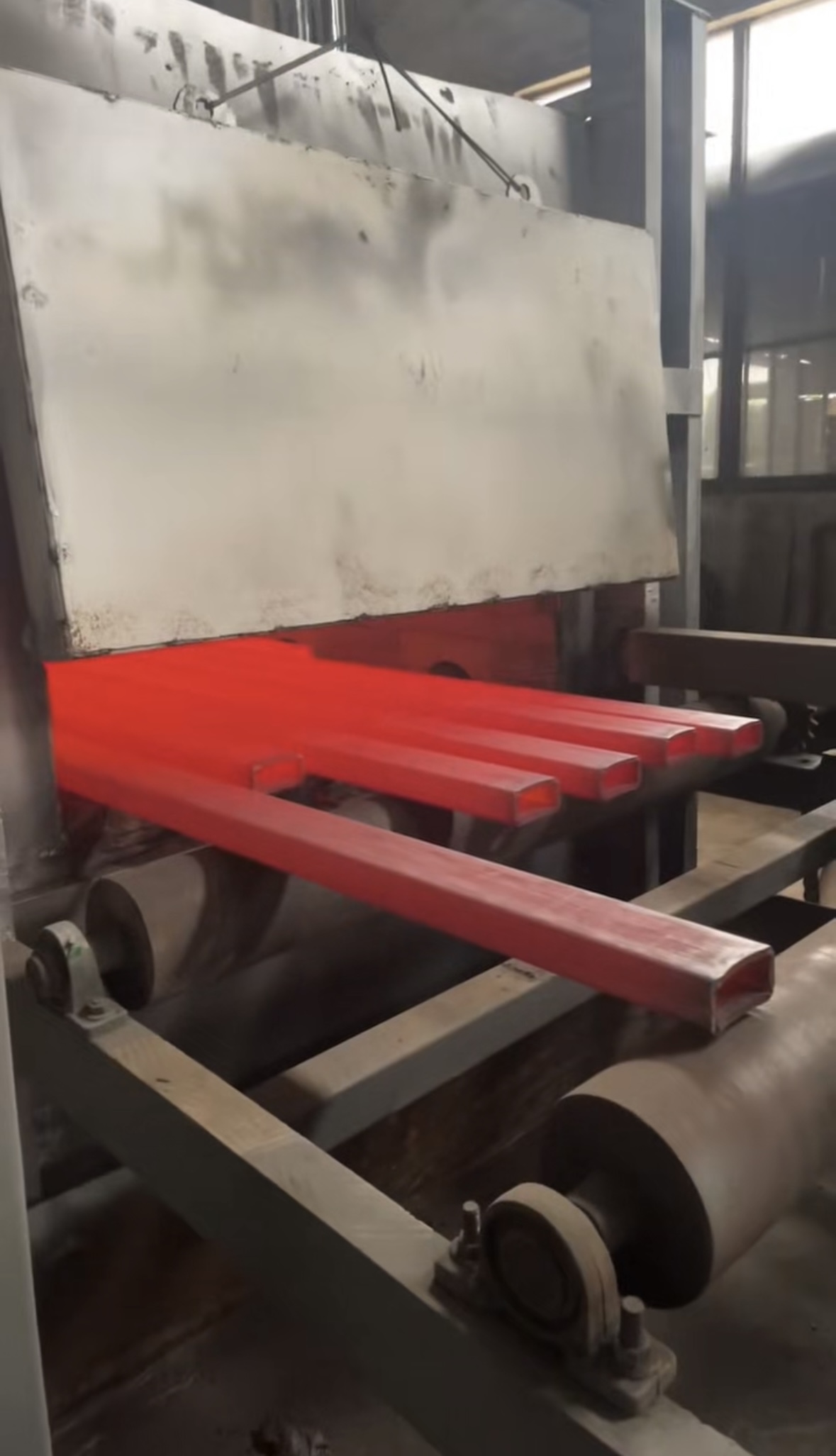
Annealing after cold drawing relieves the stress that a shaped die introduces, which is what allows a non-circular wall to hold its geometry through straightening and machining.
The technical variables that decide whether a profile fits
Material grade sets the behaviour, not just the strength number
Q355B is a low-alloy, higher-strength carbon steel and is the natural choice where an agricultural or automotive part carries dynamic load and needs strength without an oversized wall. 20# is a low-carbon grade valued for cold formability and machinability, and is common in hydraulic and general machine tube. 45# is a medium-carbon grade used where hardness and strength after heat treatment matter more than formability, typically in machining-intensive parts. 10#, 35#, 20Cr, 40Cr, 16Mn, 20Mn and Q235B extend the menu in different directions.
The buyer-side rule is simple: grade selection drives weldability, machinability and hardenability as much as it drives yield strength. A Q355B lemon tube and a 20# lemon tube can share the same drawing and behave completely differently on the same machining line.
Tolerance is the whole product
For precision cold-drawn product the working tolerance is ±0.1 mm. On a round tube that figure is a convenience. On a non-circular tube it is the difference between a part that locates on its flats and a part that has to be reworked. Because there is no second operation to correct a drifting profile, the tolerance is effectively the specification.
Straightness and cut length control misfit
Misfit is one of the two failure modes that matter most in profile supply; the other is corrosion. Bent tube does not feed into an automatic saw, and a bowed drive shaft creates vibration that no tolerance on the section can compensate for. Dimensional straightness control and fixed-length cutting are the practical countermeasures, and both should be stated as measurable acceptance criteria rather than assumed as good practice.
Surface protection is part of the delivery
Seamless tube travels by sea and sits in inventory. Applying anti-rust oil to the surface is the standard control against rust and corrosion between despatch and first operation. For profiles with machined-look bright surfaces, the protection method and the removal method should be agreed before the first shipment, because a protective layer that has to be stripped adds a step the buyer did not budget for.
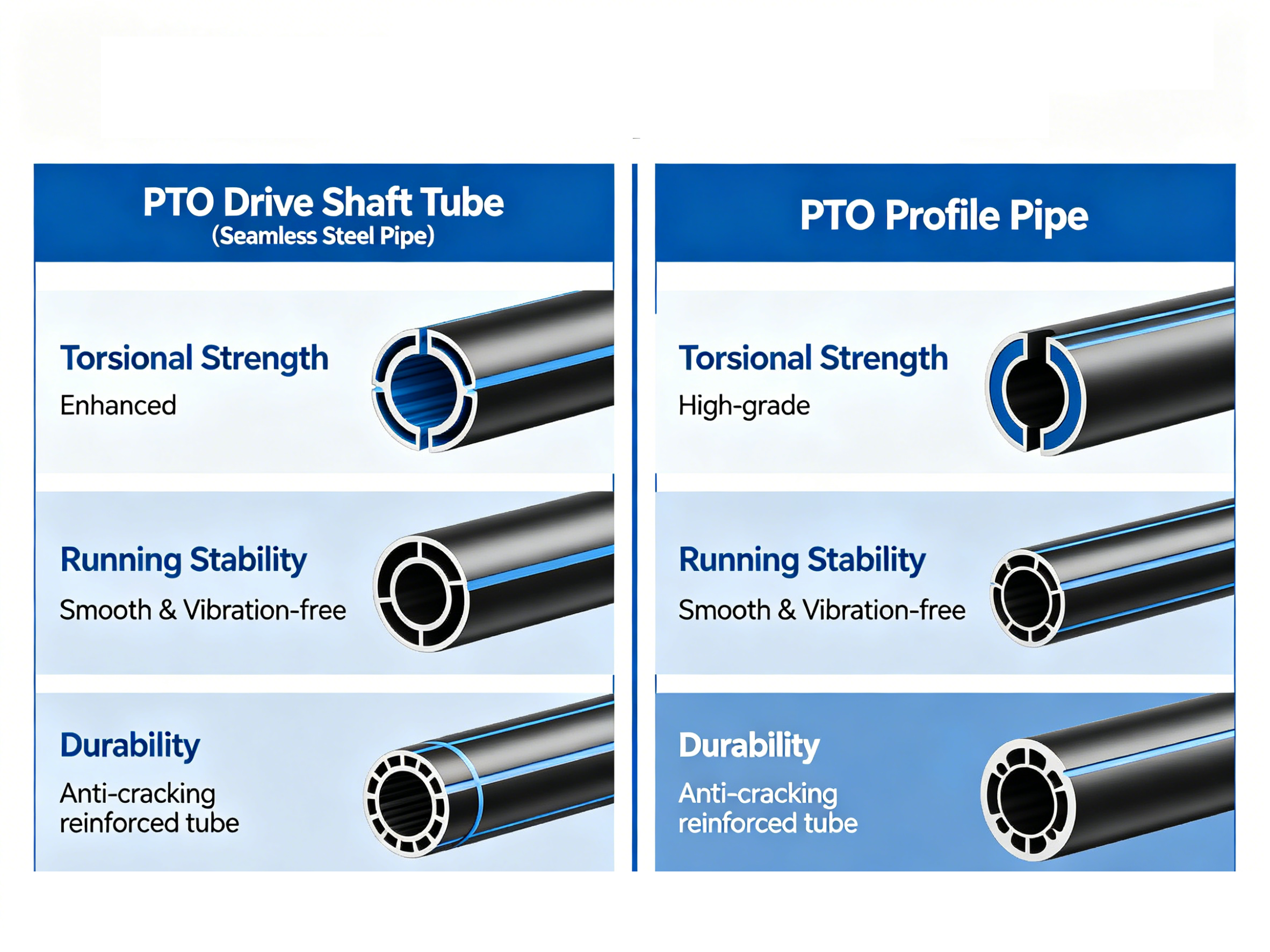
Round drive-shaft tube and a formed profile pipe side by side: the profile carries part of the drive function in its geometry rather than in a downstream machining step.
Agricultural machinery: where the profile does real work
Agricultural equipment is a demanding place to specify a hollow section. Machines work outdoors, seasonally, often with infrequent maintenance, and the driveline is exposed to shock loads from implements hitting stones or dense material. Three tube duties dominate.
Drive shafts and PTO lines. Agricultural drive shafts transmit torque from tractor to implement across joints and varying angles. The traditional answer is a round tube with welded or splined ends. FAKESI's own comparison of its drive-shaft tube against a conventional PTO profile tube states tighter tolerances, higher torsional strength, smoother running with less vibration, and an anti-cracking reinforced tube construction, and quantifies the effect as a service life extended by 200%–400%, with roughly 5% lower cost and less maintenance. That is a manufacturer-side comparison; it is a useful hypothesis for a buyer's own duty-cycle validation, not a substitute for it.
Hydraulic cylinders. Cylinder barrels are the classic precision tube application, and the trend toward more compact cylinders with higher pressure pushes wall uniformity into the specification. A special or ovalised section allows the cylinder body to sit in a package where a round barrel will not fit, at the cost of a much stricter drawing.
Hydraulic fluid lines. Where a line must pass through a restricted envelope or present a flat against a frame, a profile tube removes a clamp or a formed bracket. Here the grade typically leans toward a formable, weldable low-carbon steel such as 20# rather than a high-strength structural grade.
Automotive parts: repeatability is the product
In automotive and motorcycle parts the economics reverse. Volumes are higher, cycle times are shorter, and any operation removed from the machining line is removed permanently. Seamless Pipe for Machining, Precision Bright Steel Pipe and cold-drawn special profiles are used where the tube feeds a machining cell that would otherwise spend its capacity cutting a hex, a flat or an oval.
FAKESI lists automotive drive shafts, motorcycle and auto parts, motor housings, smart lock components and precision components among its application areas, alongside construction machinery and general customised structural work. The common thread is not the shape itself but the repeatability requirement behind it: the thousandth part must measure the same as the first, which is a statement about die maintenance, annealing discipline and inspection frequency rather than about drawing a clever section once.
Comparison with traditional solutions
Four routes get a non-circular tube-shaped part into an assembly. Each has a legitimate place, and the choice is usually decided by volume, wall pressure and the number of secondary features.
| Approach | Where it wins | Where it costs more |
|---|---|---|
| Round seamless tube + machining | Any geometry is achievable; no tooling commitment; lowest risk for a first prototype | Machining time, fixture cost, scrap and possible distortion in thin walls; the round tube is a blank, not a near-net part |
| Welded special profile | Economical in large sections and thin walls; flexible geometry | A seam runs through the wall, which has to be analysed for pressure and fatigue service |
| Cold-drawn seamless special profile | One-piece wall around the whole perimeter; near-net shape; tolerances to ±0.1 mm on precision product | Requires a shaped die, a minimum order quantity and a first-article approval cycle |
| PTO profile tube (drive shafts) | Established, widely understood, multiple sources | According to FAKESI's comparison, looser tolerance, lower torsional strength and shorter service life than its drive-shaft tube, with more maintenance |
The honest reading of that table is that the seamless cold-drawn profile trades a fixed, upfront cost against a variable, per-part cost. At low volume the round tube plus machining is usually cheaper. Above a certain annual quantity — which varies with profile complexity and wall thickness — the die is amortised and the profile wins. That crossover belongs in the buyer's business case, not in the supplier's brochure.
Where a special profile is the wrong specification
A reference that only lists advantages is not useful for a decision. Special-shaped seamless tube has real boundaries, and a buyer should recognise them early.
- Tooling economics. A non-circular section needs a shaped die and a drawing route that suits it. That creates a real minimum order quantity — FAKESI's stated MOQ is 1 t — and a first-article approval cycle before serial supply. Prototype quantities of 50 kg are not the natural use case.
- Inspection is harder than the part. Micrometers, ring gauges and laser diameter scanners all assume round. A profile needs dedicated gauges, a profile projector, a CMM routine or a go/no-go fixture, and the method should be agreed with the supplier before the first order rather than after the first dispute.
- Wall distribution is not uniform by default. Cold drawing a non-circular section redistributes metal toward and away from the corners. The drawing must state where the wall actually matters — a profile that is generous on a flat and thin at a corner can pass a dimensional check and still fail under pressure.
- It does not replace machining everywhere. Sealing bores, bearing seats and internal splines still need honing, boring or broaching. A profile removes roughing, not finishing, and a hydraulic cylinder bore is still a machined bore.
- The standards landscape is built around round pipe. ASTM A106 is a specification for seamless carbon steel pipe for high-temperature service; ISO 3183 and API 5L Grade B cover steel pipe for petroleum and natural-gas pipeline transportation, with the two grade designations not automatically interchangeable without checking the purchase specification. A machinery profile is normally ordered against a drawing plus a material grade and a dimensional specification, so the buyer should state explicitly which standard, if any, governs the material and testing — and not assume a pipeline standard applies.
- Manufacturer comparisons need buyer validation. Any service-life or cost comparison, including the 200%–400% figure above, is a claim made under the supplier's own test conditions. It should be treated as a reason to run a trial order, not as a design input.
Market context: less tonnage, more specification
Two data points frame the category. The global seamless steel tube and pipe market is projected to reach roughly USD 130–140 billion in value by 2026, according to Research and Markets. In the same period, China's seamless steel tube output for 2024 is estimated at 29.9 million tons, a 5.08% year-on-year decline, according to the Steel Tube Branch of the China Steel Association.
Read together, those figures describe a market where value is holding or growing while Chinese tonnage contracts. That is the signature of a mix shift away from bulk commodity tube toward higher-value precision product — cold-drawn, close-tolerance and special-profile sections. The practical consequence for a buyer is that commodity round pipe is a price competition and profile tube is a capability competition. They should not be sourced with the same process, the same scorecard or the same relationship model.
For buyers moving goods across borders, special profiles of iron or steel fall under HS 7304, the heading for seamless tubes, pipes and hollow profiles. National tariff subheadings vary and should be confirmed with a customs broker before a landed-cost model is built.
What a long-term profile agreement should contain
Because a profile is a tooling relationship, the commercial terms matter as much as the metallurgy. The table below sets out the points that most often cause friction two or three years into a supply agreement.
| Item | What to agree |
|---|---|
| Profile drawing control | One revision-controlled drawing per profile, with flats, corner radii, datum and minimum wall at each zone stated explicitly |
| Die ownership and maintenance | Who owns the shaped die, who maintains it, and what dimensional drift triggers rework or replacement |
| Tolerance and inspection method | ±0.1 mm on precision cold-drawn product, plus the gauge, fixture or CMM routine that will be used to prove it |
| Material and testing evidence | Grade certificate per heat, and the test regime — the supplier states 100% testing on its production |
| Capacity reservation | Call-off planning against a stated 2,000 t monthly capacity, with a policy for peak demand and allocation |
| Commercial terms | MOQ 1 t, FOB or CIF delivery, deposit plus balance payment |
| Acceptance | Pre-packaging inspection before the goods leave the plant, with the right to attend or to appoint a third party |
| Corrosion protection and packing | Anti-rust oil applied to the surface, plus the packing method appropriate to sea freight and to the buyer's storage time |
| Change notification | Advance notice of any change to material source, drawing route, annealing cycle or die, since each of these can move a profile outside tolerance |
FAKESI's export profile — roughly half of output going to the EU, Eurasia and MENA — is relevant here for a simple reason: a supplier whose order book already spans those routes has usually met the documentation, packing and inspection expectations that those markets impose. That is a starting signal, not a qualification; the audit is still the audit.
Future outlook
Three directions look likely to shape special-profile seamless tube over the next several years. The first is a continued shift toward near-net shape, driven by the energy and labour cost of machining: every feature that moves from a milling cutter to a die removes cycle time, scrap and a quality record. The second is inspection technology — profile scanning and in-line measurement make it practical to control a non-circular section continuously rather than by sampling, which is the missing piece for higher-volume automotive use. The third is documentation: as agricultural and automotive supply chains tighten traceability, the supplier who can hand over a heat-level certificate and a dimensional record per lot will be preferred over the supplier who can only hand over a mill certificate.
Electrification will change driveline architecture in both end markets, but it will not remove hydraulic cylinders, structural tube or precision components. It is more likely to raise the precision expectation on the tube that remains.
FAQ
Which special-shaped seamless tube profiles can be supplied?
FAKESI's special-shaped range covers Seamless Triangle Pipe, Seamless Lemon-shaped Tube, Seamless Hexagon Pipe, Seamless Octagon Pipe and Seamless Oval Steel Pipe, produced alongside Seamless Round Pipe, Cold Drawn Seamless Pipe and precision seamless steel pipe. Each profile is confirmed against a drawing rather than against a catalogue name, because flat widths, corner radii and wall thickness at each zone determine whether the section can be drawn.
Which carbon steel grade should be used for an agricultural drive shaft versus an automotive component?
Q355B is a low-alloy, higher-strength carbon steel suited to dynamically loaded agricultural driveline and structural parts. 20# is a low-carbon grade chosen for cold formability and machinability, and is common in hydraulic fluid lines and general machine tube. 45# is a medium-carbon grade used where hardness and strength after heat treatment matter, typically in machining-intensive automotive parts. The available range also includes 10#, 35#, 20Cr, 40Cr, 16Mn, 20Mn and Q235B, so the grade decision follows the duty cycle and the downstream process rather than the shape.
How is fit controlled when the section is not round?
Three controls do most of the work. Tolerance on precision cold-drawn product is held to ±0.1 mm, which sets the size of the profile against its drawing. Straightness is controlled dimensionally, because a bowed profile will not feed reliably into automatic equipment. Cut length is fixed to the agreed dimension. Because a non-circular section cannot be checked with a standard micrometer or ring gauge, the inspection method — dedicated gauge, fixture or CMM routine — should be agreed at the drawing stage and confirmed by pre-packaging inspection before shipment.
What are the minimum order quantity and standard commercial terms for a profile order?
The stated MOQ is 1 t. Delivery terms are FOB or CIF, and payment terms are deposit plus balance. Acceptance is based on pre-packaging inspection before the goods leave the plant. Because a non-circular profile requires a shaped die and a drawing route, the first order also carries a tooling and first-article approval stage that should be planned into the schedule rather than discovered during production.
What can a special-shaped seamless tube not replace?
It does not replace finishing machining on functional surfaces. Sealing bores, bearing seats and internal splines still require honing, boring or broaching, so a hydraulic cylinder body made from a profile tube still needs a machined bore. It is also a poor fit for very low volumes, where the die cost cannot be amortised, and for geometries with undercuts or complex internal features that cannot be produced by drawing. Wall uniformity at corners is the other boundary: cold drawing redistributes wall, so the drawing must state where the wall matters.
Further reference. FAKESI's full product and specification documentation is available in the company brochure: FAKESI seamless steel tube brochure (PDF).
Data references: global market value projection for 2026 — Research and Markets, Global Seamless Steel Tube and Pipe Market Size, Share, Trends, and Forecast, 2021–2031; China seamless steel tube output 2024 (29.9 million tons, −5.08% year-on-year) — Steel Tube Branch of the China Steel Association, Steel Tube Industry High-Quality Development 2024–2025; HS 7304 classification for seamless tubes, pipes and hollow profiles — UNdata / UN Comtrade; ASTM A106, ISO 3183 and API 5L Grade B references — Tata Steel UK technical brochure. Company specification, capacity, application and commercial terms — FAKESI / Wuxi Jiangbo Intelligent Technology Co., Ltd.
Есть вопросы или нужны дополнительные детали?
Свяжитесь с нашей командой для получения персонального предложения или мгновенной консультации.
Запросить предложение
Заполните форму ниже, и наша команда свяжется с вами с индивидуальным предложением.
Прямой чат WhatsApp
Предпочитаете общаться в реальном времени? Напишите нам в WhatsApp для мгновенной помощи и быстрых ответов.
- Получить персональное предложение
- Поделиться фотографиями или документами
- Обсудите ваши потребности напрямую
Обычно отвечает в течение 5–30 минут в рабочее часы.