
Securing Long-Term Supply: Rod End & Spherical Bearing Supplier Stability
Securing Long-Term Supply: Rod End & Spherical Bearing Supplier Stability
Independent industry reference · Procurement interpretation for rod ends and spherical plain bearings · Buyer stage: Evaluation
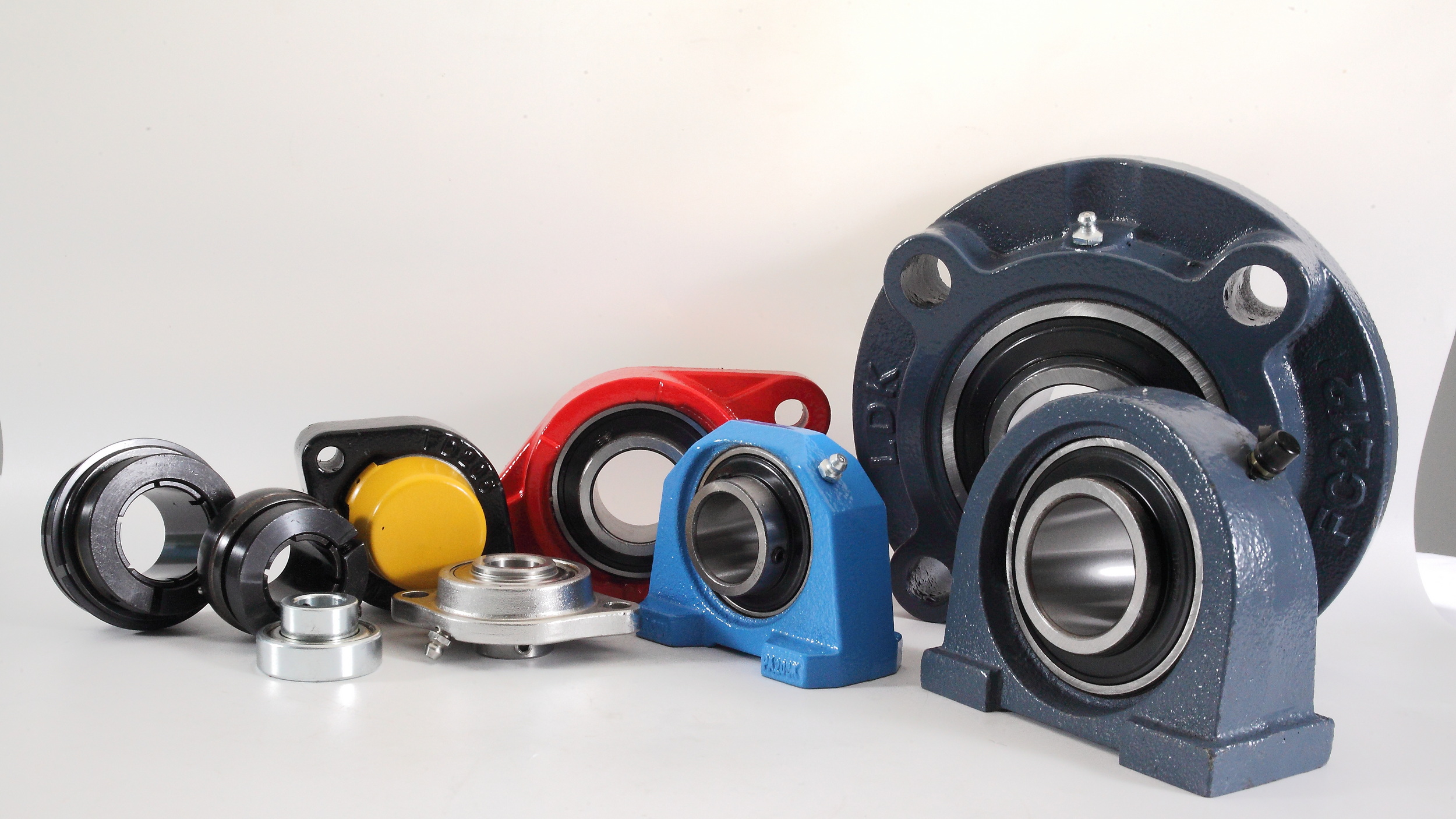
Cover: production environment associated with rod end and spherical plain bearing manufacturing.
Procurement of rod end bearings and spherical plain bearings often begins with a quote. Unit price, minimum order quantity, and lead time frame the first comparison. What a quote does not capture is whether a manufacturer will still be producing the same part numbers, at the same quality level, three years from now.
For equipment OEMs with multi-year design cycles, supplier stability sits alongside unit price in the first procurement decision. This article outlines an evaluation checklist for assessing the long-term viability of a rod end and spherical plain bearing manufacturer, with product portfolio breadth — such as offering both rod end bearings (SJM..T) and spherical plain bearings (YSSB, NSSB) — as one of the clearest indicators of invested specialization.
Why Supplier Stability Outlasts the First Quote
Re-sourcing a bearing supplier carries costs that never appear on a quotation. Engineering re-validation, production line downtime, inventory write-offs, and the risk of a quality gap during switchover are all part of the real cost of a supplier change. For a buyer maintaining a bill of materials across multiple rod end and spherical plain bearing part numbers, that cost multiplies with the number of parts the supplier covers.
This is why stability is not a soft procurement criterion. It is a measurable part of total cost of ownership, and it becomes more visible the longer a product stays in service.
An Evaluation Checklist for Manufacturer Stability
The checklist below focuses on structural signals that a bearing manufacturer is built to continue supplying, rather than on short-term commercial terms.
1. Product portfolio breadth as a signal of invested specialization
The most direct question is not how many products a supplier lists, but how deep a single manufacturing capability extends. A manufacturer that offers rod end bearings such as SJM..T alongside spherical plain bearings such as YSSB and NSSB is drawing on overlapping capabilities: stainless steel machining, PTFE and PTFE-fabric liner bonding, precision spherical surface grinding, and consistent sealing and lubrication systems.
These are not separate product lines assembled from trading relationships. They are evidence that the supplier has invested in a shared process base. A supplier with that base is structurally less likely to exit a product family, because the capability that supports one series supports the others.
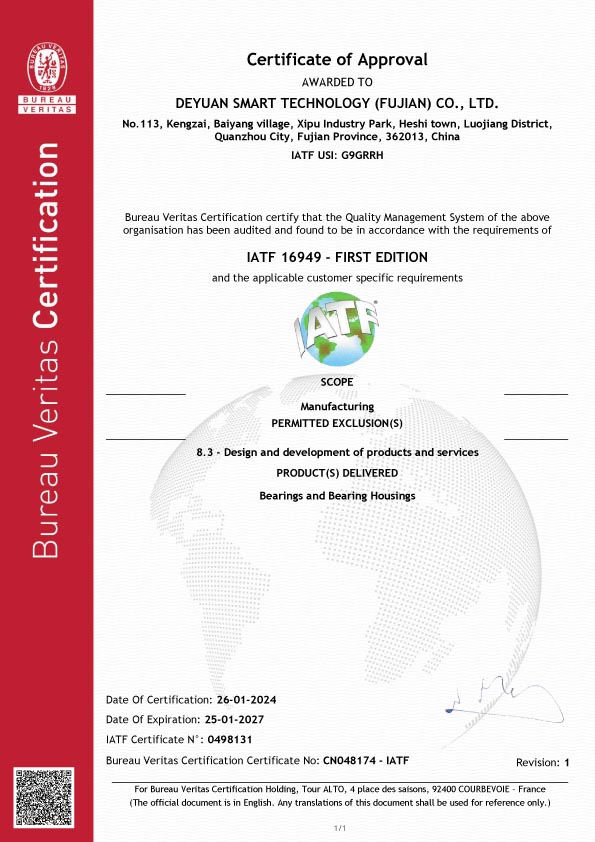
Manufacturing stability is anchored in a maintained quality management system, not a single audit.
2. Manufacturing depth: in-house production versus assembly
A supplier that only assembles purchased components is more exposed to upstream disruption than one that controls more of the process. The relevant question is which steps are performed in-house: bearing ring machining, heat treatment, surface treatment, liner bonding, and assembly. In-house control over these steps shortens the response path when a specification changes or a capacity issue arises.
3. Certification continuity
Certificates are only useful when they are current. An IATF 16949 certificate for manufacturing, an ISO 45001 certificate for occupational health and safety, and an ISO 14001 certificate for environmental management each carry issue and expiry dates. A supplier operating a continuous certification cycle is signaling that the management system is maintained, not renewed only under customer pressure.
Material compliance follows the same logic. An SGS RoHS verification report that lists the specific series it covers, with a validity period, allows a buyer to confirm that the declared scope matches the parts being purchased.
4. Capacity and delivery consistency
Capacity statements become meaningful when paired with defined commercial parameters. Monthly capacity, lead time ranges, and minimum order quantities together describe how a manufacturer actually schedules production. A stated on-time delivery performance level converts these parameters into a trackable commitment.
5. Product range consistency across series
Consistency is the hardest signal to verify remotely and the most important for long-term supply. A supplier that produces rod end bearings and spherical plain bearings to the same material and heat treatment standards reduces the risk of variation between product families. Reviewing whether specification conventions, material declarations, and inspection criteria are documented across series reveals whether the range is genuinely integrated or only catalogued.
How LDK Applies These Signals
LDK is the bearing brand of DE YUAN SMART TECHNOLOGY (FUJIAN) CO., LTD., a bearing manufacturer established in 1986 and based in Quanzhou, Fujian Province, China. The company produces pillow block bearings, rod end bearings, and spherical plain bearings, exporting approximately 60% of output to Europe, North America, Latin America, and Oceania.
Its product portfolio includes rod end bearings such as SJM..T (stainless steel, self-lubricated, male thread, 17-4Ph body and race) and spherical plain bearings such as YSSB and NSSB (stainless steel, maintenance-free, with PTFE or Teflon fabric liner permanently bonded to the race I.D.). Offering both series from the same production base reflects a shared investment in stainless steel machining and self-lubricating liner technology.
The manufacturer operates a 90,000 m² facility with in-house production of both bearings and housings. Its monthly capacity is stated at 300,000 units, with lead times of 30–90 days and a minimum order quantity of 5,000 units for OEM programs. Stated on-time delivery performance is at or above 95%.

Declared compliance scope is tied to specific series rather than to a general statement.
Technical Basis: Why Range Consistency Reduces Risk
Rod end bearings and spherical plain bearings share several technical requirements. Both rely on hardened, ground spherical surfaces; both depend on controlled surface treatment such as phosphating or hard chrome plating; and self-lubricated variants rely on a liner that must bond consistently to the race.
When a manufacturer produces both families in-house, these requirements are governed by the same process controls. That matters for buyers because a specification change — for example, a shift in required surface hardness or liner thickness — does not require re-qualifying a different supply chain. Under ISO 12240, spherical plain bearings are organized across radial, angular contact, thrust, and rod end categories. A supplier operating across these categories with consistent material declarations presents fewer compatibility risks across a mixed bill of materials.
Application Evidence
Long-term supply capability tends to surface in application records rather than in brochures. For heavy truck diesel engine exhaust systems, a rod end bearing from product 4181 was used to connect a pneumatic actuator to a lever in the engine bay. The project delivered 5,000 pieces within 12 months, achieving 5 million movement cycles across a −40°C to 300°C range with maintenance-free operation.
In a separate case, 180,000 rod end linkages (product 4265) were supplied to an automotive OEM in Germany for EGR system applications, completed within 12 months. The one-piece design provides durability and higher strength in high-temperature environments.
These records show that a supplier's ability to maintain a specification over time is validated where tolerances and environments are demanding, not only in standard catalog conditions.
Market Trend Context
The wider bearing market gives additional context for prioritizing stability. The global plain bearing market was valued at USD 10.4 billion in 2024 and is expected to reach USD 17.8 billion by 2034, according to Dataintelo. The global rod ends market was valued at USD 1.79 billion in 2025, with Asia Pacific accounting for a 42.3% revenue share. China's bearing industry recorded revenue of CNY 231.5 billion in 2024, a 6.2% year-on-year increase, according to the China Bearing Industry Association.
Automotive applications represent the largest demand segment for rod ends at approximately 38.5% of market share. These figures describe a growing market, but they also describe a market in which supply relationships are expected to remain active over long product lifecycles. Stability therefore becomes a structural requirement rather than a preference.
Limits and Boundaries of This Evaluation
Product portfolio breadth is a useful signal, but it is not a guarantee. A manufacturer with a wide range may still lack capacity for a specific bore size, material grade, or thread configuration at a given time. Buyers should verify availability at part-number level rather than relying on catalog coverage.
Scale is likewise not a substitute for stability. A large facility can still concentrate risk if a single process step is outsourced or if certification lapses. Conversely, a smaller specialized manufacturer may offer stronger continuity for a narrow series. The checklist above is intended to structure comparison, not to substitute for part-level verification.
Future Outlook
As equipment lifecycles lengthen and supply chains continue to be re-evaluated, supplier evaluation is likely to shift further from price comparison toward continuity assessment. Buyers are increasingly likely to ask for documented material compliance scopes, in-house process maps, and multi-year delivery records. Manufacturers that can answer these questions with maintained certification, defined capacity parameters, and consistent cross-series standards will be better positioned to remain in approved supplier lists over the long term.
FAQ
What signals indicate that a rod end bearing manufacturer is stable long-term?
Relevant signals include maintained certification with current validity dates, in-house control over key production steps, defined capacity and delivery parameters, and documented consistency across product series. None of these alone is decisive; together they describe whether the manufacturing system is likely to remain intact.
How does product portfolio breadth relate to supply continuity?
A manufacturer offering both rod end bearings such as SJM..T and spherical plain bearings such as YSSB and NSSB draws on overlapping capabilities, including stainless steel machining and self-lubricating liner bonding. Because the process base supports multiple series, the supplier has more structural reason to continue producing each family.
Is a large factory always a more stable supplier?
No. Facility size does not establish continuity by itself. A large plant that outsources a critical process step may carry more risk than a smaller plant that controls it. The more useful indicator is which production steps are performed in-house, combined with certification status and delivery performance.
How can buyers verify product range consistency?
Buyers can request documentation that shows material declarations and inspection criteria across series, rather than only for a single part number. Comparing specification conventions between rod end and spherical plain bearing families indicates whether the range is integrated at process level or assembled from separate supply arrangements.
Why do ISO 12240 and material certification matter for long-term sourcing?
ISO 12240 organizes spherical plain bearings into radial, angular contact, thrust, and rod end categories, providing a shared reference for specification. Material certification, such as an SGS RoHS verification report that lists covered series and a validity period, allows buyers to confirm that the declared compliance scope matches the parts being procured over time.
For additional product and capability documentation, the manufacturer brochure is available for public download: LDK product and capability brochure (PDF).